AUKUS and the Philippines – sleepwalking into military-nuclear entanglements

From peaceful, nuclear-free Asean to battle-ready Indo-Pacific? Manila Times, By Dan Steinbock, October 18, 2021As the Duterte era is gradually ending, new arms races and nuclear proliferation cast a dark shadow over Southeast Asia. The Philippines may be sleepwalking into military-nuclear entanglements.
ACCORDING to the new trilateral security pact between the United States, the United Kingdom and Australia (Aukus), Washington and London will “help” Canberra to develop and deploy nuclear-powered submarines.
The highly controversial $66-billion deal is expected to trigger arms races and nuclear proliferation in Asia. It violates the Southeast Asian Nuclear-Weapon-Free Zone Treaty (SEANWFZ, 1995), effective since 1997. It would seem to violate the Philippine Constitution. And it is strongly opposed by China.
Yet, right after the Aukus, when Asean began to build consensus on the nuclear pact, Philippine Foreign Affairs Secretary Teodoro Locsin Jr. welcomed the pact.
PH policies, Asean concerns
According to Locsin, the Philippines “welcomes Australia’s decision to establish” the Aukus. And he added: “Asean member states, singly and collectively, do not possess the military wherewithal to maintain peace and security in Southeast Asia.”
According to this logic, Asean is irrelevant in matters of regional peace and security and therefore each Asean should align with one or another major military power, irrespective of collective consequences.
Such logic shuns and could derail, inadvertently or purposefully, the ongoing work by the Asean and China on the Code of Conduct for the South China Sea by 2022. Most importantly, the logic opens the door to the nuclearization of the region at the expense of the SEANWFZ treaty and the aspirations of the Asean community. That’s why Malaysia’s veteran statesman Mahathir Mohamad blasted the Aukus statement: “You have escalated the threat.”
The first reaction of both Malaysia and Indonesia was to warn of an impending arms race unleashed by such a pact. Australia’s nuclear decision prompted the Indonesian foreign ministry’s official note that it was “deeply concerned over the continuing arms race and power projection in the region.” So, why did Locsin choose to break ranks with the Asean?
ADRi: China the issue of 2022
The plan to drag the Philippines into the Indo-Pacific containment front against China seems to have evolved in the mid-2010s, but fell apart with the Duterte election triumph and the meltdown of the Liberal Party.
To avoid a déjà vu, former Foreign Affairs secretary Albert del Rosario recently called on the Philippines to choose a leader who will reverse President Rodrigo Duterte‘s policy of “loving and embracing” China after the “’22 polls.”
In this quest, a key supportive role belongs to the Stratbase Albert del Rosario Institute (ADRi), embedded with US business and national security interests. Through its board members and executives, Rosario’s ADRi is joined with its parent, Stratbase, an “advisory and research consultancy,” and Bower Group Asia led by Ernest Z. Bower 4th. Stratbase is the Philippine partner of Bower Group Asia.
Until the 2000s, Bower led the US-Asean Business Council. He is an ADRi board member and Southeast Asia advisor at the Center for Strategic and International Studies (CSIS), a leading US think-tank close to the State Department, Pentagon, defense contractors and Wall Street.
The maritime dispute with China, said ADRi’s president Victor Manhit, is what “we will make an issue in the 2022 elections.” Due to interlocking leaderships, Manhit himself heads Stratbase and Bower Asia Group‘s Philippine branch.
The goals go back to the Benigno “Noynoy” Aquino 3rd government (2010 to 2016).
As the Duterte era is gradually ending, new arms races and nuclear proliferation cast a dark shadow over Southeast Asia. The Philippines may be sleepwalking into military-nuclear entanglements.
ACCORDING to the new trilateral security pact between the United States, the United Kingdom and Australia (Aukus), Washington and London will “help” Canberra to develop and deploy nuclear-powered submarines.
The highly controversial $66-billion deal is expected to trigger arms races and nuclear proliferation in Asia. It violates the Southeast Asian Nuclear-Weapon-Free Zone Treaty (SEANWFZ, 1995), effective since 1997. It would seem to violate the Philippine Constitution. And it is strongly opposed by China.
Yet, right after the Aukus, when Asean began to build consensus on the nuclear pact, Philippine Foreign Affairs Secretary Teodoro Locsin Jr. welcomed the pact.
Such logic shuns and could derail, inadvertently or purposefully, the ongoing work by the Asean and China on the Code of Conduct for the South China Sea by 2022. Most importantly, the logic opens the door to the nuclearization of the region at the expense of the SEANWFZ treaty and the aspirations of the Asean community. That’s why Malaysia’s veteran statesman Mahathir Mohamad blasted the Aukus statement: “You have escalated the threat.”
The first reaction of both Malaysia and Indonesia was to warn of an impending arms race unleashed by such a pact. Australia’s nuclear decision prompted the Indonesian foreign ministry’s official note that it was “deeply concerned over the continuing arms race and power projection in the region.” So, why did Locsin choose to break ranks with the Asean?…………..
Conflicts of interest, military entanglements…………..
…….. the Aukus pact does contribute to the ongoing arms races in Southeast Asia. It will foster nuclear proliferation in the region. It violates the goals of the nuclear-free Southeast Asia treaty. It is not in line with the Philippine Constitution.
President Duterte has pledged to end the bilateral military deal with Washington if US nuclear weapons are found in the Philippines. But his term will end by next summer.
Obviously, Australia, the US and UK seek to calm Asean members, arguing that nuclear weapons are not really for military purposes. But since 1945, assurances have not been reliable in nuclear matters. During the Cold War, US nuclear warheads were secretly stockpiled in the Philippines. Moreover, in the 1965 Philippine Sea A-4 crash, a US Skyhawk attack aircraft fell into the sea off Japan. Coming from the US Naval Base in Subic Bay, it was carrying a nuclear weapon with 80 times the blast power of the Hiroshima explosion.
It wasn’t until 1989 that the Pentagon disclosed the loss of the 1-megaton hydrogen bomb.
New policy? Two policies? No policy?
Today, the destructive power of these weapons is far greater, as stressed by the International Campaign to Abolish Nuclear Weapons (ICAN). In January, the Philippines ratified the ICAN’s legally binding Treaty on the Prohibition of Nuclear Weapons (TPNW). On May 19, Locsin stated that the Philippines welcomes the Aukus nuclear pact.
Only two days later, Locsin reaffirmed the Philippines’ “principled policy and commitment toward the complete prohibition of nuclear weapons as enshrined in the relevant provisions of the Philippine Constitution and the Treaty.”
The Philippines’ principled policy is crystal clear: The country definitely welcomes nuclear proliferation in Southeast Asia. And the country is absolutely committed against nuclear-free Southeast Asia. Where will that “principled policy and commitment” take us after the 2022 election?
 |
Keep space for peace – opposition to New Zealand’s space industry and its military connections
NZ’s $1.7 billion space industry rockets away, but a law review sparks more debate about controversial military payloads, Stuff Amanda Cropp, Oct 17 2021 ”……………….. how far and how fast the New Zealand space industry has come since Rocket Lab’s first test launch blasted off in 2017 from its Māhia Peninsula launch site, with millions being invested by the Government and the private sector.A review of the Outer Space and High-Altitude Activities Act that regulates launches and payloads received only 17 responses last month, but consultation on the “peaceful, sustainable and responsible” use of space, delayed until next year because of Covid-19, is likely to get a much more heated reception.
Peace groups, the Green Party and members of the Māhia community have already been vocal about their opposition to Rocket Lab’s military work in the wake of the controversial Gunsmoke-J satellite it launched for the United States Army Space and Missile Defence Co………….
…… The Outer Space and High-Altitude Activities Act outlaws payloads that contribute to nuclear weapons programmes or capabilities, harm, interfere with or destroy other spacecraft or systems on earth; support or enable specific defence, security or intelligence operations that are contrary to government policy, or are likely to cause serious or irreversible harm to the environment…………….
Space for Peace
In March, 17 peace groups wrote an open letter to Prime Minister Jacinda Ardern saying the Gunsmoke-J launch appeared to breach both the New Zealand Nuclear Free Zone, Disarmament and Arms Control Act and the Cabinet-approved to payload assessments.
They argued that because US military strategy was increasingly using satellite systems to control and direct nuclear, as well as non-nuclear, weapons, it was extremely difficult to determine whether any given satellite was contributing to supporting this weapons system.
……… In mid-September the Anti-Bases Campaign had about 100 attendees at a Keep Space for Peace webinar, and organiser Murray Horton says they were primarily concerned Rocket Lab’s Auckland and Māhia operations effectively constituted a US base in New Zealand, albeit a privately owned one.
Sonya Smith of the Māhia’s Rocket Lab Monitoring Group says they want future regulations to include a clause outlawing payloads that will “assist in the operation of a weapon”.
Professor Kevin Clements is a member of the Peace Foundation International Affairs and Disarmament Committee, which was a signatory to the letter to the prime minister, and he does not believe MBIE is the appropriate agency to vet payloads.
“They have a vested interest in seeing [space] is a thriving industry bringing dollars into the New Zealand economy. This needs to be handled by the prime minister’s department.”…….. https://www.stuff.co.nz/business/126560061/nzs-17-billion-space-industry-rockets-away-but-a-law-review-sparks-more-debate-about-controversial-military-payloads
Many businesses urge UK government to incentivise the uptake of genuinely clean energy

The government is facing yet more calls to slash VAT rates on domestic renewable energy and clean technology systems so as to incentivise the uptake of green solutions that can reduce household carbon emissions and
shield consumers from volatile gas prices.
In a letter to the government yesterday, nearly 30 companies and organisations from across the energy
sector argued steps needed to be taken to bring down the cost of a number of clean technologies, arguing that domestic zero carbon energy systems remained “unaffordable” for many households.
The coalition – which includes the Association for Renewable Energy and Clean Technology (REA), EDF, Nissan, and Ovo Energy – called on the government to slash VAT on a range of domestic energy saving materials, including energy storage systems, domestic EV chargers, heat pumps, and solar PV installations.
Business Green 15th Oct 2021
https://www.businessgreen.com/news/4038700/energy-players-vat-scrapped-green-home-solutions
Catholic Archbishop at UN urges immorality of nuclear weapons, and of militarising space
UN nuncio denounces nuclear weapons, other weapons of mass destruction, Oct 15, 2021by Catholic News Service, UNITED NATIONS — The world’s leaders “cannot allow” themselves to be “spectators to violence and war, to brothers killing brothers, as if we were watching games from a safe distance,” Archbishop Gabriele Caccia told a U.N. committee session discussing nuclear weapons and other weapons of mass destruction Oct. 13.
“The lives of peoples are not playthings. We cannot be indifferent onlookers,” the Vatican’s permanent observer to the United Nations added.
The archbishop, quoting Pope Francis’ encyclical “Fratelli Tutti, on Fraternity and Social Friendship,” also stressed that world leaders should never forget the people who “who have suffered the effects of atomic radiation or chemical attack
He also reiterated the pope’s assessment about the immorality not only of using, but also of possessing nuclear weapons, “since the intrinsic intentionality of having nuclear weapons is the threat to use them.”
It is time for nuclear weapon stockpiles to “be definitively capped,” he emphasized.
“Our world is so interconnected that all nuclear weapons, wherever they may be, must be eliminated in the shortest feasible time, lest accident or miscalculation lead to catastrophic humanitarian and environmental consequences,” he said. ……………
He also stressed the need to not lose sight of the threat of “dirty bombs” or radiological weapons and the need for measures to prohibit the use of radiological materials as weapons.
In his final remarks, he emphasized that “the Holy See wishes to state its conviction that outer space should remain the peaceful domain that it has been thus far in human history. While certain military uses of that environment have been deployed, such as communications, navigation and monitoring, these are also critical for peaceful purposes.”
He said that to weaponize space, “either by deploying weapons, or by attacking space objects from the ground, would be extremely dangerous” and urged the negotiation of measures “so that the outer space environment remains safe for all of us.”………..
The archbishop also noted the needs of island countries for help — and the urgency of listening to their appeal — in protecting their environment and ecosystems from the effects of climate change. https://www.ncronline.org/news/justice/un-nuncio-denounces-nuclear-weapons-other-weapons-mass-destruction
European Commission urges member states to speed up solar energy deployment
The European Commission (EC) has urged member states to accelerate solar
deployment in order to tackle Europe’s rising electricity prices and has
released a ‘toolbox’ to address the short-term impact of prices and
strengthen resilience against future shocks.
Speaking at a press conference
earlier this week (13 October), the EC Energy Commissioner, Kadri Simson,
called the current situation in Europe, which has pushed energy prices up
to record levels, “exceptional” but urged member states to future proof
their countries from further shocks.
PV Tech 15th Oct 2021
Opposition to UK’s plans for nuclear fusion
ANTI-NUCLEAR campaigners have hit out at the UK Government’s plan to
create a prototype nuclear fusion power plant that is being developed with
hopes to sustain moves away from fossil fuels.
The Scottish Campaign for Nuclear Disarmament (CND) has said that this latest effort to extol the
virtues of nuclear fusion as a “low carbon” source of energy is to keep the
industry “alive” due to the UK being a “nuclear weapon state”.
The National 15th Oct 2021
UK to push for nuclear power: households to pay up long before the reactors are built
UK to put nuclear power at heart of net zero emissions strategy. British
ministers will put nuclear energy at the heart of Britain’s strategy to
reach net zero carbon emissions by 2050 in government documents due as
early as next week, along with new details on its funding model.
Kwasi Kwarteng, business secretary, is due to unveil the “Net Zero Strategy”,
as well as a “Heating and construction strategy” and an assessment of
the Treasury of the cost to reach the 2050 target. The main strategy will
be heavily focused on the long overdue and slow British nuclear program.
The country’s existing reactors are expected to be phased out by 2035,
with construction of a single large plant, Hinkley Point C, already
underway.
The creation of a “regulated asset base” (RAB) model will be
the key to the delivery of a future fleet of large nuclear power plants.
Under this program, households will be billed for the cost of the plant via an energy
tax long before it starts producing electricity, which could take a decade
or more from the time. where the final investment decision is made.
FT 16th Oct 2021
https://www.ft.com/content/e6426194-21e6-49c4-9520-97c337b350fd
Japan’s new pro nuclear push – and for small nuclear reactors
Japan’s Carbon Goal Is Based on Restarting 30 Nuclear Reactors, Bloomberg, By Isabel Reynolds 17 October 2021, Japan’s goal of reducing carbon emissions by 46% by 2030 is based on the assumption it will restart 30 of its nuclear reactors, a top ruling party executive said.
Akira Amari, secretary general of the Liberal Democratic Party, made the remarks Sunday in a televised debate broadcast by NHK ahead of the Oct. 31 general election.
Much of Japan’s nuclear capacity has been offline since the 2011 Fukushima disaster and Amari said only nine reactors are currently in service. Surveys generally show the electorate is against restarting the plants.
The LDP has also been promoting the idea of building small modular reactors, saying they are safer than Japan’s existing atomic plants……..https://www.bloomberg.com/news/articles/2021-10-17/amari-says-japan-s-carbon-goal-based-on-restarting-30-reactors
French President Macron now goes for small nuclear reactors – with vision of an exporting bonanza
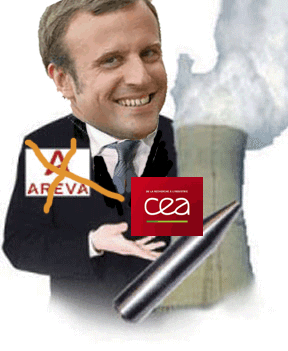
France unveils nuclear power overhaul – with an eye on China, French President Emmanuel Macron announced a shift to small modular nuclear reactors on Tuesday as he unveiled his €30 billion, five-year strategy to bolster France’s high-tech sectors, building on the country’s history as a pioneer of nuclear energy. France 24, 17 Oct 21,
Macron announced that the “number one priority” for his industrial strategy was for France to develop “innovative small-scale nuclear reactors” by 2030.
This marks a sea change in France’s approach to nuclear energy……………“The small modular reactors each generate less than 300 megawatts (MW) of energy; far less than most reactors currently in service, which tend to produce between 950 and 1300 MW, with some of them including the Flamanville plant [on the English Channel] capable of as much as 1600 MW,” said Giorgio Locatelli, an expert on the engineering of nuclear power stations at Milan Polytechnic.
……… In the grand sweep of the history of French nuclear power, the shift towards smaller reactors looks like a step back, Locatelli suggested, because France “started with small reactors in the 1960s before switching to larger ones to develop economies of scale”.However, this trend has now reached its limited, he continued. “Reactors like the one at Flamanville are not only very expensive, but also it’s a long and complex process to build them.” It takes billions to create such plants, and often it is difficult for governments to find investors willing to wait up to a decade before their returns start coming in.
Competition with China
Most countries lack the means to pull of these massive reactors, noted Nicolas Mazzucchi, an energy specialist at France’s Foundation for Strategic Research: “The financing models they require – not to mention the capacity to really mobilise a country’s savoir-faire in this domain – are increasingly rare, except in nations like Russia and China where energy companies have total state backing.”
Consequently, switching to small modular reactors is a strategic pivot to allow France to deal with competition from countries like China, which has increasingly big ambitions when it comes to nuclear power.
France’s change of approach could also allow it to win lucrative new markets. “By 2025, nearly a quarter of the world’s existing nuclear capacity will be exhausted because the reactors will have become too old,” Mazzucchi continued……………..
‘Lack of experience’………. The people in charge of reactors using cutting-edge technology “will have to justify their safety”, Herviou said. So far, the theoretical advantages of small modular reactors have not been confirmed in practice. Some 70 such reactors are currently in development throughout the world – and the vast majority of these projects are still in the early stages. “The main concern with this technology is the lack of a track record,” said Locatelli. What is more, he continued, nuclear power’s “chicken-and-egg problem is still there: Is it better to start building reactors first to win over buyers or is it best to find the investors first?” …………. https://www.france24.com/en/france/20211013-france-unveils-nuclear-power-overhaul-with-eye-on-china
October 17 Energy News — geoharvey

Opinion: ¶ “Electrification And Energy Reduction Go Hand-In-Hand To Reduce Household Impacts” • The status quo of getting energy from natural gas, water service, and even sewer service is baked into many if not most homes, and it’s hard for the owner (and harder for a renter) to get out of that rut. Here, I […]
October 17 Energy News — geoharvey
1 This Month

of the week – Shut Down Drone Warfare!


Tell the Ukrainian Government to Drop Prosecution of Peace Activist Yurii Sheliazhenko

Petition to revoke the licensing of the Near Surface Nuclear Disposal Facility (NSDF) at Chalk River. https://www.ourcommons.ca/petitions/en/Petition/Details?Petition=e-7247
To see nuclear-related stories in greater depth and intensity – go to https://nuclearinformation.wordpress.com
-
Archives
- April 2026 (103)
- March 2026 (251)
- February 2026 (268)
- January 2026 (308)
- December 2025 (358)
- November 2025 (359)
- October 2025 (376)
- September 2025 (257)
- August 2025 (319)
- July 2025 (230)
- June 2025 (348)
- May 2025 (261)
-
Categories
- 1
- 1 NUCLEAR ISSUES
- business and costs
- climate change
- culture and arts
- ENERGY
- environment
- health
- history
- indigenous issues
- Legal
- marketing of nuclear
- media
- opposition to nuclear
- PERSONAL STORIES
- politics
- politics international
- Religion and ethics
- safety
- secrets,lies and civil liberties
- spinbuster
- technology
- Uranium
- wastes
- weapons and war
- Women
- 2 WORLD
- ACTION
- AFRICA
- Atrocities
- AUSTRALIA
- Christina's notes
- Christina's themes
- culture and arts
- Events
- Fuk 2022
- Fuk 2023
- Fukushima 2017
- Fukushima 2018
- fukushima 2019
- Fukushima 2020
- Fukushima 2021
- general
- global warming
- Humour (God we need it)
- Nuclear
- RARE EARTHS
- Reference
- resources – print
- Resources -audiovicual
- Weekly Newsletter
- World
- World Nuclear
- YouTube
-
RSS
Entries RSS
Comments RSS
 nuclear-news