Conservative British MP opposes ‘nuclear dumping ground’
JILL MORTIMER (Conservative MP for Hartlepool): Plan would turn the town into a ‘nuclear dumping ground’. I am sure that a number of you are already aware of a meeting between Sacha Bedding, Chief Executive of the
Wharton Trust charity, and representatives from the Labour group on Hartlepool Borough Council – I want to take this opportunity to make my position on the proposal to introduce a nuclear waste dump to Hartlepool clear – not on my watch!
I was shocked to hear that these discussions have taken place, and I fully support Ben Houchen – Tees Valley Mayor in
his opposition to such a suggestion. This week myself and Ben have submitted a Freedom of Information request to Hartlepool Borough Council, relating to any correspondence between Staff at Radioactive Waste Management, Staff at The Wharton Trust and the Council, including elected councillors. Whoever is encouraging behind the scenes discussions of something that we believe will have such a devastating impact on the town’s prospects – the people of Hartlepool deserve to know.
Hartlepool Mail 12th Aug 2021
Strong call for New York City to legislate against investment of pension funds into nuclear weapons production

“We call on Speaker Corey Johnson and the City Council to vote and urgently pass Res. 976 and Intro.1621 to divest pension funds from nuclear weapon producers and reaffirm New York City as a Nuclear Weapons Free Zone. The legislation introduced by Council member Danny Dromm already inspired a historic hearing in City Hall and has the support of a majority of the City Council. As New Yorkers this is our moment to make hope and peace possible for a new generation.”
Nuclear disarmament campaigners press for legislation in New York City on 76th Anniversary of Hiroshima and Nagasaki Bombings. Pressenza, 13.08.21 – US, United States – Pressenza New York In a commemoration of the August 6 and August 9, 1945 bombings of Hiroshima and Nagasaki that was both somber and spirited, New York City-based nuclear disarmament advocates assembled outside the Municipal Building in downtown New York City. Advocates joined members of the International Campaign to Abolish Nuclear Weapons (ICAN), 2017 Nobel Peace Laureate in honoring New York nuclear disarmament heroes and urging Council Speaker Corey Johnson to reaffirm NYC as a nuclear weapons free zone.
Speakers included Michie Takeuchi, second generation Hiroshima Hibakusha survivor, Robert Croonquist, Hibakusha Stories Project founder, Bud Courtney of the Catholic Worker, Dr. Emily Welty, Director of Peace and Justice Studies at Pace University, Seth Shelden, ICAN representative at the United Nations and Brendan Fay ogranizer with NYCAN (New York Campaign to Abolish Nuclear Weapons).
Dr. Emily Welty reminded the gathering that the site for the Vigil is profound with history, because the development of the atomic bombs began across the street from City Hall at the Manhattan Project headquarters, at 270 Broadway.
In remarks Brendan Fay, Irish gay activist and nuclear disarmament advocate highlighted the legacy of LGBTQ New Yorkers in the global movement for nuclear disarmament.
- Bayard Rustin (1912-1987) highlighted the connection between colonialism, racism and nuclear weapons and traveled to Algeria in 1959 to protest French nuclear testing.
- James Baldwin (1924 –1987) as a member of National Committee for a Sane Nuclear Policy was among the leading speakers at the 1961 Peace Rally in Washington, DC. He said, “What am I doing here? Only those who would fail to see the relationship between the fight for civil rights and the struggle for world peace would be surprised to see me. Both fights are the same.”
- David McReynolds (1929-2018) was the first openly gay presidential candidate, a socialist and lifelong pacifist. During his 40-year career with the War Resisters League he became an international hero of the nuclear disarmament movement.
- Leslie Cagan (b. 1947) was a lead organizer of the largest disarmament rally in US history, the June 12, 1982 Rally Against the Arms Race.
- Peter Ciccchino (1960-2000) was arrested over two dozen times for peace, for nuclear disarmament, and for housing and human rights.
Fay thanked Council Member Danny Dromm (District 25) for introducing the nuclear divestment legislation in 2019. “Council Member Dromm follows the steps of previous council members including Council President and civil rights leader Paul O’Dwyer (1907 – 1998) who was a strong advocate for nuclear disarmament in City Hall.
Holding a poster of African American Civil rights leader and nuclear disarmament advocate Bayard Rustin,
Fay said, “As LGBTQ+ New Yorkers we join the rest of the human family this August 6th and August 9th in raising our voices to demand a world without nuclear weapons, for the sake of the children, for a future of hope. On this 76th anniversary of the bombing of Hiroshima and Nagasaki we say there is no Pride in bomb production. There is no Pride in raising the rainbow flag while investing in weapons of death.”
What of the nuclear weapons New York worker pensions are invested in? They are built to divide, harm, maim, kill. $475 million (0.25%) of New York worker pension funds are currently invested in the production of nuclear weapons. Our worker pensions must no longer be used as weapons of war. We are nurses, doctors, teachers, sanitation workers, firefighters, social workers, artists – our common cause is justice and peace……..
Fay said, “We call on Speaker Corey Johnson and the City Council to vote and urgently pass Res. 976 and Intro.1621 to divest pension funds from nuclear weapon producers and reaffirm New York City as a Nuclear Weapons Free Zone. The legislation introduced by Council member Danny Dromm already inspired a historic hearing in City Hall and has the support of a majority of the City Council. As New Yorkers this is our moment to make hope and peace possible for a new generation.”…….
Resolution 976 calls on the Comptroller to instruct pension funds to divest from companies involved in the production of nuclear weapons (approximately $475 million dollars) and re-affirms New York City as a Nuclear Weapons Free Zone.
Introduction 1621 establishes a Nuclear Disarmament Advisory Committee to advise the City Council.
The Treaty on the Prohibition of Nuclear Weapons, adopted by 122 countries in 2017, makes nuclear weapons comprehensively illegal and became international law on January 22, 2021. https://www.pressenza.com/2021/08/nuclear-disarmament-campaigners-press-for-legislation-in-new-york-city-on-76th-anniversary-of-hiroshima-and-nagasaki-bombings/
Japanese Nuclear Drama ‘Gift of Fire’ Heads for U.S Theaters
Japanese Nuclear Drama ‘Gift of Fire’ Heads for U.S Theaters Variety, By Patrick Frater 13 Aug 21,
“Gift of Fire,” a fact-based drama film about Japan’s secret nuclear bomb program, will play in U.S. cinemas from November this year. Produced in 8K digital, it opened in Japanese theaters last week, distributed by Aeon and scored a top ten ranking.
Yagira Yuya, the Japanese actor who won the acting prize in Cannes for his role in Koreeda Hirokazu’s “Nobody Knows,” heads the cast. He plays a nuclear scientist who struggles with his conscience while working Japan’s own nuclear weapon effort, a secret program that remained largely unknown until a decade ago.
The film is directed by Kurosaki Hiroshi, whose past work includes multi award-winning “Goldfish” (aka “Hi No Sakana”) and 2011’s “Second Virgin.” It was produced in partnership between Japanese public broadcaster NHK and Los Angeles-based Eleven Arts
Eleven Arts will now handle the U.S. release and has set a launch date of Nov. 12, 2021.
“When I first read the script for Gift of Fire I didn’t know that during WWII, Japan was developing an atomic bomb alongside the rest of the world,” said producer Mori Ko. “Instead of being a grand WWII film, the story focuses on the intimate details of three youthful characters’ lives. They deal with the same struggles as the rest of us, while also taking part in the life-changing scientific developments of the era and a war of epic proportions.”
………… “On one hand, the story reflects the romanticism present when floating on the surface of the ocean and looking up at the starry skies to imagine the vastness of the universe. On the other hand, the story explores the crimes that can be committed in the name of science and discovery,” said writer-director Kurosaki. https://variety.com/2021/film/asia/gift-of-fire-japan-nuclear-drama-yagira-yuya-1235041233/
The real photos of the Hiroshima bombing tell the story – no need for fictionalised ones.
Bad Idea: The New Yorker’s Nuclear Option, Peta Pixel AUG 12, 2021 ALLEN MURABAYASHI, On August 6, 1945, the U.S. detonated the world’s first wartime nuclear bomb over Hiroshima. An estimated 70,000 people died that day with another 70,000 perishing within four months from injury and radiation poisoning. On the ground, photojournalist Yoshito Matsushige miraculously survived unharmed despite living 1.7 miles from ground zero. Over the course of 10 hours, he could only bring himself to take 7 photos.
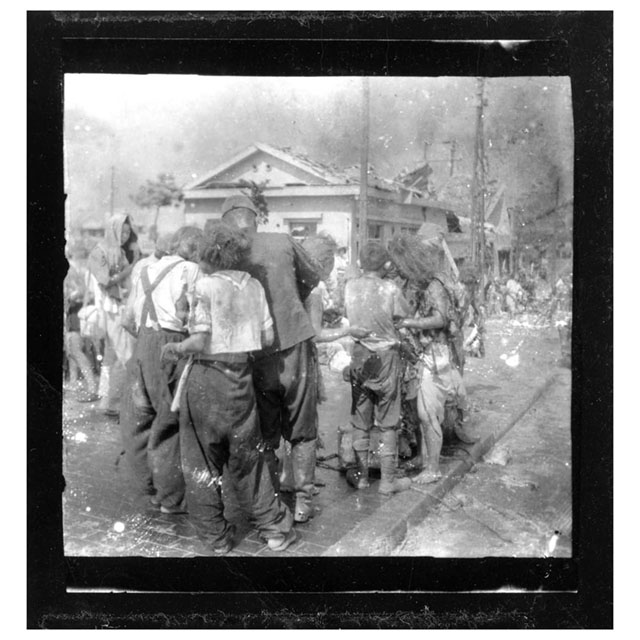
photo description: West end of Miyuki Bridge. This photograph was taken moving in closer to the people after taking the photograph on the left.From in front of the police box, both sides on Miyuki Bridge were full of dead and injured people. From that evening, the injured were taken by truck to Ujina and Ninoshima Island.Just after 11 a.m. Photo by Yoshito Mastushige
In an account of the bombing, Matsushige recalled passing by a girls junior high school, “Having been directly exposed to the heat rays, they were covered with blisters, the size of balls, on their backs, their faces, their shoulders, and their arms. The blisters were starting to burst open and their skin hung down like rugs.”
Three days later, the U.S. detonated a second nuclear bomb over Nagasaki. The following day, Yosuke Yamahata, a military photographer, spent 12 hours photographing the devastation. His 100 photos are a graphic and disturbing reminder about the horrors of nuclear war.

Photo by Yosuke Yamahata.
Yamahata died on his forty-eighth birthday in 1965 from terminal cancer of the duodenum. After retiring from his newspaper job, Matsushige spent the rest of his life as a dedicated peace activist…………….
A few days ago, journalist Max McCoy recounted his 1986 interview with Matushige. They hoped to meet again but never did. Matsuhige died in 2005 at the age of 92. In 2015, during a return trip to Japan, McCoy was approached by a close friend of Matsushige who relayed an untold part of his Hiroshima bombing story. McCoy wrote:
After developing the film, he was overcome by regret. In one of the photos from the bridge, at the edge of the frame, was a mother clutching a dead baby. He remembered the woman calling the child’s name. Using the point of a pair of scissors, he scratched the woman’s face from the negative, to save her — and himself — from the shame.
The horrors of nuclear war are unfathomable. The indiscriminate and instantaneous killing of tens of thousands of civilians needs no fictionalized reimagining. …….. https://petapixel.com/2021/08/12/bad-idea-the-new-yorkers-nuclear-option/
Academies Panel to Consider Future of Revived DOE Low-Dose Radiation Program,
Academies Panel to Consider Future of Revived DOE Low-Dose Radiation Program, https://www.aip.org/fyi/2021/academies-panel-consider-future-revived-doe-low-dose-radiation-program Julia BauerAmerican Institute of Physics
fyi@aip.orgThe National Academies has kicked off development of a strategy for the Department of Energy’s low-dose radiation research program. DOE terminated the program in 2016 but recently revived it at the behest of Congress.
The National Academies held a kickoff meeting last month for a study that will propose a long-term strategy for research on the biological effects of low doses of ionizing radiation. Congress mandated the study through the Energy Act of 2020, which updated a 2018 law directing the Department of Energy to reestablish the low-dose radiation research program it had terminated two years earlier.
Continue readingInventor of video games was also part of developing atomic bomb – later opposing it.
If nothing else, William Higinbotham was a man with range Kotaku.com ByJohn Walker ”…………….. . In 1958 the American physicist
William Higinbotham learned that the Brookhaven National Laboratory’s fancy new computer, the Donner Model 30, could simulate trajectories with wind resistance. So, like any good scientist, he figured, “Hey, I’ll invent video games.” Teaming up with Robert V Dvorak, three weeks later they’d done exactly that, creating a little tennis sim drawn in green lines on the circular oscilloscope screen. It was a hit at the lab’s annual public exhibition.
…….. some 25 years earlier, he’d been part of the damn Manhattan Project, heading a group involved in building the first ever atomic bomb.During World War II: Germany Strikes Back, Higinbotham was working at the infamous Los Alamos National Laboratory, where he was in charge of the electronics department. He led a team that created the electronic triggers for those first A-bombs. However, as his 1994 New York Times obituary points out, Higinbotham very quickly went on to establish the Federation of American Scientists, a group that lobbied for tight controls over nuclear weapons. He spent the rest of his career campaigning for nuclear nonproliferation……….. https://kotaku.com/nuclear-bombs-and-video-games-were-created-by-the-same-1847481382
Concern over plan to bury nuclear waste offshore
Hartlepool’s storm in a nuclear teacup. A war of words has broken out in
Hartlepool about early discussions on a possible offshore radioactive waste
storage facility. Material in the Geological Disposal Facility (GDF) would
be stored one kilometre below the surface in concrete containers. The
opening salvo came from a press release by Conservative Tees Valley Mayor
Ben Houchen.
North East Bylines 12th Aug 2021
Nuclear waste – we don’t want that muck here!
‘We don’t want that muck here’: Residents react to nuclear waste row in
Hartlepool. A row exploded between politicians in Hartlepool over the issue
this week. People in Hartlepool have expressed concern about their town
becoming a nuclear waste “dumping ground”, after a row exploded between
politicians over the issue this week.
The decision by Hartlepool council’s
deputy leader, Conservative Mike Young, to defend facilitating meetings
about the potential for a waste disposal facility in the town, was branded
“hugely disappointing” by Tees Valley Mayor Ben Houchen. Mr Houchen is
“concerned” that the admission was only made after he brought the issue to
the attention of the public, and submitted an FOI to the council demanding
information about who has discussed Hartlepool as a potential location.
Teesside Gazette 13th Aug 2021
https://www.gazettelive.co.uk/news/teesside-news/we-dont-want-muck-here-21294512
Olympic champions in Tokyo, let’s be climate champions in Glasgow — Inside track

This post is by Robbie MacPherson, environment APPG coordinator and political adviser at Green Alliance. This week the Intergovernmental Panel on Climate Change (the IPCC) reconfirmed what we already knew; that climate change is the most serious challenge of our time and that human behaviour has contributed to a warming planet. The IPCC Report was […]
Olympic champions in Tokyo, let’s be climate champions in Glasgow — Inside track
August 13 Energy News — geoharvey

Science and Technology: ¶ “Theory Versus Reality: The Dirty Hydrogen Story” • Not all hydrogen is clean. According to a report in the New York Times, a peer-reviewed study by researchers at Cornell and Stanford finds that most hydrogen used today is extracted from natural gas in a process that requires a lot of energy […]
August 13 Energy News — geoharvey
Utah Taxpayers Association is very wary of Small Nuclear Reactors

Imagine you picked up a gallon of milk that was labeled at $4, but by the time you made it to the cash register the price had gone up. Worse still, there was an automatic agreement that forced you to buy with no guarantee that the lid would ever open or that the price wouldn’t increase again by the time you had to pay. That’s essentially the situation in which UAMPS is putting municipalities.
Imagine you picked up a gallon of milk that was labeled at $4, but by the time you made it to the cash register the price had gone up. Worse still, there was an automatic agreement that forced you to buy with no guarantee that the lid would ever open or that the price wouldn’t increase again by the time you had to pay. That’s essentially the situation in which UAMPS is putting municipalities.
Utah cities shouldn’t gamble on nuclear power https://www.deseret.com/opinion/2021/8/11/22620772/utah-cities-shouldnt-gamble-with-taxpayer-funds-on-modular-nuclear-power-plant
An Idaho project is a financial risk that is best borne by the private sector. By Rusty Cannon Aug 11, 2021, ”………….. one of our critical missions is to protect taxpayers when it comes to the use of public funds, and we believe strongly that the taxpayers and communities of Utah should not act as venture capitalists for risky bets.
The bet that’s on the table now for Utah municipalities is nuclear. Specifically, it’s a type of nuclear called “small modular,” and the Utah Associated Municipal Power Systems (UAMPS) is recruiting towns and communities around the West to pay for it. The project, if it happens, would be located in Idaho.
Last fall, seven Utah cities from Logan to Lehi wisely withdrew their support for the UAMPS nuclear project due to financial risks that their residents should not be asked to accept. But many municipalities, such as Brigham City, Hyrum, Hurricane, and Washington City, are still gambling with their taxpayers’ dollars.
If modular nuclear power is ready for market, let the private sector show it by putting up its money. Governments ought to stay out of it, particularly when risking public funds.
The participation commitments UAMPS has been getting from Utah communities to buy the power come with required upfront payments from residents for a product that is full of uncertainty. The developer — Oregon-based NuScale — hasn’t built a plant like this before, its design keeps changing, and it’s nearly a decade away from even being potentially operational.
While we still believe the project is risky and that municipalities should withdraw, any investment of public dollars must be done in the open with public scrutiny. Sadly, the information exchange between UAMPS and its potential payers has been opaque. The public receives only a trickle of information, and it’s vague at best.
When we do see information, it’s troubling. For example, the project’s budget has ballooned from an initial $3.1 billion to a more recent estimate of $6.1 billion. It was only recently uncovered that the company that was going to operate the plant, Energy Northwest, backed out in March.
The financial sand is shifting in other ways, as well. In late June, UAMPS suddenly decided to reduce the number of modules at the power plant by half because they’ve struggled to get more communities to commit. That led to a hike in the power price that UAMPS had been promising, putting still-participating municipalities in a bind.
Imagine you picked up a gallon of milk that was labeled at $4, but by the time you made it to the cash register the price had gone up. Worse still, there was an automatic agreement that forced you to buy with no guarantee that the lid would ever open or that the price wouldn’t increase again by the time you had to pay. That’s essentially the situation in which UAMPS is putting municipalities.
Plenty of Utah city council members have listened to their constituents and said “thanks but no thanks.” Bountiful, Kaysville, Murray, Lehi and Heber were some of the largest subscribers to the modular nuclear proposal, but have since bowed out.
However, other communities remain officially interested in this particular power project, and are keeping it in their shopping cart so far. If you reside in these communities, pay attention and watch your wallet. There may still be time to withdraw from the project.
Utah municipalities should remain conservative watchdogs of tax dollars. Say yes to prudent and transparent use of public money. Say no to unproven technology and murky promises that keep shifting. At this point modular nuclear power is a venture, not a product. So let private venture capital come in and pay for it, not Utah taxpayers.
Rusty Cannon is President of the Utah Taxpayers Association
Why Are We Still Building Nuclear Weapons? Follow the Money

Why Are We Still Building Nuclear Weapons? Follow the Money, Forbes, William Hartung, 11 Aug 21,

The FY 2022 Pentagon budget proposal includes billions of dollars for new nuclear delivery vehicles, with a handful of prime contractors as the primary beneficiaries. For example, Northrop Grumman’s NOC+0.9% twelve largest subcontractors for its new ICBM include some of the nation’s largest defense companies, including Lockheed Martin LMT+0.3%, General Dynamics GD+0.8%, L3Harris, Aerojet Rocketdyne AJRD+0.2%, Honeywell, Bechtel, and the Collins Aerospace division of Raytheon RTX+1.1% Technologies. Other beneficiaries of the funding of new nuclear delivery vehicles include Raytheon (a nuclear-armed cruise missile), General Dynamics (ballistic missile submarines), Lockheed Martin (submarine-launched ballistic missiles), and Northrop Grumman – again – for the new nuclear-armed bombers.
This month marks the 76th anniversary of the bombings of Hiroshima and Nagasaki, events that resulted in the immediate deaths of well over 100,000 people and underscored the devastating consequences of building, deploying, and using nuclear weapons. Those attacks should have served as a wake-up call on the need to control and eliminate these potential world-ending weapons, but determined efforts by scientists, political leaders, policy advocates, and grassroots advocates around the world have yet to abolish them……………
the international community, under the leadership of the International Campaign to Abolish Nuclear Weapons (ICAN), has created and brought into force the Treaty on the Prohibition of Nuclear Weapons, which has been signed by 86 nations and ratified by 55 of them. This is an historic accomplishment, but the real culprits – the major nuclear weapons states that possess the vast bulk of the world’s nuclear weapons – have yet to sign onto the measure.
The United States maintains an active nuclear stockpile of roughly 4,000 nuclear weapons, including over 1,500 deployed warheads. Russia’s stockpile is comparable, at roughly 4,400, while China follows with roughly 300 strategic nuclear warheads. Despite its considerably smaller arsenal, recent revelations regarding China’s construction of new silos for long-range nuclear missiles are cause for real concern as they raise the risk of accelerating the nuclear arms race at great risk to the future of the planet. These developments demand dialogue to roll back the production of new nuclear weapons systems, leading to reductions in the size of global arsenals and the ultimate elimination of this existential threat.
The continued development and deployment of intercontinental ballistic missiles (ICBMs) is of particular concern. As former Secretary of Defense William Perry has noted, ICBMs are “some of the most dangerous weapons in the world” because a president would have only a matter of minutes to decide whether to launch them upon warning of a nuclear attack, increasing the possibility of an accidental nuclear war based on a false alarm.
Given all of the above, why is the United States still building nuclear weapons, more than seven decades after the devastation of Hiroshima and Nagasaki? The U.S. is not alone in building a new generation of nuclear weapons – Russia and China are doing so as well. But the Pentagon’s 30-year plan to build new nuclear-armed bombers, missiles, and submarines – along with new nuclear warheads to go with them at a cost of up to $2 trillion – is the height of folly and an unnecessary, grave risk to the lives of current and future generations. A major reason for this misguided policy can be summed up in a phrase – there is money to be made in perpetuating the nuclear arms race.
The FY 2022 Pentagon budget proposal includes billions of dollars for new nuclear delivery vehicles, with a handful of prime contractors as the primary beneficiaries. For example, Northrop Grumman’s NOC+0.9% twelve largest subcontractors for its new ICBM include some of the nation’s largest defense companies, including Lockheed Martin LMT+0.3%, General Dynamics GD+0.8%, L3Harris, Aerojet Rocketdyne AJRD+0.2%, Honeywell, Bechtel, and the Collins Aerospace division of Raytheon RTX+1.1% Technologies. Other beneficiaries of the funding of new nuclear delivery vehicles include Raytheon (a nuclear-armed cruise missile), General Dynamics (ballistic missile submarines), Lockheed Martin (submarine-launched ballistic missiles), and Northrop Grumman – again – for the new nuclear-armed bomber.
Additional recipients of nuclear weapons-related funding are the firms that run the nuclear warhead complex. Major contractors include Honeywell and Bechtel, which run key facilities for the development and production of nuclear warheads.
Nuclear weapons contractors spend millions of dollars on campaign contributions and lobbying efforts every year in their efforts to shape nuclear weapons policy and spending. While not all of this spending is devoted to lobbying on nuclear weapons programs, these expenditures are indicative of the political clout they can bring to bear on Congress as needed to sustain and expand the budgets for their nuclear-related programs.
The major nuclear weapons contractors made a total of over $119 million in campaign contributions from 2012 to 2020, including over $31 million in 2020 alone. The companies spent $57.9 million on lobbying in 2020 and employed 380 lobbyists among them.
The only way to be truly safe from nuclear weapons is to eliminate them altogether, as called for in the United Nations Treaty on the Prohibition of Nuclear Weapons. As noted above, the major nuclear powers have yet to sign onto the treaty but pressing them to do so should be a central component of efforts to rein in nuclear dangers.
It’s time that we stopped allowing special interest lobbying and corporate profits to stand in the way of a more sensible nuclear policy. The future of humanity depends on it. https://www.forbes.com/sites/williamhartung/2021/08/10/why-are-we-still-building-nuclear-weapons—-follow-the-money/?sh=442b7ad15888
Republican Congressman Adam Kinzinger champions inclusion of nuclear power incentive in U.S. Infrastructure Bill.
- Kinzinger-backed Nuclear Power Incentive Included in Senate Infrastructure Bill,
A financial credit program for nuclear power plants has been included in the Senate’s Infrastructure Investment and Jobs Act which was approved in the Senate on Tuesday. The program has been championed by Republican Congressman Adam Kinzinger, who has proposed the program in separate legislation in the past.
Kinzinger says he wants some federal help to available to keep nuclear power plants online as two in the 16th Congressional District are slated to close near the end of this year. Exelon, the company who runs the two plants, has said they are seeing a revenue shortfall at power plants in Morris and Byron.
State lawmakers have been trying to negotiate an energy deal that would keep the plants open, but have had some snags. Area lawmakers have said that an agreement is in place for the nuclear portion of the bill.
New ”Natrium” nuclear reactors – a very risky gamble.

A July 2021 Foreign Affairs article reports that in the past sixty years eight countries have spent $100 billion to produce sodium cooled fast reactors such as the one proposed for Wyoming. All have failed. The money’s spent and the lights are out.
While the Natrium design posits less risk of a meltdown, the sodium coolant is under high pressure and is explosive in the event of any breach in the containment area. And while Natrium plants produce less radioactive waste than traditional nuclear plants, there’s still the necessity to safely and permanently store this waste. How much will it cost? World Nuclear Industry Status Report’s editor Mycle Schneider says, “No one knows…because there is no functioning permanent storage facility.” Nowhere.
How much power are we talking about anyway? Writing for Canary Media, Eric Wesoff reported that in 2020, 2.4 gigawatts of new nuclear power plants were installed worldwide while there were 100 gigawatts of new solar and 60 gigawatts of new wind power generators. Meanwhile, old nuclear plants close—Indian Power in New York, Diablo Canyon in California, Exelon’s Byron and Dresden plants in Illinois. What do we do with decommissioned nuclear plants? A cooling tower in Germany has become a climbing wall.
Romtvedt: Proposal for nuclear power calls for caution https://trib.com/opinion/columns/romtvedt-proposal-for-nuclear-power-calls-for-caution/article_ecb135f0-1378-5728-9992-abd11b681ba4.html, David Romtvedt, Aug 10, 2021
In conjunction with PacifiCorp, Rocky Mountain Power’s parent company, owned by Berkshire Hathaway Energy, a subsidiary of Warren Buffett’s Berkshire Hathaway, Inc; and TerraPower, a nuclear reactor design company founded by Bill Gates, Wyoming Governor Mark Gordon has announced his support for the construction of a nuclear reactor demonstration plant in Wyoming. According to Berkshire Hathaway, the project is intended to “validate the design, construction and operational features” of TerraPower’s Natrium nuclear plant design which uses liquid sodium as a coolant rather than water.
Governor Gordon believes that Natrium offers a safe, reliable solution to Wyoming’s economic woes, saying, “I am thrilled to see Wyoming selected for this demonstration pilot project as our great state is the perfect place for this type of innovative utility facility and our experienced workforce is looking forward to the jobs this project will provide.”
So the benefits of the nuclear plant are said to be increased economic security and diminished environmental risk than with other forms of nuclear power plants. But it’s not so clear. Both in construction and operation, Natrium nuclear plants require uniquely skilled workers employing specialized materials and building techniques. Other economic issues include the temporary nature of construction work, long lead times for safety and licensing reviews (Natrium is not licensed by the Nuclear Regulatory Commission), and diminished severance tax revenues as a result of the shift from coal to nuclear.
There’s also the fuel—Natrium uses high-assay low-enriched uranium (HALEU). Power Magazine reports that there is no current supply of HALEU and that it will take at least seven years with sufficient demand to develop a fuel cycle infrastructure. Edwin Lyman of the Union of Concerned Scientist cautions that Russia is currently the only source of suitable fuel. In whatever quantity, the fuel is not likely to come from Wyoming uranium mines.
After construction there’s generation. World Nuclear Industry Status Report has recorded the changing costs of electric generation per kilowatt hour (in US cents) between 2009 and 2020. They are: solar—35.9 to 3.7, down 90%; wind—13.5 to 4.0, down 70%; gas—8.3 to 5.9, down 29%; coal—11.1 to 11.2, up 1%; and nuclear 12.3 to 16.3, up 33%. Nuclear is the most expensive way to generate electricity.
And time—the Wyoming proposal projects seven years to completion. Since no new nuclear power plant with a license application submitted since 1975 has yet begun operation, we may question the Wyoming timeline. More time equals more cost. Georgia Power’s Vogtle nuclear plants are years behind schedule with costs having risen from $14 billion to over $25 billion. But it may not matter as Georgia Power can charge cost overruns to its customers—the more the project is over budget, the more the company profits. In Florida, Duke Power, after seeing a cost increase from $5 billion to $22 billion, abandoned a Natrium nuclear project after passing $800 million dollars in excess costs to ratepayers.
A July 2021 Foreign Affairs article reports that in the past sixty years eight countries have spent $100 billion to produce sodium cooled fast reactors such as the one proposed for Wyoming. All have failed. The money’s spent and the lights are out.
While the Natrium design posits less risk of a meltdown, the sodium coolant is under high pressure and is explosive in the event of any breach in the containment area. And while Natrium plants produce less radioactive waste than traditional nuclear plants, there’s still the necessity to safely and permanently store this waste. How much will it cost? World Nuclear Industry Status Report’s editor Mycle Schneider says, “No one knows…because there is no functioning permanent storage facility.” Nowhere.
I’m guessing that Governor Gordon’s decision was driven in part by his hope to protect the lives and livelihoods of Wyoming workers. But generating radioactive waste without a procedure for safe permanent storage of that waste will protect no one—not unemployed coal miners, not me, not the governor.
How much power are we talking about anyway? Writing for Canary Media, Eric Wesoff reported that in 2020, 2.4 gigawatts of new nuclear power plants were installed worldwide while there were 100 gigawatts of new solar and 60 gigawatts of new wind power generators. Meanwhile, old nuclear plants close—Indian Power in New York, Diablo Canyon in California, Exelon’s Byron and Dresden plants in Illinois. What do we do with decommissioned nuclear plants? A cooling tower in Germany has become a climbing wall.
The questions loom. If I were a betting man, given initial costs, cost overruns, lost tax revenue, the increasing viability of renewables, the history of nuclear failure, and the health and safety hazards surrounding nuclear waste, I’d pause before I put my money on nuclear power. Not being a betting man, I wouldn’t consider it.
David Romtvedt is a writer and musician from Buffalo, Wyoming. A former activist with the Ground Zero Center for Nonviolent Action, he serves as a board member for the Powder River Basin Resource Council.
Joe Biden’s Infrastructure Bill gives $50 billion to bail out the nuclear industry

Nuclear Power Bailout In The Infrastructure Bill https://www.wortfm.org/nuclear-power-bailout-in-the-infrastructure-bill/
AUGUST 11, 2021 BY 8 O’CLOCK BUZZ The bi-partisan infrastructure bill just passed by the U.S. Senate has allotted $50 billion over the next 10 years to bolster the dying nuclear power industry, according to Hannah Smay, Digital Organizer of the Nuclear Information and Resource Service. And the $3.5 trillion reconciliation bill promises even more, fails to create jobs, reduce carbon, and the Band-Aid approach interferes with the transition to clean energy.
1 This Month
26 April – Chernobyl: Inside the Meltdown airs on National Geographic on Sunday 26th April from 4pm

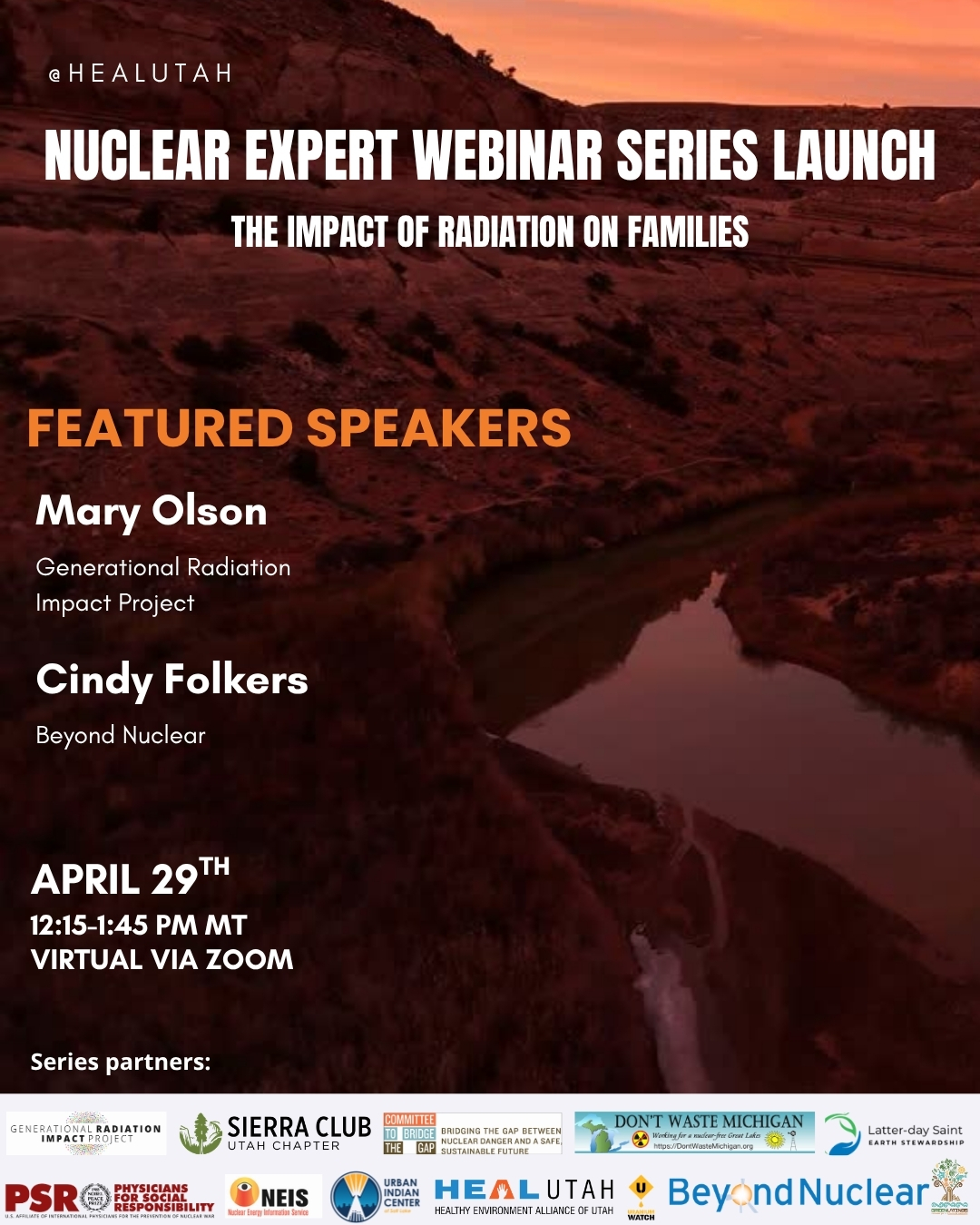
29 April – Nuclear Expert Webinar #1 – Radiation Impacts on Families with Mary Olson and Cindy Folkers
- 12:15 PM MT – 1:45 PM MT
- Location: Virtual – REGISTER TODAY

4 May -West Suburban Peace Coalition to discuss Iran war at May Educational Forum
Monday, May 4, 7:00 – 8:00 PM Central Standard Time
Title: : How Trump’s Narrative Tries to Shape the Reality of the War on Iran.
Contact Walt Zlotow, zlotow@hotmail.com 630 442 3045 for further information
14 May – online event From Bombs to Data Centres: the Face of Nuclear Colonialism

Pine Ridge Uranium is the real threat, not Tehran- Tell Burgum: Stop the Extraction.
Chernobyl: The Lost Tapes – A good documentary on Chernobyl on SBS available On Demand for the next 3 weeks– https://www.sbs.com.au/ondemand/tv-program/chernobyl-the-lost-tapes/2352741955560
To see nuclear-related stories in greater depth and intensity – go to https://nuclearinformation.wordpress.com
-
Archives
- April 2026 (288)
- March 2026 (251)
- February 2026 (268)
- January 2026 (308)
- December 2025 (358)
- November 2025 (359)
- October 2025 (376)
- September 2025 (257)
- August 2025 (319)
- July 2025 (230)
- June 2025 (348)
- May 2025 (261)
-
Categories
- 1
- 1 NUCLEAR ISSUES
- business and costs
- climate change
- culture and arts
- ENERGY
- environment
- health
- history
- indigenous issues
- Legal
- marketing of nuclear
- media
- opposition to nuclear
- PERSONAL STORIES
- politics
- politics international
- Religion and ethics
- safety
- secrets,lies and civil liberties
- spinbuster
- technology
- Uranium
- wastes
- weapons and war
- Women
- 2 WORLD
- ACTION
- AFRICA
- Atrocities
- AUSTRALIA
- Christina's notes
- Christina's themes
- culture and arts
- Events
- Fuk 2022
- Fuk 2023
- Fukushima 2017
- Fukushima 2018
- fukushima 2019
- Fukushima 2020
- Fukushima 2021
- general
- global warming
- Humour (God we need it)
- Nuclear
- RARE EARTHS
- Reference
- resources – print
- Resources -audiovicual
- Weekly Newsletter
- World
- World Nuclear
- YouTube
-
RSS
Entries RSS
Comments RSS
 nuclear-news