Under cover of the nation’s preoccupation with the pandemic, France changes the rules, to permit nuclear installations in urbanised areas.

A government decree authorizes the construction of nuclear installations in urbanized or urbanizable areas. While the media, health and political institutions are grinding the brains of citizens with a virus, the government continues to issue decrees spiraling out of control.
This time, on June 29, 2021, a decree dispensing with the town planning code will allow the establishment of nuclear installations in urbanized areas, including where people reside! The ministers of ecology and housing signed this crap. The whole territory is now at the mercy of nuclear predation. It’s radioactivity in your garden or on the balcony.
Insanity presides over autocratic political power and lobbying.
Co-ordination Antinucleaire 2nd July 2021
How Taishan almost became China’s Chernobyl.
How Taishan almost became China’s Chernobyl. https://www.spectator.co.uk/article/how-taishan-almost-became-china-s-chernobyl Ian Williams, 4 July 21,
Days after a nuclear power plant began spewing deadly radiation, the ruling Communist party pushed ahead with a huge and self-indulgent celebration of the sort that had become a hallmark of its rule. This was no time for bad news, and the party delayed, dithered and hid the truth about the deadly events that were unfolding.
That was the Chernobyl disaster in 1986. Soviet leaders allowed Kiev’s International Workers’ Day celebrations to go ahead. The participants, meanwhile, were oblivious to events at the stricken reactor just 60 miles away. The images of those May Day celebrations have come to symbolise the party’s criminal dishonesty, and they were nearly echoed after a technical glitch hit the Taishan nuclear power plant in Guangdong province early last month, just weeks before the Chinese Communist party’s centenary.
Thankfully it did not turn into another Chernobyl, but the response of the authorities in China was chillingly reminiscent of those dark days in Ukraine.
On 16 June, the Chinese government said that there had been an incident with the fuel rods at a nuclear plant, but this information took over a week to get out: a close reminder that authoritarian states repel uncomfortable truths. On 8 June, US authorities were reportedly informed that there was an ‘imminent radiological event’ at the Taishan Nuclear Power Plant in Guangdong Province, just 80 miles from Hong Kong. The Chinese safety authorities were reportedly raising the acceptable limits for radiation detection outside the plant in order to avoid having to shut it down. The French company who part-owned the plant, Framatome, needed to obtain a US waiver to obtain the technical information needed to solve the problem – a problem the Chinese authorities at the time had not even acknowledged existed.
After reports were broadcast by CNN, Framatome issued a statement saying it was trying to resolve a ‘performance issue’ at the plant, in which it has a 30 per cent stake. The Chinese firm, CGN, refused to comment, though the plant said that everything was ‘normal’. Only on 16 June did the Chinese government inform the International Atomic Energy Authority that there had been an issue with some damaged fuel rods. It described the issue as a common occurrence, which did not trigger safety concerns.
It could have been far worse. The technical details are reassuring, but they were far too slow to come out. Had this been a wholly-owned Chinese plant, we would still be completely in the dark. It is chillingly reminiscent not only of the early days at Chernobyl, but also the beginning of the Covid-19 outbreak. During those early days in Wuhan there was open speculation that Xi Jinping had finally reached his ‘Chernobyl moment’ – the disaster that would hasten the demise of a monolithic communist party.
There is visibly a pattern emerging in China which we have seen in authoritarian regimes before. Bad news is quashed and denied. The Chinese Communist party is secretive by nature, and regards itself as accountable to nobody. This has been exacerbated by Xi Jinping’s concentration of power. Officials are afraid to pass bad news up the food chain, preferring to tell the emperor what he wants to hear. In democracies, bad news travels to the top quickly. In autocracies, less so.
Britain has an especially pressing reason to pay attention to events at the Chinese power plant. The Chinese and French firms are also collaborating on the £22 billion Hinkley Point nuclear plant now under construction in Somerset, which will use the same technology. A second joint project in Suffolk has yet to begin construction. The Chinese firm is also angling to build its own reactor at Bradwell in Essex – the first Chinese-designed plant outside its own borders, with Beijing wanting to widen markets for its nuclear technology.
Allowing the Chinese firm which has close links to the Communist party to play such a crucial role in such a sensitive part of Britain’s most critical infrastructure was always foolhardy. It looks even more so in the light of the CCP’s behaviour at Taishan. The party is so wilfully lacking in transparency that it should never be in charge of a nuclear power plant in its own country, let alone on the coast of Britain. The British government has the power to do something about it. The question is whether it has the will.
UK Treasury’s new green savings bonds says YES to wind energy, NO to nuclear

the nuclear energy aspect had been scrapped in the process of working out suitable investments.
Yes to wind, no to nuclear: the green bonds investment planSavers can be part of £15bn scheme with just £100m
Sunday July 04 2021, The Sunday Times The money raised through the Treasury’s new green savings bonds will not be used to fund any nuclear energy projects, despite the power source being a crucial part of the government’s ten-point plan towards net zero.
The term net zero means achieving a balance between the carbon emitted into the atmosphere and the carbon removed from it.
Investors might be able to help fund the government’s plans to “build back better and greener” as early as September, when it is expected that the first tranche of bonds will be launched.
Farnam Bidgoli, the head of environmental, social and governance (ESG) solutions at HSBC, said that the nuclear energy aspect had been scrapped in the process of working out suitable investments. “When doing our market research,……….. (subscribers only) https://www.thetimes.co.uk/article/yes-to-wind-no-to-nuclear-the-green-bonds-investment-plan-9pcrz6rsw
The space tourism plans of Bezos, Musk and Branson are morally reprehensible,

Ben Bramble sets out a problem that ought to be so obvious – that this space travel push is a wasteful, and even childish example of the rich boys club doing its thing – Bezos, Musk, Gates, Branson etc trying to outdo each other
But there is a more sinister side to space travel and space research – the national rivalries, started with Donald Trump’s plan for a Space Force – nuclear reactors, nuclear-powered rockets, and nuclear weapons in space. Those billionaires are all too well connected with NASA and this space military push. The thought of a nuclear war in space is horrendous. But what else could possibly go wrong?
The space tourism plans of Bezos, Musk and Branson are morally reprehensible, The Age, Ben Bramble, 5 July 21.
With billionaires Jeff Bezos, Elon Musk, and Richard Branson soon to send paying customers into space, members of US Congress are askingwhether and how to regulate commercial spaceflight. But there is a more basic question: Should there be such an industry in the first place?
Supporters of such an industry, such as Republican Kevin McCarthy, cast these billionaires as modern-day Wright brothers, innovating commercialspaceflight in a way governments either can’t or won’t. While billionaires will be the first in space, they say, soon everyone will get their chance.
But this is clearly not feasible any time soon, given Earth’s environmental crises. It is unsustainable for humans to keep consuming resources at the rate we currently are, let alone if space tourism were to become commonplace. The fact that a product can be made cheap enough for many people to afford it does not show that it is environmentally sustainable for many people to actually consume it.
Still, you might say, what could be wrong with commercial spaceflight reserved for the ultra-wealthy? This wouldn’t significantly worsen our environmental crises.–
But there is something morally distasteful in the extreme about space tourism exclusively for the ultra-wealthy when so many people on Earth are in such great need. Going into space, in full view of the many billions of humans who are struggling on a daily basis, is a little like enjoying a pop-up Michelin star meal in front of a homeless shelter.
This is not to decry all luxury goods. But there is something particularly objectionable about spending so much money on a fleeting experience for oneself and others, who are already among the best off on the planet, when so many cannot even make ends meet (through no fault of their own).
At present, there seems a clear tendency to reserve moral criticism for people who cause bad things or who set out to harm others. Such behaviour is certainly bad and merits criticism. But we should feel grumpy also at people for failing to help others when they easily can. Those who display an indifference to the plight of others or who are too wrapped up in themselves and their own self-serving projects are morally criticisable even if they are not the cause of others’ suffering. While it is true that Bezos has recently become a major sponsor of the environment, much more is needed. Every dollar spent on sending billionaires into space is money that could have been used instead to help save the planet or bring others out of poverty.
It is worth adding that many billionaires have contributed to Earth’s problems. Our environmental crises are largely due to excessive consumption, something that companies such as Amazon have played a major role in making possible, affordable and accepted……….
Bezos has said that one of his reasons for founding his company Blue Origin is that “we’re now big compared to the size of the planet”. Like Musk, he thinks we need to look beyond Earth to survive our present crises. But this is far too premature. We can still save the Earth. But to save it, we’re going to have to re-engineer our consumer cultures and economies. This, and not space tourism, is the great engineering challenge of the 21st century. I’d like to see these billionaires use their brilliant minds to help save the Earth, rather than flee it. If this means smaller growth for their own companies, so be it. ….. https://www.theage.com.au/national/the-space-tourism-plans-of-bezos-musk-and-branson-are-morally-reprehensible-20210704-p586o1.html
Global heating: “unprecedented” heatwave temperatures will become routine.

With the global climate warming, such “unprecedented” heatwave temperatures will start to become routine. Some parts of the world may simply become too hot for human habitation. Not only will heatwaves become more common, but hotter, drier conditions will lead to more wildfires.
Times 4th July 2021, Canada experienced its highest recorded temperature last week as the mercury surged to 49.6C in British Columbia on Tuesday. This is not onlythe highest temperature for Canada, but the hottest ever recorded above the 45th parallel north, roughly the latitude of Bordeaux and Bologna. In the US, the states of Washington, Oregon and Idaho also broke records.
The Pacific northwest is roasting. Hundreds have died. In Pakistan, the city of Jacobabad can reach 52C. As temperatures hit nearly 50C there last week, ts scorching streets were deserted as people tried to shelter at home, most without air-conditioning. The hospitals were flooded with heatstroke victims.
With the global climate warming, such “unprecedented” heatwave temperatures will start to become routine. Some parts of the world may simply become too hot for human habitation. Not only will heatwaves become more common, but hotter, drier conditions will lead to more wildfires.
In January last year, before Covid-19 dominated the news, Australia was aflame with massive areas of bushfire. Hurricanes and typhoons will also become more intense. Tropical diseases will spread. We’ll find it harder to feed
ourselves. And the problems won’t be shared evenly. Some regions will receive less rainfall and lose crops to drought, others will receive more and lose crops to flooding. There will be a global reconfiguration of where food can reliably be grown, and where people can safely live.
The climate refugees of today are only the first trickle of what could become a mass migration of people into parts of the world still offering habitable conditions – a movement of humanity unlike anything seen before in history. It is unlikely that this large-scale population disruption, combined with dwindling resources such as fresh water, will come without conflict.
The next wars could well be climate wars. It was human ingenuity and resourcefulness that got us into this mess, and I am hopeful that our same capabilities will find the way out again too.
https://www.thetimes.co.uk/article/how-to-live-in-a-climate-emergency-t6rfz7ckv
United Kingdom will not finance any nuclear-energy related expenditures under its Green Financing Framework

Nuclear energy has been excluded from the UK government’s Green Financing Framework, while several EU Member States have written to the European Commission to oppose nuclear’s inclusion in the bloc’s green taxonomy.
The UK’s Green Financing Framework describes how the government plans to finance expenditures through the issuance of green gilts and the retail Green Savings Bonds that it says will be critical in tackling climate change and other environmental challenges. The framework, which was produced and published yesterday by the Treasury, sets out the basis for identification, selection, verification and reporting of the green projects that are eligible for such financing.
Under ‘exclusions’, the document says: “Recognising that many sustainable investors have exclusionary criteria in place around nuclear energy, the UK government will not finance any nuclear energy-related expenditures under the Framework.”
World Nuclear News 2nd July 2021
https://www.world-nuclear-news.org/Articles/UK-excludes-nuclear-from-green-taxonomy
European Court of Justice condemns France for preventing anti-nuclear group from access to legal justice.
Le Figaro 1st July 2021

Bure: France condemned for having rejected the legal action of an
 antinuclear association. The European Court of Human Rights (ECHR) on
 Thursday condemned France for having "disproportionately" restricted access
to justice to an association opposed to the nuclear waste burial project in
 Bure (Meuse).

The seven judges of the judicial body of the Council of Europe which sits in Strasbourg considered that France had violated article 6.1 of the European Convention on Human Rights which guarantees "the right of access to a court »Regarding the Mirabel-LNE association.......


The Cigéo project, on the border of the Meuse and Haute-Marne, aims to eventually store some 85,000 m3 of nuclear waste at a depth of nearly 500 meters.
 Le Figaro 1st July 2021

 https://www.lefigaro.fr/flash-eco/bure-la-france-condamnee-pour-avoir-rejete-le-recours-en-justice-d-une-association-antinucleaire-20210701
In extreme heat wave, forest fire threatens Sakatchewan uranium mine – another example of global heating hitting nuclear activities.

Forest fire burns uncontained near Cigar Lake uranium mine in northern Sask., CBC, 2 July 21, All non-essential personnel have been evacuated due to the fire, Cameco said in a statement.
The Cameco Corporation has reported a forest fire in the vicinity of its Cigar Lake uranium mine in northern Saskatchewan.
In a statement Thursday morning, the company said it has evacuated about 230 workers from the mine and roughly 80 people remain on site to keep the facility in a safe state.
Cameco said, should the wildfire threat continue to grow, there is a plan to keep the workers there safe and a number of precautions have been implemented. It said it’s working closely with the Saskatchewan Public Safety Agency on site.
Cameco said the fire is complicated by extremely warm, dry weather resulting from the heat dome currently over Western Canada.
Production at the Cigar Lake mine has been temporarily suspended. …….
…… As of early Thursday afternoon, the provincial government’s website listed 19 active fires across Saskatchewan. Five are not contained, including the Briggs fire near the Cigar Lake mine. https://www.cbc.ca/news/canada/saskatchewan/forest-fire-cigar-lake-mine-1.6087459
Buried in the sand of Southern Algeria – the radioactive pollution from French nuclear tests

Algérie: sous le sable, les déchets nucléaires français, translation by
Hervé CourtoisC.A.N. Coalition Against Nukes, 2 July 21
This is one of the major issues in the reconciliation of memories between France and Algeria. A subject that has long remained buried in the sands of the Sahara: the pollution of southern Algeria by French nuclear tests.
More than fifty years after the last test in 1966, Algiers has just created an agency for the rehabilitation of former nuc;ea test sites.
The Propaganda
From 1960 to 1966, the French army conducted 17 nuclear tests in southern Algeria, on the sites of Reggane and In Ekker. At the time, Albdekrim Touhami, a native of Tamanrasset, was a teenager. In Ekker is 150 kilometers north. He remembers the installation of the French military base, seen then as a welcome source of employment.”For us, it was a godsend. Everyone came running to get a job as a laborer or simple worker on the site. We didn’t think that this bomb was going to be a disaster for the region. We were told, “Here it is, the bomb will go off at such and such a time. You may feel some shaking, like an earthquake. But don’t worry, there will be no problem.” “
Fifteen years after Hiroshima and Nagasaki, the danger of nuclear weapons is known. Southern Algeria is chosen to conduct these tests, because the area is considered quite deserted compared to the Southern Alps or Corsica, while being close to the French mainland.
France wanted to quickly demonstrate its capacity to use the bomb in the context of the Cold War and the race for nuclear deterrence.”France wanted to catch up with the other nuclear powers, the United States, Russia and the United Kingdom, to remain in what was called at the time “the big league”. This partly explains why the priority was the result, not the concern about the environmental impact or the collateral damage to the population. The priority was to explode the bomb,” recalls Patrice Bouveret, co-founder of the Observatoire de l’armement, an independent center of expertise.A highly polluted area .
In1962, Algeria became independent. The tests continued. Most of them, eleven, were carried out between 1962 and 1966 and therefore with the agreement of the new Algerian authorities. Systematically, the waste generated by these tests was buried, explains Jean-Marie Collin, spokesperson for Ican-France (International Campaign for the Abolition of Nuclear Weapons) who published a study with Patrice Bouveret, “Under the sand, the radioactivity! “.
Very clearly, France has a desire to bury,” emphasizes Jean-Marie Collin. It considers the desert as an ocean, an ocean of sand, and it buries everything that is likely to be contaminated. Algerian independence and the fact that France left Algeria under rather complicated conditions did not play in favor of depollution. On the contrary, even more waste was left behind. “Waste that goes from the simple screwdriver to the tank exposed to test the resistance of military equipment to the atomic bomb. Another pollution linked to nuclear tests, the accidental one during the Berryl underground test in 1962.
The reason for the tests was that the nuclear technology was not fully mastered and therefore there were accidents that released radioactive lava,” continues the Ican-France spokesman. The test concerned was in 1962. We were there in 2007. The scientists measured the radioactivity, which was extremely high, and they told us: “You should not stay more than twenty minutes on the spot, if you do not want to absorb radioactivity that is dangerous for your body. “
Only one victim compensated.
Contaminated rocks left in the open air, in areas of passage. Contaminated sand disseminated by the winds beyond the Algerian borders, particularly in neighboring Niger. For about fifteen years, in the area of Tamanrasset and with very few means, Abdelkrim Touhami and his association Taourirt tries to draw up a sanitary assessment.We learned that many people died of suspicious deaths,” he confides. People were dying little by little. Babies were being born with deformities. Cancers were occurring through this disaster. “
To date, no official census of the people exposed, whether French or Algerian. Only one Algerian victim has been compensated under the Morin Law (2010). The decree of May 31 creating an agency for the rehabilitation of test sites in Algeria is an important step for Jean-Marie Collin of Ican-France.
Until now,” he explains, “the Algerian state created a certain surveillance zone on these sites, but there had never been any action to protect these zones in order to avoid any real access. This decree opens up the possibility that international organizations such as States could come and help rehabilitate these nuclear test sites. What we have at the same time are discussions between France and Algeria, officially revealed in April, whereas until then, these discussions did not officially exist.
“These discussions took place within the framework of the Franco-Algerian working group on nuclear tests, created in 2008 under the presidency of Nicolas Sarkozy. This issue of rehabilitation was also included in the report by Benjamin Stora on the reconciliation of memories between France and Algeria. Algiers must ratify the Tian, the Treaty for the Prohibition of Nuclear Weapons, to which France is not a signatory, before mid-October.
.Supporters of the rehabilitation of former nuclear test sites want a joint Franco-Algerian mission to be sent to map the polluted sites in order to circumscribe them, and eventually treat them so that the inhabitants are no longer exposed to radioactivity. . https://www.rfi.fr/fr/afrique/20210629-alg%C3%A9rie-sous-le-sable-les-d%C3%A9chets-nucl%C3%A9aires-fran%C3%A7ais?fbclid=IwAR2Gn0qmn8xngwhyIaCBN1ut9lU9w_YwziHLSr9S2SkwmBGc9oaWL0f18As
5 European nations warn the European Commission that nuclear energy must be excluded from the EU’s green finance taxonomy.
A group of five EU member states led by Germany have sent a letter to the European Commission asking for nuclear energy to be kept out of the EU’s green finance taxonomy. The letter – signed by the environment or energy ministers of Austria, Denmark, Germany, Luxembourg, and Spain – points to “shortcomings” in a report by the European Commission’s Joint Research Centre published on 2 April, which concluded that nuclear energy is safe.
“Nuclear power is incompatible with the Taxonomy Regulation’s ‘do no significant harm’ principle,” the ministers wrote, urging the Commission to keep nuclear out of the EU’s green finance rules. “We are concerned that including nuclear power in the Taxonomy would permanently damage its integrity, credibility and therefore its usefulness,” they warned.
Euractiv 2nd July 2021
Fukushima: Radioactive boars create mutant hybrid species decade after nuclear disaster
A decade after the Fukushima disaster, wild boars have been mating with domestic pigs in the nuclear wasteland and creating a new mutant species, DNA researchers have determined, Daily Star, By Kirsty Car 2 JUL 2021
Radioactive wild boars have been breeding with Japan’s domestic pigs to create a new hybrid species, researchers say.
…. ..the area’s wild boars bred with domestic pigs that escaped from nearby properties after farmers had to flee, creating a new hybrid species.
A study has led by Donovan Anderson, a researcher at Fukushima University in Japan, analysed DNA samples from muscles of 243 wild boars, pigs and boar-pig hybrids, taken from local slaughterhouses.
The results proved that 31 wild boar, or 16% of the wild boar from the evacuated zone, were hybrids……… The team also claim that while the boar-pigs are radioactive, the study did not link radioactivity with the creation of the new hybrid species……..
 | |||
https://www.dailystar.co.uk/news/weird-news/fukushima-radioactive-boars-create-mutant-24439268
Biden’s Bombing of Iraq and Syria Only Serves the Weapons Industry, by Glenn Greenwald — Rise Up Times

“The U.S. government is a lawless entity. It violates the law, including its own Constitution, whenever it wants. The requirement that no wars be fought absent congressional authority is not some ancillary bureaucratic annoyance…”
Biden’s Bombing of Iraq and Syria Only Serves the Weapons Industry, by Glenn Greenwald — Rise Up Times
Even this conservative journal recognises renewables as the only meaningful future energy source – nuclear is irrelevant

Regardless of what the nuclear industry itself wants, the signs are that renewables may be defining themselves not only as the cheapest, but also as the only meaningful energy proposal for the future.
Let’s Leave Nuclear Power In The Past https://www.forbes.com/sites/enriquedans/2021/06/30/lets-leave-nuclear-power-in-thepast/?sh=4beadbb23864 Enrique Dans, Senior Contributor

It makes a lot of sense to start this article by linking to the old smiling sun badge that symbolizes the opposition to nuclear energy, to talk about the increasingly negative perceptions of nuclear power around the world, to the point where, with the exception of a few unconditional enthusiasts, it is beginning to be seen as a technology with less and less of a role in the world’s energy future.

During the 1950s, the term atomic age was widely used to describe a future where all energy would be based on nuclear fission, one in which energy would be so cheap and inexhaustible that it wouldn’t be worth metering it, to the point that it would be used not only to make weapons or provide energy, but even to power cars like the Ford Nucleon, to heat water in swimming pools, to keep artificial hearts beating and even for the mechanism of a ballpoint pen.
What happened? First, the obvious problem of safety: in a world with an increasingly unstable climate and more extreme weather phenomena, nuclear power plants are, as the tenth anniversary of the Fukushima accident on March 11 reminded us, a reckless option. Germany became the first major economy to commit to retiring its nuclear power plants by 2022, but China also seems to be losing interest in the technology due to cost and safety concerns, while nuclear power is relegated to a token role in the US energy map.

Large reactors cannot compete with low renewable energy prices. Many of them have already closed, and furthermore, due to their high cost, complexity and difficulties, it seems very unlikely that any new large plants will be built in the coming decades. Nuclear power has turned out to be a promise that never materializes, and looks increasingly remote as an answer to the climate emergency.

Some point to small modular reactors (SMRs) as the only option that could be implemented on a significant scale in the climate-critical period of the next few decades, but quite a few analyses suggest this is extremely unlikely to happen.
The option that seemed the most obvious can easily be sidelined as new technologies develop and undergo their own economies of scale. Nuclear power, which still generates around 10% of the world’s total energy, is now seen as too slow, too expensive and too dangerous, something no one wants to see being built near their home or town. Regardless of what the nuclear industry itself wants, the signs are that renewables may be defining themselves not only as the cheapest, but also as the only meaningful energy proposal for the future.
The world is bequeathing to our descendants the costly nightmare of unsolved nuclear waste disposal
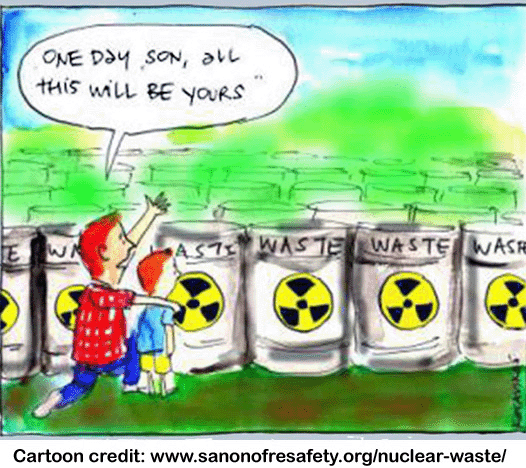
Nuclear legacy is a costly headache for the future, https://climatenewsnetwork.net/nuclear-legacy-is-a-costly-headache-for-the-future/
June 28th, 2021, by Paul Brown How do you safely store spent nuclear waste? No-one knows. It’ll be a costly headache for our descendants.
LONDON, 28 June, 2021 − Many states are leaving future generations an unsolved and costly headache: how to deal with highly dangerous nuclear waste.
The decision to start closing down the United Kingdom’s second generation of nuclear power stations earlier than originally planned has highlighted the failure of governments to resolve the increasingly expensive problem of the waste they leave behind them.
Heat-producing radioactive spent fuel needs constant cooling for decades to avoid catastrophic accidents, so future generations in countries that have embraced nuclear power will all be paying billions of dollars a year, every year, for at least the next century or two to deal with this highly dangerous legacy.
A report by the Organisation for Economic Cooperation and Development (OECD) and its Nuclear Energy Agency looks at 12 member countries facing the problem: Belgium, Canada, Finland, France, Germany, Japan, South Korea, Spain, Sweden, Switzerland, the UK and the US.
The report shows that none of the 12 has yet got to grips with the legacy bequeathed by producing nuclear waste. None has any means yet of disposing of it. It says every country must quickly realise that the money the industry has put aside to deal with the problem is inadequate, leaving successive future generations with the bill for keeping themselves safe.
Failure to progress
Finland is closest to dealing with the internationally preferred route for making spent nuclear fuel safe: building an underground repository in rocks deep underground to store and ultimately seal up the waste in this final burial place.
The Finns have actually started building such a facility and regard it as the complete solution to the problem, even though it is still decades away from completion.
Finland’s progress is a shining example to the rest of the nuclear world. International rules require countries that create nuclear waste to deal with it within their own borders − yet most governments have failed to make progress on doing so. Some have spent decades looking for a suitable site and have failed to find one.
This has often been because local opposition has forced governments to abandon a chosen location, or because scientists judge the site too dangerous to store wastes for the required 100,000 years or so, because of poor geology. They may suspect a risk that the radioactivity could leak into water supplies, or rise to the surface and kill unwary future generations.
The funding shortfall has become much more problematic because of low inflation and the current Covid pandemic. Governments previously put money aside on the assumption that economies would constantly grow and positive interest rates would create massive long-term investments.
But the current low or negative return on government bonds means investments made in the past and designed to pay huge future bills will no longer be enough to deal with the cost of spent fuel and other high-level wastes.
The report says governments’ assumptions have proved optimistic. It is not directly critical of governments, but points out that “the polluter pays” principle is not being applied. New funding needs to be found, it says, if future generations are not to be saddled with this generation’s expensive and life-threatening legacy.
The UK, one of the pioneer nuclear states because of its race to develop a nuclear bomb, is a classic example of leaving the grandchildren to pay for past and present nuclear wastes.
As early as 1976, in the Flowers Report on nuclear power and the environment, the UK was warned that it should not build any more nuclear power stations until it had found a way of getting rid of the waste. The government agreed.
Since then, for more than 40 years, successive governments have been looking for a repository to make good on their promise. But none has yet been found, and none is expected until the current target date of 2045.
True cost unknown
Yet the OECD says the original nuclear weapons programme, plus the first generation of nuclear stations, now all closed, are costing today’s taxpayers US$4.58 billion a year (£3.3bn) just to manage the waste and keep the population safe. The cost is around $185bn (£133bn) for 17 sites over 120 years. There could be liabilities of another $200bn (£144bn) to restore the installations to greenfield sites.
The second generation of nuclear stations can call on the Nuclear Liabilities Fund, set up by the UK government when the French company EDF took over the newer British advanced gas cooled reactors (AGRs) in 2009 so that money from electricity sales could be invested to pay for de-fuelling and decommissioning at the end of their lives. The first of these, Dungeness B, on the English Channel coast, started de-fuelling this month.
The cost of dismantling this generation of reactors is estimated at $28.57bn (£20.59bn) by EDF − $10bn more than the Nuclear Liabilities Fund provides for. This shortfall is almost certainly a large under-estimate because the actual cost of closing the stations and storing the waste is unknown, let alone that of restoring the sites to greenfield conditions.
Partly this is because AGRs have never yet been taken out of service before there is a disposal route for the waste. If none is found, taxpayers will have to pay to keep it safe in closely managed stores for many decades.
Despite this, the current UK government is now building a new nuclear station at Hinkley Point in the West of England, and wants to build many more. Meanwhile the mounting financial liabilities for future generations who will need to keep the waste safe in a time of climate change are left unresolved. And so the costly headache remains for countless generations to come. − Climate News Network
Canada is a warning: more and more of the world will soon be too hot for humans
| |||

Canada is a warning: more and more of the world will soon be too hot for humans https://www.theguardian.com/commentisfree/2021/jun/30/canada-temperatures-limits-human-climate-emergency-earth# Simon Lewis How did a small town in Canada become one of the hottest places on Earth?
Without an immediate global effort to combat the climate emergency, the Earth’s uninhabitable areas will keep growing
The climate crisis means that summer is a time of increasingly dangerous heat. This week in the Pacific north-west, temperature records are not just being broken, they are being obliterated. Temperatures reached a shocking 47.9C in British Columbia, Canada. Amid temperatures more typically found in the Sahara desert, dozens have died of heat stress, with “roads buckling and power cables melting”.
Another heatwave earlier in June saw five Middle East countries top 50°C. The extreme heat reached Pakistan, where 20 children in one class were reported to have fallen unconscious and needed hospital treatment for heat stress. Thankfully, they all survived.
Additional warming from greenhouse gas emissions means that such extreme heatwaves are more likely and scientists can now calculate the increase in their probability. For example, the 2019 European heatwave that killed 2,500 people was five times more likely than it would have been without global warming.
In most places, extreme heatwaves outside the usual range for a region will cause problems, from disrupting the economy to widespread mortality, particularly among the young and old. Yet in places in the Middle East and Asia something truly terrifying is emerging: the creation of unliveable heat.
While humans can survive temperatures of well over 50C when humidity is low, when both temperatures and humidity are high, neither sweating nor soaking ourselves can cool us. What matters is the “wet-bulb” temperature – given by a thermometer covered in a wet cloth – which shows the temperature at which evaporative cooling from sweat or water occurs. Humans cannot survive prolonged exposure to a wet-bulb temperature beyond 35C because there is no way to cool our bodies. Not even in the shade, and not even with unlimited water.
In most places, extreme heatwaves outside the usual range for a region will cause problems, from disrupting the economy to widespread mortality, particularly among the young and old. Yet in places in the Middle East and Asia something truly terrifying is emerging: the creation of unliveable heat.
While humans can survive temperatures of well over 50C when humidity is low, when both temperatures and humidity are high, neither sweating nor soaking ourselves can cool us. What matters is the “wet-bulb” temperature – given by a thermometer covered in a wet cloth – which shows the temperature at which evaporative cooling from sweat or water occurs. Humans cannot survive prolonged exposure to a wet-bulb temperature beyond 35C because there is no way to cool our bodies. Not even in the shade, and not even with unlimited water.
Second, prepare for the inevitable heatwaves of the future. Emergency public health planning is the initial priority: getting essential information to people and moving vulnerable people into air-conditioned locations. Heatwave forecasts should include wet-bulb temperatures so that people can learn to understand the dangers.
Plans should account for the fact that heatwaves intensify structural inequalities. Poorer neighbourhoods typically have fewer green spaces and so heat up more, while outdoor workers, often poorly paid, are especially vulnerable. The rich also buy up cooling equipment at high prices once a heatwave is underway and have many more options to flee, underscoring the importance of public health planning.
Beyond crisis management, governments need to invest in making countries function in the new climate we are creating, including the extremes. In climate policy terms this is known as “adaptation”.
Of paramount importance is energy supplies being resilient to heatwaves, as people will be relying on electricity for cooling from air-conditioning units, fans and freezers, which are all life-savers in a heatwave. Similarly, internet communications and data centres need to be future-proofed, as these are essential services that can struggle in the heat.
Beyond this, new regulations are needed to allow buildings to keep cool and for transport systems, from roads to trains, to be able to operate under much higher temperature extremes.
Many of these changes can meet other challenges. Retro-fitting homes to be energy-efficient is also the perfect opportunity to modify them to also keep us cool. For example, installing electric heat pumps to warm houses in the winter means that in the summer they can also be switched to run in reverse to work as a cooling system. Cities can be kept cooler with green roofs and more green spaces, which also make them better places to live.
The final task is future-proofing agriculture and the wider ecosystems we all ultimately rely on. Heat can cause havoc with crop production. In Bangladesh, just two days of hot air in April this year destroyed 68,000 hectares of rice, affecting over 300,000 farmers with losses of US$39m (£28m). New heat-tolerant varieties of crops need developing and deploying. The alternative is higher food costs and food price spikes with the increased poverty and civil unrest that typically accompanies them.
Given these immense challenges how are governments doing on climate adaptation? Very poorly. The Paris agreement on climate change obliged countries to submit their adaptation plans, but only 13 countries have done so. One of those is the UK, but government plans were judged by its own independent advisors to have “failed to keep pace with the worsening reality of climate risk”.
The Glasgow Cop26 climate talks will need to put the spotlight on adaptation planning and funding for vulnerable countries. To curtail the impacts of ever more ferocious heatwaves, reducing emissions will need to go hand in hand with adapting to the swelteringly hot world we are creating. Stabilising the climate by 2050 is well within the timeframe of one working lifetime, as is adapting to allow us all to prosper in this new world. There is no time to lose.
- Simon Lewis is professor of global change science at University College London and University of Leeds
1 This Month

of the week – Shut Down Drone Warfare!


Tell the Ukrainian Government to Drop Prosecution of Peace Activist Yurii Sheliazhenko

Petition to revoke the licensing of the Near Surface Nuclear Disposal Facility (NSDF) at Chalk River. https://www.ourcommons.ca/petitions/en/Petition/Details?Petition=e-7247
To see nuclear-related stories in greater depth and intensity – go to https://nuclearinformation.wordpress.com
-
Archives
- April 2026 (44)
- March 2026 (251)
- February 2026 (268)
- January 2026 (308)
- December 2025 (358)
- November 2025 (359)
- October 2025 (376)
- September 2025 (257)
- August 2025 (319)
- July 2025 (230)
- June 2025 (348)
- May 2025 (261)
-
Categories
- 1
- 1 NUCLEAR ISSUES
- business and costs
- climate change
- culture and arts
- ENERGY
- environment
- health
- history
- indigenous issues
- Legal
- marketing of nuclear
- media
- opposition to nuclear
- PERSONAL STORIES
- politics
- politics international
- Religion and ethics
- safety
- secrets,lies and civil liberties
- spinbuster
- technology
- Uranium
- wastes
- weapons and war
- Women
- 2 WORLD
- ACTION
- AFRICA
- Atrocities
- AUSTRALIA
- Christina's notes
- Christina's themes
- culture and arts
- Events
- Fuk 2022
- Fuk 2023
- Fukushima 2017
- Fukushima 2018
- fukushima 2019
- Fukushima 2020
- Fukushima 2021
- general
- global warming
- Humour (God we need it)
- Nuclear
- RARE EARTHS
- Reference
- resources – print
- Resources -audiovicual
- Weekly Newsletter
- World
- World Nuclear
- YouTube
-
RSS
Entries RSS
Comments RSS
 nuclear-news