Astronauts to Mars – a game of cancer-russian-roulette, especially dangerous to women


women were more likely to develop lung cancer than men, suggesting a greater sex-based vulnerability to harmful radiation.
the risk to an astronaut exposed to space radiation is long-term rather than immediate. Without proper shielding (which tends to be rather heavy and thus prohibitively expensive to launch) their chances of developing cancer, as well as cardiovascular disease, cataracts and central nervous system damage, slightly increase each day they are in space. In a person’s cells, space radiation can sever both strands of a DNA molecule’s double helix. And while a few such instances might come with very limited risks, each additional severance raises the odds of developing a harmful mutation that could cause cancer………
New Space Radiation Limits Needed for NASA Astronauts, Report Says, Scientific American, By Ramin Skibba on July 14, 2021 https://www.scientificamerican.com/article/new-space-radiation-limits-needed-for-nasa-astronauts-report-says/ Although meant to minimize risks to human health, the proposed new limits would still be exceeded by any conceivable near-future crewed voyage to MarsAstronaut Scott Kelly famously spent an entire year residing onboard the International Space Station (ISS), about 400 kilometers above Earth, and his NASA colleague Christina Koch spent nearly that long “on station.” Each returned to Earth with slightly atrophied muscles and other deleterious physiological effects from their extended stay in near-zero gravity.
But another, more insidious danger lurks for spacefarers, especially those who venture beyond low-Earth orbit.
Space is filled with invisible yet harmful radiation, most of it sourced from energetic particles ejected by the sun or from cosmic rays created in extreme astrophysical events across the universe. Such radiation can damage an organism’s DNA and other delicate cellular machinery. And the damage increases in proportion to exposure, which is drastically higher beyond the protective cocoon of Earth’s atmosphere and magnetic field (such as on notional voyages to the moon or Mars). Over time, the accrued cellular damage significantly raises the risk of developing cancer.
To address the situation, at NASA’s request, a team of top scientists organized by the National Academies of Sciences, Engineering, and Medicine published a report in June recommending that the space agency adopt a maximum career-long limit of 600 millisieverts for the space radiation astronauts can receive. The sievert is a unit that measures the amount of radiation absorbed by a person—while accounting for the type of radiation and its impact on particular organs and tissues in the body—and is equivalent to one joule of energy per kilogram of mass. Scientists typically use the smaller (but still quite significant) quantity of the millisievert, or 0.001 sievert. Bananas, for instance, host minute quantities of naturally occurring radioactive isotopes, but to ingest a millisievert’s worth, one would have to eat 10,000 bananas within a couple of hours.
Every current member of NASA’s astronaut corps has received less than 600 millisieverts during their orbital sojourns, and most, including Koch, have received much less and can thus safely return to space. But a year on the ISS still exposes them to more radiation than experienced by residents of Japan who lived near the Fukushima Daiichi nuclear accidents of 2011.
“Everybody is planning trips to the moon and Mars,” and these missions could have high radiation exposures, says Hedvig Hricak, lead author of the report and a radiologist at Memorial Sloan Kettering Cancer Center in New York City. Using current spaceflight-proved technologies, long-distance voyages—especially to the Red Planet—would exceed the proposed threshold, she says.
That could be a big problem for NASA’s Artemis program, which seeks to send astronauts to the moon in preparation for future trips to Mars. Another problem for the space agency is that the epidemiological data it uses mostly come from a longevity study of Japanese survivors of atomic bomb blasts, as well as from the handful of astronauts and cosmonauts who have endured many months or even years in low-Earth orbit. NASA’s current space radiation limit, which was developed in 2014, involves a complicated risk assessment for cancer mortality that depends on age and sex, yet more relevant data are necessary, Hricak argues. In the atomic bomb survivor study, for instance, women were more likely to develop lung cancer than men, suggesting a greater sex-based vulnerability to harmful radiation. “But with the knowledge we presently have, we know we cannot make a comparison between high exposure versus chronic exposure,” Hricak says. “The environment is different. There are so many factors that are different.”
NASA wants to update its standards now because the agency is on the cusp of sending so many astronauts well beyond low-Earth orbit, where greater amounts of space radiation seem destined to exceed previously mandated exposure limits. Furthermore, Hricak says, having a single, universal radiation limit for all space travelers is operationally advantageous because of its simplicity. A universal limit could also be seen as a boon for female astronauts, [ Ed. a boon?when they still are more susceptible to cancer than men are?] who had a lower limit than men in the old system and therefore were barred from spending as many days in space as their male counterparts.
The new radiation limit proposed by Hricak and her team is linked to the risks to all organs of a 35-year-old woman—a demographic deemed most vulnerable in light of gender differences in the atomic bomb survivor data and the fact that younger people have higher radiation risks, partly because they have more time for cancers to develop. The goal of the radiation maximum is to keep an individual below a 3 percent risk of cancer mortality: in other words, with this radiation limit, at most three out of 100 astronauts would be expected to die of radiation-induced cancer in their lifetime.
“NASA uses standards to set spaceflight exposure limits to protect NASA astronauts’ health and performance, both in mission and after mission,” says Dave Francisco of NASA’s Office of the Chief Health and Medical Officer. He acknowledges that, while astronauts on Mars missions would benefit from the thin Martian atmosphere that provides some limited protection, “transit in deep space has the highest exposure levels.”
That means long-haul space trips come with the biggest risks. A stay on the lunar surface for six months or more—presuming, of course, that astronauts eventually have a presence there and do not spend most of their time in subsurface habitats—would involve nearly 200 millisieverts of exposure, a higher amount than an extended visit to the ISS. And an astronaut traveling to Mars would be exposed to even more radiation. Whether they reached the Red Planet through a lunar stopover or on a direct spaceflight, they could have experienced significant radiation exposure en route. Even before they embarked on the trip back home, they could have already exceeded the 600 millisievert limit. The entire voyage, which would likely last a couple of years, could involve well more than 1,000 millisieverts. So if astronauts—and not just robots—will be sent to Mars, NASA likely will need to request waivers for them,
Hricak says, although the exact process for obtaining a waiver has not yet been laid out.
The report’s proposal for a new radiation maximum is not without its critics. “For a mission to Mars, a 35-year-old woman right at that limit could have an over 10 percent chance of dying in 15 to 20 years. To me, this is like playing Russian roulette with the crew,” says Francis Cucinotta, a physicist at the University of Nevada, Las Vegas, and former radiation health officer at NASA. Despite the supposed benefits the new limits would have for female astronauts, he is concerned that the risks are particularly pronounced for younger women in space.
On the contrary, Hricak says, in its request for new limits, NASA has sought to be conservative. The European, Canadian, and Russian space agencies all currently have a higher maximum allowed dose of 1,000 millisieverts, while Japan’s limit is age- and sex-dependent like NASA’s current one, mainly because of a shared dependence on the atomic bomb survivor data.
But unlike someone in the vicinity of a nuclear explosion, the risk to an astronaut exposed to space radiation is long-term rather than immediate. Without proper shielding (which tends to be rather heavy and thus prohibitively expensive to launch) their chances of developing cancer, as well as cardiovascular disease, cataracts and central nervous system damage, slightly increase each day they are in space. In a person’s cells, space radiation can sever both strands of a DNA molecule’s double helix. And while a few such instances might come with very limited risks, each additional severance raises the odds of developing a harmful mutation that could cause cancer………
considering how little is known about various health risks from different kinds of space radiation, compared with radiation we are familiar with on Earth, researchers will surely continue with more studies like these to protect astronauts as much as possible. “I can tell you exactly how much exposure you’re going to get from a CT scan,” Hricak says, “but there are many uncertainties with space radiation.”….. https://www.scientificamerican.com/article/new-space-radiation-limits-needed-for-nasa-astronauts-report-says/
UK government plan – residents on the hook in advance for costly Sizewell nuclear plan that will be useless to combat climate change

A remote area on England’s east coast, halfway between the seaside towns of Felixstowe and Lowestoft, is set to become the centre of debate about Britain’s future energy security. UK ministers are aiming to bring
forward legislation in the autumn to support the financing of a 3.2 gigawatt nuclear power station in Sizewell, East Suffolk….
Ministers have been in formal negotiations with EDF about how to fund the proposed £20bn Sizewell C
plant since December, and the government and the French state-backed utility have had discussions about replacing Britain’s ageing nuclear reactors for years.
However, the question of whether Britain should build more large plants took on added urgency last month, when EDF closed the 1.1GW Dungeness B station in Kent seven years early. It also raised the prospect that other reactors may also be decommissioned ahead of schedule, owing to problems with their graphite cores……….

“If there was [a capacity issue], what good is Sizewell going to do given it won’t come on line until 2034
according to EDF?” asks Stephen Thomas, emeritus professor of energy policy at the University of Greenwich. Nuclear sceptics have long argued that money would be better spent on clean energy technologies, such as
offshore wind, and reducing electricity demand through measures including insulation.
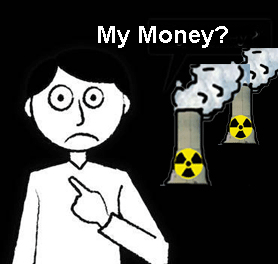
Under a RAB model, consumers would pay towards a new plant through their energy bills long before any electricity is generated. Opponents of the model warn that consumers would also be on the hook for
cost overruns.
FT 14th July 2021
https://www.ft.com/content/3f2bfc76-5b74-437c-8b18-67f9cde991af
Most Hanford nuclear cleanup workers exposed to hazardous materials: Washington state report
Most Hanford cleanup workers exposed to hazardous materials: Washington state report https://thehill.com/policy/energy-environment/561893-most-hanford-workers-exposed-to-hazardous-materials-state-report
BY CELINE CASTRONUOVO – 07/07/21 More than half of all current and former workers involved in the Hanford Nuclear Reservation cleanup effort have said they were exposed to hazardous materials, according to a new report from the Washington state government.
The report, the last in a series from the Department of Commerce’s Hanford Healthy Energy Workers Board, found that 57 percent “of all current and former workers reported being in an exposure event,” with 32 percent saying they experienced “long-term exposure to hazardous materials.”
The 106-page document cited “deep concerns” among current and former workers about “compensation system processes and the healthcare system’s ability to meet workers’ needs,” and identified “deficiencies in continued engagement with workers after an initial assessment or diagnosis as a common obstacle for the Hanford workforce.”
The findings cap eight months of research by a state-commissioned board tasked with making recommendations on addressing the health needs of workers at the Hanford nuclear site.
The 560-square-mile area in Washington was used by the federal government from 1944 to 1987 to produce plutonium for nuclear weapons and missile warheads.
However, the state board noted that during this time, “many highly radioactive byproducts and waste chemicals were dumped directly into the ground or stored in subterranean multi-million-gallon underground storage areas known as tank farms.”
The Department of Energy’s mission at the site shifted from production to cleanup beginning in the late 1980s.
The site has come under increased scrutiny in recent years for its affect on health and the environment, with the Energy Department warning in April that it believed an underground tank at the facility was leaking waste produced by plutonium production.
The Hanford area is considered the most contaminated site of radioactive waste in the U.S.
The board’s final report on Wednesday offered a look at some of the long-term impacts of nuclear production and waste at the site, including incurable conditions like chronic beryllium disease, which leads to scarring of lung tissue.
The board said that “information sharing could be key to finding cures” to the disease and other chronic conditions developed from exposure to hazardous materials.
Other recommendations included the creation of a Hanford Healthy Energy Workers Center to “serve as a centralized clearinghouse for Hanford-specific health-related information that includes up-to-date scientific knowledge, research on emergent topics, exposure data analysis, medical surveillance data analysis and coordinated intergovernmental efforts for policy and advocacy.”
The board said greater access should be given to specialty and follow-up care, and urged health officials to improve “the quality of care available to Hanford workers both at the Hanford site and in the Tri-Cities area.”
Japan’s government acknowledges that solar power will be cheaper than nuclear
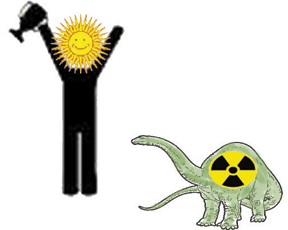
Solar power eclipses nuclear energy in terms of costs, Asahi Shimbun, By SATOSHI SHINDEN/ Staff Writer, July 13, 2021 For businesses looking ahead to reduce costs, solar power would definitely seem to be the way to go. Households could possibly benefit as well.
A new estimate by the industry ministry on future costs of power generation found that solar power will eclipse nuclear energy in terms of costs as of 2030.
The finding, released July 12, is expected to have significant implications for the nation’s energy policy.
This is the first time for the Ministry of Economy, Trade and Industry to acknowledge that the cost to generate solar power will be lower than that for nuclear power.
The estimates were presented at a meeting of a working group of the Advisory Committee for Natural Resources and Energy the same day.
Estimated costs for nuclear power came to close to the 12 yen level or more per kilowatt-hour as of 2030, about 1 yen higher than the previous estimate in 2015.
Costs for solar power ranged from the lower 8 yen level to close to 12 yen for businesses. The rate for homes was estimated at between the last half of the 9 yen level to the first half of the 14 yen level.
The government and electric utilities have continued to champion nuclear power generation even after the 2011 triple meltdown at the Fukushima No. 1 nuclear plant, citing cost efficiency over other energy sources.
However, the latest estimates would seem to call the legitimacy of that argument into question and will likely have an impact on the government’s Basic Energy Plan, for which officials are working to revise.
The Basic Energy Plan is updated almost every three years.
“The industry ministry has finally acknowledged it can no longer maintain the position that nuclear power is the most economical source of energy,” noted Kenichi Oshima, a professor of environmental economics at Ryukoku University who studies the nation’s nuclear policy, referring to the latest findings about costs.
The estimated costs for generating electricity with nuclear energy have risen each time calculations were made.
The ministry was forced to include ballooning costs for decommissioning of nuclear reactors and decontaminating crippled facilities in the aftermath of the Fukushima nuclear disaster…..
solar energy is getting cheaper.
The latest estimate for solar power was down from the previous calculation in 2015 because the costs of installing solar panels are dropping.
Charges for generating electricity are calculated as follows: the total cost of building a new power facility, operating it for decades and finally dismantling it divided by the overall amount of power produced during the period…… https://www.asahi.com/ajw/articles/14394069
If you thought that space research had nothing to do with weapons – think again!

With all three Gunsmoke-J satellites on orbit, the Army is ready to test space-based targeting C4ISR NETBy Nathan StroutTue Jul 13 2021, The Army is keen to use the vantage of space to find and target beyond-line-of-sight (BLOS) threats. While satellite imagery has traditionally been a product of the intelligence community, the development of relatively affordable yet highly capable small satellites that can operate in low Earth orbit has convinced military leaders that it can play a tactical role on the battlefield.
In a demonstration last fall, the Army was able to show that it could take images from satellites on orbit down to Earth, process them with artificial intelligence to find threats, and deliver targeting data to weapon systems in about 20 seconds. That speed is opening a whole slew of possibilities to commanders, enabling them to “see” further down the battlefield in near real time than ever before.
That demonstration used images from commercial satellite constellations, but now the Army has its own trio of imagery satellites to further develop this capability. The Army’s Gunsmoke-J program has launched three cubesats to use “emerging advanced electronics to allow the use of dedicated intelligence assets to provide tactically actionable targeting data to war fighters on a responsive and persistent timeline,” according to an annual budget proposal. Gunsmoke-J is a Joint Capability Technology Demonstration conducted by the Army Space and Missile Defense Command and Assured Position Navigation and Timing/Space Cross Functional Team………..
“This deployment and same day launch of two separate Gunsmoke-J satellites is a major step toward demonstrating what we believe will be enabling tactical warfighter capability,” ……..
If the Gunsmoke experiments are successful, then this work could lead to future systems, which would enhance long-range precision fires in support of the war fighter.” https://www.c4isrnet.com/battlefield-tech/space/2021/07/12/with-all-three-gunsmoke-j-satellites-on-orbit-the-army-is-ready-to-test-space-based-targeting/
July 14 Energy News — geoharvey

Opinion: ¶ “New Republican-Only Conservative Climate Caucus Light On Science, Heavily Pro-Fossil Fuels” • A Conservative Climate Caucus has been formed with a roster of roughly 60 members. Their website is light on content, but it has enough to make a few early assessments. Their actions may pleasantly surprise me one day, but the start […]
July 14 Energy News — geoharvey
Spain’s nuclear regulator blocks permit for a uranium concentrate plant
| Spain’s nuclear regulator blocks permit for Salamanca. The board of Consejo de Seguridad Nuclear (CSN), Spain’s Nuclear Safety Council, has issued an unfavourable report that will block Berkeley Energia’s plans for a uranium concentrate plant at its Salamanca project in Retortillo, western Spain. Mining Magazine 13th July 2021 https://www.miningmagazine.com/geomechanics-ground-control/news/1413748/spain%E2%80%99s-nuclear-regulator-blocks-permit-for-salamanca |
British court ruling heightens danger of Assange extradition to the US
British court ruling heightens danger of Assange extradition to the US, WSWS, Oscar Grenfell, 12 July 21, Last week’s ruling by the British High Court allowing prosecutors to appeal an earlier judgment blocking Julian Assange’s extradition, poses the very real danger that the WikiLeaks publisher will be dispatched to his American persecutors in the not-too-distant future.
The ruling is a microcosm of the Assange case as a whole. As they have for the past decade, the British courts have thrown aside the WikiLeaks founder’s legal and democratic rights. They have granted a US appeal that is both duplicitous and irregular under conditions in which the entire attempt by the American state to prosecute Assange has been exposed as an illegal frame-up.
The US appeal is a damning refutation of those, including among Assange’s own supporters, who have peddled dangerous illusions that the US administration of President Joe Biden may drop the prosecution if a sufficient number of moral pleas are addressed to the new occupant of the White House.
The appeal was first issued in the dying days of the Trump administration but it was continued, honed and argued for by Biden’s Justice Department. Assange remains in London’s maximum-security Belmarsh Prison and faces the prospect of lifetime incarceration in the US because Biden is determined to press ahead with the prosecution of a journalist and publisher for exposing American war crimes, human rights violations and illegal spying operations.
That is because the Assange prosecution is viewed as a crucial precedent by the imperialist powers for the suppression of dissent and anti-war opposition amid a ratcheting up of the preparations for military conflict, including the Biden administration’s threats and provocations against China, and the first signs of a resurgence of working-class struggle.
The appeal also confirms the warnings made by the World Socialist Web Site about January’s British District Court decision that barred extradition.
Judge Vanessa Baraitser accepted all the substantive arguments of the US prosecutors, including their right to try a publisher under the Espionage Act. Her ruling, prohibiting extradition, was framed in the narrowest terms. Its purpose was to defuse a groundswell of opposition to the prospect of Assange’s extradition and to provide the US with ample scope for appeal.
Baraitser ruled that extradition would be “oppressive.” Assange’s compromised health and the conditions of his imprisonment in the US would likely result in his suicide.
The deliberate consequence of that judgment was that there was only a legal sliver between Assange and extradition.
The US has exploited this with its appeal claiming that the conditions of imprisonment would not be so oppressive. It has proposed worthless assurances that Assange would not be held under Special Administrative Measures (SAM), regulations that impose almost total isolation on a prisoner, and that he could serve out his sentence in Australia.
The extradition hearing had heard harrowing testimony about the dire psychological consequences of SAMs and conditions at the supermax ADX Florence prison where they are frequently imposed.
The US arguments, accepted as a legitimate basis of appeal by the British court, were demolished by Stella Moris, Assange’s partner and an international human rights lawyer.
In a statement issued on Friday, Moris wrote: “Reports about US undertakings are grossly misleading. On any given day 80,000 prisoners in US prisons are held in solitary confinement. Only a handful are in ADX/under special administrative measures. ADX is just one of dozens of self-described supermax prisons in the United States. The US government also says it may change its mind if the head of the CIA advises it to do so once Julian Assange is held in US custody.
“With regard to the supposed concession of allowing Julian to serve jail time in Australia, it was always his right to request a prisoner transfer to Australia to finish serving his sentence because he is an Australian. It is no concession at all. There are existing agreements between the US and Australian authorities. What is crucial to understand is that prisoner transfers are eligible only after all appeals have been exhausted. For the case to reach the US Supreme Court could easily take a decade, even two.
“What the US is proposing is a formula to keep Julian in prison effectively for the rest of his life. The only assurance that would be acceptable would be for the Biden Administration to drop this shameful case altogether, once and for all. He should not be in prison for a single day, not in the UK, not in the United States, not in Australia—because journalism is not a crime.”
As Moris noted, the US appeal itself reserved the “right” to impose SAMs once Assange is on US soil. Testimony at the extradition hearing, including from a former US prison warden, established that the imposition of SAMs is essentially extra-judicial, often being introduced at the say-so of the intelligence agencies, and with no genuine means of appeal.
“What the US is proposing is a formula to keep Julian in prison effectively for the rest of his life. The only assurance that would be acceptable would be for the Biden Administration to drop this shameful case altogether, once and for all. He should not be in prison for a single day, not in the UK, not in the United States, not in Australia—because journalism is not a crime.”
As Moris noted, the US appeal itself reserved the “right” to impose SAMs once Assange is on US soil. Testimony at the extradition hearing, including from a former US prison warden, established that the imposition of SAMs is essentially extra-judicial, often being introduced at the say-so of the intelligence agencies, and with no genuine means of appeal.
The hearings, moreover, heard evidence of a case in which similar assurances were immediately thrown out the door once extradition was secured……………
Thordarson has now admitted, however, that almost all his testimony consisted of lies proffered in exchange for immunity from US prosecution. The American government thus submitted a false indictment to the British courts……….https://www.wsws.org/en/articles/2021/07/12/assa-j12.html?pk_campaign=assange-newsletter&pk_kwd=wsws
New Book ”The Wretched Atom”

| America’s Global Gamble with Peaceful Nuclear Technology https://global.oup.com/academic/product/the-wretched-atom-9780197526903?cc=au&lang=en& Jacob Darwin Hamblin, 13 July 21Includes formerly secret documents from the CIA and State Department about American efforts to shape nuclear programs in Japan, Iran, Israel, and many other countriesDraws on more than a decade of archival research in national and international institutions in several different countriesIncludes documents never published before about cover-ups at the International Atomic Energy Agency. |
French nuclear company EDF struggles with increasing debt and poor prospects for its nuclear fleet.

Telegraph 11th July 2021, Macron’s battle to rewire EDF. French President Emmanuel Macron wants to restructure EDF and separate the costly nuclear power arm from the rest of the business. Jean-Bernard Lévy has developed a remarkable level of patience in his role leading utilities giant EDF. The French state-controlled company oversees some of the longest-running infrastructure projects in the world, operating 73 reactors globally.
But even Lévy is bound to have grown frustrated by the lack of progress in the French government’s effort to improve the company’s prospects. In what has been code-named Project Hercules, France wants to overhaul competition rules and separate EDF’s costly nuclear power arm from other areas of its business.
It is hoped the move could allow EDF to double its growth target in renewable energy to 100 gigawatts (GW) by 2030 and help it manage its debts. Brussels must first give approval for EDF’s reorganisation, but talks appear to have stalled and time is running out before France’s general election in April.
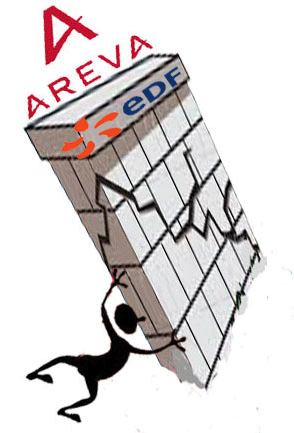
Its expensive nuclear fleet is one reason for its heavy net debt of €42bn. Multi-billion euro investment is needed in coming years to decommission, maintain and build new plants. S&P Global says nuclear projects “represent the highest risk to the group’s credit quality”.
It expects net debt to rise to €50bn-€52bn by the end of 2023. EDF argues it is disadvantaged by rules in France allowing competitors to buy a quarter of the electricity generated by its nuclear fleet at a fixed price of €42 per MwH, to make up for its monopoly in themarket. The price is too low and inflexible, EDF argues.
Meanwhile, EDF’s spending grows. The company is building several large assets without yet getting paid, including the £22bn-23bn nuclear power plant Hinkley Point C Somerset. For its next planned nuclear power station in the UK, Sizewell C in Suffolk, a different funding mechanism is being discussed with the
Government that would allow EDF to recoup costs from household bills during construction, rather than having to wait until the plant is generating.Ministers are believed to be preparing to introduce legislation this
autumn.
https://www.telegraph.co.uk/business/2021/07/11/macrons-battle-rewire-edf/
How Right-Wing Extremists Pose A Nuclear Threat
How Right-Wing Extremists Pose A Nuclear Threat. Cincinnati Public Radio By ANN THOMPSON 12 july 21, According to the Harvard Kennedy School’s Matthew Bunn, “For whatever reason, for a certain brand of right-wing extremists in the United States and elsewhere, there’s a real obsession with nuclear.” He says we need to be especially concerned when they work or know somebody who works at a nuclear plant.
These insiders are especially dangerous, he says, because of all the nuclear threats we know about, almost all of them were perpetrated by insiders or with the help of insiders.
Bunn and Scott Sagan recently co-edited a book called Insider Threats. Some of the material covered involves nuclear threats
” ‘The Turner Diaries,’ which is one of the sort of foundational documents for extreme racists, right-wing movements in the United States, envisons them using nuclear weapons against U.S. cities to sort of bring down the government in order to rebuild a whites-only nation,” says Bunn.
One extremist who worked at a nuclear plant was Ashli Babbitt. She was among the crowd storming the Capitol Jan. 6. Police shot and killed her after she tried to get through a barrier. From 2015 to 2017, Babbitt was employed by Calvert Cliffs nuclear power plant in Maryland and as far as anybody knows, didn’t do anything wrong there.
But nuclear plants remain an interest to plenty of extremists. In 2015, a suspect linked to the Paris attacks was found with surveillance footage of a top official at a nuclear facility in Belgium. Authorities were worried the Islamic State may have been plotting to kidnap the official to obtain radioactive material for the terrorist attack, according to The New York Times.
And it doesn’t stop there. “The Japanese terror group called Alum Shinnikyo that launched nine gas attacks in the Tokyo subways in 1995 and Al Quaeda both pursued nuclear weapons fairly actively,” Bunn says. “Recently the Under Secretary General of the United Nations for Counterterrorism reported that the Islamic State has used bitcoin to buy and sell radioactive materials.”……….. https://www.wvxu.org/post/how-right-wing-extremists-pose-nuclear-threat#stream/0
To 12 July – nuclear news this week
No – there’s not really much happening in the nuclear sphere. What is happening is the increasing pro nuke propaganda. It is so noticeable in my country, Australia. Not that it’s widespread (yet), but the pro-nuke spiel from the Murdochracy is so patently, silly, and ill-informed that it deserves mention for its absurdity. I hope to write more about this next time.
CLIMATE Serious as the pandemic is, – I’m thinking that in the total picture, it does not compare with the weather extremes, the suffering, the forced refugees, that the world faces from global heating.
When it happens in America, the media does sit up and take notice. It’s happening in California, with raging temperatures and raging wildfires. I know that this is terrible, and not funny, but still, I wonder if some climate change denialists might be having second thoughts , as they’re finding it hard to get oysters and other luxury shellfish – seeing that these coastal marine organisms are being cooked now, before they can be harvested.https://www.youtube.com/watch?v=DTZD5K6JBGk
CORONAVIRUS. World Health Organisation sounds alarm as global deaths top 4 million, delta variant spreads to 100 countries.
If They Chose, Biden and Putin Could Make the World Radically Safer, Nuclear arms control hasn’t worked. We need a new approach.
Key witness in Julian Assange case admits to lies in indictment. https://www.youtube.com/watch?v=HlLbAVSHeA8 U.S. government offers meaningless assurances on Julian Assange’s well-being, as it gets right to appeal on UK court ruling against his extradition. U.S. proposals about extradition of Julian Assange are designed to keep him in prison for life.
Rapid growth of global renewable energy: it’s the major energy source in Europe.
Mobile phones/cellphones – the health danger from electromagnetic radiation.
JAPAN. The 44 year process for demolishing TEPCO’s Fukushima No. 2 nuclear station, – with nowhere to put the radioactive trash. Japan’s nuclear regulator to order review of earthquake risks of Genkai nuclear plant. The danger of Japan’s increasing stockpile of plutonium. Fukushima’s ”nuclear recovery Olympics’‘ has gone even more wrong, as spectators banned.
EUROPE. Both UK and European Commission want nuclear energy excluded from clean energy investments -”otherwise clean energy finances would not be credible”.
GERMANY, As Germany’s election approaches, political parties differ on the future of U.S. nuclear weapons based there,.
UK.
As wind power becomes half the price of nuclear, nuclear power may not be an election winner. British households will pay for nuclear construction long before it supplies any electricity, under the govt’s new plan. Investors won’t back the nuclear ”white elephant’‘, neither should the UK taxpayers. UK residents face higher electricity bills, paying in advance, for the construction of new nuclear reactors.- Green party makes gains in East Suffolk Council by-election – area that includes planned Sizewell nuclear station.
- Nuclear fusion – a very unlikely development for Bradwell.
- The UK and Ireland Nuclear Free Local Authorities (NFLA) deplore the new secrecy on defence nuclear safety reports.
IRAN.Iran trying to enrich uranium metal that could help develop nuclear weapon, UN watchdog says.
FRANCE. “EDF’s Chinese dream seems well and truly over“- a minor nuclear incident becomes a major industrial disaster for the French nuclear firm. France’s government helps settle the debts of bankrupt nuclear company AREVA (which is now resuscitated as ORANO) France refuses to hand over maps of nuclear tests in Algeria.
TAIWAN. Taiwan Shuts Another Reactor as Part of Nuclear-Free Goal,.
USA.
- William Perry and Jerry Brown address the unwisdom of spending $2 trillion on new nuclear weapons. U.S. Space Force opens new centre to facilitate war in space. Nuclear weapons testing has never really stopped. We just call underground testing ”subcritical”.
- The nuclear rort in Georgia. Consumers may end up paying for billions of dollars in cost overruns on the Plant Vogtle nuclear expansion. In the USA State of Ohio, pro nuclear legislation is helped along by misinformation on renewable energy.
- U.S. nuclear lobby wants to sell advanced nuclear technology to China, on the spurious claims of ”safety” and ”advancing climate action”.
- Nuclear injustice in New Mexico must end.
- EPA Withdraws Disastrous Trump-Era Radioactive Roads Approval.
RUSSIA. Dialogue between Russia and USA must include subject of offensive weapons in outer space – says Russian Foreign Minister.
NORTH KOREA. North Korea Needs the Bomb to Protect Itself From America.
AUSTRALIA. South Australian law demands an Inquiry into the Federal government’s nuclear waste storage plan. Australian Members of Parliament from right and left parties call on US President Biden to drop charges against Julian Assange,
Reaching net zero without nuclear

Our latest Talking Points makes the case
Not only is it possible, it’s essential https://beyondnuclearinternational.org/2021/07/11/reaching-net-zero-without-nuclear/

The fourth in our series of Talking Points draws on the new report by Jonathon Porritt, New Zero Without Nuclear: The Case Against Nuclear Power. Given the far-off illusory promise of new reactor designs; the enormous costs; the limited capacity for carbon reductions compared to renewables; the unsolved waste problem; and the inflexibility and outdatedness of the “always on” baseload model, nuclear power is in the way of — rather than a contributor to — climate mitigation. You can download the Net Zero Without Nuclear Talking Points here. This is the fourth in our series. You can find all four here.
By Jonathon Porritt 10 July 21
I first took an interest in Greenpeace back in 1973, before I joined Friends of the Earth, CND and the Green Party (then the Ecology Party) a year later. I’d followed the campaigns against the testing of nuclear weapons in Amchitka (one of the Aleutian islands in Alaska), and then in the French nuclear testing area of Moruroa in the Pacific. I was 23 at the time, with zero in-depth knowledge, but it just seemed wrong, on so many different fronts.
That early history of Greenpeace seems much less relevant now, given all its achievements over the last 50 years in so many other areas of critical environmental concern. But it still matters. Greenpeace has been an ‘anti-nuclear organisation’ through all that time, sometimes fiercely engaged in front-line battles, sometimes maintaining more of a watching brief, and nuclear power plays no part in Greenpeace’s modelling of a rapid transition to a Net Zero carbon world. It’s been very supportive of my new report, ‘Net Zero Without Nuclear’.
I wrote this report partly because the nuclear industry itself is in full-on propaganda mode, and partly because that small caucus of pro-nuclear greens (that’s existed for as long as I can remember) seems to be winning new supporters.
And I can see why. The Net Zero journey we’re now starting out on for real (at long last!) is by far the most daunting challenge that humankind has ever faced. Writing in the Los Angeles Review of Books in June 2019, author and Army veteran Roy Scranton put it like this:
‘Climate change is bigger than the New Deal, bigger than the Marshall Plan, bigger than World War II, bigger than racism, sexism, inequality, slavery, the Holocaust, the end of nature, the Sixth Extinction, famine, war, and plague all put together, because the chaos it’s bringing is going to supercharge every other problem. Successfully meeting this crisis would require an abrupt, traumatic revolution in global human society; failing to meet it will be even worse.’
Not many people see it like that – as yet. But more and more will, as signals of that kind of chaos start to multiply. And we already know that the kind of radical decarbonisation on which our future depends is going to be incredibly hard. So why should we reject a potentially powerful contribution to that decarbonisation challenge?
I became Director of Friends of the Earth in 1984. The same year that my first book, ‘Seeing Green’, was published. Looking back on what I said then, I was indeed fiercely critical of nuclear power, but have to admit that my advocacy of renewables (as the principal alternative) was somewhat muted. Apart from a few visionaries in the early 1980s (including Friends of the Earth’s Amory Lovins and Walt Patterson), no-one really thought that renewables would be capable of substituting for the use of all fossil fuels and all nuclear at any point in the near future. And anyone expressing such a view in official circles was rapidly put back in their box.
Given the scale of the challenge we face, we need to have very strong grounds for keeping nuclear out of today’s low/zero-carbon portfolio. Not least as nuclear power, historically, has already made a huge contribution to low-carbon generation. Since the early 1960s, nuclear power has provided the equivalent of 18,000 reactor years of electricity generation. We’d be in a much worse place today if all that electricity had been generated from burning coal or gas.
Happily, there is no longer any doubt about the viability of that alternative. In 2020, Stanford University issued a collection of 56 peer-reviewed journal articles, from 18 independent research groups, supporting the idea that all the energy required for electricity, transport, heating and cooling, and all industrial purposes, can be supplied reliably with 100% (or near 100%) renewable energy. The solutions involve transitioning ASAP to 100% renewable wind – water – solar (WWS), efficiency and storage.
The transition is already happening. To date, 11 countries have reached or exceeded 100% renewable electricity. And a further 12 countries are intent on reaching that threshold by 2030. In the UK, the Association for Renewable Energy and Clean Technology says we can reach 100% renewable electricity by 2032. Last year, we crossed the 40% threshold.
There is of course a world of difference between electricity and total energy consumption. But at the end of April, Carbon Tracker brought out its latest analysis of the potential for renewables, convincingly explaining why solar and wind alone could meet total world energy demand 100 times over by 2050, and that fears about the huge amount of land this would require are unfounded. The land required for solar panels to provide all global energy would be 450,000 km2, just 0.3% of global land area – significantly less than the current land footprint of fossil fuel infrastructures. As the Report says:
The technical and economic barriers have been crossed and the only impediment to change is political. Sector by sector and country by country the fossil fuel incumbency is being swamped by the rapidly rising tide of new energy technologies. Even countries where the technical potential is below 10 times energy demand. . . have devised innovative approaches to energy generation.
The fossil fuel industry cannot compete with the technology learning curves of renewables, so demand will inevitably fall as wind and solar continue to grow. At the current 15-20% growth rates of solar and wind, fossil fuels will be pushed out of the electricity sector by the mid-2030s and out of total energy supply by 2050.‘
The unlocking of energy reserves 100 times our current demand creates new possibilities for cheaper energy and more local jobs in a more equitable world with far less environmental stress.‘
Poor countries are the greatest beneficiaries. They have the largest ratio of solar and wind potential to energy demand and stand to unlock huge domestic benefits.’
Nuclear plays no part in any of these projections, whether we’re talking big reactors or small reactors, fission or fusion. The simple truth is this: we should see nuclear as another 20th century technology, with an ever-diminishing role through into the 21st century, incapable of overcoming its inherent problems of cost, construction delay, nuclear waste, decommissioning, security (both physical and cyber), let alone the small but still highly material risk of catastrophic accidents like Chernobyl and Fukushima. My ‘Net Zero Without Nuclear’ report goes into all these inherent problems in some detail.
So why are the UK’s politicians (in all three major parties) still in thrall to this superannuated technology? It’s here we have to go back to Amchitka! Some environmentalists may still be taken aback to discover that the Government’s principal case for nuclear power in the UK today is driven by the need to maintain the UK’s nuclear weapons capability – to ensure a ‘talent pool’ of nuclear engineers and to support a supply chain of engineering companies capable of providing component parts for the nuclear industry, both civilian and military. The indefatigable work of Andy Stirling and Phil Johnston at Sussex University’s Science Policy Research Unit has established the depth and intensity of these interdependencies, demonstrating how the UK’s military industrial base would become unaffordable in the absence of a nuclear energy programme.
What that means is that today’s pro-nuclear greens are throwing in their lot not just with a bottomless pit of hype and fantasy, but with a world still dangerously at risk from that continuing dependence on nuclear weapons. That’s a weird place to be, 50 years on from the emergence of Greenpeace as a force for good in that world.
Fukushima’s ”nuclear recovery Olympics” has gone even more wrong, as spectators banned.

Fukushima to ban Olympic spectators as Covid cases rise,
U-turn deals blow to Japan’s hopes of using Games to showcase recovery from 2011 tsunami, Guardian, 10 Jul 21,
, The Fukushima prefecture of Japan will bar spectators from the Olympic events it hosts this summer owing to rising Covid-19 infections, its governor said on Saturday, reversing a position announced two days earlier by organisers.
The decision deals another blow to Japan’s hopes of using the Olympics to showcase its recovery from a devastating earthquake and tsunami that hit the northern coast in 2011, destroying a nuclear power station in Fukushima in the worst nuclear accident since Chernobyl.
Organisers had said on Thursday there would be no spectators in the host city, Tokyo, as a resurgent coronavirus forced the prime minister, Yoshihide Suga, to declare a state of emergency in the capital that will run throughout the Games, which were already postponed by a year due to the pandemic……..
Fukushima’s move comes a day after the Australian Olympic Committee president, John Coates, expressed optimism about audiences in Fukushima. Japan take on Australia in a softball game that will be the first competition of the Olympics on 21 July, two days before the opening ceremony.
………. Organisers said there was no change to plans for limited crowds in Miyagi, Shizuoka and Ibaraki prefectures. https://www.theguardian.com/sport/2021/jul/10/fukushima-to-ban-olympic-spectators-as-covid-cases-rise
Mobile phones/cellphones – the health danger from electromagnetic radiation
Ed. note. We know that ionising radiation from nuclear activities causes cancer and other health ill-effects. But we should also be aware of non-ionising radiation, and its effects on health – electromagnetic radiation as emitted by mobile pnones.

Since then, he said, research has shown significant adverse biologic and health effects — including brain cancer — associated with the use of cellphones and other wireless devices. And now, he said, with the fifth generation of cellular technology, known as 5G, there is an even bigger reason for concern.

Moskowitz: Cellphone radiation is harmful, but few want to believe it. Berkely News, Anne Brice, Berkeley News| JULY 1, 2021 For more than a decade, Joel Moskowitz, a researcher in the School of Public Health at UC Berkeley and director of Berkeley’s Center for Family and Community Health, has been on a quest to prove that radiation from cellphones is unsafe. But, he said, most people don’t want to hear it.
“People are addicted to their smartphones,” said Moskowitz. “We use them for everything now, and, in many ways, we need them to function in our daily lives. I think the idea that they’re potentially harming our health is too much for some people.”
Since cellphones first came onto the market in 1983, they have gone from clunky devices with bad reception to today’s sleek, multifunction smartphones. And although cellphones are now used by nearly all American adults, considerable research suggests that long-term use poses health risks from the radiation they emit, said Moskowitz.
“Cellphones, cell towers and other wireless devices are regulated by most governments,” said Moskowitz. “Our government, however, stopped funding research on the health effects of radiofrequency radiation in the 1990s.”
Since then, he said, research has shown significant adverse biologic and health effects — including brain cancer — associated with the use of cellphones and other wireless devices. And now, he said, with the fifth generation of cellular technology, known as 5G, there is an even bigger reason for concern.
Berkeley News spoke with Moskowitz about the health risks of cellphone radiation, why the topic is so controversial and what we can expect with the rollout of 5G.
Berkeley News: I think we should address upfront is how controversial this research is. Some scientists have said that these findings are without basis and that there isn’t enough evidence that cellphone radiation is harmful to our health. How do you respond to that?
Joel Moskowitz: Well, first of all, few scientists in this country can speak knowledgeably about the health effects of wireless technology. So, I’m not surprised that people are skeptical, but that doesn’t mean the findings aren’t valid.
A big reason there isn’t more research about the health risks of radiofrequency radiation exposure is because the U.S. government stopped funding this research in the 1990s, with the exception of a $30 million rodent study published in 2018 by the National Institute of Environmental Health Sciences’ National Toxicology Program, which found “clear evidence” of carcinogenicity from cellphone radiation.
In 1996, the Federal Communications Commission, or FCC, adopted exposure guidelines that limited the intensity of exposure to radiofrequency radiation. These guidelines were designed to prevent significant heating of tissue from short-term exposure to radiofrequency radiation, not to protect us from the effects of long-term exposure to low levels of modulated, or pulsed, radiofrequency radiation, which is produced by cellphones, cordless phones and other wireless devices, including Wi-Fi. Yet, the preponderance of research published since 1990 finds adverse biologic and health effects from long-term exposure to radiofrequency radiation, including DNA damage.
More than 250 scientists, who have published over 2,000 papers and letters in professional journals on the biologic and health effects of non-ionizing electromagnetic fields produced by wireless devices, including cellphones, have signed the International EMF Scientist Appeal, which calls for health warnings and stronger exposure limits. So, there are many scientists who agree that this radiation is harmful to our health.
Our 2009 review, published in the Journal of Clinical Oncology, found that heavy cellphone use was associated with increased brain cancer incidence, especially in studies that used higher quality methods and studies that had no telecommunications industry funding.
Last year, we updated our review, published in the International Journal of Environmental Research and Public Health, based on a meta-analysis of 46 case-control studies — twice as many studies as we used for our 2009 review — and obtained similar findings Our main takeaway from the current review is that approximately 1,000 hours of lifetime cellphone use, or about 17 minutes per day over a 10-year period, is associated with a statistically significant 60% increase in brain cancer.
Why did the government stop funding this kind of research?
The telecommunications industry has almost complete control of the FCC, according to Captured Agency, a monograph written by journalist Norm Alster during his 2014-15 fellowship at Harvard University’s Center for Ethics. There’s a revolving door between the membership of the FCC and high-level people within the telecom industry that’s been going on for a couple of decades now.
The industry spends about $100 million a year lobbying Congress. The CTIA, which is the major telecom lobbying group, spends $12.5 million per year on 70 lobbyists. According to one of their spokespersons, lobbyists meet roughly 500 times a year with the FCC to lobby on various issues. The industry as a whole spends $132 million a year on lobbying and provides $18 million in political contributions to members of Congress and others at the federal level.
……… there are strong parallels between what the telecom industry has done and what the tobacco industry has done, in terms of marketing and controlling messaging to the public. ……… For safety tips on how to reduce exposure to wireless radiation from the California Department of Public Health and other organizations, Moskowitz recommends readers visit his website, saferemr.com, Physicians for Safe Technology and the Environmental Health Trust. https://news.berkeley.edu/2021/07/01/health-risks-of-cell-phone-radiation/#:~:text=Moskowitz%3A%20Cellphone%20radiation%20is%20harmful%2C%20but%20few%20want%20to%20believe%20it,-By%20Anne%20Brice&text=For%20more%20than%20a%20decade,radiation%20from%20cellphones%20is%20unsafe.
1 This Month
5 January -Webinar-What is Trump’s Golden Dome?
REGISTER AT Massachusetts Peace Action Education


New book – https://www.amazon.com/dp/1923372157?utm_source=substack&utm_medium=email
Now until to February 10, 2026 Radioactive waste storage in France: the debate is finally open! How to participate?
-
Archives
- January 2026 (52)
- December 2025 (358)
- November 2025 (359)
- October 2025 (377)
- September 2025 (258)
- August 2025 (319)
- July 2025 (230)
- June 2025 (348)
- May 2025 (261)
- April 2025 (305)
- March 2025 (319)
- February 2025 (234)
-
Categories
- 1
- 1 NUCLEAR ISSUES
- business and costs
- climate change
- culture and arts
- ENERGY
- environment
- health
- history
- indigenous issues
- Legal
- marketing of nuclear
- media
- opposition to nuclear
- PERSONAL STORIES
- politics
- politics international
- Religion and ethics
- safety
- secrets,lies and civil liberties
- spinbuster
- technology
- Uranium
- wastes
- weapons and war
- Women
- 2 WORLD
- ACTION
- AFRICA
- Atrocities
- AUSTRALIA
- Christina's notes
- Christina's themes
- culture and arts
- Events
- Fuk 2022
- Fuk 2023
- Fukushima 2017
- Fukushima 2018
- fukushima 2019
- Fukushima 2020
- Fukushima 2021
- general
- global warming
- Humour (God we need it)
- Nuclear
- RARE EARTHS
- Reference
- resources – print
- Resources -audiovicual
- Weekly Newsletter
- World
- World Nuclear
- YouTube
-
RSS
Entries RSS
Comments RSS
 nuclear-news