British households will pay for nuclear construction long before it supplies any electricity, under the govt’s new plan
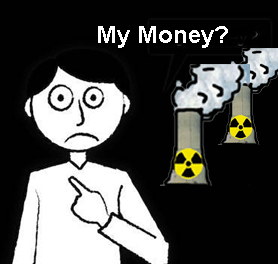
the model is deeply unpopular with nuclear sceptics, who have said it would expose consumers to construction risks, notably any cost overruns.
EDF and its junior partner in Hinkley Point C, the Chinese state-owned company CGN, are financing the plant in return for a generous electricity price of £92.50 per megawatt hour guaranteed by the government.
The price… was agreed in 2012 and rises in line with inflation.
UK households face energy bills surcharge to fund nuclear plants
Ministers plan legislation for new financing model to underpin building of £20bn Sizewell C reactor, Ft.com
Nathalie Thomas in Edinburgh and Jim Pickard in London, 7 jul 21,
British households face paying a surcharge on their energy bills to pay for new nuclear power stations in the UK as the government draws up legislation to underpin the new financing plan. Ministers aim to unveil legislation in the autumn that would enable Sizewell C, a £20bn nuclear power plant proposed by France’s EDF for England’s east coast, to go ahead through a financing model called the regulated asset base, said several people briefed on the government’s thinking. This model would mean that energy bill payers start contributing towards the cost of the plant at Sizewell in Suffolk long before it generates any electricity.
Boris Johnson has said he wants the government to reach a final investment decision on “at least one” new nuclear power station before the next general election ……….
Under the model, owners of a power station could add chunks of the value of a partly built plant to what would be its regulated asset base in stages during the risky construction phase. They could then charge an agreed regulatory return on this value to UK households through their energy bills, in a move designed to cover financing costs. State-backed EDF has said the steady returns guaranteed by the regulated asset base model would allow it to attract low-risk investors such as pension funds and would lead to overall savings for consumers.
But the model is deeply unpopular with nuclear sceptics, who have said it would expose consumers to construction risks, notably any cost overruns.
EDF is planning to use a design called the European Pressurised Reactor at Sizewell C, but budgets have spiralled at other projects deploying similar technology, including the Hinkley Point C plant under construction in Somerset. The Treasury is supportive of the regulated asset base model, said several people briefed on the department’s stance…..
EDF and its junior partner in Hinkley Point C, the Chinese state-owned company CGN, are financing the plant in return for a generous electricity price of £92.50 per megawatt hour guaranteed by the government.
The price, which was controversial with environmental groups, was agreed in 2012 and rises in line with inflation. UK ministers entered formal negotiations with EDF over the financing of Sizewell C in December. The government said at the time that consideration would be given “to the potential role of government finance in construction, provided there is clear value for money for consumers and taxpayers”.
Stephen Thomas, emeritus professor of energy policy at the University of Greenwich, said he imagined that the government would have to take a “strategic stake” in Sizewell C “as a signal to investors that this won’t be allowed to collapse, and ditto EDF”. It is not yet clear what role CGN will play in Sizewell C. CGN is financing 20 per cent of the development costs of the Suffolk plant alongside EDF but some Conservative MPs are opposed to Chinese involvement in critical UK infrastructure. CGN declined to comment. https://www.ft.com/content/d115c0bd-da17-4bbf-a070-b62b525c7fa1
1 Comment »
Leave a comment
1 This Month


Tell the Ukrainian Government to Drop Prosecution of Peace Activist Yurii Sheliazhenko

Petition to revoke the licensing of the Near Surface Nuclear Disposal Facility (NSDF) at Chalk River. https://www.ourcommons.ca/petitions/en/Petition/Details?Petition=e-7247


of the week – STOP SMALL MODULAR REACTORS IN CANADA
To see nuclear-related stories in greater depth and intensity – go to https://nuclearinformation.wordpress.com
-
Archives
- March 2026 (193)
- February 2026 (268)
- January 2026 (308)
- December 2025 (358)
- November 2025 (359)
- October 2025 (376)
- September 2025 (258)
- August 2025 (319)
- July 2025 (230)
- June 2025 (348)
- May 2025 (261)
- April 2025 (305)
-
Categories
- 1
- 1 NUCLEAR ISSUES
- business and costs
- climate change
- culture and arts
- ENERGY
- environment
- health
- history
- indigenous issues
- Legal
- marketing of nuclear
- media
- opposition to nuclear
- PERSONAL STORIES
- politics
- politics international
- Religion and ethics
- safety
- secrets,lies and civil liberties
- spinbuster
- technology
- Uranium
- wastes
- weapons and war
- Women
- 2 WORLD
- ACTION
- AFRICA
- Atrocities
- AUSTRALIA
- Christina's notes
- Christina's themes
- culture and arts
- Events
- Fuk 2022
- Fuk 2023
- Fukushima 2017
- Fukushima 2018
- fukushima 2019
- Fukushima 2020
- Fukushima 2021
- general
- global warming
- Humour (God we need it)
- Nuclear
- RARE EARTHS
- Reference
- resources – print
- Resources -audiovicual
- Weekly Newsletter
- World
- World Nuclear
- YouTube
-
RSS
Entries RSS
Comments RSS
 nuclear-news
How is this going to work, with all this climate issues we’ve got now, Boris said he want to do this before the next election, Look at all the flooding we’ve experience recently