California’s Pacific Gas and Electric Company (PG and E) settles over nuclear plant’s environmental violations.
California company agrees to 5.9-mln-dollar settlement over nuclear plant’s environmental damage http://www.xinhuanet.com/english/northamerica/2021-06/25/c_1310027301.htm, Xinhua| 2021-06-25 Editor: huaxia LOS ANGELES, — California’s Pacific Gas and Electric Company (PG&E) has agreed recently on a 5.9-million-U.S.-dollar settlement for once-through cooling water discharges from its Diablo Canyon nuclear power plant.
The settlement, reached with the Central Coast Regional Water Quality Control Board, was the result of a thorough Water Board investigation into alleged violations stemming from the plant’s use of water from the Pacific Ocean in its cooling system since 1985 and was officially filed on May 25 with the San Luis Obispo Superior Court.
According to Thursday’s report by Cal Coast News, the nuclear power plant takes in water from sea to condense steam after it passes through two electrical generators in a process called “once-through cooling” and the used water is then released back into the ocean.
Under the power plant’s local permit, public water was allowed to be piped from nearby sea area into the ocean, but environmentalists argued the discharge of water into the ocean harmed marine life.
Ailene Voisin, spokesperson for the Central Coast Regional Water Quality Control Board, estimated the thermal discharge to be about 20 degrees Fahrenheit (11.1 degrees centigrade) above the ambient ocean temperature in that area and that alterations to the nearby ecosystem “are well-documented and well-understood,” yet with “no feasible technological alternatives or modifications.”
Another problem was that the induction system that pumps water from Diablo Canyon into the power plant also sucked up an estimated 1.5 billion fish larvae per year, causing disruptions to the reproductive cycle of local fish.
The Water Board said in a press release on June 18 that the settlement funds received from PG&E would be used for water quality projects that benefit the region. In addition to the settlement, the release indicated that PG&E had also been making yearly payments to mitigate the issues from their overheated discharges.
Senator Markey urges the NRC to improve safety and security of nuclear decommissioning process.
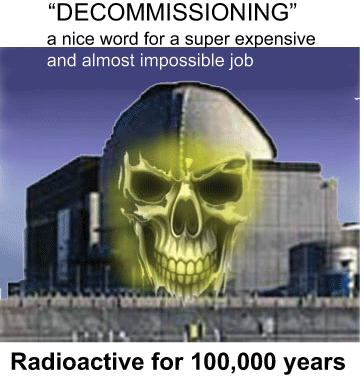
SENATOR MARKEY URGES THE NRC TO IMPROVE SAFETY AND SECURITY OF NUCLEAR DECOMMISSIONING PROCESS, https://www.markey.senate.gov/news/press-releases/senator-markey-urges-the-nrc-to-improve-safety-and-security-of-nuclear-decommissioning-process In a letter, Markey requests stricter safeguards as 23 nuclear power plants, including the Pilgrim Nuclear Power Station, undergo decommissioning in the U.S.
Washington (June 25, 2021) – Senator Edward J. Markey (D-Mass.), Chair of the Subcommittee on Clean Air, Climate, and Nuclear Safety in the Senate Committee on Environment and Public Works, today sent a letter to the Nuclear Regulatory Commission (NRC), urging the agency to address safety and security concerns before approving the draft rule, “Regulatory Improvements for Production and Utilization Facilities Transitioning to Decommissioning,” and putting out a proposed rule for public comment. “The Nuclear Regulatory Commission must prioritize the safety and security of the nuclear plants it oversees,” said Senator Markey. “As currently written, the proposed rule would allow the NRC and plant operators to cut corners on safety and limit public participation, which is critical to the decommissioning process. The communities around our nuclear plants deserve better than this.”
A copy of the letter can be found HERE.In his letter, Senator Markey requests that the NRC:
- propose a defined and exact set of rules on how plants should navigate the decommissioning process;
- improve public participation during the NRC’s consideration of any license transfers requested in connection with a nuclear plant’s decommissioning process;
- acknowledge and address the fact that spent fuel could remain onsite for long periods of time, perhaps indefinitely; and
- reevaluate its proposal to reduce financial protections for offsite and onsite liability claims for plants that are in the process of decommissioning.
Senator Markey also requests that the NRC ensure that the twenty-three nuclear reactors, such as Pilgrim Nuclear Power Station, that have already begun the decommissioning process adapt their operations to reflect stronger standards. The NRC should also establish the proper checks to ensure the safety and security of the eight additional nuclear power plants that have already declared their intent to decommission. Senator Markey has consistently urged the NRC to prioritize safety and public participation in the nuclear decommissioning process. Last Congress, Senator Markey reintroduced the Dry Cask Storage Act, which was aimed at improving the storage of spent nuclear fuel at nuclear plants across the nation.
As the Pilgrim Power Station commenced its decommissioning process, Senator Markey continued to fight to ensure that the NRC prioritized safety and public participation. In August 2019, Senators Markey and Elizabeth Warren (D-Mass.), and Representative William Keating (MA-09) wrote to the NRC to urge it to delay ruling on the proposed license transfer for Pilgrim from Entergy Nuclear Operations, Inc. to Holtec International until after the Commission considered and ruled on extant petitions and motions. In October 2018, Senator Markey and Rep. William demanded clear details from Holtec and Entergy about the safety and security issues involved in the ownership, transfer, and eventual decommissioning of the power plant.
U.S. Democrats launch bill allowing existing nuclear plants tax credit

U.S. Democrats launch bill allowing existing nuclear plants tax credit
Reuters WASHINGTON, June 24 (Reuters) 25 June 21, – Five Democrats in the U.S. Senate introduced a bill on Thursday that would allow some existing nuclear power plants to receive a tax credit equal to an incentive already given to operators of wind power turbines.
The bill, led by Senator Ben Cardin, provides a production tax credit of $15 per megawatt hour for existing nuclear plant owners or operators in states such as New York, Illinois, and Pennsylvania which have deregulated power markets. Cardin’s state, Maryland, has two reactors at Exelon Corp’s (EXC.O) Calvert Cliffs plant…………………….. https://www.reuters.com/world/us/us-democrats-launch-bill-allowing-existing-nuclear-plants-tax-credit-2021-06-24/
Long legacy of France’s nuclear tests in Algeria
| Abdelkrim touhami was still a teenager when, on May 1st 1962, French officials in Algeria told him and his neighbours to leave their homes in the southern city of Tamanrasset. It was just a precaution. France wasabout to detonate an atom bomb, known as Beryl, in the desert some 150km away. The blast would be contained underground. Two French ministers were there to witness the test. But things did not go as planned. Theunderground shaft at the blast site was not properly sealed. The mountain above the site cracked and black smoke spread everywhere, says Mr Touhami. The ministers (and everyone else nearby) ran as radioactive particles leaked into the air. Nevertheless, in the months and years after, locals would go to the area to recover scrap metal from the blast for use in their homes. Economist 24th June 2021 https://www.economist.com/middle-east-and-africa/2021/06/24/the-long-legacy-of-frances-nuclear-tests-in-algeria |
Nuclear energy NOT GREEN, not renewable,and wastes water, is slow, dangerous,expensive
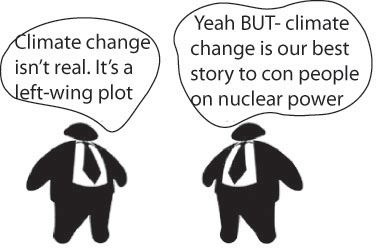
In a recent Guardian article, Jacobin magazine’s founding editor Bhaskar
Sunkara declared that “If we want to fight the climate crisis, we mustembrace nuclear power.” He praised nuclear as clean and reliable and
suggested that opponents of nuclear power are either gripped by “paranoia … rooted in Cold War associations” or are relying on “outdated
information”.
I disagree entirely. Here are ten reasons why nuclear power is still no solution for climate change: Nuclear is dangerous; nuclear wastes water; nuclear is slow; nuclear is not green; nuclear is not renewable; nuclear is expensive; nuclear power means nuclear weapons; nuclear waste lasts forever; uranium mining is unsafe; nuclear means dispossession. Green Left 24th June 2021 https://www.greenleft.org.au/content/ten-reasons-climate-activists-should-not-support-nuclear |
Increasing numbers of nuclear warheads globally
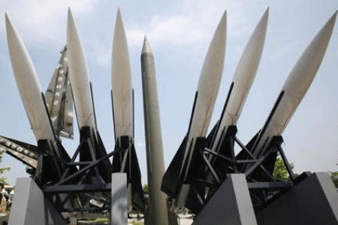
Global nuclear warhead stockpile appears to be growing, SIPRI warns https://www.business-standard.com/article/international/global-nuclear-warhead-stockpile-appears-to-be-growing-sipri-warns-121061400304_1.html
The overall number of nuclear warheads in global military stockpiles appears to be increasing this year, a new finding released by the Stockholm International Peace Research Institute (SIPRI) reveals
“The nine nuclear-armed states – the United States, Russia, the United Kingdom, France, China, India, Pakistan, Israel and the Democratic People’s Republic of Korea (North Korea) – together possessed an estimated 13 080 nuclear weapons at the start of 2021. This marked a decrease from the 13 400 that SIPRI estimated these states possessed at the beginning of 2020,” SIPRI said.
However, SIPRI research shows that this declining trend appears to have stalled.
“Despite this overall decrease, the estimated number of nuclear weapons currently deployed with operational forces increased to 3825, from 3720 last year,” the research institute said.
According to SIPRI, the US and Russia continued to reduce their nuclear weapon arsenals in 2020, but both are estimated to have had around 50 more nuclear warheads in operational deployment at the start of 2021 than a year earlier.
“Both countries’ deployed strategic nuclear forces remained within the limits set by the 2010 Treaty on Measures for the Further Reduction and Limitation of Strategic Offensive Arms (New START), although the treaty does not limit total nuclear warhead inventories,” SIPRI specified.
The institute also pointed out that China is modernizing and expanding its nuclear weapon inventory, along with India and Pakistan.
In February, Russia and the United States agreed to extend the New START treaty for five more years without renegotiating any of its terms. The treaty, now set to expire on February 5, 2026, is the only arms control agreement between two countries that is still in force.
The treaty limits each party’s nuclear arsenal to 1,550 deployed warheads, 800 launchers, and 700 missiles. Both the United States and Russia met the central limits of the New START Treaty in 2018, and have stayed at or below them ever since.
According to the White House, Russian President Vladimir Putin and US President Joe Biden are expected to discuss a wide range of bilateral issues related to strategic stability and arms control during their Wednesday summit in Geneva
Magnox Silo Liquor “Crack Under Control.” note: it isn’t — RADIATION FREE LAKELAND
How does the Nuclear Industry get away with wanting to produce ever more and ever hotter nuclear wastes when they cannot contain the existing wastes. The Magnox Swarf silo is leaking – from an unknown point – part of the silo is below ground. United Utilities are abstracting drinking water for West Cumbria from boreholes […]
Magnox Silo Liquor “Crack Under Control.” note: it isn’t — RADIATION FREE LAKELAND
Scientists say New Brunswick’s plutonium plan is undermining the global nuclear weapons non-proliferation regime
Scientists say New Brunswick’s plutonium plan is undermining the global nuclear weapons non-proliferation regime, https://nbmediacoop.org/2021/06/14/scientists-say-nbs-plutonium-plan-is-undermining-the-global-nuclear-weapons-non-proliferation-regime/ by Susan O’Donnell and Gordon EdwardsJune 14, 2021 The company Moltex Energy wants to extract plutonium from the thousands of used nuclear fuel bundles stored at Point Lepreau on the Bay of Fundy. They plan to use the plutonium as fuel for a new nuclear reactor, still in the design stage. If the project is successful, the entire package could be replicated and sold to other countries.
However, American scientists and non-proliferation experts say that Canadian government support for the Moltex plutonium-extraction project is undermining the global nuclear weapons non-proliferation regime. Plutonium is the primary nuclear explosive material in the world’s arsenals of nuclear weapons.
On March 18 this year, federal Intergovernmental Affairs Minister Dominic LeBlanc announced a $50.5 million grant for the Moltex project, adding to the $5 million the New Brunswick government gave the company in 2018. During the announcement, LeBlanc and Premier Blaine Higgs described the Moltex project as “recycling” nuclear waste, although less than one percent of the used nuclear fuel is potentially available for use as new reactor fuel, leaving a lot of radioactive waste leftovers.
On May 25, nine US non-proliferation experts sent an open letter to Prime Minister Trudeau expressing concern that by “backing spent-fuel reprocessing and plutonium extraction, the government of Canada will undermine the global nuclear weapons non-proliferation regime that Canada has done so much to strengthen.”
The nine signatories to the letter include senior White House scientist appointees and other US government advisors who worked under six US presidents: Kennedy, Johnson, Nixon, George H.W. Bush, Clinton, and Obama; and who hold professorships at the Harvard Kennedy School, University of Maryland, Georgetown University, University of Texas at Austin, George Washington University and Princeton University.

Plutonium is a human-made element created as a byproduct in every nuclear reactor. India exploded its first nuclear weapon in 1974 using plutonium extracted from a “peaceful” Canadian nuclear reactor given as a gift many years earlier. In the months afterwards, it was discovered that South Korea, Pakistan, Taiwan and Argentina – all customers of Canadian nuclear technology – were well on the way to replicating India’s achievement.
The US and its allies acted swiftly to prevent these countries from acquiring the necessary plutonium extraction facilities. To this day South Korea is not allowed to extract plutonium from used nuclear fuel on its own territory due to proliferation concerns.
Several years after the Indian explosion, the US Carter administration ended federal support for civil reprocessing of spent nuclear fuel in the US out of concern that making plutonium more available would contribute to the proliferation of nuclear weapons. At that time, Canada’s policy on reprocessing also changed to accord with the US policy.
Moltex is proposing extract plutonium at Point Lepreau using “pyroprocessing,” in which the solid used reactor fuel is converted to a liquid form, dissolved in a very hot bath of molten salt. What happens next was described by Moltex Chairman and Chief Scientist Ian Scott in a recent article in Energy Intelligence. “We then — in a very, very simple process — extract the plutonium selectively from that molten metal. It’s literally a pot. You put the metal in, put salt in the top, mix them up, and the plutonium moves into the salt, and the salt’s our fuel. That’s it … You tip the crucible and out pours the fuel for our reactor.”

From an international perspective, the federal support of the Moltex project can be seen as Canada sending a signal – giving a green light to plutonium extraction and the reprocessing of used nuclear fuel.
The US experts are concerned other countries could point to Canada’s support of the Moltex project to help justify their own plutonium acquisition programs. That could undo years of efforts to keep nuclear weapons out of the hands of countries that might want to join the ranks of unofficial nuclear weapons states. The Moltex project is especially irksome since its proposed pyroprocessing technology is very similar to the one South Korea has been trying to deploy for almost 10 years.
Despite the alarm raised by the nine experts in their letter to Trudeau, the government has not yet responded. The only response has come from the industry, Moltex CEO Rory O’Sullivan. His reply to a Globe and Mail reporter: the plutonium extracted in the Moltex facility would be “completely unsuitable for use in weapons.”
But the International Atomic Energy Agency (IAEA) has stated that “Nuclear weapons can be fabricated using plutonium containing virtually any combination of plutonium isotopes.” All plutonium is of equal “sensitivity” for purposes of IAEA safeguards in non-nuclear weapon States.
Similarly, a 2009 report by non-proliferation experts from six US national laboratories concluded that pyroprocessing is about as susceptible to misuse for nuclear weapons as the original reprocessing technology used by the military.
In 2011, a US State Department official responsible stated that pyroprocessing is just as dangerous from a proliferation point of view as any other kind of plutonium extraction technology, saying “frankly and positively that pyroprocessing is reprocessing. Period. Full stop.”
And, despite years of effort, the IAEA has not yet developed an approach to effectively safeguard pyroprocessing to prevent diversion of plutonium for illicit uses.
Given that history has shown the dangers of promoting the greater availability of plutonium, why is the federal government supporting pyroprocessing?
The answer: the Canadian nuclear lobby wants it. In the nuclear industry’s report released in March, “Feasibility of Small Modular Reactor Development and Deployment in Canada,” reprocessing (which they call “recycling”) spent nuclear fuel is presented as key to the industry’s future plans.
To date however, there has been no democratic open debate or public consultation over the path Canada is charting with nuclear energy. Important national and international issues are at stake, and conscientious New Brunswickers and all Canadians should sit up and take notice. Political representatives in the Canadian Parliament and the New Brunswick Legislature owe it to their constituents to demand more accountability and ask why our governments are supporting a plutonium-extraction project that raises such serious international concerns.
Susan O’Donnell, a Fredericton-based researcher specializing in technology adoption and environmental issues, is the lead researcher for the RAVEN project at the University of New Brunswick. Gordon Edwards is a Montreal-based mathematician, physicist, nuclear consultant, and President of the Canadian Coalition for Nuclear Responsibility.
Russophobia – British warship had no business being in the Black Sea near the Crimean coast,
Craig Murray: Black Ops in the Black Sea https://consortiumnews.com/2021/06/23/craig-murray-black-ops-in-the-black-sea/ June 23, 2021, The former British ambassador reacts to news that Russia fired warning shots at a British destroyer on Wednesday that entered the territorial waters of Crimea, still claimed by Ukraine.
Russia said Wednesday it had fired warning shots at a British warship that had entered its territorial waters. The British Ministry of Defense has denied the incident took place, saying, “No warning shots have been fired at HMS Defender. The Royal Navy ship is conducting innocent passage through Ukrainian territorial waters in accordance with international law.”
By Craig Murray
CraigMurray.org.uk Sometimes it is worth stating the obvious. The United Kingdom does not have a coast in the Black Sea. British warships are not infesting the Black Sea out of a peaceful intent, and there is no cause for them to be entering disputed waters close to anybody’s coast. This is not a question of freedom of navigation under the UN Convention of the Law of the Sea. There is nowhere that a British warship can be heading from the UK under the right of innocent passage that would require it to pass through coastal waters by Crimea. The Black Sea is famously a cul-de-sac.
I expect we will now be in for a mad frenzy of Russophobia, yet again. I shall comment further once I have more details of why and exactly where Russia was firing warning shots. But just remember this, it was not Russian warships near the British coast, it was British warships in an area where they had no business other than ludicrous, British nationalist, sabre-rattling.
Craig Murray is an author, broadcaster and human rights activist. He was British ambassador to Uzbekistan from August 2002 to October 2004 and rector of the University of Dundee from 2007 to 2010. His coverage is entirely dependent on reader support.
New nuclear and gas plants ‘unnecessary’ for net zero energy system.
New nuclear and gas plants ‘unnecessary’ for net zero energy system.
Refraining from building new nuclear and gas plants will not have a
significant impact on the overall costs of creating a net zero energy
system, a new report has found. The report, compiled by Energy Systems
Catapult, models six pathways to net zero by 2050, including one which
would see renewable technologies meet 98 per cent of all electricity
demand.
Utility Week 23rd June 2021
TEPCO begins process to scrap Fukushima No. 2 nuclear plant,
TEPCO begins process to scrap Fukushima No. 2 nuclear plant, http://www.asahi.com/ajw/articles/14379413
THE ASAHI SHIMBUN, June 23, 2021 Tokyo Electric Power Co. Holdings Inc. began decommissioning the Fukushima No. 2 nuclear power plant in Fukushima Prefecture on June 23, aiming to complete the work in fiscal 2064.
In 2018, TEPCO decided to scrap all four reactors at the plant, located south of the No. 1 nuclear plant that was devastated by the 2011 Great East Japan Earthquake and tsunami. Operations at the No. 2 plant have been suspended since it was inundated by the tsunami.
The company estimates the total cost of scrapping the No. 2 plant, including reprocessing spent nuclear fuel, at 410 billion yen ($3.70 billion).
TEPCO divided the process of decommissioning the plant in four stages, each taking about a decade. In the first stage, the company will focus mainly on decontamination work.
TEPCO has already begun work to scrap all six reactors at the crippled No. 1 plant. The company needs considerable manpower to simultaneously carry out the decommissioning work at both plants.
It is also facing many challenges, such as where some 10,000 spent nuclear fuel assemblies should be transferred to.
The Nuclear Regulation Authority, the government’s nuclear watchdog, approved TEPCO’s decommissioning plan for the No. 2 plant on April 28. The company also obtained prior consent to the plan from Fukushima Prefecture as well as Tomioka and Naraha towns, which co-host the plant, on June 16.
Fukushima Governor Masao Uchibori is urging TEPCO to move the spent fuel out of the prefecture and to cultivate a corporate culture that prioritizes safety and to work with local companies when carrying out the decommissioning work.
TEPCO started the work by inspecting the interior of the reactor buildings and checking the procedure for decommissioning. It will bring in necessary equipment and materials to the plant from July 1 and begin decontamination work on a full scale from mid-July.
(This article was written by Tetsuya Kasai and Satoshi Shinden.)
Physicians raise doubts on environmental and safety risks of extending life of Wisconsin’s ageing nuclear plant. Federal Licensing Board to consider.
Federal Licensing Board Considers Challenge To Wisconsin’s Last Nuclear Plant
Wisconsin-Based Physicians Group Argues Point Beach Nuclear Plant Needs To Address Environmental Impact, Safety Concerns, Wisconsin Public Radio, By Hope Kirwan, Wednesday, June 23, 2021,
A Wisconsin advocacy group argued Tuesday that the state’s last operational nuclear power plant shouldn’t have their license extended given the environmental impact and safety concerns about the aging infrastructure.
Physicians for Social Responsibility Wisconsin (PSR), an anti-nuclear nonprofit group of health care professionals based in Madison, filed a petition in March challenging the application to renew Point Beach Nuclear Plant’s licenses for an additional 20 years.
The Two Rivers power plant is owned by NextEra Energy and its current licenses expire in 2030 and 2033.
The U.S. Nuclear Regulatory Commission’s Atomic Safety and Licensing Board held a remote hearing Tuesday to consider the nonprofit group’s challenge.
Terry Lodge, an attorney representing PSR, argued the nuclear power plant has caused “50 years of carnage” to fish, fish larvae and some migratory birds because the plant pulls water from Lake Michigan.
“There’s considerable local kill that occurs,” Lodge said during the hearing. “So long as this system is allowed to operate as it does, it is inevitable, with the uptake of approximately a billion gallons a day for purposes of cooling the two units at Point Beach.”
Lodge also claimed NextEra Energy didn’t adequately consider utility-scale solar energy systems as an alternative to continuing to operate the nuclear power plant. They argue solar technology will continue to progress before Point Beach’s current license expires and will be a more environmentally-friendly alternative to nuclear power.
“There is a fixation that is manifest in the Point Beach application that centralized, large baseload power units are somehow the most satisfactory and effective way of addressing the electric power needs in their jurisdiction. That is very false and in fact, Point Beach is an obstacle to the future,” Lodge said.
Lodge argued the 50-year-old plant hasn’t done sufficient testing or safety improvements to ensure there is a low probability of a reactor or turbine failure……..
After several hours of questioning both the utility and the doctors’ group during Tuesday’s hearing, the three-member licensing board is expected to issue a decision within 45 days. https://www.wpr.org/federal-licensing-board-considers-challenge-wisconsins-last-nuclear-plant
French company EDF’s Plan A – Britain to legislate finance for Sizewell nuclear plant: there is no Plan B.
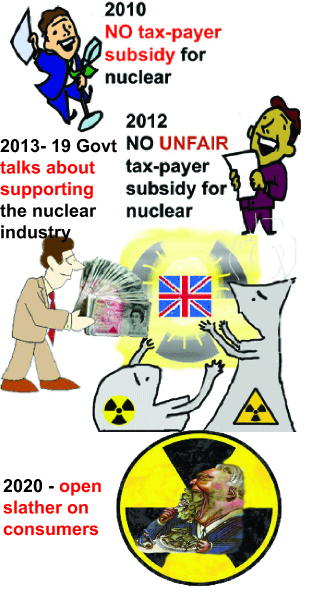
REUTERS EVENTS EDF calls for funding legislation for new UK nuclear power plant, Kate Holton LONDON, June 23 (Reuters) – France’s EDF (EDF.PA) called on the British government to deliver the legislation that would underpin the financing of a new nuclear plant, Sizewell C, saying it was now essential………
Asked if his company had a Plan B in the event the government did not advance with the legislation, Simone Rossi, the UK head of EDF, said: “We do not really. I have to say that would be for the UK government to consider.”………
China General Nuclear Power Corporation (CGN) which holds a 20% share in the pre-construction phase of the Sizewell C project, is on a U.S. government list of companies Washington deems are acting contrary to U.S. interests………….https://www.reuters.com/business/energy/reuters-events-edf-calls-uk-produce-sizewell-funding-legislation-2021-06-23/
Australia’s collective voice should silence the ‘drums of war’

Australia’s collective voice should silence the ‘drums of war’ Independent AustraliaBy Barbara Hartley | 24 June 2021, With Australia raising its hand to be part of joint naval exercises in the South China Sea, its departure from the G7 in Cornwall continues the “down-under” tradition of following U.S. foreign policy.
Although the beat of war drums is currently more muffled, anti-China rhetoric still echoes down the chilly halls of Federal Parliament as the winter sitting takes place.
In 2003, without parliamentary oversight, Australia followed the U.S. into Iraq. The given purpose was to initiate action against what then-U.S. President George W. Bush called the “axis of evil”: initially Iraq, Iran and North Korea, and later expanded to Cuba, Libya and Syria. This axis was in fact quite shaky.
One consequence of that unconscionable invasion was the toll on young Australian defence personnel, and others such as journalists, in terms of moral injury and stress. The compulsive loop of the Federal Government supporting U.S. wars with no direct relation to Australia – Korea, Vietnam, Iraq, Afghanistan – and those wars damaging Australian lives, has played non-stop since its entry into the ANZUS agreement.
Some, especially weapons trade profiteers and their political lackeys, want conflict with China to continue that unhappy pattern.
It is imperative that the now muted “drums of war” are silenced once and for all.
Readers are therefore urged to respond to the People’s Inquiry for a Peaceful and Independent Australia being conducted by the Independent Peaceful Australia Network (IPAN).
The inquiry’s purpose is to examine the impact of involvement in U.S.-led wars and the U.S.-Australia Alliance on everyday Australians. The current obsession with China and the inexplicable desire to face off with the world’s greatest military power is arguably a result of our alliance with the U.S.
The Inquiry Chairperson is Kelly Tranter, one of Australia’s leading authorities on the growing influence of weapons manufacturers on government policy in Australia.
There are also several panels addressing the various ways in which involvement in U.S.-led wars impacts our lives.
In addition, an IPAN website questionnaire can be completed in a very short time. Both submission and questionnaire suggestions will inform the Inquiry’s final report. Possible submission talking points are raised below………………………….. https://independentaustralia.net/politics/politics-display/australias-collective-voice-should-silence-the-drums-of-war,15219
China’s plans for a huge nuclear waste bunker

China builds bunker to test whether nuclear waste can be dumped underground, SCMP
Lab more than 500 metres underground in the Gobi Desert will be the world’s largest of its kind
If research there is successful, a long-term underground dump for high-level radioactive waste could be built, helping to address a global problem
China has started building a laboratory deep underground in the Gobi Desert to assess whether it would be a suitable location for a nuclear waste dump, amid moves to expand its nuclear power capacity.
The Beishan Underground Research Laboratory in the northwestern province of Gansu will be used to research long-term storage of high-level radioactive waste. With its deepest level to be built 560 metres (1,837 feet) below ground, it will be the world’s largest lab of its kind, according to the ChinaNuclear Energy Association, which promotes nuclear power.
- The world has about a quarter of a million tonnes of highly radioactive waste, all kept in “temporary” storage. No country has found a solution for permanent deep geological storage, with public opposition often a factor.
- China’s attempt to find an answer comes at a time when it plans to build a fleet of new reactors. Disposal of high-level radioactive waste is becoming more critical as it uses more nuclear power and tries to become carbon neutral
……. It is estimated that the lab will cost over 2.7 billion yuan (US$400 million), take seven years to build and operate for 50 years. If research proves the site to be suitable, a long-term underground repository for high-level radioactive waste will be built nearby by 2050, Wang Ju, chief designer of the lab, told state media in April………. https://www.scmp.com/news/china/science/article/3138484/china-builds-bunker-test-whether-nuclear-waste-can-be-dumped
-
Archives
- February 2026 (228)
- January 2026 (308)
- December 2025 (358)
- November 2025 (359)
- October 2025 (376)
- September 2025 (258)
- August 2025 (319)
- July 2025 (230)
- June 2025 (348)
- May 2025 (261)
- April 2025 (305)
- March 2025 (319)
-
Categories
- 1
- 1 NUCLEAR ISSUES
- business and costs
- climate change
- culture and arts
- ENERGY
- environment
- health
- history
- indigenous issues
- Legal
- marketing of nuclear
- media
- opposition to nuclear
- PERSONAL STORIES
- politics
- politics international
- Religion and ethics
- safety
- secrets,lies and civil liberties
- spinbuster
- technology
- Uranium
- wastes
- weapons and war
- Women
- 2 WORLD
- ACTION
- AFRICA
- Atrocities
- AUSTRALIA
- Christina's notes
- Christina's themes
- culture and arts
- Events
- Fuk 2022
- Fuk 2023
- Fukushima 2017
- Fukushima 2018
- fukushima 2019
- Fukushima 2020
- Fukushima 2021
- general
- global warming
- Humour (God we need it)
- Nuclear
- RARE EARTHS
- Reference
- resources – print
- Resources -audiovicual
- Weekly Newsletter
- World
- World Nuclear
- YouTube
-
RSS
Entries RSS
Comments RSS
 nuclear-news