USA’s unnecessary plutonium pits production to cost $10+ Billion
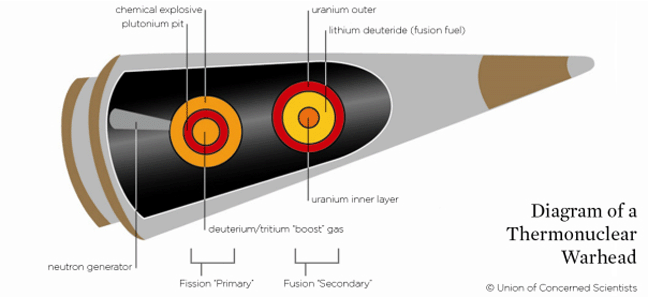
Cost Estimate for SRS Plutonium Bomb Plant to Soar to $10+ Billion? Causing Trouble for Contractors and Boosters Pushing New Pit Plant and “Money Pit” ICBM “Needing” New Plutonium Pits? https://www.rnanews.eu/cost-estimate-for-srs-plutonium-bomb-plant-to-soar-to-10-billion-causing-trouble-for-contractors-and-127657.html 11 May 21,
Stay tuned for the release by the US DOE’s National Nuclear Security Administration of a “Critical Decsion-1” determination on the proposed SRS Plutonium Bomb Plant. CD-1 would approve the basic project design and present an update cost range. The cost for the bomb plant could soar to $10 billion or more, more than double the earlier estimate of $4.6 billion to convert the partially finished plutonium fuel MOX plant at SRS to pit production.
The CD-1 document package was turned over to NNSA by contractor Savannah River Nuclear Solutions (SRNS) in January 2021. In March, the CEO of SRNS told the South Carolina Nuclear Advisory Council that a decision on CD-1 by NNSA could come in late May or June.
A huge jump in the cost of the SRS Plutonium Bomb Plant will ramp up the pressure on DOE/NNSA/Department of Defense to fund such an expensive facility and the new ICBM, Ground Based Strategic Deterrent (GBSD) – aka the Money Pit Missile – with a lifetime cost over $200 billion. The new ICBM and its W87-1 warhead would require new plutonium pits.
This missile and pits for it are not needed. As it’s part of planning for full-scale nuclear war, it would undermine national security and transfer a vast amount of money from patriotic taxpayers to contractors such as Northrop Grumman, Savannah River Nuclear Solutions and pit-production contractors at Los Alamos National Lab, the other site being considered for expanded pit production. In sum, the GBSD and plans for new pits must be canceled and the CD1 document will be a wake-up call for decision makers.
Meanwhile, Congress is still refusing to investigate possible waste, fraud, abuse and mismanagement of the failed MOX project by NNSA and contractors.
How the heck can they just sweep under the rug the waste of $8 billion on the failed project? Who is Congress protecting and why???
Nuclear fission reactions are happening at Chernobyl again

Nuclear Fission Reactions Are Happening at Chernobyl Again
Scientists are scrambling to neutralize the threat. Popular Mechanics, BY CAROLINE DELBERT, MAY 10, 2021
- A melted amalgam of nuclear fuel at Chernobyl is beginning to react.
- The issue is rainwater, which has activated materials buried deep within the closed plant.
- The reaction could burn out naturally, but it could also require human intervention.
On April 26, 1986, Reactor No. 4 exploded at the Chernobyl Nuclear Power Plant in Ukraine, causing the worst nuclear accident in history. Now, thirty-five years later, smoldering nuclear “embers” are still buried within Chernobyl site, raising questions about just what might happen there—and what’s at stake.
Ukrainian scientists recently realized that leftover nuclear fission fuel made of uranium has begun reacting again in an “inaccessible room” deep within a damaged area of the shuttered plant. The telltale sign is increased readings of neutron activity—a measurable byproduct of nuclear fission, according to the scientists from Institute for Safety Problems of Nuclear Power Plants (ISPNPP) in Kyiv, Ukraine, who held discussions about dismantling the reactor last month, according to Science magazine.
- Chernobyl Nuclear Power Plant is surrounded by a massive megastructure called Chernobyl New Safe Confinement (NSC). At NSC, there are hundreds of sensors working around the clock to monitor factors like air quality, and the sensors have detected increased neutron activity near the fallen reactor hall where the “embers” are.
- Some zones within the NSC are fully sealed off in their own sarcophagus-like structure called the Shelter—including the reactor hall where scientists have noticed the increasing neutrons. That means tough questions about what the best course of action is.Inside the reactor hall, everything is a dangerous mess.
- Science’s Richard Stone reports:
- “When [the] reactor’s core melted down, uranium fuel rods, their zirconium cladding, graphite control rods, and sand dumped on the core to try to extinguish the fire melted together into a lava. It flowed into the reactor hall’s basement rooms and hardened into formations called fuel-containing materials (FCMs), which are laden with about 170 tons of irradiated uranium—95 [percent] of the original fuel.”
It’s important to note that experts don’t fear a second Chernobyl disaster, as there isn’t enough viable material or surrounding collateral for that kind of threat or damage. But the right kind of small nuclear activity could bring down the Shelter itself, which is 34 years old and “rickety.”
Scientists believe rainwater leakage has caused similar higher neutron readings in the past, and they’ve since installed special chemical sprinklers that can stanch neutrons in most of the interior of the Shelter. But some basement rooms are just out of reach even for the sprinklers………. https://www.popularmechanics.com/science/energy/a36364988/chernobyl-nuclear-reactions/
India is operating the world’s most dangerous, fastest-growing, nuclear weapons and missile programs in the world
World’s most dangerous fastest-growing nuclear weapons programme
Nowadays, South Asia is categorized by international analysts as one of the unstable regions of the world, where the chances of nuclear brinkmanship are high because of the longstanding rivalry between Pakistan and India, The Nation, Syed Zain Jaffery, May 11, 2021
‘‘…………………India is operating the world’s most dangerous fastest-growing nuclear weapons and missile programs in the world, which are not only threatening for the region but world peace because of flawed nuclear safety and security standards. Increasing stocks of Indian fissile material and the development of nuclear triad capability – bombers, missiles and nuclear power/capable submarines – have increased the capability of New Delhi in the strategic realm. Contrary to International media claims, the Indian triad consists almost 500 nuclear weapons including thermonuclear weapons and has the capacity to produce over 2,600 nuclear weapons for tactical and strategic use.
Today, the undisclosed plutonium stocks have not been under IAEA’s inspection and left with Indian arms production facilities under the discriminatory nuclear cooperation deal between the United States and India. The civilian Plutonium reserves that are outside the safeguards of the IAEA and designated for strategic purposes are the main cause of concern. In a three-stage plan, India is continuing to expand its unsafeguarded nuclear power program. The installation of several nuclear reactors has also been announced by New Delhi. This capability will generate excessive fissile material, other than the fuel necessary for breeder and naval reactors. Over the next few years, India will be capable to replace China, France and the United Kingdom in terms of its abilities to produce nuclear weapons to become the third behind the US and Russia.
Under the influence of the rising economy of India, like-minded Western analysts are trying to divert the consideration of the international community from the fastest growing Indian nuclear weapons program and threats associated with it to the peaceful neighboring countries. Since 1974, the Indian intentions are clear that it will use any kind of advanced technology, which provided under the rubric of peaceful purposes, for military use and will violate any international law related to nuclear, space and missiles program to exercise hegemony in the region. The Indian policy aims, concerning nuclear weapons, are solely constructed to push its hegemony in the region. Now it is time for the international community to realize the Indian nuclear threat.
https://nation.com.pk/11-May-2021/world-s-most-dangerous-fastest-growing-nuclear-weapons-programme
Cyberattacks grind Hanford nuclear energy workers’ benefit program to a halt

Cyberattacks grind Hanford nuclear energy workers’ benefit program to a halt, Seattle Times May 10, 2021 By Patrick Malone
Cyber attacks on the U.S. government have abruptly paused processing of benefit applications for workers who were sickened while working on nuclear weapons programs at Hanford and other Department of Energy sites, delaying aid to some dying workers, according to advocates.
Without warning, advocates from the Alliance of Nuclear Workers Advocacy Group received notice late last Friday that effective Monday, a vital component of the Energy Employees Occupational Illness Compensation Program would be offline for two to four months.
The Radiation Dose Reconstruction Program databases’ sudden hiatus could delay approval of new benefits for groups of workers who believe they’ve been exposed to workplace hazards.
Among them are more than 550 workers from Hanford, a mothballed plutonium processing site in Richland, who were potentially exposed to radiation and toxins when they were provided leaky respirators, according to a Seattle Times investigation last year.
Those workers are seeking inclusion in the federal benefits program administered by the Department of Labor. The National Institute of Occupational Safety and Health plays an instrumental role in determining eligibility.
Hanford, born in secrecy during World War II in a rush to develop the first atomic bomb, processed the plutonium fuel for nuclear weapons for four decades, a process that fouled the 580-square-mile site with radioactive waste and toxic vapors that sickened and killed many workers.
Washington’s U.S. Sen. Patty Murray and Rep. Adam Smith, both Democrats, sponsored legislation in response to The Times investigation that would expand benefits to include the Hanford cleanup crew who were given faulty respirators and other nuclear workers across the country who aren’t yet eligible.
Others who could be affected are some 1,378 individual workers across the country currently applying for assistance, and those with recent terminal diagnoses, who normally would be eligible for benefits awarded as quickly as a day after application. Those benefits can be worth hundreds of thousands of dollars.
“Terminally ill workers often do not have 2 to 4 months to live,” Terrie Barrie, ANWAG founder, wrote in a Monday, May 3, letter to NIOSH director to Dr. John Howard. “Will they no longer have the option to have their claim expedited so that they can receive the medical and financial benefits before they die?”
The source and nature of the cyberattacks are unclear, but in a May 4 letter to ANWAG, Howard said that an ongoing review of the energy workers’ compensation databases “identified very significant concerns about the cybersecurity integrity of the Program’s claimant database,” forcing an immediate and secret shutdown of the claims process……………………. https://www.seattletimes.com/seattle-news/times-watchdog/cyberattacks-grind-hanford-nuclear-energy-workers-benefit-program-to-a-halt/
Tallying up Russia’s nuclear weapons
Nuclear Notebook: How many nuclear weapons does Russia have in 2021? Bulletin of the Atomic Scientists, By Hans M. Kristensen, Matt Korda, March 15, 2021 T his is a very long article. Some introductory bits:
Russia is in the middle of a decades-long modernization of its strategic and nonstrategic nuclear forces to replace Soviet-era weapons with newer systems………
Putin also noted his disappointment with the “deterioration” of the US-Russia arms control regime, and declared that the United States withdrew from the Anti-Ballistic Missile Treaty, the Intermediate-Range Nuclear Forces Treaty, and the Open Skies Treaty under “contrived pretexts.”……..
As of early 2021, we estimate that Russia has a stockpile of nearly 4,500 nuclear warheads assigned for use by long-range strategic launchers and shorter-range tactical nuclear forces……
Russia has significantly reduced the number of warheads deployed on its ballistic missiles to meet the New START limit of no more than 1,550 deployed strategic warheads. Russia achieved the required reduction by the February 5, 2018 deadline, when it declared 1,444 strategic warheads attributed to 527 launchers (Russian Federation Foreign Affairs Ministry 2018)………
Russia (like the United States) could potentially upload several hundreds of extra warheads onto their launchers, but is prevented from doing so by the New START treaty limit, which has been extended for an additional five years to 2026. The treaty provides for important transparency of Russian (and U.S.) strategic nuclear forces: As of December 2020, the United States and Russia have completed a combined 328 on-site inspections and exchanged 21,293 notifications (US State Department, Bureau of Arms Control, Verification and Compliance 2020b). Due to the ongoing Covid-19 pandemic, there have been no on-site Type One or Type Two inspections since April 1st, 2020……….
What is Russia’s nuclear strategy?……….
Russia’s publicly stated policy. In June 2020, President Putin approved an update to the “Basic Principles of State Policy of the Russian Federation on Nuclear Deterrence,” which notes that “The Russian Federation considers nuclear weapons exclusively as a means of deterrence.” The policy clearly lays out four conditions under which Russia could launch nuclear weapons:
“arrival of reliable data on a launch of ballistic missiles attacking the territory of the Russian Federation and/or its allies;
use of nuclear weapons or other types of weapons of mass destruction by an adversary against the Russian Federation and/or its allies;
attack by adversary against critical governmental or military sites of the Russian Federation, disruption of which would undermine nuclear forces response actions;
aggression against the Russian Federation with the use of conventional weapons when the very existence of the state is in jeopardy” (Russian Federation Foreign Affairs Ministry 2020).
Submarines and submarine-launched ballistic missiles
The Russian Navy operates 11 nuclear-powered nuclear-armed ballistic missile submarines (SSBNs) of three classes:……….https://thebulletin.org/premium/2021-03/nuclear-notebook-russian-nuclear-weapons-2021/?utm_source=Newsletter&utm_medium=Email&utm_campaign=Newsletter05102021&utm_content=NuclearRisk_RussiaNotebook_03152021
How to deal with a nuclear-armed Kim Jong Un

How to deal with a nuclear-armed Kim Jong Un, by David A. Andelman, May 10, 2021, CNN,The Biden administration has pledged to pursue “calibrated” diplomacy.
to persuade North Korean leader Kim Jong Un to halt his mad dash toward a deliverable nuclear weapon. But that is a vain hope. Instead, the world and especially the United States must find a way to live with a North Korea armed with The Bomb. And keep Kim from using — or selling — it.
Discussions with a number of individuals who have dealt with the North Korean government or monitored the actions of its ruling family have convinced me that no Kim — neither Kim Jong Un, nor his father nor his grandfather — ever has or will give up a quest for a deliverable nuclear weapon. Nor is Kim likely to relinquish such a device once it can be deployed. Indeed, North Korea clearly does have any number of such devices — some analysts say it could be more than 60 — though the delivery vehicles are still in development.
That brings us to the realm of what may be possible and achievable. For Kim, possession of a nuclear weapon is a question of existential survival. His ultimate fear is no doubt the fate of Libyan strongman Colonel Moammar Gadhafi — dragged from a drain pipe by rebels and executed, a direct consequence of the decision to relinquish his own nuclear program that allowed his enemies in the West to undermine his regime.
Still, it’s not clear that President Biden or his principal advisers are prepared to accept any nuclearized North Korea. President Joe Biden has said that any diplomacy “has to be conditioned upon the end result of denuclearization.” At the same time, he and his team are rightly rejecting former President Donald Trump’s “go big or go home” approach — agreeing to remove all sanctions in exchange for North Korea fully dismantling its weapons program — which Kim rejected out of hand at their last, abortive summit in Hanoi……….
The essence of any such [diplomacy] plan must lie in the United States finding a way to persuade the North to join the global nuclear non-proliferation club. Implicit would be the acceptance that it already has a weapon. In turn the North will need to make its weapons and their security clearly visible and open to inspection…………
The essence of any such plan must lie in the United States finding a way to persuade the North to join the global nuclear non-proliferation club. Implicit would be the acceptance that it already has a weapon. In turn the North will need to make its weapons and their security clearly visible and open to inspection. https://edition.cnn.com/2021/05/09/opinions/north-korea-nuclear-biden-andelman/index.html
To 10 May – the week in nuclear news

Growing number of Asian countries ravaged by fresh coronavirus waves. World Health Organisation updates its coronavirus advice, acknowledging aerosol transmission as the major source of infection. Covid-19: hopes for ‘Herd Immunity’ fade as virus hurtles toward becoming endemic. Biden’s proposal to waive patent rights for vaccine production has raised quite a storm.
Climate change: how bad could the future be, if we do nothing?
And now – to nuclear issues. There have been a number of important articles this week, on nuclear weapons in space – the militarisation of space. It’s ironic that a big news discussion has also gone on, about an ”out-of-control” Chinese rocket, that could have hit land and caused havoc. Ever ready to put a comforting Western spin on the news, this incident was used by the media to show how very safe U.S. rockets are, in comparison with those reckless Chinese efforts.
Many space rockets planned, thousands of satellites, thousands of space debris –what could possibly go wrong?
Nuclear weapons have triggered a new geological era. The Fateful Choice: Nuclear Arms Race or Nuclear Weapons-Free World . Amidst Pandemic and Economic Sufferings, 2020’S Global Military Spending Reached Highest Level in Decades. Amid Widespread Disease, Death, and Poverty, the Major Powers Increased Their Military Spending in 2020.
Faster glacier melting raises hunger threat.
Hypocrisy, climate bullshit, and the push for hydrogen+fossil fuels.
Bitcoin’s dirty little secret – its danger to the environment and the climate.
JAPAN. The toll on marine life of radioactive water poured into the Pacific Ocean. Radioactive water release – Fukushima nuclear disaster continues to haunt the world. Anti-Olympics campaign gains traction online in Japan. A number of cases of unauthorized access have occurred at the Kashiwazaki-Kariwa plant since January 2018.
FRANCE. France’s nuclear output slumped in April – they had to import power. France’s nuclear emergency plans are inadequate. France, the most nuclearised country in the world, is poorly prepared for nuclear emergencies.
CHINA. China sets out to control the world nuclear industry, – Pakistan, UK, and beyond. 20 tonne space rocket out of control, but luckily landed in the Indian Ocean, rather than on land. https://www.youtube.com/watch?v=w4hGxvcKPhY
TAIWAN. Nuclear plants a big security risk.
UK. Britain is now undermining the Nuclear Non Proliferation Treaty (NPT). UK energy policy is still weighed down by the nuclear dream. Serious concerns about China’s role in Hinkley Point nuclear power station. Millions of fish to be destroyed by UK’s new nuclear stations, but Centre for Environment, Fisheries and Aquaculture Science (Cefas) is in the pay of nuclear firm EDF.
CANADA. Small Modular Nuclear Reactors Are Mostly Bad Policy . Bribing a declining rural community – into taking in nuclear waste.
EUROPE. Nuclear anxiety in Luxembourg – expanding their emergency evacuation plan. How Chernobyl’s radioactive dust blanketed Europe in 1986.
ISRAEL. Israel’s ‘shadow war’ and plans to scupper Iran’s nuclear deal.
USA.
Standing up to the USA’s militarisation of space. The Squad and Their Allies Should Unite to Block Biden’s Massive Military Budget,. Now is the opportunity for progressives in US Congress to force Biden to defund new nuclear weapons. U.S. Nuclear Weapons Upgrade Sees Delay on Leaky Silos, Old Tech. Climatic and Humanitarian Impacts of Nuclear War. Alan Robock to talk for Friends of Oak Ridge National Laboratory.- The dramatic economic faillure of America’s nuclear industry. The Biden administration wants to go all-in on nuclear energy: Not all Democrats are on-board. Biden backs subsidies to keep nuclear plants alive, says Jennifer Granholm, energy chief. NRC extends lifespans of nuclear reactors (it’s cheaper than closing them down). Biden administration to subsidise nuclearv reactors on the pretext of stopping climate change?
- Small nuclear reactors- a very problematic ”solution” to climate change. Scientists refute Exelon’s claim about costs of replacing nuclear with renewable energy.
- Steady growth of USA’s nuclear radioactive trash ( they prefer to call it ”spent fuel inventory”) Hanford challenge demands action on leaking nuclear waste tank. Texas Bill prevented – one that would have ”opened the floodgates for uncontrolled amounts of radioactive waste”.
- The New Climate Denial Is Delay at the Breakthrough Institute, – Norhaus and Shellenger. The manipulative propaganda tactics of Michael Shellenger,Mark Lynas and Rachel Pritzker of the Breakthrough Institute. Breakthrough Institute comes apart – Michael Shellenger started new nuclear front propaganda group – Environmental Progress.
ISRAEL. Israel’s ‘shadow war’ and plans to scupper Iran’s nuclear deal.
RUSSIA. Investigative journalism – Anti-nuclear resistance in Russia: problems protests, reprisals. Russia’s Rosatom launches the nuclear lobby’s propaganda push for ”climate change credibility” – ”Atoms For Humanity’. Russia to test powerful new nuclear weapon.
UKRAINE. Restless radioactive remains are still stirring in Chernobyl’s nuclear tomb.
IRAN. Iran nuclear talks in Vienna make headway, as USA shows plans for removing sanctions. Talks ‘intensify’ on bringing US back to Iran nuclear deal. Fire breaks out in port city near Iranian nuclear plant.
SWEDEN. Sweden’s nuclear waste problem may mean closure of 5 reactors by 2028.
FINLAND. Further delay, more costs, for Finland’s nuclear power station, Fennovoima.
INDIA. France desperate to sell its flawed nuclear technology to India, Time for India to cancel Jaitapur nuclear power project. Pakistan expresses deep concern over the seizure of nuclear explosive material in India.
AUSTRALIA.
Australia risks bringing on a nuclear war with China : Urgent need to change foreign policy.
Many space rockets planned, thousands of satellites, thousands of space debris -what could possibly go wrong?

To read the news, you’d think that only China was the naughty nation that had accidents in space. Indeed, it’s all written up to convey the message that USA space stuff is utterly safe.
Reminds me of when the nuclear lobby tried to put across the idea that the Fukushima disaster was proof of the safety of U.S. nuclear technology.
Wikileaks lists spaceflight accidents and incidents.
Thousands of satellites in orbit (not all functioning) There are at least 6,900 satellites now in orbit around Earth, with 4000 still functioning.
Space debris
Number of debris objects regularly tracked by Space Surveillance Networks and maintained in their catalogue – About 28160 .
Estimated number of break-ups, explosions, collisions, or anomalous events resulting in fragmentation -More than 560
Total mass of all space objects in Earth orbitMore than 9300 tonnes.
NASA slams rocket risk, The Age, print version 10 May 2021, Remnants of China’s biggest rocket have landed in the Indian Ocean,with the bulk of its components destroyed on re-entry into the atmosphere according to Chinese state media., fencing days of speculation over where the debris would hit….
The coordinates given by the media yesterday, citing the China Manned Space Engineering Office, put the point of impact west of the Maldives archipelago.The Long March launched last week was the second deployment of the 5B variant since its maiden flight in May 2020 last year pieces from the first Long March 5B fell on Ivory Coast, damaging several buildings. No injuries were reported.
During the rocket’s flight, Harvard based astrophysicist Jonathon McDowellsaid the debris zone could have been as far north as New York, Madrid or Beijing, and as far south as southern Chile and New Zealand.
*************************************
large chunks of the NASA space station Skylab fell from orbit in July 1979 and landed in Australia
Standing up to the USA’s militarisation of space

U.S. push for space weaponisation must be challenged, Independent Australia While most of the world supports outlawing space weaponry, the U.S. Government is still pushing to militarise space, writes Karl Grossman.
RETIRED U.S. Army Colonel John Fairlamb stated in a piece in The Hill, the Washington, DC news website:
Fairlamb knows the issue with the weaponisation of space. His background includes being an International Affairs Specialist for the Army Space and Missile Defense Command and Military Assistant to the U.S. Secretary of State for Political-Military Affairs. He is familiar with war first-hand: he was a company commander in Vietnam and holds a doctorate in Comparative Defense Policy Analysis.
In his opinion column headed ‘The U.S. should negotiate a ban on basing weapons in space’, Fairlamb wrote:
Given the implications for strategic stability, and the likelihood that such a decision [to deploy weapons in space] by any nation would set off an expensive space arms race in which any advantage gained would likely be temporary, engaging now to prevent such a debacle seems warranted.
It’s time for arms control planning to address the issues raised by this drift toward militarisation of space. Space is a place where billions of defence dollars can evaporate quickly and result in more threats about which to be concerned. Russia and China have been proposing mechanisms for space arms control at the United Nations for years; it’s time for the U.S. to cooperate in this effort.
Indeed, if weapons are deployed in space – and for decades, including during the Reagan Administration’s “Star Wars” (officially named the Strategic Defense Initiative) push, now likely again with the Trump Administration’s creation of a U.S. Space Force and its mission to “dominate” space – there will be no return.
Space weaponisation ‘cannot be walked back’. And the world is at a crossroads.
Russian Foreign Minister Serge Lavrov two weeks ago called tor talks to create an ‘international legally binding instrument’ to ban the deployment of “any types of weapons” in space.
Lavrov declared:
We consistently believe that only a guaranteed prevention of an arms race in space will make it possible to use it for creative purposes, for the benefit of the entire mankind. We call for negotiations on the development of an international legally binding instrument that would prohibit the deployment of any types of weapons there, as well as the use of force or the threat of force.”
He made the statement on 12 April, the International Day of Human Space Flight, marked this year by the 60th anniversary of Russian Yuri Gagarin’s space flight, the first by a person in space.
The U.S., the United Kingdom and the then Soviet Union joined decades ago in drafting the Outer Space Treaty of 1967 that designated space as a “global commons” for peaceful purposes. The treaty bans the deployment of weapons of mass destruction in space. It’s been signed by most nations on Earth.
Russia and China – along with U.S. neighbour Canada – have led in a move to expand the Outer Space Treaty by outlawing the deployment of any weapons in space.
During the period of Reagan’s “Star Wars” and in years since, the U.S. has been working on developing space weaponry that has included hypervelocity guns and particle beam and laser weapons.
The Prevention of an Arms Race in Outer Space (PAROS) treaty has been pushed by Canada, Russia and China to broaden the Outer Space Treaty.
PAROS has worldwide support. But through a succession of U.S. administrations – Republican and Democrat – the U.S. Government has voted against the PAROS treaty at the Conference on Disarmament of the United Nations. Because conference decisions must be supported by consensus, the U.S. has effectively vetoed the enactment of the PAROS treaty.
The day after Lavrov’s statement, the Chinese Foreign Ministry joined Russia in its plea.
Deputy director of the Chinese Ministry of Foreign Affairs Information Department Zhao Lijian said on 13 April:
“We are calling on the international community to start negotiations and reach agreement on arms control in order to ensure space safety as soon as possible. China has always been in favour of preventing an arms race in space; it has been actively promoting negotiations on a legally binding agreement on space arms control jointly with Russia.”
As for the Biden Administration and space militarisation, spokesperson Jen Psaki tweeted: ‘We look forward to the continuing work of Space Force…’…..
The comments from retired Army Colonel John Fairlamb are quite excellent as he calls for the U.S. to seriously enter into negotiations with Russia and China on PAROS. Both those nations for years have been offering to enter into negotiations at the U.N. to close the door to the barn before the horse gets out. In other words, develop a new treaty that prevents a space arms race before it happens. Sadly, the U.S. due to aerospace industry greed and dreams of space domination has been blocking this much need treaty development process.
Some might see Mr Fairlamb’s comments as representing the U.S. military – as if a sea change was happening inside the Pentagon – on this very important issue.
The comments from retired Army Colonel John Fairlamb are quite excellent as he calls for the U.S. to seriously enter into negotiations with Russia and China on PAROS. Both those nations for years have been offering to enter into negotiations at the U.N. to close the door to the barn before the horse gets out. In other words, develop a new treaty that prevents a space arms race before it happens. Sadly, the U.S. due to aerospace industry greed and dreams of space domination has been blocking this much need treaty development process.
Some might see Mr Fairlamb’s comments as representing the U.S. military – as if a sea change was happening inside the Pentagon – on this very important issue.
Alice Slater, a member of the boards of both the Global Network and the organisation World BEYOND War, said
The U.S. mission to dominate and control the military use of space has been, historically and at present, a major obstacle to achieving nuclear disarmament and a peaceful path to preserve all life on Earth. Reagan rejected Gorbachev’s offer to give up “Star Wars” as a condition for both countries to eliminate all their nuclear weapons. Bush and Obama blocked any discussion in 2008 and 2014 on Russian and Chinese proposals for a space weapons ban in the consensus-bound Committee for Disarmament in Geneva.
At this unique time in history, when it is imperative that nations of the world join in cooperation to share resources to end the global plague assaulting its inhabitants and to avoid catastrophic climate destruction or Earth-shattering nuclear devastation, we are instead squandering our treasure and intellectual capacity on weapons and space warfare. https://independentaustralia.net/politics/politics-display/us-push-for-space-weaponisation-must-be-challenged,15066#.YJcE8NQEv74.twitter
20 tonne space rocket out of control, but luckily landed in the Indian Ocean, rather than on land.
Out-of-control Chinese rocket finally lands in Indian Ocean near the Maldives, https://www.9news.com.au/world/chinese-rocket-expected-to-crash-into-earth-this-weekend/4b39859c-cfc4-4f3c-b9e2-f294e1bb65f4 By CNNJoe Attanasio May 9, 2021 A large Chinese rocket that was orbiting earth out of control has finally made impact, landing in the Indian Ocean close to the Maldives and drawing sharp criticism from NASA.
According to China Manned Space Engineering Office, the rocket made impact about 12.24pm AEST, roughly two hours earlier than predicted.Most of the remnants of the vessel burned up during re-entry to earth’s atmosphere, officials said, putting to bed week-long fears over the potential damage the rocket could have caused if it struck land.What was left of the spacecraft landed at open sea, at 72.47 degrees east longitude and 2.65 degrees north latitude.The Long March 5B rocket, which was around 30 metres tall and weighed 20 tonnes, entered earth’s low orbit earlier this morning.
It travelled at more than 30,000 kilometres an hour, was more than 10 stories tall, and weighed roughly the same as a full garbage truck, causing many to raise concerns about the impact its landing could have hadThe rocket launched a piece of the new Chinese space station into orbit on April 29 but then was left to hurtle through space uncontrolled until Earth’s gravity began pulling it back to the ground.
That approach is a break with what officials call “best practice” compared with what other space agencies do.
NASA Administrator Bill Nelson criticised China over the re-entry, saying spacefaring nations needed to minimise risk and maximise transparency in such situations.”It is clear that China is failing to meet responsible standards regarding their space debris,” he said, in a statement.”It is critical that China and all spacefaring nations and commercial entities act responsibly and transparently in space to ensure the safety, stability, security, and long-term sustainability of outer space activities.”Despite recent efforts to better regulate and mitigate space debris, Earth’s orbit is littered with hundreds of thousands of pieces of uncontrolled junk, most of which are smaller than 10 centimetres.Objects are constantly falling out of orbit, though most of them burn up in the Earth’s atmosphere before they have a chance to make an impact on the surface.
Hanford challenge demands action on leaking nuclear waste tank

Ongoing threat.’ Groups demand action on leaking Hanford nuclear waste tank, Tri City Herald,
BY ANNETTE CARY, MAY 01, 2021 RICHLAND, WA
The newly discovered leak in another of Hanford’s aging tanks storing radioactive waste does not appear to threaten the health of Washington people in the near term, said Gov. Jay Inslee.
The Washington state Department of Ecology has the legal authority under the Tri-Party Agreement to take immediate action in response to the leaking tank only if it is “necessary to abate an imminent and substantial endangerment” to people or the environment.
Instead, the agency is starting talks with federal energy officials on what to do next.
If the two agencies can’t agree, then the state could take action, such as fines, and require specific steps to deal with the underground leak.
But groups from Seattle to the Tri-Cities that follow Hanford closely spoke out after the public was told Thursday about the leak.
Demands ranged from immediately emptying the tank to building better storage tanks for waste to a pilot project that could get more waste treated soon.
DOE notified the state Thursday that the tank was leaking, after investigating that possibility since March 2019.
Estimates of the amount of waste that have leaked vary, but the Department of Ecology puts it at a rate of nearly 1,300 gallons per year with an estimated 1,700 gallons leaked into the soil since March 2019…………..
The governor believes Congress should find opportunities to pay for construction needed to prepare waste now held in underground tanks for treatment and to glassify the tank for permanent disposal, his staff said.
Transferring waste from leak-prone single shell tanks to hold them in newer double-shell tanks is only a stop-gap measure and permanent solutions are needed, he said.
Tank B-109 is the second of Hanford’s 149 single-shell tanks identified as having active leaks in recent years. In 2013 Tank T-111 was discovered to be leaking about a half gallon to a gallon a day of waste.
Hanford is left with 56 million gallons of mixed radioactive and other hazardous chemical waste from the past production of two-thirds of the nation’s plutonium for its nuclear weapons program during World War II and the Cold War.
Work is underway to empty waste from leak-prone single-shell tanks into 27 newer double-shell tanks until it can be treated for permanent disposal.
As DOE works to start turning some of the tank waste into a stable glass form for disposal at the Hanford site’s $17 billion vitrification plant by the end of 2023, space is running short in the double-shell tanks.
NEW TANKS VS CLEANUP
Hanford Challenge, based in Seattle, said Tank B-109 needs to be emptied into another tank, putting pressure on DOE to build more tanks.
It quoted a Government Accountability Office report saying that DOE said that insufficient space in double-shell tanks was the top risk to its work to empty and close its aging tanks.
Work is underway to empty waste from leak-prone single-shell tanks into 27 newer double-shell tanks until it can be treated for permanent disposal.
As DOE works to start turning some of the tank waste into a stable glass form for disposal at the Hanford site’s $17 billion vitrification plant by the end of 2023, space is running short in the double-shell tanks.
Tank B-109 has been in use since World War II and currently holds about 123,000 gallons of waste, including about 15,000 gallons of liquid waste………………. https://www.tri-cityherald.com/news/local/hanford/article251052504.html
The Biden administration wants to go all-in on nuclear energy. Not all Democrats are on-board.
Energy Secretary Jennifer Granholm floats federal subsidies for nuclear power plants
The Biden administration wants to go all-in on nuclear energy. Not all Democrats are on-board.
By Rich Edson |Fox News, 9 May 21, “The DOE has not historically subsidized plants but I think this is a moment to consider and perhaps in the American Jobs Plan or somewhere to make sure that we keep the current fleet active,” said Energy Secretary Jennifer Granholm, in a hearing Thursday before a House Appropriations subcommittee………..
“The DOE has not historically subsidized plants but I think this is a moment to consider and perhaps in the American Jobs Plan or somewhere to make sure that we keep the current fleet active,” said Energy Secretary Jennifer Granholm, in a hearing Thursday before a House Appropriations subcommittee.
Sen. Elizabeth Warren (D-MA) has said the US should phase out nuclear power by 2035. In Sen. Bernie Sanders’ (I-VT) Green New Deal pledge, he calls nuclear power a “false solution” and argues that “toxic waste byproducts of nuclear plants are not worth the risks of the technology’s benefit, especially in light of lessons learned from the Fukushima meltdown and the Chernobyl disaster.”
“Paying to keep aging reactors online is courting disaster and guaranteed to slow the deployment of truly clean renewables,” said Lukas Ross, the program manager of Friends of the Earth. “Congress and President Biden should not throw good money after bad.”
Opponents point to the massive expense and cost overruns related to building new reactors. Once they’re operational, they face significant security costs and completion from falling prices of other renewable energy sources like wind and solar.
There’s also nuclear waste. The U.S. has over 80,000 metric tons of spent nuclear fuel from commercial nuclear power plants, according to the Government Accountability Office. Most spent nuclear fuel is stored at reactor sites around the country.
The administration’s decision to support nuclear could also affect other sources as the US tries to meet its aggressive emissions pledge………. https://www.foxnews.com/politics/jennifer-granholm-floats-federal-subsidies-for-nuclear-power-plants
Nuclear plants a big security risk
Nuclear plants a big security risk, https://www.taipeitimes.com/News/editorials/archives/2021/05/10/2003757127 By Henry Sokolski
As Taiwan’s August referendum on completing its Fourth Nuclear Power Plant approaches, one question that has not yet been fully considered is to what extent this and Taiwan’s other three plants are military liabilities — radioactive targets that China aims to attack. At best, a threatened strike or an intentional near-miss against one plant would likely force the government to shut the other nuclear plants down as a precaution. At worst, a strike could produce Chernobyl-like contamination, forcing the evacuation of millions.
Some partial, temporary defenses are possible and should be pursued, but ultimately, the smart money is on substituting non-nuclear alternatives for these reactors as soon as possible.
As Ian Easton noted last month in these pages, Beijing released a 2013 internal course book on Taiwan’s military geography that spotlighted a potential amphibious landing area at Fulong Beach where Taiwan’s fourth incomplete nuclear plant sits (“Ian Easton On Taiwan: Are Taiwan’s nuclear plants safe from Beijing?” April 12, page 6).The military handbook also highlighted Xialiao Beach, which hosts Taiwan’s Guosheng Nuclear Power Plant in Wanli District (萬里).
In a separate 2014 People’s Liberation Army (PLA) field manual, Easton noted, Taiwan’s reactors were described as high-value targets that should be temporarily knocked out (for subsequent reopening) with precision weapons fired from helicopters. That is the optimistic plan. However, the PLA appeared uncertain about how surgical its attacks might be
Yet another 2015 PLA guidebook, Easton notes, warned PLA troops that they must be prepared to fight through nuclear “contamination,” and they may need to “wash” themselves off as they complete their invasion.Since these military guidebooks were written, the PLA has acquired thousands of additional highly accurate ballistic and cruise missiles and drones, which make highly precise attacks against Taiwan’s reactors much easier.
What might the consequences of such precision attacks be? Bad to catastrophic. The Nonproliferation Policy Education Center, which I run, recently commissioned a radiological analysis of several Chinese strikes against Taiwan’s nuclear plants. In the least destructive case, the Chinese target one of their missiles just near the reactor — perhaps the plant employees’ parking lot. While the Chinese missile might not kill anyone, Taiwan’s government would likely pull all of their reactors off the grid as a precautionary measure.
That is roughly 10 percent of Taiwan’s electrical production. In addition, residents near the reactors would likely hit the road in massive numbers to evade possible follow-on attacks. These attacks might target the reactors’ grid connection or its emergency diesel generators. This, again, would not necessarily lead to a core meltdown (unless both were hit simultaneously), but would definitely put the population on edge.
That is the best case. Much worse would be a missile or drone strike against the reactor’s control room or reactor core. In these cases, a loss of necessary coolant and radiological release are likely. What the consequences might be depends on the prevailing winds. Here are maps of an attack on the Maanshan plant at Kenting in June and in December. The orange and red areas describe irradiated regions the U.S. Environmental Protection Agency would recommend populations be evacuated from.
In either case, the evacuation of many thousands to several million is likely.
Of course, if China hit Taiwan’s spent reactor fuel ponds, the contaminating radiation released would be far greater.
None of this is welcome news. All of it recommends shutting down Taiwan’s nuclear plants as soon as is practical and replacing them with non-nuclear alternatives. At a minimum, completing Taiwan’s fourth reactor should be a nonstarter.
In the interim, Taiwan should remove as much radioactive waste from its spent reactor fuel ponds as possible and place it in hardened, concrete dry storage casks. The US, Euratom nations, and Japan are already doing this; so should Taiwan.
Taiwan should also build emergency spent fuel pond sprinkler and cooling water monitoring systems to reduce the likelihood of spent fuel fires if these pools are hit and water levels become dangerously low. Taiwan also should consider building remote control rooms for its three operating plants, as Japan has done in at least one case.
Finally, it should consider hardening certain structures and actively defending at least against local drone attacks.
As urgent as these steps are, none, however, should be taken with an eye to extending these reactors’ operations. Just the opposite. If Taiwan is serious about its national security, it will replace all of these potential radiological targets with non-nuclear generators as soon as possible.
Henry Sokolski is the executive director of the Nonproliferation Policy Education Center in Arlington, Virginia, and author of Underestimated: Our Not So Peaceful Nuclear Future. He served as deputy for nonproliferation policy in the office of the US secretary of defense during former US president George H.W. Bush’s administration.
Fire breaks out in port city near Iranian nuclear plant
A fire at the same port in 2020 damaged seven ships, . https://www.theweek.in/news/world/2021/05/08/fire-breaks-out-in-port-city-near-iranian-nuclear-plant.htmlBy PTI May 08, 2021 Just four weeks after a blackout hit Iran’s Natanz nuclear facility, which the country attributed to Israel as an act of “nuclear terrorism”, a fire has broken out near the Bushehr Port, just 12km south of the country’s sole functioning nuclear plant.
Visuals of the blaze were shared on social media. According to local reports, it was located on a local naval base.
The fire raged overnight, following which another fire made headlines on the other side of the country, at a chemical plant in Qasvin.
World powers held the fourth round of high-level talks on Friday in Austria aimed at bringing the United States back into the nuclear deal with Iran, with both sides signalling a willingness to work out the major stumbling blocks.
Pakistan expresses deep concern over the seizure of nuclear explosive material in India
Pakistan Expresses Deep Concern Over The Seizure Of Nuclear Explosive Material In India, https://eurasiantimes.com/pakistan-expresses-deep-concern-over-the-seizure-of-nuclear-explosive-material-in-india/ ByEurAsian Times DeskMay 8, 2021
Pakistan has expressed deep concern over the seizure of natural uranium in the Indian state of Maharashtra. Uranium is used in several areas, including nuclear explosives.
A tweet by Pakistan’s Foreign Office read – We have noted with serious concern reports about the seizure of more than 7 Kg natural uranium from unauthorized persons in India. Security of nuclear materials should be the top priority for all countries, and there is a need for a thorough investigation of the matter.
Earlier, Indian authorities seized around seven kilograms of natural uranium and arrested two people in Maharashtra (the capital of India’s financial hub – Mumbai) for “illegally possessing” the highly radioactive substance.
“We had received information that one person identified as Jigar Pandya was going to illegally sell pieces of Uranium substance, a trap was laid and he was arrested,” the Maharashtra police said. “Investigation into the case revealed that another person identified as Abu Tahir gave him these pieces of Uranium.”
The police said a huge quantity of substance was recovered when Tahir was apprehended.
The case was registered after a report from the Bhabha Atomic Research Centre in Mumbai authenticated the seized material is highly radioactive. “A report was received that the substance is natural uranium. It’s highly radioactive and dangerous to human life,” the police said.
It is the second time in India that such a highly radioactive material has been seized by police in recent years. In 2016, police seized around nine kg of depleted uranium in the Thane area of Maharashtra.
1 This Month





PLEASE OPPOSE HR 8255 AND S.3639 – bills would accelerate satellite deployment, with no environmental review or safeguards – https://ncstd5li.quorum.us/campaign/169331/
To see nuclear-related stories in greater depth and intensity – go to https://nuclearinformation.wordpress.com
-
Archives
- October 2026 (74)
- September 2026 (339)
- August 2026 (330)
- July 2026 (355)
- June 2026 (287)
- May 2026 (306)
- April 2026 (356)
- March 2026 (251)
- February 2026 (267)
- January 2026 (308)
- December 2025 (358)
- November 2025 (359)
-
Categories
- 1
- 1 NUCLEAR ISSUES
- business and costs
- climate change
- culture and arts
- ENERGY
- environment
- health
- history
- indigenous issues
- Legal
- marketing of nuclear
- media
- opposition to nuclear
- PERSONAL STORIES
- politics
- politics international
- Religion and ethics
- safety
- secrets,lies and civil liberties
- spinbuster
- technology
- Uranium
- wastes
- weapons and war
- Women
- 2 WORLD
- ACTION
- AFRICA
- Atrocities
- AUSTRALIA
- Christina's notes
- Christina's themes
- culture and arts
- Events
- Fuk 2022
- Fuk 2023
- Fukushima 2017
- Fukushima 2018
- fukushima 2019
- Fukushima 2020
- Fukushima 2021
- general
- global warming
- Humour (God we need it)
- Nuclear
- RARE EARTHS
- Reference
- resources – print
- Resources -audiovicual
- Weekly Newsletter
- World
- World Nuclear
- YouTube
-
RSS
Entries RSS
Comments RSS

