GOVERNOR CUOMO ANNOUNCES PROTECTIONS FOR SAFE CLOSURE OF INDIAN POINT NUCLEAR POWER FACILITY
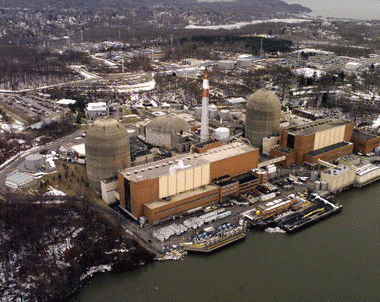
Holtec Agrees to Extensive Monetary Assurances and Administrative Safeguards to Ensure Safe, Rapid, Complete Dismantling & Cleanup of Nuclear Power Facility
Governor Andrew M. Cuomo today announced a joint proposal with Holtec International and its subsidiaries to safely close the Indian Point nuclear power facility in the lower Hudson Valley. The agreement, negotiated by the State of New York, County of Westchester, local governments, Public Utility Law Project, Riverkeeper, Entergy — the owner of Indian Point and Holtec, provides for a transfer of the nuclear power facility to Holtec for a swift, complete and safe decommissioning and site remediation.
The joint proposal, which is now available for public comment, is slated to be reviewed and considered by the State Public Service Commission during a future session. “Since my time as Attorney General I have been deeply concerned with the safety of the Indian Point nuclear power facility given its proximity to the most densely populated area in the country,” Governor Cuomo said. “Shuttering Indian Point was, at one time, one of the main progressive causes in New York, and after years of relentless work, we’ve finally reached an agreement to close it safely and responsibly. This is a victory for the health and safety of New Yorkers, and moves us a big step closer to reaching our aggressive clean energy goals.”
In 2017, Entergy — the owner of Indian Point — agreed with Governor Cuomo to close the two remaining operating units at the site. Unit 2 powered down in April 2020, and Unit 3 is scheduled to cease operations this month. In November 2019, Entergy and Holtec filed an application for license transfer with the federal Nuclear Regulatory Commission and separately filed a petition asking the PSC not to exercise any jurisdiction over the sale of the Indian Point facilities and site. Instead, the State Department of Public Service staff, Department of Environmental Conservation, Office of Attorney General, local governments and others worked to ensure that the public’s interests were protected, and those agencies secured the financial and administrative provisions contained in the Joint Proposal that will now be presented to the Public Service Commission for its review and consideration. The NRC approved the license transfer without the provisions contained in the joint proposal, and the State of New York filed a lawsuit challenging NRC’s decision. This joint proposal to the Public Service Commission will also resolve the federal litigation.
Decommissioning, the radiological clean-up and dismantling of a nuclear facility, is extremely demanding, both technically and financially. Accordingly, the NRC requires that nuclear facilities establish and maintain funding to pay for facility decommissioning following closure. In the case of Indian Point, portions of its three decommissioning trusts were capitalized by New York ratepayers through electricity bills. Holtec obtained the NRC’s approval to use the trust money, not only to conduct the required radiological decommissioning, but also to fund spent fuel management and site restoration. Of the approximately $2.4 billion of aggregated decommissioning trust funds, Holtec estimated that it will spend more than $630 million for spent fuel management alone, which raised concerns whether the remaining funds were adequate to conduct safe and comprehensive decommissioning at a site known to harbor substantial contamination. The Joint Proposal to resolve the ongoing PSC proceeding and address the State’s concerns is intended to ensure that adequate funds are available to complete the project subject to State oversight. Under the agreement, Holtec is required to adhere to financial and administrative provisions, including:
- Maintaining a minimum balance of no less than $400 million in the Decommissioning Trust Fund for 10 years following the Transaction Closing Date;
- Maintaining a minimum balance of no less than $360 million in the Decommissioning Trust Fund at partial site release from the NRC for costs related to waste management and radiological cleanup of the site;
• Requiring Holtec to return 50 percent of the money it recovers from the Department of Energy for spent fuel management costs to the Decommissioning Trust Fund; - Conduct site restoration and remediation under an order on consent with the New York State Department of Environmental Conservation, which will oversee the hazardous materials cleanup at Indian Point, including through the use of an on-site monitor;
- Providing funding towards state and local emergency management and response; and
- Providing financial and project reporting to the State and the public through a website and other channels to ensure transparency regarding project status and costs.
Per additional agreement terms, the State of New York, Riverkeeper, the Town of Cortlandt and the Hendrick Hudson School District will withdraw their lawsuits against the NRC that are currently pending in the U.S. Court of Appeals for the District of Columbia Circuit.
New York State Department of Environmental Conservation Commissioner Basil Seggos said, “Today marks a milestone in the State’s sustained efforts to shut down Indian Point. It’s a victory for public safety and the millions of New Yorkers living in the shadow of this aging facility. As New York State continues its transition to a safer, renewable green energy future, it’s imperative that we work together to ensure the swift and safe dismantling and decommissioning of this facility. I commend everyone who worked to secure this agreement today to advance a comprehensive cleanup of this site.”
Doreen M. Harris, President and CEO, NYSERDA said, “As the State’s nuclear coordinator, NYSERDA has been pleased with the robust stakeholder engagement leading to this joint proposal and that the agreement appropriately addresses both the financial and environmental interests of New Yorkers.”
Nuclear power will be a big issue in France’s 2022 presidential election
Le Monde 15th April 2021, Why nuclear will be featured in the 2022 presidential campaign. The left
and the Macronist majority seem divided on the rapid construction of new
EPRs, while the right and the far right are stepping up their support for
the sector.
They don’t hide it anymore. Space travel is all about nuclear power and nuclear weapons in space.
Jeff Bezos’ Blue Origin lands a Pentagon contract to design nuclear-powered spacecraft, Business Insider,
KATE DUFFYAPR 13, 2021,
- The Pentagon has awarded Blue Origin, Jeff Bezos’ aerospace company, a $2.5 million contract.
- Blue Origin will design concepts for a nuclear-powered spacecraft.
- It won a contract for the craft alongside Lockheed Martin and General Atomics.
The Pentagon on Monday awarded Blue Origin, the aerospace company founded by Jeff Bezos, a $2.5 million contract to design a nuclear-powered spacecraft.
The Pentagon’s Defense Advanced Research Projects Agency (DARPA) agency also chose Lockheed Martin and General Atomics for the first phase of a program to design and build the spacecraft, it said in a statement.
Lockheed Martin got a $2.9 million contract to design a craft for the Demonstration Rocket for Agile Cislunar Operations (DRACO) program, and General Atomics a $22.2 million one to design a small nuclear reactor to power a rocket, CNBC reported.
DARPA wants to test nuclear thermal propulsion technology, which uses a nuclear reactor in a rocket to heat up the fuel and propel the craft beyond low Earth orbit….
The agency said in the statement it wanted to try a nuclear-powered spacecraft in orbit in 2025…….. https://www.businessinsider.com.au/jeff-bezos-blue-origin-award-pentagon-nuclear-space-contract-darpa-2021-4?r=US&IR=T
An insight into Japan’s contentious plans to release contaminated water
NS Energy 15th April 2021, An insight into Japan’s contentious plans to release contaminated water
from Fukushima. Japan has announced it will release more than one million
tonnes of contaminated water into the Pacific Ocean from the Fukushima
nuclear plant – a decision that hasn’t gone down well across large quarters
of the world
https://www.nsenergybusiness.com/features/fukushima-contaminated-water-plans/
UK and Ireland Nuclear Free Local Authorities (NFLA) endorse Jonathon Porritt’s report on Net Zero Without Nuclear
The UK & Ireland Nuclear Free Local Authorities (NFLA) warmly welcomes and
endorses a detailed report by leading environmentalist Jonathon Porritt
which outlines why, in seeking to get to ‘net zero’ carbon emissions
and tackling the climate emergency, there is no need for new nuclear power
stations. Jonathon Porritt is a former Chief Executive of Friends of the
Earth and of the Sustainable Development Commission. His detailed report
published today seeks to look at an issue NFLA has been heavily involved in
for some time – can new nuclear provide any positive assistance in the
critical endeavour to mitigate and adapt to the challenge of climate
change? His ringing answer is a clear and concise ‘no’.
NFLA 15th April 2021
The Nuclear Question: Violence Begats Violence, by Alicia Sanders-Zakre and Dorothy VanSoest talks about Nuclear Action — Rise Up Times
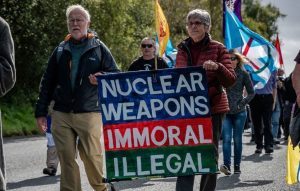
“The cost of building and maintaining the Ground-Based Strategic Deterrent, or GBSD, as it’s known, could swell to $264 billion over the coming decades, with much of the money going to military contractors, including Northrop Grumman, Lockheed Martin and General Dynamics.”
The Nuclear Question: Violence Begats Violence, by Alicia Sanders-Zakre and Dorothy VanSoest talks about Nuclear Action — Rise Up Times
Iran to enrich uranium to 60% after ‘wicked’ nuclear site attack,
Iran to enrich uranium to 60% after ‘wicked’ nuclear site attack, https://www.bbc.com/news/world-middle-east-56743560 14 Apr 21, Iran will produce 60%-enriched uranium in retaliation for a suspected Israeli attack on a nuclear site, President Hassan Rouhani says, bringing it closer to the purity required for a weapon.
A blast knocked out the power system at Natanz on Sunday, causing damage to thousands of uranium centrifuges.
Mr Rouhani warned the perpetrators that enrichment would now be ramped up as a response to “your wickedness”.
But he reiterated that Iran’s nuclear activities were “exclusively peaceful”.
France, Germany and the UK expressed “grave concern” at the move, saying Iran had “no credible civilian need for enrichment at this level”.
The three countries are parties to a 2015 nuclear deal with Iran, under which it is permitted to enrich uranium up to 3.67% purity to make reactor fuel. Weapons-grade uranium is 90%-enriched or more.
Iran began producing 20%-enriched uranium – a level that takes most of the overall effort required to get to weapons-grade – in January as part of its response to the US sanctions reinstated by former President Donald Trump when he abandoned the accord three years ago.
Israel, which sees Iran’s nuclear programme as a potential threat to its existence and is critical of Joe Biden’s efforts to revive the deal, has neither confirmed nor denied involvement in the Natanz incident. But public radio cited intelligence sources as saying it was a cyber operation by Mossad, Israel’s overseas intelligence agency.
US intelligence officials told the New York Times that a large explosion completely destroyed the power system that supplied an underground hall at Natanz where uranium hexafluoride gas was fed into centrifuges to separate out the most suitable isotope for nuclear fission, called U-235.
The head of the Iranian parliament’s research centre, Alireza Zakani, said on Tuesday that several thousand centrifuges were “damaged or destroyed in one instant” and that “the main part of our enrichment capacities” were eliminated.
On Tuesday night, Iran’s ambassador to the International Atomic Energy Agency (IAEA) announced it had just started enriching uranium up to 60% purity for the first time in response to the attack.
“We expect to accumulate the product next week,” Kazem Gharibabadi tweeted. “This will improve significantly both the quality and quantity of radiopharmaceutical products.”
Iran will also install 1,000 additional centrifuges at Natanz and replace damaged IR-1 centrifuges – the oldest and least efficient – with more advanced IR-6 models, significantly increasing its enrichment capacity.
President Rouhani told a cabinet meeting on Wednesday that, while Iranian security agencies had yet to provide their final reports on the attack, “apparently it is the crime of the Zionists”. Iran does not recognise Israel’s right to exist and often refers to it as the “Zionist state”.
“You cannot conspire against the Iranian nation and commit a crime in Natanz; we will cut off your arms when you commit a crime,” he said.
“What you did was nuclear terrorism; what we’ve done is legal,” he added.
Mr Rouhani said those responsible wanted to derail the indirect talks between US and Iranian officials in Vienna which are aimed at reviving the nuclear deal, formally known as the Joint Comprehensive Plan of Action (JCPOA).
“We know what you are trying to do; you want us to be empty-handed at the talks but we’re attending the negotiations with an even fuller hand.”
ran’s Supreme Leader, Ayatollah Ali Khamenei, later warned that US officials did not want to “accept the truth” and often made suggestions that were “not even worth looking at”.
“Sanctions must be removed first. Once we are certain that has been done, we will carry out our commitments,” he said.
The governments of France, Germany and the UK said enriching uranium up to 60% was “a serious development” since it constituted “an important step in the production of a nuclear weapon”.
“Iran’s announcements are particularly regrettable given they come at a time when all JCPOA participants and the United States have started substantive discussions, with the objective of finding a rapid diplomatic solution to revitalise and restore the JCPOA. Iran’s dangerous recent communication is contrary to the constructive spirit and good faith of these discussions.”
White House spokeswoman Jen Psaki said Iran’s decision was “provocative”.
In their annual threat assessment released on Tuesday, US intelligence agencies said they continued to “assess that Iran is not currently undertaking the key nuclear weapons-development activities that we judge would be necessary to produce a nuclear device”.
The nuclear industry – a vortex of corruption

Part two | Nuclear energy in Africa, The second in this three-part series looks at how power purchase agreements raise the cost of electricity for consumers and act as major sources of inflationary pressure in economies. New Frame, By: Neil Overy, 1 Dec 2020
”……………..A vortex of corruption
Another issue that needs to be seriously considered when evaluating the cost of nuclear power is corruption. A 2013 survey of corruption in the nuclear industry by Richard Tanter from the University of Melbourne found “widespread and often deep corruption” in the nuclear industry, saying that national and international nuclear regulatory regimes were “virtually completely ineffective”.
In recent years, the industry has been rocked by several corruption scandals.
In 2014, a massive corruption scandal involving South Korean nuclear vendor Korea Hydro & Nuclear Power, a subsidiary of Korea Electric Power Company, resulted in dozens of employees receiving a cumulative total of 258 years in prison for fraud and corruption. Many of these charges related to the supply of counterfeit equipment, some of it safety-related, to nuclear power stations in South Korea and the United Arab Emirates.
In July, five people were arrested in Ohio in the United States, including the Ohio house speaker, for receiving $60 million from an embattled nuclear energy operator in exchange for securing the passage of a $1.5 billion bailout for the operator.
A month later, Brazilian federal prosecutors charged a subsidiary of EDF and Brazilian nuclear company Eletronuclear with corruption.
The construction and ongoing maintenance of nuclear power stations are areas particularly susceptible to corruption for two specific reasons. First, because they are megaprojects they are massively complicated enterprises that involve potentially hundreds of contractors and subcontractors, which creates fertile conditions for corruption. Second, these fertile conditions are exacerbated by the secrecy that surrounds nuclear power. While this secrecy is supposedly designed to stop the spread of nuclear technology or the capture of nuclear materials, it fosters an environment that is shielded from scrutiny and public oversight.
While Africa has no recent experience of nuclear power plant construction, other recent megaprojects on the continent – the Lesotho Highlands Water Project, the Lauca Dam in Angola, the Mambilla Hydropower Project in Nigeria, and the construction of the Medupi and Kusile power stations in South Africa – show how corruption can become entrenched in megaprojects on the continent.
In this regard, it is worth remembering that Transparency International’s Corruption Perception Index for 2019 found that sub-Saharan Africa was the worst performing region in the world, followed closely by North Africa. There is clearly good reason to be concerned about possible corruption in any nuclear deals concluded on the continent. South Africa’s recent unlawful deal between former president Jacob Zuma’s government and Rosatom shows just how real this danger is.
Part three looks at the costs associated with nuclear waste disposal, decommissioning nuclear power stations and major nuclear accidents. https://www.newframe.com/part-two-nuclear-energy-in-africa/
Electricity customers pay excessive costs for nuclear power – Egypt, Turkey, UK, France, Russia

Part two | Nuclear energy in Africa, The second in this three-part series looks at how power purchase agreements raise the cost of electricity for consumers and act as major sources of inflationary pressure in economies. New Frame, By: Neil Overy, 1 Dec 2020 Recent deals brokered between host nations and nuclear power companies show how consumers ultimately bear the cost of building nuclear power plants because of power purchase agreements, which favour the vendor and lower their financial risk but often lead to hugely inflated electricity costs for consumers.
No official details have yet been given to indicate what the price will be for electricity generated by the El Dabaa plant that Russia’s state-owned Rosatom is building in Egypt. But in 2016, one Egyptian energy expert predicted that prices per megawatt hour – how much it costs to produce one megawatt of energy for one hour – from El Dabaa would be at least four times more than from renewable power sources. Renewable energy prices have fallen significantly since 2016, while nuclear power has become more expensive.
British consumers will pay excessive amounts for electricity from the Hinkley Point C nuclear power station that EDF is building for decades after the plant is completed. While construction does not follow the Build-Own-Operate model, EDF negotiated a 35-year power purchase price linked to inflation with the British government in 2016 to extract as much profit as possible. The British government’s Public Accounts Committee conservatively estimated that this deal will cost consumers an additional $40 billion (about R615 billion) over the 35 years of the contract compared with alternative energy sources such as solar and wind.
A similar story is playing out in Turkey. Critics have pointed out that the price the government has agreed to pay Rosatom for electricity generated by the Akkuyu plant the Russian vendor is building will cost the country an additional $27 billion over the 15-year period of the power purchase agreement. This is because the price that has been agreed between Rosatom and the Turkish government is significantly above current electricity costs. A 2019 report by the Union of Chambers of Turkish Engineers and Architects notes that electricity purchased from the plant will be at least 275% more expensive than alternatives.
Financial trouble
Despite such deals being signed, the long-term financial viability of state-owned nuclear vendors is questionable. EDF received significant cash injections from the French government and secured favourable loans backed by the British Treasury for Hinkley Point C, but was still forced to sell a third of its stake in the project to the China General Nuclear Power Group in 2016 because it was running out of money.
And EDF remains in serious financial trouble. It is about $52 billion in debt and two major agencies have given it a negative credit rating. The French energy company’s problems stem from delays in the construction of Hinkley Point C, which is said to have cost it at least another $4 billion so far, and at other nuclear power stations it is building. The Flamanville 3 project in France is now four times over budget and 10 years late. In Finland, the Olkiluoto 3 project is also four times over budget and is now only expected to be running in 2022, 13 years after its original start-up date. Further delays at Hinkley Point C and Flamanville 3 are strongly anticipated, which will plunge EDF further into the mire, meaning that more bailouts from the French government are likely.
Rosatom has experienced serious problems financing the Akkuyu nuclear power station. In 2016, it tried to sell a 49% share in the project because it could not raise the necessary capital to complete the plant. After failing to find any buyers, Rosatom was saved, at least in the short term, late last year by a $400 million loan from another Russian state-owned enterprise, Sberbank. Unsurprisingly, the completion of this plant is also delayed. Originally scheduled to be operational by 2019, its completion has already been pushed back twice and it is now predicted to be partially operational by 2023.
That companies like EDF and Rosatom are reliant on the willingness of their respective governments to fund their survival is troubling. The economic consequences of the Covid-19 pandemic perfectly illustrate how susceptible both the global economy and individual economies are to unexpected shocks. Falling electricity sales in France owing to Covid-19 are resulting in intense speculation that EDF will need a significant emergency bailout from the French government sometime in early 2021 or face financial ruin. It is not clear what would happen to the plants it is currently building if EDF were to collapse. They could be abandoned, or taxpayers in host countries could be forced to pay even more for their completion.
These financial difficulties are often the result of problems that emerge during the construction phase of nuclear power stations, which lead to delays. A study completed in 2014 revealed the extent of this problem, saying only 3% of nuclear power stations have been built on schedule. In 2018, researchers from the Centre for Environmental Policy at Imperial College London found that between 1955 and 2016, construction delays increased the cost of nuclear power plants by 18% on average over their original budgets.
Consumers as cash cows
In effect, the public pays twice for these delays. In vendor countries such as France and Russia, taxpayers contribute to the bailouts of state-owned companies like EDF and Rosatom. In recipient countries, such as the United Kingdom, Egypt and Turkey, the public pays through artificially inflated electricity bills.
Rather than reflecting on this double burden, vendors and compliant governments are inventing new ways to squeeze yet more money out of the public. To fund additional nuclear power plants in Britain, the government is now considering a new funding model called Regulatory Asset Base (RAB).
The RAB model basically gives a blank cheque to vendors, allowing them to start charging customers for electricity during the construction phase of a power plant, before the station even produces electricity. In addition, it covers vendors for construction cost overruns of up to 30%, all of which would be paid for by consumers. It is proposed that the British government would cover any construction cost overruns of more than 30%. In effect, this funding model transfers almost all financial risk from investors to consumers, through hugely inflated electricity bills or tax transfers to vendors, or both.
In September, EDF appeared to indicate that it would only bid for the contract to build the proposed $25 billion Sizewell C nuclear plant in Britain if the British government adopted the RAB funding model…………………https://www.newframe.com/part-two-nuclear-energy-in-africa/
Iran and Israel – the situation shows the strong connection between nuclear power and nuclear weapons- small nuclear reactors with enriched uranium fuel.
Nuclear Alert: Iran & Israel Playing High-Stakes Poker with Nuclear Power & Nuclear Weapons Fairewinds, Maggie Gunderson, 14 Apr 21, Fairewindsy now, Fairewinds is sure you know that an explosion at an Iranian nuclear enrichment plant has slowed Iran’s progress to enrich uranium. The crisis shows a very blurry line between Civilian Atomic Power and Military Atomic Bombs!………..
For decades, we are informed there is no correlation between weapons and civilian power. This standoff between Iran and Israel highlights the strong connection between nuclear weapons and nuclear power, like hand-in-glove.
The borderline between bomb-grade uranium and civilian power-grade uranium is determined by how much the isotope Uranium-235 (U-235) is enriched. Traditionally, if uranium enrichment is above 20%, that is considered the low-end of weapons-grade enrichment, which falls between 20% and 100% enrichment for bombs. Therefore, the higher the percent of enrichment of U-235, the easier it is to manufacture a nuclear bomb.
To be cost-effective, the nuke industry claims its U-235 must be more enriched to prevent atomic power reactors from refueling as often. Currently, uranium fuel used worldwide in operating nuclear power plants is enriched to about 6%. But the nuclear industry’s new designs for proposed Small Modular Reactors (SMRs) will use fuel enriched to about 20%.
Yes, as Fairewinds quoted above, SMRs will use nuclear fuel that is “one step away from weapons-grade uranium” used to make bombs!
At Fairewinds, we have two questions today:
- First, what are Iran’s plans for gaining that much enrichment? Iran claims that this centrifuge produced fuel is for peaceful purposes only, then why does the uranium have to be enriched to almost bomb-grade? Is Iran building SMRs?
- Where does that place the United States in world politics with its creation of SMRs? The U.S. plans to build tens of thousands of these allegedly new Small Modular Reactors. Moreover, SMRs use HALEU fuel (High-Assay Low-Enriched Uranium) enriched to almost 20% Uranium-235.
- How does this action make the U.S. any different from what Iran is doing when the U.S. SMRs will contain high-test Uranium identical to what is being enriched in Iran?
- Is this federal push for this new SMR design some type of ploy to spread atomic bomb-grade fuel all over the world?
- The U.S. nuclear power industry is looking at SMRs as its latest cash cow, expecting to sell and build SMRs all over the world! What kind of international threat is this if thousands of proposed SMRs are located all over the U.S. and worldwide?

As a result of the attack on its enrichment facility, Iran has further changed its mind and said it would enrich uranium to 60%. According to the BBC:
Iran will produce 60%-enriched uranium in retaliation for a suspected Israeli attack on a nuclear site, President Hassan Rouhani says, bringing it closer to the purity required for a weapon. … But he reiterated that Iran’s nuclear activities were “exclusively peaceful”.
France, Germany and the U.K. expressed “grave concern” at the move, saying Iran had “no credible civilian need for enrichment at this level”.
Fairewinds is clear that the 20% enriched fuel planned to be used in SMRs is only one easy step away from creating bomb-grade atomic fuel! Now that Iran has informed the world that it intends to enrich its uranium to 60%, scientists worldwide know that there is no peaceful civilian atomic reactor of any kind using U-235 enriched to 60%!
Fairewinds hopes that diplomats will resolve this enrichment conundrum before the military situation escalates further. https://www.fairewinds.org/demystify/nuclear-alert-iran-israel-playing-high-stakes-poker-with-nuclear-power-nuclear-weapons
A shadow war between Israel and Iran hangs ominously over nuclear talks in Vienna
A shadow war between Israel and Iran hangs ominously over the resumption of
critical talks in Vienna on Wednesday, aimed at returning Iran and the US
to the 2015 nuclear agreement. The talks come just three days after a
sabotage attack at a key Iranian nuclear plant near Natanz, where an
explosion cut off electricity to the whole site. The attacked damaged an
unknown number of centrifuges – sophisticated machines that make uranium
usable for nuclear purposes – and has stopped work at the facility for now.
BBC 14th April 2021
https://www.bbc.co.uk/news/world-middle-east-56716472
thousands of machines used to refine nuclear material were destroyed or
damaged in an attack at a key site on Sunday, an Iranian official has said.
Alireza Zakani, head of the Iranian parliament’s Research Centre, said the
incident had “eliminated” Iran’s ability to carry out the process. The
attack took place in a facility up to 50m (165ft) underground, another
official said. Iran has blamed Israel for what it called an act of “nuclear
terrorism”.
BBC 13th April 2021
https://www.bbc.co.uk/news/world-middle-east-56734657
Iran gave notice yesterday that it will begin enriching uranium closer to
weapons-grade purity, two days after an explosion at its most important
nuclear facility for which it blamed Israel.
TTimes 14th April 2021
https://www.thetimes.co.uk/article/iran-takes-its-biggest-step-to-building-atomic-bomb-rtt587wxf
The fiasco of nuclear preprocessing: UK, Japan, USA.

Part one | The slow violence of SA’s nuclear waste,
Part one of this four-part story considers the imminent danger involved in storing used radioactive materials, a dilemma growing at a rate of more than 32 tonnes a year. New Frame , By: Neil Overy, 8 Mar 21
”……………..This is a process by which fission products are chemically separated out of used fuel rods to extract any unused uranium. This alleged solution to the problem of high-level waste has been one of the illusionary solutions Eskom has regularly mooted and just as regularly abandoned because of the colossal costs and serious dangers involved in reprocessing.
In the United Kingdom, the Thermal Oxide Reprocessing Plant, opened at huge cost in 1994, closed in 2018 having reached none of its intended reprocessing targets. Its decommissioning is now set to cost taxpayers at least $5.5 billion and take up to 100 years to complete. In Japan, construction of the Rokkasho Reprocessing Plant began in 1993 and was supposed to be completed by 1997. Incredibly, the plant is still not complete – its completion date has been postponed 25 times – and it is now expected to be operational in 2023, 26 years late and tens of billions of dollars over budget.
Even when operational, large quantities of dangerously radioactive waste, which needs to be stored for thousands of years, remains. Some of this waste is separated plutonium, a fissile material used in nuclear bombs, which presents a very serious security risk. This is precisely why reprocessing has never been authorised in the United States. As the Union of Concerned Scientists conclude, reprocessing is “dangerous, dirty and expensive”. Quite clearly, reprocessing is not an option South Africa should consider. …… , https://www.newframe.com/part-1-the-slow-violence-of-sas-nuclear-waste/?fbclid=IwAR0TEdv3xITKJISxqQs_UwdO9JB4m5LkPABzUl9b6R_nYVZKdL2S2ikp-MA
South Korea aims to fight, at International Tribunal, Japan’s plan to empty Fukushima water into Paific Ocean
S Korea aims to fight Japan’s Fukushima decision at tribunal, https://www.aljazeera.com/news/2021/4/14/s-korea-aims-to-fight-japans-fukushima-decision-at-tribunal, 15 Apr S Korea
Moon Jae-in asks officials to look at ways to refer Japan’s Fukushima decision to the International Tribunal for the Law of the Sea.
South Korean President Moon Jae-in has ordered officials to explore petitioning an international court over Japan’s decision to release water from its Fukushima nuclear plant, his spokesman said, amid protests by fisheries and environmental groups.
Moon said officials should look into ways to refer Japan’s move to the International Tribunal for the Law of the Sea, including filing for an injunction, spokesman Kang Min-seok told a briefing.
Japan unveiled plans on Tuesday to release more than 1 million tonnes of contaminated water into the sea from the plant, which was crippled by a 2011 earthquake and tsunami, starting in about two years after filtering it to remove harmful isotopes.South Korea protested strongly against the decision, summoning Koichi Aiboshi, Tokyo’s ambassador in Seoul, and convening an intra-agency emergency meeting to craft its response.
Moon also expressed concerns about the decision as Aiboshi presented his credentials, having arrived in South Korea in February for the ambassador’s post.“I cannot but say that there are many concerns here about the decision as a country that is geologically closest and shares the sea with Japan,” Moon said, asking Aiboshi to convey such worries to Tokyo, according to Kang.An aerial view shows the storage tanks for treated water at the tsunami-crippled Fukushima Daiichi nuclear power plant in Okuma town, Fukushima prefecture, Japan February 13, 2021 [Kyodo via Reuters]South Korea’s foreign ministry issued a statement saying it had raised similar concerns with the United States after the Department of State said Japan’s decision was “transparent” and in line with global safety standards.
The ministry also said it shared “strong regret and serious concerns” about the water’s planned release at a video conference on Wednesday with Chinese officials on maritime issues.
A series of protests against the move by politicians, local officials, fishermen and environmental activists took place in South Korea on Wednesday, including in front of the Japanese embassy in Seoul and consulates in the port city of Busan and on Jeju island.
A coalition of 25 fisheries organisations staged a rally and delivered a written protest to the embassy, urging Tokyo to revoke the decision and Seoul to ban imports from Japanese fisheries.
“Our industry is on course to suffer annihilating damage, just with people’s concerns about a possible radioactive contamination of marine products,” it said in a statement.
The progressive minor opposition Justice Party and some 30 anti-nuclear and environmental groups called Japan’s move “nuclear terrorism,” and said they sent the Japanese embassy a list of signatures of more than 64,000 people opposed to the move collected from 86 countries since February.
Regulator’s stop to restarting Kashiwazaki-Kariwa plant a blow to nuclear company Tepco.
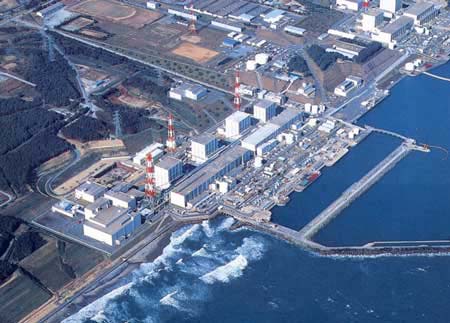
Japan Times 14th April 2021, Japan’s nuclear regulator decided Wednesday to effectively ban Tokyo Electric Power Company Holdings Inc. from restarting its largest nuclear plant due to serious safety flaws, dealing a blow to the utility’s efforts to turn its business around following the 2011 Fukushima nuclear disaster.
The Nuclear Regulation Authority formally decided to bar Tepco from transporting nuclear fuel stored at the Kashiwazaki-Kariwa plant in Niigata Prefecture or loading it into reactors. The company has seen restarting the seven-reactor Kashiwazaki-Kariwa complex, once one of the world’s largest nuclear plants by output, as a main pillar of its
business restructuring plan.
The plant was found to have been vulnerable to unauthorized entry at 15 locations since March last year because of
defective intruder detection systems and backups, according to the NRA. It is the first time the regulator has issued a corrective order for a commercial nuclear reactor.
https://www.japantimes.co.jp/news/2021/04/14/national/tepco-nuclear-plant-restart-ban/
Fukushima: How the ocean became a dumping ground for radioactive waste

Fukushima: How the ocean became a dumping ground for radioactive waste, https://www.dw.com/en/fukushima-how-the-ocean-became-a-dumping-ground-for-radioactive-waste/a-52710277
The nuclear disaster at Fukushima sent an unprecedented amount of radiation into the Pacific. But, before then, atomic bomb tests and radioactive waste were contaminating the sea — the effects are still being felt today.
Almost 1.2 million liters (320,000 gallons) of radioactive water from the Fukushima nuclear power plant is to be released into the ocean. That’s on the recommendation of the government’s advisory panel some nine years after the nuclear disaster on Japan’s east coast. The contaminated water has since been used to cool the destroyed reactor blocks to prevent further nuclear meltdowns. It is currently being stored in large tanks, but those are expected to be full by 2022.
Exactly how the water should be dealt with has become highly controversial in Japan, not least because the nuclear disaster caused extreme contamination off the coast of Fukushima. At the time, radioactive water flowed “directly into the sea, in quantities we have never seen before in the marine world,” Sabine Charmasson from the French Institute for Radiological Protection and Nuclear Safety (IRSN) tells DW.
Radiation levels in the sea off Fukushima were millions of times higher than the government’s limit of 100 becquerels. And still today, radioactive substances can be detected off the coast of Japan and in other parts of the Pacific. They’ve even been measured in very small quantities off the US west coast in concentrations “well below the harmful levels set by the World Health Organization,” according to Vincent Rossi, an oceanographer at France’s Mediterranean Institute of Oceanography (MIO).
But that doesn’t mean there’s no risk, says Horst Hamm of the Nuclear Free Future Foundation. “A single becquerel that gets into our body is enough to damage a cell that will eventually become a cancer cell,” he says.
A study from the European Parliament reached a similar conclusion. The research found that “even the smallest possible dose, a photon passing through a cell nucleus, carries a cancer risk. Although this risk is extremely small, it is still a risk.”
And that risk is growing. Radioactive pollution in the ocean has been increasing globally — and not just since the disaster at Fukushima.
Atomic bomb tests
In 1946, the US became the first country to test an atomic bomb in a marine area, in the Pacific Bikini Atoll. Over the next few decades, more than 250 further nuclear weapons tests were carried out on the high seas. Most of them (193) were conducted by France in French Polynesia, and by the US (42), primarily in the Marshall Islands and the Central Pacific.
But the ocean wasn’t just being used as a training ground for nuclear war. Until the early 1990s, it was also a gigantic dump for radioactive waste from nuclear power plants.
From 1946 to 1993, more than 200,000 tons of waste, some of it highly radioactive, was dumped in the world’s oceans, mainly in metal drums, according to the International Atomic Energy Agency (IAEA). Several nuclear submarines, including nuclear ammunition, were also sunk during this time.
Is the ocean a perfect storage site?
The lion’s share of dumped nuclear waste came from Britain and the Soviet Union, figures from the IAEA show. By 1991, the US had dropped more than 90,000 barrels and at least 190,000 cubic meters of radioactive waste in the North Atlantic and Pacific. Other countries including Belgium, France, Switzerland and the Netherlands also disposed of tons of radioactive waste in the North Atlantic in the 1960s, 70s and 80s.
“Under the motto, ‘out of sight, out of mind,’ the dumping of nuclear waste was the easiest way to get rid of it,” says Horst Hamm.
To this day, around 90% of the radiation from discarded barrels comes from those in the North Atlantic, most of which lie north of Russia or off the coast of Western Europe.
“The barrels are everywhere,” says ecologist Yannick Rousselet of Greenpeace France. He was present in 2000 when the environmental organization used submarines to dive for dumped drums a few hundred meters off the coast of northern France, at a depth of 60 meters (196 feet).
“We were surprised how close they were to the coast,” Rousselet says. “They are rusty and leaking, with the radiation clearly elevated.”
Nuclear waste barrels dumped in the sea decades ago, a common practice in the Channel between France and England in the 1960s, are now rusty and are leaking radioactive substances
Germany also implicated
In 1967, Germany also dumped 480 barrels off the coast of Portugal, according to the IAEA. Responding to a 2012 request for information from the Greens about the condition of those barrels, the German government wrote: “The barrels were not designed to ensure the permanent containment of radionuclides on the sea floor. Therefore, it must be assumed that they are at least partially no longer intact.”
Germany and France don’t want to salvage the barrels. And even Greenpeace activist Yannick Rousselet says he sees “no safe way to lift the rusted barrels” to the surface. That means nuclear waste will likely continue to contaminate the ocean floor for decades to come.
For Horst Hamm, the long-term consequences are clear. The radiation will be “absorbed by the marine animals surrounding it. They will eventually end up caught in fishing nets, and come back to our plates,” he says.
In its 2012 response to the Greens, however, the German government described the risk to humans from contaminated fish as “negligible.”
Rousselet sees things differently: “The entire area along the coast is contaminated by radiation — not just in the sea, in the grass, in the sand, you can measure it everywhere.”
Radioactive dumping ground
The main reason behind the radiation along the northern French coastline isn’t the underwater barrels, but rather the nuclear fuel reprocessing plant at La Hague. It is located directly on the coast and “legally discharges 33 million liters of radioactive liquid into the sea each year,” says Rousselet. He thinks it’s scandalous.
In recent years, La Hague has also been the scene of several incidents involving increased radioactivity levels.
The dumping of nuclear waste in drums was banned in 1993 by the London Convention on the Prevention of Marine Pollution. But discharging liquid contaminated with radiation into the ocean is still permitted internationally.
Spike in cancer rates
According to a study by the European Parliament, statistics show cancer rates are significantly higher in the region surrounding La Hague. Cancer rates are also high near the nuclear processing plant in Sellafield in northern England. A study from 2014 concluded that the total amount of radioactivity discharged into the sea from the Sellafield plant over the years is equivalent to the amount released by the nuclear meltdown at Fukushima.
The report say a link to health effects “cannot be ruled out” even if there is no clear evidence to date of a link between illness and radioactive discharges from nuclear facilities.
“The exact effects of radioactive radiation are extremely difficult to measure and prove. We only know that it has an impact,” says Rousselet, adding that it’s crucial to walk away from everything that causes radioactive waste.
Dumping more waste at Fukushima
In Fukushima, the operating company of the Tokyo Electric Power Company nuclear plant claims that before the cooling water is discharged into the sea as planned, all 62 radioactive elements will be filtered down to safe levels — except for the isotope tritium. The advisory panel in Tokyo considers discharging the cooling water into the sea to be “safer” than other alternatives, such as evaporating the water.
Just how harmful tritium is to humans is a source of controversy. According to the plant operator, the concentration of tritium in the collection tanks is sometimes much higher than that of conventional cooling water from nuclear power stations.
“The local fishermen and residents cannot accept the discharge of water,” Takami Morita of the National Research Institute of Fisheries Science said in a press release. While fish pollution levels are below the harmful limit, demand for fish from the region has dropped to one-fifth of what it was before the disaster.
Releasing the cooling water into the sea “is a good method because of the diluting properties of the water,” Sabine Charmasson of the IRSN says. “There aren’t any real problems on the security side, but it’s difficult, because there are also social implications. It might be an appropriate method, but it’s never easy to release radioactive substances into the environment.”
In a press release, Greenpeace said: “There is no justification for additional, deliberate radioactive pollution of the marine environment or atmosphere.”
-
Archives
- February 2026 (228)
- January 2026 (308)
- December 2025 (358)
- November 2025 (359)
- October 2025 (376)
- September 2025 (258)
- August 2025 (319)
- July 2025 (230)
- June 2025 (348)
- May 2025 (261)
- April 2025 (305)
- March 2025 (319)
-
Categories
- 1
- 1 NUCLEAR ISSUES
- business and costs
- climate change
- culture and arts
- ENERGY
- environment
- health
- history
- indigenous issues
- Legal
- marketing of nuclear
- media
- opposition to nuclear
- PERSONAL STORIES
- politics
- politics international
- Religion and ethics
- safety
- secrets,lies and civil liberties
- spinbuster
- technology
- Uranium
- wastes
- weapons and war
- Women
- 2 WORLD
- ACTION
- AFRICA
- Atrocities
- AUSTRALIA
- Christina's notes
- Christina's themes
- culture and arts
- Events
- Fuk 2022
- Fuk 2023
- Fukushima 2017
- Fukushima 2018
- fukushima 2019
- Fukushima 2020
- Fukushima 2021
- general
- global warming
- Humour (God we need it)
- Nuclear
- RARE EARTHS
- Reference
- resources – print
- Resources -audiovicual
- Weekly Newsletter
- World
- World Nuclear
- YouTube
-
RSS
Entries RSS
Comments RSS
 nuclear-news