Brookfield interested in selling its stake in nuclear company Westinghouse
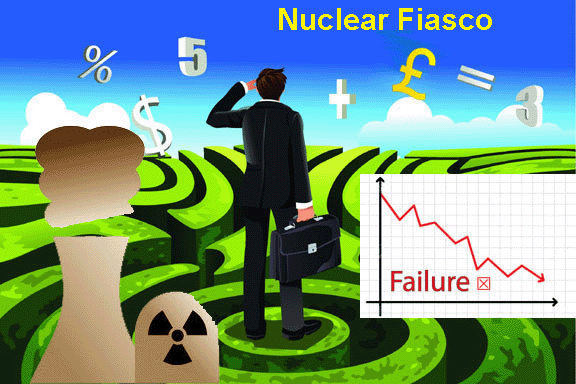
Brookfield explores sale of stake in nuclear firm Westinghouse -sources, Reuters, 24 Apr 21, Joshua FranklinDavid French, Brookfield Business Partners (BBU_u.TO) is exploring options including the sale of a minority stake in Westinghouse Electric Co that could value the U.S. nuclear power developer and servicer at as much as $10 billion including debt, people familiar with the matter said on Friday.
The sale plans come as the nuclear power sector may benefit from President Joe Biden’s push to tackle climate change. Biden unveiled a target to slash America’s carbon emissions by the end of the decade to 50% of what they were in 2005, and included nuclear power in the potential energy mix to achieve this goal. read more
While critics argue it is more expensive than renewable power sources and poses heightened safety risks, Westinghouse is among the companies seeking to develop smaller nuclear reactors, which are billed as cheaper and easier to deploy.
Brookfield Business Partners has hired investment banks to engage with potential buyers for a minority stake in Westinghouse, the sources said, requesting anonymity as the discussions are private.
The sources cautioned that there is no certainty Brookfield will find a buyer and that an outright sale of the company is also an option. Brookfield Business Partners and Westinghouse declined to comment.
Brookfield Business Partners Chief Executive Cyrus Madon said on a Feb. 5 earnings call that it could “test the market” in relation to Westinghouse.
“We could hang onto it and continue milking these incredible cash flows, but it will all come down to what’s the value we can get versus what we can create by keeping it,” Madon said.
One of the most storied names in the American power industry, Westinghouse was acquired by Brookfield Business Partners, an affiliate of Canadian asset manager Brookfield (BAMa.TO), in 2018 for $4.6 billion, including debt, from Toshiba Corp (6502.T)…… Brookfield Business Partners Chief Executive Cyrus Madon said on a Feb. 5 earnings call that it could “test the market” in relation to Westinghouse.
“We could hang onto it and continue milking these incredible cash flows, but it will all come down to what’s the value we can get versus what we can create by keeping it,” Madon said.
One of the most storied names in the American power industry, Westinghouse was acquired by Brookfield Business Partners, an affiliate of Canadian asset manager Brookfield (BAMa.TO), in 2018 for $4.6 billion, including debt, from Toshiba Corp (6502.T)…….. Brookfield Business Partners Chief Executive Cyrus Madon said on a Feb. 5 earnings call that it could “test the market” in relation to Westinghouse.
“We could hang onto it and continue milking these incredible cash flows, but it will all come down to what’s the value we can get versus what we can create by keeping it,” Madon said.
One of the most storied names in the American power industry, Westinghouse was acquired by Brookfield Business Partners, an affiliate of Canadian asset manager Brookfield (BAMa.TO), in 2018 for $4.6 billion, including debt, from Toshiba Corp (6502.T)……. https://www.reuters.com/business/energy/exclusive-brookfield-explores-sale-stake-nuclear-firm-westinghouse-sources-2021-04-23/
Artificial Intelligence is already a serious problem in military systems

Worried about the autonomous weapons of the future? Look at what’s already gone wrong, Bulletin of the Atomic Scientists, By Ingvild Bode, Tom Watts, April 21, 2021……..a close look at the history of one common type of weapons package, the air defense systems that militaries employ to defend against missiles and other airborne threats, illuminates how highly automated weaponry is actually a risk the world already faces…… while many policymakers say they want to ensure humans remain in control over lethal force, the example of air defense systems shows that they face large obstacles.
Weapons like the US Army’s Patriot missile system, designed to shoot down missiles or planes that threaten protected airspace, include autonomous features that support targeting. These systems now come in many different shapes and sizes and can be typically operated in manual or various automatic modes. In automatic modes, the air defense systems can on their own detect targets and fire on them, relegating human operators to the role of supervising the system’s workings and, if necessary, of aborting attacks. The Patriot air defense system, used by 13 countries, is “nearly autonomous, with only the final launch decision requiring human interaction,” according to research by the Center for Strategic and International Studies………..
Our research on the character of human-machine interaction in air defense systems suggests that over time, their use has incrementally reduced the quality of human oversight in specific targeting decisions. More cognitive functions have been “delegated” to machines, and human operators face incredible difficulties in understanding how the complex computer systems make targeting decisions……….
A study of air defense systems reveals three real-world challenges to human-machine interaction that automated and autonomous features have already created. These problems are likely to grow worse as militaries incorporate more AI into the high-tech weapons of tomorrow.
Targeting decisions are opaque.
The people who operate air defense systems already have trouble understanding how the automated and autonomous features on the weapons they control make decisions…………
The history of Patriot systems operated by the US Army, for instance, includes several near-miss so-called “friendly fire” engagements during the First Gulf War in the 1990s and in training exercises…….. . Rather than addressing the root-causes of these deficiencies or communicating them to human operators, the military appears to have framed the issues as software problems that could be fixed through technical solutions.
Another problem that operators of air defense systems encounter is that of automation bias and over-trust. Human operators can be overly confident of the reliability and accuracy of the information they see on their screens.
Operators can lose situational awareness……….. In real terms, the machines are now performing the bulk of the cognitive skills involved in operating an air defense system, not just the motor and sensory tasks……….
The tragic 1988 downing of an Iranian Air flight carrying 290 passengers and crew by a US Navy warship, the Vincennes, illustrates how human operators in the midst of combat can misinterpret computer outputs and make fatal mistakes. ………..
Improvements in the speed and maneuverability of modern weaponry continue to reduce the time human operators have to decide whether to authorize the use of force. Take what happened to an unfortunate Ukraine International Airlines jet as a recent example. The Iranian operators of a Tor-M1 system near Tehran’s airport shot down the civilian plane carrying 176 passengers and crew members in January 2020, only minutes after the plane took off…………
Regulating autonomous weapons. In our assessment, the decades long process of integrating automated and autonomous features into the critical functions of air defense systems has contributed toward an emerging norm governing the use of air defense systems. The norm is that humans have a reduced role in use of force decisions……..
Countries have been debating possible regulations on lethal autonomous weapons systems at the United Nations since 2014. Many states have agreed in principle that human responsibility for using weapons systems has to be retained to ensure that autonomous weapons systems are used in compliance with international humanitarian law. But this raises two questions. First, how can human control over the use of force be defined; and second, how can such control be measured to ensure that it is people, not machines, who retain ultimate control over the use of force?
Almost a decade after a nonprofit called Article 36 introduced the concept of meaningful human control, there is no agreement on what exactly makes human control meaningful. ………………..The current crop of more-or-less autonomous weapons has created norms for human control over lethal force, and policymakers need to understand how these may undermine any (potential) international efforts to regulate autonomous weapons systems. https://thebulletin.org/2021/04/worried-about-the-autonomous-weapons-of-the-future-look-at-whats-already-gone-wrong/?utm_source=Newsletter&utm_medium=Email&utm_campaign=MondayNewsletter04262021&utm_content=DisruptiveTechnology_AlreadyWrong_04212021
Washington’s nuclear industry a costly failure for ratepayers. Now they’re about to fail again, with small nuclear reactors
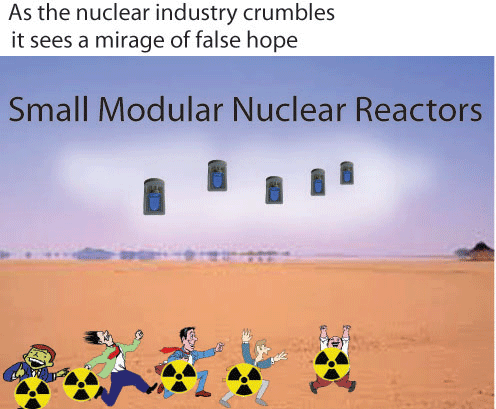
Advanced Nuclear Dreaming in Washington State, CounterPunch, PATRICK MAZZA 19 Apr 21……………..The WPPSS default was part of the first wave of nuclear failures in the U.S. In the wake of the 1979 Three Mile Island accident, approximately 100 proposed nuclear plants were cancelled. Recent years have seen a second round of failures. The Energy Policy Act of 2005 put $25 billion in nuclear subsidies on the table. That jumpstarted all of four nuclear reactors, two each in Georgia and South Carolina. The only way Wall Street would touch the projects was to make ratepayers carry the risk by paying for “work in progress” before the first watt is delivered. South Carolina ratepayers won’t even see that. Cost overruns killed the project there in 2017 after $9 billion was thrown away, setting up a political and court fight over whether ratepayers will continue to be soaked. The last two standing, Georgia’s Vogtle plants, were to have cost $14 billion and come on line in 2016-17. Now costs have doubled to $28 billion and scheduled completion this year and next is considered unlikely.
IS THE SMR A SOLUTION?
SMRs are the nuclear industry’s answer to avoid such failures in the future. Instead of being custom-built and individually licensed, SMRs are intended to cut costs by licensing a single design manufactured at a plant and sent for final assembly to their operating site. Smaller than the 1,000-megawatt-plus plants with which we’re familiar, SMRs are 100 MW or less, and designed with safety features to prevent meltdowns such as experienced at Japan’s Fukushima plant in 2011. Though there are questions about that, as covered below.
X-energy’s proposed plant is 80 MW. The Washington partnership envisions clustering four to make a 320-MW complex, with costs estimated at $2.4 billion. Half is to come from the U.S. Department of Energy’s Advanced Reactor Demonstration Program (ARDP), and half from private investors, apparently leaving ratepayers out of the picture this time.
ARDP in 2020 made two $80 million grants to advanced nuclear reactor developers, one to X-energy, and the other to TerraPower, a venture in which Bill Gates has invested. The latter, slated to be 345 MW, aims at eventual scales as large as today’s plants, so it is not an SMR. The TerraPower liquid-sodium cooled reactor concept has its own set of issues. Liquid-sodium reactors have suffered operating difficulties and fires, and pose potential weapons proliferation hazards. The Raven will look at TerraPower in a future post……..
ROCKY ROAD TO MASS PRODUCTION
“The road to such mass manufacturing will be rocky,” Makhijani and M.V. Ramana write in a recent article, “Why Small Modular Reactors Won’t Help Counter the Climate Crisis.” “Even with optimistic assumptions about how quickly manufacturers could learn to improve production efficiency and lower cost, thousands of SMRs, which will all be higher priced in comparison to large reactors, would have to be manufactured for the price per kilowatt for an SMR to be comparable to that of a large reactor.”
That sets up “a chicken-and-egg economic problem,” they write. “Without the factories, SMRs can never hope to achieve the theoretical cost reductions that are at the heart of the strategy to compensate for the lack of economies of scale. But without the cost reductions, there will not be the large number of orders to stimulate the investments needed to set up the supply chain in the first place.”
That is leaving aside the prospect of a design defect being discovered after many SMRs have been deployed. In the 1990s, multiple Westinghouse-built reactors suffered common steam generator problems, resulting in lawsuits. “If an error in a mass-manufactured reactor were to result in safety problems, the whole lot might have to be recalled, as was the case with the Boeing 737 Max and 787 Dreamliner jetliners,” Makhijani and Ramana write. “But how does one recall a radioactive reactor? What will happen to an electricity system that relies on factory-made identical reactors that need to be recalled?”
The economic hurdles of SMRs posed by its competitors are overwhelming.
“Lazard, a Wall Street financial advisory firm, estimates the cost of utility-scale solar and wind to be about $40 per megawatt-hour,” Makhijani and Ramana write. “The corresponding figure for nuclear is four times as high, about $160 per MWh – a difference that is more than enough to use complementary technologies, such as demand response and storage, to compensate for the intermittency of solar and wind.”
While costs for competitors declines, nuclear costs continue to escalate. Cost for a proposed Idaho project by NuScale, another SMR developer, has doubled from an estimated $3 billion in 2015 to $6.1 billion in 2020 “long before any concrete has been poured,” Makhijani and Ramana note………. https://www.counterpunch.org/2021/04/19/advanced-nuclear-dreaming-in-washington-state/
The solution to climate change must include nuclear disarmament — IPPNW peace and health blog

This COVID-19 crisis has exposed many systemic flaws and vulnerabilities, and as serious as its impact has been to our health and our economies worldwide, it is not an existential threat, and its impact is insignificant compared to that of the impending climate crisis and of a nuclear war, whatever its proportions. Nuclear weapons represent an unacceptable cost and risk and undermine the foundations of international cooperation and goodwill that are essential to resolving global crises. The solution to both threats must necessarily involve the entire international community.
The solution to climate change must include nuclear disarmament — IPPNW peace and health blog
Fukushima waste water plan won’t win public confidence, no matter how hard Japan tries
Fukushima waste water plan won’t win public confidence, no matter how hard Japan tries, Peter Wynn Kirby https://www.scmp.com/comment/opinion/article/3130239/fukushima-waste-water-plan-wont-win-public-confidence-no-matter-how
- The nuclear industry’s history of secrecy and cover-ups is only one reason
- Tepco’s incompetent and at times dishonest handling so far of the 2011 disaster and its aftermath has shattered what’s left of people’s trust.
To exasperated observers, this recalled the nuclear industry’s notorious 1990s mobilisation of Pluto-kun, a puckish cartoon character who drinks plutonium – arguably the world’s most dangerous substance – to demonstrate its harmlessness.

While other nations in the region have registered vociferous opposition to the water release plan, the domestic resistance is telling. A majority of Japanese oppose the plan. For a decade, the fishing industry has laboured, successfully, to show that the seafood it brings to market is safe, giving a wide berth to the plume of radioactive effluent haemorrhaging out of the Fukushima nuclear plant. All these efforts may soon appear to have been made in vain.
As indicated above, the choice of last Tuesday for the announcement seems to have been dictated by politics alone. Did Japan see the Olympics as a feel-good spectacle that could provide cover for the decision? Did US President Joe Biden’s recent pressure on Japan and South Korea to work together on regional security make the timing more palatable?
Whatever the calculus involved, one thing is for sure: the more Japan tries to make Fukushima Daiichi seem perfectly safe, the more people distrust the message – and the messenger.
As the Japanese proverb goes, “Let the past drift away like water.” Yet with radiation, letting go is not so simple. Even as the Japanese government tries to rid itself of the catastrophic after-effects of the Fukushima nuclear crisis, radioactive traces stubbornly remain.
Japan announced last week its intention to release about 1.25 million tonnes of waste water collected from the bowels of the crippled Fukushima Daiichi nuclear power station. The water to be released into the Pacific Ocean contains tritium, a radioactive hydrogen isotope with a half-life of over 12 years. The unwelcome news has provoked uproar both within Japan and among neighbouring countries.
For over a decade, authorities have been engaged in a messy, difficult, frustrating, even Sisyphean task, flushing the ruined footprint of the power station with water to keep the slumped nuclear fuel there from triggering a chain reaction.The meltdowns left parlous uranium fuel in desultory clumps amid the wreckage below. The only way to cool the escaped uranium is to flood the most dangerous areas of the Fukushima Daiichi complex with circulating seawater. Radioactive groundwater and waste water have been stored on-site to avoid contact with humans and the environment.
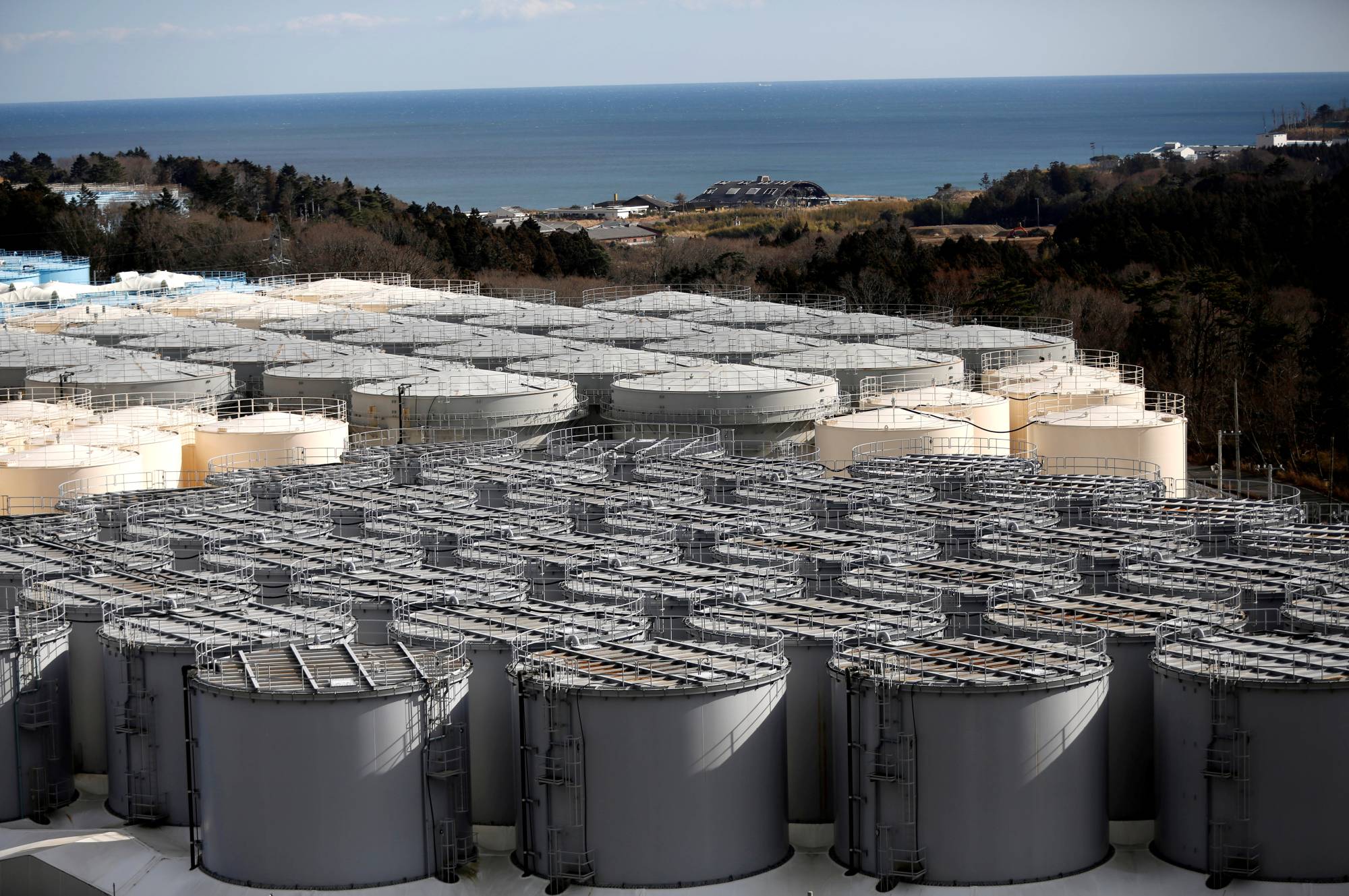
Ever since, huge water tanks filled with contaminated water have been springing up around the Fukushima Daiichi site like poisonous mushrooms. Now, there are over 1,000 of them. Most rival the size of small Japanese apartment buildings.
You didn’t have to be a genius to realise that the situation at Fukushima Daiichi was unsustainable. Any child who could do basic maths, or maybe a bit of Minecraft, would have been able to see that, day by day, month by month, the water would increase and the 350-hectare site would have less and less available space.Whatever else you might say about Japanese bureaucrats with regard to nuclear policy, they have very good maths skills. As a result, we can surmise that Prime Minister Yoshihide Suga’s announcement last week was, at root, a question of politics and calculated timing
Not that Japan didn’t attempt to resolve the situation otherwise. Authorities tried a range of strategies, including plugging leaks and creating a gigantic US$300 million ice wall around the site, underground, to stem water flow.
In the end, filtering the waste water was the only workable solution. But Japan had mixed results with this strategy. In June 2011, the first filtration system set up by reviled Tepco – Tokyo Electric Power Co, the company that owned the nuclear power station – broke down after only a few hours. The amount of radioactive Caesium in the water overwhelmed the filters.
More recently, before a parliamentary commission, Tepco was forced to admit that it had falsely claimed to have treated most of the waste water from the plant. In actual fact, Tepco had properly dealt with only about one-fifth of the waste water.
Astonishingly, this disappointing result stemmed from it not having bothered to change the filters often enough. Even such basic elements of quality control seem to be beyond the capabilities of the Tepco team, which already lives in infamy after having presided over the world’s second most damaging civil nuclear disaster, after Chernobyl.
Predictably, scientists, officials and industry stakeholders argue that this degree of tritium discharge happens all the time in the nuclear industry – this is more or less true, however perturbing – and suggest that the announced controlled release should therefore present no problem whatsoever.
But the history of the nuclear industry globally is one of military synergies, secrecy, cover-ups, Machiavellian information management, and propaganda-style communication with the public. Indeed, it was striking that on the very same day as Suga’s announcement, Japan’s reconstruction agency released a video depicting tritium in the form of Tritium-kun, a harmless-seeming fishlike creature with blushing cheeks who says tritium release is safe.
70 years later, ionising radiation from nuclear bomb tests still found in U.S. honey

Nuclear fallout is showing up in U.S. honey, decades after bomb tests, Science Nikk Ogasa Apr. 20, 2021
Fallout from nuclear bomb tests in the 1950s and ’60s is showing up in U.S. honey, according to a new study. Although the levels of radioactivity aren’t dangerous, they may have been much higher in the 1970s and ’80s, researchers say.
“It’s really quite incredible,” says Daniel Richter, a soil scientist at Duke University not involved with the work. The study, he says, shows that the fallout “is still out there and disguising itself as a major nutrient.”
In the wake of World War II, the United States, the former Soviet Union, and other countries detonated hundreds of nuclear warheads in aboveground tests. The bombs ejected radiocesium—a radioactive form of the element cesium—into the upper atmosphere, and winds dispersed it around the world before it fell out of the skies in microscopic particles. The spread wasn’t uniform, however. For example, far more fallout dusted the U.S. east coast, thanks to regional wind and rainfall patterns.
Radiocesium is soluble in water, and plants can mistake it for potassium, a vital nutrient that shares similar chemical properties. To see whether plants continue to take up this nuclear contaminant, James Kaste, a geologist at the College of William & Mary in Williamsburg, Virginia, gave his undergraduate students an assignment: Bring back local foods from their spring break destinations to test for radiocesium.
One student returned with honey from Raleigh, North Carolina. To Kaste’s surprise, it contained cesium levels 100 times higher than the rest of the collected foods. He wondered whether eastern U.S. bees gathering nectar from plants and turning it into honey were concentrating radiocesium from the bomb tests.
So Kaste and his colleagues—including one of his undergrads—collected 122 samples of locally produced, raw honey from across the eastern United States and tested them for radiocesium. They detected it in 68 of the samples, at levels above 0.03 becquerels per kilogram—roughly 870,000 radiocesium atoms per tablespoon. The highest levels of radioactivity occurred in a Florida sample—19.1 becquerels per kilogram.
The findings, reported last month in Nature Communications, reveal that, thousands of kilometers from the nearest bomb site and more than 50 years after the bombs fell, radioactive fallout is still cycling through plants and animals………
The findings raise questions about how cesium has impacted bees over the past half-century, says Justin Richardson, a biogeochemist at the University of Massachusetts, Amherst. “They’re getting wiped out from pesticides, but there are other lesser known toxic impacts from humans, like fallout, that can affect their survival.”
After the Chernobyl nuclear disaster in 1986, scientists showed radiation levels nearby could hamper the reproduction of bumble bee colonies. But those levels were 1000 times higher than the modern levels reported here, notes Nick Beresford, a radioecologist at the U.K. Centre for Ecology & Hydrology.
So even though the new study shouldn’t raise any alarm bells over today’s honey, understanding how nuclear contaminants move around is still vital for gauging the health of our ecosystems and our agriculture, says Thure Cerling, a geologist at the University of Utah. “We need to pay attention to these things.” https://www.sciencemag.org/news/2021/04/nuclear-fallout-showing-us-honey-decades-after-bomb-tests
Legal and other problems for Japan, with growing opposition to its plan for dumping Fukushima waste-water in the ocean
Toxic reaction to Japan’s
Fukushima water dump, https://www.lowyinstitute.org/the-interpreter/toxic-reaction-japan-s-fukushima-water-dump ARISTYO RIZKA DARMAWAN, 21 Apr 21,
Experts insist the release of treated radioactive water is not dangerous.
Legal challenges might find otherwise.
The Netflix documentary “Seaspiracy” caused a stir following its release last month, both for highlighting the serious damage human activities are causing the world’s oceans – whether from marine debris or whale hunting – and also for claims that the program features misleading statements and statistics.
But the controversy pales against the announcement last week by the Japanese government that it plans in two years to release treated radioactive water into the Pacific Ocean.
The contaminated water has been held in tanks since an earthquake and subsequent tsunami damaged the Fukushima nuclear reactor in 2011. With storage capacity predicted to run out late next year, Japan has decided to press ahead with long-speculated plans to dump treated wastewater into the sea.
Even though the Japanese government, International Atomic Energy Agency and some experts have argued that the release of the water is not dangerous and will do no harm to the ocean, there are good reasons to be concerned about the potential for environmental damage. Local Japanese, South Korean and Taiwanese fishing industries have protested the move, as have communities in the Pacific Islands. China has been scathing, with one recent op-ed in the state-run China Daily declaring “Japan cannot use the Pacific as its sewer”. The United States has been more understanding in its comments, with Secretary of State Antony Blinken praising Japan for “transparent efforts” in its decision.
But Japan may also be challenged under international law, and South Korea has already threatened legal action under international dispute settlement mechanisms.
There are at least two international treaties that regulate or ban the dumping of waste at sea: the United Nations Convention on the law of the Sea (UNCLOS) and the 1996 Protocol to the Convention on the Prevention of Marine Pollution by Dumping of Wastes and Other Matter, 1972, generally referred to as the London Convention and Protocol.
UNCLOS stipulates that all parties shall cooperate in protecting the marine environment and under Article 210 explicitly requires “laws, regulations and measures shall ensure that pollution by dumping is not carried out without the permission of the competent authorities of States”.
That terminology will be debated, whether it be over the notion of “competent authorities” or indeed whether Japan’s plan amounts to “dumping”. UNCLOS defines the terminology of dumping as “any deliberate disposal at sea of wastes or other matter from vessels, aircraft, platforms or other man-made structures at sea”. Given that the proposal is to release water held on land, this may not be covered by the convention.
It may even be argued that dumping at sea is allowable under Article 8 of the London Convention and Protocol. The article stipulates that dumping is allowed during an emergency, with the provision that a party “shall consult any other country or countries that are likely to be affected”. That may explain the “transparency” of Japan providing two years notice of its intended action. Yet in this case, it is questionable whether running out of storage capacity can be considered an emergency, given the article also stipulates such action is permissible only “in emergencies posing an unacceptable threat to human health, safety, or the marine environment and admitting of no other feasible solution”.
Regardless of how such disputes play out, however, it is also notable that neither UNCLOS nor the London Convention and Protocol have strong sanction mechanisms. Enforcement relies on either coastal states or flag states.
Neighbouring countries have reacted strongly, as have international environmental NGOs, including Greenpeace. Boycotts and bans on Japanese fisheries products have already been mooted. Unless another solution is found, Japan’s plan will continue to face a mounting tide of opposition.
Decision on Fukushima waste water should be in consultation with international agencies, not just a decision by Japan alone.
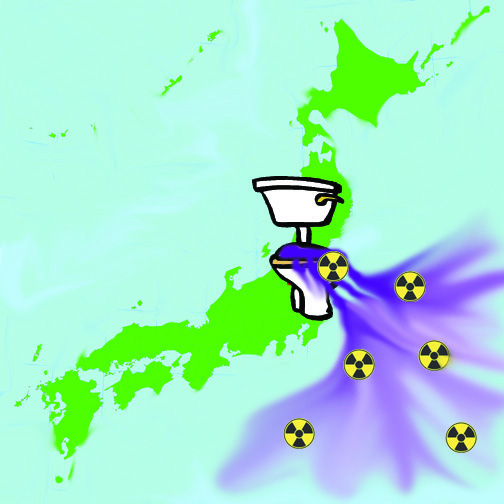
Disposal of Fukushima nuclear wastewater should be assessed under framework of intl agencies, not let world pay: FM, By Global Times, 21 Apr 21, China’s Foreign Ministry said on Wednesday the disposal of Fukushima nuclear wastewater should be assessed and discussed under the framework of international agencies including the UN, the WHO, and the IAEA, urging the Japanese government to correct its irresponsible decision to dump of the wastewater to the ocean and avoid involving people all around the world in paying for its wrongdoings.
The remarks came after South Korean Foreign Minister Chung Eui-yong expressed opposition to the move, and said on Tuesday that Seoul will work closely with international agencies to deal with Japan.
At a routine press conference, China’s Foreign Ministry spokesperson Wang Wenbin stressed that before dumping nuclear-contaminated water, there should be a discussion with neighboring countries and an evaluation within the framework of international agencies including the United Nations, the World Health Organization, and the International Atomic Energy Agency.
Wang added that Japan’s decision to dump the nuclear-contaminated water is not only opaque, unscientific, unlawful, irresponsible and unethical, but also at risk of being condemned by the world.
“A ban has been placed on black scorpionfish caught off Fukushima waters from entering markets due to the detection of excessive radioactive materials. And this is the second time that fish have been found with excessive radioactive materials in Fukushima waters since February,” said Wang.
All of these signs point to the fact that disposal of radionuclides is complicated and difficult, noted Wang, adding that the Fukushima nuclear power plant accident has been bringing harm to its surroundings for the past decade since it happened. ……..
Wang said that the methods of the wastewater disposal concern the safety of the Asia-Pacific region, the global ecological environment, and the lives and the health of people in all countries. The data should be evaluated and consultations held with all parties whose interests are bound to it.
“We noticed that Japan’s Tokyo Electric Power Company intends to submit a progress plan for wastewater disposal in May. We express strong opposition and serious concern to the matter as Japan unilaterally pushes forward the plan without consultation with the international community especially neighboring countries,” Wang said.
“Please don’t let people all over the world pay for Japan’s wrongdoings,” he added. https://www.globaltimes.cn/page/202104/1221712.shtml
Japan’s government bans shipments of black rockfish from Fukushima, due to highlevels of radioactive cesium
Fish radioactive report prompts Fukushima ban, http://global.chinadaily.com.cn/a/202104/21/WS607f7f4ea31024ad0bab93e5.html
By WANG XU in Tokyo China Daily 2021-04-21 The Japanese government banned shipments of black rockfish from Fukushima on Monday, after a radioactive substance was found to be more than five times higher than acceptable levels in the fish caught off the prefecture.
The Fukushima prefectural government said 270 becquerels of radioactive cesium were detected per kilogram of the black rockfish, which had been caught at a depth of 37 meters near the city of Minamisoma, Fukushima, on April 1.
The amount of radioactive cesium is five times more than the limit set by a local fisheries cooperative of 50 becquerels per kg. It is also sharply higher than Japan’snational standard in general foods of 100 becquerels per kg.
In response, Japan’s national nuclear emergency response headquarters on Monday ordered a ban on the shipment of the fish caught off the waters of Fukushima.
Early in February, radioactive cesium 10 times above permitted levels in Japan were detected in the same area.
Scientific research showed the amount of cesium in foods and drinks depends upon the emission of radioactive cesium through the nuclear power plant, mainly through accidents. High levels of radioactive cesium in or near one’s body can cause nausea, vomiting, diarrhea, bleeding, coma, and even death.
Monday’s restrictions came a week after Japan’s government decided to release radioactive water from the crippled Fukushima Daiichi nuclear plant into the sea despite fierce opposition from fishing crews at home and concern from the international community.
“The (Japanese) government’s decision is outrageous,” said Takeshi Komatsu, an oyster farmer in Miyagi prefecture, north of Tokyo. “I feel more helpless than angry when I think that all the efforts I’ve made to rebuild my life over the past decade have come to nothing.”
South Korea strongly criticized the decision to release the contaminated water, with its Foreign Ministry summoning the Japanese ambassador. President Moon Jae-in ordered officials to explore petitioning an international court over the issue.
Alaska to increase its radiation testing of seafood..

A Decade After Fukushima Nuclear Disaster, Alaska Expands Seafood Monitoring High North News, Apr 21 2021
State environmental regulators announced Monday they’re expanding radiation testing of commercially harvested Alaska seafood using a gamma radiation detector at a state laboratory in Anchorage, according to APM.
A devastating earthquake and tsunami off the coast of Japan in 2011 crippled the Fukushima Dai-ichi nuclear plant, which released radioactive material into the air and ocean…….. https://www.highnorthnews.com/en/decade-after-fukushima-nuclear-disaster-alaska-expands-seafood-monitoring
Iran Nuclear Deal Talks Advance as U.S. Offers Sanctions Relief
Iran Nuclear Deal Talks Advance as U.S. Offers Sanctions Relief
Biden administration signals openness to easing measures against oil, finance and other sectors, but Tehran wants to see specifics, WSJ, By Ian Talley, Benoit Faucon and Laurence NormanUpdated April 21, 2021
The Biden administration has signaled it is open to easing sanctions against critical elements of Iran’s economy, including oil and finance, helping narrow differences in nuclear talks, according to people familiar with the matter.
Despite the progress, senior diplomats warned that weeks of difficult negotiations over the 2015 nuclear agreement lie ahead and progress remains fragile. Talks in Vienna are complicated by domestic politics in Washington and Tehran and by Iran’s refusal to meet directly with the U.S.
President Biden wants to return to the 2015 deal after former President Donald Trump withdrew in 2018. The U.S. decision to quit the deal and impose sweeping sanctions on Iran prompted Tehran to breach many of the key restrictions in the accord, making a return to the agreement’s provisions and limits difficult for both sides.
Senior officials in Vienna this week wrapped up five days of talks, with delegations returning home before negotiations resume next week. People involved in the talks say progress has come as the U.S. laid out more clearly the contours of the sanctions relief it is prepared to provide.
Many of the sanctions were imposed under Mr. Trump using U.S. terrorism authorities, and U.S. officials previously have said they are willing to consider lifting some of them. But they haven’t detailed which sanctions could be eased or which Iranian entities stand to be affected…….. (subscribers only) https://www.wsj.com/articles/iran-nuclear-deal-talks-advance-as-u-s-offers-sanctions-relief-11619024783
Overdue Shutdown of the Indian Point Nuclear Plant
Overdue Shutdown of the Indian Point Nuclear Plant
Environmental groups write that gains in energy efficiency and renewable power exceed the plant’s annual output.
“Nuclear Plant’s Shutdown Means More Fossil Fuel in New York”(news article, April 13):
New York State is making good on its promise to replace the aging, unsafe Indian Point nuclear plant with clean energy. Gains in energy efficiency and renewable power over the last decade already exceed the plant’s total annual output, with much more to come.
We can expect year-to-year changes given fluctuations in energy demand and prices. But the overall trend in New York is clear: Clean energy is here to stay, and emissions reductions are on track to reach the state’s ambitious climate goals.
Closing this dangerous plant is overdue. Over the years Indian Point has experienced reactor structure problems with the potential for structural failure, as well as leaks, fires and unplanned shutdowns.
For the 20 million people who live within 50 miles of it, Indian Point’s long-planned closure ends a risky chapter. Paul GallayKit Kennedy
Mr. Gallay is president of Riverkeeper and Ms. Kennedy is senior director, climate and clean energy program, at the Natural Resources Defense Council. https://www.nytimes.com/2021/04/21/opinion/letters/indian-point-nuclear.html
The $2.5Billion-a-year effort to stabilise the Hanford reservation’s dangerous nuclear wastes

Nuclear waste structures in Washington state are stabilized, https://apnews.com/article/environment-and-nature-business-government-and-politics-washington-nuclear-waste-14e29e8923c62bf5835f33e1b649000c RICHLAND, Wash. (AP) — The U.S. Department of Energy has confirmed that two underground structures at the decommissioned Hanford nuclear reservation in Washington state have been stabilized after they were deemed at risk of collapsing and spreading radioactive contamination into the air.
“With this work completed, Hanford has ensured the stability of these structures and reduced risks to workers and the environment,” department spokesperson Geoff Tyree said.
The partial collapse of a tunnel storing nuclear waste the nuclear reservation in 2017 prompted a federal study which concluded last year that a large settling tank and two trenches where plutonium-contaminated liquids were poured into the ground for disposal posed a high risk of collapse and contamination, Tri-City Herald reported Tuesday.
The Hanford reservation produced plutonium for nuclear weapons during the Cold War and World War II, leaving 56 million gallons (212 million litres) of radioactive waste in underground tanks. The largest of the three underground structures, which operated from 1955 to 1962, was estimated to be contaminated with 105 pounds (48 kilograms) of plutonium.
Scott Sax, president of Hanford contractor Central Plateau Cleanup Co., told employees that the three underground structures identified in the study were filled with concrete-like grout to prevent them from collapsing.
The work was done by White Shield Inc. of Pasco under a contract originally valued at about $4 million.
Sax also said that at least one of the trenches was buried deep enough to prevent nuclear waste from releasing into the air in the event of a collapse.
“Routine monitoring will continue to ensure all three structures remain stable,” Sax said, at least until further environmental cleanup action is taken.
Final cleanup plans for the structures have not yet been made as the Energy Department focuses on other high-priority projects, including capsules of radioactive waste that are at risk of releasing contamination in the event of a severe earthquake.
About $2.5 billion a year is being spent to stabilize and clean up waste and contamination left at the 580-square-mile (1,500-square-kilometer) site in Richland, Washington about 200 miles (322 kilometers) southeast of Seattle, officials said.
S.Korean students shave heads in protest over Japan’s nuclear waste water plan
S.Korean students shave heads in protest over Japan’s nuclear waste water plan, Reuters, Hyun Yi 21 Apr 21, More than 30 South Korean college students shaved their heads in front of the Japanese embassy in Seoul on Tuesday to protest Japan’s decision to release water from its crippled Fukushima nuclear plant into the sea.
Police periodically dispersed crowds, who chanted and held placards, but did not stop the event from taking place, though there is an anti-pandemic ban on gatherings larger than 10 people.
The protesters who were shaved were draped in protective sheets emblazoned with messages condemning the Japanese plan and calling for it to be ditched.
One read: “The Japanese government should immediately cancel the plan to release the contaminated water.”…….. https://www.reuters.com/business/environment/skorean-students-shave-heads-protest-over-japans-nuclear-waste-water-plan-2021-04-20/
Huge disruption for Northern New Mexico with electricity plans for Los Alamos plutonium cores production.
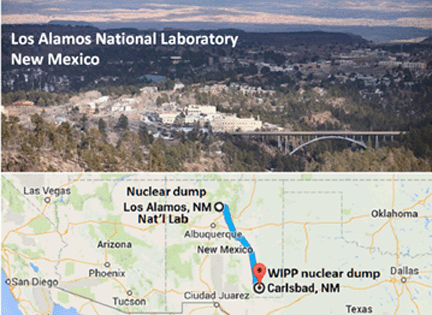
US Lab Looks to Boost Power Supply Ahead of Nuclear Mission https://www.usnews.com/news/business/articles/2021-04-20/us-lab-looks-to-boost-power-supply-ahead-of-nuclear-mission
The U.S. government plans to build a new transmission line and make other upgrades to ensure its northern New Mexico nuclear weapons laboratory has enough electricity for current and future missions. April 20, 2021, By SUSAN MONTOYA BRYAN, Associated Press
ALBUQUERQUE, N.M. (AP) — The U.S. government plans to build a new transmission line and make other upgrades costing hundreds of million dollars to ensure its laboratory in northern New Mexico has enough electricity for ongoing operations and future missions that include manufacturing key components for the nation’s nuclear arsenal.
Officials have said one of the existing lines that feeds Los Alamos National Laboratory is expected to reach capacity this summer.
The other likely will hit its limit within the next few years amid more high-computing projects related to nuclear weapons design and performance and as work ramps up to build the plutonium cores that are used to trigger weapons.
The U.S. Energy Department’s National Nuclear Security Administration announced Monday that it will work with federal land managers to assess the project’s potential environmental effects. A virtual public meeting is scheduled for May 6 and the public will have until May 21 to weigh in on the scope of the planned review.
The proposed transmission line would stretch more than 12 miles (19 kilometers), crossing national forest land in an area known as the Caja del Rio and spanning the Rio Grande at White Rock Canyon. New structural towers would need to be built on both sides of the canyon.
The project — which could cost up to $300 million — also would require new overhead poles with an average span of 800 feet (244 meters), access roads for construction and maintenance and staging areas where materials can be stored.
Federal officials have said they plan to try to have the project avoid known biological, recreational, cultural and historical resources, such as the Camino Real Aldentro National Historic Trail. Another goal would be minimizing visibility of the transmission line from residential areas.
Part of the line would be built along an existing utility corridor, but a new path would have to be cut through forest land to reach an electrical substation.
The Los Alamos Study Group, a watchdog group that has been critical of the lab’s expansion plans, reiterated concerns about the lack of an overall analysis of the cumulative effects that plutonium core production and more weapons work could have on the surrounding communities.
Greg Mello, the group’s director, said no comprehensive information regarding the future of lab is available to the public, to local and state governments or to the immediately affected Native American tribes. He pointed to future land acquisition and site plans and other documents that have been redacted.
“This is a poorly-justified project, one we strenuously oppose,” he said in a statement, adding that the electrical capacity the lab claims it needs is double what it has now and is premised on as-yet-unapproved programs and projects.
Environmentalists, residents and others have suggested that the lab tap into its scientific capabilities and consider other options such as superconducting transmission lines, battery storage and solar generation.
They point to the project as an opportunity to move the state close to reaching mandates of electricity generation being carbon-free over the next two decades.
They also voiced concerns about potential effects on the Caja del Rio, saying it encompasses wide Indigenous landscapes and is a scenic gateway to northern New Mexico.
The area has seen an increase in outdoor recreational use and it serves as a migration corridor for wildlife.
-
Archives
- February 2026 (228)
- January 2026 (308)
- December 2025 (358)
- November 2025 (359)
- October 2025 (376)
- September 2025 (258)
- August 2025 (319)
- July 2025 (230)
- June 2025 (348)
- May 2025 (261)
- April 2025 (305)
- March 2025 (319)
-
Categories
- 1
- 1 NUCLEAR ISSUES
- business and costs
- climate change
- culture and arts
- ENERGY
- environment
- health
- history
- indigenous issues
- Legal
- marketing of nuclear
- media
- opposition to nuclear
- PERSONAL STORIES
- politics
- politics international
- Religion and ethics
- safety
- secrets,lies and civil liberties
- spinbuster
- technology
- Uranium
- wastes
- weapons and war
- Women
- 2 WORLD
- ACTION
- AFRICA
- Atrocities
- AUSTRALIA
- Christina's notes
- Christina's themes
- culture and arts
- Events
- Fuk 2022
- Fuk 2023
- Fukushima 2017
- Fukushima 2018
- fukushima 2019
- Fukushima 2020
- Fukushima 2021
- general
- global warming
- Humour (God we need it)
- Nuclear
- RARE EARTHS
- Reference
- resources – print
- Resources -audiovicual
- Weekly Newsletter
- World
- World Nuclear
- YouTube
-
RSS
Entries RSS
Comments RSS
 nuclear-news