Global nuclear industry delighted that Joe Biden pushes ”new nuclear for jobs”
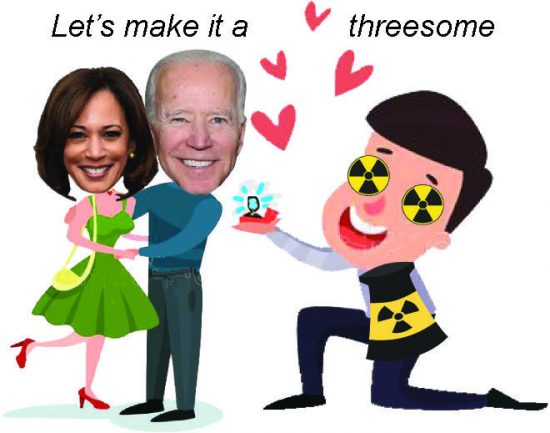
US President includes nuclear in American Jobs Plan
US President Joseph Biden yesterday announced a USD2 trillion jobs, infrastructure and clean energy plan to reshape the country’s economy. Among the proposed investments to tackle climate change, the American Jobs Plan calls for funding for the development of advanced nuclear reactors .………
Industry welcomes plan, World Nuclear News, 01 April 2021
The Nuclear Innovation Alliance (NIA) welcomed Biden’s announcement of the American Jobs Plan……….
NIA’s Executive Director Judi Greenwald said:
The technology-inclusive American Jobs Plan specifically incorporates advanced nuclear energy as eligible for funding for demonstration projects, building on ongoing activities by the Department of Energy and industry to demonstrate the commercial viability of next generation nuclear power.”
In a joint statement, American Nuclear Society President Mary Lou Dunzik-Gougar and CEO Craig Piercy said, “The nuclear energy industry supports high-paying jobs that last decades and a growing world market for small modular and advanced reactor designs promise job growth for communities across the US.”
Joe Biden’s support for the nuclear industry is stated, but it’s not clear

Nuclear should be considered part of clean energy standard, White House says
Biden’s plan goes beyond most states’ definitions of clean power. Ars Technica
TIM DE CHANT – 4/3/2021 More details have emerged about the climate and energy priorities of President Joe Biden’s infrastructure plan, and they include support for nuclear power and carbon capture with sequestration (CCS).
In a press conference yesterday with reporters, White House climate adviser Gina McCarthy said the administration would seek to implement a clean energy standard that would encourage utilities to use greener power sources. She added that both nuclear and CCS would be included in the administration’s desired portfolio. The clean energy standard adds a climate dimension to the Biden administration’s recently announced infrastructure plan, seeking to put the US on a path to eliminating carbon pollution.
………. But nuclear has been criticized by some environmentalists over its radioactive waste and concerns about meltdowns.
Typically, state standards do not include nuclear in their portfolios. Rather, they usually focus on renewable energy sources like wind, solar, and hydropower. McCarthy did not provide details about how far a CES would go in supporting nuclear power. It’s possible that the policy may only cover plants that are currently operating, but it may also extend to include new plants. The former is more likely than the latter, though, given the challenges and costs involved in building new nuclear capacity……… https://arstechnica.com/tech-policy/2021/04/nuclear-should-be-considered-part-of-clean-energy-standard-white-house-says/
Living with Chernobyl — Beyond Nuclear International

The nuclear disaster 35 years on
Living with Chernobyl — Beyond Nuclear International
The U.S. War on China: Panda Huggers and Panda Sluggers by K. J. Noh — Rise Up Times

“Unless we do something about it, President Biden’s doctrine toward China will likely be a continuation of the noxious U.S. arc of history, ideology, and planning.”
The U.S. War on China: Panda Huggers and Panda Sluggers by K. J. Noh — Rise Up Times
China, Total Information Warfare: Sinophobia, by K. J. Noh — Rise Up Times
“While China demonstrates the possibility of multi-polarity, or the sharing of power, the U.S. is committed to unipolarity: its domination of world power at any cost.”
China, Total Information Warfare: Sinophobia, by K. J. Noh — Rise Up Times
April 4 Energy News — geoharvey

Opinion: ¶ “Strong Winds Off The Coast Could Power A Clean Energy Economy In North Carolina” • To learn the direction of energy production in North Carolina, look to a weather vane. Last year, Duke Energy and Dominion Energy of Virginia called off the 600-mile Atlantic Coast Pipeline. Now the weather vane points toward the […]
April 4 Energy News — geoharvey
Noam Chomsky: Biden’s Foreign Policy Is Largely Indistinguishable From Trump’s — Rise Up Times

“Clearly what is needed is diplomacy and negotiations on contested matters, and real cooperation on such crucial issues as global warming, arms control, future pandemics — all very severe crises that know no borders.”
Noam Chomsky: Biden’s Foreign Policy Is Largely Indistinguishable From Trump’s — Rise Up Times
Florida declares state of emergency due to potential radioactive material leak
FLORIDA DECLARES STATE OF EMERGENCY DUE TO POTENTIAL RADIOACTIVE MATERIAL LEAK, 600 MILLION GALLONS OF POLLUTED WATER MIGHT SOON FLOOD A MASSIVE STRETCH OF THE STATE. https://futurism.com/the-byte/florida-declares-state-emergency-due-potential-radioactive-material-leak, 4 Apr 21,
Imminent And Uncontrolled
Florida has declared a state of emergency in Manatee County after officials announced a wastewater pond containing radioactive material is at risk of collapsing.
Governor Ron DeSantis issued the state of emergency for the region on Saturday, according to CBS News. Officials at the Manatee County Public Safety Department declared a mandatory evacuation notice for the area “due to the imminent uncontrolled release of wastewater.”
Radioactive Wastewater
The wastewater originated from the former Piney Point phosphate processing plant where a reservoir containing stacks of phosphogypsum — radioactive waste created by processing phosphate ore into fertilizer — experienced a leak.
A portion of the containment wall at the leak site shifted laterally signifying that structural collapse could occur at any time,” said Manatee Director of Public Safety Jake Saur to CBS News.
Officials fear the leak could potentially flood the area with radioactive wastewater and have begun the process of releasing 22,000 gallons of water a minute out of a retention pond to alleviate the stress on the containment site.
“We are talking about the potential of about 600 million gallons within a matter of seconds and minutes leaving that retention pool and going around the surrounding area,” said Manatee County Administrator Scott Hopes in a press conference.
If and when the containment reservoir breaks completely, it could lead to a generational destruction of the surrounding region. It’s a tough pill to swallow — but state officials need to wield a firmer hand when it comes to regulating, you know, radioactive wastewater that’s upstream from an entire county of people.
The IAEA is getting worried about nuclear safety, in view of climate extremes, and especially of earthquakes
New IAEA Publications Highlight Importance of Seismic Safety for Nuclear Power Plants, Ovidiu Coman, IAEA Department of Nuclear Safety and Security,IAEA 25 Mar 21,
The importance of withstanding earthquakes and their consequences has proven to be critical for the safety of nuclear power plants, and seismic re-evaluation has been identified as an important step towards reducing the risks facing these plants. After the Fukushima Daichii accident in 2011, which was caused by a tsunami following an earthquake, many countries performed comprehensive safety and risk evaluations of their nuclear power plants against external hazards.
The specific seismic risk for each nuclear facility is vital to identify when developing and implementing the safety requirements for these plants, and two recent IAEA publications provide assistance to national experts on implementing improved seismic safety.
The IAEA is contributing to continued enhancement of nuclear safety globally by promoting best international practices and experience. From this perspective, we should consider the increased likelihood of rare natural events, which have been more common in recent years, and postulate that they may occur during a facility’s lifetime,” said Greg Rzentkowski, Director of the IAEA’s Division of Nuclear Installation Safety.
The IAEA’s Safety Report No. 103 Methodologies for Seismic Safety Evaluation for Nuclear Installations and TECDOC-1937 Probabilistic Safety Assessment for Seismic Events support implementation of the IAEA Safety Standards based on updated technologies and state-of-the-art practices. Both provide detailed technical guidance for the assessment of seismic safety for nuclear installations.
“Seismic hazard is a key contributor to overall plant risk evaluation. At the same time, observations regarding extreme seismic events are rather limited, and predictive models are subject to considerable uncertainties,” Rzentkowski said. “Yet, we have to anticipate such events and consider corresponding risks in the design process of nuclear power plants to ensure adequate protection of people and the environment.” ………………………
Dennis Henneke from the Chief Engineer’s Office of General Electric-Hitachi added: “The most advanced reactors, including small modular reactors, require either a design phase seismic PSA or a plant and site-specific seismic PSA. TECDOC-1937, when used in combination with other IAEA documents in this specialized area of nuclear safety, provides a comprehensive approach that can be used to support these advanced plant seismic PSAs. These documents fill a gap in the industry methodology.” ,,,,,,,,, https://www.iaea.org/newscenter/news/new-iaea-publications-highlight-importance-of-seismic-safety-for-nuclear-power-plants
Busting the spin that promotes ‘Small Nuclear Reactors’
Saint John MP Long is wrong on small modular nuclear reactors, https://nbmediacoop.org/2021/04/03/mp-long-is-wrong-on-smrs/ by Christopher Reibling, April 3, 2021 This is in response to MP Wayne Long’s letter in the Telegraph Journal (March 20 – “Coon Got It Wrong on SMRs”), which is riddled with dangerous and alarming inaccuracies.
Long’s misuse of the word “recycling” is particularly troubling. When it comes to nuclear fuel, plutonium obtained from existing used reactor fuel (i.e. from the Point Lepreau reactor or from the US) can be incorporated, after burning, into new fuel elements used to power a small modular nuclear reactor (SMR). This much is true.
In doing so, however, the structural materials used to build an SMR, the steel and concrete, become so radioactively contaminated that they can never be “recycled.” This is because some of these materials have a half life of many hundreds of thousands of years.
Worse yet, and as New Brunswickers learned from the March 18 announcement from Mr. Long and Premier Blaine Higgs that SMRs would be coming to the province soon, these materials cannot be safely reprocessed or disposed of, like plastic bottles or paper, in storage facilities presently available in New Brunswick. If either of these politicians had attended the presentations given in New Brunswick last March by mathematician and nuclear consultant Gordon Edwards, they would have been aware of these contingencies.
Edwards’s takedown of the nuclear industry also details the “litany of economic failures” which have dogged it worldwide since 2000. Citing the multi-million dollar collapse of the giant Areva Corporation in France and the U.S. government’s $8.3 billion dollar bailout of Westinghouse Electric in 2010, Edwards itemizes the misfortunes of an industry which has barely been able to keep itself alive over the past three decades. Major US banks now refuse to invest in nuclear energy, leaving government’s to pick up the slack and placing taxpayers on the hook for all failures and vagaries. Sound familiar?
As leader of New Brunswick’s Green Party, David Coon has obviously familiarized himself with current research on the subject of SMRs which is why, presumably, he maintains that, introducing SMRs to New Brunswick, is tantamount to “opening up a Pandora’s box of radioactive waste.”
Long, however, views Coon’s due diligence as a sign that he does not inhabit the “real world,” ironically claiming that the industry about to be foisted by his government on a gullible New Brunswick is somehow a “green initiative.”Challenging Long’s claim that the science pertaining to the safety and economic feasibility of SMRs is “clear,” I would suggest that the question both he and Blaine Higgs should be asking themselves is this: who in their right mind, Green or otherwise, would want to move to Saint John once it’s been turned into a testing ground for small nuclear reactors. Would you?
Boom in ”decommissioning” nuclear reactors brings worries about financial costs, and safety
Environmental & Energy Study Institute 30th March 2021, The Environmental and Energy Study Institute (EESI) held an online briefing on nuclear energy issues, including the current economics of the U.S. nuclear power industry, how to approach decommissioning as more civilian reactors shut down, and what to do with their high-level radioactive waste.
In particular, the briefing assessed the impacts of extending the licenses of existing nuclear plants and pursuing “advanced reactors” as a way to fight climate change.
As U.S. nuclear plants age out or become unprofitable, the growing number of shuttered reactors has spawned a new
decommissioning business model that promises to remediate sites quickly, but also raises new questions about safety, financial assurance, cleanup standards, and waste disposition. Decommissioning companies want to ship highly radioactive spent fuel through 75 percent of Congressional districts to their proposed consolidated interim storage facilities (CISFs) in New Mexico and Texas, which overburdened residents there oppose.
An example of the international aspect of nuclear developments – Ireland’s complaint to Britain on the Sizewell nuclear risks
Times 4th April 2021, An Irish agency has complained to British authorities that they have not sufficiently assessed the potential implications for Ireland of a severe accident at a planned nuclear facility on the east coast of England, more
than 500km away.
In a submission to the UK’s Planning Inspectorate last October, the Environmental Protection Agency claimed the “major accidents and disasters assessment” for the Sizewell C project had “a number of limitations, including the fact that no modelling or detailed calculations were undertaken”.
It disputed the inspectorate’s conclusion that the plant, which is due for completion in 2031, was unlikely to have a
significant effect on the environment in any other European country. “The EPA believes that this environmental impact assessment does not sufficiently address the transboundary implications of a severe accident,” it said. “A severe accident at Sizewell C, combined with unfavourable weather which resulted in radioactive contamination in Ireland, could lead to food controls and agricultural protective actions being introduced.”
It cited a study by the Economic and Social Research nstitute that claimed a nuclear accident anywhere in northwest Europe would cost Ireland about €4 billion, even if there was no contamination here, because of the damage to tourism and export markets. It acknowledged that the normal operation of the plant, which will be located more than
520km from Ireland’s east coast, would have no measurable radiological impact in this country or on the Irish marine environment.
The joint Oireachtas committee on housing, local government and heritage has also filed an objection to the project, claiming it has concerns about nuclear regulation in Britain after it leaves Euratom, the European nuclear energy treaty, as part of Brexit. “The committee has concerns that once Britain has left Euratom, [its] government will no longer be subject to legal proceedings at the European Court of Justice [ECJ] in the event of failures to comply with nuclear safety regulations,” the committee said.
“Taking into account the absence of access to the ECJ post-Brexit, the ambiguity of the long-term funding of a new nuclear regulator, and the potential impacts to the Irish public and the Irish economy in the event of an incident, [we]
would like to register an objection to the proposed development.”
Britain consulted Ireland on the Sizewell C project under the Espoo Convention, which requires international consultation on activities that may have an adverse transboundary environmental effect. Tony Lowes of Friends of the
Irish Environment, which campaigned for Ireland to be consulted on Britain’s nuclear plans under Espoo, said: “The question of liability after Brexit has not been answered.”
https://www.thetimes.co.uk/article/epa-atomic-plans-eastern-uk-sizewell-c-znxz5w7sw
Greenland might reject Australian-Chinese company Greenland Minerals in its bid to mine rare earths
Telegraph 4th April 2021, AS elections go, it sounds rather minor-league: a contest with just 40,000 voters, triggered by a planning row in one of the most remote, inhospitable corners of the planet. On Tuesday, though, diplomats from Washington to
Beijing will be watching carefully as Greenland holds snap parliamentary polls. With a total of population of just 56,000, its electorate is smaller than some British town councils – yet their vote over the vexed issue of the Kvanefjeld mine project could have implications not just for Greenland, but the global superpower race.
Overlooking the tiny fishing settlement of Narsaq, where locals live mainly off catching whales and seals, the project
aims to tap into one of world’s biggest deposits of “rare earth” minerals – materials as vital to the 21st-century as oil was to the 20th. Their supermagnetic, superconductive properties are used in everything from i-Phones and solar panels through to hybrid cars and weapons systems.
Yet while they are key to the goals of a high-tech, low-carbon world, extracting them itself can be an environmentally-hazardous process – a point not lost on Greenland’s residents, some of whom are sceptical of promises from the Australian firm behind the project, Greenland Minerals, that strict anti-pollution measures will be enforced.
Frontrunners in the election are the Left-wing, pro-green Inuit Ataqatigiit party, who could throw the mine project out altogether, despite warnings from rival parties that Greenland’s isolated economy must end its dependence on fishing. But for others, the stakes are about much more than even that. Of particular concern is that Greenland Minerals is part-owned by Shenghe Holdings, a Chinese firm with close ties to the Beijing government.

Australian government’s $billion gift to foreign weapons companies
Foreign war lobby gets a $billion for missiles – media fawns

https://www.michaelwest.com.au/foreign-war-lobby-gets-a-billion-for-missiles-media-fawns/ 4 Apr 21,
Scott Morrison’s latest billion-dollar missile spend was deftly leaked to the media then talked up by ASPI whose sponsors have raked in $51 billion in Defence Department contracts while doling cash to the conflicted “think-tank”. Marcus Rubenstein investigates.
No sooner had Scott Morrison’s new cabinet been sworn in than it was back to business, feeding out distractions to the Canberra press gallery.
Nearly 14 hours before the prime minister announced to the nation that Australia was going to spend a billion dollars on building “our own missiles” Greg Sheridan from The Australian had the scoop—along with The Age/SMH, Nine Newspapers stablemate Australian Financial Review and the ABC. Along with the ranks of metropolitan mainstream media dailies who all fell in line behind the announcement.
And with military precision they all fired off their online reports at 10:30pm… or, to be more precise, 22:30 hrs.
The Age and Sydney Morning Herald both quoted ASPI (Australian Strategic Policy Institute) in their coverage as did The Conversation, along with others they listed potential weapons maker partners for this home grown missile mission.
Apart from the glaring fact that none of these companies are actually Australian, most were listed by ASPI in a report it published last year. Of the five potential partner companies being touted by mainstream media— Raytheon (USA), Lockheed Martin (USA), Kongsberg (Norway), Rafeal (Israel) and BAE Systems (UK)—all but one is a long-term financial backer of ASPI.
As is de rigueur there was no mention that ASPI’s enthusiasm for substantial new military expenditure was directed towards spending on weapons made by their sponsors.
A number of media reports included PR handout images from US missile maker Raytheon, which for years was a loyal ASPI sponsor and also the former employer of, recently demoted, Defence Minister Linda Reynolds.
The actual announcement was made by the prime minister, not at Parliament House, but at the South Australian facility of Raytheon.
Government access for weapons makers
Since ASPI’s foundation in 2001, when it was created to challenge the policy direction of Defence, it has become more and more commercialised.
This fact was highlighted by ASPI’s founding Executive Director Hugh White, who wrote on the 15th anniversary of its foundation, “The quality of defence policy slumped… [and] ASPI’s focus inevitably swung round to contributing to public debates not government policy-making.”
Under Hugh White’s leadership, ASPI preserved a great deal of independence and only took an average of $28,000 per year in commercial revenue.
In the last financial year, under the leadership of (former Howard Government adviser) Peter Jennings, ASPI raked in $6,953,000 in commercial revenue. Yet it maintains its façade of independence of outside influence.
ASPI sponsor, French-owned Naval Group was awarded the contract for Australia’s controversial $80 billion future submarine project. It has been in the headlines recently after an independent report released in March found the project was “dangerously off track”.
In 2016, when the contract was awarded Jennings, wrote a glowing opinion piece, about his sponsor, under the headline “Vive Australia’s choice of a French submarine”.
The release of the Future Submarines Report was very critical of the entire project and there were suggestions from highly credentialed defence strategists that Australia should walk away from the deal.
In response, ASPI wrote that not only should Naval Group keeps its contract but the Royal Australian Navy should commission un-maned Orca submarines whilst waiting decades for the French submarines order to be fulfilled.
And who makes the Orca? Another ASPI sponsor, Boeing Defense.
This comes after revelations in March that ASPI had been commissioned to write a report critical of the federal government’s awarding of cloud computing contracts to Australian company Canberra Data Centres (CDC).
As it transpires, ASPI had been commissioned to write the report by lobbying firm Australian Public Affairs (APA); the Commonwealth Lobbyists Register reveals APA represent CDC’s three main commercial rivals.
Last October, ASPI’s Peter Jennings told the ABC, “ASPI’s work as a think tank is genuinely independent” and suggestions it was controlled by sponsors were “frankly nonsense”.
The massive ASPI payoff
ASPI is not an independent think tank, it is in fact a Commonwealth Company which reports to the parliament through the Defence Ministry. In its latest annual report ASPI singled out the then Defence Minister for her “continuing close personal engagement and support”.
In her first speech as Defence Minister, Linda Reynolds boasted of her close friendship with ASPI’s Peter Jennings.
Clearly ASPI’s boss and his board, which is chaired by former Chief of the Army, Lt Gen (Ret’d) Kenneth Gillespie and includes former Liberal Defence Minister Brendan Nelson, has access to the highest levels of government and the Defence Department.
Since ASPI’s inception it has received sponsorship from 12 manufacturers of weapons and weapons systems. Over that period, they have been awarded 9,423 Defence Department contracts with a total value of $51.2 billion.
This does not include another 49 ASPI sponsors who do not manufacture weapons, yet Department of Finance data, reveals have benefitted from more than $30 billion in defence contracts since 2001.
ASPI’s most recent annual report revealed that in the year before the COVID-19 pandemic, it hosted 142 separate events and meetings, many of them bringing together defence policy makers and defence suppliers.
At one such event in 2019, sponsored by Thales, Northrop Grumman and Lockheed Martin, then Defence Minister Linda Reynolds was keynote speaker. Presumably executives from these foreign weapons makers had some level of access to the minister.
Department of Finance figures later revealed that ministerial and department staff were charged $30,723 by ASPI in order to attend that speech.
Every type of nuclear fusion still requires more energy put in than it gives out!
Four ways to fusion: The pros and pitfalls of our nuclear power pursuit, New Atlas By Nick Lavars, April 03, 2021For nearly a century, scientists have been tantalized by the prospect of attaining an inexhaustible source of energy through nuclear fusion. Unfortunately, engineering a controlled environment where atomic nuclei can continuously fuse under extreme pressure and temperature to produce energy that we can capture is very difficult, but that doesn’t mean exciting advances aren’t being made. Here we take a look at some of the different approaches to nuclear fusion, and the reasons why some appear more promising than others. Fusion and fission are different processes for producing nuclear energy. Where nuclear fusion seeks to combine separate atoms into a larger one, nuclear fission relies on breaking apart an atom (usually Uranium 235) by striking it with a neutron. Both processes release huge amounts of energy, though fusion produces more. This energy produced by nuclear fission is captured inside reactors, like those at Fukushima and Chernobyl, and used to heat water into steam, which spins a turbine and generates electricity. But this process creates waste products that can remain radioactive for millions of years, which, as we have seen at Fukushima and Chernobyl, can become a disaster when things go awry.Fusion, on the other hand, would produce no long-lasting nuclear waste, with the necessary materials able to be recycled within 100 years. There is also no danger of a meltdown or nuclear accident because it relies on high-temperature reactions that cool within seconds when disrupted. And because these reactions use relatively small amounts of fuel, there is no danger of them being harnessed to produce nuclear weapons………………… while ITER, toroidal magnetic confinement and the tokamak design are certainly the most progressed, nuclear fusion researchers are pursuing a number of different approaches, all with their advantages and disadvantages. Unfortunately, regardless of the approach, nuclear fusion still requires more energy from us than it gives back….. https://newatlas.com/energy/four-ways-fusion-clean-nuclear-power/ |

-
Archives
- February 2026 (233)
- January 2026 (308)
- December 2025 (358)
- November 2025 (359)
- October 2025 (376)
- September 2025 (258)
- August 2025 (319)
- July 2025 (230)
- June 2025 (348)
- May 2025 (261)
- April 2025 (305)
- March 2025 (319)
-
Categories
- 1
- 1 NUCLEAR ISSUES
- business and costs
- climate change
- culture and arts
- ENERGY
- environment
- health
- history
- indigenous issues
- Legal
- marketing of nuclear
- media
- opposition to nuclear
- PERSONAL STORIES
- politics
- politics international
- Religion and ethics
- safety
- secrets,lies and civil liberties
- spinbuster
- technology
- Uranium
- wastes
- weapons and war
- Women
- 2 WORLD
- ACTION
- AFRICA
- Atrocities
- AUSTRALIA
- Christina's notes
- Christina's themes
- culture and arts
- Events
- Fuk 2022
- Fuk 2023
- Fukushima 2017
- Fukushima 2018
- fukushima 2019
- Fukushima 2020
- Fukushima 2021
- general
- global warming
- Humour (God we need it)
- Nuclear
- RARE EARTHS
- Reference
- resources – print
- Resources -audiovicual
- Weekly Newsletter
- World
- World Nuclear
- YouTube
-
RSS
Entries RSS
Comments RSS
 nuclear-news