Nuclear power – a way to stop other, faster, and cheaper, climate solutions
Electric Auke: ‘Don’t use nuclear power to stymie short-term solutions’
Every other week we take a look with sustainability expert Auke Hoekstra at what catches his eye about the preservation of our earth.
9 April 2021, Innovation origins, MILAN LENTERS If it were up to the Dutch Forum for Democracy party, Brabant would get a nuclear power plant. Eric de Bie, a provincial executive member, argued for this last week. Even though a study commissioned by the province from the Netherlands Organisation for Applied Scientific Research (TNO) and the Nuclear Research Consultancy Group (NRG) shows that nuclear power is currently more expensive than green power. Still, FvD wants to go for nuclear power because of the lack of space. Far more space with solar panels and windmills would be required to generate the same amount of energy as from a nuclear power plant.
What does Auke think about this? Well, he considers building a nuclear power plant as a form of procrastination. “In the short term, a nuclear power plant will not solve the problem we have of too many CO2 emissions. The sooner we emit less CO2, the better. It’s just procrastination. All the extra CO2 that goes into the air in the time that it takes to build it needs to be removed again. Then any efforts into reducing all of that have to go even faster. Which invariably leads to extra costs, and techniques for filtering CO2 from the air are expensive. While you can already reduce CO2 emissions with the use of wind turbines.”
Moreover, the story that FvD is now bandying about is incomplete. The honest story would be quite different, according to Auke. “The potential for misuse cannot be ruled out. In any case, I am not comfortable with it. Terrorists could instigate a meltdown. Or countries that suddenly acquire a dictatorial regime can flout rules and use that knowledge to develop nuclear weapons,” Auke explains.
Higher energy bills as a result of nuclear power
In addition to those concerns, there are also a number of practical issues that FvD is now overlooking, Auke argues. “Building a nuclear power plant takes a long time and it often turns out to be much more expensive than stated in the original tender. In actual practice, it regularly happens that the construction is aborted. The storage of nuclear waste is also a huge problem. If we are going to go for nuclear power plants, let’s get this sorted out once and for all. Do they already have a storage site in mind? I don’t think so, because nobody wants one. Actually, FvD says they don’t want to build ugly windmills, but they forget to mention that our energy will become more expensive.”
Auke shrugs. “In fact, the actual question is: How much extra are we willing to pay in order not to have to look at a windmill? Quite a logical question and they have a point. Those things are hideous. I wouldn’t want one in my backyard either.”
But he quickly comes up with a solution for the question concerning space: “What if we put all those windmills out to sea? Of course, that’s already happening more and more. What’s more, we could install the solar panels on sunny fields vertically so that crops can be grown in between, for example. Mixed land use, that’s another way to use space differently.”…………. https://innovationorigins.com/electric-auke-dont-use-nuclear-power-to-stymie-short-term-solutions/
Dodgy European Taxonomy report was favourable to nuclear power – but it’s far from a done deal.

About EU Taxonomy Report , Joint Research Centre , JD Supra 9 Apr 21,
”……..While the JRC report has been well received by the nuclear industry, there are further administrative hurdles to be cleared prior to nuclear energy being deemed sustainable under the EU Taxonomy Regulation. The JRC report needs to be reviewed by two additional expert groups: (a) the group of experts on radiation and protection and waste management under Article 31 of the Euratom Treaty, and (b) the Scientific Committee on Health, Environmental and Emerging Risks, who deal with environmental impacts. These two groups are expected to issue their reports within the next three months and will inform the EU Commission’s final decision on the matter. There could of course be some delay as the Scientific Committee on Health, Environmental and Emerging Risks remains very occupied with COVID matters at the current time……”
An American village made dependent on the nuclear industry. Perry schools’ crisis if the nuclear power station shuts down

After Being “Promised Wealth:” What Happens to Perry if the Nuclear Power Plant Shuts Down? Spectrum News, By Micaela Marshall Cleveland, Apr. 08, 2021, PERRY, Ohio — What’s been called the largest corruption and money-laundering scheme in Ohio history has dominated headlines since last summer.
The political back-and-forth surrounding House Bill 6 has led to uncertainty in communities that rely on the two Ohio nuclear power plants caught up in the controversy.
What You Need To Know
The money-laundering scheme surrounding House Bill 6 has been in the headlines for months
House Bill 6 is a bailout for nuclear power plants
The halting of the bailout causes concerns the plants may close
The communities and schools depending on the employment at the plants are worried.
The village of Perry in Lake County is known for two things: The Perry Nuclear Power Plant and Perry Local Schools, and the relationship between the two is vital to the local economy. ……
Less than three miles away [from the schools complex] is the Perry Nuclear Power Plant.
It was commissioned in 1987 and a big promise was made to the people of Perry, in return for the risk of exposure.
“Back in the day, they were promised wealth that would go on through eternity,” Thompson said.
That guarantee held up at first and allowed for the Perry Local Schools District to become home to state-of-the-art facilities.
“We were able to build and have some amenities that were not common,” Thompson said.
The Goodwin Theatre, and a campus fitness center with an Olympic-sized pool are some of those amenities.
“You’re not going to see another district that’s built like this,” he said.
Grants have led to upgrades over the years. …..
The two-story building’s architecture is elaborate. There’s even a clock tower.
“It has absolutely zero use other than aesthetics,” Thompson said.
Many of the features are unique for a school, especially one in rural Ohio.
“You have this outside veranda that is just gorgeous,” he said pointing to the area outside the middle school.
………… “Nothing’s going to replace the revenue that the nuclear power plant has brought this community over the last 30 years,” Thompson said. ………. https://spectrumnews1.com/oh/columbus/news/2021/04/08/-they-were-promised-wealth-that-would-go-on-through-eternity–what-happens-to-perry-if-the-nuclear-power-plant-shuts-down-
U.S. – China co-operation on cyber security

China-U.S. Cyber-Nuclear C3 Stability, Carnegie Endowment for International Peace, GEORGE PERKOVICH, ARIEL (ELI) LEVITE, LYU JINGHUA, LU CHUANYING, LI BIN, FAN YANG, XU MANSHU, 9 Apr 21,
Cyber threats to nuclear command, control, and communications systems (NC3) attract increasing concerns. Carnegie and partners have developed a platform of unclassified knowledge to enable U.S.-China engagement on this issue.
ABOUT THE PROJECT
This paper was produced through a three-year dialogue led by Carnegie and the Shanghai Institute for International Studies, with inputs and review provided by American and Chinese technical and military experts.
FOREWORDS
CHEN DONGXIAO
The impact of cyber on nuclear stability is one of the most forward-looking and strategic topics in the current international security field. The Shanghai Institutes for International Studies (SIIS) and Carnegie Endowment for International Peace (CEIP) have conducted a joint study around this topic, aiming to provide a reference for the establishment of cyber and nuclear stability mechanisms among nuclear states.
Cyber attacks on nuclear command, control, and communications (NC3) systems have become a potential source of conflict escalation among nuclear powers. Yet major powers have not established effective risk-reduction mechanisms in this regard. While information technology strengthens nuclear strategic forces in many ways, including the modernization of NC3, it also poses an increasingly serious cyber threat to nuclear command and control systems. Cyber operations against the strategic command and control systems of nuclear states—including those probing major vulnerabilities in the command and control systems and satellite communications systems, cyber threats from third parties, and the lack of strategic trust in cyberspace—have exacerbated the impact of cybersecurity on nuclear stability.
Because of the unique nature of nuclear weapons, any cyber incidents concerning nuclear weapons would cause state alarm, anxiety, confusion, and erode state confidence in the reliability and integrity of nuclear deterrent. Cyber attacks against a nuclear command and control system would expose the attacked state to significant pressure to escalate conflict and even use nuclear weapons before its nuclear capabilities are compromised. At the same time, compared to the mature experience and full-fledged mechanisms in nuclear deterrence, crisis management, and conflict escalation/de-escalation among the traditional nuclear powers, states not only lack a comprehensive and accurate perception of the threat posed by cyber operations but also lack consensus on crisis management and conflict de-escalation initiatives.
Given that not enough attention has been paid to this new type of threat on the agenda of security dialogue between nuclear powers, SIIS and CEIP launched a joint research project on cyber and nuclear stability in U.S.-China relations in 2017, focusing on exploring the possibility of building consensus and agreement among nuclear states. It is hoped that the cyber-nuclear nexus will awaken national policymakers to the urgency of maintaining cyber stability and that nuclear states will fully recognize the dangers of cyber attacks and their respective vulnerabilities to such attacks, and thus take steps to reduce nuclear instability accompanying advancing cyber technologies and prevent nuclear war.
………… Obviously, with today’s evolving information technology, it is in the interest of both countries to avoid war and reduce conflicts that may escalate into war, and it is both the international responsibility of major powers and the common expectation of the international community. Hopefully, this joint study will promote in-depth dialogue and security cooperation between China and the United States and establish a corresponding workable and professional mechanism.
This is an important joint study released by two prominent think tanks in China and the United States, hoping to improve mutual understanding between China and the United States on each other’s security concerns, interests and solutions to problems, promote stability in China-U.S. relations, and facilitate the healthy development of overall China-U.S. relations. I also believe it has important reference value for the two governments on how to bridge differences and forge consensus in sensitive areas. ………
THOMAS CAROTHERS
Military and national security experts increasingly warn that the most likely cause of major warfare—conventional or nuclear—between the United States and China is a minor conflict that escalates sharply, even despite the desires and efforts by one or both countries to avert such a spiraling disaster. Cyber operations, whether by China against the United States, or vice versa, are especially prone to provoking an escalation. It is very difficult for officials who detect an intruder in their country’s strategic computer networks to determine the intruder’s intentions. These intentions might be primarily defensive—seeking to gain warning of a future attack. But they might be offensive—precursors of efforts to disrupt or destroy the functioning of warning systems and/or command and control and communications systems related to a nuclear deterrent. Without knowing what an intruder is seeking to do, those who detect the digital footprints of an intrusion may well assume the worst. Pressure could thus mount quickly to strike first, before the other side can make this more difficult or even impossible.
Such risks are especially evident between the United States and China because these two powers, unlike the United States and Russia, have never defined their strategic relationship as one of mutual vulnerability, with attendant understandings of how to stabilize it. The asymmetry between their nuclear forces and other offensive and defensive capabilities may incline Chinese officials to assume that the United States will at some point act on the temptation to negate China’s nuclear deterrent. Chinese actions, especially in the cyber domain, to try to avoid such a possibility might make U.S. officials fear that China is seeking to impede the U.S. nuclear deterrent.
These risks will grow as dual-use systems—satellites, missiles, or command and control systems that are used both for potential conventional and nuclear warfare—are deploye by one side or the other. An adversary may intend only to preempt or retaliate against conventional war-fighting capabilities, but the target of the attack could perceive them to be directed against or at least affecting its own nuclear forces.
This pathbreaking paper, which is being published in English and Mandarin, calls attention to these rising dangers. It is the product of a unique multi-year joint venture between the Shanghai Institute for International Studies and the Carnegie Endowment for International Peace. It aims to provide a robust open-source foundation for discussion of these issues in both China and the United States, overcoming the barriers of high classification and institutional compartmentation that frequently impede analysis and deliberation. The co-authorship of the paper by Chinese and U.S. teams also aims to overcome (at least partially) barriers of culture and language that render mutual understanding in this domain so difficult.
The paper begins by detailing plausible scenarios of grave concern and providing a framework for analyzing them. It then explores steps that the U.S. and Chinese governments—and, with their encouragement, nongovernmental groups such as think tanks in both countries—could take to diminish inadvertent cyber threats to nuclear command, control, and communication systems. …………. https://carnegieendowment.org/2021/04/08/china-u.s.-cyber-nuclear-c3-stability-pub-84182
Scientists urge Biden administration to reduce spending on nuclear weapons.
Science Group Urges Biden Administration to Reduce Spending on Nuclear Weapons https://www.ucsusa.org/about/news/biden-administration-urged-reduce-nuclear-spending
Statement by Stephen Young, Global Security Program at the Union of Concerned Scientists.
WASHINGTON (April 9, 2021)—The Biden administration Fiscal Year 2022 budget overview released today indicates that its request for spending on the military will be even higher than the Trump administration’s last defense budget. As the final 2022 budget request develops, the Union of Concerned Scientists (UCS) calls on the administration to make substantial cuts to the proposed $753 billion in military spending by significantly reducing funding for dangerous and unnecessary nuclear weapons, freeing up funds to better meet the nation’s many other challenges and opportunities.
In particular, UCS urges the administration to eliminate funding for the nuclear missile program known as the Ground Based Strategic Deterrent (GBSD) so it will be better positioned to advance President Biden’s spending priorities such as such as COVID relief, infrastructure, climate change solutions, and economic and racial justice.
In advance of the budget release, Sen. Edward J. Markey and Rep. Ro Khanna set a good example by recently introducing the Investing in Cures Before Missiles (ICBM) Act of 2021 that proposes eliminating all funding for the GBSD and diverting $1 billion of that money toward the development of a universal coronavirus vaccine.
Below is a statement by Stephen Young, senior Washington representative and acting co-director of the Global Security Program at the Union of Concerned Scientists.
“It is far past time for the United States to reconsider its nonsensical plans to spend a trillion dollars to build thousands of new nuclear warheads, hundreds of new long-range nuclear-armed missiles, a hundred long-range nuclear-armed bombers, and a dozen new submarines each carrying 16 nuclear-armed missiles. The world survived one massive nuclear arms race during the Cold War; but we should not tempt fate again. That money could be much better invested in protecting everyone in the United States from this pandemic and the next, from the ravages of climate change, and from the injustice of racial inequality.
“The poster child of wasteful spending is the proposal to spend $264 billion for a new land-based nuclear-armed missile. Those missiles, vulnerable to attack and kept on hair trigger alert, actually increase the risk of nuclear war rather than reduce it.
“The United States must stop relying on the Cold War-created threat of mutually assured destruction to maintain national security. Such a precarious approach risks fatal human error in defiance of all common sense.
“We call on the Biden administration to make major cuts to proposed nuclear weapons programs and start us on the path to actual national and international security.”
Iran nuclear talks to continue next week after breakthrough
Iran nuclear talks to continue next week after breakthrough
Iranian deputy foreign minister says all Trump-imposed sanctions must be lifted to revive deal, Guardian, Patrick Wintour Diplomatic editor, 9 Apr 21, Talks on the terms for the US and Iran to come back into compliance with the 2015 nuclear deal are to resume next week after making sufficient progress since Tuesday’s breakthrough agreement on a roadmap for both sides.
The US has not been in direct talks with the Iranian delegation in Vienna this week but is relaying messages mainly to European members of the body that oversees the deal.
Iran is insisting all sanctions imposed by the US since 2016, including those classified by the US as non-nuclear-related, must be lifted, and it is not clear whether Iran will take its steps to come back into compliance until it is satisfied that the lifting of the sanctions has had a practical impact on its ability to conduct business, including exporting its oil.
The Trump administration imposed a wall of sanctions on Iran before and after it left the deal in 2018. The US has in the past drawn a distinction between its willingness to lift nuclear-related sanctions and to retain those not linked to the nuclear deal, such as human rights or terrorism-related sanctions.
“Lifting all US sanctions imposed under the previous US president is a necessary step in reviving the joint comprehensive plan of action [the Iran deal], and only after verifying the lifting of those sanctions Iran will be ready to stop its remedial actions and return to full implementation of the deal,” Iran’s deputy foreign minister, Seyed Araghchi, said at the end of the talks on Friday.
Full-scale talks at the level of foreign ministry deputies will recommence on Wednesday, with technical talks between officials continuing in the interim……………… https://www.theguardian.com/world/2021/apr/09/iran-nuclear-talks-to-continue-next-week-after-breakthrough
Iran frees South Korean ship as more nuclear talks planned in Vienna
Iran frees South Korean ship as more nuclear talks planned in Vienna, WP, By Loveday Morris, Simon Denyer and Kareem Fahim, April 10, 2021 ,
BERLIN — Iran said Friday it had released a South Korean ship seized three months ago and released its captain, easing a source of tension between Tehran and Washington as their negotiating teams held indirect meetings in Vienna aimed at reviving the 2015 nuclear deal.
Iranian forces intercepted the South Korean tanker in the Persian Gulf in January, alleging it was captured for “technical” reasons related to environmental pollution, while also complaining that Seoul had frozen $7 billion of its assets to comply with U.S. sanctions.
On Friday, South Korea also said that the ship, the MT Hankuk Chemi, had been freed, while MarineTraffic.com data showed the ship leaving the port of Bandar Abbas.
It was unclear to what extent Iran’s move was linked to the talks in Vienna, which are expected to stretch for weeks. But Iran’s demand for access to its frozen funds is part of broader negotiations over the revival of the nuclear deal between Tehran and six world powers.
President Donald Trump withdrew from the deal in 2018 and reimposed harsh sanctions. Iran, in retaliation, began increasing its uranium enrichment beyond permitted levels. The Biden administration and Iran have expressed their desires to revive the agreement but have been at an impasse as to how to do so.
Iran and the United States began indirect talks in Vienna on Tuesday. For days, European diplomats have shuttled proposals between the two delegations, holed up in two separate luxury hotels on opposite sides of a tree-lined boulevard in the Austrian capital.
Their hope is to agree to a road map that would lift U.S. sanctions imposed under Trump and recommit Tehran to its agreements under the accord, including limits on uranium enrichment.
Iran and signatories to the deal — excluding the United States — held formal meetings on Friday that “took stock of the discussions held at various levels” over the past days, the European Union said in a statement……….
It’s getting too late for an effective missile deal with Iran.
The window for an Iran missile deal is already closing, Bulletin of the Atomic Scientists, By John Krzyzaniak | April 7, 2021 Calls to limit Iran’s missile program have become all the rage in Washington. In early March, a bipartisan group of 140 US lawmakers urged the Biden administration to pursue a more “comprehensive” deal with Iran that goes beyond the 2015 Joint Comprehensive Plan of Action to include not just Iran’s nuclear program but also its ballistic missile program and its support for non-state groups in the Middle East. Despite this and similar appeals, the prospects for even a modest missile deal with Iran are looking slimmer by the day. While the more ambitious proposals were unrealistic to begin with, the most feasible option—to lock in a 2,000-kilometer range limit on Iran’s ballistic missiles—may soon slip out of reach too.
Proposals for a missile agreement. Despite the heightened interest in constraining Iran’s missile capabilities, there have been few concrete proposals to accomplish that goal, and even fewer that are remotely plausible.
On the more fanciful side, one proposal involves demanding that Iran give up any and all missiles capable of delivering a 500 kilogram (kg) payload to a range of 300 kilometers (km) or more, on the thesis that such missiles are inherently capable of delivering nuclear weapons. After all, the prospect of Iran’s missiles serving as delivery vehicles for nuclear weapons (if Iran ever decides to build them) is what most worries Western policymakers. Avner Golov and Emily B. Landau advocate for a deal to eliminate Iranian missiles that exceed the 500 kg–300 km threshold in a February 2018 article in Foreign Policy.
Setting aside that the definition of what constitutes a “nuclear-capable” missile is contested, there are three additional problems that make this proposal unworkable. First, depending on how different systems are counted, Iran has at least eight missile types that would be covered by such an agreement, and it would have to give them all up. Second, Israel, Saudi Arabia, and the United Arab Emirates also have missiles that exceed the 500 kg–300 km threshold, and Iran would demand that those countries adhere to the same arrangement. Third, verification of such a deal would present a Herculean task involving an extensive, on-the-ground inspection presence.
None of these conditions seems remotely possible given the current political environment. In fact, Golov and Landau themselves admit that getting Iran to agree to a ban on missiles above the 500 kg–300 km threshold would be “extremely unlikely.”
On the more modest side is the recommendation to lock in a 2,000-km range limit on Iran’s ballistic missiles, including by banning the flight testing of missiles that exceed that range, made by Michael Elleman and Mark Fitzpatrick in a 2018 article in Foreign Policy. Robert Einhorn and Vann Van Diepen also include this among their recommendations in a 2019 report for Brookings…………
if Western policymakers want to seize this modest but worthwhile option, they will need to act quickly, as recent events suggest that Iran may be preparing to throw off the self-imposed range limit. If Iran blows past 2,000-km ranges with its missiles, it won’t be easy to put the genie back in the bottle.
Why the window may be closing. The first and most glaring reason why a missile deal focused on capping Iran’s missiles at 2,000 km—or any missile deal for that matter—may be beyond reach is that there has been no revival of the 2015 nuclear agreement. Since the deal was agreed, Iranian officials including the supreme leader have signaled that the nuclear deal would be an important test in determining whether Western countries were good-faith negotiating partners or not. Iranian Foreign Minister Javad Zarif hammered home this point in an interview published in Politico on March 17, when he said, “if the US passes the test of [the nuclear deal] … then we can consider other issues.”
Fast forward six years, and Iranians—both government officials and the broader public—have been embittered by the experience of the 2015 agreement. In Zarif’s eyes, the United States has “miserably failed” the aforementioned test. Even if the deal is revived and the Biden administration lifts sanctions, convincing Iran to negotiate on its ballistic missiles in particular, which Iranian officials have repeatedly insisted are non-negotiable, would be a hard sell.
But it is Iran’s technological progress that is beginning to erode the 2,000-km range limit, increasing the probability that, as time goes by, Iran will officially cast it off……..Fast forward six years, and Iranians—both government officials and the broader public—have been embittered by the experience of the 2015 agreement. In Zarif’s eyes, the United States has “miserably failed” the aforementioned test. Even if the deal is revived and the Biden administration lifts sanctions, convincing Iran to negotiate on its ballistic missiles in particular, which Iranian officials have repeatedly insisted are non-negotiable, would be a hard sell.
But it is Iran’s technological progress that is beginning to erode the 2,000-km range limit, increasing the probability that, as time goes by, Iran will officially cast it off………………https://thebulletin.org/2021/04/the-window-for-an-iran-missile-deal-is-already-closing/?utm_source=Newsletter&utm_medium=Email&utm_campaign=ThursdayNewsletter04082021&utm_content=NuclearRisk_IranDealWindow_04072021
Japanese government and Tepco must pay monthly compensation to 3550 Fukushima residents displaced due to continued radioactivity.
International Bar Association 8th April 2021, In mid-February, the Tokyo High Court ruled that the Japanese government and nuclear plant operator Tokyo Electric Power Company (Tepco) should pay a total of JPY 278m (approximately $2.6m) in damages to a group of survivors of the 2011 Fukushima nuclear disaster.
The ruling came ahead of the ten-year anniversary of the major Tohoku earthquake, which killed and displaced thousands of people. The tsunami caused by the earthquake led to the meltdown of three nuclear reactors at the Fukushima Daiichi Nuclear Power Plant, operated by Tepco.
In September 2020, the Sendai High Court ordered the state and the plant operator to pay approximately $9.5m in
damages in total to 3,550 plaintiffs, finding both negligent for not taking measures to prevent the disaster. The plaintiffs had sought $265m in the form of monthly compensation of $470 each until radiation in the affected region subsided.
https://www.ibanet.org/Article/NewDetail.aspx?ArticleUid=1462911D-400D-422C-ABDA-99D4D5BF78A8
France fully nationalises debt-laden EDF nuclear company, – EDF can now focus on renewable energy.
France reportedly to spend $12bn to buy out EDF minority shareholders
NS Energy 7th April 2021
POWERNUCLEARINVESTMENTBy NS Energy Staff Writer 07 Apr 2021
The move is part of the proposed restructuring of the multinational electric utility company
The French government is reportedly anticipating to spend around 10 billion euros ($11.87bn) to buy out minority shareholders in EDF.
The move is part of the proposed restructuring of the multinational electric utility company, in which the current ownership of the French government stands at 83.7%.
Currently under discussion between Paris and the European Commission, the restructuring is expected to result in the formation of a holding company, EDF SA, Reuters reported.
The holding company will be fully state-owned and the proposed restructuring of EDF is codenamed “Project Hercules.”
CGT union executive Sebastien Menesplier was quoted by the news agency as saying: “We are told the state will invest 10 billion euros to buy back the shares held by minority shareholders in order for EDF SA to become 100% state-owned.”
The French government has initiated Project Hercules in order to secure the future of the debt-laden nuclear unit of EDF.
The project was also conceived to enable more attractive part of the business not get impacted by the group’s liabilities.
The proposed restructuring is planned to include nationalisation of the holding company that will incorporate nuclear assets.
As part of the plans, a separate entity, which will be controlled by the holding company, will be created to hold more lucrative businesses.
EDF earlier said that it would be able to double its growth target for renewable energy if the planned restructuring was given go ahead.
The company expected to expand its renewable energy capacity to 100GW by 2030, if Project Hercules is rolled out.
In February, EDF Renewables, along with its partners Enbridge and wpd, started the construction activities at the 448MW Calvados offshore wind farm in France.
Uncertain future for EDF’s Dungeness nuclear power station. It may have to shut down early.
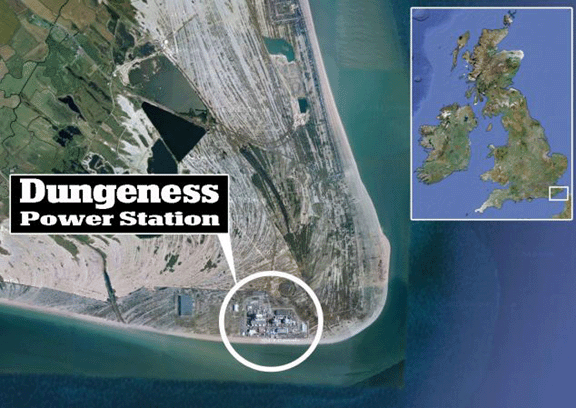
Reuters 8th April 2021, DF Energy, owned by French utility EDF, is exploring a range of scenarios for its Dungeness B nuclear plant in Britain, including bringing forward its decommissioning date of 2028, it said on Thursday. The 1.1 gigawatt Dungeness B plant, in Kent on the south coast of England, has been offline since 2018 as the company has been carrying out inspections and maintenance of pipes carrying steam to the turbine. EDF Energy has also been trying to complete repair work on corrosion identified during inspections of safety back-up systems.
The plant is currently forecast to return to service in August. It was designed in the 1960s and first started generating
electricity in 1983. EDF Energy said it has spent more than 100 million pounds ($138 million) on the plant during its current outage and it has a number of ongoing technical challenges that make its future uncertain.
New defects in France’s Flamanville nuclear project. Doubts that it will start-up on time, – or indeed ever!
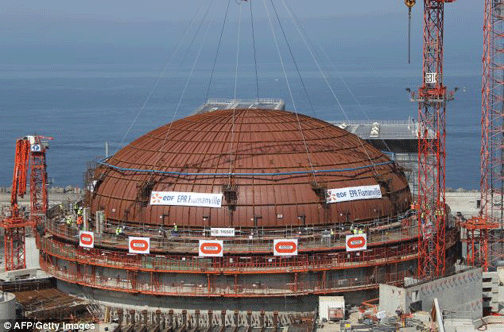
France Info 7th April 2021, Flamanville EPR: “The start-up does not seem possible before 2023” and we can doubt “that it will start one day”, according to negaWatt. “The decision to stop the costs is extremely difficult to take because we are talking about an investment of around 20 billion euros,” said energy expert and spokesperson for the association, Yves Marignac.
La Presse de la Manche 6th April 2021, The Nuclear Safety Authority was notified on March 17, 2021 of the late detection of faults in several pieces of equipment in reactors 1 and 2 at the Flamanville nuclear power plant, in the English Channel.
French Prime Minister visiting Algeria. The question of radioactive dust from nuclear tests will be on the agenda.
*Algeria – French Nuclear Testing**
French atomic tests in Algeria: so much brings the wind. The wind regularly
blows radioactive particles from the Sahara over Europe, a memory of the
atomic tests carried out in Algeria in the 1960s. Will the responsibility
of Paris be on the menu of Jean Castex’s visit to Algiers this weekend.
end?
Liberation 7th April 2021
On April 10 and 11, French Prime Minister Jean Castex will travel to
Algiers, accompanied by eight ministers – including the ministers of
foreign affairs and the armed forces to participate in the 5th session of
the France-Algeria High Level Intergovernmental Committee (CIHN). The
question of the health and environmental consequences of the 17 nuclear
tests carried out by France in the Sahara between 1960 and 1966, as well as
that of nuclear and non-nuclear waste left by France, will be on the menu
of discussions.
ICAN France 7th April 2021
http://icanfrance.org/alerte-presse-les-consequences-des-essais-nucleaires-francais-en-algerie/
Like the other nuclear powers, China wants to put a dirty great radioactive waste dump on indigenous land.
China’s $422m underground lab will probe massive national nuclear waste dump in remote Gansu, Global Construction Review,
9 April 2021 | By GCR Staff
China will spend $422m building an underground laboratory to find a way of storing high-level radioactive waste from the country’s growing fleet of nuclear power plants deep underground.
If successful, a repository that could store a hundred years worth of strontium-90, cesium-137 and plutonium-239 istopes will be built.
Building just the lab itself will be a feat. Wang Ju, vice-president of the Beijing Research Institute of Uranium Geology, told the China Daily newspaper that it would be sited in granite 560m below ground in the Beishan region of Gansu province, in China’s remote northwest . …………..
The offices and laboratories on the surface will have a floor area of 2.4ha within a 247ha site, however the underground complex will require the excavation of 514,200 cubic metres, along with 13.4km of tunnels. At present work is under way on supporting infrastructure, such as paved roads.
The lab, which was listed as a major scientific project in the 13th Five-Year Plan (2016-20), will take seven years to build. If its research proves successful, a long-term underground repository for high-level waste will be added nearby by 2050…….. https://www.globalconstructionreview.com/news/chinas-422m-underground-lab-will-probe-massive-nat/
Texas lawmakers want to ban dangerous radioactive waste.
Texas lawmakers want to ban dangerous radioactive waste.
Texas lawmakers want to ban dangerous radioactive waste. The proposal would give a nuclear waste company a big financial break.
A bill advancing in the House seeks to ban spent nuclear fuel, one of the most dangerous types of radioactive waste, from coming to Texas.
TEXAS TRIBUNE, BY ERIN DOUGLAS APRIL 8, 2021 As a nuclear waste company’s plan to store the most dangerous type of radioactive waste in West Texas moves forward at the federal level, state lawmakers are aiming to ban the materials from entering the state.
Environmental and consumer advocates for years have decried a proposal to build a 332-acre site in West Texas near the New Mexico border to store the riskiest type of nuclear waste: spent fuel rods from nuclear power plants, which can remain dangerously radioactive for hundreds of thousands of years.
A bill advancing in the House, filed by Rep. Brooks Landgraf, R-Odessa, whose district includes Andrews County — where the proposed facility would be located — seeks to stop the plan by banning that type of radioactive waste from being disposed of or stored in Texas.
But House Bill 2692 would also give that same company a big break on state fees it pays for its existing disposal facility for lower-risk radioactive waste.
“This bill bans high-level waste altogether,” Landgraf said during a committee hearing in March, “and focuses on making low-level waste the safest and best, most competitive and most efficient facility it can be.”
Waste Control Specialists has been disposing of the nation’s low-level nuclear waste, including tools, building materials and protective clothing exposed to radioactivity, for a decade in Andrews County. The company is currently pursuing, with a partner, a federal Nuclear Regulatory Commission license to store spent nuclear fuel on a site adjacent to its existing facility.
Waste Control Specialists and Interim Storage Partners — a joint venture between WCS and Orano USA, a subsidiary of one of the world’s biggest nuclear power companies — declined to comment on the proposed bill through a spokesperson.
Interim Storage Partners applied for the license in 2016. Scientists agree that spent nuclear fuel, which is currently stored at nuclear power plants, should be stored deep underground, but the U.S. still hasn’t located a suitable site. The Interim Storage Partners plan proposes storing it in above-ground casks until a permanent location is found. It expects federal regulators to make a decision sometime this year.
The plan faces stiff opposition from Gov. Greg Abbott, some oil companies that operate in the region and environmentalists over concerns about the risk of groundwater contamination and transportation accidents. Abbott wrote to federal regulators last year asking them to deny the license application, stating that the proposal presents a “greater radiological risk than Texas is prepared to allow.”………
The facility currently accepts Class A, B and C radioactive waste, which typically includes a wide range of contaminated items such as radioactive gloves, shoe covers and medical tubes. Some environmental and consumer advocates asked Landgraf to also include a ban on “greater than Class C” waste in his bill as well — it falls into what nuclear waste experts call a gray area between the lower-level categories and spent nuclear fuel. That type of waste is currently banned by the Texas Commission on Environmental Quality, but the Nuclear Regulatory Commission may soon consider regulations that would allow WCS to accept that waste.
Landgraf said he chose not to include a ban on that type of waste in the bill because it is technically not considered “high level” by the federal government, although it is currently treated that way for disposal purposes. Nuclear waste experts have told the Tribune that this category can be wide ranging, both in terms of danger and the time it will remain radioactive………….https://www.texastribune.org/2021/04/08/nuclear-waste-texas-ban/
-
Archives
- February 2026 (228)
- January 2026 (308)
- December 2025 (358)
- November 2025 (359)
- October 2025 (376)
- September 2025 (258)
- August 2025 (319)
- July 2025 (230)
- June 2025 (348)
- May 2025 (261)
- April 2025 (305)
- March 2025 (319)
-
Categories
- 1
- 1 NUCLEAR ISSUES
- business and costs
- climate change
- culture and arts
- ENERGY
- environment
- health
- history
- indigenous issues
- Legal
- marketing of nuclear
- media
- opposition to nuclear
- PERSONAL STORIES
- politics
- politics international
- Religion and ethics
- safety
- secrets,lies and civil liberties
- spinbuster
- technology
- Uranium
- wastes
- weapons and war
- Women
- 2 WORLD
- ACTION
- AFRICA
- Atrocities
- AUSTRALIA
- Christina's notes
- Christina's themes
- culture and arts
- Events
- Fuk 2022
- Fuk 2023
- Fukushima 2017
- Fukushima 2018
- fukushima 2019
- Fukushima 2020
- Fukushima 2021
- general
- global warming
- Humour (God we need it)
- Nuclear
- RARE EARTHS
- Reference
- resources – print
- Resources -audiovicual
- Weekly Newsletter
- World
- World Nuclear
- YouTube
-
RSS
Entries RSS
Comments RSS
 nuclear-news