USA’s nuclear rocket plan, and the Nazi history behind it.
The US plans to put a nuclear-powered rocket in orbit by 2025, David Hambling.. (subscribers only)
: https://www.newscientist.com/article/2274199-the-us-plans-to-put-a-nuclear-powered-rocket-in-orbit-by-2025/#ixzz6rrl4rEGB
Nuclear space craft very clearly is part of nuclear weapons programme
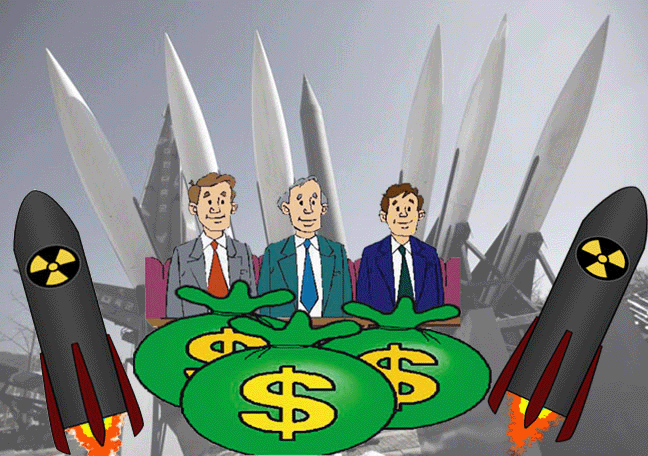
DARPA awards nuclear spacecraft contracts to Lockheed Martin, Bezos’ Blue Origin and General Atomics
PUBLISHED MON, APR 12 2021 HTTPS://WWW.CNBC.COM/2021/04/12/DARPA-NUCLEAR-SPACECRAFT-LOCKHEED-BEZOS-BLUE-ORIGIN-GENERAL-ATOMICS.HTML
The Pentagon’s DARPA awarded contracts to General Atomics, Lockheed Martin and Jeff Bezos’ space venture Blue Origin under the agency’s DRACO (Demonstration Rocket for Agile Cislunar Operations) program.
The Pentagon’s research and development arm on Monday awarded a trio of companies with contracts to build and demonstrate a nuclear-based propulsion system on a spacecraft in orbit by 2025.
General Atomics, Lockheed Martin and Jeff Bezos’ space venture Blue Origin won the Defense Advanced Research Projects Agency or DARPA awards, under the agency’s Demonstration Rocket for Agile Cislunar Operations program or DRACO.
The goal of the program is deceptively simple: Use a nuclear thermal propulsion system to power a spacecraft beyond low Earth orbit.
The problem of plutonium programs

Plutonium programs in East Asia and Idaho will challenge the Biden administration, Bulletin of the Atomic Scientists, By Frank N. von Hippel | April 12, 2021 Among the Biden administration’s nuclear challenges are ongoing civilian plutonium programs in China and Japan. Also, South Korea’s nuclear-energy research and development establishment has been asserting that it should have the same “right” to have a plutonium program as Japan. These challenges have been compounded by a renewed push by the Energy Department’s Idaho National Laboratory to revive a plutonium program that was shut down in the 1980s. These foreign and domestic plutonium programs are all challenges because plutonium is a nuclear-weapon material.
Henry Kissinger’s State Department quickly discovered that the governments of Brazil, Pakistan, South Korea, and Taiwan—all under military control at the time—had contracted for French or German spent-fuel “reprocessing” plants. The United States intervened forcefully and none of these contracts were fully consummated…………………..
…………….A possible path forward. During the Trump administration, the Energy Department fell back into the never-never land of plutonium-fueled reactors from which the United States extracted itself in the 1980s. Fortunately, the big-dollar commitments to the Versatile Test Reactor and the Natrium Reactor have not yet been made, and the Biden administration could use the excuse of budget stringency not to make those commitments.
In South Korea, the Biden administration will have to deal with the completion of the Idaho National Lab–Korea Atomic Energy Research Institute Joint Fuel Cycle Study. Although there will no doubt be obfuscation in the report, the conclusions of the 10-year study should have been obvious from the beginning: reprocessing is hugely costly, creates proliferation risks, and complicates spent fuel disposal. Fortunately, the anti-nuclear-energy Moon administration is unlikely to push for reprocessing. It will be much more interested in the opportunities that the Biden administration can provide to advance the Korean Peninsula denuclearization agenda. It should therefore be politically relatively easy for the Biden Administration to terminate cooperation on pyroprocessing.
China’s reprocessing and fast-neutron reactor program may be driven in part by China’s interest in obtaining more weapon-grade plutonium to build up the size of its nuclear arsenal. If that is the case, China’s incentive to build up could be reduced through nuclear arms control. Specifically, if China is building up its nuclear arsenal out of concern about the adequacy of its nuclear deterrent in the face of an unconstrained US missile-defense buildup, then the United States could examine the possibility of an agreement to limit missile defenses as an alternative to an open-ended, offense-defense arms race. That was the path of wisdom that the United States and Soviet Union chose with their 1972 Anti-Ballistic Missile Treaty.
In Japan, the Biden administration will be faced with the continued unwillingness of the powerful Ministry of Economics, Trade, and Industry to wind down Japan’s dysfunctional plutonium program. But, if a linkage could be made between constraining China’s nuclear buildup and ending Japan’s hugely costly reprocessing program, that might help tip the balance in Japan’s internal debate over reprocessing. https://thebulletin.org/2021/04/plutonium-programs-in-east-asia-and-idaho-will-challenge-the-biden-administration/?utm_source=Newsletter&utm_medium=Email&utm_campaign=MondayNewsletter04122021&utm_content=NuclearRisk_EastAsia_04122021
New nuclear power may not be feasible in USA – former NRC chair says
Former NRC chair questions economic feasibility of new nuclear in US, Utility Dive Iulia Gheorghiu. 12cApr 21,
Without further aid from Congress and the White House, the prospects for the U.S. nuclear industry will dwindle in the face of cheaper resources that are getting built faster than new nuclear generators, according to a former Chairman of the U.S. Nuclear Regulatory Commission………
Excepting NuScale Power, which has advanced in permitting with the NRC, the near-term potential for other small modular reactor designs to replace physical coal plants is “very low in the near future, like zero,” Allison Macfarlane, …..
The only U.S. reactors currently under construction continue to face delays. Vogtle Unit 3 and Unit 4 are poised to be the first nuclear plants completed in the United States [since 2016]……….
Excepting NuScale Power, which has advanced in permitting with the NRC, the near-term potential for other small modular reactor designs to replace physical coal plants is “very low in the near future, like zero,” Allison Macfarlane, …..
The only U.S. reactors currently under construction continue to face delays. Vogtle Unit 3 and Unit 4 are poised to be the first nuclear plants completed in the United States [since 2016]……….
Georgia Power, one of the owners of the two nuclear reactors at Vogtle Power Plant, recently announced construction remediation work, signaling further delays for the unit that is expected to be operational later this year.
“If we don’t pay attention to this issue, there is no future for nuclear, you will not build anything. It will all be too expensive, it will all take too long,” she said.
She remarked on supply chain issues with larger designs, such as the Westinghouse AP1000 design, a pressurized water reactor power plant that was used in V.C. Summer and Vogtle construction.
“The AP1000 is a good design, but it may be a dead design,” Macfarlane said. https://www.utilitydive.com/news/former-nrc-chair-questions-economic-feasibility-of-new-nuclear-in-us/598188/
Bitcoin: cryptocurrency an extreme energy user. Can it be justified in a climate emergency?

This is a critically important article. As long as multi billionaires like Elon Musk and Bill Gates are accepted as authorities of integrity, on what direction society should take, we are in trouble. Both of these visionary zealots are enthusiastic about nuclear power. Both are enthusiastic about nuclear-powered space rocketry. Elon Musk is all for Bitcoin. I don’t know about Bill Gates’opinion on this. While we acknowledge thsat these entrepreneurs have made beneficial achievements, we really do not need to minlessly follow them. Neither are really scientific experts, and should not in any way be determining society’s policies on climate, or anything else. Neither show any awareness of concern about unlimited growth and unlimited energy use, on a finite planet.
A new “crypto climate accord” wants to clean up Bitcoin. But the calls for government regulation, bans and taxation are growing. The post Can cryptocurrency be justified in a climate catastrophe? appeared first on RenewEconomy.
Can cryptocurrency be justified in a climate catastrophe? — RenewEconomy
Bitcoin mining and cryptocurrency in general are having what could very loosely be sort of described as a ‘coming of age’ moment. It’s loose because advocates of these digital currencies, which obtain ‘trust’ from requiring massive amounts of energy to generate (‘proof of work’), don’t seem to be handling the challenges of dealing with key issues like climate and environment particularly well.
This was explored recently in RenewEconomy, in this post detailing how there are many Bitcoin mining operations running massive server farms that either exist on carbon intensive grids, or even directly use fossil gas on mining sites where that gas would have otherwise been flared.
And last week, we covered a piece of research that predicted Bitcoin’s energy consumption will match that of Australia’s by the year 2024.
“Under the Paris Agreement, China is devoted to cut down 60 per cent of the carbon emission per GDP by 2030 based on that of 2005. However, according to the simulation results of the [blockchain carbon emission] model, we find that the carbon emission pattern of Bitcoin blockchain will become a potential barrier against the emission reduction target of China”, the researchers found. It’s significant, because the fate of China on energy and climate decides, by and large, the fate of the world.
Part of the reason interest has increased in Bitcoin was a significant purchase of it by Tesla. CEO Elon Musk is a well-known fan of cryptocurrency, including Dogecoin, an alternative to the more mainstream Bitcoin. But scrutiny of its extreme energy consumption, alongside a lack of any real sustainability or environment initiatives across the industry of Bitcoin miners, has led to nearly months now of constant criticism (including from this author).
Now, a new initiative is attempting to change that at a surprisingly ambitious and fundamental level. Last week, a range of organisations launched the ‘Crypto Climate Accord’, aiming to decarbonise the entire cryptocurrency industry, including Bitcoin trading house Coinshares.
Among the partners are the Rocky Mountain Institute (RMI), well-regarded among energy experts, and representations from the United Nations Framework Convention on Climate Change (UNFCCC). Energy Web and the Alliance for Innovative Regulation (AIR) are involved too, as are the cryptocurrency companies.
“The Accord intends to achieve this by working collaboratively with the cryptocurrency industry — including all blockchains — to transition to 100% renewable energy by 2025 or sooner. While many organisations are individually taking steps to decarbonise their operations, the Accord recognises that an industry-wide coalition and scalable solutions can quickly multiply impact.”
Total decarbonisation of power by 2025 comes along with full decarbonisation of all business operations by 2040, and with the active removal of historical emissions from the Earth’s atmosphere by 2040. These are both genuinely ambitious goals, and they seem to be closely tied to international climate diplomacy. It is a far cry from the decentralised, regulation-hating, unaccountable world of Bitcoin mining as it exists today.
While this seems like a step in the right direction, it is very likely its advocates will be swimming against the tide. The very philosophy of collective action to take responsibility for the externalities of profit-making business is contrary to the libertarian values of individual freedom. Some participants may not be all that invested. “Coinshares less than two weeks ago was arguing more energy consumption is about the best thing ever. I’m not sure how this is inspired by the Paris Agreement if they’ve clearly never read it or don’t understand it”, wrote Alex De Vries, author of the Digiconomist blog.
Meanwhile, Bitcoin seems only to be getting hungrier for energy, and there doesn’t seem to be much effort to direct that big ship towards clean power sources only. Cheap coal and gas will likely get cheaper, as they both get displaced from grids by renewable energy.
The Centre for Global Development just released a new analysis showing that mining a single Bitcoin is equivalent to the total annual energy usage of 18 Americans, or 2,199 Tanzanians.
They recommend a range of policy options to forcibly clamp down on the problem, including a ban of large mining operations and taxing mining activity. Neither of these will be welcomed by the industry. “The most hopeful case for the environment is that the price of bitcoin falls low enough to push most miners out of business, leaving behind only those with access to cheap renewable energy and the most efficient mining rigs”, they write.
The question is whether voluntary accords or forcible regulation win out in cleaning up Bitcoin. The alternative is very ugly – a major new threat to climate action at a sensitive time indeed.
Reforms needed at Canadian Nuclear Safety Commission ~ Hill Times letter to the editor — Concerned Citizens of Renfrew County and Area
April 12, 2021 https://www.hilltimes.com/2021/04/12/reforms-needed-at-canadian-nuclear-safety-commission/292381 Canada’s nuclear regulatory agency, the Canadian Nuclear Safety Commission says it’s the “World’s best nuclear regulator” on its website. That “self-image” of the CNSC’s is inconsistent with statements made in recent years by international peer reviewers, high-ranking Canadian officials, international nuclear proponents and others. The International Atomic Energy Agency recently reviewed Canada’s nuclear […]
Reforms needed at Canadian Nuclear Safety Commission ~ Hill Times letter to the editor — Concerned Citizens of Renfrew County and Area
Scottish Greens’ manifesto includes pledge to force Westminster to remove nuclear subs from Faslane.
Morning Star 11th April 2021, Scottish Greens’ manifesto includes pledge to force Westminster to remove
nuclear subs from Faslane. The party policy would amend the Marine Scotland
Act under Holyrood’s devolved powers to make it impossible for the navy
to operate Trident from Faslane, banning “the movement of nuclear weapons
through Scottish waters.”
The United States collaborates on nuclear pyroprocessing with South Korea.

Plutonium programs in East Asia and Idaho will challenge the Biden administration, Bulletin of the Atomic Scientists, By Frank N. von Hippel | April 12, 2021, ”…………………………………The United States collaborates on pyroprocessing with South Korea. The Idaho and Argonne National Laboratories also continue to promote the pyroprocessing of spent fuel. After the Clinton Administration shut down the Experimental Breeder Reactor II in 1994, the laboratory persuaded the Energy Department to continue to fund pyroprocessing as a way to process Experimental Breeder Reactor II spent fuel and blanket assemblies into stable waste forms for disposal in a deep underground repository. The proposal was to complete this effort in 2007. According to a review by Edwin Lyman of the Union of Concerned Scientists, however, as of the end of Fiscal Year 2016, only about 18 percent of the roughly 26 metric tons of assemblies had been processed at a cost of over $200 million into waste forms that are not stable. (Since then, an additional three percent has been processed.)
During the George W. Bush administration, Vice President Cheney accepted Argonne’s argument that pyroprocessing is “proliferation resistant” and the two US national laboratories were allowed to share the technology with the Korea Atomic Energy Research Institute.
At the beginning of the Obama administration, however, a group of safeguards experts from six Energy Department national laboratories, including Argonne and Idaho, concluded that pyroprocessing is not significantly more resistant to proliferation than PUREX, the standard reprocessing technology originally developed by the United States to extract plutonium for its weapons.

In 2014, the US-Republic of Korea Agreement for Cooperation on the Peaceful Uses of Atomic Energy was due to expire, but the negotiations on a successor agreement bogged down over Korea’s insistence that the new agreement include the same right to reprocess spent fuel as the 1988 US-Japan Agreement for Cooperation.
The compromise reached the following year was that the Korea Atomic Energy Research Institute and the Idaho National Laboratory would complete their Joint Fuel Cycle Study on “the technical, economic, and nonproliferation (including safeguards) aspects of spent fuel management and disposition technologies.” If the United States could be convinced that the proliferation risks of pyroprocessing were manageable, the secretary of energy would give consent for South Korea to use the technology on its territory. The final report from the joint study is due this year.
Meanwhile, in 2017, Moon Jae-in was elected president of the Republic of Korea on a platform that included not building any more nuclear power plants in South Korea. Fast-neutron reactors and pyroprocessing obviously do not fit with that policy. This gives the Biden administration an opportunity to end a cooperative nuclear-energy research and development program that is contrary to both US nuclear nonproliferation policy and South Korea’s energy policy. The United States could propose instead a joint collaborative program on safe spent fuel storage and deep underground disposal……………https://thebulletin.org/2021/04/plutonium-programs-in-east-asia-and-idaho-will-challenge-the-biden-administration/?utm_source=Newsletter&utm_medium=Email&utm_campaign=MondayNewsletter04122021&utm_content=NuclearRisk_EastAsia_04122021
The National 12th April 2021
The National 12th April 2021, When Scotland becomes an independent country, weapons of mass destruction
will be removed from the Clyde.
Nuclear warheads are only stored at HMNB Clyde for the sole purpose of being mated to Trident II D-5 missiles before
they are loaded onto nuclear submarines. As is widely known, as part of the agreement made by the Thatcher and Reagan governments, the UK’s missiles are maintained by the United States at Kings Bay Georgia, as part of a
shared pool.
China’s ambiguous plutonium policy.

Plutonium programs in East Asia and Idaho will challenge the Biden administration, Bulletin of the Atomic Scientists, By Frank N. von Hippel | April 12, 2021 ”…………………….China’s ambiguous plutonium policy. China is estimated to have produced between 2.3 and 3.5 tons of weapon-grade plutonium before it halted production in 1988. China is also estimated to have doubled the number of its nuclear warheads since the end of the Cold War to about 300, with a public call from one government-owned journal for a further increase to 1000.
That would require more weapon-grade plutonium.
China is, in fact, building a “demonstration” reprocessing plant and two plutonium breeder reactors. Breeder reactors produce weapon-grade plutonium in the uranium “blankets” surrounding their cores. This plutonium ordinarily would be mixed in with the non-weapon-grade plutonium recovered from the core and recycled into new fuel, but could be kept separate and used for weapons.
One troubling development that suggests that China may be reconsidering the civilian character of its plutonium program is that, since 2017, it has halted making the public annual declarations to the International Atomic Energy Agency of its civilian plutonium stocks required by the Guidelines for the Management of Plutonium. China was one of nine countries, including France and the United States, that committed to make those declarations starting in 1997. An International Atomic Energy Agency official has informed me that that the agency “does not request those member states to submit updates and has no role in connection with the implementation of these voluntary commitments.” One of the other states that are parties to the guidelines could, however, ask China why it has stopped submitting updates.
China’s National Nuclear Corporation has been negotiating since 2007 with France’s Orano to purchase technology for a large reprocessing plant like Japan’s that could separate up to eight tons of reactor-grade but weapon-usable plutonium per year. France’s finance minister said in 2018 that the sale could “save” France’s nuclear industry.
Unless the economic competitiveness of breeder reactors proves to be better in China than elsewhere, however, the rate of plutonium separation by the French plant would be vastly in excess of the amount that China could use to start a realistic number of breeder prototypes. Other countries, including France, Japan, Russia, and the United Kingdom, have been down this road before and ended up with huge stocks of reactor-grade plutonium (Figure 1 on original). One would hope that China would learn from rather than emulate their folly.
The Biden administration should engage France on the wisdom of Orano’s continued promotion of plutonium separation worldwide through offers of both reprocessing services and technology.
If China moves ahead with its own large-scale reprocessing program, it will make it more difficult to pressure Japan to end its plutonium program, which both countries clearly understand provides Japan with a nuclear-weapon option.
The Obama administration suggested to Beijing a bilateral multidisciplinary dialogue on pros and cons of civilian reprocessing. The Biden administration could press again for such a private discussion. Perhaps, backing away from reprocessing would become more attractive in both Beijing and Tokyo if they made their decisions in parallel…………..https://thebulletin.org/2021/04/plutonium-programs-in-east-asia-and-idaho-will-challenge-the-biden-administration/?utm_source=Newsletter&utm_medium=Email&utm_campaign=MondayNewsletter04122021&utm_content=NuclearRisk_EastAsia_04122021
This week in nuclear news

Forgive me for being so remiss – I’ve neglected to cover Prince Philip’s funeral. He deserves remembering for some good work that he did for the environment.
NUCLEAR. Heightened anxiety about keeping, repairing the Iran nuclear agreement, and a suspicious accident at Iran’s nuclear enrichment site. Continued pressure from the nuclear lobby to get Europe to decide that nuclear power is “clean and green”.
CORONAVIRUS . The news is not good. A”shocking imbalance” in the distribution of coronavirus vaccines between rich and poor countries. Covid cases, deaths surging around the world as variants spread, vaccination lags.
CLIMATE. Radio Ecoshock covers the issue of Future Cities: Hot and Flooded.
A bit of good news – COVID-19 success story for Rwanda is a wake-up call for wealthy West.
Investigative journalism – “Fair” exposes in detail how corporate media uses “Tropes” to win intelligent people over to USA militarism.
Two years since Julian Assange was seized from the Ecuadorian Embassy.
Let’s get rid of nuclear weapons before they ruin us. Artificial Intelligence and the risk of catalytic nuclear war.
U.S. – China co-operation on cyber security.
Nuclear power – a way to stop other, faster, and cheaper, climate solutions. Despite the influence of Bill Gates, experts find that nuclear power is the wrong climate solution.
Japanese engineering firm EPC joins with NuScale in small modular reactor investment.
Racism, inequities move to the center of the climate debate.
Rapid global increase in energy consumption.
IRAN. Accident at Iran’s Natanz nuclear station. Iran calls Natanz nuclear enrichment site blackout ‘nuclear terrorism’. Iran nuclear talks to continue next week after breakthrough. It’s getting too late for an effective missile deal with Iran. Iran frees South Korean ship as more nuclear talks planned in Vienna.
GREENLAND. Opposition to uranium and rare earths mining – party wins Greenland election
EUROPE. Greenpeace warns European Commission on nuclear energy classification. Dodgy European Taxonomy report was favourable to nuclear power – but it’s far from a done deal. Nuclear nation France exerted pressure on European Commission. Climate taxonomy deal threatened by possible inclusion of nuclear as ”virtuous”.
FRANCE. France fully nationalises debt-laden EDF nuclear company, – EDF can now focus on renewable energy. New defects found in France’s Flamanville nuclear project. Doubts that it will start-up on time, – or indeed ever!.
CANADA. Canada’s tax-payer funded small nuclear reactors unlikely to succeed. Pickering Nuclear plant at risk of ‘Fukushima-type accident.
NORTH KOREA. North Korea’s new tactical nuclear weapons means new dangers, new U.S. strategy needed.
SOUTH KOREA. Climate change probably increasing this problem – nuclear reactors halted because of jellyfish-like sea salps.
JAPAN. Crookedness, fraud, in 10 years of Fukushima nuclear clean-up. Japanese government and Tepco must pay monthly compensation to 3550 Fukushima residents displaced due to continued radioactivity. Japan’s Prime Minister getting ready to release Fukushima waste water into the Pacific ocean? Japan poised to release Fukushima nuclear cooling water into the sea. 4,000 Fukushima waste bags contain unidentified radioactive materials.
Japanese government continues Japan’s ”Nuclear Village” generous grants to keep ageing nuclear reactors going. Niigata governor wants Japan’s Nuclear Regulator to reassess Tepco, following security lapses. Japan halts restart of nuclear plant over poor anti-terror measures. Japan has the ability to become both coal-free and nuclear-free.
USA.
- Pentagon and tax cheats already cost taxpayers far more than Biden’s job plan. Biden’s Announcement That Trump Got Military Spending Just Right Is Dead Wrong . Scientists urge Biden administration to reduce spending on nuclear weapons.
- Ohio’s Electric Power Association happy to see the end of customer-funded nuclear subsidies.
- Records falsified at Turkey Point nuclear power station.
- An American village made dependent on the nuclear industry. Perry schools’ crisis if the nuclear power station shuts down.
- Nuclear waste director: Proposed New Mexico nuclear waste storage facility is illegal, Texas lawmakers want to ban dangerous radioactive waste.
- Explanation of a nonsense tweet from U.S. Strategic Command.
UK. UK losing credibility with its new, ambiguous, nuclear weapons policy. Sleekit’ increase in Trident nuclear warheads on the Clyde.
Britain needs to rethink – whether it really needs new nuclear power, in view of tensions with the supplier, China. Chinese-French nuclear power station planned for Bradwell UK – issues raised that might prevent its construction. Uncertain future for EDF’s Dungeness nuclear power station. It may have to shut down early.
POLAND. In a positive move, Polish utilities remove their investment from nuclear power development.
RUSSIA. Russia planning to test a ‘doomsday’ nuclear-powered torpedo in the Arctic. Putin amassing, testing, huge military arsenal in the Arctic.
CHINA. Bitcoin mining to consume more electricity than whole of Australia by 2024. Like the other nuclear powers, China wants to put a dirty great radioactive waste dump on indigenous land.
ALGERIA. French Prime Minister visiting Algeria. The question of radioactive dust from nuclear tests will be on the agenda.
SOUTHEAST ASIA. Southeast Asia can leapfrog uncompetitive nuclear energy, and go straight to renewables.
AUSTRALIA. There’s a long and devastating history behind the proposal for a nuclear waste dump in South Australia. Who Says There Is No Kimba Dump Opposition? Australia’s part in continuing nuclear havoc in Pacific islands – legacy of atomic bomb tests.
Two years since Julian Assange was seized from the Ecuadorian Embassy
the Biden administration has continued Trump’s pursuit of the WikiLeaks founder—in 2010, Biden had labelled him a “high-tech terrorist”.

Two years since Assange was seized from the Ecuadorian Embassy, World Socialist Website, Thomas Scripps, 9 April 2021 Two years ago on Sunday, WikiLeaks founder Julian Assange was seized from the Ecuadorian embassy in London. He has been incarcerated ever since, fighting extradition to the United States where he faces life imprisonment in barbaric conditions for exposing war crimes, coup plots, mass state surveillance, torture and corruption.
On April 11, 2019, Assange’s political asylum status was revoked by the Ecuadorian government and British police entered the embassy building, dragging him away. The recently published diaries of former Foreign Office minister Sir Alan Duncan confirm the involvement of the highest levels of the state in this lawless operation.
Duncan explains how he watched the police raid on a live feed from the “Operations Room at the top of the Foreign Office.” Codenamed “Pelican”, Duncan recalled how one of its officials looked on, “wearing a pelican-motif tie.” Duncan’s diary entry concludes, “So, job done at last—and we take a commemorative photo of Team Pelican. It had taken many months of patient diplomatic negotiation, and in the end it went off without a hitch. I do millions of interviews, trying to keep the smirk off my face.”
The sadism of the British state’s snatch-and-grab operation was matched only by the degraded efforts of the pseudo-left to vilify Assange and blacken his reputation in support of a manufactured sexual assault investigation launched by Sweden in 2010. Rightly fearing that his extradition to Sweden would be a stepping-stone to US extradition, Assange sought asylum in the Ecuadorian embassy. While he was there, his former “media partners”, most prominently the Guardian, and an international roll call of pseudo-left groups, launched a despicable years’ long slander campaign to smear him as a sexual predator………………
The Trump administration, it was later revealed, was working with the CIA to spy on Assange, including his privileged communications with lawyers and doctors, and to steal his personal documents. CIA operatives discussed plans for Assange’s kidnap or assassination, until Ecuadorian President Lenin Moreno agreed to turn him over to the UK police.
Once in the hands of the British state, Assange was subjected to two years of pseudo-legal persecution, culminating in a degrading show trial. Hauled in front of Westminster Magistrates Court just hours after he was seized from the embassy, Assange was found guilty of violating bail. District judge Michael Snow declared, “His assertion that he has not had a fair hearing is laughable. And his behaviour is that of a narcissist who cannot get beyond his own selfish interests.”………..
Assange’s time in Belmarsh was characterised by the repeated and flagrant denial of his legal rights, aimed at crushing him and which left him suicidal. He was repeatedly denied proper access to his lawyers and to materials necessary to prepare his defence. When Assange reached the end of his sentence, District Judge Vanessa Baraitser ordered that he continue to be held in Belmarsh on remand. During the initial week of Assange’s extradition hearing, held in February 2020 at Woolwich Crown Court, he was held in a glass box, with Baraitser preventing him from speaking or communicating effectively with his lawyers. He was stripped twice and handcuffed 11 times on the first day.
In the run-up to the main hearing at Westminster Magistrates Court in September 2020, Assange was repeatedly denied bail, even as COVID-19, to which he is especially vulnerable on account of a respiratory condition, ripped through Belmarsh prison.
The US government used this time to develop its monstrous assault on democratic rights. The initial indictment of the WikiLeaks founder, unsealed on the day of his seizure from the embassy, charged him with conspiracy to commit computer intrusion, with a maximum sentence of five years. On May 23, 2019, the US unveiled 17 new charges under the 1918 Espionage Act with a combined potential sentence of 170 years. These charges have chilling implications for freedom of the press, criminalising basic journalistic practices and holding them tantamount to treason or espionage.
Another superseding indictment was issued on June 24, 2020, after one phase of Assange’s hearing had been completed and a matter of weeks before the defence was due to submit its skeleton argument for the second. Besides being a gross abuse of due process, the new indictment, based largely on testimony from FBI informants with histories of fraud and entrapment, expanded the framework of the charges to an even wider range of journalistic activity.
The immense significance of WikiLeaks’ and Assange’s journalism, and the criminality of their persecution, was underscored at his hearing in September. Dozens of witnesses spoke to WikiLeaks’ pioneering source protection and the global impact of releases like the Collateral Murder video, revealing the massacre of Iraqi civilians, journalists and first responders by a US Apache helicopter gunship. The US case was exposed as a groundless, vindictive witch-hunt designed to destroy Assange and set a dictatorial precedent for what will happen to any journalists who dare expose imperialist crimes.
With a ruling in favour of extradition considered all but assured, Baraitser delivered a surprise decision against on January 4 of this year. But her politically calculated ruling blocked the extradition request solely on the grounds that it would be oppressive by reason of Assange’s compromised mental health and his risk of suicide if he were imprisoned in the US. She accepted every other element of the prosecution’s case, including its denial of free speech and freedom of the press, and its justification of the abuse of Assange’s democratic rights.
This left the gate wide open to a US appeal. The US Department of Justice quickly responded, “While we are extremely disappointed in the court’s ultimate decision, we are gratified that the United States prevailed on every point of law raised. In particular, the court rejected all of Mr. Assange’s arguments regarding political motivation, political offense, fair trial, and freedom of speech. We will continue to seek Mr. Assange’s extradition to the United States.”………
the Biden administration has continued Trump’s pursuit of the WikiLeaks founder—in 2010, Biden had labelled him a “high-tech terrorist”. As the World Socialist Web Site and the International Committee of the Fourth International (ICFI) have warned, Assange’s persecution is integral to the war drive of US imperialism, escalated by Trump and now intensified by his successor.
Biden has engaged in an aggressive anti-China campaign and is whipping up anti-Chinese xenophobia at home, promoting conspiracy theories on the origin of COVID-19. The US and its allies stand on a cliff edge with Russia over Crimea and eastern Ukraine, with NATO’s endless anti-Russia provocations and proxy incursions threatening to spill into war.
Military conflicts of such catastrophic scope can only be pursued abroad by destroying democratic rights at home. WikiLeaks’ releases of the Afghanistan and Iraq war logs were a spark to mass anti-war sentiment all over the world. The ruling class in the imperialist countries around the world are determined to prevent their war plans and crimes being reported and have sought to crack down on left-wing, socialist and anti-war opposition. The Assange case is emblematic of this turn to dictatorship.
In the two years since Assange’s arrest, two sharply opposed political perspectives have defined themselves in the fight for his freedom. The official campaign, run by Don’t Extradite Assange (DEA), has based itself on rotten appeals to the state and its representatives. The DEA’s first champion was former Labour leader Jeremy Corbyn. Throughout the 2019 general election, as leader of the Labour Party, Corbyn maintained a politically criminal silence on Assange, blocking the development of a mass movement against British and US imperialism to secure his freedom. When Corbyn did finally speak, it was to appeal to Boris Johnson and the British justice system that had trampled Assange’s democratic rights………..
The pandemic has proved beyond all doubt that there is no constituency in the ruling class for even the most basic democratic rights, including the right to protest and assembly and the right to life. It has responded to the virus with a policy of social murder and by advancing its preparations for state repression and war on a vast scale……….
On the second anniversary of the WikiLeaks founder’s seizure, we reaffirm our demand for Assange’s immediate, unconditional freedom and our commitment to a programme of class struggle to achieve it. https://www.wsws.org/en/articles/2021/04/10/assa-j01.html?pk_campaign=assange-newsletter&pk_kwd=wsws
Iran calls Natanz nuclear enrichment site blackout ‘nuclear terrorism’
Iran calls Natanz nuclear enrichment site blackout ‘nuclear terrorism’, ABC, 12 Apr 21, A blackout at Iran’s Natanz nuclear facility on Sunday was an act of “nuclear terrorism”, according to the country’s nuclear chief, Ali Akbar Salehi.
Key points:
- Multiple Israeli media outlets reported a cyberattack caused the blackout
- The incident took place a day after Tehran launched advanced uranium enrichment centrifuges
- Israel has not claimed responsibility for the attack
While there was no immediate claim of responsibility, suspicion fell immediately on Israel, where its media nearly uniformly reported a devastating cyberattack orchestrated by the country caused the blackout.
Earlier on Sunday, a spokesman for the country’s Atomic Energy Organisation (AEOI) said that a problem with the electrical distribution grid of the Natanz site had caused an incident, Iranian media reported.
The spokesman said that “the incident caused no casualties or contamination”.
The incident took place a day after Tehran launched new advanced uranium enrichment centrifuges at the site……… https://www.abc.net.au/news/2021-04-12/iran-calls-natanz-atomic-site-blackout-nuclear-terrorism/100062156
Britain needs to rethink – whether it really needs new nuclear power, in view of tensions with the supplier, China.

For the UK government, the question is whether a new generation of nuclear power is as necessary as it seemed a decade ago. Financing challenges, rising costs and endless delays have all made nuclear less attractive, while the costs of alternative sources of supply such as offshore wind have fallen sharply.
How growing conflict with China could impact UK nuclear power, Given the tension between the two countries, the UK is unlikely to give China access to its nuclear energy. But a trade dispute would affect us more than them, Prospect 10th April 2021, By Nick Butler
”………. The deterioration of relations between London and Beijing, for instance, now threatens to derail the development of nuclear power in the UK and force a rethink of Britain’s energy policy.
A decade ago, China was the new strategic ally of the British government under David Cameron and George Osborne, a potential counterweight to dependence on either the European Union or the United States. Chinese investors were invited in—not least the fledgling Chinese nuclear industry, which sought to use Britain as a stepping stone to penetrate world markets. The stepping stone took the form first of an investment in the new nuclear plants being developed by the French state company EDF, including the Hinkley Point C project in Somerset, and then a Chinese-led project to build, own and operate a further nuclear reactor at Bradwell in Essex.
The intervening period has seen state-to-state relations sour. ……………………..
Given the divisions which have emerged, it is impossible to envisage the UK government now giving approval to the development of the Bradwell power station. The reason, of course, has nothing to do with the technology or the competence of China General Nuclear Power Group (the Chinese company involved). China has become a leading player in the global nuclear power business. The problem is that nuclear power stations are part of the UK’s strategic national infrastructure, and China is no longer a friend to be trusted with such levers of power. China’s recent behaviour has compounded the doubts which already existed around the wisdom of giving it control of nuclear capacity and open access to the UK’s national grid.
China, however, would with some justification regard the postponement or cancellation of the Bradwell project as a breach of contract. If China decides that the link with EDF to finance a third of the costs of Hinkley and contribute to other French-led projects was conditional on Bradwell, CGNP could end its involvement and demand its money back.
For the UK government, the question is whether a new generation of nuclear power is as necessary as it seemed a decade ago. Financing challenges, rising costs and endless delays have all made nuclear less attractive, while the costs of alternative sources of supply such as offshore wind have fallen sharply. With the exception of the hope that the smaller scale modular reactors being developed by Rolls-Royce can provide some additional capacity in the 2030s and beyond, nuclear power is barely mentioned in the government’s recent statements on its plans for reducing the use of hydrocarbons and cutting emissions. For the immediate future, given that Hinkley is still the only new reactor under construction in the UK, everything depends on the reliability of the existing nuclear plants—most of which have been in operation since the 1980s……. https://www.prospectmagazine.co.uk/world/nuclear-investment-power-uk-china-government-energy
Pentagon and Tax Cheats Already Cost Taxpayers Far More Than Biden’s Job Plan
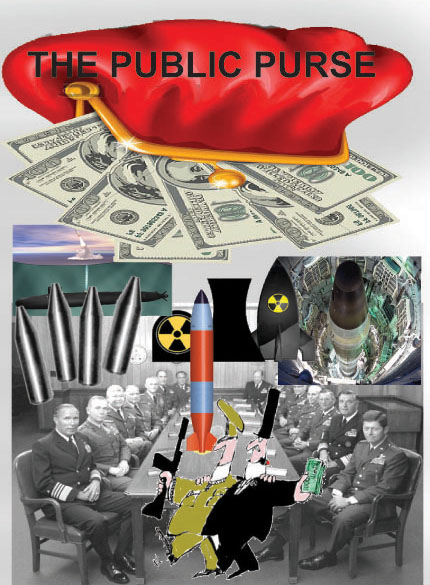
Pentagon and Tax Cheats Already Cost Taxpayers Far More Than Biden’s Job Plan, BY Lindsay Koshgarian, Truthout, April 11, 2021
As President Biden’s $2.3 trillion jobs plan too big? Conservatives are arguing that the package is too expensive and its broad reach is unnecessary.
In order to assess the size and necessity of the bill, it’s important to situate Biden’s jobs plan within a larger federal budget context. Looking at the spending patterns going back decades, the upshot is that the Biden plan is really not all that big, especially given how overdue it is. In fact, progressives have argued that the package, while ambitious in its aims, doesn’t provide enough resources. The plan as proposed is less ambitious than Biden’s campaign proposals, and it already enjoys widespread popularity. There’s plenty of room to make this bill larger, and to make that easier by cutting some of the most egregious uses of federal dollars.
$2.3 trillion sounds like a lot, and it is. But trillions have been spent and are still spent every year in the course of normal government business, on everything from wars and weapons to much-needed but exclusionary social programs like the GI Bill, to tax cuts for corporations and the wealthy. To reach the level of spending that is really needed to solve problems like climate change and inequality, it will be necessary to be as bold with this jobs package as the country has been with so many other costly endeavors………
War Spending: $6.4 Trillion
Over the past 20 years, the U.S. has spent $6.4 trillion on wars that have served only to further destabilize the Middle East, cause hundreds of thousands of deaths and enrich military contractors. If that money had been spent on infrastructure and clean energy instead of destructive and deadly wars, the U.S. could have had a fully renewable energy grid by now. The Pentagon is one of the most egregious uses of trillions of dollars.
That $6.4 trillion doesn’t even include the regular, non-war Pentagon budget. President Biden’s $2.3 trillion jobs package works out to about $280 billion a year. The last time the military budget was less than that amount was 1951.
Just a week after announcing his jobs plan, President Biden released a budget proposal that pegged Pentagon spending at $753 billion. That’s more than the $740 billion the Pentagon got this year under President Trump, and it’s more than two and a half times the annual value of the jobs proposal. Every year in recent memory, the Pentagon has accounted for more than half of the discretionary federal budget that Congress allocates each year………..https://truthout.org/articles/pentagon-and-tax-cheats-already-cost-taxpayers-far-more-than-bidens-job-plan/?eType=EmailBlastContent&eId=bc86a7bb-082f-4047-add9-9379daa553e8
-
Archives
- February 2026 (228)
- January 2026 (308)
- December 2025 (358)
- November 2025 (359)
- October 2025 (376)
- September 2025 (258)
- August 2025 (319)
- July 2025 (230)
- June 2025 (348)
- May 2025 (261)
- April 2025 (305)
- March 2025 (319)
-
Categories
- 1
- 1 NUCLEAR ISSUES
- business and costs
- climate change
- culture and arts
- ENERGY
- environment
- health
- history
- indigenous issues
- Legal
- marketing of nuclear
- media
- opposition to nuclear
- PERSONAL STORIES
- politics
- politics international
- Religion and ethics
- safety
- secrets,lies and civil liberties
- spinbuster
- technology
- Uranium
- wastes
- weapons and war
- Women
- 2 WORLD
- ACTION
- AFRICA
- Atrocities
- AUSTRALIA
- Christina's notes
- Christina's themes
- culture and arts
- Events
- Fuk 2022
- Fuk 2023
- Fukushima 2017
- Fukushima 2018
- fukushima 2019
- Fukushima 2020
- Fukushima 2021
- general
- global warming
- Humour (God we need it)
- Nuclear
- RARE EARTHS
- Reference
- resources – print
- Resources -audiovicual
- Weekly Newsletter
- World
- World Nuclear
- YouTube
-
RSS
Entries RSS
Comments RSS
 nuclear-news