The danger of Japan dumping Fukushima wastewater into the ocean
The danger of Japan dumping Fukushima wastewater into the ocean, https://thehill.com/opinion/energy-environment/548726-the-danger-of-japan-dumping-fukushima-wastewater-into-the-ocean
BY RICK STEINER,— 04/17/21 The Japanese government just announced that it intends to release over 1.2 million tons of radioactive wastewater from the Fukushima Nuclear Power Plant into the North Pacific. This would result in dangerous radionuclides flowing across the ocean to Russia, Alaska, Canada, Hawaii and the U.S. West Coast. The release of this material — which is strongly opposed by local scientists and residents in Japan — would begin in two years and continue for another 40 years.
The Biden administration must urge Japan to abandon this unnecessary and dangerous plan.
The 2011 Fukushima nuclear disaster was caused by the 9.1 magnitude Tohoku earthquake and a 14-meter-high tsunami. The tsunami flooded and disabled emergency generators needed to pump cooling water into the nuclear reactor cores, causing three reactor core meltdowns and hydrogen explosions. Radionuclides flowed eastward across the Pacific and were eventually found in waters off California, Hawaii, Oregon, Washington, British Columbia and Alaska. We all live downstream.
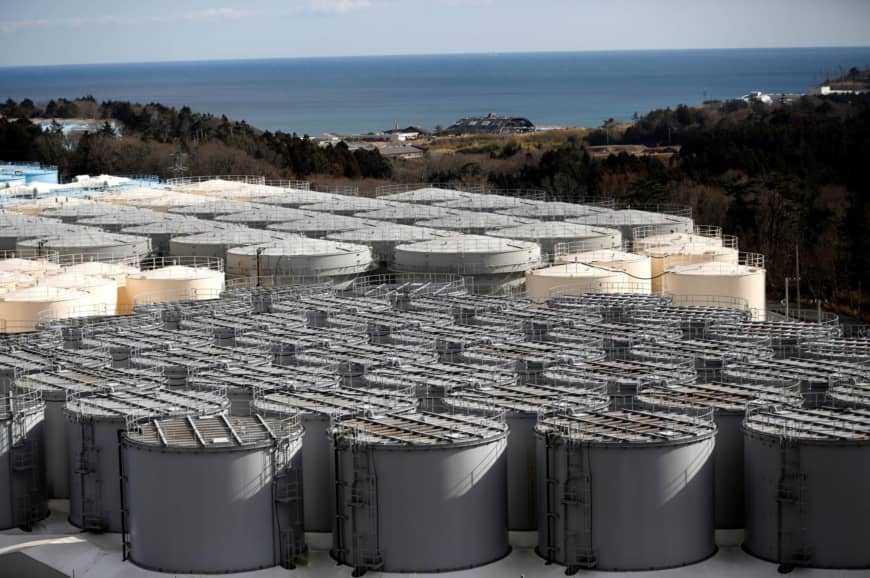
The storage tanks now hold seawater that has been used to continue cooling the reactor cores, and this water is contaminated with such radionuclides as Cesium-137, Carbon-14, tritium (including the more dangerous “Organically Bound Tritium”), Strontium-90, Cobalt-60, Iodine-129, Plutonium-239 — and over 50 other radionuclides. Some of this has reportedly been removed, but some has not (e.g. radioactive tritium and C-14).
The Tokyo Electric Power Company (TEPCO) that owns Fukushima, and is now responsible for the cleanup (that is likely to last the remainder of this century), didn’t admit until recently that the wastewater contains significant amounts of radioactive Carbon-14. As C-14 has a half-life of 5,730 years, and is known to bio-accumulate in marine ecosystems and cause cellular and genetic impairment. This is a very serious concern.
Fukushima C-14 will be added to the already elevated radioactive C-14 load in the oceans from nuclear weapons tests — or “bomb carbon” — last century. It’s now found in organisms even in the deepest part of the ocean, the Marianas Trench. It is easy to imagine the impact this new, intentional Fukushima release could have, rightly or not, on the public image of clean marine seafood and tourism along the Pacific coast.
TEPCO claims the water has been sufficiently treated and is OK to release, but the treatment system they are using is reported to be substandard and not up to the job. Communities across the Pacific deserve an independent scientific assessment of TEPCO’s claims, by an Independent Scientific and Technical Commission. Remember, TEPCO and the Japanese government approved locating the nuclear power plant’s emergency generators in a tsunami flood zone. Their assurances now that there is no risk in releasing this radioactive water are neither credible nor scientifically defensible.
China and South Korea have registered objections to the release plan with Japan, but other downstream nations — the U.S., Russia and Canada — have stayed quiet. It isn’t often that China expresses more concern for the environment than the U.S., but this is one such time.
And even if the ecological and public health risk from the planned release is indeed low, as claimed (this is highly doubtful), the risk is entirely unnecessary and avoidable.
Beyond marine discharge, several other disposal options have been considered, including evaporating the water, or injecting it into deep geologic formations.
But by far the best solution is for TEPCO to build more storage tanks and continue holding all contaminated water for another 15 years or so, during which time the radioactive tritium level will decay by half, and simultaneously treat it with best available technology (such as ion exchange systems and modular “detritiation” systems in the U.S.) to remove all radionuclides possible.
Japan and TEPCO considered this long-term storage option, but opted instead for the cheapest choice — simply dumping the wastewater into the Pacific.
The era of intentionally dumping toxic waste in our one global ocean is, or should be, over.
Fukushima was, and continues to be, a nuclear nightmare, and all nations should join together in a collaborative effort to resolve this mess. This effort will take hundreds of billions of dollars, over many decades, and the U.S. and other G20 nations must step up and help both financially and technically.
Unless and until this wastewater is independently certified as effectively free of radionuclides and safe, not one drop should be released into the beautiful deep blue Pacific.
Finally, Fukushima should be the last nail in the coffin for the notion that nuclear fission power could be a realistic solution to our climate crisis.
Rick Steiner is a marine conservation biologist in Anchorage and former professor of marine conservation with the University of Alaska from 1980-2010. He now consults for the U.N., governments and NGOs on marine environmental issues. He is author of “Oasis Earth: Planet in Peril.”
No comments yet.
1 This Month
Chernobyl: The Lost Tapes – A good documentary on Chernobyl on SBS available On Demand for the next 3 weeks– https://www.sbs.com.au/ondemand/tv-program/chernobyl-the-lost-tapes/2352741955560

of the week–London Campaign for Nuclear Disarmament

Tell the Ukrainian Government to Drop Prosecution of Peace Activist Yurii Sheliazhenko
To see nuclear-related stories in greater depth and intensity – go to https://nuclearinformation.wordpress.com
-
Archives
- April 2026 (139)
- March 2026 (251)
- February 2026 (268)
- January 2026 (308)
- December 2025 (358)
- November 2025 (359)
- October 2025 (376)
- September 2025 (257)
- August 2025 (319)
- July 2025 (230)
- June 2025 (348)
- May 2025 (261)
-
Categories
- 1
- 1 NUCLEAR ISSUES
- business and costs
- climate change
- culture and arts
- ENERGY
- environment
- health
- history
- indigenous issues
- Legal
- marketing of nuclear
- media
- opposition to nuclear
- PERSONAL STORIES
- politics
- politics international
- Religion and ethics
- safety
- secrets,lies and civil liberties
- spinbuster
- technology
- Uranium
- wastes
- weapons and war
- Women
- 2 WORLD
- ACTION
- AFRICA
- Atrocities
- AUSTRALIA
- Christina's notes
- Christina's themes
- culture and arts
- Events
- Fuk 2022
- Fuk 2023
- Fukushima 2017
- Fukushima 2018
- fukushima 2019
- Fukushima 2020
- Fukushima 2021
- general
- global warming
- Humour (God we need it)
- Nuclear
- RARE EARTHS
- Reference
- resources – print
- Resources -audiovicual
- Weekly Newsletter
- World
- World Nuclear
- YouTube
-
RSS
Entries RSS
Comments RSS
 nuclear-news
Leave a comment