The problem of plutonium programs
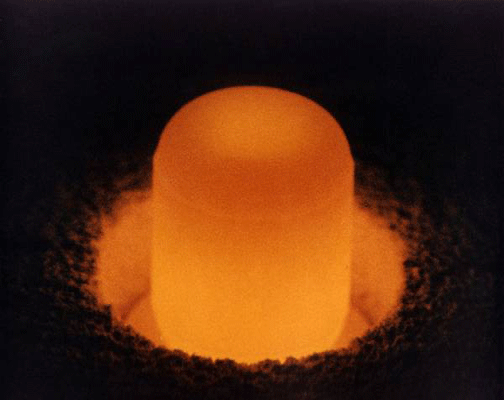
Plutonium programs in East Asia and Idaho will challenge the Biden administration, Bulletin of the Atomic Scientists, By Frank N. von Hippel | April 12, 2021 Among the Biden administration’s nuclear challenges are ongoing civilian plutonium programs in China and Japan. Also, South Korea’s nuclear-energy research and development establishment has been asserting that it should have the same “right” to have a plutonium program as Japan. These challenges have been compounded by a renewed push by the Energy Department’s Idaho National Laboratory to revive a plutonium program that was shut down in the 1980s. These foreign and domestic plutonium programs are all challenges because plutonium is a nuclear-weapon material.
Henry Kissinger’s State Department quickly discovered that the governments of Brazil, Pakistan, South Korea, and Taiwan—all under military control at the time—had contracted for French or German spent-fuel “reprocessing” plants. The United States intervened forcefully and none of these contracts were fully consummated…………………..
…………….A possible path forward. During the Trump administration, the Energy Department fell back into the never-never land of plutonium-fueled reactors from which the United States extracted itself in the 1980s. Fortunately, the big-dollar commitments to the Versatile Test Reactor and the Natrium Reactor have not yet been made, and the Biden administration could use the excuse of budget stringency not to make those commitments.
In South Korea, the Biden administration will have to deal with the completion of the Idaho National Lab–Korea Atomic Energy Research Institute Joint Fuel Cycle Study. Although there will no doubt be obfuscation in the report, the conclusions of the 10-year study should have been obvious from the beginning: reprocessing is hugely costly, creates proliferation risks, and complicates spent fuel disposal. Fortunately, the anti-nuclear-energy Moon administration is unlikely to push for reprocessing. It will be much more interested in the opportunities that the Biden administration can provide to advance the Korean Peninsula denuclearization agenda. It should therefore be politically relatively easy for the Biden Administration to terminate cooperation on pyroprocessing.
China’s reprocessing and fast-neutron reactor program may be driven in part by China’s interest in obtaining more weapon-grade plutonium to build up the size of its nuclear arsenal. If that is the case, China’s incentive to build up could be reduced through nuclear arms control. Specifically, if China is building up its nuclear arsenal out of concern about the adequacy of its nuclear deterrent in the face of an unconstrained US missile-defense buildup, then the United States could examine the possibility of an agreement to limit missile defenses as an alternative to an open-ended, offense-defense arms race. That was the path of wisdom that the United States and Soviet Union chose with their 1972 Anti-Ballistic Missile Treaty.
In Japan, the Biden administration will be faced with the continued unwillingness of the powerful Ministry of Economics, Trade, and Industry to wind down Japan’s dysfunctional plutonium program. But, if a linkage could be made between constraining China’s nuclear buildup and ending Japan’s hugely costly reprocessing program, that might help tip the balance in Japan’s internal debate over reprocessing. https://thebulletin.org/2021/04/plutonium-programs-in-east-asia-and-idaho-will-challenge-the-biden-administration/?utm_source=Newsletter&utm_medium=Email&utm_campaign=MondayNewsletter04122021&utm_content=NuclearRisk_EastAsia_04122021
No comments yet.
1 This Month
Chernobyl: The Lost Tapes – A good documentary on Chernobyl on SBS available On Demand for the next 3 weeks– https://www.sbs.com.au/ondemand/tv-program/chernobyl-the-lost-tapes/2352741955560

of the week–London Campaign for Nuclear Disarmament

Tell the Ukrainian Government to Drop Prosecution of Peace Activist Yurii Sheliazhenko
To see nuclear-related stories in greater depth and intensity – go to https://nuclearinformation.wordpress.com
-
Archives
- April 2026 (152)
- March 2026 (251)
- February 2026 (268)
- January 2026 (308)
- December 2025 (358)
- November 2025 (359)
- October 2025 (376)
- September 2025 (257)
- August 2025 (319)
- July 2025 (230)
- June 2025 (348)
- May 2025 (261)
-
Categories
- 1
- 1 NUCLEAR ISSUES
- business and costs
- climate change
- culture and arts
- ENERGY
- environment
- health
- history
- indigenous issues
- Legal
- marketing of nuclear
- media
- opposition to nuclear
- PERSONAL STORIES
- politics
- politics international
- Religion and ethics
- safety
- secrets,lies and civil liberties
- spinbuster
- technology
- Uranium
- wastes
- weapons and war
- Women
- 2 WORLD
- ACTION
- AFRICA
- Atrocities
- AUSTRALIA
- Christina's notes
- Christina's themes
- culture and arts
- Events
- Fuk 2022
- Fuk 2023
- Fukushima 2017
- Fukushima 2018
- fukushima 2019
- Fukushima 2020
- Fukushima 2021
- general
- global warming
- Humour (God we need it)
- Nuclear
- RARE EARTHS
- Reference
- resources – print
- Resources -audiovicual
- Weekly Newsletter
- World
- World Nuclear
- YouTube
-
RSS
Entries RSS
Comments RSS
 nuclear-news
Leave a comment