France fully nationalises debt-laden EDF nuclear company, – EDF can now focus on renewable energy.
France reportedly to spend $12bn to buy out EDF minority shareholders
NS Energy 7th April 2021
POWERNUCLEARINVESTMENTBy NS Energy Staff Writer 07 Apr 2021
The move is part of the proposed restructuring of the multinational electric utility company
The French government is reportedly anticipating to spend around 10 billion euros ($11.87bn) to buy out minority shareholders in EDF.
The move is part of the proposed restructuring of the multinational electric utility company, in which the current ownership of the French government stands at 83.7%.
Currently under discussion between Paris and the European Commission, the restructuring is expected to result in the formation of a holding company, EDF SA, Reuters reported.
The holding company will be fully state-owned and the proposed restructuring of EDF is codenamed “Project Hercules.”
CGT union executive Sebastien Menesplier was quoted by the news agency as saying: “We are told the state will invest 10 billion euros to buy back the shares held by minority shareholders in order for EDF SA to become 100% state-owned.”
The French government has initiated Project Hercules in order to secure the future of the debt-laden nuclear unit of EDF.
The project was also conceived to enable more attractive part of the business not get impacted by the group’s liabilities.
The proposed restructuring is planned to include nationalisation of the holding company that will incorporate nuclear assets.
As part of the plans, a separate entity, which will be controlled by the holding company, will be created to hold more lucrative businesses.
EDF earlier said that it would be able to double its growth target for renewable energy if the planned restructuring was given go ahead.
The company expected to expand its renewable energy capacity to 100GW by 2030, if Project Hercules is rolled out.
In February, EDF Renewables, along with its partners Enbridge and wpd, started the construction activities at the 448MW Calvados offshore wind farm in France.
Uncertain future for EDF’s Dungeness nuclear power station. It may have to shut down early.
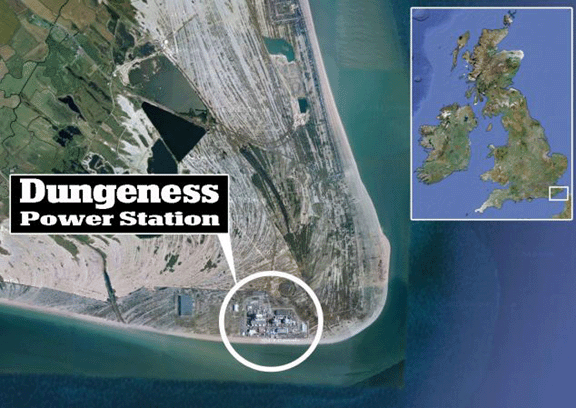
Reuters 8th April 2021, DF Energy, owned by French utility EDF, is exploring a range of scenarios for its Dungeness B nuclear plant in Britain, including bringing forward its decommissioning date of 2028, it said on Thursday. The 1.1 gigawatt Dungeness B plant, in Kent on the south coast of England, has been offline since 2018 as the company has been carrying out inspections and maintenance of pipes carrying steam to the turbine. EDF Energy has also been trying to complete repair work on corrosion identified during inspections of safety back-up systems.
The plant is currently forecast to return to service in August. It was designed in the 1960s and first started generating
electricity in 1983. EDF Energy said it has spent more than 100 million pounds ($138 million) on the plant during its current outage and it has a number of ongoing technical challenges that make its future uncertain.
New defects in France’s Flamanville nuclear project. Doubts that it will start-up on time, – or indeed ever!
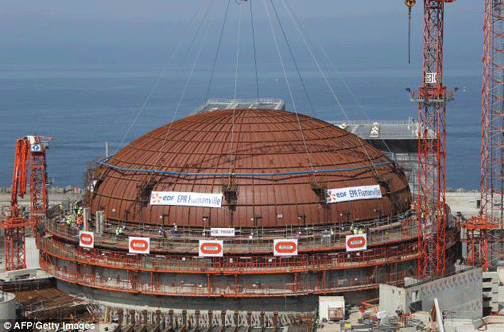
France Info 7th April 2021, Flamanville EPR: “The start-up does not seem possible before 2023” and we can doubt “that it will start one day”, according to negaWatt. “The decision to stop the costs is extremely difficult to take because we are talking about an investment of around 20 billion euros,” said energy expert and spokesperson for the association, Yves Marignac.
La Presse de la Manche 6th April 2021, The Nuclear Safety Authority was notified on March 17, 2021 of the late detection of faults in several pieces of equipment in reactors 1 and 2 at the Flamanville nuclear power plant, in the English Channel.
French Prime Minister visiting Algeria. The question of radioactive dust from nuclear tests will be on the agenda.
*Algeria – French Nuclear Testing**
French atomic tests in Algeria: so much brings the wind. The wind regularly
blows radioactive particles from the Sahara over Europe, a memory of the
atomic tests carried out in Algeria in the 1960s. Will the responsibility
of Paris be on the menu of Jean Castex’s visit to Algiers this weekend.
end?
Liberation 7th April 2021
On April 10 and 11, French Prime Minister Jean Castex will travel to
Algiers, accompanied by eight ministers – including the ministers of
foreign affairs and the armed forces to participate in the 5th session of
the France-Algeria High Level Intergovernmental Committee (CIHN). The
question of the health and environmental consequences of the 17 nuclear
tests carried out by France in the Sahara between 1960 and 1966, as well as
that of nuclear and non-nuclear waste left by France, will be on the menu
of discussions.
ICAN France 7th April 2021
http://icanfrance.org/alerte-presse-les-consequences-des-essais-nucleaires-francais-en-algerie/
Like the other nuclear powers, China wants to put a dirty great radioactive waste dump on indigenous land.
China’s $422m underground lab will probe massive national nuclear waste dump in remote Gansu, Global Construction Review,
9 April 2021 | By GCR Staff
China will spend $422m building an underground laboratory to find a way of storing high-level radioactive waste from the country’s growing fleet of nuclear power plants deep underground.
If successful, a repository that could store a hundred years worth of strontium-90, cesium-137 and plutonium-239 istopes will be built.
Building just the lab itself will be a feat. Wang Ju, vice-president of the Beijing Research Institute of Uranium Geology, told the China Daily newspaper that it would be sited in granite 560m below ground in the Beishan region of Gansu province, in China’s remote northwest . …………..
The offices and laboratories on the surface will have a floor area of 2.4ha within a 247ha site, however the underground complex will require the excavation of 514,200 cubic metres, along with 13.4km of tunnels. At present work is under way on supporting infrastructure, such as paved roads.
The lab, which was listed as a major scientific project in the 13th Five-Year Plan (2016-20), will take seven years to build. If its research proves successful, a long-term underground repository for high-level waste will be added nearby by 2050…….. https://www.globalconstructionreview.com/news/chinas-422m-underground-lab-will-probe-massive-nat/
Texas lawmakers want to ban dangerous radioactive waste.
Texas lawmakers want to ban dangerous radioactive waste.
Texas lawmakers want to ban dangerous radioactive waste. The proposal would give a nuclear waste company a big financial break.
A bill advancing in the House seeks to ban spent nuclear fuel, one of the most dangerous types of radioactive waste, from coming to Texas.
TEXAS TRIBUNE, BY ERIN DOUGLAS APRIL 8, 2021 As a nuclear waste company’s plan to store the most dangerous type of radioactive waste in West Texas moves forward at the federal level, state lawmakers are aiming to ban the materials from entering the state.
Environmental and consumer advocates for years have decried a proposal to build a 332-acre site in West Texas near the New Mexico border to store the riskiest type of nuclear waste: spent fuel rods from nuclear power plants, which can remain dangerously radioactive for hundreds of thousands of years.
A bill advancing in the House, filed by Rep. Brooks Landgraf, R-Odessa, whose district includes Andrews County — where the proposed facility would be located — seeks to stop the plan by banning that type of radioactive waste from being disposed of or stored in Texas.
But House Bill 2692 would also give that same company a big break on state fees it pays for its existing disposal facility for lower-risk radioactive waste.
“This bill bans high-level waste altogether,” Landgraf said during a committee hearing in March, “and focuses on making low-level waste the safest and best, most competitive and most efficient facility it can be.”
Waste Control Specialists has been disposing of the nation’s low-level nuclear waste, including tools, building materials and protective clothing exposed to radioactivity, for a decade in Andrews County. The company is currently pursuing, with a partner, a federal Nuclear Regulatory Commission license to store spent nuclear fuel on a site adjacent to its existing facility.
Waste Control Specialists and Interim Storage Partners — a joint venture between WCS and Orano USA, a subsidiary of one of the world’s biggest nuclear power companies — declined to comment on the proposed bill through a spokesperson.
Interim Storage Partners applied for the license in 2016. Scientists agree that spent nuclear fuel, which is currently stored at nuclear power plants, should be stored deep underground, but the U.S. still hasn’t located a suitable site. The Interim Storage Partners plan proposes storing it in above-ground casks until a permanent location is found. It expects federal regulators to make a decision sometime this year.
The plan faces stiff opposition from Gov. Greg Abbott, some oil companies that operate in the region and environmentalists over concerns about the risk of groundwater contamination and transportation accidents. Abbott wrote to federal regulators last year asking them to deny the license application, stating that the proposal presents a “greater radiological risk than Texas is prepared to allow.”………
The facility currently accepts Class A, B and C radioactive waste, which typically includes a wide range of contaminated items such as radioactive gloves, shoe covers and medical tubes. Some environmental and consumer advocates asked Landgraf to also include a ban on “greater than Class C” waste in his bill as well — it falls into what nuclear waste experts call a gray area between the lower-level categories and spent nuclear fuel. That type of waste is currently banned by the Texas Commission on Environmental Quality, but the Nuclear Regulatory Commission may soon consider regulations that would allow WCS to accept that waste.
Landgraf said he chose not to include a ban on that type of waste in the bill because it is technically not considered “high level” by the federal government, although it is currently treated that way for disposal purposes. Nuclear waste experts have told the Tribune that this category can be wide ranging, both in terms of danger and the time it will remain radioactive………….https://www.texastribune.org/2021/04/08/nuclear-waste-texas-ban/
Pickering Nuclear plant at risk of ‘Fukushima-type accident,
Nuclear plant at risk of ‘Fukushima-type accident,’ Ontario group says, National Observer,
By Charles Mandel | News, Energy | April 8th 2021 Citing the potential for a repeat of the 2011 Fukushima nuclear meltdown, the Ontario Clean Air Alliance wants an interim moratorium on the Pickering Nuclear Generating Station’s (PNGS) operation.
The aging plant is slated for closure in 2024, and the alliance says a moratorium should be imposed until the operators can prove to the public that it poses no risk to public safety. Ontario Power Generation (OPG) operates the plant, which consists of eight CANDU reactors— a type of reactor that uses deuterium oxide, or heavy water, as a moderator and coolant and natural (not enriched) uranium as a fuel. Two of the plant’s reactors have already been permanently shuttered because of their age.
OPG has been lobbying Ontario’s provincial government to keep the plant open until 2025. Currently, it is slated to remain operating until 2024, at which point decommissioning would begin. The OPG gained its last licence renewal for the plant in 2018.
The clean air alliance made its demand March 30 in a letter addressed to Rumina Velshi, president of the Canadian Nuclear Safety Commission (CNSC).
However, Marc Leblanc, CNSC commission secretary, said in a release in early April that an interim moratorium is not under consideration. “The commission sees no basis on which it might reconsider its licensing decision to authorize the operation of the PNGS.”
The CNSC did not return National Observer’s phone calls.
Fears of ‘Fukushima-type accident’
OPG says the plant’s exemplary safety record is proof there is no cause for concern.
However, a number of experts told National Observer the Pickering plant is well past its prime and shouldn’t be allowed to continue operations.
Jack Gibbons, president of the Ontario Clean Air Alliance, cited the plant’s aging pressure tubes as one reason the plant should be shuttered.
“It turns out that OPG does not have the data to show that Pickering’s pressure tubes are still safe for service. If the pressure tubes aren’t fit for service they could potentially rupture or break, and in the worst case scenario there could be a Fukushima-type accident,” Gibbons said.
The clean air alliance notes PNGS has at least twice as many people living within 30 kilometres as any other nuclear station on the continent. A 2018 study the alliance commissioned from Ian Fairlie, an independent consultant on radioactivity in the environment, cites dire consequences should a meltdown occur at PNGS.
It says a Fukushima-level accident at PNGS could cause approximately 26,000 cancers, require the evacuation of more than 150,000 homes and more than 650,000 people, and trigger a $125-billion loss in the value of single-family homes in the Greater Toronto Area.
Aging pressure tubes ‘a prime concern’
The pressure tubes in question are about 10 centimetres in diameter and some six metres long. Each pressure tube in a reactor holds 12 uranium bundles, which are the basis for the nuclear reaction that produces heat and provides the energy. The tubes — there are approximately 400 of them in a reactor — also carry the coolant. But like any aging part, the tubes could fail.
Gordon Edwards, president of the non-profit Canadian Coalition for Nuclear Responsibility, says OPG is “running these plants like no other CANDU reactor in the world.”
He explains that every other CANDU reactor that reaches a certain age is scheduled for refurbishment or re-tubing, which is a replacement of the pressure tubes and feeder pipes that go into the reactor’s core and cool the fuel.
Over their lifespan, the tubes are subjected to great heat, pressure and radiation from the fissioning uranium atoms. Over time, the stress to the tubes can cause them to become brittle and develop blisters that potentially become the site for an elongated crack or a serious rupture.
“Cooling the fuel is essential in nuclear power. If you don’t cool the fuel even after shutdown, you can have a meltdown. That’s what happened at Fukushima. I’m not saying every loss of coolant will lead to a meltdown, but that’s the precipitating cause that could lead to a meltdown. So therefore the integrity of the piping is a prime concern,” Edwards said.
While the Pickering plant must inspect the tubes as a condition of its operating licence, Edwards notes it only tests a fraction of the tubes, fewer than 10 per cent. Nor are the tubes uniform. One might have signs of degradation while the one next to it might be fine. According to Edwards, that makes the sampling less than reassuring.
Frank Greening is a research scientist who worked for OPG for 23 years. During that period, he estimates he spent half the time researching pressure tubes.
Greening says the benchmark for operating performance for CANDU reactors is roughly 30 years at 80 per cent capacity. Pickering reached that benchmark around 2015, but since then the OPG has “kept pushing the envelope, and the limiting factor is the pressure tubes’ fitness for service.”
According to Greening, “every time you turn around, they try and squeeze a little bit more juice out of the lemon. This is a way to keep the nuclear industry gainfully employed, and stretching the lifetime of these reactors as far as they can. I think they’ve gone too far.”……… https://www.nationalobserver.com/2021/04/07/news/ontario-nuclear-plant-risk-fukushima-accident-clean-air-alliance
Holocaust Remembrance 2021, Never Forget: the Knowledge of what the Nazis did cannot be Unlearned, it is a Warning to Us and those Who Follow — The Inglorius Padre Steve’s World

Friends of Padre Steve’s World, Yesterday was Holocaust Remembrance Day in the United States. It takes place on the anniversary of the Warsaw Ghetto Uprising. In 2019 had the honor of speaking about not forgetting the Holocaust at Norfolk’s Temple Israel. When I look at the Holocaust and the men who managed and executed the […]
Holocaust Remembrance 2021, Never Forget: the Knowledge of what the Nazis did cannot be Unlearned, it is a Warning to Us and those Who Follow — The Inglorius Padre Steve’s World
April 9 Energy News — geoharvey

Opinion: ¶ “Yes, Industrial Waste Disasters Are More Likely From Climate Change” • The threat of a catastrophic failure in Piney Point, Florida, sending a 20-foot wall of industrial wastewater over homes and businesses illustrates the danger of our reliance on industrial waste ponds. The risk they pose is greater because of climate change. [CleanTechnica] […]
April 9 Energy News — geoharvey
1 This Month

of the week – Shut Down Drone Warfare!


Tell the Ukrainian Government to Drop Prosecution of Peace Activist Yurii Sheliazhenko

Petition to revoke the licensing of the Near Surface Nuclear Disposal Facility (NSDF) at Chalk River. https://www.ourcommons.ca/petitions/en/Petition/Details?Petition=e-7247
To see nuclear-related stories in greater depth and intensity – go to https://nuclearinformation.wordpress.com
-
Archives
- April 2026 (114)
- March 2026 (251)
- February 2026 (268)
- January 2026 (308)
- December 2025 (358)
- November 2025 (359)
- October 2025 (376)
- September 2025 (257)
- August 2025 (319)
- July 2025 (230)
- June 2025 (348)
- May 2025 (261)
-
Categories
- 1
- 1 NUCLEAR ISSUES
- business and costs
- climate change
- culture and arts
- ENERGY
- environment
- health
- history
- indigenous issues
- Legal
- marketing of nuclear
- media
- opposition to nuclear
- PERSONAL STORIES
- politics
- politics international
- Religion and ethics
- safety
- secrets,lies and civil liberties
- spinbuster
- technology
- Uranium
- wastes
- weapons and war
- Women
- 2 WORLD
- ACTION
- AFRICA
- Atrocities
- AUSTRALIA
- Christina's notes
- Christina's themes
- culture and arts
- Events
- Fuk 2022
- Fuk 2023
- Fukushima 2017
- Fukushima 2018
- fukushima 2019
- Fukushima 2020
- Fukushima 2021
- general
- global warming
- Humour (God we need it)
- Nuclear
- RARE EARTHS
- Reference
- resources – print
- Resources -audiovicual
- Weekly Newsletter
- World
- World Nuclear
- YouTube
-
RSS
Entries RSS
Comments RSS
 nuclear-news