Duane Arnold nuclear reactor, same type as Fukushima Daiichi, vulnerable to extreme weather
|
Fukushima 10 years later: It still could happen here https://thebulletin.org/2021/03/fukushima-10-years-later-it-still-could-happen-here/ By Edwin Lyman | March 11, 2021 On March 11, 2011, 10 years ago this week, a massive earthquake and tsunami flooding triggered a power blackout at the Fukushima Daiichi nuclear plant in Japan, causing three reactors to melt down and release massive amounts of radioactive material. Last summer, an aging nuclear reactor several miles outside of Cedar Rapids, Iowa came uncomfortably close to experiencing a similar fate. On August 10, a powerful storm called a derecho swept through the Midwest with wind gusts of up to 130 miles per hour, cutting off the external power supply to the Duane Arnold Energy Center, a General Electric reactor of the same type and vintage as the doomed Fukushima Daiichi units. A pandemic-weary nation didn’t pay much attention, but it should have. According to a preliminary Nuclear Regulatory Commission (NRC) analysis, this was the most serious US nuclear power plant incident in at least 18 years. Duane Arnold, which its owner, NextEra, had been planning to shut down at the end of October 2020 for economic reasons, was already in a vulnerable state. It was operating at only 80 percent of capacity because the primary containment had been overheating due to a cooling system leak, and there was a ruptured nuclear fuel element in the core. In addition, major pieces of safety equipment were out of service for maintenance. At 12:49 p.m. local time, Duane Arnold automatically shut down after the derecho took down all six power lines supplying the plant. The reactor’s two emergency diesel generators started up as expected. However, the nuclear fuel remained hot, and it took plant operators 14 hours of deft maneuvering to stabilize and cool down the reactor—a process that was not trouble-free. Operators violated technical restrictions several times, one of the two spent fuel pool cooling pumps blew a fuse, and a strainer that filtered potentially damaging debris from the cooling water supply to one of the diesel generators became clogged and had to be bypassed. Off-site power to the plant was not restored until nearly 24 hours after it was lost. Meanwhile, the destructive derecho had blown down the cooling towers that normally provide shutdown heat removal, punched a hole in the reactor’s secondary containment, and ripped large sections of siding from the turbine building. The storm also damaged one of two storage buildings containing emergency backup equipment that the NRC required all nuclear plants to acquire after Fukushima, rendering that equipment inoperable. Given all this damage, NextEra decided to scrap the plant then and there, rather than repair it for only another couple of months of operation. Although operators were able to compensate for all the problems and shut down Duane Arnold safely, the NRC estimates that there was at least a one-in-1,000 chance, on average, that the reactor could have experienced a meltdown. The NRC considers such high-risk events “significant” precursors to a severe accident. For example, if the reactor’s emergency diesel generators had failed, a station blackout similar to the Fukushima accident would have occurred. (The NRC risk estimate optimistically assumes a nearly 90 percent chance that personnel would have been able to save the plant even after a blackout, which workers had failed to accomplish three times over at Fukushima.) The NRC initially decided not to conduct a more intensive inquiry of Duane Arnold’s near-miss and its potential implications for other US reactors. John Hanna, an NRC analyst who dissented from this decision, wrote: “Some population of our commercial reactor fleet may have unacceptably high risk due to (weather-related) losses of off-site power coincident with a challenge to the ultimate heat sink. I am of the opinion that the Duane Arnold event is ‘telling us something,’ and I think we, as an agency, should listen.” In response to Hanna’s concerns, the agency did agree to undertake a review, which should be completed this month. Unfortunately, it is highly unlikely that the NRC will take action even if it finds other plants with similar risks, as the agency continues to maintain an “it can’t happen here” attitude. After Fukushima, the NRC ordered all nuclear plant owners to reassess their facilities’ vulnerability to natural disasters such as floods and earthquakes, and most found that their sites faced more severe hazards than they were required to withstand. Regardless, the NRC decided that it was unnecessary for owners to harden their plants’ defenses against these updated threats. Under the leadership of newly appointed chairman Christopher Hanson, the NRC should reverse course and require nuclear plants to thoroughly prepare not only for the known hazards they face today, but also for the potentially greater disasters that climate change will likely bring in the future. Otherwise, a US Fukushima-like disaster may be all but inevitable. |
|
UN expresses concern over UK’s move to increase nuclear weapons arsenal
|
UN expresses concern over UK’s move to increase nuclear weapons arsenal https://www.business-standard.com/article/international/un-expresses-concern-over-uk-s-move-to-increase-nuclear-weapons-arsenal-121031800241_1.html
The UN has expressed concerns over the UK’s decision to increase its nuclear weapons arsenal, as part of the country’s foreign policy overhaulThe UN has expressed concerns over the UK’s decision to increase its nuclear weapons arsenal, as part of the country’s foreign policy overhaul. The UK’s decision is contrary to its obligations under Article VI of the Nuclear Non-Proliferation Treaty (NPT), Xinhua news agency quoted Stephane Dujarric, spokesman for UN Secretary-General Antonio Guterres, as saying at a briefing on Wednesday. It could have a damaging impact on global stability and efforts to pursue a world free of nuclear weapons, he said.
“At a time when nuclear weapon risks are higher than they have been since the Cold War, investments in disarmament and arms control is the best way to strengthen the stability and reduce nuclear danger,” Dujarric was quoted as further saying. The UK government on Tuesday announced its plan to increase the number of nuclear warheads to not more than 260, reversing its previous policy of reducing its overall nuclear warhead stockpile ceiling to not more than 180 warheads by the mid-2020s. Outlining the strategy to MPs, Prime Minister Boris Johnson said the UK would have to “re-learn the art” of competing against countries with “opposing values”. But he added the UK would remain “unswervingly committed” to the NATO defence alliance and preserving peace and security in Europe. Speaking to the BBC on Tuesday, Beatrice Fihn, head of the International Campaign to Abolish Nuclear Weapons, described the UK’s decision to change its nuclear provision as “outrageous, irresponsible and very dangerous”. She said it went against international law and did not address the real security threats faced by the UK such as climate change and disinformation. |
|
Plutonium used at Japanese reactor will be glassed, stored at Savannah River Site
Plutonium used at Japanese reactor will be glassed, stored at Savannah River Site, Aiken Standard, By Colin Demarest cdemarest@aikenstandard.com, Mar 17, 2021
The National Nuclear Security Administration has decided a cache of plutonium sent from Japan years ago will be processed and disposed of for the foreseeable future at the Savannah River Site, a change of plans with local ramifications.
Up to 350 kilograms of stainless steel-clad plutonium from a Japanese reactor will be rid of using a slew of Savannah River Site facilities, tech and staff, recent federal documents show.
The Fast Critical Assembly fuel – already at the Savannah River Site – will be processed and dissolved at H-Canyon, a one-of-a-kind separations facility built in the 1950s. The material will then go to the tank farms, where millions of gallons of waste is stored.
After that, it will move to the Defense Waste Processing Facility, a mammoth plant that encases nuclear sludge in glass, making it safer to handle and stow long-term. The glass cylinders will ultimately go to an on-site storage building, where they will stay pending the availability of a dedicated depot, like Yucca Mountain in Nevada.
The entire endeavor will take years. And Japan is helping defray the cost.
The plutonium was previously slated to be handled and treated at the Savannah River Site and entombed at the Waste Isolation Pilot Plant in New Mexico, a repository resembling a salt mine. “Direct disposal of the FCA materials” at the Savannah River Site is a “sound option,” said SRS Watch Director Tom Clements, but it drums up some other questions……….. https://www.postandcourier.com/aikenstandard/news/savannah-river-site/plutonium-used-at-japanese-reactor-will-be-glassed-stored-at-savannah-river-site/article_b7b08e4c-8667-11eb-b8cd-8f0fb9c35316.html?fbclid=IwAR1s_w6jcU21h64HZ6z-tzb7uaWt4x-51ECsKd8E3bw6tvGacJn9_9gGmA8
Conclusions and recommendations of safety assessment of advanced nuclear reactors – non-light-water ones
Assessing the Safety, Security, and Environmental Impacts of Non-Light-Water Nuclear Reactors,Union of Concerned Scientists, Edwin Lyman Mar 18, 2021 “Advanced” Isn’t Always Better ”
”……….Conclusions of the Assessment
The non-light-water nuclear reactor landscape is vast and complex, and it is beyond the scope of this report to survey the entire field in depth. Nevertheless, enough is clear even at this stage to draw some general conclusions regarding the safety and security of NLWRs and their prospects for rapid deployment.
Based on the available evidence, the NLWR designs currently under consideration (except possibly once-through, breed-and-burn reactors) do not offer obvious improvements over LWRs significant enough to justify their many risks. Regulators and other policymakers would be wise to look more closely at the nuclear power programs under way to make sure they prioritize safety and security. Future appropriations for NLWR technology research, development, and deployment should be guided by realistic assessments of the likely societal benefits that would result from the investment of billions of taxpayer dollars.
Little evidence supports claims that NLWRs will be significantly safer than today’s LWRs. While some NLWR designs offer some safety advantages, all have novel characteristics that could render them less safe.
All NLWR designs introduce new safety issues that will require substantial analysis and testing to fully understand and address—and it may not be possible to resolve them fully. To determine whether any NLWR concept will be significantly safer than LWRs, the reactor must achieve an advanced stage of technical maturity, undergo complete comprehensive safety testing and analysis, and acquire significant operating experience under realistic conditions.
The claim that any nuclear reactor system can “burn” or “consume” nuclear waste is a misleading oversimplification. Reactors can actually use only a fraction of spent nuclear fuel as new fuel, and separating that fraction increases the risks of nuclear proliferation and terrorism.
No nuclear reactor can use spent nuclear fuel directly as fresh fuel. Instead, spent fuel has to be “reprocessed”—chemically treated to extract plutonium and other TRU elements, which must then be refabricated into new fuel. This introduces a grave danger: plutonium and other TRU elements can be used in nuclear weapons. Reprocessing and recycling render these materials vulnerable to diversion or theft and increases the risks of nuclear proliferation and terrorism—risks that are costly to address and that technical and institutional measures cannot fully mitigate. Any fuel cycle that requires reprocessing poses inherently greater proliferation and terrorism risks than the “once-through” cycle with direct disposal of spent fuel in a geologic repository.
Some NLWRs have the potential for greater sustainability than LWRs, but the improvements appear to be too small to justify their proliferation and safety risks.
Although some NLWR systems could use uranium more efficiently and generate smaller quantities of long-lived TRU isotopes in nuclear waste, for most designs these benefits could be achieved only by repeatedly reprocessing spent fuel to separate out these isotopes and recycle them in new fuel—and that presents unacceptable proliferation and security risks. In addition, reprocessing plants and other associated fuel cycle facilities are costly to build and operate, and they increase the environmental and safety impacts compared with the LWR once-through cycle. Moreover, the sustainability increases in practice would not be significant in a reasonably foreseeable time frame.
Once-through, breed-and-burn reactors have the potential to use uranium more efficiently without reprocessing, but many technical challenges remain.
One type of NLWR system that could in principle be more sustainable than the LWR without increasing proliferation and terrorism risks is the once-through, breed-and-burn reactor. Concepts such as TerraPower’s traveling-wave reactor could enable the use of depleted uranium waste stockpiles as fuel, which would increase the efficiency of uranium use. Although there is no economic motivation to develop more uranium-efficient reactors at a time when uranium is cheap and abundant, reducing uranium mining may be beneficial for other reasons, and such reactors may be useful for the future. However, many technical challenges would have to be overcome to achieve breed-and-burn operation, including the development of very-high-burnup fuels. The fact that TerraPower suspended its project after more than a decade of development to pursue a more conventional and far less uranium-efficient SFR, the Natrium, suggests that these challenges have proven too great.
High-assay low enriched uranium (HALEU) fuel, which is needed for many NLWR designs, poses higher nuclear proliferation and nuclear terrorism risks than the lower-assay LEU used by the operating LWR fleet.
Many NLWR designs require uranium enriched to higher levels than the 5 percent U-235 typical of LWR fuel. Although uranium enriched to between 10 and 20 percent U-235 (defined here as HALEU) is considered impractical for direct use in nuclear weapons, it is more attractive for weapons use—and requires more stringent security—than the lower-assay enriched uranium in current LWRs.
The significant time and resources needed to safely commercialize any NLWR design should not be underestimated.
It will likely take decades and many billions of dollars to develop and commercially deploy any NLWR design, together with its associated fuel cycle facilities and other support activities. Such development programs would come with a significant risk of delay or failure and require long-term stewardship and funding commitments. And even if a commercially workable design were demonstrated, it would take many more years after that to deploy a large number of units and operate them safely and reliably.
Vendors that claim their NLWRs could be commercialized much more quickly typically assume that their designs will not require full-scale performance demonstrations and extensive safety testing, which could add well over a decade to the development timeline. However, current designs for sodium-cooled fast reactors and high-temperature gas-cooled reactors differ enough from past reactor demonstrations that they cannot afford to bypass additional full-scale prototype testing before licensing and commercial deployment. Molten salt–fueled reactors have only had small-scale demonstrations and thus are even less mature. NLWRs deployed commercially at premature stages of development run a high risk of poor performance and unexpected safety problems.
Recommendations
The DOE should suspend the advanced reactor demonstration program pending a finding by the NRC whether it will require full-scale prototype testing before licensing the two chosen designs as commercial power reactors.
The DOE has selected two NLWR designs, the Natrium SFR and the Xe-100 pebble-bed HTGR, for demonstration of full-scale commercial operation by 2027. However, the NRC has yet to evaluate whether these designs are mature enough that it can license them without first obtaining data from full-scale prototype plants to demonstrate novel safety features, validate computer codes, and qualify new types of fuel in representative environments. Without such an evaluation, the NRC will likely lack the information necessary to ensure safe, secure operation of these reactors. The DOE should suspend the Advanced Reactor Demonstration Program until the NRC—in consultation with the agency’s Advisory Committee on Reactor Safeguards and external experts—has determined whether prototypes will be needed first.
Congress should require that an independent, transparent, peer-review panel direct all DOE R&D on new nuclear concepts, including the construction of additional test or demonstration reactors.
Given the long time and high cost required to commercialize NLWR designs, the DOE should provide funding for NLWR R&D judiciously and only for reactor concepts that offer a strong possibility of significantly increasing safety and security—and do not increase proliferation risks. Moreover, unlike the process for selecting the two reactor designs for the Advanced Reactor Demonstration Program, decision-making should be transparent.6 Congress should require that the DOE convene an independent, public commission to thoroughly review the technical merits of all NLWR designs proposed for development and demonstration, including those already selected for the ARDP. The commission, whose members should represent a broad range of expertise and perspectives, would recommend funding only for designs that are highly likely to be commercialized successfully while achieving clearly greater safety and security than current-generation LWRs.
The DOE and other agencies should thoroughly assess the implications for proliferation and nuclear terrorism of the greatly expanded production, processing, and transport of the high-assay low-enriched uranium (HALEU) required to support the widespread deployment of NLWRs.
Large-scale deployment of NLWRs that use HALEU fuel will require establishing a new industrial infrastructure for producing and transporting the material. The DOE is actively promoting the development of HALEU-fueled reactor designs for export. Given that HALEU is a material of higher security concern than lower-assay LEU, Congress should require that the DOE immediately assess the proliferation and nuclear terrorism implications of transitioning to the widespread use of HALEU worldwide. This assessment should also address the resource requirements for the security and safeguards measures needed to ensure that such a transition can occur without an unacceptable increase in risk.
The United States should make all new reactors and associated fuel facilities eligible for IAEA safeguards and provide that agency with the necessary resources for carrying out verification activities.
The IAEA, which is responsible for verifying that civilian nuclear facilities around the world are not being misused to produce materials for nuclear weapons, has limited or no experience in safeguarding many types of NLWRs and their associated fuel cycle facilities. NLWR projects being considered for deployment in the United States, such as the Natrium SFR and the Xe-100 pebble-bed HTGR, would provide ideal test beds for the IAEA to develop safeguards approaches. However, as a nuclear-weapon state, the United States is not obligated to give the IAEA access to its nuclear facilities. To set a good example and advance the cause of nonproliferation, the United States should immediately provide the IAEA with permission and funding to apply safeguards on all new US nuclear facilities, beginning at the design phase. This would help to identify safeguard challenges early and give the IAEA experience in verifying similar facilities if they are deployed in other countries.
The DOE and Congress should consider focusing nuclear energy R&D on improving the safety and security of LWRs, rather than on commercializing immature NLWR designs.
LWR technology benefits from a vast trove of information resulting from many decades of acquiring experimental data, analysis, and operating experience—far more than that available for any NLWR. This gives the LWR a significant advantage over other nuclear technologies. The DOE and Congress should do a more thorough evaluation of the benefits of focusing R&D funding on addressing the outstanding safety, security, and cost issues of LWRs rather than attempting to commercialize less mature reactor concepts. If the objective is to expand nuclear power to help deal with the climate crisis over the next few decades, improving LWRs could be a less risky bet.
Endnotes………
This is a condensed, online version of the executive summary. For all figures, references, and the full text, please download the PDF. https://ucsusa.org/resources/advanced-isnt-always-better#read-online-content
Nuclear reactors – “Advanced” Isn’t Always Better” – Non-Light-Water Nuclear Reactors
|
Assessing the Safety, Security, and Environmental Impacts of Non-Light-Water Nuclear Reactors,Union of Concerned Scientists, Edwin Lyman Mar 18, 2021 “Advanced” Isn’t Always Better ”……………………….Key Questions for Assessing NLWR Technologies It is critical that policymakers, regulators, and private investors fully vet the claims that the developers of NLWRs are making and accurately assess the prospects for both successful development_ and_ safe, secure, and cost-effective deployment. Given the urgency of the climate crisis, rigorous evaluation of these technologies will help our nation and others avoid wasting time or resources in the pursuit of high-risk concepts that would be only slightly better— or perhaps worse—than LWRs. Key questions to consider are the following:
To help inform policy decisions on these questions, the Union of Concerned Scientists (UCS) has evaluated certain claims about the principal types of NLWRs. In particular, this report compares several classes of NLWRs to LWRs with regard to safety and security, the risks of nuclear proliferation and nuclear terrorism, and “sustainability”—a term that in this context includes the often-claimed ability of some NLWRs to “recycle” nuclear waste and use mined uranium more efficiently. The report also considers the potential for certain NLWRs to operate in a once-through, “breed-and-burn” mode that would, in theory, make them more uranium-efficient without the need to recycle nuclear waste—a dangerous process that has significant nuclear proliferation and terrorism risks.
Non-Light-Water Reactor TechnologiesUCS considered these principal classes of NLWRs: Sodium-cooled fast reactors (SFRs): These reactors are known as “fast reactors” because, unlike LWRs or other reactors that use lower-energy (or “thermal”) neutrons, the liquid sodium coolant does not moderate (slow down) the high-energy (or “fast”) neutrons produced when nuclear fuel undergoes fission. The characteristics and design features of these reactors differ significantly from those of LWRs, stemming from the properties of fast neutrons and the chemical nature of liquid sodium. High-temperature gas–cooled reactors (HTGRs): These reactors are cooled by a pressurized gas such as helium and operate at temperatures up to 800ºC, compared with around 300ºC for LWRs. HTGR designers developed a special fuel called TRISO (tristructural isotropic) to withstand this high operating temperature. HTGRs typically contain graphite as a moderator to slow down neutrons. There are two main variants of HTGR. A prismatic-block HTGR uses conventional nuclear fuel elements that are stationary; in a pebble-bed HTGR, moving fuel elements circulate continuously through the reactor core. Molten salt–fueled reactors (MSRs): In contrast to conventional reactors that use fuel in a solid form, these use liquid fuel dissolved in a molten salt at a temperature of at least 650ºC. The fuel, which is pumped through the reactor, also serves as the coolant. MSRs can be either thermal reactors that use a moderator such as graphite or fast reactors without a moderator. All MSRs chemically treat the fuel to varying extents while the reactor operates to remove radio-active isotopes that affect reactor performance. Therefore, unlike other reactors, MSRs generally require on-site chemical plants to process their fuel. MSRs also need elaborate systems to capture and treat large volumes of highly radioactive gaseous byproducts. The Fuels for Non-Light-Water ReactorsToday’s LWRs use uranium-based nuclear fuel containing less than 5 percent of the isotope uranium-235. This fuel is produced from natural (mined) uranium, which has a uranium-235 content of less than 1 percent, in a complex industrial process called uranium enrichment. Fuel enriched to less than 20 percent U-235 is called “low-enriched uranium” (LEU). Experts consider it a far less attractive material for nuclear weapons development than “highly enriched uranium” (HEU), with a U-235 content of at least 20 percent. The fuel for most NLWRs differs from that of LWRs. . Some proposed NLWRs would use LEU enriched to between 10 and 20 percent uranium-235; this is known as “high-assay low enriched uranium” (HALEU).2 While HALEU is considered impractical for direct use in a nuclear weapon, it is more attractive for nuclear weapons development than the LEU used in LWRs. Other types of NLWRs would use plutonium separated from spent nuclear fuel through a chemical process called reprocessing. Still others would utilize the isotope uranium-233 obtained by irradiating the element thorium. Both plutonium and uranium-233 are highly attractive for use in nuclear weapons. Typically, the chemical forms of NLWR fuels also differ from those of conventional LWR fuel, which is a ceramic material composed of uranium oxide. Fast reactors can use oxides, but they can also use fuels made of metal alloys or chemical compounds such as nitrides. The TRISO fuel in HTGRs consists of tiny kernels of uranium oxide (or other uranium compounds) surrounded by several layers of carbon-based materials. MSR fuels are complex mixtures of fluoride or chloride salt compounds. The deployment of NLWRs also would require new industrial facilities and other infrastructure to produce and transport their different types of fuel, as well as to manage spent fuel and other nuclear wastes. These facilities may use new technologies that themselves would require significant R&D. They also may present different risks related to safety, security, and nuclear proliferation than do LWR fuel cycle facilities—important considerations for evaluating the whole system. Non-Light-Water Reactors: Past and PresentIn the mid-20th century, the Atomic Energy Commission (AEC)—the predecessor of today’s Department of Energy (DOE) and the NRC—devoted considerable time and resources to developing a variety of NLWR technologies, supporting demonstration plants at various scales at sites around the United States. Owners of several of these reactors abandoned them after the reactors experienced operational problems (for example, the Fort St. Vrain HTGR in Colorado) or even serious accidents (the Fermi-1 SFR in Michigan). Despite these negative experiences, the DOE continued R&D on various types of NLWR and their fuel cycles. In the 1990s, the DOE initiated the Generation IV program, with the goal of “developing and demonstrating advanced nuclear energy systems that meet future needs for safe, sustainable, environmentally responsible, economical, proliferation-resistant, and physically secure energy.” Although Generation IV identified six families of advanced reactor technology, the DOE has given most of its subsequent support to SFRs and HTGRs. Today, a number of NLWR projects at various stages of development are under way, funded by both public and private sources (Table 1). With support from Congress, the DOE is pursuing several new NLWR test and demonstration reactors. It is proceeding with the design and construction of the Versatile Test Reactor (VTR), an SFR that it hopes to begin operating in the 2026–2031 timeframe. The VTR would not generate electricity but would be used to test fuels and materials for developing other reactors. In October 2020, the DOE selected two NLWR designs for demonstrating commercial power generation by 2027: the Xe-100, a small pebble-bed HTGR that would generate about 76 megawatts of electricity (MWe), and the 345 MWe Natrium, an SFR that is essentially a larger version of the VTR with a power production unit. The DOE is also providing funding for two smaller-scale projects to demonstrate molten salt technologies. In addition, the DOE, the Department of Defense (DOD), and a private company, Oklo, Inc., are pursuing demonstrations of so-called micro-reactors—very small NLWRs with capacities from 1 MWe to 20 MWe—and project that these will begin operating in the next few years. A number of universities also have expressed interest in building small NLWRs for research. Congress would need to provide sufficient and sustained funding for any of these projects to come to fruition. This is far from assured—for example, funding for the VTR to date has fallen far short of what the DOE has requested, all but guaranteeing the project will be delayed. The Goals of New Reactor DevelopmentIf nuclear power is to play an expanded global role to help mitigate climate change, new reactor designs should be demonstrably safer and more secure—and more economical—than the existing reactor fleet. Today’s LWRs remain far too vulnerable to Fukushima-like accidents, and the uranium enrichment plants that provide their LEU fuel can be misused to produce HEU for nuclear weapons. However, developing new designs that are clearly superior to LWRs overall is a formidable challenge, as improvements in one respect can create or exacerbate problems in others. For example, increasing the physical size of a reactor core while keeping its power generation rate constant could make the reactor easier to cool in an accident, but it could also increase cost.
Moreover, the problems of nuclear power cannot be fixed through better reactor design alone. Also critical is the regulatory framework governing the licensing, construction, and operation of nuclear plants and their associated fuel cycle infrastructure. Inadequate licensing standards and oversight activities can compromise the safety of improved designs. A key consideration is the extent to which regulators require extra levels of safety—known as “defense-in-depth”—to compensate for uncertainties in new reactor designs for which there is little or no operating experience………
This is a condensed, online version of the executive summary. For all figures, references, and the full text, please download the PDF. https://ucsusa.org/resources/advanced-isnt-always-better#read-online-content |
|
The nuclear lobby holds too much sway over governments, particularly in Japan
Nuclear power: at what cost?
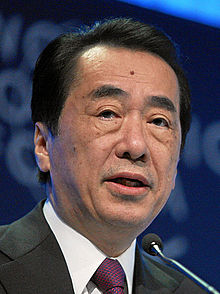 Julie Ward – Despite mounting evidence from environmental experts as well as economists, the nuclear lobby still holds sway at government level in many countries.
New type of large and highly radioactive particles found in Japan
|
Recent studies have revealed that the fall-out from reactor unit 1 also included larger caesium-bearing particles, each greater than 300 micron in diameter, which have higher levels of activity in the order of 105 Bq per particle. These particles were found to have been deposited in a narrow zone stretching around 8 km north-northwest from the reactor site.
Surface soil samplesIn their study, chemist and environmental scientist Satoshi Utsunomiya of Japan’s Kyushu University and colleagues have analyzed 31 of these particles, which were collected from surface soil taken from roadsides in radiation hotspots. “[We] discovered a new type of radioactive particle 3.9 km north northwest of the Fukushima Daiichi Nuclear Power Plant, which has the highest caesium-134 and caesium-137 activity yet documented in Fukushima, 105–106 Bq per particle,” Utsunomiya says. Alongside the record-breaking radioactivity seen in two of the particles (6.1×10⁵ and 2.5×10⁶ Bq, after correction to the date of the accident) the team also found that they had characteristic compositions and textures that differed from those previously seen in the reactor unit 1 fall-out. Reactor building materialsA combination of techniques including synchrotron-based nano-focus X-ray analysis and transmission electron microscopy indicated that one of the particles was found to be an aggregate of smaller silicate nanoparticles each with a glass-like structure. This is thought to be the remnants of reactor building materials that were first damaged in the explosion and then picked up caesium that had been volatized from the reactor fuel. The other particle had a glassy carbon core and a surface peppered with other microparticles of various compositions, which are thought to reflect a forensic snapshot of the particles that were airborne within the reactor unit 1 building at the moment of the hydrogen explosion and the physio-chemical phenomena they were subjected to. “Owing to their large size, the health effects of the new particles are likely limited to external radiation hazards during static contact with skin,” explained Utsunomiya — with the two record-breaking particles thought too large to be inhaled into the respiratory tract. Impact on wildlifeHowever, the researchers note that further work is needed to determine the impact on the wildlife living around the Fukushima Daiichi facility — such as, for example, filter feeding marine molluscs which have previously been found susceptible to DNA damage and necrosis on exposure to radioactive particles. “The half-life of caesium-137 is around 30 years,” Utsunomiya continued, adding: “So, the activity in the newly found highly radioactive particles has not yet decayed significantly. As such, they will remain [radioactive] in the environment for many decades to come, and this type of particle could occasionally still be found in radiation hot spots.” Nuclear material corrosion expert Claire Corkhill of the University of Sheffield – who was not involved in the study – says that the team have offered new insights into the events that unfurled during the accident. “Although the two particles selected [for analysis] were small, a mighty amount of chemical information was yielded,” she said, noting that some of the boron isotopes the researchers identified could only have come from the nuclear control rods damaged in the accident……… The study is described in Science of the Total Environment. https://physicsworld.com/a/new-type-of-fallout-from-fukushima-daiichi-found-a-decade-after-nuclear-disaster/ |
|

Don’t believe hydrogen and nuclear hype – they can’t get us to net zero carbon by 2050
 Don’t believe hydrogen and nuclear hype – they can’t get us to net zero carbon by 2050 https://www.theguardian.com/commentisfree/2021/mar/16/hydrogen-nuclear-net-zero-carbon-renewables
ow that the whole world seems to be aligned behind the goal of net zero carbon emissions by 2050, the nuclear industry is straining every sinew to present itself as an invaluable ally in the ambitious aim. Energy experts remain starkly divided on whether or not we can reach this global net zero target without nuclear power, but regardless, it remains a hard sell for pro-nuclear enthusiasts.
The problems they face are the same ones that have dogged the industry for decades: ever-higher costs, seemingly inevitable delays, no solutions to the nuclear waste challenge, security and proliferation risks.
The drawbacks to nuclear are compounded by the burgeoning success of renewables – both solar and wind are getting cheaper and more efficient, year after year. There is also a growing realisation that a combination of renewables, smart storage, energy efficiency and more flexible grids can now be delivered at scale and at speed – anywhere in the world.
While the majority of environmentalists continue to oppose nuclear power, there is now a significant minority, increasingly concerned about accelerating climate change, who just don’t see how we can get to that net zero comfort zone without it. They’re right to be concerned – it is a truly daunting challenge. All emissions of greenhouse gases (across the entire economy, including those from transport, heating, manufacturing and refining, farming and land use, as well as from shipping and aviation) must be brought down to as close to zero as possible, with all residual emissions compensated for by the removal of an equivalent amount of CO2 from the atmosphere.
It’s the sheer scale of that challenge that has led a lot of people (including Boris Johnson with the government’s 10-point plan in November) not just to keep a flag flying for the nuclear industry, but to revisit the idea of hydrogen doing some of the heavy lifting. Hydrogen hype has become all the rage over the last 18 months, with some offering up this “clean energy technology”, as government officials insist on describing it, as the answer to all our net zero prayers.
For those prayers to be answered, there will need to be a complete revolution in the way in which hydrogen is produced. As it is, 98% of the 115m tonnes used globally is “grey hydrogen”, made from natural gas or coal, that emits around 830m tonnes of CO2 per annum – 2% of total global greenhouse gas emissions. Beyond that, there’s a tiny amount of so-called “blue hydrogen” – essentially grey hydrogen but with its CO2 emissions captured and stored – and an even tinier amount of “green hydrogen” from electrolysing water, both of which are much more expensive than the climate-wrecking grey hydrogen.
The gulf between that current reality, one rarely mentioned by hydrogen enthusiasts, and the prospect of readily available and affordable green hydrogen that could help us get to net zero, is absolutely vast.
Don’t get me wrong: we will indeed need significant volumes of green hydrogen and it’s good that the government has set an ambitious target for 2030, in the hope that this will significantly reduce the costs of electrolysis to create it. But we need to be clear about what that green hydrogen should be used for: not for electricity; not for heating homes and non-domestic buildings; and not for cars, where electric vehicles will always be better. Instead we will need it for what are called the “hard-to-abate” sectors: for steel – replacing carbon-intensive coking coal – cement and shipping.
Much of the hype for hydrogen is coming from the oil and gas sector, in the hope that gullible politicians, seduced by an unattainable vision of limitless green hydrogen, will subsidise the vast investments needed to capture the emissions from gas-powered hydrogen. Their motivation couldn’t be clearer: to postpone the inevitable decline of their industry.
The nuclear industry is also desperate to get in on that game. One has to admire its capacity to pivot opportunistically. In February, the Nuclear Industry Council (made up of both industry and government representatives in the UK) published a shiny new Hydrogen Roadmap, exploring how either large-scale nuclear or small modular reactors could generate both the electricity and the heat needed to produce large amounts of green hydrogen. But the entire plan is premised on spectacular and totally speculative reductions in the cost of electrolysis.
Rather than being the solution we have been waiting for, this nuclear/hydrogen development would actually be a disastrous techno-fix. Low-carbon nuclear power will always be massively more expensive than renewables and we can never build enough reactors to replace those coming offline over the next decade. We also know that producing hydrogen is always going to be very expensive. The truth is, you need a lot of electricity to produce not a lot of hydrogen. All of which makes pipe-dreams about substituting hydrogen for conventional gas in the UK’s gas grid, or of producing millions of tonnes of blue hydrogen, look almost entirely absurd.
This, then, could lead to a double economic whammy of quite monstrous proportions. It would either have to be paid for through general taxation or through higher bills for consumers. That’s particularly problematic from the perspective of the 10% of households in England still living in cruel and degrading fuel poverty.
Environmentalists who are tempted by this new nuclear/hydrogen hype should remember that our transition to a net zero world has to be a just transition. Every kilowatt hour of nuclear-generated power will be a much more expensive kilowatt hour than one delivered from renewables plus storage.
So let’s just hold back on both the hydrogen hype and the nuclear propaganda, and concentrate instead on ramping up what we already know is cost-effectively deliverable: renewables. We need to do it as fast as we possibly can.
- Jonathon Porritt is an environmentalist and founder-director of Forum for the Future. His latest book is Hope in Hell: A Decade to Confront the Climate Emergency
Outcry in Tahiti over nuclear fallout study
Outcry in Tahiti over nuclear fallout study https://www.rnz.co.nz/international/pacific-news/438520/outcry-in-tahiti-over-nuclear-fallout-study 16 March 2021 Walter Zweifel, RNZ Pacific Reporter
For test veteran groups, the latest findings by Disclose confirmed that France had been economical with the truth.
At the heart of their campaign is the push for compensation, which has been a decade-long battle over measured and measurable fallout.
The Disclose assessment, if accepted, would make thousands more sick people eligible for compensation, and incur on France an obligation to pay out hundreds of millions of dollars.
The pro-independence leader Oscar Temaru said he denounced the tests all along and claims that the Disclose study proves that contamination extended to all inhabited islands as well as to other Pacific countries.
According to him, the test legacy should be raised by the Pacific Islands Forum.
Temaru furthermore pointed to the UN resolution of 2013 which put French Polynesia on the decolonisation list.
He argued that France had to report to the UN about the health and environmental impact of its 193 nuclear weapons tests.
Temaru accused France of duplicity in the way it dealt with French Polynesia and also took a swipe at the territory’s rival political side, which defended the tests.
A former president Gaston Flosse admitted he travelled the Pacific to reassure the region of the tests’ safety, but said he would now oppose the tests with physical force if he had known what price the territory had to pay.
In a statement, Flosse said on one hand that if the Disclose study was correct then France lied to French Polynesians for years.
On the other hand, he said France must re-examine all compensation claims that have been rejected, and should also scrap the compensation law because its very basis no longer existed.
The French Atomic Energy Commission, the French defence minister and the French High Commissioner in French Polynesia have largely dismissed the Disclose study.
In essence, they saw no new elements or said the existing studies had taken all relevant information into account.
The French Polynesian president Edouard Fritch expressed surprise at the virulent reaction in Tahiti.
However, nearly three years ago he told the assembly that he himself had been telling lies about the tests for decades.
For now, the French compensation commission will continue to pay compensation within the established framework, benefiting at best dozens of people.
Compensation is paid out of a sense of national solidarity not because the French state recognises any liability.
Production of plutonium must cease, for the Nuclear Non Proliferation Treaty to work
 For the NPT to work, plutonium has to go https://thebulletin.org/2021/03/for-the-npt-to-work-plutonium-has-to-go/?utm_source=Newsletter&utm_medium=Email&utm_campaign=MondayNewsletter03152021&utm_content=NuclearRisk_NPTwork_03152021
By Victor Gilinsky, Henry Sokolski | March 15, 2021 The Nuclear Nonproliferation Treaty (NPT), whose tenth review conference is coming up in August, is in trouble, and not only because of the crescendo of complaints about the failure of the nuclear-armed states to implement nuclear disarmament. The treaty is threatened with irrelevancy because its controls have not kept up with the times. It was drafted over 50 years ago, when it was widely believed that nuclear energy represented the future and would soon take over the generation of electricity. Not surprisingly, countries put few treaty restrictions on access to technology or materials other than to impose international inspection, and even that was circumscribed. We now have a more realistic view of the dangers of access to fuels that are also nuclear explosives (plutonium and highly enriched uranium) and also of the limited economic utility of these fuels for powering reactors. If we want an effective NPT, we have to eliminate these dangerous materials from civilian nuclear power programs. Dealing with uranium enrichment is complicated because nuclear power plants use enriched uranium fuel, but that should not hold us back from eliminating the danger we can eliminate—plutonium.
As soon as one mentions reinterpreting what the NPT allows, the treaty’s “originalism” crowd immediately pronounces the notion a non-starter. But we already have essentially eliminated an entire article (Article V) of the NPT that covered a technology—“peaceful” nuclear explosives—subsequently deemed both too dangerous and with negligible economic promise. That is exactly the situation with plutonium-fueled nuclear power reactors.
Separated plutonium in national hands leaves too little safety margin against possible use in warheads. At the same time, there is no economic penalty for doing without it. It should not be permitted in commercial use in all member countries. Existing civil stocks, like Japan’s nine tons, should be put under International Atomic Energy Agency (IAEA) supervision until their owners can safely dispose of the material.
This may sound radical, especially given the drumbeat of the US Energy Department and nuclear industry propaganda about a new generation of “advanced reactors” under development, most of them plutonium-fueled. But it is nothing more than President Gerry Ford’s common sense proposal in his 1976 Nuclear Policy Statement. He said we should forego using plutonium until “the world community can effectively overcome the associated risks of proliferation.” We are nowhere within reach of such a condition.
The NPT’s laxity on plutonium stems from the widespread beliefs at the time it was negotiated in the 1960s. Nuclear power plants were then considered destined to take over electricity generation and were thus vital for powering national economies. The US Atomic Energy Commission estimated that “essentially all [US] generating capacity built in the 21st century would be nuclear.” Moreover, and this is key, the Atomic Energy Commission believed uranium was scarce. To stretch nuclear fuel supply, they believed it would be necessary to develop reactors that turned the 99 percent of non-fissionable uranium into plutonium and then use that as fuel—plutonium-fueled fast breeder reactors.
That became doctrine in nuclear bureaucracies throughout the world and the NPT was drawn up to facilitate that result. (Ironically, had the projections been fulfilled, and the world commercial channels been flooded with plutonium, the possibility of effective control would have vanished.) Given nuclear power’s then-imagined critical importance, it’s not surprising that the less advanced NPT signatories insisted on full access to nuclear technology, hence on Article IV of the NPT that famously states all members have “the inalienable right” to it.
It has since turned out that all of the “expert” thinking about plutonium-fueled fast breeder reactors taking over electricity production was wrong. Contrary to the projections of the 1960s, nuclear energy’s prospects are limited, uranium is not scarce, extracting plutonium from irradiated uranium fuel is hugely expensive, and the plutonium-fueled reactors are expensive to build, which eliminated the economic arguments for the so-called plutonium economy. This is now clear to all but messianic believers in nuclear energy.
But the vestiges of this technological archaism continue to animate national bureaucracies that deal with the NPT, including that of the US, and the IAEA, as well. Perhaps the most glaring examples of the residual attachment to plutonium is Japan, which accumulated an enormous stockpile of plutonium and China, which, like Japan, plans to open a large reprocessing plant to separate more for two large fast breeder reactors. The US Energy Department is planning an expensive fast reactor to test fuel (the Versatile Test Reactor) for a mythical future commercial generation of such reactors. These steps legitimate similar actions elsewhere and undermine effective nonproliferation controls.
With the diminished prospects of nuclear power, the amount of this plutonium-related activity is not going to be anything like what the nuclear community once projected. The essential point remains: Amounts of plutonium that are very small in commercial terms can be very large in military terms.
At a more fundamental level, the United States needs to speak clearly to dispel the myth—one that still grips some NPT member countries—that nuclear power is an essential technology without which a country cannot consider itself as advanced. To get into the details would take us too far afield. But, as an indication of current nuclear prospects, consider the collapse of the highly vaunted “nuclear renaissance” at the beginning of this century that was to lead to construction of dozens of plants in the United States. US nuclear operators filed license applications for 31 large units. They ultimately canceled all but two, and those two are years behind schedule and already double the original cost, which led the original contractor, once proud Westinghouse, to file for bankruptcy.
America’s utility sector has been consistent on this score: It is not going to build any additional large nuclear reactors and doesn’t extract plutonium from used nuclear fuel. This message presented at the 2021 NPT Review Conference would help clear the decks for an honest assessment of what is needed for protection against access to nuclear weapons. If plutonium and reprocessing (its separation technology) are generally permissible, and only barred when worries arise in special cases like Iran, the NPT will ultimately undo itself.
None of this is to suggest that the NPT members will be easily persuaded, or perhaps even persuaded at all, of the need to limit what is permissible under the treaty. The entrenched plutonium-fuel firms and laboratories, and their government backers, including those in the United States, will not easily let go of their subsidies. But we need to start.
Review of Michael Shellenberger’s book on ”Why Environmental Alarmism Hurts Us All”
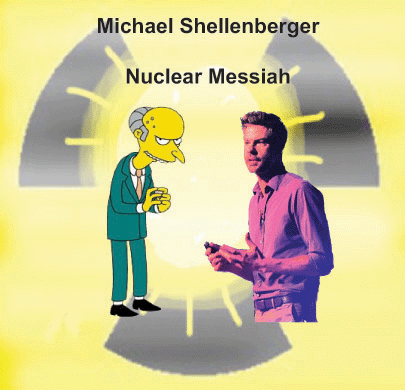 Book review: Bad science and bad arguments abound in ‘Apocalypse Never’ by Michael Shellenberger’, Yale Climate Connections , By Dr. Peter H. Gleick | Wednesday, July 15, 2020 ”……………….. A recent entry in this debate is Michael Shellenberger’s “Apocalypse Never: Why Environmental Alarmism Hurts Us All” (HarperCollins Publishers, 2020). Shellenberger explains in his introduction that he seeks to counter and dismiss what he considers irrational, overwrought arguments of pending Malthusian catastrophes; instead, he seeks to promote the Cornucopian view that environmental problems can be eliminated if we’d just pursue aggressive economic growth, simple technological advances, and increased tapping of abundant natural resources. In doing so, he echoes previous efforts of authors like Herman Kahn, Julian Simon, and Bjørn Lomborg.
Shellenberger self-describes as an environmentalist activist and a bringer of facts and science to counter “exaggeration,
Two Cornucopian ideas lie at the heart of this book: The first idea is that there are no real “limits to growth” and environmental problems are the result of poverty and will be solved by having everyone get richer. This idea isn’t original and has long been debunked by others (for a few examples see here, here, here, and here).
View that nuclear alone can address needs
The second idea – and the focus of much of Shellenberger’s past writings – is that climate and energy problems can and should be solved solely by nuclear power. He writes, “Only nuclear, not solar and wind, can provide abundant, reliable, and inexpensive heat,” and, “Only nuclear energy can power our high-energy human civilization while reducing humankind’s environmental footprint.” (“Apocalypse Never” – hereafter “AN” – pp. 153 and 278) The many economic, environmental, political, and social arguments levied against nuclear are simply dismissed as having no merit, for example: “As for nuclear waste, it is the best and safest kind of waste produced from electricity production. It has never hurt anyone and there is no reason to think it ever will.” (AN, p. 152) ……….
Using the facade of ‘strawman arguments’
Shellenberger regularly sets up other strawman arguments and then knocks them down. [A strawman argument is an effort to refute an argument that hasn’t been made by replacing your opponent’s actual argument with a different one.] One of the most prevalent strawman arguments in the climate debate is that scientists claim climate change “causes” extreme events, when in fact, climate scientists make careful distinctions between “causality” and “influence” – two very different things. This area, called “attribution science,” is one of the most exciting aspects of climate research today.
Shellenberger sets up the strawman argument that people are incorrectly claiming recent extreme events (like forest fires, floods, heat waves, and droughts) were caused by climate change, and then he debunks this strawman. “Many blamed climate change for wildfires that ravaged California” (AN, p.2) and “the fires would have occurred even had Australia’s climate not warmed.” (AN p. 21) He misrepresents how the media reported on the fires, describing a New York Times story on the 2019 Amazon fires: “As for the Amazon, The New York Times reported, correctly, that the ‘fires were not caused by climate change.’” But here Shellenberger is cherry-picking a quote: If you look at the actual article he cites, the journalist makes clear the “influence” of climate change just two sentences later:
These fires were not caused by climate change. They were, by and large, set by humans. However, climate change can make fires worse. Fires can burn hotter and spread more quickly under warmer and drier conditions. (emphasis added)
He also misunderstands or misrepresents the extensive and growing literature on the links between climate change and extreme events, ……
……. Another example of a serious conceptual confusion is his chapter dismissing the threat of species extinctions. The chapter is full of misunderstandings of extinction rates, ecosystem and biological functions, confusions about timescales, and misuses of data. For example, Shellenberger confuses the concept of species “richness” with “biodiversity” and makes the astounding claim that
Around the world, the biodiversity of islands has actually doubled on average, thanks to the migration of ‘invasive species.’ The introduction of new plant species has outnumbered plant extinctions one hundred fold. (AN, p. 66)
By this odd logic, if an island had 10 species of native birds found only there and they went extinct, but 20 other invasive bird species established themselves, the island’s “biodiversity” would double. This error results from a misunderstanding of the study he cites, which properly notes that simply assessing species numbers (richness not biodiversity) on islands ignores the critical issues of biodiversity raised by invasive species, including the disruption of endemic species interactions, weakening of ecosystem stability, alteration of ecosystem functions, and increasing homogenization of flora and fauna………………
Another classic logical fallacy is to try to discredit an opponent’s argument by attacking the person and her or his motives, rather than the argument – hence the Latin “ad hominem” (“against the man”). Ad hominem attacks are pervasive in this book and detract from its tone and the content.
Shellenberger attacks “apocalyptic environmentalists” as “oblivious, or worse, unconcerned” about poverty (AN, p. 35) or for opposing a massive dam on the Congo river. (AN, p. 276) He attacks the finances of leading environmental groups and leaders like the late David Brower, arguing they have taken donations from fossil fuel companies to “greenwash the closure of nuclear plants.” (AN, p. 205) And he attacks the motives, reputations, and science of many individual environmental and geophysical scientists whose work contradicts his arguments……
Shellenberger has a special level of animosity for the press:
News media, editors, and journalists might consider whether their constant sensationalizing of environmental problems is consistent with their professional commitment to fairness and accuracy, and their personal commitment to being a positive force in the world…….
In the most disturbing examples of vicious personal attacks, he paints broad categories of people who disagree with him as motivated by a hatred of humanity:
”When we hear activists, journalists, IPCC scientists, and others claim climate change will be apocalyptic unless we make immediate, radical changes, including massive reductions in energy consumption, we might consider whether they are motivated by love for humanity or something closer to its opposite (AN, p. 275, emphasis added). We must fight against Malthusian and apocalyptic environmentalists who condemn human civilization and humanity itself. (AN, p. 274) (emphasis added).”
He argues in his closing sections that people worried about environmental disasters are playing out “a kind of subconscious fantasy for people who dislike civilization” (AN, p. 270) and suggests that people who oppose the solutions he prefers do so because they long for the destruction of civilization – a nasty attack on the motives of all those working in this field.
Finally, the book is riddled with a variety of simple errors……. the number and scope of them here is problematic. …. one example is a massive misstatement of the amount of water required to produce energy. ….. in an important omission, he fails to note that key renewable energy sources such as wind and solar photovoltaics require far less water per unit of electricity produced than all fossil fuel and nuclear thermal plants. …. He claims, twice (AN pp. 211 and 241), that nuclear power plants produce “zero pollution” ………
Dr. Peter H. Gleick is president emeritus of the Pacific Institute, a member of the U.S. National Academy of Sciences, a MacArthur Fellow, and winner of the 2018 Carl Sagan Prize for Science Popularization. https://yaleclimateconnections.org/2020/07/review-bad-science-and-bad-arguments-abound-in-apocalypse-never/?fbclid=IwAR2jUB12zAF9WbluEtglePOQlOSKbLkIxdbWeeh9eSWbc366JXrHNIERzzY
‘Toxic masculinity’ – Britain to build more nuclear weapons

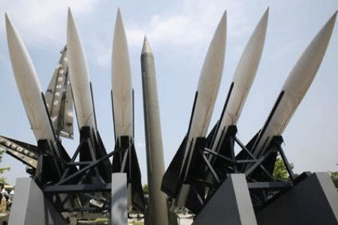
Boris Johnson ‘violating international law’ with plan to build more nuclear weapons, Defence review appears to breach Article 6 of nuclear non-proliferation treaty, Independent, Jon Stone Policy Correspondent, 16 Mar 21,
”………..Reacting to the new policy, Beatrice Fihn, executive director of the International Campaign to Abolish Nuclear Weapons (ICAN), said: “A decision by the United Kingdom to increase its stockpile of weapons of mass destruction in the middle of a pandemic is irresponsible, dangerous and violates international law.
“While the British people are struggling to cope with the pandemic, an economic crisis, violence against women, and racism, the government choses to increase insecurity and threats in the world. This is toxic masculinity on display.
“While the majority of the world’s nations are leading the way to a safer future without nuclear weapons by joining the Treaty on the Prohibition of Nuclear Weapons, the United Kingdom is pushing for a dangerous new nuclear arms race.”
In a further statement, the organisation suggested the UK would face censure at the next NPT review conference, which is due to take place in August at the United Nations.
“The United Kingdom is legally obligated under the nuclear non-proliferation treaty to pursue disarmament. States will meet soon to review the NPT’s success and when they do, the UK will have to answer for its actions,” the statement said.
ICAN won the Nobel Peace Prize in 2017 for its “ground-breaking efforts to achieve a treaty-based prohibition” of nuclear weapons.
Article 6 of the NPT, to which Britain is a signatory, commits countries to “pursue negotiations in good faith on effective measures relating to cessation of the nuclear arms race at an early date and to nuclear disarmament”.
Kate Hudson, general secretary of the UK’s Campaign for Nuclear Disarmament, said: “A decision to increase Britain’s nuclear arsenal absolutely goes against our legal obligations under the nuclear non-proliferation treaty.
“Not only is the UK failing to take the required steps towards disarmament, it is willfully and actively embarking on a new nuclear arms race – at a time when presidents Biden and Putin have renewed their bilateral nuclear reductions treaty. Britain must not be responsible for pushing the world towards nuclear war. This is a dangerous and irresponsible move, and must be reversed.”….. https://www.independent.co.uk/news/uk/politics/boris-johnson-uk-nuclear-weapons-international-law-b1817827.html
Nuclear power has become irrelevant — like it or not
 https://english.kyodonews.net/news/2021/03/1a9b07886b98-opinion-nuclear-power-has-become-irrelevant—-like-it-or-not.html, By Mycle Schneider, KYODO NEWS , 16 Mar 21,
Ten years went by since the Fukushima Daiichi accident began. What happened in the United States, historically leading the world’s nuclear power programs and still operating the largest reactor fleet in the world? What are global developments in energy policy increasingly dominated by renewable energy?
“The debate is over. Nuclear power has been eclipsed by the sun and the wind,” Dave Freeman wrote in the foreword to the World Nuclear Industry Status Report 2017.
he renowned industry thinker, called an “energy prophet” by The New York Times, passed away last year at age 94. He had seen nuclear power coming and going. President Carter appointed him as chairman of the only fully public electricity utility in the United States, the Tennessee Valley Authority in 1977.
Construction had started on two nuclear reactors in the state in 1972. It took until 1996 to complete the first one and until 2016 for the second one. Those were the last units to start up in the United States.
Construction began on four units in 2013, but in 2017, the bankruptcy of builder Westinghouse led to the abandonment of the $10 billion V.C. Summer two-unit project in South Carolina.
Construction cost estimates for the only other active construction site in the United States, the two-unit Vogtle project in Georgia, have multiplied by a factor nearing five from $6.1 billion in 2009 to $28 billion by 2018. The startup continues to be delayed.
Meanwhile, lacking newbuild, the U.S. nuclear fleet is aging and the 94 still operating reactors now exceed an average age of 40 years. Although the U.S. nuclear industry claims to have achieved decreasing operation and maintenance costs — the only nuclear country to do so — the utilities are still struggling to compete with fierce competitors from the renewable energy sector.
Solar photovoltaic plants saw their electricity-generating costs decrease by 90 percent over the past decade, and wind power is down 70 percent, while nuclear kilowatt-hour costs increased by one third.
The global nuclear industry has lost the newbuild market. Five reactors started up in 2020, while six were closed down. While there was a net nuclear capacity increase of 0.4 gigawatt, renewables added an estimated 248 gigawatt. China, the only country with a significant newbuild program, added 2 gigawatt of nuclear and 150 gigawatt of solar and wind combined.
As Freeman stated, “These renewable, free-fuel sources are no longer a dream or a projection — they are a reality that are replacing nuclear as the preferred choice for new power plants worldwide.”
No wonder despair is reigning in nuclear companies’ headquarters. Ten years after the disaster struck Japan, nuclear power has become irrelevant in the world, an industrial reality that also Japanese policymakers need to face.
(Mycle Schneider is an independent international consultant on energy and nuclear power. He is the coordinator and publisher of the annual World Nuclear Industry Status Report.)
Sudden death of defendant in Ohio nuclear corruption case
|
Lobbyist Neil Clark, Defendant In Ohio Nuclear Bailout Case, Found Dead At 67, WOSU
By ANDY CHOW-16 Mar, 21 Neil Clark, a longtime Ohio lobbyist indicted in a sweeping federal bribery investigation into the state’s nuclear bailout law, has been found dead in Florida……
The Naples, Fla. medical examiner says they are conducting an autopsy on the 67-year-old Clark, following a sheriff’s office report of a man found dead with a head wound and a gun on the premises……
Clark was one of several defendants charged with racketeering last year in connection with HB6, Ohio’s nuclear bailout law. Federal prosecutors say the $61 million bribery scheme funneled money from FirstEnergy companies to then-Ohio House Speaker Larry Householder, in exchange for securing a $1 billion bailout benefiting several plants owned by First Energy and its former subsidiaries.
Clark pleaded not guilty in August. Householder has also pleaded not guilty in the case. Two other defendants and the dark money group Generation Now, which prosecutors said was created and operated at Householder’s discretion, have entered guilty pleas….. https://radio.wosu.org/post/lobbyist-neil-clark-defendant-ohio-nuclear-bailout-case-found-dead-67#stream/0 |
Serious security lapse at a Japanese nuclear plant
|
Serious security lapse at nuclear plant in Niigata https://www3.nhk.or.jp/nhkworld/en/news/20210316_26/
Japanese nuclear regulators have assessed a security lapse at the Kashiwazaki-Kariwa nuclear plant in Niigata Prefecture as being at the most serious level in terms of anti-terror measures. The Nuclear Regulation Authority was notified by the plant’s operator, Tokyo Electric Power Company, in January that a worker accidentally damaged sensor equipment for detecting intruders. On Tuesday, the result of an investigation of the plant was reported at an NRA closed-door meeting. The probe found that other sensor equipment may have remained broken since March of last year, making the plant vulnerable to intruders for months. The NRA revealed that TEPCO employees in charge of security did nothing despite knowing that alternative measures taken were ineffective. The NRA’s provisional assessment of the security lapse was that it was the most serious on a four-level scale of risks in safeguarding nuclear material. The authority members plan to consider punishment for the utility as soon as the assessment is finalized. Last September, another problem took place at the plant. An employee entered the plant’s central control room illegally, using another employee’s ID card. |
|
-
Archives
- February 2026 (228)
- January 2026 (308)
- December 2025 (358)
- November 2025 (359)
- October 2025 (376)
- September 2025 (258)
- August 2025 (319)
- July 2025 (230)
- June 2025 (348)
- May 2025 (261)
- April 2025 (305)
- March 2025 (319)
-
Categories
- 1
- 1 NUCLEAR ISSUES
- business and costs
- climate change
- culture and arts
- ENERGY
- environment
- health
- history
- indigenous issues
- Legal
- marketing of nuclear
- media
- opposition to nuclear
- PERSONAL STORIES
- politics
- politics international
- Religion and ethics
- safety
- secrets,lies and civil liberties
- spinbuster
- technology
- Uranium
- wastes
- weapons and war
- Women
- 2 WORLD
- ACTION
- AFRICA
- Atrocities
- AUSTRALIA
- Christina's notes
- Christina's themes
- culture and arts
- Events
- Fuk 2022
- Fuk 2023
- Fukushima 2017
- Fukushima 2018
- fukushima 2019
- Fukushima 2020
- Fukushima 2021
- general
- global warming
- Humour (God we need it)
- Nuclear
- RARE EARTHS
- Reference
- resources – print
- Resources -audiovicual
- Weekly Newsletter
- World
- World Nuclear
- YouTube
-
RSS
Entries RSS
Comments RSS
 nuclear-news