US Nuclear Corp signs agreements with Chinese nuclear corporation
US Nuclear Completes $256,626 Shipment to China, Signs New Agreement With CNNC Subsidiary, Intrado, March 22, 2021 LOS ANGELES, CA, (GLOBE NEWSWIRE) — via NewMediaWire – US Nuclear Corp. (OTCQB: UCLE) recently completed a shipment to China of USN’S popular tritium and carbon-14 air samplers as well as portable tritium monitors worth a total of $256,626.
Furthermore, as part of US Nuclear’s expansion into the Chinese market, US Nuclear signed a new “Cooperation Agreement” on March 1, 2021 with Dalian Zhonghe Scientific and Technological Development Co., a subsidiary of China National Nuclear Corporation (CNNC). Together, the companies will work to design the perfect instrumentation to outfit Chinese nuclear power plants. The instruments are planned to be built at a local factory in China to be cost-competitive and will be optimized for Chinese operators based on the local regulations and procedures. This can be a game changer since currently 80% of nuclear instruments purchased are imported into China at a high cost, and the functionality often does not fit local procedures, regulations, and language.
US Nuclear already has a local sales office in Beijing, China, and this new cooperation agreement with Dalian Zhonghe will help US Nuclear capture even more of the burgeoning market for nuclear power and radiation detection equipment in China.
The China National Nuclear Corporation (CNNC) controls most nuclear sector business including R&D, engineering design, uranium exploration and mining, enrichment, fuel fabrication, reprocessing, and waste disposal. It is also said to be the major investor in all nuclear plants in China.
China’s Nuclear Power Measurement Market
China is by far the world’s most active builder of nuclear power with plans to surpass the U.S. as the world’s top producer of nuclear energy by as early as 2030…………
China National Nuclear Corporation (CNNC) designs and builds nuclear power plants and oversees all aspects of China’s civilian and military nuclear programs. ……… China National Nuclear Corporation (CNNC) designs and builds nuclear power plants and oversees all aspects of China’s civilian and military nuclear programs. https://currently.att.yahoo.com/att/us-nuclear-completes-256-626-123000822.html
New research into the effects of nuclear bomb tests on Montebello islands
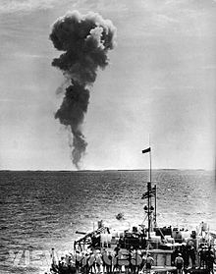 Montebello Islands the focus of new research to test nuclear impact.
 By Susan Standen 22 Mar 21, A new Edith Cowan University research project hopes to collect important data on the impact of historical nuclear testing in the remote Montebello Islands area.
Key points:
- New research will look at remaining radioactive residue in Montebello Islands
- Plutonium nuclides persist in sediment of the marine environment
- The research may be used in future to track fish migrations along the WA coast
Sixty years after the British government conducted nuclear explosion testing on the islands, there is little data available to find how much residue plutonium still exists.
The project hopes to be the first study to outline how and where man-made radioactivity is still existing in the marine sediment.
Collections of sediment are being collected from remote field trips to the islands to analyse amounts of residue plutonium radionuclides.,,,,,,,,,,,,
Ms Hoffman says other island nations affected by nuclear blasts will be able to use the Montebello Islands research as a reference baseline to start their own investigations.
Will it inform health research?
Ms Hoffman says the first step is to find out what remains there as a legacy…………..
The project is a collaboration between the Edith Cowan University, the Department of Biodiversity and Conservation and the Australian Radiation Protection and Nuclear Safety Agency. https://www.abc.net.au/news/2021-03-22/montebellos-nucelar-fallout-research/13260242
Kim Jong-un wants ”arms control talks” with USA, not denuclearisation in the short term
|
North Korea’s new nuclear gambit and the fate of denuclearisation, East Asia Forum, 22 March 2021 Author: Evans JR Revere, BrookingsIn March 2012, North Korean Foreign Minister Ri Yong-ho told a group of US experts and former officials that North Korea would not denuclearise until the United States removed its ‘threat’. He defined this as the US–South Korea alliance, the presence of US troops in South Korea, and the US nuclear umbrella defending South Korea and Japan.
‘If you remove the threat’, Ri said, ‘we will feel more secure, and in 10 or 20 years we will be able to consider denuclearisation’. ‘In the meantime,’ he declared, ‘we can sit down and engage in arms control talks as one nuclear power with another’. Ri’s remarks provided valuable insight into North Korea’s strategy and goals at the time. Today, his words shed light on why North Korean leader Kim Jong-un has doubled down on nuclear and ballistic missile programs. Faced with a new US president whose North Korea policy remains unclear, Kim Jong-un has decided to pre-empt the outcome of the ongoing US policy review by ending all prospects of denuclearisation and expanding his nuclear and missile capabilities instead. In doing so, Kim hopes to compel Washington to engage in ‘arms control talks’ if it hopes to slow the North’s nuclear program. Kim’s gambit to change the main topic of US–North Korea dialogue from denuclearisation to arms control was hiding in plain sight in his January 2021 address to the Korean Workers Party Congress. He described North Korea’s nuclear weapons development as the nation’s ‘strategic and predominant goal’ and an ‘exploit of greatest significance in the history of the Korean nation’. Declaring North Korea a ‘responsible nuclear weapons state’, Kim’s message was that the regime is now a permanent nuclear power and Washington must deal with it as such. No less important was Kim’s announcement of a plan to enhance his nuclear and missile arsenals by developing ‘ultramodern tactical nuclear weapons’, multiple-warhead missiles and solid-fuel intercontinental ballistic missiles. Kim’s remarks signalled his determination to make a dangerous threat even more potent. Much has been said about the Biden administration’s ongoing North Korea policy review. But Kim Jong-un’s remarks to the Party Congress suggest Pyongyang has conducted its own review, the result of which will be a major challenge for a new US administration still finding its feet…………… https://www.eastasiaforum.org/2021/03/22/north-koreas-new-nuclear-gambit-and-the-fate-of-denuclearisation/ |
|
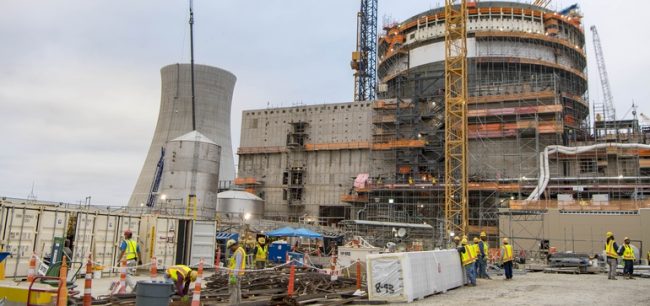
Delay in construction of Vogtle nuclear station – every day extra means additional costs to customers
|
Southern Company identifies ‘likely’ nuclear construction delay on Vogtle unit, Utility Dive, 22 Mar 21, Iulia Gheorghiu @IMGheorghiu
Dive Brief:
“Every day that that unit is delayed means additional cost burdens are going to get thrust on customers,” David Rogers, Southeast deputy regional director for Sierra Club’s Beyond Coal Campaign, said. “We could find cheaper, more effective ways to meet any needs that [Unit 3] fills by using things like wind, solar, storage, [and] energy efficiency.”……. https://www.utilitydive.com/news/southern-company-identifies-likely-nuclear-construction-delay-on-vogtle-u/597095/
|
|
UK nuclear announcement ‘shocking and alarming’ warn the Elders
UK nuclear announcement ‘shocking and alarming’ warn the Elders https://theelders.org/news/uk-nuclear-announcement-shocking-and-alarming-warn-elders MARY ROBINSONNUCLEAR DISARMAMENT-22 Mar 21,
The Elders say UK proposals risk contributing to a dangerous new nuclear arms race.
Following the release by the UK government of its Integrated Review of Security, Defence, Development and Foreign Policy, Mary Robinson, Chair of The Elders, said:
“The announcement today by the UK Government of its intention to increase by over 40% the cap on its nuclear warhead numbers is surprising and deeply alarming. This would be incompatible with the UK’s international obligations to pursue disarmament under the Non-Proliferation Treaty (NPT), and risks contributing to a dangerous new nuclear arms race. It also risks undermining the NPT Review Conference due to take place in August this year.
It is particularly shocking that a permanent member of the UN Security Council should make such an announcement at a time when other countries have been taking positive steps to reverse the deterioration in nuclear arms controls, following the extension of New START between the US and Russia, and the entry into force of the Treaty on the Prohibition of Nuclear Weapons earlier this year.
While the UK cites increased security threats as justification for this move, the appropriate response to these challenges should be to work multilaterally to strengthen international arms control agreements and to reduce – not increase – the number of nuclear weapons in existence.
The Elders call on all nuclear states to demonstrate their commitment to nuclear disarmament, and to make concrete reductions to their stockpiles in line with the minimisation agenda put forward by The Elders.
As decision-makers take stock of the UK government’s announcement, we urge all world leaders to recall the spirit of Ronald Reagan and Mikhail Gorbachev’s declaration in 1985 that “a nuclear war can never be won and must never be fought”, and redouble their efforts to make progress towards achieving a world wholly free from nuclear weapons.”
For media inquiries, please contact Luke Upchurch, Director of Communications at The Elders (+44 7741 742 064) or email:media@theElders.org
David Swanson: A Cold War Re-Education in 8 Minutes — Rise Up Times

“The U.S. could have chosen hot war, but could also have chosen peace.”
David Swanson: A Cold War Re-Education in 8 Minutes — Rise Up Times
Nuclear news – week to 22 March
Not a lot of remarkable news on nuclear this week . The nuclear lobby is doubling down on its media propaganda, touting nuclear as the solution to climatev change. Also it is determinedly promoting the Tokyo Olympics – the so-called ‘recovery Olympics’, despite the fact that international visitors are banned.
Coronavirus. Incidence of new cases globally continues to rise, but death numbers are falling. Problems in distribution of vaccines.
Climate. Developments in global heating are covered each week in Radio Ecoshock, which is a jump ahead of most news media. This week, it’s been about the predicted high temperatures in the world’s cities. Also, it’s a warm\ning that climate tipping points are coming sooner than expected.
A bit of good news. March 20 was the U.N.’s International Day of Happiness. For the fourth year in a row, Finland has been named the happiest country in the world, with Iceland coming in second, followed by Denmark, Switzerland, and the Netherlands.
Investigative journalism – Advanced nuclear reactors : Assessing the Safety, Security, and Environmental Impacts of Non-Light-Water Nuclear Reactors. New science report: advanced nuclear reactors no safer than conventional nuclear plants. The economics of nuclear power plants are not favorable to future investments.
Nuclear power has become irrelevant — like it or not. Why the Fukushima disaster signalled the end of Big Nuclear.
New research to determine plutonium pollution and its sources.
Don’t believe hydrogen and nuclear hype – they can’t get us to net zero carbon by 2050
Review of Michael Shellenberger’s book on ”Why Environmental Alarmism Hurts Us All”.
JAPAN. The nuclear lobby holds too much sway over governments, particularly in Japan. Serious security lapse at a Japanese nuclear plant. Japanese regulator decides against restarting Kashiwazaki-Kariwa No. 7 nuclear reactor.
New type of large and highly radioactive particles found in Japan. Fukushima disaster 10 years on: How long will it take to clean up the nuclear waste?
UK.
- How the British government reacted to the Fukushima catastrophe – with propaganda promoting the nuclear industry.
- Boris Johnson joins Britain up to a perilous, uncontrollable, nuclear weapons race. UK should build foreign policy on aid, conflict resolution, not on reversing nuclear disarmament. UN expresses concern over UK’s move to increase nuclear weapons arsenal. UK govt – cutting costs on troops as it expands nuclear missile numbers
- New report on human and environmental impact of Hinkley Point C nuclear project. Hinkley Point C nuclear power station ‘could suck up 182 million fish a year’ from Severn Estuary. Dilemma over plan to dump Himkley radioactive mud off Cardiff coast. Hinkley Point nuclear reactors with cracks are allowed to resume limited operations.
USA.
- Production of plutonium must cease, for the Nuclear Non Proliferation Treaty to work. Plutonium used at Japanese reactor will be glassed, stored at Savannah River Site.
- With ”regulatory capture” of USA’s Nuclear Regulatory Commission, California’s got nuclear fuel buried 108 feet from the sea .
- Duane Arnold nuclear reactor, same type as Fukushima Daiichi, vulnerable to extreme weather.
- Georgia’s Vogtle nuclear station likely to yet again miss a deadline.
- Report alleges elevated cancer deaths in Monroe may be result of nuclear plant.
- Sudden death of defendant in Ohio nuclear corruption case.
- Deb Haaland -new U.S. Secretary for Interior, – first Native American in a U.S. presidential cabinet.
RUSSIA. Russia planning to dispose of highly dangerous nuclear reactor cores of submarines at bottom of Kara Sea.
IRAN. United Nations nuclear watchdog says it’s possible to return to the Iran nuclear deal.
FRANCE. France must restructure debt-laden EDF (Electricite de France) and reform nuclear sector by October. Flamanville nuclear reactor: 3 new welds do not meet safety requirements.
PACIFIC ISLANDS. Outcry in Tahiti over nuclear fallout study.
UNITED ARAB EMIRATES. Unitede Arab Emirates $32 billion Barakah nuclear plant poses environmental, safety, and security problems.
AUSTRALIA. Minerals Council of Australia trying to influence European Commission, to push for fossil fuels and nuclear.
Fukushima disaster 10 years on: How long will it take to clean up the nuclear waste?
Decontamination and living with ‘black bags’
Piles of black bags were generated by the vast, painstaking clean-up and then transported from other storage places. Those black bags have occupied more than 90 blocks ranging from 180 sq m to 6,500 sq m in the northern part of Tomioka since 2015.
According to a 2018 report from Japan’s Ministry of the Environment, the estimated total quantity of decontaminated soil will be somewhere between 16 and 22 million cubic metres after volume reduction. This is 13 to 18 times larger than the volume of the Tokyo Dome.
The Ministry says the total will likely be at the lower end of the provided range, in a latest reply to The Straits Times’ query.
Limits of decontamination
The “decontamination” only involves soil removal in flatland areas – the government has said that it is impossible to clear the soil in mountainous areas, but more than 70 per cent of the hardest-hit areas are mountainous.
Mr Nobuyoshi Ito is one of those who live in the mountainous areas where vast decontamination is hard to carry out.
Mr Ito first moved to Iitate village in Fukushima prefecture in 2010 after he retired as an IT engineer, to work as an “apprentice farmer”.
He had no ties with the village before that, but the self-professed “guinea pig” ended up staying on there, in open defiance of government orders to evacuate, and against his children’s wishes for him to live with them in Niigata prefecture on the west coast.
“When the government asked us to evacuate… I asked if there would be criminal charges if I continued to live here,” he told The Straits Times in 2016. “They said no.”
He carries a dosimeter around with him all the time, measuring anything he can lay his hands on from soil, plants to animal carcasses. He also owns a laboratory-grade radiation measuring machine at his cabin, deep in the mountains in the village.
He thinks the government’s decision to not decontaminate forested mountainous areas will backfire due to factors such as rain that may spread radioactive material, and in a study last year found that 43 out of 69 locations along the Olympic torch relay route had radiation levels above the government limits.
He told The Straits Times that he fears that Tokyo is overly eager to portray that everything was “under control”, given that this could give the impression that it is “case closed”.
Non-profit Greenpeace notes that such standards in towns neighbouring the nuclear plant would not pass in other parts of the world.
The indefinite future: Where to permanently store 16 million bags of nuclear waste
The law requires that the final disposal site of high-level nuclear waste should be outside of Fukushima by March 2045.
Two fishing villages in Hokkaido are vying to host the final storage facility of Japanese nuclear waste for half a century, splitting communities between those seeking investment to stop the towns from dying, and those haunted by the 2011 Fukushima disaster who are determined to stop the project.
I cannot give a deadline at this moment. We will consider the entire schedule based on the progress at the two new potential sites, along with nationwide public relations activities.
MS MASARU KASHIMA
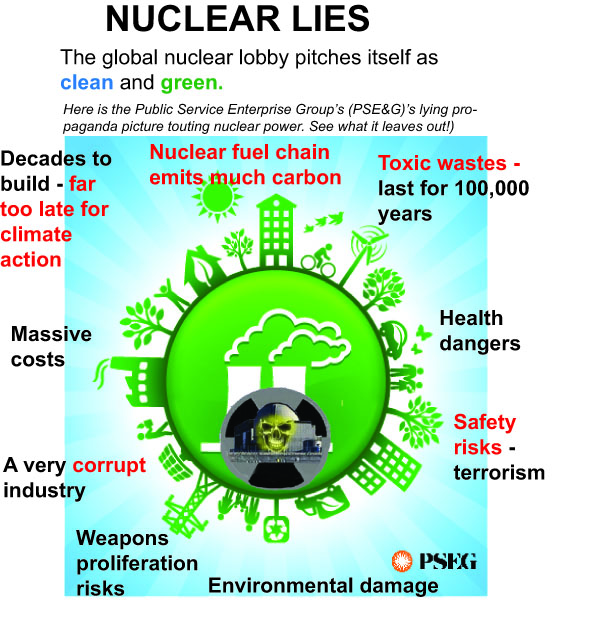
The nuclear lobby’s lying propaganda on the run up to COP Climate Conference
Ya gotta admire the global spread and relentless persistence of the nuclear industry at every level. Whether it be aimed ast schoolkids or heads of state, – the message is just such a lie – that nuclear power is ”essential to fight climate change’‘
Never mind that nuclear power is itself very vulnerable to climate change (over-heating, rising sea leveles, storm surges, water shortages……)
Anyway, today I was captivated by a charming, pretty, graphic, touted by the Public Service Enterprise Group, (PSE&G’) in an article extolling nuclear power, published by INSIDER NJ.
I just felt the need to make PSE&G’s picture honest.
The economics of nuclear power plants are not favorable to future investments
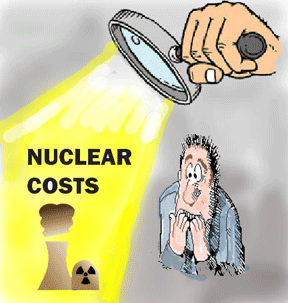 Investing into third generation nuclear power plants – Review of recent trends and analysis of future investments using Monte Carlo Simulation https://www.sciencedirect.com/science/article/abs/pii/S1364032121001301 Renewable and Sustainable Energy Reviews Volume 143, June 2021, 110836 Author links open overlay panelB.WealerabS.BauerbC.v.HirschhausenabC.KemfertacL.Göke
Highlights
- •Cost escalations in the nuclear sector observed in previous research continue until today.
- •Investing into a nuclear power plant today is not a profitable business case.
- •The net present values are mainly negative, in the range of five to ten billion USD.
- •Interest during construction is a major cost driver not to be underestimated.
- •Policy debates should consider total costs including interest and construction time.
Abstract
This paper provides a review of trends in third generation nuclear power plants, and analyzes current and future nuclear power plant investments using Monte Carlo simulations of economic indicators.
We first review global trends of nuclear power plant investments, including technical as well as economic trends. The review suggests that cost escalations in the sector observed in previous research continue until today, including the most recent investment projects in the U.S. and in Europe.
In order to extend this analysis, we carry out our own investment analysis of a representative third generation nuclear power plant, focusing on the net present value and the levelized cost of electricity. We base our analysis on a stochastic Monte Carlo simulation to nuclear power plant investments.
We define and estimate the main drivers of our model: Overnight construction costs, wholesale electricity prices, and weighted average cost of capital, and discuss reasonable ranges and distributions of those parameters.
Model runs suggest that investing in nuclear power plants is not profitable, i.e. expected net present values are highly negative, mainly driven by high construction costs, including capital costs, and uncertain and low revenues.
Even extending reactor lifetimes does not improve the results significantly. We conclude that our numerical exercise confirms the literature review, i.e. the economics of nuclear power plants are not favorable to future investments, even though additional costs (decommissioning, long-term storage) and the social costs of accidents are not even considered.
With ”regulatory capture” of USA’s Nuclear Regulatory Commission, California’s got nuclear fuel buried 108 feet from the sea

Nuclear Fuel Buried 108 Feet From the Sea https://www.counterpunch.org/2021/03/19/nuclear-fuel-buried-108-feet-from-the-sea/, BY ROBERT HUNZIKER “The most toxic substance on Earth is separated from exposure to society by ½” of steel encased in a canister.” (Blanch)
That eye-opener comes from renowned nuclear expert Paul Blanch in reference to spent fuel rods removed from San Onofre Nuclear Generation Plant buried near the sea on California’s southern coastline 50 miles north of San Diego.
Seventy-three 20-foot tall canisters of highly toxic nuclear spent fuel rods are nestled underground within 108 feet of the Pacific Ocean and not far from Interstate 5 from which passersby catch a glimpse of 73 large rectangular lids poking above ground, thus sealing the most toxic substances on Earth ensconced in ½” dry casks. (Footnote: In contrast, German CASTOR V/19 ductile cast iron casks, with permanent integrated monitoring, are nearly two-feet thick)
What could possibly go wrong on the seashore?
At the outset of San Onofre’s plans for its 73 buried canisters, the Nuclear Regulatory Commission itself admitted: (1) the thin ½” stainless steel canisters could crack within 30 years (2) there’s no current technology to inspect, repair or replace cracked canisters (3) limited monitoring means leaks may not be detected soon enough. (Source: Sanonofresafety.org) It is not believed the foregoing has changed one iota.
Unfortunately, when it comes to nuclear risks, what can go wrong isn’t known until it actually goes wrong. Then, it’s too late. Which explains the contention of a professional group associated with publicwatchdogs.org that discussed issues of credibility and truthfulness of the US Nuclear Regulatory Commission at a public hearing on March 9th, 2021. More on that follows later.
The 73 San Onofre rectangular lids symbolize the final act of decommissioning San Onofre Nuclear Generating Station, remnants of 50 years of nuclear power. Nobody knows with any degree of certainty the consequences of highly toxic spent fuel rods buried within 108 feet of the ocean. Is it risky or not risky? Is it even possible to define the risk?
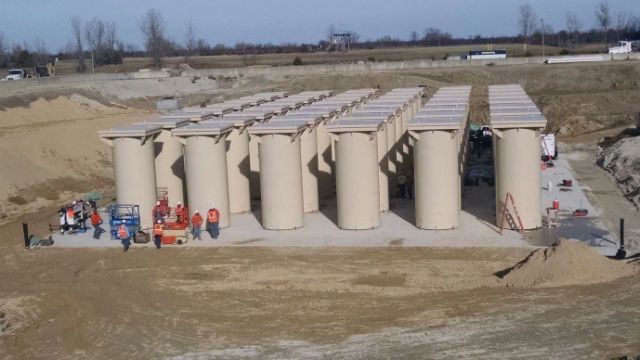
In truth, the risks of nuclear power cannot be adequately defined. Experience shows that the risk factors have no ceiling, no comparisons, no analogies, nothing similar, only disastrous results when things go wrong. More to the point, it’s a grand experiment of juggling the most potent substance on the planet. Like a hot potato, nobody knows what to do with it, other than bury it somewhere somehow that hopefully keeps it secure. Is a beachfront 108 feet off the ocean a good, secure location?
Still, given enough time, nuclear risks are defined via incidents, e.g., Fukushima, which exposed the consequences of failure of identifying nuclear risks. If it were otherwise, Fukushima would’ve been better prepared. They weren’t!
According to Prime Minister Naoto Kan /Japan, 2011: “We did not anticipate such a huge natural disaster could happen.” At the tensest moments, PM Kan was briefed on plans for complete evacuation of Tokyo, a horrific beyond belief event that came far too close for comfort! Nowadays, the former PM is an antinuke protestor.
It’s worth noting that Fukushima houses 10 nuclear reactors and 11 open pools of water containing spent fuel rods. If exposed to open air, spent fuel rods erupt into a sizzling zirconium fire followed by massive radiation bursts of the most toxic material known to humanity. It can upend an entire countryside and force evacuation of major cities, literally begging the impossible question of whether San Onofre’s remnants threaten all of Southern California?
Throughout America nuclear facilities contain open pools of spent fuel rods. According to the widely recognized nuclear expert Paul Blanch: “Continual storage in spent fuel pools is the most unsafe thing you could do.” Some spent fuel rods have been removed and stored in dry casks, but what if the dry casks are buried 108 feet from the Pacific Ocean? And, what of dry casks only ½” thick filled with radioactive spent fuel rods running a 500°F temp inside and 400°F on the canister’s exterior? By all appearances, it is an extremely lively affair!
That goes to the heart of questions posed at a recent Nuclear Regulatory Commission public hearing on March 9th. Thereupon, on behalf of the general public, three professionals drilled down into the procedures of the NRC whilst questioning its credibility. The bios of those three professionals:
Paul Blanch, registered professional engineer, US Navy Reactor Operator & Instructor with 55 years of experience with nuclear engineering and regulatory agencies, widely recognized as one of America’s leading experts on nuclear power.
Stuart H. Scott, founder and Executive Director of Facing Future, best known for bringing Greta Thunberg to the 2018 UN climate negotiations in Poland (COP-24) and for convincing Dr. James Hansen, the 32-year veteran Director of NASA’s Goddard Institute for Space Studies to COP-21, to attend Paris ’15.
Charles Langley, Executive Director of PublicWatchdogs.org, a public advocate with more than 25 years of experience in the field of energy law, energy policy, and utility rate setting.
 According to publicwatchdogs.org, the NRC is a “captive regulator” that accedes to nearly every request for regulatory relief for the nuclear power industry, as well as relaxation of safety rules and enforcement for the industry, in fact, following the command of industry insiders. But, when it comes to the general public, the NRC summarily rejects nearly every public petition aimed at strengthening the rules or following enforcement of existing rules. The petition process at the NRC is a one-sided affair that leaves the public out in the cold. From 1975- 2012 there were 387 petitions filed under provisions of the code, only two granted substantive relief, and one of those was from the nuclear industry. So, over 37 years there were, in actuality, more like a thousand petitions submitted by the public, and only one made it. It should be noted that rejections of petitions cannot be appealed.
On the other hand, when an industry player makes requests, according to Paul Blanch, working for a public utility, asking NRC for “a deviation from the rules” on a phone call got approved within one hour.
As it happens, the field of play with the NRC is lopsided. Industry players can ask any questions of NRC, but the public can only ask “process questions,” which does not lead to adequate answers, if any answers at all. Moreover, according to publicwatchdogs.org: “The NRC is providing inaccurate and false information to the public… At issue is the fact that the NRC is claiming that a flooding event at the SONGS (San Onofre Nuclear Generating Station) Independent Spent Fuel Storage Installation or ISFSI is ‘non-credible’.”
Really? Non-credible? What does that mean?
According to publicwatchdogs.org: “ISFSI is an Orwellian word used by the NRC to describe a toxic beachfront nuclear waste dump containing a spent nuclear fuel depot that is deadly radioactive for 250,000 years. The SONGS “ISFSI” is located 108 feet from the beach, in a tsunami inundation zone next to an earthquake fault line. It contains 73 thin-walled stainless steel cans weighing upwards of 100,000 pounds each. Each 20-foot high canister contains the same amount of Cesium-137 that was released into the atmosphere during the entire Chernobyl event. The cans themselves are only guaranteed to last for 25 years.”
What happens if a king tide, during full moon, or tsunami strikes and triggers a loss of cooling for the containers? Therefore, publicwatchdogs.org demanded the NRC provide a realistic flood analysis, with consequences spelled out. But, according to the petitioners, the NRC has never analyzed a loss of cooling of the 73 buried canisters. That fact alone is beyond comprehension. How could they not? Will they now?
Furthermore, nobody can explain what happens with ruptured casks. The San Onofre casks are filled with helium gas with natural conduction airflow surrounding each individual container, which are thin casks ½” thick.
In all, Public Watchdog’s research found that NRC misrepresented information. At the hearing, petitioners exposed inept Nuclear Regulatory Commission processes, responses, and a lack of credibility, claiming the NRC is merely a rubber stamp for the nuclear industry and not at all responsive to public queries.
The following is a condensed version of the issues brought forth on the virtual meeting with the Nuclear Regulatory Commission:
It should be noted that NRC rejected the group’s Oct 13th petition on the dubious grounds of the term “not credible.” Failure or leakage of the canisters, according to NRC, is “not credible.” But “not credible” is not defined anywhere in NRC documents. Of course, no answers came at the scheduled meeting.
An important pursuit at the hearing was exposure of deficiencies of the Holtec Umax spent fuel storage system at San Onofre, as well as exposing its use at other locations in the US. Not only that but a king tide could wash over the canisters, no tsunami needed. A few feet of water would be disastrous. Meanwhile, there are no contingency plans to remove flooded water from the canisters in an emergency. Which is insidiously irresponsible: “Each canister contains more radioactive cesium than released at Chernobyl, each of 73 canisters, plus there are over 3,000 in this country.” (Blanch)
The Holtec canisters provide a 1/2” to 5/8” barrier between the most toxic material in the world and a Chernobyl-size release of radiation. The canisters must be kept full of helium gas, welded shut, thus they can never be examined on the inside for cracks or leaks, and scandalously, not monitored for temperature, pressure, or radiation. But yet, the NRC says failure is “not credible.”
Was Chernobyl not credible?
Was Fukushima not credible?
Making matters worse, there’s no provision for drainage of water in the underground canisters. A king tidal wave could flood, and as water boils off, nobody would know what to do to save Southern California from some level of mass evacuation. Additionally, there are no provisions to refill the canisters with pressurized helium should pressure drop. These are obvious risks factors, plus: San Onofre is located within an inundation zone for tsunamis. It’s also close to Camp Pendleton, a legitimate enemy target.
“We regard the NRC’s preliminary decision to reject our petition as irresponsible and wrong and it places millions of people in Southern California at risk that is unquantifiable.” (Petitioners)
When NRC receives petitions, they can be rejected by an unspecified number of PRB members and the petitioner does not know if it’s only one member a minority a majority or whatever. No logical reasons are given for rejections of petitions and no supporting documentation.
The San Onofre canisters need to be removed and placed into thick-wall casks and transported to a new repository in New Mexico. “The biggest problem is the NRC failure to admit there is a problem.” (Blanch)
In the final analysis, the NRC abrogates its own mission statement, which is to license and regulate civilian use of radioactive materials to protect public health and safety to promote the common defense and security and protect the environment. Yet, by all appearances, the NRC is more akin to an emotionless Frankenstein monster that belittles detractors via evasion and disdain without any answers for credible questions. What a trip!
Robert Hunziker lives in Los Angeles and can be reached at rlhunziker@gmail.com
Need for more research into causes of increased incidence of childhood lukaemia near nuclear site
National Library of Medicine 15th March 2021, A previous investigation of the occurrence of childhood acute leukemia around the Belgian nuclear sites has shown positive associations around one nuclear site (Mol-Dessel). In the following years, the Belgian Cancer Registry has made data available at the smallest administrative unit for
which demographic information exists in Belgium, i.e. the statistical sector. This offers the advantage to reduce the potential misclassification due to large geographical scales.
Results confirm an increased incidence of acute childhood leukemia around Mol-Dessel, but the number of cases remains very small. Random variation cannot be excluded and the ecological design does not allow concluding on causality. These findings emphasize the need for more in-depth research into the risk factors of childhood leukemia, for a better understanding of the etiology of this disease.
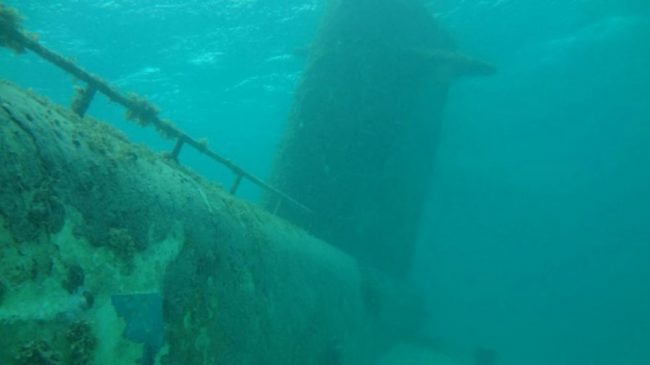
Russia planning to dispose of highly dangerous nuclear reactor cores of submarine at bottom of Kara Sea
|
Rosatom seeks contractor to dispose of sunken subs reactor cores https://bellona.org/news/nuclear-issues/2021-03-rosatom-seeks-contractor-to-dispose-of-sunken-subs-reactor-cores Rosatom, Russia’s state nuclear corporation, has announced a tender for disposing of reactor cores from the K-27 submarine, which was itself scuttled by the Soviet Navy in the Kara Sea four decades ago. March 21, 2021 by Anna Kireeva, translated by Charles Digges The tender speaks specifically of preparing for dismantlement and disassembly the spent removable cores from the reactor of the project 645 (item 64) nuclear submarine. These removable parts, which were removed in 1967, are currently located at the Gremikha storage base in Russia’s Murmansk region.
The tender also demands the preparation of cassettes of these irradiated parts in order to transport them to a federal nuclear fleet storage point, from where they will be sent for processing. The price tag for the task is 500 million rubles, about $6.7 million. Anatoly Grigoriev, head of international technical assistance projects at Rosatom, confirmed that the tender refers to the removable reactor cores from the K-27, which were extracted in 1967. After unloading, the cores were deposited at the Gremikha base. “It is worth noting that the publication of the tender has attracted a lot of attention and caused contradictory interpretations,” said Andrei Zolotkov, who heads Bellona’s offices in Murmansk. “First, it is not clear why a submerged nuclear submarine is called ‘scrapped.’ Secondly, it was not clear how it was possible to prepare for the disposal of spent removable parts of a nuclear submarine that lies at the bottom of the Kara Sea, when the decision to lift it has not yet been made. ” The K-27 was sunken intentionally in the Kara Sea’s Stepovoy Bay in 1981. It is considered by experts to be especially dangerous thanks to its liquid metal cooled reactors. At the time, the submarine was prepared for flooding by filling it with bitumen, concrete and furfural. But it’s likely that these substances left pockets of air, which would allow for the formation of condensation within the sunken hull. The submarine has been included as a priority on a federal list of sunken objects to be lifted from the seabed. The urgency owes to the high enrichment of the K-27’s nuclear fuel and the shallow 33-meter depth at which it lies. The furfural-combination filler used to seal the sub before its sinking also has a limited shelf-life, and is only guaranteed to last another few years. Some experts also fear that the nuclear fuel onboard the sub could undergo a spontaneous chain reaction should they be breached by water. Discussion among Russian officials on lifting various pieces of nuclear debris from the Arctic has heated up in recent years. In 2019, a group of Russian scientists collected, systematized and analyzed data on each of these sunken nuclear and radiation hazards and identified the most dangerous among them. The K-27 is listed as one of six such hazards requiring lifting within a federal effort called the “Strategy for the Development of the Arctic Zone of the Russian Federation until 2035.” The problem is that lifting the flooded objects is an extremely difficult task, as shown by the years-long effort to raise the Kursk nuclear submarine, which sank during a naval exercise in 2000, killing all 118 crew members. Russian scientists have weighed the options for lifting the hazards and calculated possible damages should the operations fail. The consequences could be serious, involving releases of radiation into the sea and air, with contamination possibly surpassing Russia’s borders. At the moment, engineers are designing a vessel capable of lifting these sunken radiation hazards from the sea floor, with construction of a recovery ship projected by the end of 2026. Lifting and dismantling the K-27 thereafter is expected to take from 2028 to 2013. According to Rosatom, the total activity of the sunken radiation hazards in the Kara and Barents Seas is 1 million Curie. According to preliminary estimates of Russian specialists, they can all be extracted within 12 years. |
|
New research to determine plutonium pollution and its sources
 EurekAlert 19th March 2021, Researchers looking at miniscule levels of plutonium pollution in our soils have made a breakthrough which could help inform future ‘clean up’ operations on land around nuclear power plants, saving time and money.
those responsible for environmental assessment and clean up.
https://www.eurekalert.org/pub_releases/2021-03/lu-npr031721.php
Boris Johnson joins Britain up to a perilous, uncontrollable, nuclear weapons race
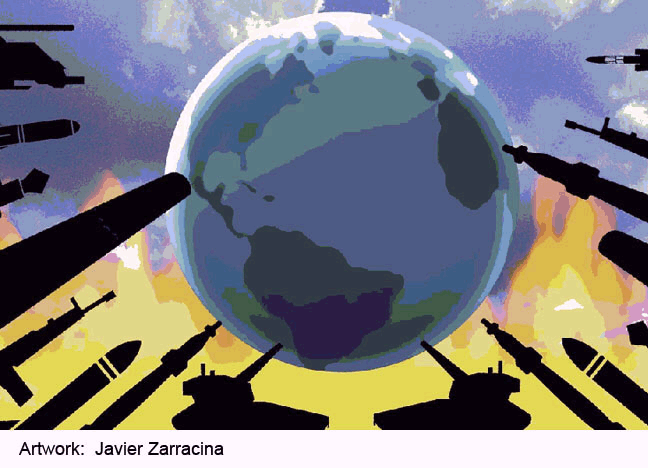  Boris Johnson is playing a dangerous nuclear game Boris Johnson is playing a dangerous nuclear gameSerhii Plokhy, Guardian, 19 Mar 21,Britain has joined an uncontrolled arms race in a world more unstable and unpredictable than even during the cold war
Boris Johnson’s decision to increase the cap on British nuclear stockpiles by more than 40%, from 180 to 260 Trident nuclear warheads, might easily be interpreted as a manoeuvre inspired by domestic politics, rooted in the Conservative party’s longstanding love affair with nuclear power and the recent politics of Brexit. But the decision has broader significance. It reflects the rapidly changing international nuclear environment, and will make it significantly worse. The world entered a new and dangerous era on 2 August 2019. On that day, the planet’s strongest nuclear powers, the US and Russia, declared their withdrawal from the Intermediate-range Nuclear Forces treaty signed by Ronald Reagan and Mikhail Gorbachev in 1987. The treaty was the last cold war-era arms control agreement remaining in force. We are now officially at the start of an uncontrolled nuclear arms race. What this meant became clear on 8 August, less than a week after the Reagan-Gorbachev agreement was abandoned. The reactor of a nuclear-powered and nuclear-armed Russian cruise missile, codenamed Skyfall, exploded in the Barents Sea, killing five Russian scientists and naval officers and contaminating the atmosphere and waters in the Arkhangelsk region of Russia. The ultimate target of Skyfall, as President Putin demonstrated in a public video a year earlier, is the US. Today, we are back to a situation that resembles the period preceding the Cuban missile crisis, when there were no mutually binding arms control agreements and various countries, the UK among them, were competing to outspend one another in building nuclear arsenals. In October 1962, only luck and the fear of nuclear confrontation shared by John Kennedy and Nikita Khrushchev saved the world from nuclear war. The shock of the crisis led the two superpowers to negotiate a number of arms control deals, ranging from the Partial Nuclear Test Ban treaty to arms control and limitation agreements. MAD, or mutually assured destruction, a concept strongly associated in the public imagination with Dr Strangelove’s “Doomsday Machine”, miraculously kept the nuclear powers at bay, maintaining what Churchill called the “balance of terror”………………….. While we face new challenges, we lack the fear of nuclear war developed by previous generations of political leaders and societies. Kennedy and Khrushchev considered nuclear war unwinnable. This is now changing with the scrapping of the old arms control treaties, the renewal of the nuclear arms race, and the development of new technologies making possible the execution of extremely accurate nuclear strikes. These factors have lowered the psychological barrier for using nuclear arms and brought back the illusion of the pre-hydrogen bomb age that wars conducted with limited use of nuclear weapons can be fought and won. That in turn feeds the new nuclear arms race, which the US and Russia have already started by abandoning cold war-era limitations. Hence the true importance of Johnson’s announcement, which opens the door for the UK and other countries to join the race. Even if the government decides not to limit itself to lifting the cap on Trident nuclear warheads and in fact acquires all 80 warheads over a short period of time, the world nuclear balance will hardly change. Despite all the changes around the globe since the end of the cold war, there are still two nuclear superpowers: Russia, with approximately 4,300 warheads, and the US, with an estimated 3,800 warheads. Eighty additional Trident warheads will not make much of a difference, nor will they make the UK safer if it comes to the worst. But by deciding to increase the cap, the UK – the world’s third country to develop its own nuclear capability – is sending the wrong signal: rearm. Instead, the world should be heading to the negotiating table to breathe new life into the arms control talks that all but ceased with the end of the cold war. That is no easy task, as negotiations will now have to go beyond the two nuclear superpowers and include the rest of the nuclear “haves” – first and foremost, China. The UK could play an important role in stopping the new nuclear arms race, instead of restarting it.
|
|
-
Archives
- February 2026 (228)
- January 2026 (308)
- December 2025 (358)
- November 2025 (359)
- October 2025 (376)
- September 2025 (258)
- August 2025 (319)
- July 2025 (230)
- June 2025 (348)
- May 2025 (261)
- April 2025 (305)
- March 2025 (319)
-
Categories
- 1
- 1 NUCLEAR ISSUES
- business and costs
- climate change
- culture and arts
- ENERGY
- environment
- health
- history
- indigenous issues
- Legal
- marketing of nuclear
- media
- opposition to nuclear
- PERSONAL STORIES
- politics
- politics international
- Religion and ethics
- safety
- secrets,lies and civil liberties
- spinbuster
- technology
- Uranium
- wastes
- weapons and war
- Women
- 2 WORLD
- ACTION
- AFRICA
- Atrocities
- AUSTRALIA
- Christina's notes
- Christina's themes
- culture and arts
- Events
- Fuk 2022
- Fuk 2023
- Fukushima 2017
- Fukushima 2018
- fukushima 2019
- Fukushima 2020
- Fukushima 2021
- general
- global warming
- Humour (God we need it)
- Nuclear
- RARE EARTHS
- Reference
- resources – print
- Resources -audiovicual
- Weekly Newsletter
- World
- World Nuclear
- YouTube
-
RSS
Entries RSS
Comments RSS
 nuclear-news