Impacts from Fukushima Nuclear Disaster Still Remain Ahead of Tokyo 2020 Olympics
UAlbany Professor: Impacts from Fukushima Nuclear Disaster Still Remain Ahead of Tokyo 2020 Olympics https://www.newswise.com/articles/ualbany-professor-impacts-from-fukushima-nuclear-disaster-still-remain-ahead-of-tokyo-2020-olympics?ta=home
| by University at Albany, State University of New York ALBANY, N.Y. (March 24, 2021) – The postponed torch relay for the Tokyo 2020 Olympics is set to officially kick off tomorrow, traveling across all 47 prefectures in Japan over 121 days and landing at the Olympic Stadium for the Opening Ceremony on July 23. The starting point of the relay is the J-Village soccer training center in Fukushima which, 10 years ago this month, was used as an operational base after a nuclear disaster in the region that was triggered by a massive earthquake and tsunami. While this is meant to be symbolism of Fukushima’s recovery, Thomas Bass, a professor of English and Journalism at the University at Albany, recently published an article in the Bulletin of the Atomic Scientists that argues many long-lasting impacts from the tragedy still remain and are largely ignored.“ The torch for the 2020 Olympics – delayed for a year by the coronavirus pandemic but still called the ‘2020 Olympics’ – is scheduled to be lit on March 25… 12 miles south of Fukushima Daiichi, where this March also marks something else: the 10th anniversary of the meltdown of three of the six nuclear reactors at the generating complex known as Fukushima No. 1, or F1.” “After a lighting ceremony… the Olympic torch will be run for three days through Fukushima’s nuclear exclusion zone. Japan hopes to focus our attention on the refurbished schools and town halls, re-opened train stations, and two new museums that have been built in Fukushima, while trying to keep the TV cameras away from the ruined houses and radioactive cars lying nearby.” Bass argues that there is a public safety risk, not only for the athletes, but also for the residents of the region who continue to be exposed to dangerous levels of radiation.“The generally accepted safety standard for radiation exposure is one milliSievert, or one-thousandth of a Sievert, per year… The Japanese government now allows individuals in Fukushima prefecture to be exposed to 20 milliSieverts per year.” Bass has taught at UAlbany for more than 15 years and is the author of seven books, including “The Eudaemonic Pie” and “The Predictors,” as well as several books on Asia. He has also written numerous articles for Wired, The New York Times, The New Yorker, Smithsonian, Discover, and other magazines. |
Scottish government firmly opposed to nuclear weapons and demands complete withdrawal of all nuclear weapons from Scotland
Scottish government firmly opposed to nuclear weapons and demands complete withdrawal of all nuclear weapons from Scotland https://www.helsinkitimes.fi/world-int/18924-scottish-government-firmly-opposed-to-nuclear-weapons-and-demands-complete-withdrawal-of-all-nuclear-weapons-from-scotland.html“Following the publication of the UK Government’s Integrated Review of Security, Defence, Development and Foreign Policy, the Scottish Government reaffirms that it is firmly opposed to the possession, threat and use of nuclear weapons – and it is committed to pursuing the safe and complete withdrawal of all nuclear weapons from Scotland,” the Scottish government said in a statement released today.
Britain is lifting the cap on the number of Trident nuclear warheads it can stockpile by more than 40% – from 180 to 260 warheads, Boris Johnson announced on Tuesday last week. This will end 30 years of gradual disarmament since the collapse of the Soviet Union. This would require a £24 billion (€27 billion) investment in response to “perceived” threats from Russia and China.
Ironically, Johnson criticised Iran for increasing its enriched Uranium stockpile in the same speech. Iran has signed the nuclear non-proliferation agreement and does not have any nuclear weapons.
Britain stockpiles its nuclear weapons at Coulport in the Clyde Area in Scotland. The depot consists of sixteen nuclear weapon storage bunkers. Trident missile warheads and conventional torpedoes are stored at the weapons depot, where they are installed and removed from submarines.
The United Kingdom is one of the five “official” nuclear weapon states and has been estimated to have a stockpile of 120 active nuclear warheads and 215 nuclear warheads in total.
The Scottish Parliament, in a meeting on Tuesday 3 November 2015, voted in favour of a motion calling on the UK government to drop plans to renew Trident nuclear weapons.
A review, ‘Scotland: A Good Global Citizen A Scottish Perspective on Climate, Defence, Security and External Affairs’, was published today. The publication outlines the Scottish Government’s position on a range of key international issues including a desire to engage proactively and energetically with the European Union, resolute support for international development, and a commitment to being a good global citizen.
Cabinet Secretary for Justice Humza Yousaf said:
“Scotland is an open, welcoming nation, internationalist in outlook and committed to working in partnership to tackle global challenges. We are steadfastly European, and do not want to turn our backs on our closest friends and partners.
“We are determined to enhance and develop this approach. This document – an important restatement of our approach to security, defence, development and foreign policy, which also outlines our strengths such as science, technology and shipbuilding – reflects that commitment, and indeed our values as a nation.
“The UK Government’s plans to expand the stockpile of nuclear weapons, spending billions on weapons that must never be used, is a lamentable and deeply disturbing response to the rapidly changing challenges of the modern age.
“Indeed the decision to increase the nuclear weapon stockpile is completely at odds with two thirds of the international community who signed the United Nation’s Treaty on the Prohibition of Nuclear Weapons.”
The Scottish government reiterated its position that only independence can give Scottish people the possibility of deciding on their own affairs, including removal of all nuclear weapons from Scotland.
“A steadfast opposition to nuclear weapons is underlined in the Scottish Government’s new assessment of security, defence, development and foreign policy,”
The review also emphasises that Scotland is committed to working with others to tackle global challenges including the climate crisis, migration and human rights.
Japan seeks support for Fukushima tank water release
Wednesday, March 24, 2021
Japan yesterday asked the International Atomic Energy Agency for support carrying out the future release of massive amounts of treated but still-radioactive water from the wrecked Fukushima Daiichi nuclear power plant, most likely into the sea….. (subscribers only) https://www.eenews.net/energywire/2021/03/24/stories/1063728273
Natural Resources Defense Council (NRDC) says advanced nuclear reactors are not a viable option to combat climate change
| Not So Advanced: Hype vs. Reality for Nuclear Technology https://www.nrdc.org/experts/matthew-mckinzie/not-advanced-hype-vs-reality-nuclear-technology March 24, 2021 Matthew McKinzie While aging US nuclear plants continue to close because they cannot compete in the market, proponents of so-called “advanced nuclear reactors” promise they are the future because of their significant benefits. However, a recent report by the Union of Concerned Scientists (UCS) found little evidence that “advanced nuclear reactors” can be significantly safer than today’s nuclear plants. And these new designs face considerable uncertainty about commercial viability.NRDC agrees with the conclusions and recommendations of this report. The UCS report compared the existing light-water reactor design to classes of proposed non-light-water reactors. These reactors include sodium-cooled fast reactors, high-temperature gas-cooled reactors, and molten salt-fueled reactors. In its report, UCS characterized and compared the performance of the designs according to a number of categories: Safety and security risk – the vulnerability of reactors and fuel cycle facilities to severe accidents or terrorist attacks that result in significant releases of radioactivity to the environment.Sustainability – the amount of nuclear waste generated by reactors and fuel facilities that require secure, long-term disposal, as well as the efficiency of using natural (mined) uranium or thorium. Nuclear proliferation and nuclear terrorism risk – the danger that nations or terrorist groups could illicitly obtain nuclear-weapon-usable materials from reactors or fuel cycle facilities.By using these criteria for classes of non-light-water designs, the report concluded that:The new designs currently under consideration do not offer obvious improvements over light-water reactors significant enough to justify their many risks. All non-light-water designs introduce new safety issues that will require substantial analysis and testing to fully understand and address.Some designs would entail reprocessing of nuclear fuel, which inherently poses greater proliferation and security risks. High-assay low enriched uranium fuel, which is needed for many new designs, poses higher nuclear proliferation and nuclear terrorism risks than the uranium fuel existing reactors require. Policymakers and lawmakers should examine these conclusions before relying on the hype from nuclear proponents. On top of this, it could take many years and billions of dollars to safely commercialize any non-light-water design, and that should not be underestimated. Thus far, non-light-water reactors can’t demonstrate that they are safe, sustainable, and resistant to nuclear weapons proliferation. Until that can be demonstrated, none of the so-called advanced reactors can be commercially viable. There are no more significant threats today to the planet than climate change. Our focus must be to convert the world’s carbon-based energy system to a net-zero, clean and renewable energy system by 2050. Due to their risks and significant time and resource requirements, advanced reactor designs are not a proven technological solution to get us to net-zero greenhouse gas emissions in the timely manner the climate crisis demands. Today nuclear power plants produce roughly 10% of global electricity and about 20% of electricity within the United States. Countries have to decide whether it is worth investing the time and resources to scale up nuclear power as part of their solution to address climate change. Important considerations in this analysis include public acceptance of reactors, the safe operation of nuclear plants, the nuclear waste problem and the economics of nuclear power. And should nuclear power increase worldwide, it could lead to an increased risk of nuclear weapons proliferation. Given the trends for these issues, NRDC asserts that reliance on non-light-water nuclear energy technologies is not a viable strategy for addressing the climate crisis. The closing of currently operating reactors can be managed for a smooth transition to renewable energy with vast energy efficiency gains, and models of economy-wide decarbonization provide low-nuclear roadmaps for achieving climate change solutions through renewable energy, electrification of buildings and transportation, and improved transmission. |
Community group created to advise cleanup of Three Mile Island nuclear site
| Community group created to advise TMI cleanup https://stateimpact.npr.org/pennsylvania/2021/03/23/community-group-created-to-advise-tmi-cleanup/ Rachel McDevitt MARCH 23, 2021 Communities surrounding the shuttered Three Mile Island nuclear plant near Harrisburg now have a citizens committee to help guide decommissioning of the plant’s Unit 2 reactor, which partially melted down in 1979. The Community Advisory Panel is made up of 15 people who represent the plant and its neighbors, including townships, school districts, first responders, nuclear planners and state historians. Londonderry Township manager Steve Letavic will lead the group. He said they hope to make decommissioning plans more transparent.“If people aren’t engaged and you’re not getting the right information out, then they have no other options than to jump to conclusions, or draw their own conclusions,” Letavic said. Issues at the site include what will happen to radioactive waste.Decommissioning company EnergySolutions agreed to work with a citizen committee after state regulators objected to accelerated plans to dismantle the site last year.“We’re going to get to work directly with EnergySolutions through the decommissioning process and really make sure that we’re all on the same page, we all have the same information, and we all know the next steps as we move forward through decommissioning,” Letavic said. DEP Secretary Patrick McDonnell wrote to the federal Nuclear Regulatory Commission last April detailing concerns including unknown levels of radiation left on site and cost to dismantle.In 2018, the reactor’s then-owner reported that a decommissioning trust fund for TMI-2 held about $899 million, while the estimated clean-up costs were $1.35 billion. In December, the NRC approved the reactor’s license transfer from FirstEnergy to TMI-2 Solutions for decommissioning. The company is a subsidiary of Utah-based EnergySolutions, which aims to profit by dismantling nuclear sites under budget. Asked how EnergySolutions plans to work with the community panel, spokesman Mark Walker said, “We created the TMI-2 CAP for the sole purpose to keep the community informed of TMI-2 decommissioning activities throughout the project.” Watchdog group Three Mile Island Alert, which opposed the transfer and has raised concerns about waste storage and the cleanup budget, was invited to join the panel.In a statement, TMI Alert chair Eric Epstein said they decided “not to serve on the advisory board as currently designed due to its unbalanced proposed structure, lack of enforcement teeth and the general perceived inability of the advisory board to have any real advisory capacity.” Letavic said the community group’s first meeting will include overviews of regulatory and decommissioning processes.It’s scheduled for April 7 from 2-3:30 pm and will be held virtually. All meetings will be open to the public. More information can be found at www.tmi2solutions.com.The group plans to meet two to three times per year until final decommission.It will take years to dismantle the plant; EnergySolutions hopes to finish in 2037.Letavic said because it is such a long process, new members will eventually replace the current panel.TMI-2’s partial meltdown in 1979 remains the country’s most serious accident at a commercial nuclear power plant.TMI Unit 1, owned by Exelon, shut down on Sept. 20, 2019.The NRC’s website says decommissioning must be completed within 60 years of a plant ceasing operations, unless necessary to protect public health and safety. |
Nuclear Hotseat -special feature on Three Mile Island nuclear anniversay
**Three Mile Island**
Nuclear Hotseat 23rd March 2021 This week’s full-length Three Mile Island Anniversary SPECIAL features
interviews with:
Arnie Gundersen, Chief Engineer for Fairewinds Energy Education.
Watch a video of Arnie Gundersen speaking about the accident at the 40th Anniversary of the founding of TMI Alert. Peter Bradford, who was a Commissioner at the Nuclear Regulatory Commissioner during the TMI
accident.
Eric Epstein, Chair of Three Mile Island Alert. TMI Alert’s Radiation monitoring page.
Mary Stamos, long time Middletown resident and TMIA member
Walter Cronkite, anchor for the CBS Evening News at the time of TMI and known as “the most trusted newsman in America.
Nuclear Hotseat 23rd March 2021
http://nuclearhotseat.com/2021/03/23/three-mile-island-nuclear-meltdown-never-forget/?s=09
Japan’s nuclear regulator bans Tepco from restarting Kashiwazaki-Kariwa plant due to safety flaws.
Japan Times 24th March 2021 ,Japan’s nuclear regulatory body decided Wednesday to effectively ban Tokyo
Electric Power Company Holdings Inc. (Tepco) from restarting a nuclear plant on the Sea of Japan coast after the complex was found to have serious safety flaws.
The Nuclear Regulation Authority decided at its meeting to ban Tepco from transporting nuclear fuel to the Kashiwazaki-Kariwa plant in Niigata Prefecture or loading it into the reactors. A final decision will be made after the operator is given an opportunity to provide an explanation. The punitive measure will be effective until Tepco’s response to the incident is “in a situation where self-sustained improvement is expected,” according to the regulator.
Nuclear industry in decline, lobbies hard to portray itself as ”green”
Over the past week, Energy Monitor has run a series of in-depth articles to mark the tenth anniversary of the Fukushima Daiichi disaster in Japan. The climate crisis has injected fresh impetus into the debate over the role of
nuclear power in energy production. The nuclear industry wants its slice of the action and is lobbying for its part in a post-Covid green recovery.
The numbers tell the story of an industry in global decline. In 2019, for the first time in history, non-hydro renewables like solar, wind and biomass generated more electricity than nuclear power plants. The amount of nuclear power peaked in 2006 and there were fewer reactors operating at the end of 2019 than 30 years ago.
These figures headline in the World Nuclear Industry Status Report (WNISR), a detailed annual account of the commercial nuclear power industry led by Mycle Schneider, a prominent international nuclear expert, and nuclear sceptic. However, a similar tale emerges in other studies, including from nuclear adherents such as the International
Energy Agency (IEA), which issued its first report on nuclear power in almost 20 years in May 2019.
Energy Monitor 22nd March 2021
Hinkley nuclear project, costs have risen, completion date pushed back to 2026
New Civil Engineer 23rd March 2021 The cost of Hinkley Point C nuclear power station has risen by around £500M and its start date pushed back to June 2026 due to delays arising from the Covid-19 pandemic. In January, EDF said it expected the Somerset project to cost up to £23bn compared with a 2019 estimate of a £22.5bn maximum. The start of electricity generation from Unit One of the power station had been scheduled for the end of 2025, but work postponed last year at the height of the first lockdown has not yet been completed.
In a message to employees, Hinkley Point C managing director Stuart Crooks said: “Ten months after it began, we are still facing the full force of the pandemic. “Even though experience has allowed us to increase numbers on site during the pandemic from below 2,000 to more than 5,000, social distancing requirements still limit the number of people we can safely have on site at any one time.” Crooks added that “a longer construction period also adds some cost — as does the reduced efficiency of operating a site for a long period under Covid-19 conditions”.
UK new coal mine – to pave the way for a radioactive waste dump?
Isle of Man Today 22nd March 2021, Campaigners opposed to plans for a new UK coal mine believe it will be a
‘Trojan horse’ for a nuclear waste disposal facility. Woodhouse Colliery will be Britain’s first deep coal mine in 30 years if it is sunk under the Irish Sea off the coast of Whitehaven.
But campaigners from Keep Cumbrian Coal in the Hole fear that the coal mine is a Trojan horse for the UK’s plans for a nuclear waste disposal facility in the area immediately adjacent. However, the Nuclear Decommissioning Authority’s Radioactive Waste Management subsidiary insists a coal mine is simply not suitable as a site for a geological disposal facility for radioactive waste.
No market for small nuclear reactors, so no justification for setting up factories to make them.
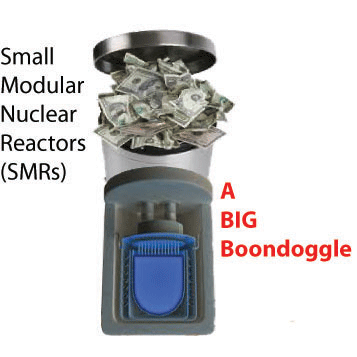
IEEE 9th March 2021, Small modular and advanced nuclear reactors have been proposed as potential ways of dealing with the problems—specifically economic competitiveness, risk of accidents, link to proliferation and production of waste—confronting nuclear power technology. This perspective article examines whether these new designs can indeed solve these problems, with a particular focus on the economic challenges.
It briefly discusses the technical challenges confronting advanced reactor designs and the many decades it might take for these to be commercialized, if ever. The article explains why the higher construction and operational costs per unit of electricity generation capacity will make electricity from small modular reactors more expensive than electricity from large nuclear power plants, which are themselves not competitive in today’s electricity markets.
Next, it examines the potential savings from learning and modular construction, and explains why the historical record suggests that these savings will be inadequate to compensate for the economic challenges resulting from the lower generation capacity. It then critically examines arguments offered by advocates of these technologies about job creation and other potential uses of energy generated from these plants to justify subsidizing and constructing these kinds of nuclear plants. It concludes with an assessment of the markets for these technologies, suggesting that
these are inadequate to justify constructing the necessary manufacturing facilities.
https://ieeexplore.ieee.org/document/9374057
The UK would open a “Pandora’s box” if it were to consider using its nuclear arsenal against non-nuclear countries
The UK would open a “Pandora’s box” if it were to consider using its
nuclear arsenal against non-nuclear countries possessing equivalent weapons
of mass destruction, a former defence secretary has warned. Raising his
concerns at Westminster, Labour peer Lord Reid of Cardowan argued against
any shift in the potential deployment of the UK’s submarine-based
deterrent. He made his comments this evening following the Government
publishing details of its major review of foreign and defence policy, known
as the Integrated Review.
City AM 23rd March 2021
UK’s decision to expand nuclear weapons – destabilises the fragile world order say Musicians for Peace and disarmament
| Guardian 23rd March 2021, Letter: Serhii Plokhy’s article (Boris Johnson is playing a dangerous nuclear game, 19 March) explains why this could not be a worse time for the government to raise the cap on nuclear warheads. Musicians for Peace and Disarmament (MPD) has been campaigning for a nuclear-free world since 1983. Although progress towards this end has been painfully slow, little did we expect such a sudden and profound setback as the recent announcement. This reckless decision threatens to destabilise the already fragile world order, and instead of using precious funds for positive purposes, it squanders them on weapons of mass destruction that can never be used, are illegal, and are inherently immoral. Society will need rebuilding after the destructive effects of the pandemic; millions of people around the world are in desperate need of help after years of conflict in their countries, yet foreign aid has been cut; and the climate emergency, now almost at the point of no return, must be made a matter of absolute priority. Along with countless other people who have expressed their dismay, MPD strongly urges the prime minister and his government to show political wisdom and moral leadership by withdrawing this plan. https://www.theguardian.com/politics/2021/mar/23/boris-johnson-should-withdraw-this-reckless-nuclear-weapons-plan |
Covid-19 causes more delays and costs for Hinkley Point C nuclear projects
New Civil Engineer 23rd March 2021, The cost of Hinkley Point C nuclear power station has risen by around £500M and its start date pushed back to June 2026 due to delays arising from the Covid-19 pandemic. In January, EDF said it expected the Somerset project to cost up to £23bn compared with a 2019 estimate of a £22.5bn maximum.
The start of electricity generation from Unit One of the power station had been scheduled for the end of 2025, but work postponed last year at the height of the first lockdown has not yet been completed. In a message to employees, Hinkley Point C managing director Stuart Crooks said: “Ten months after it began, we are still facing the full force of the
pandemic. “Even though experience has allowed us to increase numbers on site during the pandemic from below 2,000 to more than 5,000, social distancing requirements still limit the number of people we can safely have
on site at any one time.” Crooks added that “a longer construction period also adds some cost — as does the reduced efficiency of operating a site for a long period under Covid-19 conditions”.
https://www.newcivilengineer.com/latest/hs2-and-hinkley-to-crossrail-and-tideway-tracking-covids-impact-on-uks-biggest-infrastructure-projects-23-03-2021/
France’s nuclear reactors in state of disrepair, reducing electricity output
World Nuclear Industry Status Report 21st March 2021, Will France ever run out of electricity? Hardly believable in the homeland of nuclear power! By the admission of EDF officials, France is no longer immune to power cuts on very cold days. Here’s why. on January 8, RTE , the subsidiary of EDF in charge of balancing electricity supply and demand, invited households to reduce their consumption in order to avoid a bad surprise.
The production capacities, ie 88,200 megawatts, were indeed just sufficient to cover the needs (88,000 megawatts). The day went off without a hitch, but ” the winter of 2020-2021 remains under special vigilance, mainly because of the health crisis,” RTE made a point of clarifying . If the weather conditions turn out to be normal, then no difficulty will be
expected with the electricity supply. On the other hand, in the event of a cold snap, difficulties could arise ”.
An elegant way to ask us to prepare the candles … Name of a pylon, but how did it come to this, in a country supposedly king of nuclear energy ? The first reason is precisely the state of disrepair of our atomic park. In the annual World Nuclear Industry Status Report for 2020, written by a group of internationalbexperts led by Mycle Schneider, the chapter devoted to France is particularly harsh for our national electricity supplier.
It reveals that the number of days of unavailability of its 58 reactors exploded in 2019, reaching 96.2 on average. This represents more than three months of closure each year for each of our plants. ! Suddenly, the load factor of the tricolor nuclear fleet (in other words its real production compared to its capacities) does not exceed 68.1%, an extremely low figure. By way of comparison, other nuclear countries, such as the United States, show
performances close to 90%.
https://www.worldnuclearreport.org/La-France-va-t-elle-manquer-un-jour-d-electricite.html
-
Archives
- February 2026 (228)
- January 2026 (308)
- December 2025 (358)
- November 2025 (359)
- October 2025 (376)
- September 2025 (258)
- August 2025 (319)
- July 2025 (230)
- June 2025 (348)
- May 2025 (261)
- April 2025 (305)
- March 2025 (319)
-
Categories
- 1
- 1 NUCLEAR ISSUES
- business and costs
- climate change
- culture and arts
- ENERGY
- environment
- health
- history
- indigenous issues
- Legal
- marketing of nuclear
- media
- opposition to nuclear
- PERSONAL STORIES
- politics
- politics international
- Religion and ethics
- safety
- secrets,lies and civil liberties
- spinbuster
- technology
- Uranium
- wastes
- weapons and war
- Women
- 2 WORLD
- ACTION
- AFRICA
- Atrocities
- AUSTRALIA
- Christina's notes
- Christina's themes
- culture and arts
- Events
- Fuk 2022
- Fuk 2023
- Fukushima 2017
- Fukushima 2018
- fukushima 2019
- Fukushima 2020
- Fukushima 2021
- general
- global warming
- Humour (God we need it)
- Nuclear
- RARE EARTHS
- Reference
- resources – print
- Resources -audiovicual
- Weekly Newsletter
- World
- World Nuclear
- YouTube
-
RSS
Entries RSS
Comments RSS
 nuclear-news