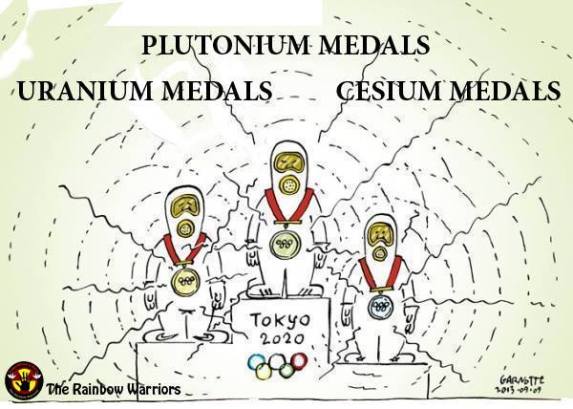
Tokyo Olypics: is it safe to promote Japan’s so-called “recovery” by sending athletes into a nuclear exclusion zone?
|
‘Fukushima today: “I’m glad that I realized my mistake before I died.” Bulletin of the Atomic Scientists, By Thomas A. Bass | March 10, 2021”……….After a lighting ceremony at J-Village, the Olympic torch will be run for three days through Fukushima’s nuclear exclusion zone. The zone is now a checkerboard of remediated areas and other places that are closed off behind accordion fences. Japan hopes to focus our attention on the refurbished schools and town halls, re-opened train stations, and two new museums that have been built in Fukushima, while trying to keep the TV cameras away from the ruined houses and radioactive cars lying nearby. The torch will then be run to Fukushima City, 40 miles to the northwest, where the first six Olympic games in softball and baseball are scheduled to be played after the games officially open July 23. But is it safe to promote Japan’s so-called “recovery” by sending athletes into a nuclear exclusion zone? The area has been tidied up and dotted with LED monitors showing the latest cesium releases from F1, comparable to the devices that measure airborne radiation levels found in other parts of the world. But these airborne releases are only part of the story—and not the most worrisome part. In 2013, scientists discovered that Fukushima’s exploding reactors had showered Japan with microparticles, or little glassy beads, of radioactive cesium and uranium. Hot spots from these microparticles can be found in vacuum cleaner bags and automobile air filters as far away as Tokyo. Fukushima prefecture is full of radioactive hot spots, and these hot spots keep moving as microparticles are washed down from the forested mountains that make up 70 percent of the prefecture, researchers said in Nature Scientific Reports. In 2019, a survey conducted for Greenpeace found hot spots in the J-Village parking lot, where children participating in a youth soccer match were eating their lunch. Greenpeace measured radiation levels at over 71 microSieverts per hour (one microSievert is one-millionth of a Sievert, or one-thousandth of a milliSievert)—1,775 times higher than the normal reading in this area before the Fukushima disaster of about 0.04 microSieverts per hour. The elevated reading, which translates to roughly about 0.62 Sieverts over the course of a year, meant that anyone breathing dust from the J-Village playing fields could be ingesting radioactive particles—little death stars lighting the way to cancer and genetic mutation. Since then, researchers have found radioactive hot spots at the Azuma baseball stadium in Fukushima City and all along the route to be run by the Olympic torch bearers….. https://thebulletin.org/2021/03/fukushima-today-im-glad-that-i-realized-my-mistake-before-i-died/?utm_source=Newsletter&utm_medium=Email&utm_campaign=ThursdayNewsletter032021&utm_content=NuclearRisk_Bass_03102021 |
|
Report: Cancer death rates rising near Fermi nuclear plant
 Report: Cancer death rates rising near Fermi nuclear plant https://www.13abc.com/2021/03/11/report-cancer-death-rates-rising-near-fermi-nuclear-plant/
A new study is looking to test baby teeth from children living near the plant. NEWPORT, Mich. (WTVG) – A new report from the Radiation and Public Health Project claims that the cancer death rate in Monroe County, Michigan is on the rise and it’s tying that growth to the Fermi 2 nuclear plant in Newport.
According to the report, which uses public health data from the Centers for Disease Control and Prevention, the rate of death due to cancer in Monroe County was roughly equal to that of the rest of the United States. Since 1988, that rate has risen steadily, reaching 11.3% higher than the national average in the most recent 10 years (2009-2018). From 2014-2018, that rate was 14.3% higher than the national average, amounting to 1,794 deaths. In the period between 1969 and 1978, outlines the report, that rate was 4.5% lower than the national average.
The Fermi 2 nuclear power plant went online in June of 1985, and while the report has no concrete evidence that the plant is the definitive cause of the rise in cancer deaths in the county, it does provide a correlative pattern. 13abc has reached out to DTE Energy, owners of the Fermi 2 plant, for comment.
“The trends in Monroe County cancer rates since the mid-1980s cannot overlook the startup of the Fermi reactor, and the potential role of radioactive emissions on health,” says Joseph Mangano MPH MBA, Executive Director of RPHP and study author.
“The report needs to be taken seriously, and follow-up measures are urgently needed,” adds Christie Brinkley, a long-time activist on nuclear issues, Board member of RPHP, and a native of Monroe County. “In particular our children must be protected, as they are most vulnerable.”
In an effort to further understand the role the reactor may have had in the rise in cancer rates in the area, the RPHP is conducting a “Tooth Fairy” study. They’re collecting baby teeth from children living near the power plant to test for levels of Strontium-90, a chemical created by nuclear reactors. They’re hoping to test up to 50 teeth and will compare the results to Sr-90 levels in Detroit-area residents from a 1950s-era study of atomic bomb test fallout. Information about the study, including how to participate, can be found at their website.
Nuclear disasters? – a calculated gamble , collusion between governments and the nuclear industry

Fukushima Nuclear Disaster Nearly ‘Ended The Japanese State’, Radioactive Waste Specialist Explains, Sputnik News, by Mohamed Elmaazi 12 Mar 21, ”………Sputnik: In what sense was ‘collusion’ between the state and the nuclear industry responsible for the disaster?
Kevin Kamps: [According to the Japanese parliamentary report] Tokyo Electric Power Company and the Japanese national government, specifically its nuclear safety regulatory agency, had plenty of warnings that a large-scale earthquake, and even a tall tsunami, could hit that plant, and other nuclear plants across Japan for that matter. Yet way too little was done about it.
They just hoped it would never happen. But it did. The sea wall they had built was woefully inadequate, for example. It was easily overtopped by the tsunami. All the mistakes that led up to the catastrophic consequences had to do with this collusion. Wink wink, nod nod, between industry lobbyists and executives, safety regulators at all levels, government officials at all levels. Short cuts on safety and security, to save money, that is, boost profits, which pay astronomical executive salaries, even handsome take home pay for nuclear industry workers, kickbacks to local municipalities, revolving doors between industry and government.
And what’s so frightening about that conclusion is that we have such collusion here in the United States, [with] massive campaign contributions to office seekers, and lobbyist expenditures. The media even gets hoodwinked in all this, both in Japan and in the US. In Japan, they call this “the Nuclear Village.” Perhaps, in the US we’d call it the military-industrial-governmental-academic-media-nuclear power complex.
We [in the US] also have a couple three dozen, identical or similar nuclear power plants in design. These are General Electric boiling water reactors of the Mark I or Mark II design. The biggest in the world, for example, just south of Detroit by 25 miles, called Fermi Unit 2. So, I’ve described what happened and the consequences of what happened, where one of the largest releases of hazardous ionizing radioactivity in the environment that has ever occurred, into the ocean, into the air. Japan was hard hit with contamination.
The rest of the Pacific basin was hard hit with contamination, including the west coast of North America and the health implications of that, the genetic implications of that, will unfold for a very long time to come because these radioactive isotopes, which are hazardous caesium and strontium, for example, have at least a 300-year hazardous persistence, tritium 123 years, at least, plutonium, 240,000 years. So, in a sense, nuclear power disasters have beginnings, but they don’t really have endings when you’re talking about centuries or millennia or hundreds of thousands of years of hazard unleashed into the environment.
Sputnik: Could this be considered a freak accident? One that’s unlikely to be repeated?
Kevin Kamps: Unfortunately, not. There have been now several major nuclear power reactor meltdown disasters: Three Mile Island in Pennsylvania USA in 1979, Chernobyl in Ukraine in the Soviet Union in 1986. So many close calls to reactor meltdowns. It’s almost too many to enumerate and there’ve been other nuclear power related and nuclear weapons related disasters over the decades. So, these are actually fairly predictable. And I have colleagues who now refuse to call these accidents because these are foreseeable. This is a calculated gamble. That’s being taken every day at some 400 plus atomic reactors across the world, with more planned…… https://sputniknews.com/interviews/202103111082310108-fukushima-nuclear-disaster-nearly-ended-the-japanese-state-radioactive-waste-specialist-explains/
Trident nuclear warhead numbers set to increase for first time since cold war
|
Trident nuclear warhead numbers set to increase for first time since cold war https://www.theguardian.com/uk-news/2021/mar/12/trident-nuclear-warhead-numbers-set-to-increase-for-first-time-since-cold-war
Defence and foreign policy review expected to signal rise, in move analysts say is diplomatically provocative Dan Sabbagh Defence and security editor Downing Street’s integrated review of defence and foreign policy is expected next week to signal a potential increase of the number of Trident nuclear warheads for the first time since the end of the cold war.
Whitehall sources indicated that a cap on total warhead numbers – currently set at 180 – is expected to increase, although the exact figure is not yet known, in a move that analysts said was diplomatically provocative. The UK’s stockpile of nuclear weapons peaked at about 500 in the late 1970s, but had been gradually decreasing ever since as the perceived threat from the Soviet Union and now Russia had been assumed to be decreasing. The last strategic defence review, in 2015, committed the UK to “reduce the overall nuclear weapon stockpile to no more than 180 warheads” by the mid 2020s – and reducing the numbers of operationally available warheads to 120. Each warhead is estimated to have an explosive power of 100 kilotons. The atomic bomb dropped on Hiroshima at the end of the second world war was about 15 kilotons. The full reasons for the anticipated move are not yet clear but it comes amid speculation it is designed to help persuade the US to co-fund aspects of a Trident replacement warhead for the the 2030s. Its costs, too, are uncertain. “If this is confirmed, this would be a highly provocative move,” said David Cullen, the director of the Nuclear Information Service. “The UK has repeatedly pointed to its reducing warhead stockpile as evidence that it is fulfilling its legal duties under the nuclear non-proliferation treaty. “If they are tearing up decades of progress in reducing numbers, it will be a slap in the face to the 190 other members of the treaty, and will be regarded as a shocking breach of faith.” Britain has operated its own nuclear weapons since the 1950s but for the past 60 years, following an agreement between the then prime minister, Harold Macmillan, and the then US president, John F Kennedy, the UK has been heavily dependent on US technology. Trident missiles are deployed in four submarines, one of which is continuously at sea to make sure it can strike back in the event of an unprovoked nuclear attack. It relies on an existing US W76 warhead, based on a 1970s design, called Holbrook. However, the W76 is ageing, and the US has proposed developing a more powerful replacement, called the W93. The UK is particularly keen for the US to start work on the W93 and last summer the defence secretary, Ben Wallace, lobbied Congress for the work to go ahead. British MPs voted to renew Trident in principle in 2016, but the Commons is expected to have to vote on a new warhead at some point. In 2016, the Conservatives almost uniformly backed renewal, the SNP voted against, while Labour was split. The MoD has said developing the next generation of Dreadnought submarines to carry the new warhead would cost £30bn plus a £10bn contingency. But officials have so far refused to say how much the warhead would cost. An MoD spokesperson said: “The UK is committed to maintaining its independent nuclear deterrent, which exists to deter the most extreme threats to our national security and way of life. “Replacing the warhead and building four new Dreadnought class submarines are UK sovereign programmes that will maintain the deterrent into the future. We will not comment on speculation about the integrated review, which will be published on Tuesday.” |
|
Every hour, Fukushima reactor 2 emits more than 10,000 times the yearly allowable dose for radiation workers

|
Fukushima today: “I’m glad that I realized my mistake before I died.” Bulletin of the Atomic Scientists, By Thomas A. Bass | March 10, 2021 ”………..What we know about nuclear disasters at Chernobyl, Fukushima, and elsewhere comes primarily from modelling what is known as the “source term”—the types and amounts of radioactive material that were in a reactor’s core and then released to the environment by an accident. These models are revised as we learn more about the prevailing winds and other factors but are still only models; ideally, one wants to examine the reactors’ cores themselves. Unfortunately, even 10 years later, no one can get close to Fukushima’s reactor cores, and we do not even know precisely where they are located. As recently as December 2020, Japan’s Nuclear Regulatory Authority (NRA) announced “extremely serious” developments at Fukushima that were far worse than previously thought, the Asahi Shimbun newspaper reported. TEPCO had discovered that the massive shield plugs covering the reactors were emitting 10 Sieverts of radiation per hour—a lethal dose for humans (though it should be noted that reactor cores are normally examined by robots, unless these, too, are destroyed by radiation). Because Fukushima now has more contaminated material at higher doses than previously estimated, “this will have a huge impact on the whole process of decommissioning work,” said NRA chairman Toyoshi Fuketa. The effective dose of radiation required to sicken or kill you is measured in Sieverts, a unit named after Rolf Sievert, the Swedish physicist who first calibrated the lethal effects of radioactive energy. A dose of 0.75 Sieverts will produce nausea and a weakened immune system. (Sieverts are used to measure the relative biological damage done to the human body, while becquerels and curies are units that describe the amount of radiation emitted by radioactive material.) A dose of 10 Sieverts will kill you, if absorbed all at once. A dose somewhere in-between 0.75 and 10 Sieverts gives you a fifty-fifty chance of dying within 30 days. Guidelines for workers in the nuclear industry limit the maximum yearly dose to 0.05 Sieverts, or 50 milliSieverts—the equivalent of five CT scans, says Harvard Health Publishing. (This is a high figure compared to the 1 milliSievert per year that is considered acceptable for the general public; a physicist familiar with the industry explained that the thinking is that workers in the nuclear energy industry are implicitly being paid to take on the risk.) So how many Sieverts are currently being produced by Fukushima’s melted reactors? The latest reading from reactor No. 2 is 530 Sieverts per hour. This means that every hour the heart of the reactor is emitting more than 10,000 times the yearly allowable dose for radiation workers…… https://thebulletin.org/2021/03/fukushima-today-im-glad-that-i-realized-my-mistake-before-i-died/?utm_source=Newsletter&utm_medium=Email&utm_campaign=ThursdayNewsletter032021&utm_content=NuclearRisk_Bass_03102021 |
|
Nuclear power is unpopular: promoted only by those with vested interests/
Bellona 12th March 2021,Nuclear advocates point to the development of new technologies, such as small modular reactors, which can be deployed locally, and whose small scale limits the potential for Fukushima-sized accidents.
month for Nature, the influential US scientific journal, they assert that the nuclear industry has long ago lost touch with the public it is meant to serve.
Is nuclear waste safely managed and disposed of so that it no longer poses any danger?
 Fukushima Nuclear Disaster Nearly ‘Ended The Japanese State’, Radioactive Waste Specialist Explains, Sputnik News, by Mohamed Elmaazi 12 Mar 21,……….How is it that nuclear waste safely managed and disposed of so that it no longer poses any danger?
Kevin Kamps: Well, it’s not. We don’t know what to do with it. High-level radioactive waste is stored in indoor wet storage pools. That’s where the majority of American high-level radioactive waste is stored. What almost happened at Fukushima Daiichi, another lucky break, was that the wet indoor storage pool at unit four nearly caught fire, and it was sheer luck that it did not. And just to give you an idea of what that could have meant for Japan, there have been 160,000 nuclear evacuees due to the meltdowns, the failures of the containments.
If that pool had caught fire, and pools are not even inside containment, the Japanese prime minister serving at the time, Naoto Kan, a year after the disaster began, admitted that he had a secret contingency plan, if that pool had caught fire, to evacuate 35 million to 50 million people from North-eastern Japan and metro Tokyo. He said it would have been the end of the Japanese state.
Here in the United States where the majority of our high-level radioactive waste is still in this vulnerable indoor wet pool storage, our pools are much more densely packed than Fukushima Daiichi Unit four was on March 11th, 2011. So, we don’t have an answer. We do not have deep geologic disposal repositories. Yucca mountain, Nevada, has proven to be a failure. Besides the Western Shoshone Indians [Native Americans] did not consent, it violated their treaty rights to that site, but it’s also scientifically unsuitable. So, we’re right where we began in 1942, when Enrico Fermi first split the atom, created the first high-level radioactive waste during the Manhattan Project race for the atomic bomb. We don’t know what to do with the first cup full of high-level radioactive waste in this country. https://sputniknews.com/interviews/202103111082310108-fukushima-nuclear-disaster-nearly-ended-the-japanese-state-radioactive-waste-specialist-explains/
Slovenia’s hazardous old nuclear reactor in an earthquake zone
|
A nuclear reactor in an earthquake zone NEW EUROPE
By Otmar Lahodynsky, President of the Association of European Journalists (AEJ) and former European Editor of the Profil news magazine in Austria , 12 Mar 21, Ten years after the Fukushima nuclear disaster, an old power plant in Slovenia is about to be allowed to run till 2043. Austrian politicians and environmental organizations want to prevent that.The Slovenian nuclear power plant in Krsko actually should be decommissioned in two years. The reactor, built 40 years ago in the old Communist-era Yugoslavia with technology from the American company Westinghouse – has reached the end of its life. Nevertheless, the Slovenian-Croatian operating company, GEN Energija d. o. o., wants to keep the reactor running for 22 more years – until 2043. This week, an environmental impact study has started, a procedure that is being run under international scrutiny.
The nuclear power plant is located on the Croatian-Slovenian border, but what is truly alarming is that it is located in an area that is particularly at risk from earthquakes. Krsko is 85 kilometres from the epicentre of an earthquake that shook Croatia on December 29, 2020. The previous March, the Croatian capital Zagreb was hit hardest by an earthquake; with an epicentre that was only 40 km away from Krsko. Earthquake safety has always been one of the most discussed concerns regarding the Krsko plant. …….. https://www.neweurope.eu/article/a-nuclear-reactor-in-an-earthquake-zone/ |
|
How the world came close to nuclear war catastrophe
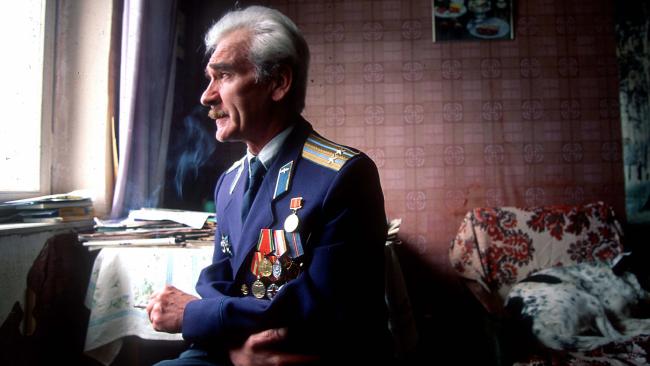
Stanislav Petrov.
Bilinovich: Averting nuclear apocalypse https://observer.case.edu/bilinovich-averting-nuclear-apocalypse/ How the world came close to catastrophe, Beau Bilinovich, Staff Columnist, March 12, 2021
No one wants to be the cause of a nuclear apocalypse. It is our responsibility to avoid one at all costs. But what happens when we don’t have a choice?
There have been numerous times throughout history where we have, by some stroke of luck and fortune, avoided catastrophe. Each of these instances tells a story, an insightful tale of human folly that culminates in one important lesson: We cannot trust ourselves with the most dangerous weapon ever invented.
There is one story which is bittersweet—in the end, everything is okay, yet it leaves everyone with a feeling of unease and urgency. Nonetheless, this story must be told, because we absolutely should learn from it.
The story began on Sept. 26, 1983 and took place deep inside the former Soviet Union. Operations were normal at Serpukhov-15, a military outpost just outside Moscow. The hero of the story was Stanislav Petrov, the officer on duty at the military installation. He and a group of other officers were monitoring Oko, the Soviet Union’s nuclear alert system.
Suddenly, the computer flashed a bright red warning: “Launch.” Alarms wailed. The officers were in shock. The United States had launched an intercontinental ballistic missile (ICBM). Oko detected no doubt.
The officers stood there, frozen, despite being trained for such a harrowing event. They could not believe what was happening.
Two, three, four, five—Oko had detected more missiles. In total, five ICBMs were reported to have been launched towards the Soviet Union on a path of destruction. Petrov had to make a decision soon: inform his higher-ups or wait.
In those crucial moments, Petrov decided not to do anything at all, despite the possibility of catastrophe looming over him. He did not even notify those higher in the chain of command. He waited.
Minutes passed, but no strike ever occurred. Relief. The warning was just a false alarm. No need to worry anymore.
Investigations concluded that the false alarm was triggered by the reflection of sunlight off the tops of clouds. Though this seems like a small mistake, it was not an isolated incident. There have been many other times where the world came close to nuclear war. One false alarm was caused by a computer playing a military training tape, and another by a faulty computer chip—tiny errors that could have bore serious consequences.
But simple mistakes are only one element that makes nuclear weapons so unfathomably dangerous and risky.
Just as concerning is the gross negligence of nuclear missile launch officers. A two-star general responsible for America’s nuclear arsenal was caught on a drunken bender while on a visit to Russia in 2013. Two launch officers were investigated as part of a narcotics scandal, where they reportedly used drugs and other illegal substances. Around 100 officers were implicated in cheating on their proficiency exams; only nine of the officers were duly dismissed.
There are also threats from outside the U.S.
Andrew Futter, associate professor at the University of Leicester, suggested that America’s nuclear weapons system could be hacked to gather information, shut down the system and even launch missiles. In fact, the National Nuclear Security Administration, which controls and maintains the nuclear weapons system, was hacked in December by Russian intelligence services, exposing the country’s most sensitive information regarding nuclear weapons.
Nuclear weapons are risky, dangerous and destructive. In total, there are 14,525 nukes across the world, with the U.S. and Russia possessing the vast majority—over 6,000 each. That is enough explosive power to end the world multiple times over. Humanity would cease to exist in the event of a nuclear war.
This is precisely why the exceptional judgment of Stanislav Petrov is heroic. Most people don’t know him, yet he secretly saved the entire world from a disastrous future. Despite his commendable behavior, we should not rely on one person to protect us.
We are left with no other option than to confront the truth.
Those entrusted with the authority to deploy and launch these missiles at a moment’s notice cannot be trusted. The systems designed to monitor attacks cannot be trusted. Foreign nations in possession of this same deadly tool cannot be trusted. While we may think we can handle nuclear weapons, reality shows the opposite. In truth, no one can be trusted with nuclear weapons. If we do not realize this, we may not have any more stories to tell.
Our inability to trust anyone with these weapons demands that we abolish them. The sooner we accomplish this goal, the safer the world becomes. Getting rid of these weapons is the only way to avoid a nuclear apocalypse.
Germany pledgse to work towards a nuclear free Europe
Ten years after the Fukushima nuclear disaster in Japan, German environment minister Svenja Schulze insisted that the country does not consider nuclear energy an option for low-carbon power production. “Nuclear power is neither safe nor clean,” Schulze said, rejecting the “myth” that the technology could help to find a way out of the climate crisis. “The future is for renewable energy,” she said. Germany’s phase-out decision, originally taken in the year 2000 and confirmed after the 2011 meltdown of the power plant in Japan, had “brought peace to a social conflict that raged for decades” and helped minimise a major risk at least nationally, Schulze said.
Nuclear power could not be in Germany’s interest when it is generated abroad either, “be it in our immediate neighbourhood, in the EU or globally”, the minister said, adding that “our work has not ended with the German nuclear exit”. The environment ministry published a position paper listing 12 key objectives required to reduce nuclear risk even further. They include actions under the three sections of a) completing the German nuclear phase-out: Close nuclear plants, promote final storage, accelerate the expansion of renewable energies; b) reducing nuclear risks in Europe, strengthen cooperation; and c) increasing nuclear safety worldwide, maintain nuclear risk competence and provide appropriate information.
Today we commemorate the catastrophic #nuclear accident that took place in #Fukushima 10 years ago. This disaster has shown us the risks of #NuclearEnergy. Also @SvenjaSchulze68
With a view to the decision by Germany’s largest neighbour country France to extend the running time of old nuclear reactors, she said that while the “principle of energy sovereignty” would have to be respected, there are “technical and economic limits to retrofitting”. Especially plants near the German border would be “monitored very closely and critically”, the minister said, adding that the German government expected France to enable “comprehensive cross-border cooperation” on the matter. More than half of all EU states do not use nuclear power at all or are considering a phase-out, Schulze said.
“Together with likeminded countries in Europe, I will actively work towards more countries joining the phase-out of nuclear power,” she stated. Schulze minister colleagues from Austria and Belgium, Leonore Gewessler and Tinne van der Straeten, joined her German counterpart in a joint message published on Twitter, in which the three state representatives said they will work towards ending the use of nuclear power in Europe and pave the way for an energy system solely based on renewables.
Nuclear “poison for a secure and climate-just future” – NGOs
Ten years after the disaster, Japanese officials in Fukushima still grapple with key questions regarding the removal, storage and processing of the plant’s nuclear waste. These problems remain unresolved and many former residents are still not allowed to return to their homes, Schulze said. “If we’ve learned something from all this then it has to be the common goal to protect people from further devastation from nuclear power.” For Germany, nuclear power’s “residual risk” simply had been too significant to carry on with the technology, she argued. Of the six remaining reactors in the country, three will go offline as planned in 2021 and the remaining three at the end of 2022. A 2019 survey found that 77 percent of people in Germany support the nuclear phase-out and 60 percent also its quick finalisation by the end of next year.
A group of more than 50 civil society and environmental groups backed the government’s stance on excluding nuclear energy from Germany’s emissions reduction plans, arguing that claims about the technology being “climate neutral” and “environmentally friendly” would be “poison for a secure and climate-just future”. In a joint letter, the group including NGOs like Germanwatch, BUND, NABU or PowerShift said nuclear power could have no future in energy systems and called on the government to double down on its efforts to phase-out the technology, including a shutdown of uranium enrichment facilities in Germany and an end of EU nuclear power project funding. Investments instead should flow into renewable power, storage technology and efficiency gains, the group argued.
Radiation from Fukushima meltdown collects in timber in affected region
Japanese government hopes that not-yet-designed robots might clean up Fukushima nuclear mess
clean up Daiichi and revitalize Fukushima Prefecture, once known for everything from seafood to sake. The effort will take so long that Tepco and government organizations are grooming the next generation of robotics experts to finish the job.
https://www.cnet.com/features/for-fukushimas-nuclear-disaster-robots-offer-a-sliver-of-hope/
Turkey’s nuclear ambitions bring fears of a ”new Chernobyl” in the region
|
Are Turkey’s nuclear power ambitions a threat to regional safety? Ekathimerini.com, 12 Mar, 21,Foreign Minister Nikos Dendias expresses fears of a new ‘Chernobyl’ in the Eastern Mediterranean in call with his US counterpart, Vassilis Nedos , Yiannis Souliotis, Approximately three weeks ago, during a 45-minute call with his American counterpart, Greek Foreign Minister Nikos Dendias broached a subject that often flies under the radar of international diplomacy. Dendias brought up the many problematic issues of constructing a nuclear power station in Akkuyu, southern Turkey, with Tony Blinken. These range from the fact that it constitutes a security threat to other states in close proximity to Turkey, to that it is the largest foreign investment by Russia, and Ankara’s unwillingness to share information on the plant. According to the same source, Dendias also highlighted the danger that Akkuyu could become a new “Chernobyl” in the Eastern Mediterranean.
For many years, Athens has attentively observed Turkey’s suspicious endeavor. Reports circulating within the responsible Greek services, which Kathimerini has been made aware of, make it clear that there is another danger regarding Turkey’s nuclear program. Through its creation of nuclear reactors for energy production, Turkey is acquiring both the necessary technological know-how and access to materials that could be used for the development of nuclear arms. Greek officials, speaking on the condition of anonymity, reported that Turkey is implementing a plan for the construction of three nuclear power plants. At the same time, it is training nuclear engineers and seeking access to dual-purpose resources – fissile material and equipment intended for both civilian and military use. Out of the three planned nuclear power stations, the one furthest along is that in Akkuyu, on Turkey’s southeastern coast near the city of Mersin. Two other plants are being constructed or planned, in Sinop on the Black Sea and Igneada in Eastern Thrace, also on Black Sea, near the border with Bulgaria. Turkish President Recep Tayyip Erdogan has publicly voiced his ambition to establish Turkey as a nuclear-weapon state. “Some states possess missiles armed with nuclear warheads and they tell us that we cannot also acquire such weapons. This is something I cannot accept,” he said to members of his Justice and Development Party (AKP) in September 2019. The deal to construct the Akkuyu plant was signed by the Turkish state and Rosatom, Russia’s state corporation for nuclear energy, in 2010. The cost of the project is approximately 22 billion dollars and the deal stipulates the construction of four 1,200 MW nuclear reactors. Two of these are already under construction and the first is scheduled to come online in 2023, the Turkish Republic’s centenary. However, the power plant is not expected to be fully operational before 2025. It is estimated that the Akkuyu nuclear power station will cover 8%-10% of Turkey’s energy needs and have an expected lifespan of at least 60 years. Rosatom is funding the project through its Turkey-based subsidiary company Akkuyu Nukleer JSC (Rosatom has held 99% of the company’s shares since 2010). It is the largest private investment in nuclear energy in the last 17 years. As for the Akkuyu site, it must be noted that it has not yet undergone the required stress tests, the evaluation of various technical issues including any dangers posed by the region’s seismic activity. ………….. Finally, it should be noted that Turkey is not a party to the International Atomic Energy Agency’s Joint Convention on the Safety of Spent Fuel Management and on the Safety of Radioactive Waste Management. https://www.ekathimerini.com/in-depth/analysis/1156931/are-turkey-s-nuclear-power-ambitions-a-threat-to-regional-safety/
|
|
|
Fukushima nuclear accident costs so far $188billion, projected final costs of $740 bn.
 David Lowry’s Blog 10th March 2021, Pediatrician Dr Alex Rosen, a leading figure in the German branch of the International Physicians for the Prevention of Nuclear War (IPPNW) said it was “luck and divine intervention” that wind from the west blew most of the radiological releases out over the Pacific Ocean, meaning the Fukushima accident released more radioactivity to the oceans than the Chernobyl accident and all the nuclear weapons tests together.
Buffett Institute for Global Affairs located in Evanston, Illinois, and the Bulletin for the Atomic Scientists, based in Chicago, to launch a new international interdisciplinary collaborative study on “Nuclear Disaster Compensation: Lessons from Fukushima: Interviews with Experts and
Intellectuals, edited by anthropology professor Hirokazu Miyazaki.
http://drdavidlowry.blogspot.com/2021/03/nuclear-fuk-ed.html
Need to establish compensation schemes for future nuclear accidents
 A Fukushima lesson: Victim compensation schemes need updating, Bulletin of the Atomic Scientists , By Hirokazu Miyazaki | March 10, 2021 At the 10th anniversary of the devastating earthquake and tsunami that set off a meltdown at Tokyo Electric Power Company’s Fukushima Daiichi nuclear power plant, it is time to revisit the laws that govern compensation for victims of such disasters. A Fukushima lesson: Victim compensation schemes need updating, Bulletin of the Atomic Scientists , By Hirokazu Miyazaki | March 10, 2021 At the 10th anniversary of the devastating earthquake and tsunami that set off a meltdown at Tokyo Electric Power Company’s Fukushima Daiichi nuclear power plant, it is time to revisit the laws that govern compensation for victims of such disasters.
Fortunately, major nuclear accidents are rare. To date, only Fukushima and the 1986 Chernobyl disaster in Russia are rated level 7 “major” accidents by the International Atomic Energy Agency. But given the potential for nuclear power generation to expand, accidents of various levels of severity could also increase in frequency. ……….. expanding protection for victims, including the amount and scope of compensation they can receive, should become an international priority for the industry, policymakers, and global nuclear organizations. As my colleagues and I who are part of the Meridian 180 Global Working Group on Nuclear Energy have found, domestic laws and international conventions around nuclear power and compensation for victims of accidents are insufficient and need to be revisited. These laws and protocols were designed, at least originally, to promote nuclear energy and protect the interests of the nuclear power industry. Given the infrequency of major accidents, the laws and protocols have not been tested very often. The laws limit the liability faced by nuclear power plant operators and manufacturers and the amount of compensation paid to victims. As a result, investors can pursue nuclear energy projects without fear of a potentially significant burden to compensate victims if a major accident were to occur. But the potential for accidents remains. Rather than assume they can be prevented, we must prepare for them—not only with emergency plans and safety protocols, but also with laws that protect and compensate the victims. Compensation claims remain unresolved. The Chernobyl disaster did lead to some reform of international and domestic laws to strengthen victim protections. But since Fukushima, few regulatory policy changes have been enacted, inside or outside Japan, and Fukushima damage compensation claims remain unresolved. Among the victims in Fukushima Prefecture are thousands of local residents who faced losses — of their homes, communities, ancestral homelands, and day-to-day life activities. Although not directly attributable, the deaths of more than 1,500 people have been linked to physical and mental stresses related to the evacuation after the nuclear reactor meltdowns. Tokyo Electric Power Company has paid more than 9.7 trillion yen (or approximately $92 billion) to nuclear accident victims, the largest damage payout ever made to such victims and among the highest (if not the highest) paid in any industrial disaster. But dissatisfaction and unsettled claims remain. Some have not been compensated for losses because their residences were outside mandatory evacuation zones. Nearly 30 collective lawsuits brought against Tokyo Electric Power Company and the Japanese government are pending. Three goals for deliberative conversation. Fair treatment and compensation for victims and those impacted by nuclear accidents can best be achieved through a deliberative conversation that is anticipatory, participatory, and transnational:
|
|
-
Archives
- February 2026 (228)
- January 2026 (308)
- December 2025 (358)
- November 2025 (359)
- October 2025 (376)
- September 2025 (258)
- August 2025 (319)
- July 2025 (230)
- June 2025 (348)
- May 2025 (261)
- April 2025 (305)
- March 2025 (319)
-
Categories
- 1
- 1 NUCLEAR ISSUES
- business and costs
- climate change
- culture and arts
- ENERGY
- environment
- health
- history
- indigenous issues
- Legal
- marketing of nuclear
- media
- opposition to nuclear
- PERSONAL STORIES
- politics
- politics international
- Religion and ethics
- safety
- secrets,lies and civil liberties
- spinbuster
- technology
- Uranium
- wastes
- weapons and war
- Women
- 2 WORLD
- ACTION
- AFRICA
- Atrocities
- AUSTRALIA
- Christina's notes
- Christina's themes
- culture and arts
- Events
- Fuk 2022
- Fuk 2023
- Fukushima 2017
- Fukushima 2018
- fukushima 2019
- Fukushima 2020
- Fukushima 2021
- general
- global warming
- Humour (God we need it)
- Nuclear
- RARE EARTHS
- Reference
- resources – print
- Resources -audiovicual
- Weekly Newsletter
- World
- World Nuclear
- YouTube
-
RSS
Entries RSS
Comments RSS
 nuclear-news