Radiation from Fukushima meltdown collects in timber in affected region
Japanese government hopes that not-yet-designed robots might clean up Fukushima nuclear mess
clean up Daiichi and revitalize Fukushima Prefecture, once known for everything from seafood to sake. The effort will take so long that Tepco and government organizations are grooming the next generation of robotics experts to finish the job.
https://www.cnet.com/features/for-fukushimas-nuclear-disaster-robots-offer-a-sliver-of-hope/
Turkey’s nuclear ambitions bring fears of a ”new Chernobyl” in the region
|
Are Turkey’s nuclear power ambitions a threat to regional safety? Ekathimerini.com, 12 Mar, 21,Foreign Minister Nikos Dendias expresses fears of a new ‘Chernobyl’ in the Eastern Mediterranean in call with his US counterpart, Vassilis Nedos , Yiannis Souliotis, Approximately three weeks ago, during a 45-minute call with his American counterpart, Greek Foreign Minister Nikos Dendias broached a subject that often flies under the radar of international diplomacy. Dendias brought up the many problematic issues of constructing a nuclear power station in Akkuyu, southern Turkey, with Tony Blinken. These range from the fact that it constitutes a security threat to other states in close proximity to Turkey, to that it is the largest foreign investment by Russia, and Ankara’s unwillingness to share information on the plant. According to the same source, Dendias also highlighted the danger that Akkuyu could become a new “Chernobyl” in the Eastern Mediterranean.
For many years, Athens has attentively observed Turkey’s suspicious endeavor. Reports circulating within the responsible Greek services, which Kathimerini has been made aware of, make it clear that there is another danger regarding Turkey’s nuclear program. Through its creation of nuclear reactors for energy production, Turkey is acquiring both the necessary technological know-how and access to materials that could be used for the development of nuclear arms. Greek officials, speaking on the condition of anonymity, reported that Turkey is implementing a plan for the construction of three nuclear power plants. At the same time, it is training nuclear engineers and seeking access to dual-purpose resources – fissile material and equipment intended for both civilian and military use. Out of the three planned nuclear power stations, the one furthest along is that in Akkuyu, on Turkey’s southeastern coast near the city of Mersin. Two other plants are being constructed or planned, in Sinop on the Black Sea and Igneada in Eastern Thrace, also on Black Sea, near the border with Bulgaria. Turkish President Recep Tayyip Erdogan has publicly voiced his ambition to establish Turkey as a nuclear-weapon state. “Some states possess missiles armed with nuclear warheads and they tell us that we cannot also acquire such weapons. This is something I cannot accept,” he said to members of his Justice and Development Party (AKP) in September 2019. The deal to construct the Akkuyu plant was signed by the Turkish state and Rosatom, Russia’s state corporation for nuclear energy, in 2010. The cost of the project is approximately 22 billion dollars and the deal stipulates the construction of four 1,200 MW nuclear reactors. Two of these are already under construction and the first is scheduled to come online in 2023, the Turkish Republic’s centenary. However, the power plant is not expected to be fully operational before 2025. It is estimated that the Akkuyu nuclear power station will cover 8%-10% of Turkey’s energy needs and have an expected lifespan of at least 60 years. Rosatom is funding the project through its Turkey-based subsidiary company Akkuyu Nukleer JSC (Rosatom has held 99% of the company’s shares since 2010). It is the largest private investment in nuclear energy in the last 17 years. As for the Akkuyu site, it must be noted that it has not yet undergone the required stress tests, the evaluation of various technical issues including any dangers posed by the region’s seismic activity. ………….. Finally, it should be noted that Turkey is not a party to the International Atomic Energy Agency’s Joint Convention on the Safety of Spent Fuel Management and on the Safety of Radioactive Waste Management. https://www.ekathimerini.com/in-depth/analysis/1156931/are-turkey-s-nuclear-power-ambitions-a-threat-to-regional-safety/
|
|
|
Fukushima nuclear accident costs so far $188billion, projected final costs of $740 bn.
 David Lowry’s Blog 10th March 2021, Pediatrician Dr Alex Rosen, a leading figure in the German branch of the International Physicians for the Prevention of Nuclear War (IPPNW) said it was “luck and divine intervention” that wind from the west blew most of the radiological releases out over the Pacific Ocean, meaning the Fukushima accident released more radioactivity to the oceans than the Chernobyl accident and all the nuclear weapons tests together.
Buffett Institute for Global Affairs located in Evanston, Illinois, and the Bulletin for the Atomic Scientists, based in Chicago, to launch a new international interdisciplinary collaborative study on “Nuclear Disaster Compensation: Lessons from Fukushima: Interviews with Experts and
Intellectuals, edited by anthropology professor Hirokazu Miyazaki.
http://drdavidlowry.blogspot.com/2021/03/nuclear-fuk-ed.html
Need to establish compensation schemes for future nuclear accidents
 A Fukushima lesson: Victim compensation schemes need updating, Bulletin of the Atomic Scientists , By Hirokazu Miyazaki | March 10, 2021 At the 10th anniversary of the devastating earthquake and tsunami that set off a meltdown at Tokyo Electric Power Company’s Fukushima Daiichi nuclear power plant, it is time to revisit the laws that govern compensation for victims of such disasters. A Fukushima lesson: Victim compensation schemes need updating, Bulletin of the Atomic Scientists , By Hirokazu Miyazaki | March 10, 2021 At the 10th anniversary of the devastating earthquake and tsunami that set off a meltdown at Tokyo Electric Power Company’s Fukushima Daiichi nuclear power plant, it is time to revisit the laws that govern compensation for victims of such disasters.
Fortunately, major nuclear accidents are rare. To date, only Fukushima and the 1986 Chernobyl disaster in Russia are rated level 7 “major” accidents by the International Atomic Energy Agency. But given the potential for nuclear power generation to expand, accidents of various levels of severity could also increase in frequency. ……….. expanding protection for victims, including the amount and scope of compensation they can receive, should become an international priority for the industry, policymakers, and global nuclear organizations. As my colleagues and I who are part of the Meridian 180 Global Working Group on Nuclear Energy have found, domestic laws and international conventions around nuclear power and compensation for victims of accidents are insufficient and need to be revisited. These laws and protocols were designed, at least originally, to promote nuclear energy and protect the interests of the nuclear power industry. Given the infrequency of major accidents, the laws and protocols have not been tested very often. The laws limit the liability faced by nuclear power plant operators and manufacturers and the amount of compensation paid to victims. As a result, investors can pursue nuclear energy projects without fear of a potentially significant burden to compensate victims if a major accident were to occur. But the potential for accidents remains. Rather than assume they can be prevented, we must prepare for them—not only with emergency plans and safety protocols, but also with laws that protect and compensate the victims. Compensation claims remain unresolved. The Chernobyl disaster did lead to some reform of international and domestic laws to strengthen victim protections. But since Fukushima, few regulatory policy changes have been enacted, inside or outside Japan, and Fukushima damage compensation claims remain unresolved. Among the victims in Fukushima Prefecture are thousands of local residents who faced losses — of their homes, communities, ancestral homelands, and day-to-day life activities. Although not directly attributable, the deaths of more than 1,500 people have been linked to physical and mental stresses related to the evacuation after the nuclear reactor meltdowns. Tokyo Electric Power Company has paid more than 9.7 trillion yen (or approximately $92 billion) to nuclear accident victims, the largest damage payout ever made to such victims and among the highest (if not the highest) paid in any industrial disaster. But dissatisfaction and unsettled claims remain. Some have not been compensated for losses because their residences were outside mandatory evacuation zones. Nearly 30 collective lawsuits brought against Tokyo Electric Power Company and the Japanese government are pending. Three goals for deliberative conversation. Fair treatment and compensation for victims and those impacted by nuclear accidents can best be achieved through a deliberative conversation that is anticipatory, participatory, and transnational:
|
|
Time to clean up Bikini Atoll,to right the nuclear wrongs done to the Pacific islands people.
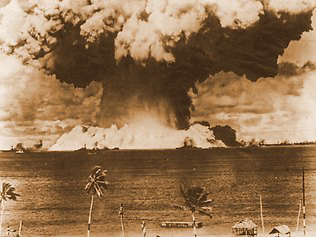 After 75 years, it’s time to clean Bikini https://thebulletin.org/2021/03/after-75-years-its-time-to-clean-bikini/?utm_source=Newsletter&utm_medium=Email&utm_campaign=ThursdayNewsletter03112021&utm_content=NuclearRisk_CleanBikini_03082021
By Hart Rapaport, Ivana Nikolić Hughes | March 9, 2021, Due to their remote location in the Northern Marshall Islands, the people of Bikini Atoll were spared the worst of the mid-Pacific fighting between the American and Japanese armies in the final years of World War II. Their millennia-old culture and sustainable way of life ended abruptly when, in early 1946, Commodore Ben Wyatt, a representative of the occupying United States Navy, informed King Juda and other Bikini residents that the US would begin to test nuclear weapons near their homes. Wyatt asked the Bikinians to move elsewhere, stating that the temporary move was for “the good of mankind and to end all wars.” Though Wyatt may have believed his words to be true, the show of might by the US that followed neither ended all conflict, nor was the exodus short-lived. Seventy-five years later, Bikinians have yet to return.
Nuclear testing in Bikini and other Marshall Islands, which lasted from 1946 to 1958, received international attention at the time. In those early Cold War days, America demonstrated its nuclear prowess through images of mushroom cloud blasts towering over the Pacific on the cover of Time magazine and other prominent publications. The word Bikini infiltrated popular culture via the name of a two-piece swimsuit (named by a French designer to be “explosive”) and SpongeBob’s home, without simultaneously suffusing our conscience with an awareness of the injustices and suffering those blasts caused the Marshallese people.
It is time, finally, to recognize and right the wrongs perpetrated by the US government in the Marshall Islands. The US forced a new and dangerous technology on the native lands and peoples, without fully comprehending the short- and long-term consequences. The Marshall Islands–and Bikini specifically–ended up the site of most of the tests of US hydrogen bombs, weapons up to a thousand times more powerful than atomic bombs used in attacks on Japan in 1945. Later, when the refugees were briefly returned to Bikini after testing ended, they were exposed to harmful radiation amounts with devastating health effects.
To be sure, the US government has taken steps to monitor and address the contamination that resulted from these nuclear detonations. However, the status quo—studies by the Energy Department for the sake of scientific publications and reports, while Bikinians continue to live on other islands—is not only inadequate, but morally repugnant. Bikini is a native land and water that, over thousands of years, was critical to the people’s sustenance and the bedrock of their culture. While some of those who survived the decades of relocations are still alive, their children and grandchildren, including the descendants of King Juda, have yet to resettle their ancestral home. Without an immediate US-government-funded plan to resettle the living refugees, the millennia-long culture and history tied to the atoll may be lost forever. Also, as one of the highest lying islands in the region, Bikini could be the solution to challenges the Marshallese face from global warming and corresponding rise of sea levels.
But it’s not as simple as saying: “Let’s move the Bikinians back.” A permanent return to the atoll by a multi-generational community would risk serious health effects unless sources of remaining radiological contamination in Bikini’s fruit, soil, and lagoon are addressed and removed, according to our research at Columbia University’s K=1 Project, Center for Nuclear Studies. We have found radioactive materials throughout Bikini Atoll, resulting in background gamma radiation above the limit agreed upon by the Republic of the Marshall Islands and US and levels of cesium-137 in various fruits that violate most relevant international and domestic safety standards. Even the waters surrounding Bikini, a formerly plentiful source of food, are riddled with radioisotopes from the detonations. The cleanup may require a novel scientific approach on par with that used after the Chernobyl and Fukushima nuclear accidents. That said, a modern nuclear testing cleanup protocol may prove useful in the event of future nuclear incidents in the United States or elsewhere.
The Biden administration has promised to lead in domestic and international spheres with morals and compassion. To do so, it must engage in a truthful, comprehensive accounting of past missteps in the Marshall Islands, regardless of whether the cost of reparations and resettlement exceeds its current pledge of roughly $110 million to Bikini. Commodore Wyatt’s allegedly “temporary” displacement of Bikinians from their native land has lasted 75 years and counting. Will the Biden administration act with morals to clean remaining radioactive material from US detonations? Will it act with compassion to help Bikinians find their way home?
Global nuclear industry in decline since 1996, even without Fukushima disaster
 Clean Energy Wire 11th March 2021, Germany right to stick to nuclear exit despite revival plans abroad – media comments. On the tenth anniversary of the Fukushima nuclear desaster, a majority of media commentators in Germany praised the country’s decision to exit the technology for good. Clean Energy Wire 11th March 2021, Germany right to stick to nuclear exit despite revival plans abroad – media comments. On the tenth anniversary of the Fukushima nuclear desaster, a majority of media commentators in Germany praised the country’s decision to exit the technology for good.Nuclear power may be gaining new advocates and investors around the world due to its [very dubiously] potential role in enabling a climate neutral economy, but the technology’s days are numbered, Christoph von Eichhorn writes in the Süddeutsche Zeitung.
“When the devastating wave hit Japan’s shores and destroyed the Fukushima-Daiichi nuclear plant, it hit a technology that was in decline already – even without having experienced three nuclear meltdowns at once,” von Eichhorn argues, adding that the global nuclear power share reached a peak at around 17 percent in 1996 and has declined ever since to around ten percent today.
Almost no country announced a nuclear exit after the disaster, but it led to higher regulatory hurdles, tighter safety measures, and cost increases that make the technology less and less profitable, von Eichhorn adds.
|
|
Japan’s main opposition party -”Japanese society is viable without operating nuclear power plants”
|
Mainichi 12th March 2021, Yukio Edano, leader of the main opposition Constitutional Democratic Party of Japan (CDP), expressed his intention to aim for the elimination of
nuclear power in Japan on March 11 — the 10th anniversary of the 2011 Great East Japan Earthquake and tsunami — after earlier stating it was no easy task. Edano’s declaration appeared to be a response to criticism over
his recent comment that “ending nuclear power is not easy.” Edano told reporters at the Diet, “It has been demonstrated during these 10 years that Japanese society is viable without operating nuclear power plants. I intend to make a society that does not depend on nuclear power permanent.” https://mainichi.jp/english/articles/20210312/p2a/00m/0na/002000c |
|
Fukushima: “How Japan was blinded to the predicted certainty of disaster”.
Impossible timetable set for returning Fukushima nuclear site to ‘greenfield”
Greenpeace 11th March 2021, Nine months after the triple reactor meltdown at the Fukushima Daiichinuclear plant in March 2011, Tokyo Electric Power Company (TEPCO) announced that decommissioning of the site will be completed within 30-40 years.
Practically, the people of Japan were told that some time between 2041 and 2051, the site would be returned to ‘greenfield.’ In the past decade, the complexity and scale of the challenge at the Fukushima Daiichi site has become slowly clearer. The decommissioning task at the Fukushima Daiichi site is unique in its challenge to society and technology. But still, the
official time frame for TEPCO’s Road Map for decommissioning remains that set in 2011.
Small modular reactors not the solution, says German nuclear authority
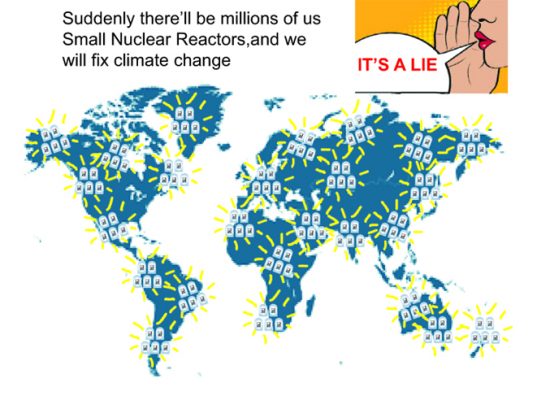
advanced reactor designs and can be operated with converted short-lived radioactive materials, solving the waste problem.
proliferation of weapons-grade materials and will probably never be as cheap as their advocates claim”, Michael Bauchmüller writes. The paper by the Institute for Applied Ecology (Öko-Institut) found that in order to replace the 400 or so large reactors today, “many thousands to tens of thousands of SMR plants” would have to be built. But this raises questions for proliferation, the spread of dangerous nuclear material.
https://reneweconomy.com.au/small-modular-reactors-not-the-solution-says-german-nuclear-authority/
‘Every euro invested in nuclear power makes the climate crisis worse’.

|
Deutsche Welle 11th March 2021, ‘Every euro invested in nuclear power makes the climate crisis worse’. Can nuclear energy help us meet climate goals? The editor of the World Nuclear Industry Status Report, Mycle Schneider, says no. Mycle Schneider:
Today we need to put the question of urgency first. It’s about how much we can reduce greenhouse gases and how quickly for every euro ($1.21) spent. So, it’s a combination between cost and feasibility, while doing it in the fastest possible way. And if we’re talking about the construction of new power plants, then nuclear power is simply excluded.
Not just because it is the most expensive form of electricity generation today, but, above all,
because it takes a long time to build reactors. In other words, every euro invested in new nuclear power plants makes the climate crisis worse because now this money cannot be used to invest in efficient climate protectionoptions. The world’s lowest price for solar power in currently in Portugal, at 1.1 cents per kilowatt hour. And we now have the first results from Spain with costs for wind and solar power at around 2.5 cents per kilowatt hour. These are below the basic operating costs of the vast majority of
nuclear power plants around the world. It would often even be affordordable to pay 1 – 1.5 cents per kilowatt hour for electricity storage in addition to the generation costs for wind and solar power and still be below the operating costs of nuclear power plants. And here we have to ask the same question: How many emissions can I avoid with one euro, one dollar or one yuan? https://www.dw.com/en/nuclear-climate-mycle-schneider-renewables-fukushima/a-56712368 |
|
1 This Month
Chernobyl: The Lost Tapes – A good documentary on Chernobyl on SBS available On Demand for the next 3 weeks– https://www.sbs.com.au/ondemand/tv-program/chernobyl-the-lost-tapes/2352741955560

of the week–London Campaign for Nuclear Disarmament

Tell the Ukrainian Government to Drop Prosecution of Peace Activist Yurii Sheliazhenko
To see nuclear-related stories in greater depth and intensity – go to https://nuclearinformation.wordpress.com
-
Archives
- April 2026 (114)
- March 2026 (251)
- February 2026 (268)
- January 2026 (308)
- December 2025 (358)
- November 2025 (359)
- October 2025 (376)
- September 2025 (257)
- August 2025 (319)
- July 2025 (230)
- June 2025 (348)
- May 2025 (261)
-
Categories
- 1
- 1 NUCLEAR ISSUES
- business and costs
- climate change
- culture and arts
- ENERGY
- environment
- health
- history
- indigenous issues
- Legal
- marketing of nuclear
- media
- opposition to nuclear
- PERSONAL STORIES
- politics
- politics international
- Religion and ethics
- safety
- secrets,lies and civil liberties
- spinbuster
- technology
- Uranium
- wastes
- weapons and war
- Women
- 2 WORLD
- ACTION
- AFRICA
- Atrocities
- AUSTRALIA
- Christina's notes
- Christina's themes
- culture and arts
- Events
- Fuk 2022
- Fuk 2023
- Fukushima 2017
- Fukushima 2018
- fukushima 2019
- Fukushima 2020
- Fukushima 2021
- general
- global warming
- Humour (God we need it)
- Nuclear
- RARE EARTHS
- Reference
- resources – print
- Resources -audiovicual
- Weekly Newsletter
- World
- World Nuclear
- YouTube
-
RSS
Entries RSS
Comments RSS
 nuclear-news