The growing threat of space debris
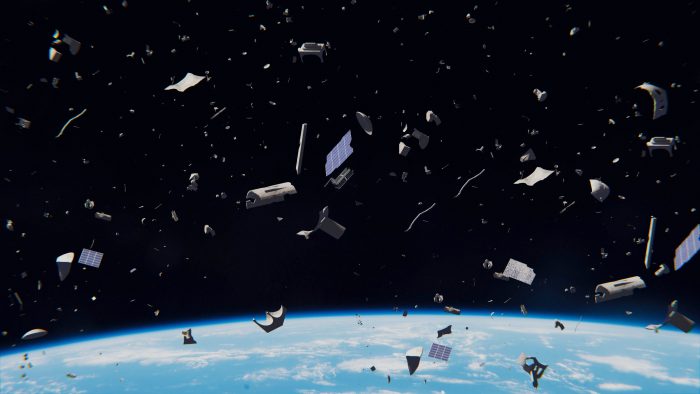
|
Space Traffic Management https://www.spacedaily.com/reports/Space_Traffic_Management_999.html by Staff Writers for Launchspace, Bethesda MD (SPX) Mar 05, 2021 Those familiar with air traffic management architectures understand the constraints of aircraft flying in the atmosphere, vehicle dynamics and command and control techniques. Unfortunately, space traffic has many more degrees of freedom and much less control capability. Add to this the completely uncontrolled nature of space debris and the reality that most debris objects cannot be tracked and motion cannot be accurately measured or simulated.
In fact, orbiting debris is a product of negligence. Over the first 60 years of space flight, mission plans ended with the completion of in-space operations. Satellites were shut down and left in their orbits, subject to natural influences. Little thought was given to any collateral effects of objects “adrift” in space, because “space” was thought of as “big.”
An analogy might be the ocean disposal of waste items, where junk gets lost in the vastness of the seas, either by sinking to the bottom or by simply drifting with ocean currents. By contrast, a “drifting” satellite remnant in low orbit is travelling at a speed in excess of 7.3 km/sec (16,300 mph). Since orbiting objects can travel in all directions, collisions between satellites and debris can occur at speeds of over 14.6 km/sec (32,600 mph). Of the suspected hundreds-of-thousands of debris objects in low orbits, only about 35,000 are 5 cm (2 inches) or larger in size, and only these can be tracked. The vast majority of the 1014+ junk items remain beyond current tracking capabilities, but are dangerous in terms of causing significant damage to operating satellites. The detrimental effects of space junk grow worse each year, putting international space infrastructures increasingly at risk as our communications, science and security networks rely ever more heavily on the interconnected system of satellites orbiting the skies. While we understand weather and have learned techniques to deal with it, the impact and disposition of orbital debris are not fully understood. Unlike weather, space junk is man-made and, if not properly dealt with, will significantly hinder the world’s future economy and security. It is a growing threat to space-based communications, weather forecasting, banking processes, scientific exploration, Earth observation and future space tourism. Space commerce is growing, and as this industry expands the need for an effective traffic management system will become critical to commercial growth and exploitation of space. At the moment, there are no programs in place to deal with orbital debris, even though new satellites continue to be launched. In fact, more than 50,000 new satellites may enter service in the next few years. New launches contribute to the already-large orbital debris population. With over 60 countries operating in space, the exponentially growing problem of orbital debris will take international collaborations and partnerships to conceive and develop innovative solutions and strategies as part of a worldwide space traffic management architecture. |
|
No comments yet.
1 This Month

Petition to revoke the licensing of the Near Surface Nuclear Disposal Facility (NSDF) at Chalk River. https://www.ourcommons.ca/petitions/en/Petition/Details?Petition=e-7247


of the week – STOP SMALL MODULAR REACTORS IN CANADA
To see nuclear-related stories in greater depth and intensity – go to https://nuclearinformation.wordpress.com
-
Archives
- March 2026 (153)
- February 2026 (268)
- January 2026 (308)
- December 2025 (358)
- November 2025 (359)
- October 2025 (376)
- September 2025 (258)
- August 2025 (319)
- July 2025 (230)
- June 2025 (348)
- May 2025 (261)
- April 2025 (305)
-
Categories
- 1
- 1 NUCLEAR ISSUES
- business and costs
- climate change
- culture and arts
- ENERGY
- environment
- health
- history
- indigenous issues
- Legal
- marketing of nuclear
- media
- opposition to nuclear
- PERSONAL STORIES
- politics
- politics international
- Religion and ethics
- safety
- secrets,lies and civil liberties
- spinbuster
- technology
- Uranium
- wastes
- weapons and war
- Women
- 2 WORLD
- ACTION
- AFRICA
- Atrocities
- AUSTRALIA
- Christina's notes
- Christina's themes
- culture and arts
- Events
- Fuk 2022
- Fuk 2023
- Fukushima 2017
- Fukushima 2018
- fukushima 2019
- Fukushima 2020
- Fukushima 2021
- general
- global warming
- Humour (God we need it)
- Nuclear
- RARE EARTHS
- Reference
- resources – print
- Resources -audiovicual
- Weekly Newsletter
- World
- World Nuclear
- YouTube
-
RSS
Entries RSS
Comments RSS
 nuclear-news
Leave a comment