Iran’s foreign minister says Tehran will offer a constructive plan for nuclear talks
Iran’s Zarif to offer ‘constructive’ plan for nuclear talks https://www.aljazeera.com/news/2021/3/5/irans-zarif-to-offer-constructive-plan-amid-hopes-of-informal
Announcement comes after European diplomatic sources said Tehran recently gave encouraging signs about opening informal talks over the nuclear deal. Iran will soon present a “constructive” plan of action, Foreign Minister Mohammad Javad Zarif said on Friday, after European sources said Tehran gave positive signs about opening informal talks about its nuclear programme.
“As Iran’s FM [foreign minister] & chief nuclear negotiator, I will shortly present our constructive concrete plan of action – through proper diplomatic channels,” Zarif said on Twitter.
A French diplomatic source and another European official said on Thursday that Iran had given encouraging signs in recent days about opening informal talks after European powers scrapped plans to criticise Tehran at the UN nuclear watchdog.
Iran has so far refused to take part in a meeting brokered by the European Union between world powers and the United States on reviving its 2015 nuclear deal.
Iran’s nuclear policy is decided by the country’s top authority, Supreme Leader Ayatollah Ali Khamenei, and not the president or the government.
Tehran and Washington have emerged from former US President Donald Trump’s attempts to wreck Iran’s nuclear deal but are locked in a standoff over who should move first to save it. Trump pulled out of the landmark accord in 2018.
Britain, France, and Germany decided to pause the submission of a resolution critical of Iran at the International Atomic Energy Agency (IAEA) on Thursday to not harm the prospects for diplomacy, after what they said were concessions gained from Iran to deal with outstanding nuclear issues.
Armenia should shut down, not repair, its dangerous nuclear power station
Is there an argument that could work now?
The EU might urge Armenia to consider a closure in light of recent developments. Post-war road, railway, and energy-development plans should increase trade and transportation linkages in the South Caucasus region after the recent conflict between Armenia and Azerbaijan. The new infrastructure and financing provide Armenia with a fresh opportunity to tap newer, safer, and more diverse energy supplies. By closing Metsamor, Armenia would not only contribute to the safety of its own citizens and those in neighboring countries but strengthen peace in the South Caucasus.
Metsamor nuclear power plant. Metsamor is located in a major seismic zone close to Armenia’s capital, Yerevan, and near Armenia’s border with Turkey. The original, Soviet-built plant included two 400 megawatt reactors. Unit 1 began commercial operation in 1977. Both units were closed by the Soviet authorities in 1989, following the Chernobyl accident and the massive Spitak earthquake in Armenia in 1988, which killed over 25,000 people.
In 1995, following Armenia’s independence, Metsamor Unit 2 was restarted at 375 megawatts electrical with Russian funding and technical support. The plant’s original operating license was supposed to end in 2016, but Yerevan extended it to 2021, and late in 2020 announced its intent to extend the plant’s operation even longer. Unit 1 has remained closed.
Metsamor is one of five of the last operating Soviet-era reactors without a containment vessel, which is a requirement of all modern reactors. …………..
In 1995, following Armenia’s independence, Metsamor Unit 2 was restarted at 375 megawatts electrical with Russian funding and technical support. The plant’s original operating license was supposed to end in 2016, but Yerevan extended it to 2021, and late in 2020 announced its intent to extend the plant’s operation even longer. Unit 1 has remained closed……..
Following the Fukushima Daiichi nuclear disaster in Japan, Germany and other key EU states shut down their nuclear power production. Also, the EU has succeeded in closing dangerous Soviet era plants among its new members. However, EU citizens remain in danger when problematic plants in their neighborhood remain operational. The EU now has an opportunity to remove one of these dangers while strengthening regional cooperation, but only if it convinces Armenia to scrap plans to repair Metsamor in favor of shutting it down altogether.
https://thebulletin.org/2021/03/armenias-nuclear-power-plant-is-dangerous-time-to-close-it/
Montana legislatures to review the law restricting nuclear developments
At the same time the House was reviewing a bill sponsored by Rep. Derek Skees, R-Kalispell, to remove restrictions on nuclear development, the Senate was at work on Senate Joint Resolution 3, which directs the state to study advanced nuclear reactors. The resolution appears well-positioned to pass — halfway through the session, SJ 3 has garnered unanimous support in the Senate.
Sponsor Terry Gauthier, R-Helena, becomes audibly excited discussing the measure. He said he sees modern nuclear technology as a way for Montana to send electrons to the energy-thirsty markets of the Pacific Northwest by tying into the high-voltage transmission lines leading out of Colstrip……..
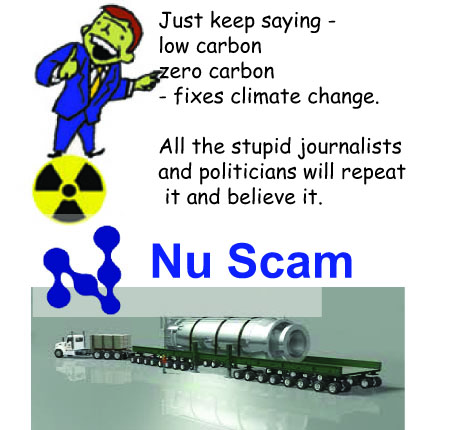 Gauthier is particularly interested in a company called NuScale, based in Portland, Ore., that’s garnered more than $1.3 billion from the federal government to advance its small modular reactor, or SMR, design. It’s the only company that’s received approval from the federal Nuclear Regulatory Commission for that type of design — a significant milestone on the journey to market……….
Much of the debate about the environmental impact associated with nuclear energy is focused on what to do with the spent fuel. Some kinds of nuclear fuel can remain radioactive for hundreds or thousands of years. The U.S. has yet to arrive at a long-term solution for re-using or storing spent fuel, creating a contentious political issue that’s spanned decades.
As is the case with larger-scale traditional nuclear plants, spent fuel from SMRs remains a “significant issue,” according to Darby.
NuScale’s plan is to store used fuel underwater in a stainless-steel lined concrete pool located onsite for at least five years. They say the pool is designed to withstand “a variety of severe natural and human made phenomena” like earthquakes and aircraft impacts. After the five-year period when the used fuel is both hottest and most radioactive has elapsed, it’s moved to a stainless-steel canister surrounded with concrete that’s designed to contain the radioactivity.
The United States doesn’t have a permanent underground repository for high-level nuclear waste, so those concrete containment vessels generally remain on-site or near the plant they came from. A 33-year-old effort to create such a long-term storage repository northwest of Las Vegas is still subject to heated debate. ……….
Another question hanging over nuclear energy development is the price of building a new plant. It’s not uncommon for new construction costs to exceed $1 billion. Concerns about cost increases led several cities that had committed to participate in NuScale’s demonstration plant in Idaho Falls to pull out of the multi-billion-dollar project last year.
NuScale told Montana Free Press that once production is rolling on their product, it anticipates the facility construction cost to be about $2,850 per kilowatt of producing capacity for its largest, 12-module iteration. For comparison, new construction of a natural gas plant averaged about $837 per kilowatt of capacity in 2018, and wind plants clocked in at $1,382, according to the U.S. Energy Information Administration.
Brad Molnar, a Republican senator from Laurel, told MTFP that cost will be an important consideration as the state plots its energy future. He said the study Gauthier is spearheading should involve the Public Service Commission, because it doesn’t make sense to conduct the study without landing on a cost-per-megawatt estimate.
Gauthier knows that nuclear is by no means the least expensive energy source, particularly if calculations are based on a strict dollars-and-cents equation…….
It’s not yet clear if Montana’s 1978 law requiring voter approval before a nuclear energy plant can be built in the state will still be on the books next year. The Legislature is still deciding the fate of HB 273, which would strike that law and remove nuclear projects from the purview of the Major Facility Siting Act.
Sen. Molnar has been asked if he’d carry HB 273 when it’s heard in the Senate, but he said he has reservations about the measure.
“By and large, I’m really hesitant to overturn a [voter] initiative,” he said, adding that the order of operations seems a little off to him.
“First you do the study, then you take action,” he said. “You don’t take action and then do the study.”
As of March 4, both HB 273 and SJ 3 have been transmitted to the Senate and House, respectively, for review. Hearing dates before those chambers’ energy committees have not been set. https://montanafreepress.org/2021/03/04/nuclear-on-the-radar-part-ii/
Safety expert recommends shutdown of several of France’s old, dubiously safe, nuclear reactors
Widespread public support for Germany’s nuclear phaseout, as renewable energy expands
TechXplore, 5 Mar 21, ”……….By the end of 2022, Germany will have achieved its goal of completely phasing out nuclear power, set by Chancellor Angela Merkel on May 30, 2011.
The plan represented a dramatic change of course by Merkel’s ruling conservatives, who just a few months earlier had agreed to extend the lifespan of Germany’s oldest power stations.
It was met with widespread public support in a country with a powerful anti-nuclear movement, fuelled first by fears of a Cold War conflict and then by disasters such as Chernobyl.
Yet it also prompted a lengthy legal battle with major energy companies, which ended Friday with Berlin’s agreement to pay 2.4 billion euros worth of compensation to nuclear power plant operators………
The German government is still looking for a long-term storage site for the country’s residual nuclear waste.
Renewables have seen a spectacular rise since 2011 and in 2020 made up more than 50 percent of Germany’s energy mix for the first time, according to the Fraunhofer research institute—compared with less than 25 percent 10 years ago.
The declining importance of nuclear power (12.5 percent in 2020) “has been compensated for by the expansion of renewable energies”, Claudia Kemfert, an energy expert at the DIW economic research institute, told AFP.
Nuclear power stations have therefore not been replaced by coal, though the fossil fuel does still represent almost a quarter of the electricity mix.
Biden’s first budget should reduce excessive expenditure on nuclear weaponry
|
Biden’s first budget should reduce nuclear excess, Defense News, By: Kingston Reif, 5 Mar 21, As the Biden administration begins crafting its defense budget submission for fiscal 2022, the debate about how it should handle the U.S. nuclear arsenal is heating up.
Proponents of the Trump administration’s approach, which fanned the flames of a burgeoning arms race, are warning any deviations will lead to disaster. President Joe Biden, however, appears to have a different view. During the campaign, he said the United States “does not need new nuclear weapons” and that his “administration will work to maintain a strong, credible deterrent while reducing our reliance and excessive expenditure on nuclear weapons.” Biden is right. Current U.S. nuclear weapons policies exceed what is necessary for a credible nuclear deterrent, and their financial costs are taking a growing toll. Biden should use his forthcoming budget to steer the country in a safer and more affordable direction. In addition to continuing legacy plans to replace the nuclear triad and its associated warheads, the Trump administration pursued new types of weapons and more bomb-making infrastructure. It also expanded the circumstances in which President Donald Trump would consider using nuclear weapons. Worse still, the administration put New START — the sole remaining agreement verifiably limiting the size of the U.S. and Russian nuclear arsenals — on the brink of expiration. Mindful of the danger he inherited, Biden quickly and wisely agreed with Russian President Vladimir Putin to extend New START by five years. Trump’s FY21 budget request of $44.5 billion to sustain and upgrade the nuclear arsenal was a 19 percent increase over the previous year. Over the next several decades, spending is likely to top $1.5 trillion. Russian and Chinese nuclear advances and aggressive behavior might seem to justify such investments. But the spending plans pose a major threat to security priorities more relevant to countering Moscow and Beijing and assuring allies. A long-foreseen budget reckoning has arrived.
An early reassessment of the Trump administration’s dubious proposal to double the number of more usable low-yield nuclear options is more than justified. In particular, the Biden administration should provide no funding to begin development of a new nuclear-armed, sea-launched cruise missile. The weapon, which is projected to cost at least $9 billion over the next decade, is a redundant and costly hedge on a hedge. But the mini-review should go further and hit pause on other controversial programs, pending the outcome of a more comprehensive policy review later this year. For example, the administration should freeze funding for the Air Force’s program to build a new land-based intercontinental ballistic missile system at the current-year level. It should also set the budget for the National Nuclear Security Administration at the level projected for FY22 as of the FY20 budget request……………. https://www.defensenews.com/opinion/commentary/2021/03/04/bidens-first-budget-should-reduce-nuclear-excess/ |
|
Germany to pay nuclear operators 2.4 bln euros for plant closures
|
Germany to pay nuclear operators 2.4 bln euros for plant closures, https://www.reuters.com/article/germany-nuclear-settlement/germany-to-pay-nuclear-operators-24-bln-euros-for-plant-closures-idUSS8N2IR026 By Reuters Staff, (Reporting by Vera Eckert, Tom Kaeckenhoff and Markus Wacket, editing by Thomas Escritt)
FRANKFURT, March 5 21, (Reuters) – The German government has agreed to pay nuclear operators 2.4 billion euros ($2.86 billion) in compensation for forcing them to shut their nuclear plants early in response to the the Fukushima disaster, ministries said on Friday.The Frankfurter Allgemeine Zeitung daily had reported on Thursday that a sum of 2.4 billion euros will be made available from the general budget, citing government sources. The four affected companies are the German listed utilities RWE, which will get 880 million euros, and E.ON , which will get 42.5 million euros, as well as Swedish state-owned rival Vattenfall, which will get 1.425 billion euros, and mainly publicly-owned German EnBW , which will get 80 million euros. A Constitutional Court ruling in November had found in favour of the companies in their complaint that the government’s previous offer had not gone far enough. The court called for a speedy settlement of the dispute, which was mainly pursued by Vattenfall. The court had already ruled in 2016 that while the nuclear phase-out was legal, the operators needed to be better compensated for lost production. ($1 = 0.8389 euros) |
|
1 This Month

of the week – Shut Down Drone Warfare!


Tell the Ukrainian Government to Drop Prosecution of Peace Activist Yurii Sheliazhenko

Petition to revoke the licensing of the Near Surface Nuclear Disposal Facility (NSDF) at Chalk River. https://www.ourcommons.ca/petitions/en/Petition/Details?Petition=e-7247
To see nuclear-related stories in greater depth and intensity – go to https://nuclearinformation.wordpress.com
-
Archives
- March 2026 (251)
- February 2026 (268)
- January 2026 (308)
- December 2025 (358)
- November 2025 (359)
- October 2025 (376)
- September 2025 (257)
- August 2025 (319)
- July 2025 (230)
- June 2025 (348)
- May 2025 (261)
- April 2025 (305)
-
Categories
- 1
- 1 NUCLEAR ISSUES
- business and costs
- climate change
- culture and arts
- ENERGY
- environment
- health
- history
- indigenous issues
- Legal
- marketing of nuclear
- media
- opposition to nuclear
- PERSONAL STORIES
- politics
- politics international
- Religion and ethics
- safety
- secrets,lies and civil liberties
- spinbuster
- technology
- Uranium
- wastes
- weapons and war
- Women
- 2 WORLD
- ACTION
- AFRICA
- Atrocities
- AUSTRALIA
- Christina's notes
- Christina's themes
- culture and arts
- Events
- Fuk 2022
- Fuk 2023
- Fukushima 2017
- Fukushima 2018
- fukushima 2019
- Fukushima 2020
- Fukushima 2021
- general
- global warming
- Humour (God we need it)
- Nuclear
- RARE EARTHS
- Reference
- resources – print
- Resources -audiovicual
- Weekly Newsletter
- World
- World Nuclear
- YouTube
-
RSS
Entries RSS
Comments RSS
 nuclear-news