Nuclear energy proponents downplay its unresolved moral and ethical concerns
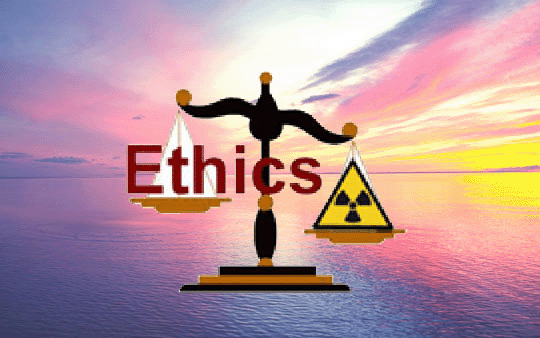 Nuclear energy, ten years after Fukushima, Nature, Ali Ahmad & Francesca Giovannini, 4 Mar 21, ” …………..Many academics have cast nuclear power as an inevitable choice if the planet is to limit global warming1. But, given the environmental and social concerns, others are more circumspect, or remain opposed2. The Intergovernmental Panel on Climate Change, in its 2018 special report on global warming, acknowledged a possible role for nuclear energy in limiting global temperature rise, but highlighted the crucial role that public acceptance will have in boosting or derailing investments.
Safety and cost are frequently highlighted as the central challenges for the nuclear industry. New technologies are tackling these issues, but such reactors might not become commercialized until mid-century. That time frame could render them obsolete, as competing technologies such as solar and wind energy (plus storage) become increasingly dominant3.
The nuclear sector has consistently failed to engage meaningfully with the public over such concerns. This failure can be traced back to the 1960s and 1970s. Psychological studies of risk at that time described the public as affective, irrational and neglectful of probability in its assessments of risk, and called on the nuclear industry either to accept and design for the public’s perceptions of risk or to educate the public8.
Industry chose the latter path, typically attempting to engage the public only at the final stages of plant regulation and focusing on educating the public with the industry’s own view of risk. This is a straightforward, quantitative equation that multiplies the probability of disaster and consequence. It often avoids or ignores the public perspective. For example, many people are willing to accept risks that are voluntary or familiar — such as flying, smoking or driving a car — against risks that are unfamiliar and over which they have little control. For involuntary risky activities, most individuals tend to de-emphasize probability and require higher levels of safety and protection for their comfort.
The industry’s mode of engagement with the public has led to an antagonistic expert–public divide. Fukushima, for example, left an undeniable mark on the public psyche. But the nuclear industry consistently plays down the disaster by focusing on the fact that it did not cause any direct casualties. Although no human deaths resulted directly from the accident, disruptions to livelihoods, social ties and irreversible damage to ecosystems have been significant. An estimated 165,000 people were displaced, and, a decade later, some 43,000 residents are unable to return to their home towns9. Industry risk assessments capture the economic impacts of such issues, but usually fail to capture the harder-to-quantify collateral damage to people’s lives and the environment………https://www.nature.com/articles/d41586-021-00580-4
No comments yet.
1 This Month

of the week – Shut Down Drone Warfare!


Tell the Ukrainian Government to Drop Prosecution of Peace Activist Yurii Sheliazhenko

Petition to revoke the licensing of the Near Surface Nuclear Disposal Facility (NSDF) at Chalk River. https://www.ourcommons.ca/petitions/en/Petition/Details?Petition=e-7247
To see nuclear-related stories in greater depth and intensity – go to https://nuclearinformation.wordpress.com
-
Archives
- April 2026 (91)
- March 2026 (251)
- February 2026 (268)
- January 2026 (308)
- December 2025 (358)
- November 2025 (359)
- October 2025 (376)
- September 2025 (257)
- August 2025 (319)
- July 2025 (230)
- June 2025 (348)
- May 2025 (261)
-
Categories
- 1
- 1 NUCLEAR ISSUES
- business and costs
- climate change
- culture and arts
- ENERGY
- environment
- health
- history
- indigenous issues
- Legal
- marketing of nuclear
- media
- opposition to nuclear
- PERSONAL STORIES
- politics
- politics international
- Religion and ethics
- safety
- secrets,lies and civil liberties
- spinbuster
- technology
- Uranium
- wastes
- weapons and war
- Women
- 2 WORLD
- ACTION
- AFRICA
- Atrocities
- AUSTRALIA
- Christina's notes
- Christina's themes
- culture and arts
- Events
- Fuk 2022
- Fuk 2023
- Fukushima 2017
- Fukushima 2018
- fukushima 2019
- Fukushima 2020
- Fukushima 2021
- general
- global warming
- Humour (God we need it)
- Nuclear
- RARE EARTHS
- Reference
- resources – print
- Resources -audiovicual
- Weekly Newsletter
- World
- World Nuclear
- YouTube
-
RSS
Entries RSS
Comments RSS
 nuclear-news
Leave a comment