Nuclear industry very nervous about EU evaluation of its’green’ claims
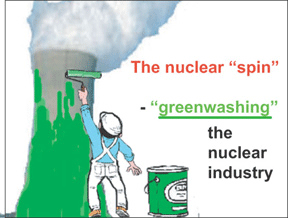 Nuclear faces ‘a lot of uncertainty’ as EU green evaluation looms, By Frédéric Simon https://www.euractiv.com/section/energy-environment/news/nuclear-faces-a-lot-of-uncertainty-as-eu-green-evaluation-looms/ EURACTIV.com 16 Feb 2021 (updated: 17 Feb 2021) The industry is growing increasingly nervous about European Commission plans to evaluate the safety of radioactive waste handling as an expert report is expected next month on how to classify nuclear energy under the EU’s green finance taxonomy.
The European Commission’s in-house research body, the Joint Research Centre (JRC), is putting the finishing touches to a report about the safe handling of radioactive waste that could be fateful for the future of Europe’s nuclear industry.
The report, expected by the end of February or beginning of March, could end up recognising nuclear power as a “transition fuel” under the EU’s green finance rulebook, or on the contrary irreversibly stigmatise it as a polluting form of energy that does “significant harm” to the environment.“The big issue for us with the taxonomy is that it will enable eligible companies to have access to bonds and funds that have a lower interest rate,” said Jessica Johnson, communications director at Foratom, the trade association representing the nuclear industry in Brussels.
“It means that the cost of finance could potentially be lower if they have access to these funds because the amount of interest they will have to pay back is a lot less,” she told journalists during an online press briefing on Wednesday (9 February).
Poland, the Czech Republic and Bulgaria are planning to build new nuclear reactors to decrease their reliance on coal and meet the EU’s climate goals.
But the classification of nuclear under the EU’s green finance taxonomy could have implications on the amount of financial support that governments will be allowed to provide for new projects under the EU’s state aid rules, which are being revised this year.
“We have seen recent consultations on state aid where reference is made to the taxonomy regulation, suggesting that there could be some link there in the future,” Johnson said. “We don’t know what they will do with that”.
Private banks are reluctant to provide loans for new nuclear projects unless governments back them with substantial financial guarantees and state aid. Renewables, by contrast, are cheaper to build and offer much faster delivery timetables and quicker returns – increasingly without state support.
“We see little economic rationale for new nuclear builds in the US or Western Europe, owing to massive cost escalations and renewables cost-competitiveness,” said rating agency S&P in a note released in 2019.
No comments yet.
1 This Month


Tell the Ukrainian Government to Drop Prosecution of Peace Activist Yurii Sheliazhenko

Petition to revoke the licensing of the Near Surface Nuclear Disposal Facility (NSDF) at Chalk River. https://www.ourcommons.ca/petitions/en/Petition/Details?Petition=e-7247


of the week – STOP SMALL MODULAR REACTORS IN CANADA
To see nuclear-related stories in greater depth and intensity – go to https://nuclearinformation.wordpress.com
-
Archives
- March 2026 (183)
- February 2026 (268)
- January 2026 (308)
- December 2025 (358)
- November 2025 (359)
- October 2025 (376)
- September 2025 (258)
- August 2025 (319)
- July 2025 (230)
- June 2025 (348)
- May 2025 (261)
- April 2025 (305)
-
Categories
- 1
- 1 NUCLEAR ISSUES
- business and costs
- climate change
- culture and arts
- ENERGY
- environment
- health
- history
- indigenous issues
- Legal
- marketing of nuclear
- media
- opposition to nuclear
- PERSONAL STORIES
- politics
- politics international
- Religion and ethics
- safety
- secrets,lies and civil liberties
- spinbuster
- technology
- Uranium
- wastes
- weapons and war
- Women
- 2 WORLD
- ACTION
- AFRICA
- Atrocities
- AUSTRALIA
- Christina's notes
- Christina's themes
- culture and arts
- Events
- Fuk 2022
- Fuk 2023
- Fukushima 2017
- Fukushima 2018
- fukushima 2019
- Fukushima 2020
- Fukushima 2021
- general
- global warming
- Humour (God we need it)
- Nuclear
- RARE EARTHS
- Reference
- resources – print
- Resources -audiovicual
- Weekly Newsletter
- World
- World Nuclear
- YouTube
-
RSS
Entries RSS
Comments RSS
 nuclear-news
Leave a comment