Global nuclear industry – rotten to the core: it’s not just Brazil

A bad barrel, not just a few bad apples. Additionally, Lava Jato revealed that the type of corruption that took place was not just a matter of a few rotten apples, but rather of systemic factors.
Corruption in the nuclear industry is a known international phenomenon. The recent scandal in Ohio illustrates how the push for subsidies to nuclear plants is not the result of a real commitment to citizens’ energy needs or climate concerns, but a way for energy corporations to maintain overpayments and assure political gains to certain parties. Brazil offers a different model, one that has used new nuclear facilities to generate kickbacks to powerful political and business interests.
|
Brazil’s Angra 3 nuclear reactor: a political undertaking, not a common good https://thebulletin.org/2021/02/brazils-angra-3-nuclear-reactor-a-political-undertaking-not-a-common-good/ By Carolina Basso | February 16, 2021 In 2019 the Brazilian government decided to resume work at Angra 3, a nuclear reactor where construction has been essentially dormant for more than three decades. The work was supposed to restart last year, with the reactor entering commercial service by late 2026, but COVID-19 and the quest for private partners to invest in the project have pushed back the schedule. Brazil currently has two operating nuclear power plants, Angra 1 and 2, that have generated less than three percent of the country’s electricity since their commercial launch. So why does Brazil want to resume construction of a third nuclear reactor? Angra 3 is questionable in economic and energy-related terms. Studies have shown that the country can generate electricity much more cheaply by integrating wind power with Brazil’s considerable hydropower resources. Analysts suggest that this combined system could supply all the electricity the population demands, making any expansion of the nuclear industry sector unnecessary and costly. The decision to resume construction of the third Brazilian reactor was made by President Jair Bolsonaro, who is committed to expanding the nuclear industry. Bolsonaro’s commitment results in part from his close ties to Brazil’s Navy, which has historically shaped the nuclear sector and currently dominates the country’s uranium enrichment and fuel cycle technology. But this factor alone cannot explain the decision. It is imperative to examine who will benefit from the project, particularly through the kinds of corruption that are endemic in Brazil. Seen in that light, the political push for building Angra 3 would seem to have more to do with money and politics than with providing a public good. A web of bribes.The Angra 3 project began in the early 1980s, but a number of administrative and financial problems slowed construction down, and it ceased altogether in 1986. Then-President Luiz Inácio Lula da Silva revived construction in 2010, but it was again interrupted in 2015 due to the detection of contractual frauds. That detection had to do with another important development in Brazilian politics: Operation Car Wash, or Lava Jato, in Portuguese. The Federal Police of Brazil launched the operation in 2014 to investigate an enormous money laundering and embezzlement scheme involving major contractors and several politicians. Amid the whirl of investigations, the police discovered an elaborate web of bribes in Eletronuclear, the state-owned electric subsidiary that operates the Angra nuclear reactors. Most of the payoffs pertained to contracts signed in the early stages of the three reactors. The corruption pattern unveiled by the police demonstrated that the corrupt activity in the nuclear sector was heavily institutionalized and took place out in the open. The actors involved developed a complex mechanism through which government officials worked with private business conglomerates to generate kickbacks worth millions of dollars.
The transactions worked as follows: Brazilian companies like Odebrecht and Camargo Correa paid bribes to politicians associated with state agencies (namely, Eletronuclear) to be hired by them or to form partnerships with international companies such as Techint to increase their profits. Nevertheless, this scheme needed private intermediaries with vast political connections to jump over bureaucratic obstacles. Therefore, part of the profits collected by the construction companies went to pay these brokers for their work and to bribe public officials. Finally, the kickbacks allowed politicians to finance their electoral campaigns and private interests. The anti-corruption probe suspended Angra 3’s construction and canceled all contracts allocated to engineering, construction, and electromechanical-assembly companies associated with the nuclear project. Operation Car Wash’s groundbreaking findings unveiled common tactics employed for decades. The investigations were crucial in exposing “the degree to which some policies make no economic sense but are implemented regardless because doing so is in the interest of a few businesses and political groups,” a lengthy report on nuclear governance in Brazil concluded. The result of that twisted pursuit is uneconomical projects with low regulatory standards for licensing and other policy decisions. A bad barrel, not just a few bad apples. Additionally, Lava Jato revealed that the type of corruption that took place was not just a matter of a few rotten apples, but rather of systemic factors. In other words, replacing individuals will not necessarily change the underlying dynamics generating demand for corruption in the first place. Angra 3 has been and likely will continue to be used as a political tool for money laundering and a vehicle for public authorities to receive tax dollars. Enter candidate Bolsonaro. The majority of his presidential campaign in 2018 capitalized on the anti-corruption wave generated by Operation Car Wash to gain votes from those outraged by the misconduct detected. Bolsonaro even invited Federal Judge Sérgio Moro, one of Lava Jato‘s main prosecutors, to become his Minister of Justice and Public Safety. But the reality of Bolsonaro’s reign as president has not lived up to his campaign promises, and corruption continues. In April 2020, former judge Moro resigned, accusing the president of attempting to interfere in Federal Police investigations. Experts point out that Moro’s departure crowns a process of politicization of government agencies that fight crime, which runs contrary to the values Bolsonaro endorsed during his campaigning. A burden on consumers. It is in light of this enduring corruption in Brazil that readers should consider the decision to resume construction of Angra 3. The combination of high costs, doubtful political intentions, and better energy options make it unreasonable to expand nuclear capabilities in Brazil. If decision-makers were truly concerned about the energy demands of the people, they would have invested in alternative systems that are more economical and sustainable. That they have not done so very likely has something to do with opposition from the lobbies of competing energy industries and the interests of political elites who hope to financially benefit from expensive projects like Angra 3. Corruption in the nuclear industry is a known international phenomenon. The recent scandal in Ohio illustrates how the push for subsidies to nuclear plants is not the result of a real commitment to citizens’ energy needs or climate concerns, but a way for energy corporations to maintain overpayments and assure political gains to certain parties. Brazil offers a different model, one that has used new nuclear facilities to generate kickbacks to powerful political and business interests. Because of this favoring of influence over qualification and fair budgeting, the burden on consumers will continue to grow. Around the world, reactor costs in the nuclear industry tend to be much higher than initially estimated. Angra 3’s estimated price has risen more than $2.7 billion from 2008 to 2018. The expensive investment has resulted in the tariff from the plant doubling from roughly $45 to $90 per megawatt hour. It is past time politicians refrain from overcharging the Brazilian population for their own advantage. |
‘Medical Scientific’ committee, stacked with nuclear executives, promotes nuclear power in space
 “The nuclear industry views space as a new—and wide-open—market for their toxic product that has run its dirty course on Mother Earth.”
“Now it appears that the nuclear industry has also infiltrated the National Academies of Sciences, Engineering, and Medicine that has been studying missions to Mars. ”
It’s going to take enormous grassroots action—and efforts by those in public office who understand the error of the space direction being taken—to stop it.
Nuclear Rockets to Mars?, BY KARL GROSSMAN– CounterPunch, 16 Feb 21,
A report advocating rocket propulsion by nuclear power for U.S. missions to Mars, written by a committee packed with individuals deeply involved in nuclear power, was issued last week by the National Academies of Sciences, Engineering and Medicine.
The 104-page report also lays out “synergies” in space nuclear activities between the National Aeronautics and Space Administration and the U.S. military, something not advanced explicitly since the founding of NASA as a civilian agency supposedly in 1958.
The report states: “Space nuclear propulsion and power systems have the potential to provide the United States with military advantages…NASA could benefit programmatically by working with a DoD [Department of Defense] program having national security objectives.”’
The report was produced “by contract” with NASA, it states.
The National Academy of Sciences, Engineering and Medicine (NAS) describes itself as having been “created to advise the nation” with “independent, objective advice to inform policy.”
The 11 members of the committee that put together the report for the National Academy includes: Jonathan W. Cirtain, president of Advanced Technologies, “a subsidiary of BWX Technologies which is the sole manufacturer of nuclear reactors for the U.S. Navy,” the report states; Roger M. Myers, owner of R. Myers Consulting and who previously at Aerojet Rocketdyne “oversaw programs and strategic planning for next-generation in-space missions [that] included nuclear thermal propulsion and nuclear electric power systems; Shannon M. Bragg-Sitton, the “lead for integrated energy systems in the Nuclear Science and Technology Directorate at the Idaho National Laboratory:” Tabitha Dodson, who at the U.S. government’s Defense Advanced Research Project Agency is chief engineer of a program “that is developing a nuclear thermal propulsion system;” Joseph A. Sholtis, Jr., “owner and principal of Sholtis Engineering & Safety Consulting, providing expert nuclear, aerospace, and systems engineering services to government, national laboratories, industry, and academia since 1993.” And so on.
The NAS report is titled: “Space Nuclear Propulsion for Human Mars Exploration.” It is not classified and is available here.
Bruce Gagnon, coordinator of the Global Network Against Weapons and Nuclear Power in Space, from its offices in Maine in the U.S., declared: “The nuclear industry views space as a new—and wide-open—market for their toxic product that has run its dirty course on Mother Earth.”
“During our campaigns in 1989, 1990, and 1997 to stop NASA’s Galileo, Ulysses and Cassini plutonium-fueled space probe launches, we learned that the nuclear industry positioned its agents inside NASA committees that made the decisions on what kinds of power sources would be placed on those deep space missions,” said Gagnon. “Now it appears that the nuclear industry has also infiltrated the National Academies of Sciences, Engineering, and Medicine that has been studying missions to Mars. The recommendation, not any surprise, is that nuclear reactors are the best way to power a Mars mission.”
“It’s not the best for us Earthlings because the Department of Energy has a bad track record of human and environmental contamination as they fabricate nuclear devices. An accident at launch could have catastrophic consequences.”
Stated Gagnon: “We fought the DoE and NASA on those previous nuclear launches and are entering the battle again. The nuclear industry has its sights set on nuclear-powered mining colonies on an assortment of planetary bodies—all necessitating legions of nuclear devices being produced at DoE and then launched on rockets that blow up from time to time.”
“We urge the public to help us pressure NASA and DoE to say no to nukes in space. We’ve got to protect life here on this planet. We are in the middle of a pandemic and people have lost jobs, homes, health care and even food on their table.”
“Trips to Mars can wait,” said Gagnon.
There have been accidents in the history of the U.S.—and also the former Soviet Union and now Russia—using nuclear power in space……
(Article goes on to explain how solar power can be, and is being used for space travel and research)
The NAS committee, however, was mainly interested in a choice between a “nuclear thermal propulsion” (NTP) or “nuclear electric propulsion” (NEP) for rocket propulsion…….
“Advanced nuclear propulsion systems (along or in combination with chemical propulsion systems) have the potential to substantially reduce trip time” to Mars “compared to fully non-nuclear approaches,” says the report.
An issue: radioactivity from either of the systems affecting human beings on the rockets with nuclear reactors propelling them. Back after World War II with the Cold War beginning, the U.S. began working on bombers propelled by onboard nuclear reactors—even built one. The idea was that such bombers could stay aloft for days ready to drop nuclear weapons on the Soviet Union. No crews would need to be scrambled and bombers then sent aloft.
But, as The Atlantic magazine noted in a 2019 article titled, “Why There Are No Nuclear Airplanes”:
“The problem of shielding pilots from the reactor’s radiation proved even more difficult. What good would a plane be that killed its own pilots? To protect the crew from radioactivity, the reactor needed thick and heavy layers of shielding. But to take off, the plane needed to be as light as possible. Adequate shielding seemed incompatible with flight. Still, engineers theorized that the weight saved from needing no fuel might be enough to offset the reactor and its shielding. The United States spent 16 years tinkering with the idea, to no avail”
The Eisenhower administration concluded that the program was unnecessary, dangerous, and too expensive. On March 28, 1961, the newly inaugurated President John F. Kennedy canceled the program. Proposals for nuclear-powered airplanes have popped up since then, but the fear of radiation and the lack of funding have kept all such ideas down.”……
The “synergies” in space nuclear activities between NASA and the U.S. military advanced in the NAS report mark a change in public acknowledgement. The agency was supposed to have a distinctly civilian orientation, encouraging peaceful applications in space science.
However, throughout the decades there have been numerous reports on its close relationship with the U.S. military—notably during the period of NASA Space Shuttle flights. As a 2018 piece in Smithsonian Magazine noted, “During the heyday of the space shuttle, NASA would routinely ferry classified payloads into orbit for the Department of Deense among other projects the agencies have collaborated on.”
With the formation of a U.S. Space Force by the Trump administration in 2019, the NASA-Pentagon link would appear to be coming out of the shadows, as indicated by the NAS report. The Biden administration is not intending to eliminate the Space Force, despite the landmark Outer Space Treaty of 1967 put together by the U.S., the then Soviet Union and the U.K, setting aside space for peaceful purposes. It is giving the new sixth branch of U.S. armed forces “full support,” according to his spokesperson Jen Psaki.
The NAS report says, “Areas of common interest include (1) fundamental questions about the development and testing of materials (such as reactor fuels and moderators) that can survive NTP conditions and (2) advancing modeling and simulation capabilities that are relevant to NTP.” And, “Additionally, a NASA NTP system could potentially use a scaled-up version of a DoD reactor, depending on the design.”
It declares: “Threats to U.S. space assets are increasing. They include anti-satellite weapons and counter-space activities. Crossing vast distances of space rapidly with a reasonably sized vehicle in response to these threats requires a propulsion system with high Isp [Specific Impulse] and thrust. This could be especially important in a high-tempo military conflict.”
Moreover, on December 19, just before he was to leave office, Trump signed Space Policy Directive-6, titled “National Strategy for Space Nuclear Propulsion.” Its provisions include: “DoD [Department of Defense] and NASA, in cooperation with DOE [Department of Energy}, and with other agencies and private-sector partners, as appropriate, should evaluate technology options and associated key technical challenges for an NTP [Nuclear Thermal Propulsion] system, including reactor designs, power conversion, and thermal management. DoD and NASA should work with their partners to evaluate and use opportunities for commonality with other SNPP [Space Nuclear Power and Propulsion] needs, terrestrial power needs, and reactor demonstration projects planned by agencies and the private sector.”
It continues: “DoD, in coordination with DOE and other agencies, and with private sector partners, as appropriate, should develop reactor and propulsion system technologies that will resolve the key technical challenges in areas such as reactor design and production, propulsion system and spacecraft design, and SNPP system integration.”
It’s going to take enormous grassroots action—and efforts by those in public office who understand the error of the space direction being taken—to stop it.
Karl Grossman, professor of journalism at State University of New York/College at Old Westbury, and is the author of the book, The Wrong Stuff: The Space’s Program’s Nuclear Threat to Our Planet, and the Beyond Nuclear handbook, The U.S. Space Force and the dangers of nuclear power and nuclear war in space. Grossman is an associate of the media watch group Fairness and Accuracy in Reporting (FAIR). He is a contributor to Hopeless: Barack Obama and the Politics of Illusion. more https://www.counterpunch.org/2021/02/16/nuclear-rockets-to-mars/

Green energy sources are not to blame for the winter storm power blackouts in Texas.
Green energy sources are not to blame for the winter storm Uri power
blackouts in Texas, experts say. More than 4.2 million people were left
without power after a rare cold front brought record-breaking freezing
conditions to the state. Fox News host Tucker Carlson, among others, has
tried to point the finger at renewable energy sources such as wind turbines
for the rolling blackouts seen in the state.
Independent 16th Feb 2021
The electricity outages suffered by millions of Texans amid frigid
temperatures sweeping across the United States have been seized upon by
conservative commentators presenting a false narrative that renewable power
was to blame.
Guardian 17th Feb 2021
Over 100,000 people sign petition to stop Sizewell nuclear, save nature reserve

East Anglian Daily Times 16th Feb 2021, More than 100,000 people have signed a petition  calling for the proposed Sizewell C nuclear power station to be rejected because of its fearednimpact on an internationally-important nature reserve.
The RSPB Love Minsmere campaign launched a national advertising campaign last week
targeting EDF Energy offices with more experts and wildlife campaigners backing its fight against the £20billion project.
https://www.eadt.co.uk/news/rspb-love-minsmere-petition-hits-100000-target-7327452
Solar sails for space voyages
 Nuclear Rockets to Mars?, BY KARL GROSSMAN– CounterPunch, 16 Feb 21,”………. As for rocket propulsion in the vacuum of space, it doesn’t take much conventional chemical propulsion to move a spacecraft—and fast.
And there was a comprehensive story in New Scientist magazine this past October on “The new age of sail,” as it was headlined. The subhead: “We are on the cusp of a new type of space travel that can take us to places no rocket could ever visit.”
The article began by relating 17th Century astronomer Johanne Kepler observing comets and seeing “that their tails always pointed away from the sun, no matter which direction they were traveling. To Kepler, it meant only one thing: the comet tails were being blown from the sun.”
Indeed, “the sun produces a wind in space” and “it can be harnessed,” said the piece. “First, there are particles of light streaming from the sun constantly, each carrying a tiny bit of momentum. Second, there is a flow of charged particles, mostly protons and electrons, also moving outwards from the sun. We call the charged particles the solar wind, but both streams are blowing a gale”—that’s in the vacuum of space.
Japan launched its Ikaros spacecraft in 2010—sailing in space using the energy from the sun. The LightSail 2 mission of The Planetary Society was launched in 2019—and it’s still up in space, flying with the sun’s energy.
New systems using solar power are being developed – past the current use of thin-film such as Mylar for solar sails.
The New Scientist article spoke of scientists “who want to use these new techniques to set a course for worlds currently far beyond our reach—namely the planets orbiting our nearest star, Alpha Centauri.”……. more https://www.counterpunch.org/2021/02/16/nuclear-rockets-to-mars/
Accidents in both USA’s and Russia’s use of nuclear power in space
 Nuclear Rockets to Mars?, BY KARL GROSSMAN– CounterPunch, 16 Feb 21”…………There have been accidents in the history of the U.S.—and also the former Soviet Union and now Russia—using nuclear power in space.
And the NAS report, deep into it, does acknowledge how accidents can happen with its new scheme of using nuclear power on rockets for missions to Mars.
It says: “Safety assurance for nuclear systems is essential to protect operating personnel as well as the general public and Earth’s environment.” Thus under the report’s plan, the rockets with the nuclear reactors onboard would be launched “with fresh [uranium] fuel before they have operated at power to ensure that the amount of radioactivity on board remains as low as practicable.” The plans include “restricting reactor startup and operations in space until spacecraft are in nuclear safe orbits or trajectories that ensure safety of Earth’s population and environment” But, “Additional policies and practices need to be established to prevent unintended system reentry during return to Earth after reactors have been operated for extended periods of time.”
The worst U.S. accident involving the use of nuclear power in space came in 1964 when the U.S. satellite Transit 5BN-3, powered by a SNAP-9A plutonium-fueled radioisotope thermoelectric generator, failed to achieve orbit and fell from the sky, disintegrating as it burned up in the atmosphere, globally spreading plutonium—considering the deadliest of all radioactive substances. That accident was long linked to a spike in global lung cancer rates where the plutonium was spread, by Dr. John Gofman, an M.D. and Ph. D., a professor of medical physics at the University of California at Berkeley. He also had been involved in developing some of the first methods for isolating plutonium for the Manhattan Project.
NASA, after the SNAP-9A (SNAP for Systems Nuclear Auxiliary Power) accident became a pioneer in developing solar photovoltaic power. All U.S. satellites now are energized by solar power, as is the International Space Station.
The worst accident involving nuclear power in space in the Soviet/Russian space program occurred in 1978 when the Cosmos 954 satellite with a nuclear reactor aboard fell from orbit and spread radioactive debris over a 373-mile swath from Great Slave Lake to Baker Lake in Canada. There were 110 pounds of highly-enriched (nearly 90 percent) of uranium fuel on Cosmos 954.
Highly-enriched uranium—90 percent is atomic bomb-grade—would be used in one reactor design proposed in the NAS report. And thus there is a passage about it under “Proliferation and security.” It states that “HEU [highly enriched uranium] fuel, by virtue of the ease with which it could be diverted to the production of nuclear weapons, is a higher value target than HALEU [high assay low enriched uranium], especially during launch and reentry accidents away from the launch site. As a result, HEU is viewed by nonproliferation experts as requiring more security considerations. In addition, if the United States uses HEU for space reactors, it could become more difficult to convince other countries to reduce their use of HEU in civilian applications.”
As for rocket propulsion in the vacuum of space, it doesn’t take much conventional chemical propulsion to move a spacecraft—and fast……..more https://www.counterpunch.org/2021/02/16/nuclear-rockets-to-mars/
ICAN chief urges Japanese govt to attend UN Nuclear Ban Treaty meeting

 Antinuke group urges Japan to attend 1st U.N. nuclear ban meeting https://english.kyodonews.net/news/2021/02/739da4953af0-antinuke-group-urges-japan-to-attend-1st-un-nuclear-ban-meeting.html Antinuke group urges Japan to attend 1st U.N. nuclear ban meeting https://english.kyodonews.net/news/2021/02/739da4953af0-antinuke-group-urges-japan-to-attend-1st-un-nuclear-ban-meeting.html
The chief of an antinuclear group has urged Japan to attend the first meeting of parties to a U.N. treaty banning nuclear weapons, saying the only country to have suffered the atomic bombings has a “moral responsibility” to do so.
In a recent online interview with Kyodo News, Beatrice Fihn, executive director of the International Campaign to Abolish Nuclear Weapons, said as an observer, Japan should “discuss issues relevant to survivors of nuclear weapons use” at the meeting as it has “the knowledge and expertise.” The first meeting on the pact outlawing the development, testing, possession and use of nuclear weapons is expected to be held in Austria within a year of the treaty going into force on Jan. 22. Japan has decided not to sign the Treaty on the Prohibition of Nuclear Weapons in consideration of its security ties with the United States, which provides a nuclear umbrella to Tokyo against security threats from North Korea and others. Other nuclear-armed states are also not signatories of the pact. The head of ICAN, which won the 2017 Nobel Peace Prize for its efforts that led to the adoption of the nuclear ban treaty, said her group expects the first meeting of the treaty’s parties to discuss issues such as support for atomic bomb victims and environmental remediation following the use of nuclear weapons. Japan “should engage in these conversations about the rights and the needs of survivors,” Fihn said. “If they don’t do that, you know, it will be to abandon the hibakusha,” or survivors of the 1945 U.S. atomic bombings of Hiroshima and Nagasaki. The Swedish executive director said there has been “a growing voice” from the hibakusha and the Japanese public calling for Tokyo to join the treaty. It’s really an issue of democracy here and the government at some point has to listen,” she said. “I would encourage Japanese people to speak out louder and stronger.” Although Fihn does not believe the administration of U.S. President Joe Biden will join the nuclear ban treaty and begin disarming in the near future, she welcomed the new government that is “serious about multilateralism and diplomacy.” Fihn expressed hope that Washington will “let other countries decide for themselves” on whether or not to join the nuclear ban treaty. Noting “a lot of support” for the pact from citizens of North Atlantic Treaty Organization member countries, she said, “I hope that the U.S. will keep an open mind” when it comes to NATO states joining this treaty. |
|
Keep the public vote on nuclear energy in Montana
 Keep the public vote on nuclear energy in Montana https://missoulacurrent.com/opinion/2021/02/opinion-nuclear-energy/
BY BACKERS OF I-80 17 bFeb 21, Forty years ago, the Montana voters passed Initiative 80 (I-80). This initiative empowered Montanans with the right to vote for or against allowing any nuclear generating facility in Montana.
Last week, Rep. Derek Skees introduced House Bill (HB) 273, a bill to overturn this initiative and eliminate the public’s right to vote on new nuclear proposals. During the hearing, Rep. Skees said, “The majority of the folks who voted for the initiative did not know what they were voting for. That shouldn’t even really be a benchmark. We’re not even overturning the will of the people when the people did not know what they were voting for.”
Really? These are the same voters that elected him! I-80 was a hotly contested ballot measure with a great deal of press coverage and citizen involvement. Opponents spent a record amount of money attempting to defeat the initiative – and failed. The public had concerns about nuclear energy and many of us thought that the public should have the final yes or no vote on whether to allow nuclear energy facilities in Montana.
In 1978, the initiative passed with an overwhelming 65% of state voters supporting it. Now, the Montana Legislature wants to overturn I-80. Do legislators think that the very same voters that elected them aren’t smart enough to determine whether nuclear energy is safe?
A year after approving I-80, the most significant nuclear accident in U.S. history occurred: Three Mile Island. That incident justified the public’s concerns regarding nuclear energy, and it continued to be justified with subsequent disasters in Chernobyl (1986) and Fukushima (2011).
The costs are catastrophic when an accident occurs at a nuclear facility: Nuclear radiation released as a result of the Chernobyl disaster seeped into local vegetation and livestock. Thousands have been diagnosed with cancer as a result.
Nuclear waste also has to be stored somewhere, as Japanese scientists and citizens are discovering. They’re running out of room to store dangerous irradiated water at the Fukushima-Daiichi power plant, and releasing it into the ocean could cause genetic damage to all living creatures.
Nuclear–generating facilities are sited on large bodies of water for cooling purposes. Flathead Lake would be ideal, as would Ennis Lake and Fort Peck just to name a few. Plus, there is no guarantee that the storage location necessary to contain the waste for thousands of years will not have severe future environmental impacts… especially in seismically active Montana.
Montana voters gave themselves the exclusive power to approve or reject the siting of nuclear power facilities through passage of Initiative 80. Regardless of how much nuclear technology has progressed, science has still not found a cure for the dangers associated with nuclear radiation. We say, if it’s safe, let Montanans decide. Montana voters are smart.
John Wilson, Jim Barngrover, Matthew Jordan, Jan Strout, Deborah Hanson, Terry Hanson, Steve Doherty, Pat Sweeney, Nancy McLane, Tom Schneider, and Adele Pittendrigh, all of whom worked to write, qualify and pass I-80.
Biden Must Take Immediate Action to Reduce the Risk of Nuclear War
Biden Must Take Immediate Action to Reduce the Risk of Nuclear War
The continuing proliferation of atomic weapons threatens the safety of billions
https://www.scientificamerican.com/article/biden-must-take-immediate-action-to-reduce-the-risk-of-nuclear-war/ By THE EDITORS | Scientific American March 2021 Issue
When Joe Biden was sworn in as the 46th U.S. president on January 20, he inherited major crises, including a raging pandemic, a planet gripped by escalating climate change, a ravaged economy and a nation riven by hyperpartisanship, worsened by what amounted to an attempted coup inspired by his predecessor. But it is an older existential threat, the fearsome power of nuclear weapons, that should still be the most terrifying. Immediately after his inauguration, the new president gained official control over the “nuclear football,” a 20-kilogram satchel containing launch codes and strike options for unleashing the nation’s vast atomic arsenal on his sole authority, at a moment’s notice. But the intricate international web of agreements and strategies used to restrain this world-destroying power—held by other countries as well as the U.S.—has become dangerously frayed.
Some 9,500 warheads are currently in military service among the world’s nine nuclear-armed states, with over 90 percent held by the U.S. and Russia. Just a minuscule fraction of that alarming total could bring about millions of deaths, unfathomable suffering and a new Dark Age from which recovery would not be guaranteed. And unlike the most significant impacts of climate change, which manifest over decades and centuries, the devastation from nuclear warfare could unfold in mere minutes and hours.
This modern-day sword of Damocles has hung over humanity’s head for generations, held at bay by diplomacy, carefully orchestrated international agreements and the chilling zero-sum game of mutually assured destruction. Yet today, after years of neglect if not outright opposition by those who believe nuclear warfare can be “winnable,” those intertwined threads of safety are worn, loose and about to come apart.
Treaties to limit the proliferation and use of nuclear weapons have expired, more nations than ever before are poised to develop new arsenals, and potential destabilizing factors such as antiballistic missile defense systems and novel hypersonic weapons platforms continue to multiply.
The Biden administration can take several steps to tiptoe back from the brink of disaster while maintaining national security. The first should be Biden’s fulfillment of his campaign promise to extend the New Strategic Arms Reduction Treaty (New START), the sole remaining arms-control agreement with Russia, set to expire on February 5. It is a vital component in curtailing each nation’s existing nuclear forces and the possibility of a new nuclear-arms race. More broadly, extending the treaty should be part of a much needed attempt to improve the perilous state of U.S.-Russia relations—exemplified by Russia’s recent, massive cyberattack on U.S. institutions, including the federal agencies charged with maintaining the national nuclear stockpile. Such efforts could serve as a model for dialogues with other nuclear-armed nations, especially China, which could in turn yield a wider range of solutions to the vexing problem of how to denuclearize North Korea.
And Biden should make good on his promise to reenter the Joint Comprehensive Plan of Action, also known as the Iran nuclear deal, an agreement from which then President Donald Trump withdrew the U.S. in 2018. The 2015 deal sought to extend Iran’s “breakout time”—its capability to produce bombs from enriched fissile material—from a few months to at least a year. But after Trump reinstated severe sanctions, Iran resumed vigorous uranium enrichment. The assassination of Iran’s top nuclear scientist last November and substantial congressional opposition to the deal all set high barriers to the U.S. rejoining. Nevertheless, the consensus view among arms-control experts is that the agreement is the least-worst option for ensuring a nuclear-free Iran.
Yet if such efforts are met with intransigence from Congress—a not unlikely event—Biden should take unilateral actions designed to reduce risks and bolster international cooperation. Drawing down the nation’s number of deployed strategic weapons; reevaluating its byzantine “command and control” systems; and declaring a “no first use” policy for nuclear weapons—something U.S. presidents have so far been unwilling to do—all fall within his purview. Most consequentially, however, Biden should order sweeping changes to what is now the president’s sole authority for launching nuclear weapons. He should insist that it be made in consultation with executive branch officials and congressional leaders, a step that can be taken without weakening deterrent ability, arms-control experts say. If this move were eventually formalized through federal legislation, it could be the most meaningful act of Biden’s presidency toward ensuring a safer world.
Germany concerned about Poland’s nuclear energy plans
|
Germany concerned about Poland’s nuclear energy plans, DW, 17 Feb 21, The Polish government wants to start producing nuclear energy in 2033 and has agreed to deals with the US and France. But Germany is increasingly alarmed by its neighbor’s energy plans……….
A seemingly perfect solutionNuclear reactors are considered by many to be the perfect solution. Plans to develop nuclear energy go back to the 1970s and construction had begun on two reactors of Soviet design in Zarnowiec, some 80 kilometers (50 miles) northwest of Gdansk, but was stopped after the 1986 Chernobyl disaster. All subsequent attempts to relaunch the project failed. Now, the new reactors will probably be built in Zarnowiec and nearby Lubiatowo-Kopalino. However, Poland cannot fund the reactors, whose capacity will be six to nine gigawatts and which are estimated to cost €30 billion ($36 billion). Last year, Prime Minister Mateusz Morawiecki said that the ideal partners for the project, both in terms of technology transfer and funds, would be “proven partners from NATO and the western world.” US or France?An ideal partner for Poland would be the US. Former President Donald Trump raised great hopes when he visited his Polish counterpart Andrzej Duda in June 2020 and promised support from US companies. The prime minister said that the meeting had “moved Poland in the right direction.” The two countries signed a preliminary agreement to cooperate on the development of Poland’s nuclear energy program less than a month before Trump’s election defeat. But with Trump out of office, Poland lost its closest ally. Now France has come into play. On February 2, the day the government approved the energy strategy, French Foreign Trade Minister Franck Riester visited Poland to offer support. The CEO of the state-owned Electricite de France (EDF) spoke to the Polish media and proposed a deal to fund two-thirds of the project while promoting the European Pressurized Reactor (EPR), which is already in operation in Taishan, China. With a capacity of over 1000 MW (1 GW) the gigantic reactor corresponds to what the government is looking for. Potential risks…..Other experts said that Poland’s plans went against the current trend in the EU to move towards gas and renewable energies. “With current technologies, it would not be difficult to raise the share of renewables in the energy mix to 80%. The missing 20% is due to the Polish winter, when there is little wind and little sun,” Marcin Popkiewicz, a nuclear physicist at Warsaw University, told DW, pointing out that it’s also very expensive to build nuclear power plants. “For customers, the cost of nuclear energy could be five times the cost of renewables.” Lagging behindThe government’s energy strategy already includes renewables, but progress has been slow. Their share of the energy mix has stagnated at 14% for years. This is lower than the EU average of 20% (2020). This could change in 2025 when Poland’s first wind farm on the Baltic coast goes into operation. It’s slated to reach a capacity of 8 GW by 2040……….. For the time being, fossil fuels account for the bulk of Poland’s energy supply Germany wants to be kept in the loopPoland’s plans are already causing resentment in neighboring Germany. According to an expert report commissioned by the Green Party’s parliamentary faction in the German Bundestag in January, the Polish nuclear power plants, just a few hundred kilometers from the German border, would pose a high risk to the population. “Experts evaluated everything on the basis of weather data over the past three years. There is a 20% probability that Germany would be affected by an accident at the planned nuclear power plant,” the chairwoman of the Bundestag Committee on the Environment, Ursula Kotting-Uhl, told DW. “In the worst-case scenario, 1.8 million Germans would be exposed to radiation of over 20 millisieverts. At that level, we would have to start evacuating. Berlin and Hamburg could be affected, which are densely populated.” https://www.dw.com/en/germany-concerned-about-polands-nuclear-energy-plans/a-56603782 |
|
Nuclear industry very nervous about EU evaluation of its’green’ claims
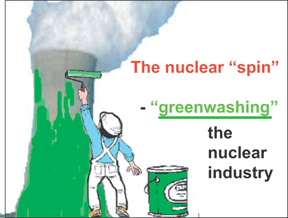 Nuclear faces ‘a lot of uncertainty’ as EU green evaluation looms, By Frédéric Simon https://www.euractiv.com/section/energy-environment/news/nuclear-faces-a-lot-of-uncertainty-as-eu-green-evaluation-looms/ EURACTIV.com 16 Feb 2021 (updated: 17 Feb 2021) The industry is growing increasingly nervous about European Commission plans to evaluate the safety of radioactive waste handling as an expert report is expected next month on how to classify nuclear energy under the EU’s green finance taxonomy.
The European Commission’s in-house research body, the Joint Research Centre (JRC), is putting the finishing touches to a report about the safe handling of radioactive waste that could be fateful for the future of Europe’s nuclear industry.
The report, expected by the end of February or beginning of March, could end up recognising nuclear power as a “transition fuel” under the EU’s green finance rulebook, or on the contrary irreversibly stigmatise it as a polluting form of energy that does “significant harm” to the environment.“The big issue for us with the taxonomy is that it will enable eligible companies to have access to bonds and funds that have a lower interest rate,” said Jessica Johnson, communications director at Foratom, the trade association representing the nuclear industry in Brussels.
“It means that the cost of finance could potentially be lower if they have access to these funds because the amount of interest they will have to pay back is a lot less,” she told journalists during an online press briefing on Wednesday (9 February).
Poland, the Czech Republic and Bulgaria are planning to build new nuclear reactors to decrease their reliance on coal and meet the EU’s climate goals.
But the classification of nuclear under the EU’s green finance taxonomy could have implications on the amount of financial support that governments will be allowed to provide for new projects under the EU’s state aid rules, which are being revised this year.
“We have seen recent consultations on state aid where reference is made to the taxonomy regulation, suggesting that there could be some link there in the future,” Johnson said. “We don’t know what they will do with that”.
Private banks are reluctant to provide loans for new nuclear projects unless governments back them with substantial financial guarantees and state aid. Renewables, by contrast, are cheaper to build and offer much faster delivery timetables and quicker returns – increasingly without state support.
“We see little economic rationale for new nuclear builds in the US or Western Europe, owing to massive cost escalations and renewables cost-competitiveness,” said rating agency S&P in a note released in 2019.
New highly radioactive particles found in Fukushima
|
New highly radioactive particles found in Fukushima https://www.sciencedaily.com/releases/2021/02/210217134852.htm
|
|
|
Is this the end of the road for UK’s Bradwell nuclear project?
|
16 February, 2021, The Blackwater Against New Nuclear Group (BANNG) considers the announcement by BRB, the UK division of China General Nuclear (CGN), that engagement and all active project work on Bradwell B will be paused for at least a year indicates a significant reversal for the project. Despite urging the developer to suspend public engagement during the pandemic, BANNG was told the national need was ‘urgent’ and it was in the public interest that the proposed development ‘is not indefinitely or even substantially delayed’.
‘Now it seems, the project is slowing down and no longer so vital. The indefinite pause makes one wonder if this could be the beginning of the end for a project for which there is no vital need and which will create irretrievable damage and danger to the coastal communities of Essex’, said Prof. Andy Blowers, Chair of BANNG. Until a year ago CGN was claiming it was ramping up its plans for Bradwell B to take pole position in the UK’s civil nuclear programme as other projects fell by the wayside. This acceleration has apparently been impeded by the problem of travel for engineers between the UK and China during the pandemic and the risk that work is being delayed and getting out of sequence. It may be that this is the precipitating cause of the delay but there were already signs that the project was encountering difficulties that could lead to ultimate abandonment. First among these was the massively negative public reaction to the proposals that were revealed on the eve of the first lockdown. People were shocked by the sheer scale of the project and its massive impact on environment, communities and wellbeing. Even the Environment Agency (EA) was scathing in its criticism emphasising the contrast between the plan’s economic ambitions and the inadequate ambition for the environment and lack of detailed information given by the developer. In the last few weeks the EA has produced a cautious assessment of the reactors planned for Bradwell indicating there are a number of issues to be resolved before the project gets design approval. On top of this came the loss of political support. Initially, all the main local authorities welcomed the power station for the potential jobs and wealth it would bring but making clear support was contingent on environmental protection and improvement. First Colchester Borough and then Maldon District, which had been a major protagonist for Bradwell B, declared total opposition to the proposals. Maldon went further, turning down BRB’s planning application for land investigations at the site. The company has appealed but the long delay by the planning inspector in determining the appeal suggests there may be problems with environmental impacts. Elsewhere, the nuclear industry is running into trouble. The recent decision by the infrastructure planning inspectorate to recommend refusal of planning for the Wylfa project in North Wales on environmental grounds bodes ill for both Sizewell and Bradwell where environmental sensitivities are at least as strong. The threat to the iconic Colchester Native Oyster and Brent Geese are among the many environmental impacts posed by Bradwell B. The potential suitability of the Bradwell site has long been contested by BANNG and it is currently under review by the Government. Recent climate change predictions indicate that the site could be overwhelmed by sea-level rise and storm surges before the end of this century and well before the site could be cleared of spent fuel and other highly radioactive wastes during the next century. And the Government’s support for nuclear power as set out in its Energy White Paper is hardly evangelical: the Government ‘will remain open to other projects if the nuclear industry demonstrates that it is able to reduce costs and deliver to time and budget’. On Bradwell B specifically the White Paper is silent. Lastly, in the geopolitical sphere, there are serious concerns about security risks in inviting Chinese participation in the development of the UK’s critical infrastructure. It is quite possible, some would say likely, that the project will be withdrawn as part of the fall out in deteriorating Chinese and UK relations. Andy Blowers commented: ‘Taking all these issues together, it is quite possible that the pause will provide the prelude to final abandonment of the project. Covid-19 may be the final straw. For far too long this black cloud has been hanging over the Blackwater. At last there are signs of a silver lining’. |
|
EPA awards $220 million for uranium mine cleanup on Navajo Nation
WASHINGTON — The Environmental Protection Agency said Thursday it will award contracts worth up to $220 million to three companies for the cleanup of some of the hundreds of abandoned uranium mines on the Navajo Nation.
Work could start later this year following the completion of assessments for mining sites coordinated between the EPA and the Navajo Nation’s environmental agency, the federal agency said.
This week’s announcement is just the latest in years of efforts to clean up the mines, the toxic legacy of Cold War mining in the region. More than 30 million tons of uranium ore were mined in the region, according to the EPA, which said more than 500 mines were ultimately abandoned.
“From World War II until the end of the Cold War, millions of tons of uranium were mined on Navajo lands, exposing mine workers and their families to deadly radiation,” said Rep. Tom O’Halleran, D-Sedona, whose district includes the Arizona portion of the Navajo Nation.
“As a result, high rates of cancer, birth defects, and contaminated water sources remain a reality for residents of the Navajo Nation even now,” O’Halleran said in a statement on the contracts.
The agency said it worked closely with Navajo Nation to develop contracts that would incentivize the creation of employment opportunities for Navajo residents in order to build local economic and institutional capacity.
The majority of funding for the contracts comes from a nearly $1 billion settlement made in 2015 with Kerr McGee Corp. for the cleanup of more than 50 mines in Nevada and on the Navajo Nation that the company and its successor, tronox, were responsible for.
From the late 1940s through the 1960s, Kerr-McGee mined more than 7 million tons of ore on or near the Navajo Nation, leaving behind uranium mine sites that included contaminated waste rock piles. Exposure to uranium in soil, dust, air, and groundwater, as well as through rock piles and structural materials used for building can pose risks to human health, according to the EPA
Mining stopped for the most part decades ago, and the Navajo Nation banned uranium mining on its lands in 2005. But the cleanup effort has lingered. The EPA launched five-year programs in 2007 and 2014 to study the issue and identify the biggest risks, and the agency last year added abandoned Navajo uranium mines to its list of Superfund sites “targeted for immediate, intense action.”……. https://www.12news.com/article/news/local/arizona/epa-awards-220-million-for-uranium-mine-cleanup-on-navajo-nation/75-154a0fae-53e3-477d-a5ce-0a678d97d
Japan town mayor OKs restarting nuclear reactor over 40 years old
|
Japan town mayor OKs restarting nuclear reactor over 40 years old
February 16, 2021 (Mainichi Japan) TSURUGA, Fukui — The mayor of a central Japan town hosting a nuclear power plant operated by Kansai Electric Power Co. informed the speaker of the municipal assembly on Feb. 15 that he would approve the restart of a reactor at the plant that is more than 40 years old. Mayor Hideki Toshima of the Fukui Prefecture town of Mihama told Mihama Municipal Assembly Speaker Yoshihiro Takenaka that he would approve the restart of the No. 3 reactor at Mihama Nuclear Power Station, which began operating in the 1970s. The assembly had already approved the reactivation of the aging reactor. Meanwhile, Mayor Yutaka Nose of the prefectural town of Takahama, home to Kansai Electric’s Takahama Nuclear Power Station, whose No. 1 and 2 reactors are also over 40 years old, has given the green light for resuming the operations of the two rectors, while the Takahama Municipal Assembly has also approved of the move. Now that local consent has been secured, the focus has shifted to the decisions expected from Gov. Tatsuji Sugimoto and the prefectural assembly………. As a general rule, a nuclear power plant operator is expected to obtain consent for restarting a rector from the local governments around the plant as well as local assemblies. As a condition for approving the restart, the Fukui Prefectural Government said Kansai Electric would need to present candidate sites outside the prefecture for interim spent nuclear fuel storage facilities. The prefectural government maintained that until that condition was achieved, the parties were “not even at the starting line of discussion.” However, after Kansai Electric proposed on Feb. 12 that it would finalize a planned site for the storage facilities by the end of 2023, the prefectural government demonstrated a positive attitude toward reactivation. Discussion on restarting the aging reactor may develop further at the prefectural assembly session convening on Feb. 16. (Japanese original by Hidetoshi Oshima, Tsuruga Resident Bureau) https://mainichi.jp/english/articles/20210216/p2a/00m/0na/008000c |
|
1 This Month

of the week – Shut Down Drone Warfare!


Tell the Ukrainian Government to Drop Prosecution of Peace Activist Yurii Sheliazhenko

Petition to revoke the licensing of the Near Surface Nuclear Disposal Facility (NSDF) at Chalk River. https://www.ourcommons.ca/petitions/en/Petition/Details?Petition=e-7247
To see nuclear-related stories in greater depth and intensity – go to https://nuclearinformation.wordpress.com
-
Archives
- March 2026 (230)
- February 2026 (268)
- January 2026 (308)
- December 2025 (358)
- November 2025 (359)
- October 2025 (376)
- September 2025 (257)
- August 2025 (319)
- July 2025 (230)
- June 2025 (348)
- May 2025 (261)
- April 2025 (305)
-
Categories
- 1
- 1 NUCLEAR ISSUES
- business and costs
- climate change
- culture and arts
- ENERGY
- environment
- health
- history
- indigenous issues
- Legal
- marketing of nuclear
- media
- opposition to nuclear
- PERSONAL STORIES
- politics
- politics international
- Religion and ethics
- safety
- secrets,lies and civil liberties
- spinbuster
- technology
- Uranium
- wastes
- weapons and war
- Women
- 2 WORLD
- ACTION
- AFRICA
- Atrocities
- AUSTRALIA
- Christina's notes
- Christina's themes
- culture and arts
- Events
- Fuk 2022
- Fuk 2023
- Fukushima 2017
- Fukushima 2018
- fukushima 2019
- Fukushima 2020
- Fukushima 2021
- general
- global warming
- Humour (God we need it)
- Nuclear
- RARE EARTHS
- Reference
- resources – print
- Resources -audiovicual
- Weekly Newsletter
- World
- World Nuclear
- YouTube
-
RSS
Entries RSS
Comments RSS
 nuclear-news