Leak at a Nuclear Power Plant concern after Japanese Earthquake, eturbo news, Juergen T Steinmetz, February 13, 2021
- Strong Earthquake in Japan 10 years after the devastating tsunami in 2011
- 7.3 strong, the earthquake reports little damage
- A leak in a nuclear plant and widespread power outage are initial concerns
The 7.3 magnitude quake which hit near Fukushima on Saturday night 11.04 pm local time hit off of Fukushima just weeks before the 10th anniversary of a quake on March 11, 2011 that devastated northeast Japan…………
, most concerning are reports of a leak at Fukushima Daini Nuclear Power plant, according to public broadcaster NHK – though this has been denied by the facility owners.
Pool water used for storing spent nuclear fuel may have leaked and contaminated the surrounding area, the outlet said.
However, reports also suggest the risk to workers and the surrounding area is low as the level of radiation is not an extreme risk………. https://eturbonews.com/2899572/leak-at-a-nuclear-power-plant-concern-after-japanese-earthquake/
February 15, 2021
Posted by Christina Macpherson |
Fukushima continuing |
Leave a comment
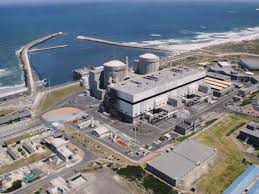
Koeberg has suffered substantial damage, according to Koeberg Alert Alliance. (with audio) https://www.capetalk.co.za/articles/408514/koeberg-nuclear-power-station-radioactivity-containment-building-is-severely-damaged?fbclid=IwAR1HSyt2Tw6lrsbwJxlEQW5m4i4YT18_Hl0MgVzEQV0f24h31btTVN150g4 Eskom says the containment building is ‘leak-tight’.
RELATED: We’ll extend Koeberg lifespan from 40 to 60 years. It’ll be safe – Eskom
Koeberg Nuclear Power Station has suffered substantial damage to its containment building, according to Koeberg Alert Alliance (KAA).
The containment building is designed to contain the escape of radioactive steam or gas in an emergency.
A nuclear accident at Koeberg will have devastating consequences for hundreds of thousands of people who live close nearby.
Eskom says it is aware of “deterioration” and that it is managing the issue by implementing a modification.
Like all other nuclear power plants around the world, we do get deterioration… We’re managing this issue… Recent tests show… It’s leak-tight. The building works…
Riedewaan Bakardien, Chief Nuclear Officer – Eskom
Sea air has severely damaged the concrete structure, highlighting the significant risk the facility poses to nearby residents, according to KAA.
A concerned insider at Koeberg brought the alarming structural problems to the attention of KAA.
The insider informed KAA of a crack so large it goes right around the entire 110-metre circumference of the containment dome.
The community group says it is struggling to access information from Eskom about the damaged containment dome.
KAA claims that a 31-page Eskom report (about the damage), has eleven pages entirely blacked out while various other sections, photos and tables were censored because, claims Eskom, it contained “sensitive technical information”.
Lester Kiewit interviewed Peter Becker, a spokesperson for KAA.
The salt in the sea air… has caused accelerated rust in the rebar in the concrete of the containment structures… which caused cracking… About 10% of the surface of the containment building has delaminated [split into layers] …
Peter Becker, spokesperson – Koeberg Alert Alliance
Eskom blacked out about half of the report before releasing it to us…
Peter Becker, spokesperson – Koeberg Alert Alliance
Eskom is surprised by the speed at which it’s deteriorating… Koeberg was not well constructed, and the effect of sea-air was not well understood.
Peter Becker, spokesperson – Koeberg Alert Alliance
Koeberg is far too close to densely populated areas. If they tried to get approval to build it in that location today, it would be refused…
Peter Becker, spokesperson – Koeberg Alert Alliance
Koeberg was designed to last for 40 years… We get to that in 2024… but Eskom wants to keep it going. It’s a really bad idea…
Peter Becker, spokesperson – Koeberg Alert AllianceThis problem will remain. We’re implementing a modification… which will retard the deterioration.
Riedewaan Bakardien, Chief Nuclear Officer – Eskom
It’s the building around the reactor. Yes, there is corrosion… We’re well aware of it…
Riedewaan Bakardien, Chief Nuclear Officer – Eskom
February 15, 2021
Posted by Christina Macpherson |
safety, South Africa |
Leave a comment
 FUKUSHIMA 2021, International Uranium Film Festival
March 11, 2021. Ten Years Fukushima Nuclear Disaster: Rio de Janeiro International Uranium Film Festival Free Online Screening and Debate.
The first International Uranium Film Festival event 2021 is scheduled for Thursday, March 11, to remember the ongoing Fukushima nuclear disaster. A free seven day online screening in cooperation with the Cinematheque of Rio de Janeiro’s Modern Art Museum (MAM Rio)(link is external). We will show two awarded documentary movies about the Fukushima nuclear accident: a poetic short film by photographer Alessandro Tesei and a feature documentary by science journalist Ranga Yogeshwar. The films can be watched online from March 11 to March 17.
After the screening the audience can chat with Fukushima expert, Professor Dr. Alphonse Kelecom from the Laboratory of Radiobiology and Radiometry of the Institute of Biology at Universidade Federal Fluminense, Rio de Janeiro. Since March 2011, Kelecom visited several times Fukushima. Of course non portuguese speakers are also invited. Prof. Alphonse Kelecom speaks Portuguese, English and French as well. Moderator is Márcia Gomes de Oliveira, director of the International Uranium Film Festival who visited Fukushima in 2015 by invitation of Peace Boat Foundation.
About the films: ………. more https://uraniumfilmfestival.org/en/fukushima-2021
February 15, 2021
Posted by Christina Macpherson |
ACTION |
Leave a comment
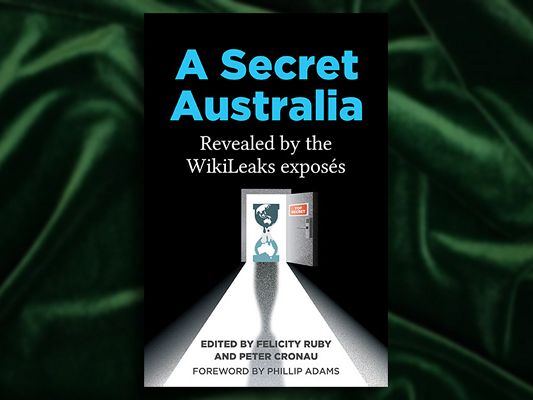
What Assange and WikiLeaks said about Australia, https://www.smh.com.au/culture/books/what-assange-and-wikileaks-said-about-australia-20210129-p56xyo.html, By Jessie Tu, February 4, 2021 He has been called “truth-telling hero”, “evil and perverted traitor”, “heroic, trickster, mythical – reviled”. Robert Manne called him the “most consequential Australian of the present time”. The new US President has called him a “high-tech terrorist”.
The protean narratives of Julian Assange, who will be 50 in July, have been brewing since 2010, when his website published “The Afghan War Diaries”, “Iraq War Logs” and “Collateral Murder”, a video showing the US military killing two Reuters employees in Iraq.
December marked 10 years since Assange has been “arbitrarily detained” in Britain, according to Felicity Ruby and Peter Cronau in their introduction to A Secret Australia – a collection of 18 essays that survey the impact WikiLeaks has had on Australia’s media landscape and the consequences of our government’s attraction towards America’s intelligence and military empire.
The potpourri of authors and thinkers includes Julian Burnside, Antony Loewenstein, Scott Ludlam and Helen Razer, who critique “the powers opposed to openness and transparency” and examine the evidence, “not the likelihoods, the probabilities, the suspicions, and assumptions” around the “subversive, technology-based publishing house”.
WikiLeaks invented a “pioneering model of journalism” – one that embodied the “contemporary spirit of resistance to imperial power”, says Richard Tanter, from the school of political and social sciences at the University of Melbourne. It brought renewed debates on free speech, digital encryption and questions around the management and protection of whistleblowers who risk their lives to expose covert, deceitful actions by governments.
The documents exposed the “brazen duplicity” of the Australian government towards its citizens and presented “off-stage alliance management conversations”, Tanter writes. They invited the layperson into the green room of the performance that is politics and international diplomacy.
WikiLeaks unmasked reports that showed governments recommending media strategies to deceive the public, demonstrating their unethically utilitarian approach to international diplomacy and governance and “enlightened the public on the dark corners of wars”, writes journalist and author Antony Loewenstein.
Assange is still in a cell at London’s Belmarsh Prison, facing an appeal by the United States in its bid to extradite him to face charges for the 2010 publications. He is continuing to be “denied adequate medical care” and “denied emergency bail in light of the COVID-19″, says Lissa Johnson, a clinical psychologist and writer for New Matilda – one of the few Australian publications that have paid genuine attention to the WikiLeaks saga.
In Australia, there’s been a “striking absence of a solid debate on WikiLeaks in the mainstream public discourse”, according to Benedetta Brevini, a journalist and media activist who insists that our concerning “lack of a thorough and sustained debate” is incomprehensible. Loewenstein calls Australia’s lack of journalistic solidarity with Assange “deeply shameful”. He says we have an “anodyne media environment” – perhaps not unsurprising, considering our highly concentrated media market, one of the most severe in the world.
Most of the essays expostulate on the same things: Assange is a journalist, not a hacker. He’s won a Walkley Award (at least six mentions of this). We have an undeniable legal obligation to him. His persecution is a “gruesome legal experiment in criminalising journalism” – a long and tortured legal process that Ludlam declares “has degenerated into an unworkable shit-show”.
The standout essays come from Guy Rundle and Helen Razer – whose amusing voice cuts through the somewhat parched tenor of cold academic-speak that lightly threads through the other essays. Her addition is a breath of fresh air in the middle of a chain of same-same arguments.
The most useful essay is Rundle’s take on the historical basis for WikiLeaks. He surveys the swirling currents of Australian history that led to its founding, identifying WikiLeaks as a continuation of political activist Albert Langer’s resistance to capital.
“We need a whole new organisation of how recent Australian history is told,” Rundle concludes, seconding Lissa Johnson’s opinion that we demand citizens who “cut across the acquiescence and consent, remove the deadbolt on the torture chamber door, turn down the music and expose what is going on inside”. This collection of polemics, though at times repetitive, takes us closer to a future where these demands no longer seem beyond reality.
A Secret Australia: Revealed by the WikiLeaks Exposes
Eds., Felicity Ruby & Peter Cronau, Monash University Publishing, $29.95
February 15, 2021
Posted by Christina Macpherson |
AUSTRALIA, media, politics international, secrets,lies and civil liberties |
Leave a comment
 Sabine von Törne 14 Feb 21,
 What happens to Wikileaks founder and publisher
#JulianAssange who remains unlawfully imprisoned at High Security Prison Belmarsh for exposing US war crimes and corruption of powerful elites matters to all of us.
Yesterday, on 12th of February 2021, the Biden administration submitted an appeal against Magistrate Baraitser’s decision to refuse extradition to the U.S. on humanitarian grounds.
This struggle is far from over.
#TheWorldIsWatching with our eyes on
#London. We must speak up for Julian’s human rights, for press freedom, free speech, the public’s right to know what those who govern us are up to in our name and thereby for the most basic principles of democracy. Keep fighting. We can win this.
#FreeJulianAssange
February 15, 2021
Posted by Christina Macpherson |
general |
Leave a comment
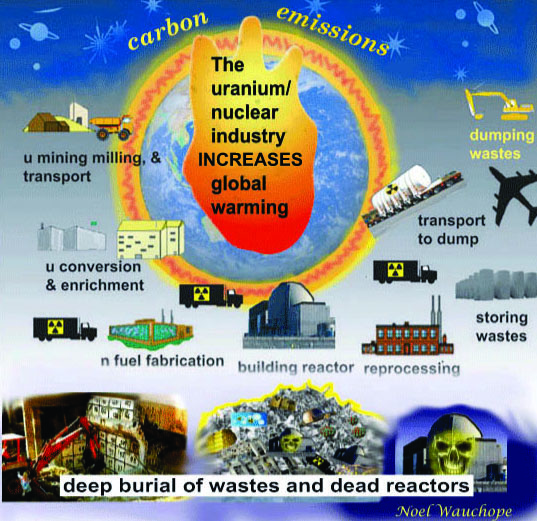
Radioactive carbon 14 is released up the stack; however, this is not a source of concern here. (Solely in consideration of carbon release as it is minuscule.) The planet doesn’t care where CO2 emissions originate. The warming effect is the same regardless of geographic origin.
There are CO2 releases throughout the nuclear fuel cycle. Mining, milling, fuel fabrication, fuel transportation, and fuel enrichment all pump CO2 into the atmosphere. Fuel enrichment for US plants (Roughly 90% of it.) is primarily done in former Soviet Union countries using coal as the prime energy source. One not so obvious source of CO2 emissions is a simple fact: Millstone runs off of the grid. The grid is not zero carbon.
Additionally, it takes people, lots of people to operate the plants,–all driving-emitting CO2- in and out of the plant. One day, I stood outside the plant’s gates and asked drivers their estimates of how many vehicles went in and out of the plant each day. The average reply was about 1500 vehicle trips, with more during refueling. Millstone zero-carbon- I don’t think so.
P.S. Will a reporter please ask Dominion Nuclear Connecticut LLC, Inc. for a copy of its electric bill and post it here.
February 15, 2021
Posted by Christina Macpherson |
climate change |
Leave a comment
The New Arab 12th Feb 2021, President Emmanuel Macron’s recent statement that a “memories and truth” commission will be established to look into the history of the French colonisation of Algeria, has led to much public discussion over this bloody legacy.
And in this context, the absence of apologies or offers of reparations by the French state has not gone unnoticed. One area of particular contention in this process is the ongoing and detrimental effects of France’s nuclear testing in Algeria, conducted throughout the
1960s. France conducted its first nuclear test known as the “Gerboise Bleue” in February 1960 in the Sahara Desert – an atomic bomb that was four times the strength of Hiroshima. A total of 17 tests were carried out, four of them atmospheric detonations, and 13 underground.
https://english.alaraby.co.uk/english/comment/2021/2/12/frances-nuclear-colonial-legacy-in-algeria
February 15, 2021
Posted by Christina Macpherson |
AFRICA, Religion and ethics, secrets,lies and civil liberties, wastes, weapons and war |
Leave a comment




 nuclear-news