This week: Not a lot happening in nuclear news, while coronavirus and climate change rage on.
It is getting harder to keep up with the coronavirus news – the fluctuating numbers regarding new cases, the comparisons between various vaccines, the good news (Israel’s success), the bad news (new more infectious strains).
Then there’s the new preoccupation in the media about big sporting events. In USA the Superbowl could turn into a super-spreader. The Australian Open Grand Slam tennis is watched anxiously, as an indication of whether the July Tokyo Olympics could safely go ahead.
Meanwhile it’s becoming clear that this pandemic is not going to be over quickly, that the vaccines are not a ”silver bullet’‘, and it is truly a global problem, needing global treatment.
CLIMATE. We are all too often focussing on USA, Canada, Australia, in news coverage. This week, a horror event in India brings home the impacts of global heating elsewhere in the world. Indian Glacier in Himalayan Valley Crumbles, Causing Flash Flooding. Himalayan glaciers melting at alarming speed.
RENEWABLE ENERGY. I muse that these industries are also becoming corporate giants, encouraging endless energy use, and overconsumption of new technologies, with little care about their toxic wastes. Whatever happened to energy conservation?
Largely due to the pandemic, nuclear developments have gone very quiet – I guess that’s one compensation. https://www.youtube.com/watch?v=6gWXFcFfN7E&t=55s https://www.youtube.com/watch?v=4XIW9hHTHnU
A bit of good news – Good news on ozone: world scientists make global assessment 5 February 2021.
Nuclear power unaffordable in USA, Russia, India, France, even China, but NO SOLUTION TO WASTES.
USA and Russia extend The New Strategic Arms Reduction Treaty (New START Treaty) to 2026.
Bees may be more susceptible to ionising radiation than previously estimated.
As outdated nuclear power closes down, pro nuclear shills viciously attack critics.
USA.
- How the nuclear industry will try to avoid decommissioning costs. America’s ”fleet” of dangerously embrittled nuclear reactors. NextEra Energy wants to avoid shutdown costs, extend license for old Point Beach Nuclear Plant..
- Although Biden is pro-nuclear, there’s a chance that the new Nuclear Regulatory Commission might get out of bed with the nuclear lobby.
- Two Ohio state Republican Senators aim to remove subsidies to nuclear power plants. The complicated politics of removing nuclear subsidies: the crooked Ohio legislation.
- Rapacious nuclear company Holtec: its dodgy record on safety, finance and lack of transparency.
- Radiation illnesses and COVID-19 in the Navajo Nation.
- America’s new strategy for space nuclear power pays little consideration to safety aspects.
- How to Support the Treaty on the Prohibition of Nuclear Weapons Without Signing It.
- USA ramps up production of nuclear bomb cores.
CANADA. Canadian local community group opposes nuclear waste dump on farming land.
IRAN. Zarif: compensation not pre-condition for reviving Iran nuclear deal.
CUBA. Cuba signs up to another nuclear disarmament treaty.
EUROPE. Increasing business and jobs in closing down Europe’s nuclear reactors, as renewable energy grows/ New Chernobyls on Europe’s doorstep?
JAPAN. In desperate economic plight, two Japanese towns willing to host nuclear waste dump. Kepco seeks prefectural government approval to restart aging nuclear reactors. Japan’s huge radioactive waste problem. Research into radiocesium in forests after the Fukushima disaster: Concerns and some hope.
UK. UK’s Infrastructure Planning Inspectorate recommends against development of Wyfa nuclear project. Pandemic causes Britain’s Trident nuclear submarine replacement to be delayed by another year. Aviva Investors doubtful about backing Sizewell nuclear power station.
SPAIN. Why Spain plans to ban uranium mining.
FRANCE . Unusually damaging Mw 4.9 earthquake near several French nuclear reactors. Unprecedented number of France’s nuclear reactors to go offline, and strikes continue. The dangers and uncertainties in Andra’s radioactive waste disposal project in Bure (Meuse)
SOUTH AFRICA. South Africa’s new nuclear power plan would be a costly mistake
AUSTRALIA. Kimba Nuclear Waste Dump Bill yet again postponed in the Australian Senate. High Court ruling a helpful precedent for opponents of Kimba nuclear dump. Meanwhile South Australia achieved world-leading 60pct wind and solar share over last year.
Nuclear reactors, big or small, useless to combat climate change, because of slowness to develop.
Just under 15 minutes on how nuclear power — far from presenting a “solution” — has actually contributed to climate change.
In 1952 the US government was advised to go solar. Instead, we got “Atoms for Peace”.
If the solar recommendation had been taken, and we had chosen the solar instead of the nuclear path, we might not have had climate change at all.
But solar had no military utility, while nuclear reactors made an important “by-product”: plutonium. This is a pre-recorded version of a talk Inrecently gave for Helensburgh, Scotland CND’s Beyond Nuclear conference.
Not in this video is a section I added during the conference presentation about how nuclear power still gets in the way of much needed and urgent nrenewable energy and energy efficiency development. This is well laid out by Amory Lovins who notes that, to protect the climate, we must save the most carbon at the least cost and in the least time.
 Since nuclear power isthe most expensive way to generate a megawatt hour of electricity, and
plants take years to build, it is out of the running even before evaluating its carbon footprint. As Lovins points out, costly options save less carbon per dollar than cheaper options. Slow options save less carbon per year than faster options. So in the case of nuclear power, whether it is “low carbon” or not instantly becomes irrelevant because it is already useless
for climate change due to its cost and slowness.
https://www.youtube.com/watch?app=desktop&v=6gWXFcFfN7E&feature=youtu.be
How to Support the Treaty on the Prohibition of Nuclear Weapons Without Signing It
 How to Support the Treaty on the Prohibition How to Support the Treaty on the Prohibition of Nuclear Weapons Without Signing It Lawfare By Jayita Sarkar, February 7, 2021, Editor’s Note: The Treaty on the Prohibition of Nuclear Weapons (TPNW), which outlaws nuclear weapons, entered force just after Biden’s inauguration. Although the Biden administration is highly unlikely to adhere to it directly, can it take smaller steps in line with the TPNW’s goals? Boston University’s Jayita Sarkar outlines a series of measures the administration could take, such as providing assistance to victims of radiation, that would advance the TPNW’s agenda but do not require complete adherence. – Daniel Byman of Nuclear Weapons Without Signing It Lawfare By Jayita Sarkar, February 7, 2021, Editor’s Note: The Treaty on the Prohibition of Nuclear Weapons (TPNW), which outlaws nuclear weapons, entered force just after Biden’s inauguration. Although the Biden administration is highly unlikely to adhere to it directly, can it take smaller steps in line with the TPNW’s goals? Boston University’s Jayita Sarkar outlines a series of measures the administration could take, such as providing assistance to victims of radiation, that would advance the TPNW’s agenda but do not require complete adherence. – Daniel Byman
……….. How will the Biden administration respond now that it is international law? In recent weeks, former policymakers, including former Secretary of Defense William Perry and former Undersecretary of State for International Security and Nonproliferation Thomas Countryman, have called for the Biden administration to adopt a supportive position on the TPNW. Critics of the treaty, such as then-U.S. Ambassador to the United Nations Nikki Haley, have called for proactive opposition, or at least benign neglect. But perhaps there is a third option that the administration could consider: the middle ground of selective support. …………… When the world is viewed solely through the prism of nuclear deterrence, the TPNW seems unrealistic and its supporters appear as impractical idealists. The TPNW, though, was developed from the approach that foregrounds the “humanitarian consequences” of nuclear weapons. This approach encompasses much more than the notion of a fragile balance of power maintained by nuclear weapons. Much of the treaty is about the effects of nuclear weapons and nuclear explosive devices on the human body. The Biden administration can show its selective support on this issue, breaking with the policy of the past two U.S. administrations. The United States is responsible for the atomic bombings of Hiroshima and Nagasaki in August 1945 and for 1,032 nuclear weapons tests that took place between 1945 and 1992. The majority of the tests were conducted in New Mexico, Nevada, Alaska, and the Pacific Ocean. Article 6 of the TPNW, entitled “Victim assistance and environmental remediation,” calls on state parties to “adequately provide age- and gender-sensitive assistance, without discrimination, including medical care, rehabilitation and psychological support, as well as provide []social and economic inclusion” to those affected by nuclear weapons and nuclear explosive devices. Providing assistance to victims of radiation in the United States has been a slow, arduous and incomplete process. The Radiation Exposure Compensation Act (RECA) was passed only in October 1990 and expanded in 2000. Administered by the U.S. Department of Justice, RECA provides one-time benefits payments to those who have developed cancers and specified diseases as a consequence of radiation exposure caused by nuclear weapons testing and uranium mining, milling or transporting. RECA has provided $2.4 billion in benefits to more than 37,000 claimants since 1990 but is expected to sunset in July 2022. RECA itself has several limitations. First, it has a narrow definition of “downwinders”—the individuals living downwind of the Nevada Test Site who are eligible for compensation. Downwinder-eligibility requires individuals to have a diagnosis of a compensable disease caused by radiation exposure and proof of residence in selected counties of Arizona, Nevada, and Utah during the period of atmospheric testing at the Nevada Test Site. Second, RECA denies compensation to victims of uranium mining after 1971, when the U.S. Atomic Energy Commission’s mining activities were transferred to commercial firms. The 2020 Democratic Party platform explicitly called for increasing victim assistance under RECA. More broadly, the platform also pledged the party to “pursuing environmental justice and climate justice, including for Indigenous peoples and communities.” Given that the majority of downwinders and uranium miners are from Indigenous communities in the United States, the Democratic Party’s commitment to “protecting Native American health” is compatible with the humanitarian consequences approach to nuclear weapons. Moreover, for the first time in its history, the Department of the Interior, the federal agency responsible for appropriation of Indigenous lands since the 19th century westward expansion, will have a Native American head—Rep. Deb Haaland, an enrolled citizen of the Pueblo of Laguna. Haaland and her fellow Democrats from New Mexico have been proactive in pushing for legislation to expand radiation compensation. In other words, the Biden administration has already promised to act on the humanitarian consequences of nuclear testing in the United States. If the administration delivers on its promise, it would be addressing commitments covered in Article 6 of the TPNW, even without signing the treaty. The TPNW is a multilateral treaty, which requires policy harmonization through domestic legislation to be implemented. RECA offers preexisting legal infrastructure on which the Biden administration can build and, with its inclusion of uranium mining, even corrects a major weakness of the TPNW, which focuses solely on victims of nuclear weapons and nuclear explosive devices. To be sure, promoting an expanded RECA as evidence of U.S. selective support for the TPNW would require diplomatic finesse at the United Nations. But, if backed by political will, the State Department under Secretary of State Antony Blinken, Deputy Secretary of State-designee Wendy Sherman, and Undersecretary-designee for Arms Control and International Security Affairs Bonnie Jenkins will have the wherewithal for it. Selective U.S. support to the TPNW would be an unusual approach toward a new treaty, but it would not be unprecedented………… By selectively supporting the TPNW through Article 6 commitments while not acceding to it, the Biden administration can be at the forefront of an anti-racist global nuclear agenda. It can promote the U.S. image abroad, which has been tarnished by the Trump administration’s four years of isolationist “America First” rhetoric. It could also win support at home. According to a 2020 poll by the Chicago Council on Global Affairs, 66 percent of Americans want a world without nuclear weapons. The present moment offers the promise of unprecedented change in global nuclear politics. When the 10th NPT Review Conference takes place in New York in August 2021 (postponed from 2020), it will be the first time in the history of the nuclear age that there will be another nuclear treaty demanding attention and action. The Biden administration could seize the day and make history. https://www.lawfareblog.com/how-support-treaty-prohibition-nuclear-weapons-without-signing-it |
|
Planning inspectors recommended against Wylfa Newydd project on Anglesey

Planning inspectors recommended refusal for new nuclear power plant, Nation Cymru Gareth Williams, local democracy reporter
Plans to build a new nuclear power station were likely to be refused even before the project was shelved by backers.
UK Government appointed planning inspectors had recommended that the Wylfa Newydd project on Anglesey be rejected over a number of concerns from experts.
The application has since been withdrawn after Hitachi, the company behind the project, decided that the power plant was too expensive to build without a funding deal with the UK Government in place.
Energy company Horizon – a subsidiary of Hitatchi – needed an Approval of the Development Consent Order (DCO) to allow the £16bn project to go ahead.
DCOs are needed for any planning application regarded as a major UK infrastructure project and DCO process for Wylfa Newydd had been underway since 2018.
The Planning Inspectorate’s conclusion, which was made public for the first time on Thursday, was intended to be considered as a recommendation – with the final decision down to the UK Government.
But expert planning officers felt that the scheme would fail to meet some of the United Nations’ biological diversity standards.
Inspectors also told UK Government ministers it had concerns over the project’s impact on the local economy, housing stock and the Welsh language…..
The findings of the planning inspectors’ report, which were made public for the first time on Thursday, said there was a lack of scientific evidence put forward by developers to demonstrate that the Arctic and Sandwich tern populations around the Cemlyn Bay area, where the plant was set to be built, would not be disturbed by construction.
There were fears that these birds would subsequently abandon nearby Cemlyn Bay as a result.
It also raised wider concerns over the general impact on Cemlyn Bay, the Cae Gwyn site of special scientific interest and Tre’r Gof……..
It went on to conclude: “Having regard to all the matters referred in this report, the ExA’s conclusion is that, on balance, the matters weighing against the proposed development outweigh the matters weighing in favour of it.
“The ExA therefore finds the case for development is not made and it recommends accordingly.”
‘Pulling the plug’
Before pulling the plug on the DCO application last month, Hitachi confirmed that talks had been taking place with potential new investors. But with no concrete offer forthcoming, Hitachi announced it would wind up its Horizon Nuclear Power subsidiary by March 2021……… https://nation.cymru/news/planning-inspectors-recommended-refusal-for-new-nuclear-power-plant/
Daily Post 5th Feb 2021, The UK’s Planning Inspectorate has released its report into Wylfa Newydd –
showing they had recommended refusal over biodiversity issues.
USA ramps up production of nuclear bomb cores
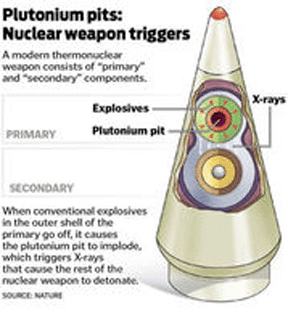 The U.S. is Boosting Production of Nuclear Bomb Cores (For More Nuclear Weapons), The National Interest. Thanks, arms race. by Michael Peck, 7 Feb 21, In another sign that the nuclear arms race is heating up, the U.S. is ramping up production of nuclear bomb cores. The National Nuclear Security Administration (NNSA) has announced that it plans to increase the production of plutonium pits to 80 per year. The grapefruit-sized pits contain the fissile material that give nuclear weapons such tremendous power. The U.S. is Boosting Production of Nuclear Bomb Cores (For More Nuclear Weapons), The National Interest. Thanks, arms race. by Michael Peck, 7 Feb 21, In another sign that the nuclear arms race is heating up, the U.S. is ramping up production of nuclear bomb cores. The National Nuclear Security Administration (NNSA) has announced that it plans to increase the production of plutonium pits to 80 per year. The grapefruit-sized pits contain the fissile material that give nuclear weapons such tremendous power.
Production will center on the Mixed-Oxide Fuel Fabrication Facility at Savannah River site in North Carolina, which would be modified to manufacture at least 50 pits per year, and Los Alamos National Laboratory in New Mexico, which would generate at least 30, by 2030. America’s nuclear weapons cores are aging, with some pits dating back to the 1970s, leading to concerns about the reliability of the U.S. nuclear stockpile……… In its 2018 Nuclear Policy Review, the Trump administration called for 80 new plutonium pits per year. Congress has also allocated large sums, with $4.7 billion alone allocated in FY 2019 for maintenance and life extension of the nuclear stockpile. The NNSA says it is legally mandated to ensure a capacity of at least 80 pits per year. ……. Anti-nuclear groups are furious. “Expanded pit production will cost at least $43 billion over the next 30 years,” argues the Natural Resources Defense Council and other groups. Yet the Defense Department and NNSA have never explained why expanded plutonium pit production is necessary. More than 15,000 plutonium pits are stored at NNSA’s Pantex Plant near Amarillo, Texas. Independent experts have concluded that plutonium pits have reliable lifetimes of at least 100 years (the average pit age is less than 40 years). Crucially, there is no pit production scheduled to maintain the safety and reliability of the existing nuclear weapons stockpile. Instead, proposed future pit production is for speculative new-design nuclear weapons, but those designs have been canceled.” Introducing a new generation of nuclear weapons “could adversely impact national security because newly produced plutonium pits cannot be full-scale tested without violating the global nuclear weapons testing moratorium.” Michael Peck is a contributing writer for the National Interest. He can be found on Twitter and Facebook. https://nationalinterest.org/blog/reboot/us-boosting-production-nuclear-bomb-cores-more-nuclear-weapons-177825 |
|
The dangers and uncertainties in Andra’s radioactive waste disposal project in Bure (Meuse)
 Le Monde 5th Jan 2021, Environmentalists and unionists combine against the radioactive waste landfill project in Bure (Meuse). In a forum at the ”World”, they stated their concern at the dangers and uncertainties of the project. Their opinion is bolstered by a recent statement issued on January 13 by the Environmental Austhority, which stressed the uncertainties surrouding the waste disposal plan.
Vigorous opposition has never ceased to alert the public, since 1987, to the immense risks of the geological disposal of radioactive waste. The opinion of the Environmental Authority corroborates what thousands of citizens, elected officials and independent scientists have been denouncing for years, without being truly heard.
1 This Month
Chernobyl: The Lost Tapes – A good documentary on Chernobyl on SBS available On Demand for the next 3 weeks– https://www.sbs.com.au/ondemand/tv-program/chernobyl-the-lost-tapes/2352741955560

of the week–London Campaign for Nuclear Disarmament

Tell the Ukrainian Government to Drop Prosecution of Peace Activist Yurii Sheliazhenko
To see nuclear-related stories in greater depth and intensity – go to https://nuclearinformation.wordpress.com
-
Archives
- April 2026 (139)
- March 2026 (251)
- February 2026 (268)
- January 2026 (308)
- December 2025 (358)
- November 2025 (359)
- October 2025 (376)
- September 2025 (257)
- August 2025 (319)
- July 2025 (230)
- June 2025 (348)
- May 2025 (261)
-
Categories
- 1
- 1 NUCLEAR ISSUES
- business and costs
- climate change
- culture and arts
- ENERGY
- environment
- health
- history
- indigenous issues
- Legal
- marketing of nuclear
- media
- opposition to nuclear
- PERSONAL STORIES
- politics
- politics international
- Religion and ethics
- safety
- secrets,lies and civil liberties
- spinbuster
- technology
- Uranium
- wastes
- weapons and war
- Women
- 2 WORLD
- ACTION
- AFRICA
- Atrocities
- AUSTRALIA
- Christina's notes
- Christina's themes
- culture and arts
- Events
- Fuk 2022
- Fuk 2023
- Fukushima 2017
- Fukushima 2018
- fukushima 2019
- Fukushima 2020
- Fukushima 2021
- general
- global warming
- Humour (God we need it)
- Nuclear
- RARE EARTHS
- Reference
- resources – print
- Resources -audiovicual
- Weekly Newsletter
- World
- World Nuclear
- YouTube
-
RSS
Entries RSS
Comments RSS
 nuclear-news