As outdated nuclear power closes down, pro nuclear shills viciously attack critics
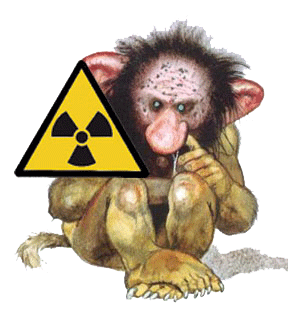 Uzbek & Rica 4th Feb 2021, No, nuclear power is not the medium-term solution to fight against global warming. France must stop its pharaonic investments in nuclear installations such as EPR reactors, which accumulate late delivery and explosion in costs, Julien Tchernia , co-founder andpresident of the renewable energy supplier ekWateur tells us in this forum.
When an article or a post is published about renewable energies, you will always find, following
it, a series of derogatory comments from nuclear advocates. Even if the content in question does not mention or refer to nuclear power, its aficionados take up pens to denigrate renewable production methods (but why so much hatred?)
And, incidentally, to write about their favorite mode of production. Why do they feel so threatened? Is the risk of this mode of production disappearing very real? And if so, would it not be less linked to the course of the political battle between pro and anti-nuclear than to
the complexity, to the costs of building and producing new nuclear power plants?
So, aren’t nuclear power stations shutting down on their own? In a manner analogous to the transition that took place for photography in the 2000s between film and digital, isn’t it time to let nuclear power stopquietly and fully accept the shift towards renewable energy?
What is the ”acceptable” death toll for China (and others) in planning for nuclear war?

|
Nuclear numbers: Assessing China’s threshold of ‘unacceptable damage’, TSG Sunday Guardian Live , Manpreet Sethi, February 6, 2021 Contemporary China appears to have a far lower threshold for taking damage than it once projected.Nuclear deterrence works on the principle of causing unacceptable damage in response to nuclear use. But what kind of damage do nations find unacceptable? How does one calculate what would be unacceptable to another? Answers to these questions are difficult, but important because a fair assessment of what the adversary would find unacceptable can help to right-size one’s own nuclear arsenal. Different countries, like different individuals, have disparate thresholds of damage absorption. For instance, during the Cold War, the US concluded that the USSR would be deterred if 50% of Soviet industry and 25% of its population were to be destroyed. Meanwhile, President Kennedy’s hesitation to lose even one American city during the Cuban missile crisis revealed America’s low damage threshold. Interestingly, in the case of Communist China, Premier Mao had created the image that his country had a high damage-taking capacity. Dismissing nuclear weapons as a “paper tiger”, he suggested that American nuclear use could not deter China because even if 50 million Chinese died, an equal number would survive to carry the country forward. But is this assumption true even today? How does modern China perceive damage? ……… Amongst the many factors that can help assess damage tolerance thresholds, five are particularly relevant. The first is to understand the historical experiences since a country that has been through more wars and experienced losses is expected to have a higher damage tolerance threshold. …….. Secondly, damage acceptability depends on the nature of the political system, with the assumption being that a closed, authoritarian system would be able to take more damage than a democracy…………damage acceptability depends on the nature of the political system, with the assumption being that a closed, authoritarian system would be able to take more damage than a democracy. While China is authoritarian, the Chinese Communist Party is extremely careful to sustain an image of legitimacy based on popular support. This, however, is not as easy to maintain today as it once was owing to society having become better educated, expressive and digitally connected. Therefore, the Party decision-making cannot afford to be insulated and ignore the mood of the masses. The third factor is the level of economic development, since an economically well-off and materially aspirational society is believed to have a low stomach for damage. ……….. Fourthly, the damage threshold varies depending on the value a country places on the objective it seeks. The more a country is politically, economically and emotionally invested in the objective, the greater its willingness to bear damage. For instance, in case of a conflict over Taiwan, which China considers an existential threat, its threshold of damage is likely to be higher than in case of conflict in high Himalayas or over areas disputed with India. Contemporary China, therefore, appears to have a far lower threshold for taking damage than it once projected. ……. These, and more such insights, should help India to calculate the “right” size of its nuclear arsenal in order to signal credible deterrence ……..https://www.sundayguardianlive.com/opinion/nuclear-numbers-assessing-chinas-threshold-unacceptable-damage |
|
Increasing risk of nuclear cataclysm , with today’s new technology weapons
 The risk of nuclear cataclysm is increasing, https://www.japantimes.co.jp/opinion/2021/02/07/commentary/world-commentary/us-russia-china-nuclear-weapons-arms-control/, BY ANDREAS KLUTH, BLOOMBERG, Feb 7, 2021
The world can breathe a small sigh of relief this week. The last remaining arms control treaty between the United States and Russia, called New START, will not expire on Feb. 5 after all, as recently feared.
In the nick of time, Russian President Vladimir Putin offered his new American counterpart an extension of the treaty for five years, an option stipulated in its text. Joe Biden agreed — after giving Putin the requisite talking to about Russia’s massive cyberattack on the United States, its jailing of the activist Alexey Navalny and other recent outrages.
In the short term, a new nuclear arms race between the two biggies has thus been avoided. Sort of. But not really — and there’s the rub. A wider glance at the world’s nuclear landscape reveals that the danger of cataclysm, by design or accident, keeps growing.
New START only covers the stockpiles of Russian and American “strategic” weapons. This refers to those warheads the two adversaries point at each other’s homeland. The treaty says nothing about “tactical” nukes, the more flexible and usually smaller warheads built for potential use in a war zone to win or avoid losing a conventional conflict.
But in that tactical category an arms race is already underway. Both the United States and Russia, in the name of upgrading their arsenals, have been designing new tactical nukes and deployment technologies. These include things that were science-fiction during the Cold War, such as nukes delivered by drones from submarines.
This race is thus fundamentally different from the one between the United States and the Soviet Union. Back then, the contest ultimately came down to a count of each side’s warheads. What ultimately stabilized that competition was the macabre but compelling logic of deterrence through “mutual assured destruction” (MAD).
Today’s competition is instead between newfangled technologies and, crucially, the military strategies thus made possible. This multiplication of scenarios and permutations undermines traditional calculations of strategy, which were largely based on the tools of game theory developed during the Cold War.
One upshot is that it’s becoming even more important for all nine of the nuclear powers to “signal” their “postures,” in the jargon. They should explain their intentions and make themselves as predictable as possible to others. And yet the most recent such signaling was hardly reassuring. In Article 4 of its Basic Principles issued last summer, Russia asserts that one purpose of its nuclear arsenal is “the prevention of an escalation of military actions and their termination on conditions that are acceptable for the Russian Federation.”
Translated, this wording suggests that Russia could respond to a conventional conflict with a tactical nuclear strike, as opposed to reserving nukes purely for retaliation in kind. But that makes any altercation potentially explosive in the fissile sense.
A conflict could, for instance, start with hybrid warfare (of the sort Russia used in its 2014 annexation of Crimea), or with cyberwar (as waged during last year’s Russian hack of some 18,000 U.S. computer systems) or with a strike in space against an adversary’s satellites. If the conflagration escalates and becomes “unacceptable,” the next step could be nukes. And then?
The first strike would still detonate somewhere — perhaps in the Baltic region, according to one hypothetical conflict between Russia and NATO. For the local population that would be far from “tactical,” and indeed terminal. It would also demand a response from the alliance.
But should that response be a nuclear counterstrike? At what scale? Against Russian forces, or a city? Moreover, how would Russia, in this hypothetical scenario, react to this “limited” NATO counterstrike? With missiles flying at supersonic speeds, all involved would have at most minutes to decide.
To make the global matrix even more complex, there are also the other seven nuclear powers to consider, and perhaps additional ones in future. Of these North Korea may appear to be the most unhinged. But China is the most ambitious. It could have 350 warheads already, according to some estimates. The Pentagon assumes China will double its arsenal in the coming decade.
China is the main reason why the United States and Russia couldn’t agree on properly renegotiating New START. Donald Trump, Biden’s predecessor, insisted on bringing Beijing into the talks. The Chinese refused. Sarcastically, they wondered aloud whether the Americans and Russians would prefer to let China raise its arsenal to their size or to cut their own down to China’s.
That makes for a good news conference zinger in Beijing. But it won’t help humanity get to grips with its conundrum: More actors are getting more weapons with more technological and tactical applications. The risk that somebody, somewhere pulls a trigger, intentionally or inadvertently, keeps rising.
In a gesture of global protest against this insanity, 86 non-nuclear countries have signed a Treaty on the Prohibition of Nuclear Weapons, with a goal of totally banning these satanic arms. It took effect on Jan. 22. But these — mainly smaller and poorer — states don’t hold the future in their hands.
The big nuclear powers do. They must put their daunting other differences aside and begin comprehensive talks to prevent the worst. And the best placed to extend the invitation is the leader who’s newest in office, and yet has the most experience with disarmament: Biden.
Zarif: compensation not pre-condition for reviving Iran nuclear deal
WASHINGTON — Iranian Foreign MinisterMohammad Javad Zarif said on Sunday that Iran receiving compensation from the United States for the U.S. withdrawal from the 2015 Iranian nuclear deal was not a “pre-condition” forreviving the agreement. (Reporting By Arshad Mohammed; Editing by Daniel Wallis)
The complicated politics of removing nuclear subsidies: the crooked Ohio legislation
COLUMBUS, Ohio (AP) — The new owners of two Ohio nuclear power plants have given indications they are no longer interested in receiving as much as $1 billion in subsidies handed out in a tainted energy bill, according to two state lawmakers.
One of the lawmakers, freshman GOP Sen. Jerry Cirino, last week cosponsored Senate Bill 44, legislation that would eradicate subsidies that would have been paid by electric customers across the state for the plants now owned by a privately held company called Energy Harbor.
The plants, one of which is in Cirino’s district, were operated by a wholly owned subsidiary of Akron-based FirstEnergy Corp. when the bill known as HB6 was approved in July 2019 and quickly signed by Republican Gov. Mike DeWine.
Messages were left Friday with Energy Harbor spokespersons seeking comment about the company’s plans.
“I believe there is extremely broad support for Senate Bill 44 in the Legislature and broad external support as well,” said Cirino, who added that recent discussions with Energy Harbor officials lead him to believe they will not find any problems with SB44.
One of the lawmakers, freshman GOP Sen. Jerry Cirino, last week cosponsored Senate Bill 44, legislation that would eradicate subsidies that would have been paid by electric customers across the state for the plants now owned by a privately held company called Energy Harbor.
The plants, one of which is in Cirino’s district, were operated by a wholly owned subsidiary of Akron-based FirstEnergy Corp. when the bill known as HB6 was approved in July 2019 and quickly signed by Republican Gov. Mike DeWine………..
Rep. Bill Seitz, a Cincinnati Republican who was a key player in pushing HB6 through the Legislature, said an Energy Harbor lobbyist told him in December that the company would like the option to decline the subsidies.
Both Seitz and Cirino said Energy Harbor officials were concerned that accepting subsidies would put the company at a disadvantage competing with non-subsidized suppliers, given priority on pricing in the 13-state PJM energy markets where electricity is bought and sold……….
HB6 critics have questioned whether Energy Harbor needs financial help to keep the plants operating after buying back $800 million of company shares last year. Energy Harbor officially took ownership of the plants in February 2020 in a deal struck with a FirstEnergy subsidiary in U.S. Bankruptcy Court.
“It’s quite a turnaround if Energy Harbor is now telling the legislature to repeal its billion-dollar corporate welfare subsidy from Ohioans,” said Ohio Consumers’ Counsel Bruce Weston in a statement. “Questions that come to mind include: Did the two nuclear plants really need the subsidy that they got from Ohioans’ state government? And were the nuclear plants really going to be closed without the subsidy?”
Former PUCO Chair Todd Snitchler, now president and CEO of the Washington-based Electric Supply Association, on Friday called HB6 a “shameful piece of legislation.”
“Ohioans don’t need to pay more only to support struggling plants,” Snitchler said in a statement. “Competitive power markets are delivering reliable power and billions in cost savings to electric customers while significantly reducing emissions and enabling new clean energy build — without subsidies and extra ratepayer charges.”
…………… HB6 has been under intense scrutiny since U.S. Attorney David DeVillers announced on July 21 that then-House Speaker Larry Householder and four others had been arrested for their involvement in a $60 million bribery scheme secretly funded by an unidentified company that clearly was FirstEnergy. Authorities have described it as the biggest bribery scheme in state history.
The five men and a dark money group were subsequently indicted on federal racketeering charges. Householder has pleaded not guilty and awaits trial. Two political operatives have pleaded guilty to charges. The dark money group called Generation Now filed a plea agreement on Friday.
Republicans who control both legislative chambers have not been able to reach a consensus so far on repealing or replacing the measure.
Sponsor testimony on the new bill eliminating the nuclear subsidies begins Tuesday. https://www.usnews.com/news/best-states/ohio/articles/2021-02-07/owners-of-two-ohio-nuclear-plants-may-decline-subsidies
Seizing the War Industry, by Christian Sorenson — Rise Up Times

“The War Industry infests the American economy like a cancer, sapping its strength and distorting its creativity while devouring its treasure.”
Seizing the War Industry, by Christian Sorenson — Rise Up Times
Aviva Investors doubtful about backing Sizewell nuclear power station
 Telegraph 6th Feb 2021, One of Britain’s biggest investors has cast doubt over whether it would
back new nuclear power stations due to environmental concerns. Aviva
Investors said nuclear’s ESG (environmental, social and corporate
governance) impact was “far from clear at this time”, even as the
Government backs the technology to help cut carbon emissions [ which it doesn’t anyway].
finance for the planned £20bn Sizewell C reactor in Suffolk. EDF is in
talks with the Government over public backing, but will also need to
attract institutional investors.
1 This Month


Tell the Ukrainian Government to Drop Prosecution of Peace Activist Yurii Sheliazhenko

Petition to revoke the licensing of the Near Surface Nuclear Disposal Facility (NSDF) at Chalk River. https://www.ourcommons.ca/petitions/en/Petition/Details?Petition=e-7247


of the week – STOP SMALL MODULAR REACTORS IN CANADA
To see nuclear-related stories in greater depth and intensity – go to https://nuclearinformation.wordpress.com
-
Archives
- March 2026 (183)
- February 2026 (268)
- January 2026 (308)
- December 2025 (358)
- November 2025 (359)
- October 2025 (376)
- September 2025 (258)
- August 2025 (319)
- July 2025 (230)
- June 2025 (348)
- May 2025 (261)
- April 2025 (305)
-
Categories
- 1
- 1 NUCLEAR ISSUES
- business and costs
- climate change
- culture and arts
- ENERGY
- environment
- health
- history
- indigenous issues
- Legal
- marketing of nuclear
- media
- opposition to nuclear
- PERSONAL STORIES
- politics
- politics international
- Religion and ethics
- safety
- secrets,lies and civil liberties
- spinbuster
- technology
- Uranium
- wastes
- weapons and war
- Women
- 2 WORLD
- ACTION
- AFRICA
- Atrocities
- AUSTRALIA
- Christina's notes
- Christina's themes
- culture and arts
- Events
- Fuk 2022
- Fuk 2023
- Fukushima 2017
- Fukushima 2018
- fukushima 2019
- Fukushima 2020
- Fukushima 2021
- general
- global warming
- Humour (God we need it)
- Nuclear
- RARE EARTHS
- Reference
- resources – print
- Resources -audiovicual
- Weekly Newsletter
- World
- World Nuclear
- YouTube
-
RSS
Entries RSS
Comments RSS
 nuclear-news