Southern African Faith Communities oppose extending the life of Koeberg nuclear power plant
 SA faith leaders against extending the life of Koeberg nuclear power plant https://www.iol.co.za/capeargus/news/sa-faith-leaders-against-extending-the-life-of-koeberg-nuclear-power-plant-e02fb49d-8b22-413b-95ef-165d7f31a5e4By Mwangi Githathu , 12 Aug, 20, Cape Town – Campaigners are urging a rethink on extending the life of the Western Cape’s Koeberg nuclear power plant, while the period for public comment on the draft regulations on the long-term operation of nuclear installations closes next Tuesday. SA faith leaders against extending the life of Koeberg nuclear power plant https://www.iol.co.za/capeargus/news/sa-faith-leaders-against-extending-the-life-of-koeberg-nuclear-power-plant-e02fb49d-8b22-413b-95ef-165d7f31a5e4By Mwangi Githathu , 12 Aug, 20, Cape Town – Campaigners are urging a rethink on extending the life of the Western Cape’s Koeberg nuclear power plant, while the period for public comment on the draft regulations on the long-term operation of nuclear installations closes next Tuesday.
Department of Mineral Resources and Energy Minister Gwede Mantashe published the request which is intended to lead to a nuclear programme delivering new installed capacity of 2.5 gigwatts in June. Mantashe said: “The plan also provides for the extension of the life of Koeberg, which is due to be decommissioned in 2024 after 40 years in operation.” Leading the charge against the extension of the plant’s life span is the Southern African Faith Communities’ Environment Institute, Safcei. In a statement, Safcei said: “As South Africa faces another push for nuclear energy when the country is in crisis from the Covid-19 pandemic, faith communities call for no more nuclear energy. “Nuclear power is not climate resilient, cheap, competitive, quick to build and deliver, safe or able to solve our immediate energy needs.” Safcei said lessons need to be learnt from the country’s past experience with nuclear energy, including what it claims were 14 years of research and billions of rands “wasted on small nuclear energy systems known as the Pebble Bed Modular Reactor (PBMR).” “The level of trust in Eskom is at an all-time low. South Africans are tired of load-shedding and annoyed that tax revenue continues to be diverted from essential services to bailout dysfunctional state owned enterprises. What reassurance do we have that a new state-owned nuclear project will be any different?” asked Safcei. Last year Eskom’s attempt to see whether there was a market and potential for the previously abandoned Pebble Bed Modular Reactor (PBMR) PBMR project was dismissed as “unrealistic” by the South African Independent Power Producers’ Association (SAIPPA). SAIPPA general secretary Dave Long said: “I can’t believe it has any real chance to succeed now. It has been overtaken by technology and nobody is that interested in nuclear any more.” |
|
Fort Worth doesn’t need dangerous nuclear waste rolling through on Tarrant rail line
|
Fort Worth doesn’t need dangerous nuclear waste rolling through on Tarrant rail lines https://www.star-telegram.com/opinion/opn-columns-blogs/other-voices/article244891627.html BY PEGGY HENDON AND LINDA HANRATTY
AUGUST 12, 2020The Nuclear Regulatory Commission is considering licensing two different facilities to store the nation’s high-level nuclear waste. One would be at the existing low-level storage facility in Andrews County, Texas. The second, known as the Holtec site, would be between Carlsbad and Hobbs, New Mexico. Why should Tarrant County be concerned? Most of the uranium waste from nuclear power plants is located east of the Mississippi River. Union Pacific Railroad appears to be the most likely carrier of the high-level nuclear waste casks, although any commercial rail lines could be used. Union Pacific tracks run through the middle of the county, just south of downtown Fort Worth and just north of Arlington’s City Hall and library, traversing neighborhoods of all kinds. Fort Worth’s medical district and the TCU and UT-Arlington campuses are within 1.5 miles of the tracks. A second Union Pacific rail line runs north toward Denton from Tower 55, a major railroad intersection just southeast of downtown Fort Worth. A large Union Pacific railyard lies southwest of downtown Tower 55 holds vital national and international significance, connecting freight and passenger travel between the East and West coasts, Southeast, Midwest, Gulf Coast, Mexico, and Canada. More than 100 trains pass through Tower 55 each day. Interim Storage Partners, which operates the Andrews County site, has asked to have 45 days to move low-level waste from Vermont. The rail cars carrying the high-level radioactive waste would sit at the Fort Worth rail yard, across from Colonial Country Club. These nuclear waste cars are readily identifiable, given their huge dumbbell-like shape, size and weight, which makes them a potential target for terrorist attacks. High-level radioactive waste is one of the most dangerous substances on earth, consisting of irradiated fuel rods that have been inside nuclear reactors. Exposure to unshielded nuclear waste is lethal. One railcar would carry more plutonium than was in the bomb dropped on Nagasaki. If the Nuclear Regulatory Commission approves either or both licenses, thousands of rail shipments of deadly, high-level radioactive waste could move through Tarrant County for more than 20 years, risking accidents leaks, and terrorist actions. Transport of massive amounts of high-level waste in thousands of shipments across the country is unprecedented. A 2019 report of the U.S. Nuclear Waste Technical Review Board found that there is a substantial lack of data regarding potential damage of spent nuclear fuel during transport. Many rails are only designed to carry 143 tons per car. The loaded casks for this waste weigh 210 tons or more. It is unclear whether tracks in Tarrant County would handle such weight. And accidents can happen. A cask carrying low-level waste that was headed to Andrews caught fire in the Chicago area in June. A better alternative would be to leave high-level waste at existing nuclear plants until a permanent repository is found to bury cannisters underground. The repository should be owned by the federal government, not a private entity. One radioactive railway accident in Tarrant County could contaminate our region and harm thousands of lives, posing substantial health risks and seriously impacting future economic growth. Resolutions opposing consolidated interim storage of this waste and its transport through heavily populated communities have been passed by Bexar, Dallas, Nueces, El Paso and Midland Counties and the cities of San Antonio, Midland and Denton, as well as the Midland Chamber of Commerce. Tarrant County, along with the cities of Fort Worth and Arlington, should also oppose the transportation of high-level nuclear waste through our communities and advise our federal representatives and the Nuclear Regulatory Commission of our serious concerns. Our lives and economic well-being may depend upon preventive action now. Peggy Hendon is president of the League of Women Voters of Tarrant County. Linda Hanratty is the group’s environmental chairwoman. |
|
Japan’s nuclear fuel imports almost zero in 2019 as industry stagnates
|
Most nuclear plants in Japan remain idle as stricter safety measures were implemented after a massive earthquake and ensuing tsunami crippled the Fukushima No. 1 nuclear complex. The operations of fuel manufacturing plants have also been suspended……. Of the 54 nuclear reactors that were in operation before the Fukushima crisis, currently, only nine have come back online after clearing harsher safety measures. In the wake of the accident, 21 reactors have been flagged for decommissioning in consideration of the hefty cost of refurbishment. All four fuel manufacturing factories are offline as they are undergoing regulatory review under the new safety standards. Kansai Electric Power Co., Shikoku Electric Power Co. and Kyushu Electric Power Co., which operate the nine plants currently back online, said they have enough fuel to run their reactors for the next several years. …….https://www.japantimes.co.jp/news/2020/08/12/business/japan-nuclear-fuel-imports-zero/ |
|
Extreme weather causes emergency shutdown of nuclear plant in Iowa
|
‘Derecho’ storm causes Cargill plant closure, emergency shutdown of nuclear plant in Iowa
The storm caused crop damage and outages throughout the Midwest Star Tribune,
By Mike Hughlett Star Tribune, AUGUST 12, 2020 — A violent storm that tore through Iowa on Monday caused an emergency shutdown at a nuclear power plant near Cedar Rapids.
The storm packing hurricane-force winds tore across the Midwest, compounding troubles for a U.S. farm economy already battered by extreme weather, the U.S.-China trade war and most recently, the disruption caused to labor and consumption by the COVID-19 pandemic. Grain silos were ripped apart, and Minnetonka-based Cargill and Archer Daniels Midland closed crop-processing plants in Cedar Rapids. The Duane Arnold nuclear plant lost its connection to the electricity grid. At about 1 p.m., the plant in Palo, 11 miles northwest of Cedar Rapids, declared an “unusual event” — an indication of a safety threat, according to a report posted Tuesday by the U.S. Nuclear Regulatory Commission (NRC). An unusual event is the lowest of four levels of emergency conditions under NRC regulations. While the Duane Arnold plant is not now producing electricity, it does have power to run its emergency systems. The plant is stable and is using a backup power source at this time,” Duane Arnold’s majority owner and operator, Florida-based NextEra Energy Resources, said in a statement. The storms damaged the plant’s cooling towers, which are used in electricity production to cool steam after it exits the turbine, NextEra said. The cooling towers are not part of the safety systems used to cool the reactor and other critical components……. David Lochbaum, former director of the Union of Concerned Scientists’ nuclear safety project, said that loss of off-site power at nuclear power plants — usually due to storms — happens about four to five times a year in the U.S. Iowa’s 45-year-old Duane Arnold plant, which is a little smaller than Xcel Energy’s nuclear plant in Monticello, is due to shut down later this year………. |
|
Germany urges S.Arabia to comply with nuclear arms control treaty.
Germany urges S.Arabia to comply with nuclear arms control treaty. Western allies concerned over Riyadh’s nuclear goals after reports reveal secret facility for extracting uranium yellowcake https://www.aa.com.tr/en/europe/germany-urges-sarabia-to-comply-with-nuclear-arms-control-treaty-/1939394 Oliver Towfigh Nia |12.08.2020 BERLIN
Germany on Wednesday called on Saudi Arabia “to fully comply” with the Treaty on the Non-Proliferation of Nuclear Weapons (NPT) following a news report about the discovery of a secret nuclear facility in northwestern Saudi Arabia.
“The German government’s critical stance on nuclear power is well known. It is of central importance that Saudi Arabia fully complies with its NPT obligations and that its nuclear program is subject to the international verification standards (‘safeguards’) of the International Atomic Energy Agency (IAEA),” the Foreign Ministry told media representatives via an e-mail.
The NPT is a landmark international treaty whose objective is to prevent the spread of nuclear weapons, to promote cooperation in the peaceful uses of nuclear energy and to further the goal of achieving nuclear disarmament and general and complete disarmament.
With China’s assistance, Saudi Arabia has constructed a facility for the extraction of uranium yellowcake — a potential precursor for a nuclear reactor — in a remote desert location near the small town of Al Ula, the Wall Street Journal newspaper reported last week, citing Western officials with knowledge of the site.
The facility, which has been kept secret, has sparked concern among Riyadh’s Western allies that the kingdom may try to expand its atomic program to keep open its option to build atomic weapons, according to the report.
Revelations of the yellowcake processing facility is expected to further increase concern among Riyadh’s neighbors and its Western allies about Saudi nuclear ambitions, especially after Saudi Crown Prince Mohammed bin Salman vowed in 2018 that “if Iran developed a nuclear bomb, we will follow suit as soon as possible.”
Yellowcake is processed from naturally occurring uranium ore and can be further enriched to create fuel for nuclear power plants and, at very high levels of enrichment, nuclear weapons.
While the Saudi Energy Ministry has “categorically” denied the Wall Street Journal report that the Gulf country has built a uranium ore milling facility, it admitted to contracting with Chinese companies for uranium exploration in Saudi Arabia.
Riyadh triggered major concerns about a likely nuclear arms race in the volatile Gulf region by moving forward with building a research reactor and inviting companies to bid on building two civilian nuclear power reactors without agreeing to oversight and inspection by the IAEA, Vienna-based UN nuclear watchdog, according to the Al Jazeera media network.
A US congressional committee published a report in May 2019, warning the administration of President Donald Trump was allowing US companies to offer Saudi Arabia nuclear technologies without first obtaining non-proliferation guarantees to ensure the know-how would not be used to eventually produce a weapon.
In February 2019, government whistle-blowers had alarmed the US House of Representatives that the Trump administration was evading the Congress to allow future sales of nuclear technology to Saudi Arabia, without non-proliferation safeguards, thus potentially paving the path for an atomic arms race in the Middle East.
Business as usual equals many extra deaths from global warming — Systemic Disorder

Is it already too late to stop global warming? That question is not asked with thoughts of throwing up hands in despair and giving up. Rather, that question must be asked in the context of mitigating future damage to whatever degree might yet be possible. The context here is that the carbon dioxide, methane and […]
via Business as usual equals many extra deaths from global warming — Systemic Disorder
Hiroshima and the normalisation of atrocities

|
Death from the sky: Hiroshima and normalised atrocities https://www.onlineopinion.com.au/view.asp?article=21049
When US President Harry S Truman made the decision to drop the atomic bomb on Hiroshima on August 6, 1945, followed by another on Nagasaki a few days later, he was not acting as an agent untethered from history. In the wheels of his wearied mind lay the battered Marines who, despite being victorious, had received sanguinary lashings at Iwo Jima and Okinawa. A fear grew, and US military sources speculated about, the slaughter that might follow an invasion of the Japanese homeland. They also pondered the future role of the Soviets, and wondered whether there were other means by which Japan’s involvement in the war might be terminated before Moscow got its hands on the battered remains of North East Asia. Much is made about the moral dilemma Truman faced. He knew there was the nastiest of weapons at hand, born from the race to acquire it from Nazi Germany. But on a certain level, it was merely another weapon, one to use, a choice sample in the cabinet of lethal means and measures. By that stage of the war, killing civilians from the air, not to mention land, was banal and common place; enemy populations were to be experimented upon, burned, torched, gassed, shelled and eradicated in the program of total war. By the time Truman made his decision, Japan had become a graveyard of strategic aerial bombing. General Curtis E. LeMay of the US Air Force prided himself on incinerating the enemy, and was encouraged by various study commissions advocating the use of incendiary bombs against Japan’s flammable urban architecture. He was realising the dreams of such figures as the pioneering US aviator and air power enthusiast Billy Mitchell, who fantasised in the 1920s about Japanese cities being “the greatest aerial targets the world has ever seen”. In 1941, US Army chief of staff George Marshall spread the word to journalists that the US would “set the paper cities of Japan on fire”. Civilians would not be spared. Towards the end of the war, daylight precision bombing had fallen out of favour; LeMay preferred the use of Boeing B-29 Superfortresses, heavily laden with firebombs, to do the work. His pride of joy in conflagration was Tokyo. During the six-hour raid over the night of March 9 and 10, 1945, the US Strategic Bombing Survey concluded that 87,793 had perished, with 40,918 injuries. There was little novel in LeMay’s blunt approach. Britain’s Air Force Marshall Arthur “Bomber” Harris fertilised the ground, and the air, for such an idea. He made it his mission to not only kill Germans but kill German civilians with a cool determination. He did so with a workmanlike conviction so disturbing it chilled the blood of many Britons. As he put it, “The cities of Germany, including their working populations, are literally the heart of Germany’s war potential.” It was his intention to, he explained to personnel, “in addition to the horrors of fire … to bring masonry crashing down on top of the Boche, to kill the Boche and to terrify the Boche”. The Teutonic enemy came, not so much in all shades, but one. Saturation bombing, regarded after the Second World War as generally ineffective, a ghastly failure to bring the population to its knees, received its blessing in Bomber Command. This entire process neutered the moral compass of its executioners. Killing civilians had ceased to be a problem of war, one of those afterthoughts which served to sanction mass murder. Britain’s chief of the air staff for a good deal of the war, Charles Portal, called it a “fallacy” that bombing Germany’s cities “was really intended to kill and frighten Germans and that we camouflaged this intention by the pretence that we would destroy industry. Any such idea is completely false. The loss of life, which amounted to some 600,000 killed, was purely incidental.” When 600,000 becomes an incidental matter, we are well on the way to celebrating the charnel houses of indiscriminate war. When the issue of saturation bombing creased the legal minds behind the Nuremberg and Tokyo war crimes trials, an admission had to be made: all sides of the Second World War had made the air a realm of convenience in the killing of humanity, uniformed or not. To win was all that mattered. While the Nuremberg Charter left it open to criminalise German aerial tactics, the International Military Tribunal hedged. As chief of the Luftwaffe, Herman Göring was singled out for air attacks on Poland and other states but the prosecutors refrained from pushing the point, likely reflecting the cold fact, as Matthew Lippmann puts it, “that both Germany and the Allies engaged in similar tactics.” It is true that Germany and Japan gave a good pioneering go at indiscriminate aerial slaughter. But the Allied powers, marshalling never before seen fleets of murderous bombers, perfected the bloody harvest. The war had to be won, and, if needed, over the corpses of the hapless mother, defenceless child and frail grandparent. As the historian Charles S. Maier notes with characteristic sharpness, a tacit consensus prevailed after the Second World War that the ledger of brutality was all stacked on one side. German bombings during the Spanish Civil War, notably of Guernica; Warsaw, Rotterdam, London and Coventry during the world war that followed, were seen as “acts of wanton terror”. The Allied attacks on Italian, German and Japanese urban centres, in proportion and scale far more destructive, were seen as “legitimate military actions”. Distinctions about civilian and non-civilian vanished in the atomic cloud. Hiroshima’s tale is the apotheosis of eliminating distinctions in war. It propagated such dangerous beliefs that nuclear wars might be won, sparing a handful of specialists and breeders in bunkers planning for the new post-apocalyptic dawn. It normalised, even as it constituted a warning, the act of annihilation itself. Prior to the twin incinerations of Hiroshima and Nagasaki, the redoubtable nurse and writer Vera Brittain issued a warning that remains salient to those who wish to resort to waging death from the sky: “If the nations cannot agree, when peace returns, to refrain from the use of the bombing aeroplane as they have refrained from using poison gas, then mankind itself deserves to perish from the epidemic of moral insanity which today afflicts our civilisation.” |
|
|
United Nations promotes the role of young people in ridding the world of nuclear weapons

Young people have a major role to play in ridding the world of nuclear weapons, https://news.un.org/en/story/2020/08/1069722 Nuclear weapons are still one of the most serious threats to mankind, and the dangers are growing. Young people can play an important role in ensuring that they are eliminated once and for all, says the UN’s top disarmament official, ahead of International Youth Day on 12 August.
This coming Wednesday, the world will highlight young people as essential partners in effecting change. The annual celebration of International Youth Day is also an opportunity to raise awareness about the problems facing youth, including the continued existence of nuclear weapons.
Seventy-five years ago last week, the only two nuclear bombs ever used in warfare were detonated over Hiroshima and Nagasaki, Japan, killing approximately 210,000 people within months and sickening tens of thousands more with cancer and lifelong diseases.
Nearly 14,000 nuclear warheads exist today, most of them many times more powerful than those two bombs dropped on Hiroshima and Nagasaki. The world has succeeded at reducing some of the risks, especially after the end of the Cold War, but Ms. Izumi Nakamitsu, United Nations Under-Secretary-General and High Representative for Disarmament Affairs, has said the danger is now “higher than it has been in generations.”
Ms. Nakamitsu talked to UN News about why, and how, young people are helping to tackle this crisis.
“When catastrophes occur, they tend to turn into numbers, and it is important to remember that everyone who suffered the devastation from the atomic bombings 75 years ago has a story. They had lives, people they loved and who loved them.
When I was about 10 or 12 years old, I visited Hiroshima and Nagasaki, and once you have seen them the memory stays with you.
Eliminating these indiscriminate and inhumane weapons is the UN’s top disarmament priority – and one of its oldest goals.
But the world’s progress to rid the world of nuclear weapons has slowed down, and now we are actually starting to go backwards. This back-sliding increases the possibility that a nuclear weapon could be used– either intentionally, by accident or because of a misunderstanding.
In today’s complicated international environment – with priorities ranging from climate change to sustainable development, pandemics and migration – nuclear weapons are still one of the most urgent threats to tackle.
Here are three reasons why.
First, they are the most destructive weapons ever invented. Most that exist today are vastly more powerful than the bombs that devastated Hiroshima and Nagasaki.
Second, nuclear weapons are one of the two threats, along with climate change, that extend to all life on the planet. Any use of nuclear weapons could cause an environmental cataclysm.
Third, no country can adequately respond to the vast suffering and death that would follow any use of a nuclear weapon. Most countries, and international organisations like the ICRC, have voiced concern about this. Some countries have adopted a new treaty which prohibits nuclear weapons.
The power of youth
As part of the largest generation in history, today’s young people hold tremendous power – and responsibility.
Jayathma Wickramanayake, the UN Secretary-General’s Envoy on Youth, stressed this during a visit to Japan earlier this year. She said, “The atomic bombings of Hiroshima and Nagasaki should always remind us, especially the younger generations, how important disarmament and denuclearization is. Young people under the age of 30 account for over half of the world’s population, and we can’t achieve world peace without their participation.
The Secretary-General’s Agenda for Disarmament recognizes youth as “the ultimate force for change”. When they are educated, engaged and empowered, they can have decisive influence on how their societies and governments view nuclear weapons.
We have seen their power before. Young campaigners, many of them women, helped lead successful global efforts to ban landmines and cluster munitions under international law, and they are rallying many countries to reduce nuclear threats.
Some of these campaigns have been awarded with a Nobel Peace Prize. Last year, the United Nations General Assembly reaffirmed the contributions that young people can make in sustaining peace and security.
Young people can contribute by starting discussion groups, hosting film screenings and planning informative events with fellow students and friends. I recommend reading the United Nations book, “Action for Disarmament: 10 Things You can Do!” to learn more about these and other outreach strategies.
How to get involved
At the UN Office for Disarmament Affairs, we want to help create space for young people to meaningfully contribute to progress on disarmament. Through a new outreach initiative, called “#Youth4Disarmament”, we are working to engage, educate and empower young people by offering resources like e-newsletters, training programmes and an upcoming website dedicated to youth and disarmament.
We also recently announced our first group of “Youth Champions for Disarmament”. These 10 young people will receive training on general principles of disarmament, non-proliferation and arms control through both online courses and a two-week in-person study tour in Vienna, Geneva, Hiroshima and Nagasaki. They will exchange ideas with experts from think tanks, civil society organizations and the diplomatic field, and develop a plan to engage their communities on disarmament-related issues.
It is vital for countries to engage with their younger citizens. They have the power to effect change, and their ideas can help strengthen our collective peace and security—now and for the future. With their fresh ideas and perspectives, together we can find solutions to the world’s gravest dangers.”
Nuclear radiation and Chernobyl’s forest fires
Twenty-five years after the disaster, Zibtsev and others predicted that if the forests in the exclusion zone were completely consumed by fire, residents in Kyiv would face an increased risk of dying from cancer and government bans would need to be imposed on foods produced as far as 90 miles away. Although such a large and intense fire is currently unlikely, recent fires have been sizable enough to create similar problems. “If Chernobyl forests burn, contaminants will migrate outside the immediate area,” says Zibtsev. “We know that.”
This April’s fires, which scorched 23 percent of the exclusion zone, were the largest burns ever recorded in the area, nearly four and a half times the size of fires in 2015. Flames torched trees less than three miles from the ruined nuclear reactor, which is now enclosed by an arch-shaped steel shroud.
 Forest Fires Are Setting Chernobyl’s Radiation Free https://www.theatlantic.com/
 science/archive/2020/08/chernobyl-fires/615067/
Trees now cover most of the exclusion zone, and climate change is making them more likely to burn. Story by Jane Braxton Little 10 Aug, 20 In the clear, calm, early hours of May 15, 2003, three miles west of the hulking ruins of the Chernobyl Nuclear Power Plant, Vasyl Yoschenko was bustling around a stand of Scotch pines planted 30 years earlier. The trees were spindly and closely spaced, but he was skinny enough to move easily among them, taking samples of biomass and litter. Just beyond the trees, he tinkered with the horizontal plates he had placed on the ground in a diagonal grid and covered with superfine cloth designed to absorb whatever came their way.
The forest burned intensely for 90 minutes, releasing cesium-137, strontium-90, and plutonium-238, -239, and -240 in blasts of smoke and heat. In just one hour, the firefighters—and Yoschenko—could have been exposed to more than triple the annual radiation limit for Chernobyl’s nuclear workers.
Only luck has saved us from nuclear war, not planning
The reason we haven’t had nuclear disasters isn’t careful planning. It’s luck. https://www.washingtonpost.com/outlook/2020/08/10/reason-we-havent-had-nuclear-disasters-isnt-careful-planning-its-luck/
The alarming role of good fortune in the history of nuclear weapons. By Benoît Pelopidas and Alex Wellerstein, August 10, 2020
On the morning of Aug. 9, 1945, the city of Nagasaki, Japan, was devastated by a single atomic bomb detonated over it by U.S. military. Nagasaki wasn’t the original target for the bomb that morning — that was Kokura, a city to its north, which was spared only because mishaps led the Bockscar airplane to arrive at its target several hours late. When it got there, Kokura was covered in clouds and a smoky haze. Due to Kokura’s luck, it was spared — but Nagasaki’s luck had run out.
Seventy-five years after the last time a nuclear weapon was used in war, the United States is planning to extend the life of its nuclear arsenal for half a century into the future, with a modernization plan going as far as 2042. Weapons the size of those used in World War II are considered to be “small” and “tactical” weapons today; most warheads in the American arsenal are dozens of times more destructive than the ones dropped on Japan. And the United States is no longer the only power with nuclear weapons, either.
Which makes it all the scarier to realize that luck — the same luck that spared Kokura and doomed Nagasaki — is one of the main reasons we’ve avoided nuclear catastrophes since then.
The agencies and organizations that manage nuclear stockpiles tend to rely on narratives of total control. They reassure us nuclear weapons have an excellent safety record, nuclear deterrence will prevent nuclear war from happening, and these large expenditures on warheads that could kill millions and millions are not only a good idea, but also necessary to preserve a world in which nuclear weapons won’t be used.
But the historical counterexamples undermine that message: the near miss nuclear accidents that resulted in nuclear warheads coming close to detonation not only in the United States (such as the Goldsboro accident over North Carolina), but also in foreign territory (like the Palomares accident over Spain); the close-calls where U.S. and Soviet early-warning systems failed and informed their users that a nuclear strike had begun; the moments of brinkmanship that led leaders of both nations to have to make decisions that could lead to the deaths of hundreds of millions of people based on incomplete or false information (such as the Cuban missile crisis). Have we avoided unwanted nuclear explosions, and nuclear war, because we have adequately managed and controlled weapons and crises … or because we have been lucky?
Luck, in this context, seems to mean the exact opposite of control. It’s all that prevented bad outcomes when things could easily have gone in a different direction, no matter what anybody wanted. The historical policymakers who have invoked “luck” have included Robert S. McNamara, who was defense secretary during the Cuban missile crisis; Dean Acheson, special envoy of President John F. Kennedy at the time; ambassador Gerard C. Smith, chief U.S. delegate to the Strategic Arms Limitation Talks in 1969; former defense secretary William Perry, former secretary of state George Shultz, former national security adviser and secretary of state Henry Kissinger, former chairman of the Senate’s Armed Services Committee, Sam Nunn, and former head of Strategic Air Command and Strategic Command, Gen. George Lee Butler.
Most people know the Cuban missile crisis was considered by those involved to be “lucky” — as McNamara put it, years later, in an interview with Errol Morris: “At the end, we lucked out. It was luck that prevented nuclear war.” But even in more mundane cases, there are clear indications that fortunate outcomes were achieved with no help at all from the nuclear control practices in the U.S. arsenal. Continue reading
The lingering human suffering after nuclear testing in Australia and Oceania
Death in paradise: the aftermath of nuclear testing in Australia and Oceania https://diem25.org/death-paradise-the-aftermath-nuclear-testing-australia-and-oceania/ 10/08/2020 by Aleksandar Novaković The United States of America is the first nuclear power — and the only one to have used its weapons for a military purpose. During World War 2 in 1945, two Japanese cities were bombed by US nuclear bombs (Hiroshima on August 6th and Nagasaki August 9th ). The devastating result was approximately 225,000 people either dead or wounded. The number of deaths in Hiroshima and Nagasaki due to exposure to lethal radiation is still being discussed, but it is certainly in the thousands.
However, even though nuclear weapons were never used again for military purposes, nuclear testing took (and continues to take) a toll on thousands of lives in Australia and Oceania.
The United States conducted about 1,054 nuclear tests from 1945 to 1992, and 105 of them (1945-1962) were made at Pacific Test Sites (Marshall Islands, Kiribati) causing the contamination of huge areas controlled by US troops. In the Pacific, this caused rising numbers of cancer and birth defects, especially on the Marshall Islands where 67 tests were made and many Marshallese were forced to leave their homes in contaminated areas.
European nuclear powers, such as France and the UK, have also “contributed” to the deaths of thousands.
France has made over 193 nuclear tests in the Pacific between 1960 and 1996, mostly on Mururoa and Fangataufa atolls that belong to French Polynesia, as well as 17 tests in Algerian Sahara. Tahiti, the most populated island of French Polynesia, was exposed to 500 times the maximum accepted levels of radiation. The impact has spread as far as to the tourist island of Bora Bora.
Civilians and the military participating in nuclear tests (more than 100,000 of them) have experienced diarrhea, skin injuries, blindness, and cancer. Their children have additionally suffered from birth defects.
From 1953 to 1963, there were over 20 bigger and smaller British A- bomb tests in Emu Farm, and the Maralinga and Montebello Islands of Australia. Overall, over 1200 peoples were exposed to radiation in the country, most of them Anangu people living in the Maralinga area. The UK has also made nuclear tests on overseas territories such as the Malden Islands and Christmas Island ( the present Republic of Kiribati).
So, what was done by the governments of the US, UK, Australia and France to help those who have suffered from radiation related illnesses, or those who lost their loved ones?
There are two answers. One is that loss of loved ones, of the way you live your life, of the nature that surrounds you, the loss of home cannot be repaid or replaced with anything else. The other is that aforementioned governments did little.
The US has awarded more than $63 million to Marshallese with radiogenic illnesses despite the fact that the Tribunal only has $45.75 million to award for both health and land claims. France is still avoiding paying reparations to Tahitians.
As for the “joint venture” of the UK and Australia, the truth is that tests were approved and conducted in the first place because British officials were misinforming Australians. The Maralinga Tjarutja (Council) of Anangu people has a compensation settlement with the Australian government, and they are receiving $13.5 million.
75 years after Hiroshima and Nagasaki, we must ask ourselves: Why are we so callous about many “Hiroshimas” and “Nagasakis” that happened over the following decades? Did we let them happen just because they took place in far-off islands in the Pacific or in the Australian desert?
The only way to deal with these existing and future horrors that can eradicate life on Earth is to heal these existing wounds.
This means that the governments of the US, UK, France and Australia must pay just reparations to the affected countries and regions. Progressives of the world must act united against the threat of nuclear holocaust and create a political climate in which it would be possible to take action on an international level in order to ban the production, storage and use of nuclear weapons.
This can be done if nuclear powers, followed by all member states, sign the United Nation’s Treaty on the Prohibition of Nuclear Weapons.
Aleksandar Novaković is a historian and dramatist. He is a member of DSC Belgrade 1 and the thematic DSC Peace and International Policy 1
All too often the world has narrowly avoided World War 3, due to mistales
concentrating this power within a single individual is a big risk. “It’s happened a number of times that a president has been heavily drinking, or subject to medication he’s taking. He may be suffering from a psychological disease. All of these things have happened in the past,”
ways a country’s own technologies could be used against them. As we become more and more reliant on sophisticated computers, there is growing concern that hackers, viruses or AI bots could start a nuclear war. “We believe that the chance of false alarms has gone up with the increased danger of cyber-attacks,” says Collina. For example, a control system [like Pine Gap] could be spoofed into thinking that a missile is coming, which could mean a president is tricked into launching a counter-attack.
many experts agree that by far the biggest threat comes from the very launch systems that are supposed to be protecting us.
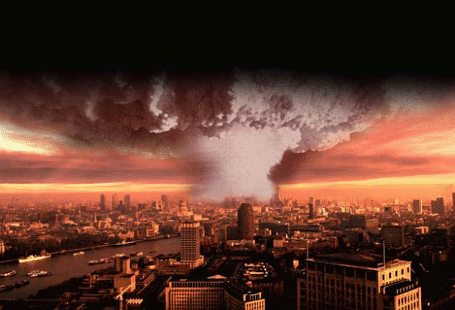 The nuclear mistakes that nearly caused World War Three , From invading animals to a faulty computer chip worth less than a dollar, the alarmingly long list of close calls shows just how easily nuclear war could happen by mistake. https://www.bbc.com/future/article/20200807-the-nuclear-mistakes-that-could-have-ended-civilisation By Zaria Gorvett, 10th August 2020 The nuclear mistakes that nearly caused World War Three , From invading animals to a faulty computer chip worth less than a dollar, the alarmingly long list of close calls shows just how easily nuclear war could happen by mistake. https://www.bbc.com/future/article/20200807-the-nuclear-mistakes-that-could-have-ended-civilisation By Zaria Gorvett, 10th August 2020It was the middle of the night on 25 October 1962 and a truck was racing down a runway in Wisconsin. It had just moments to stop a flight. Mere minutes earlier, a guard at Duluth Sector Direction Center had glimpsed a shadowy form attempting to climb the facility’s perimeter fence. He shot at it and raised the alert, fearing that this was part of a wider Soviet attack. Instantly, intruder alarms were ringing at every air base in the area. The situation escalated remarkably quickly. At nearby Volk Field, an air base, someone flicked the wrong switch – so rather than the standard security warning, pilots heard an emergency siren telling them to scramble. Soon there was a frenzy of activity, as they rushed to take to the skies, armed with nuclear weapons. Continue reading |
California’s Wildfires Are 500 Percent Larger Due to Climate Change
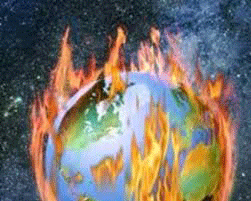 California’s Wildfires Are 500 Percent Larger Due to Climate Change California’s Wildfires Are 500 Percent Larger Due to Climate Change
“Each degree of warming causes way more fire than the previous degree of warming did. And that’s a really big deal.” The Atlantic, ROBINSON MEYERJULY 16, 2019 ” …….. Californians may feel like they’re enduring an epidemic of fire. The past decade has seen half of the state’s 10 largest wildfires and seven of its 10 most destructive fires, including last year’s Camp Fire, the state’s deadliest wildfire ever.A new study, published this week in the journal Earth’s Future, finds that the state’s fire outbreak is real—and that it’s being driven by climate change. Since 1972, California’s annual burned area has increased more than fivefold, a trend clearly attributable to the warming climate, according to the paper. The trend is dominated by fires like the Mendocino Complex Fire—huge blazes that start in the summer and feed mostly on timberland. Over the past five decades, these summertime forest fires have increased in size by roughly 800 percent. This effect is so large that it is driving the state’s overall increase in burned area. Why are summertime forest fires so much more likely? Because climate change has already redefined the seasons in Northern California. Since the early 1970s, summers in Northern California have warmed by about 2.5 degrees Fahrenheit (1.8 degrees Celsius) on average. A few degrees may not sound like much, but heat has an exponential relationship with forest fire. “Each degree of warming causes way more fire than the previous degree of warming did. And that’s a really big deal,” Park Williams, a climate scientist at Columbia University and an author of the paper, told me. Every additional increment in heat in the environment speeds up evaporation, dries out soil, and parches trees and vegetation, turning them into ready fuel for a blaze. For that reason, Williams said, hot summers essentially overpower anything else happening in Northern California. Even during a wet year, an intense heat wave can choke forests so that it is as though the rain never fell…….. https://www.theatlantic.com/science/archive/2019/07/climate-change-500-percent-increase-california-wildfires/594016/ |
|
|
Kremlin Warns The US Of Nuclear Retaliation If Russia Or Her Allies Are Targeted
|
Kremlin Warns The US Of Nuclear Retaliation If Russia Or Her Allies Are Targeted , Eurasia Times , 10 Aug 20, By Tim Edwards In a veiled warning to the US, Russia has issued a statement declaring that it will perceive any ballistic missile launched towards its territory as a nuclear attack that will warrant a nuclear retaliation.In an article published in the official military newspaper Krasnaya Zvezda (Red Star) senior officers of the Russian military’s General Staff, Major Gen. Andrei Sterlin and Col. Alexander Khryapin, stated that since there will be no way to determine if an incoming ballistic missile is fitted with a nuclear or a conventional warhead hence the military will see it as a nuclear attack.
The article follows the publication in June of Russia’s nuclear deterrent policy that envisages the use of atomic weapons in response to what could be a conventional strike targeting the nation’s critical government and military infrastructure……
The statement is reflective of Moscow’s longtime concerns about the development of weapons that could give Washington the capability to knock out key military assets and government facilities without resorting to atomic weapons.
In line with Russian military doctrine, the new nuclear deterrent policy reaffirmed that the country would not withhold using nuclear weapons in response to a nuclear attack or aggression involving conventional weapons that “threatens the very existence of the state.”……. The published article maintained that the publication of the new nuclear deterrent policy was intended to unambiguously describe what Russia sees as aggression. https://eurasiantimes.com/kremlin-warns-the-us-of-nuclear-retaliation-if-russia-or-her-allies-are-targeted/ |
|
Climate change bad for nuclear: Hot weather, water shortage, likely to curb output at France’s Chooz nuclear reactors
 Low water levels may curb output at France’s Chooz nuclear reactors -RTE, Low water levels may curb output at France’s Chooz nuclear reactors -RTE,  https://in.reuters.com/article/france-nuclear/low-water-levels-may-curb-output-at-frances-chooz-nuclear-reactors-rte-idINL8N2FC5XG PARIS, Aug 10 (Reuters) – Production may be reduced at EDF’s Chooz nuclear reactors in northern France on Saturday due to high temperatures lowering the water level on the Meuse River, French grid operator RTE said on Monday.The two reactors produce 1.45 gigawatts (GW) of power each. The shortfall could be equal to the production of one unit, RTE said. https://in.reuters.com/article/france-nuclear/low-water-levels-may-curb-output-at-frances-chooz-nuclear-reactors-rte-idINL8N2FC5XG PARIS, Aug 10 (Reuters) – Production may be reduced at EDF’s Chooz nuclear reactors in northern France on Saturday due to high temperatures lowering the water level on the Meuse River, French grid operator RTE said on Monday.The two reactors produce 1.45 gigawatts (GW) of power each. The shortfall could be equal to the production of one unit, RTE said.
The heat wave is forecast to peak at 37 degrees Celsius in the region on Wednesday, with temperatures falling as the week progresses, according to Meteo France’s weather forecast. Consumption in France is projected to reach 44.7 GW on Saturday, RTE data showed. French nuclear availability is currently at 60.6% of total capacity, with 24.6 GW offline. (Reporting by Forrest Crellin and Bate Felix; Editing by Cynthia Osterman) |
|
1 This Month

of the week – Shut Down Drone Warfare!


Tell the Ukrainian Government to Drop Prosecution of Peace Activist Yurii Sheliazhenko

Petition to revoke the licensing of the Near Surface Nuclear Disposal Facility (NSDF) at Chalk River. https://www.ourcommons.ca/petitions/en/Petition/Details?Petition=e-7247
To see nuclear-related stories in greater depth and intensity – go to https://nuclearinformation.wordpress.com
-
Archives
- April 2026 (114)
- March 2026 (251)
- February 2026 (268)
- January 2026 (308)
- December 2025 (358)
- November 2025 (359)
- October 2025 (376)
- September 2025 (257)
- August 2025 (319)
- July 2025 (230)
- June 2025 (348)
- May 2025 (261)
-
Categories
- 1
- 1 NUCLEAR ISSUES
- business and costs
- climate change
- culture and arts
- ENERGY
- environment
- health
- history
- indigenous issues
- Legal
- marketing of nuclear
- media
- opposition to nuclear
- PERSONAL STORIES
- politics
- politics international
- Religion and ethics
- safety
- secrets,lies and civil liberties
- spinbuster
- technology
- Uranium
- wastes
- weapons and war
- Women
- 2 WORLD
- ACTION
- AFRICA
- Atrocities
- AUSTRALIA
- Christina's notes
- Christina's themes
- culture and arts
- Events
- Fuk 2022
- Fuk 2023
- Fukushima 2017
- Fukushima 2018
- fukushima 2019
- Fukushima 2020
- Fukushima 2021
- general
- global warming
- Humour (God we need it)
- Nuclear
- RARE EARTHS
- Reference
- resources – print
- Resources -audiovicual
- Weekly Newsletter
- World
- World Nuclear
- YouTube
-
RSS
Entries RSS
Comments RSS
 nuclear-news