The Arctic – where global heating meets nuclear pollution – theme for September 20
Global heating is bringing massive changes to the Arctic, and at an accelerating pace. It is the warning system to the world, as sea ice melts, Greenland’s glaciers melt, swathes of frozen ground thaw, permafrost melts. The Arctic ocean will probably be ice-free in summer by 2040.
Crazily, Russians and Americans rejoice, seeing all this as the opportunity to exploit the region for oil and gas, the very things that are causing this unfolding climate nightmare. Apparently these governments are not concerned about the Arctic processes that bring changed global weather, with changed ocean currents, sudden extreme cold snaps. Global heating speeds up with feedback loops: as ice is lost , dark water absorbs more heat from the sun, melting permafrost releases methane and carbon dioxide into the atmosphere.
Arctic regions now experience repeated uncontrollable forest fires, bringing environmental and economic destruction.
Nuclear pollution. The Arctic is where the the two disastrous threats meet – climate change and nuclear radiation. This danger is happening with fires threatening Northern Russian radioactive sites, and with radiation released as buried nuclear items appear from under the ice. Russia’s dumping of nuclear submarines and other radioactive trash is now recognised as a danger to Arctic ecosystems.
There are 39 nuclear-powered vessels or installations in the Russian Arctic today with a total of 62 reactors. This includes 31 submarines, one surface warship, five icebreakers, two onshore and one floating nuclear power plant. These numbers are set to increase; . “By 2035, the Russian Arctic will be the most nuclearized waters on the planet.”
There were 2 fatal arctic accidents in 2019 – 14 sailors killed due to a fire on a nuclear-powered submarine, and an underwater nuclear-powered cruise missile exploded. Several serious submarine nuclear reactor accidents have occurred in Arctic waters, and a U.S. bomber with plutonium warheads crashed at Thule airbase on Greenland. In the Kara Sea, thousands of containers wit radioactive waste were dumped, together with 16 reactors.
Nuclear weapons, nuclear war, remain a global existential threat
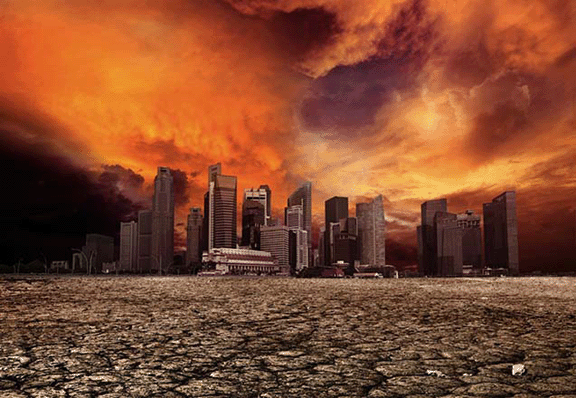
 Nuclear threat still menaces nation, world https://dailyprogress.com/opinion/editorial/opinion-editorial-nuclear-threat-still-menaces-nation-world/article_bb34e883-1484-527d-9321-67718b05eaa5.html 14 Aug 20, he nuclear weapons dropped over Hiroshima and Nagasaki 75 years ago this ]month] wreaked a devastation never before seen in human warfare. Yet they were firecrackers compared with the nuclear weapons that were soon developed — bombs, warheads, shells, torpedoes and other devices capable of vaporizing the human race in an apocalyptic flash. Nuclear threat still menaces nation, world https://dailyprogress.com/opinion/editorial/opinion-editorial-nuclear-threat-still-menaces-nation-world/article_bb34e883-1484-527d-9321-67718b05eaa5.html 14 Aug 20, he nuclear weapons dropped over Hiroshima and Nagasaki 75 years ago this ]month] wreaked a devastation never before seen in human warfare. Yet they were firecrackers compared with the nuclear weapons that were soon developed — bombs, warheads, shells, torpedoes and other devices capable of vaporizing the human race in an apocalyptic flash.
For decades, that thought cast a pall of acute anxiety over America and the world. Whether because of that fear, a strategy of effective deterrence, chance or all the above, the United States remains the only country to have used nuclear weapons in combat. With the end of the Cold War, anxiety around nuclear war has receded. Most people probably are not aware that a harrowing and expensive new arms race is now underway. Today Americans are more likely to identify climate change as the greatest man-made threat to the planet. Last year, in the list of what Americans fear compiled annually by Chapman University, “North Korea using nuclear weapons” and “Nuclear weapons attack” ranked 27 and 29, far below “Corrupt government officials” (No. 1) or “Pollution of oceans, rivers and lakes” (No. 2). Yet even with the Cold War long over and stockpiles of nuclear weapons in the Russian and American arsenals sharply reduced through a series of nuclear arms treaties, to fewer than 6,000 warheads each, there are no grounds for complacency. The world can still be destroyed in a flash.
Nine states have nuclear weapons — the United States, Russia, Britain, France, China, India, Pakistan, Israel and North Korea. Iran’s nuclear program has been the focus of intense concern for years, and Saudi Arabia has vowed that if Iran develops a nuclear weapon, it will follow suit. Consider also that two men have the power to unleash a nuclear barrage entirely on their own — President Trump and Vladimir Putin, the Russian president, who are both working assiduously on modernizing their arsenals.
Before the coronavirus pandemic put millions of Americans out of work, spending…on new doomsday weapons was profligate. Now, it seems morally indefensible. This [month], the Government Accountability Office said that, without changes, the Pentagon’s nuclear weapons modernization effort is on track to surpass its $1.2 trillion price tag over the next three decades. Nine states have nuclear weapons — the United States, Russia, Britain, France, China, India, Pakistan, Israel and North Korea. Iran’s nuclear program has been the focus of intense concern for years, and Saudi Arabia has vowed that if Iran develops a nuclear weapon, it will follow suit. Consider also that two men have the power to unleash a nuclear barrage entirely on their own — President Trump and Vladimir Putin, the Russian president, who are both working assiduously on modernizing their arsenals.
…Before the coronavirus pandemic put millions of Americans out of work, spending…on new doomsday weapons was profligate. Now, it seems morally indefensible. This [month], the Government Accountability Office said that, without changes, the Pentagon’s nuclear weapons modernization effort is on track to surpass its $1.2 trillion price tag over the next three decades. …The 75th anniversary of Hiroshima is a good time to revive serious public concern about nuclear weapons. The pandemic may leave little room for other fears, but public health and economic recovery should not have to compete for resources with a needless and enormously expensive new arms race. …Above all, the wrenching images of scorched rubble where Hiroshima had stood ought to be cause for serious reflection on what nuclear weapons do — and what they cannot do. Excerpted from The New York Times via AP.
|
|
Drastic flooding in Bangladesh, displaces ove 1.5 million, increasing coronavirus risk
|
Floods leave one third of Bangladesh underwater and displace more than 1.5 million, raising coronavirus risk, ABC News 14 Aug 20, About a third of Bangladesh has been inundated by floods, with at least 161 people killed and an estimated 1.5 million displaced, according to local officials. Key points:
The heaviest rains in almost a decade began last month and are part of the subcontinent’s summer monsoon from June to September. The floods are making it more difficult to contain coronavirus, with Bangladesh reporting 266,498 infections, including 3,513 deaths, as of Thursday. The unusually heavy rain and floods have also impacted nearby India and Nepal. Bangladesh shares a border with India, with 53 rivers running through both countries….. https://www.abc.net.au/news/2020-08-13/bangladesh-floods-sees-a-third-of-nation-underwater-coronavirus/12555448 |
|
Alberta premier’s small nukes pipe dream makes no economic sense.
 Look Over There! Jason Kenney’s Phoney Nuclear Power
  Distraction Why the Alberta premier’s small nukes pipe dream makes no economic sense., David Climenhaga 14 Aug 20, | TheTyee.ca
When Alberta Premier Jason Kenney says small nuclear reactors “could be a game changer in providing safe, zero-emitting, baseload power in many areas of the province,” as he did this week in a tweet, he’s pulling your leg…….
No electrical utility is ever going to buy one unless they are forced to by government policy or regulation — the kind of thing Alberta’s United Conservative Party purports to oppose……..
Small nuclear reactors are not as cheap to build as the premier’s fairy tale suggests.
Bringing an acceptable small nuclear reactor design all the way from the drawing board to approval by a national nuclear regulatory authority will cost hundreds of millions of dollars.
While dozens of speculative companies are printing colourful brochures with pretty pictures of little nukes being trucked to their destinations, very few are serious ventures with any possibility of building an actual reactor. The United Nations International Atomic Energy Agency says diplomatically there are about 50 concepts “at different stages of development.” Those that are serious, like NuScale Power in the United States, have huge amounts of government money behind them.
The only small nuclear reactor plant known to be operating in the world now is the Akademik Lomonosov, Russia’s floating power barge with two 35-megawatt reactors aboard. From an original estimate of US$140 million in 2006, its cost had ballooned to US$740 million when the vessel was launched last year.
The kind of small reactors Kenney is talking about won’t be cheap by any yardstick.
Small reactors are less economical to run than big reactors…….
This is why nobody wanted to buy the scaled-down CANDU-3 reactor, development of which was paid for by Canadian taxpayers in the 1980s. At 300 megawatts, they were just too small for commercial viability. A working CANDU-3 has never been built.
The cost of small reactors would have to come down significantly to change this. And remember, the research and development requirements of small reactors are just as high as for big ones. With nobody manufacturing modules, there are no existing economies of scale. In other words, dreamy brochures about the future of small reactors are just that — dreams.
By the way, in 2011 the Harper government privatized the best commercial assets of Crown-owned Atomic Energy of Canada Ltd. to… wait for it… SNC-Lavalin Group Inc. Think about that every time you hear Conservatives in Ottawa screeching about the goings on at SNC-Lavalin!
Small reactor designs mostly require enriched uranium, and Canada doesn’t produce any……
Small reactors might be safer than big ones, but we don’t really know.
Kenney and Savage talk about small reactors as if it were a fact they’re safer than big reactors. Maybe they are. But we don’t really know that because nobody but the Russians actually seems to have built one, and in most cases they haven’t even been designed.
Remember, the Russians’ small reactors are both on a barge. For what it’s worth, critics have called it “Floating Chernobyl.”
Small reactors won’t be safe without public regulation……..
Then there’s the matter of waste disposal.
Nuclear plants don’t produce a lot of waste by volume, but what there is sure has the potential to cause problems for a very long time. Thousands of years and more. So safe storage is an issue with small nukes, just like it is with big ones.
Where are we going to store the waste from all these wonderful small nuclear reactors Kenney is talking about?
How many jobs is it likely to create here in Western Canada? Well, Saskatchewan’s Ministry of Environment recently posted a job for a director of small modular reactors. That person will supervise four people. That’s probably about it for jobs for the foreseeable future.
If Alberta ever ends up with the same number of people working on this, we’ll be lucky https://thetyee.ca/Analysis/2020/08/13/Kenney-Nuclear-Power-Plant-Distraction/
No prefecture in Japan wants to host nuclear waste dump
 No Japan prefectures positive about hosting nuclear waste site https://www.japantimes.co.jp/news/2020/08/14/national/prefectures-nuclear-waste-site/ –14 Aug 20, KYODO Nearly half of Japan’s 47 prefectures said they are opposed to or held negative views about hosting a deep-underground disposal site for high-level radioactive nuclear waste, a Kyodo News survey showed Friday. No Japan prefectures positive about hosting nuclear waste site https://www.japantimes.co.jp/news/2020/08/14/national/prefectures-nuclear-waste-site/ –14 Aug 20, KYODO Nearly half of Japan’s 47 prefectures said they are opposed to or held negative views about hosting a deep-underground disposal site for high-level radioactive nuclear waste, a Kyodo News survey showed Friday.
None expressed a favorable stance. The result signals further woes for the central government in its attempt to find a permanent geological disposal repository. Little progress has been made since the process to find local governments willing to host one started in 2002, due mainly to opposition from local residents. The survey was sent to all prefectures in July, with additional interviews conducted depending on their answers. While 16 prefectures such as Fukushima, Kanagawa and Okinawa clearly opposed hosting a site, seven others including Hokkaido, Kyoto and Nagasaki also expressed negative views. Most of the others did not make their positions clear.
“We are already undertaking a certain amount of social responsibility by hosting nuclear plants and providing energy,” Niigata Prefecture said in its response. Fukui Prefecture said, “We are generating power. Nuclear waste disposal should be handled by others.” Meanwhile, Hokkaido mentioned its existing ordinance to prevent nuclear waste from being brought into the northernmost main island, a view that contradicts the relatively positive stance held by one of its municipalities. The town of Suttsu said Thursday it is considering signing up for preliminary research into its land to gauge its suitability for hosting a disposal site. On Friday, however, its mayor, Haruo Kataoka, said the town has been asked by the prefecture not to apply for the preliminary study. Before Suttsu, the town of Toyo in Kochi Prefecture applied for the study in 2007, but it later withdrew the application following strong protests by local residents. In the Kyodo News poll, the western prefecture expressed opposition to hosting a disposal site, saying it faces the need to take measures against a possible major earthquake in the region. For permanent disposal, high-level radioactive waste, produced as a result of the process of extracting uranium and plutonium from spent fuel, must be stored more than 300 meters underground so that it cannot impact human lives or the environment. Elsewhere in the world, Finland and Sweden are the only countries to have decided on final disposal sites. |
|
Even with $1.4 billion government subsidy, NuScam’s nuclear station is still a dodgy prospect

The NuScale SMR plant is designed to be built with up to a dozen 60-MW reactor modules.
UAMPS is seeking other utilities throughout the West to purchase hundreds of megawatts of the $6 billion project’s output, but no utility has agreed to such a purchase.
Utah Taxpayer Association Vice President Rusty Cannon said UAMPS members currently committed to the project should withdraw from it because of the risks.
“The development of untried new designs is no place for small utilities with no nuclear construction experience to risk their customers’ money,” former NRC Commissioner Peter Bradford said during the briefing.
the first module is now expected to be operational in June 2029. Previously NuScale had targeted commercial operation of at least one reactor module in 2027.
|
Municipal power group awaits $1.4 billion from DOE for Idaho nuclear plant, https://www.spglobal.com/platts/en/market-insights/latest-news/electric-power/081320-municipal-power-group-awaits-14-billion-from-doe-for-idaho-nuclear-plant Author, Michael McAuliffe , Editor Keiron Greenhalgh 14 Aug 20, HIGHLIGHTS Utah Associated Municipal Power Systems (UAMPS) members face September decision on project Startup of first unit delayed to 2029 from 2027 Odds of members agreeing to go forward 50/50: muni Washington — A Utah municipal power association is expecting an influx of $1.4 billion in federal funds for the small modular reactor plant it is looking to build in Idaho, but association members are still deciding whether to go forward with the 720-MW project and the completion date has recently slipped, officials said. Continue reading |
Britain’s Nuclear Free Local Authorities (NFLA) demand closing of ageing dangerous nuclear reactors

 Climate News Network 13th Aug 2020, Four of the UK’s ageing nuclear power reactors, currently closed for
repairs, should not be allowed to restart, in order to protect public health, says a consortium of 40 local authorities in Britain and Ireland.
The Nuclear Free Local Authorities (NFLA), the local government voice on nuclear issues in the United Kingdom, then wants all the rest of the country’s 14 ageing advanced gas-cooled reactors (AGRs) shut down as soon as possible, with the power they produce replaced by renewables and a programme of energy efficiency.
The four reactors they want closed immediately are two at Hunterston in Scotland and two at Hinkley Point B in
Somerset in the West of England. Of the other five power stations (each with two reactors) which the NFLA wants shut down as soon as possible, one is at Torness, also in Scotland. Three more are in the North of England –
one at Hartlepool in County Durham and two at Heysham in Lancashire – and one at Dungeness in south-east England.
To protect the jobs of those involved, the NFLA calls in its report on the future of the AGRs for a “Just Transition”: retraining for skilled workers, but also an accelerated decommissioning of the plants to use the nuclear skills of the
existing workforce.
The report details the dangers that the reactors, some more than 40 years old, pose to the public. Graphite blocks, which are vital for closing down the reactor in an emergency, are disintegrating because of constant radiation, and other plants are so corroded that pipework is judged dangerous. If the two Hunterston reactors were restarted
and the graphite blocks failed, a worst-case accident would mean both Edinburgh and Glasgow would have to be evacuated, the report says.
https://climatenewsnetwork.net/calling-time-on-uks-ageing-nuclear-power-plants/
Alberta joins Ontario, New Brunswick and Saskatchewan -led by the nose by nuclear NuScam?

Going Nuclear: Alberta Signs Inter-Provincial MOE to Explore Small Modular Reactors, J.D. Supra, 14Aug 20,
On August 7, 2020, the Government of Alberta announced its intention to enter into a Memorandum of Understanding (MOU) to explore emerging nuclear power generation technology in the form of Small Modular Reactors (SMRs).
Alberta is the fourth province to sign the MOU, following in the footsteps of the governments of Ontario, New Brunswick and Saskatchewan, which signed the MOU in December 2019. Ontario and New Brunswick are Canada’s only provinces currently producing nuclear energy, while uranium fuel is mined in Saskatchewan. Athabasca Basin contains the world’s largest high-grade deposits of uranium and straddles the Alberta-Saskatchewan border……
Small Nuclear Reactors won’t save the uranium industry
Look Over There! Jason Kenney’s Phoney Nuclear Power Distraction Why the Alberta premier’s small nukes pipe dream makes no economic sense., David Climenhaga 14 Aug 20, | TheTyee.ca
“…………..Small reactor designs mostly require enriched uranium, and Canada doesn’t produce any.
In the Alberta government’s news release, Energy Minister Sonya Savage was quoted saying “Alberta’s rich uranium deposits… could make us an attractive destination to develop and deploy SMRs.”
Not really.
With one exception, all current small reactor designs use enriched uranium, and Canada doesn’t produce any. So if we adopted a lot of the small reactors being touted by Kenney right now, we’d be putting our energy supply in the hands of foreigners.
Would putting a large percentage of our national power needs in the hands of other countries be sound policy from the standpoint of security or sovereignty? Not if you’ve been paying attention!
The only exception is the CANDU-3, which SNC-Lavalin recently rebranded as the CANDU SMR. It can run on naturally-occurring uranium like that found in Alberta.
Global uranium markets are already saturated.
Don’t expect a boom in uranium mining in Alberta, either. There’s a worldwide glut of the stuff. Prices are low. (Sound familiar?) Existing suppliers have invested billions to mine high-grade deposits, and even that production is fetching only depressed prices.
So nobody’s interested in creating new uranium mines in Alberta, probably ever…….
there’s a whiff of scam about the whole effort to proselytize the idea of a small reactor manufacturing industry, which wouldn’t be located in Alberta anyway, and more uranium mining, which isn’t going to happen… https://thetyee.ca/Analysis/2020/08/13/Kenney-Nuclear-Power-Plant-Distraction/
Vulnerability of nuclear reactors to extreme weather events. Flooding all too close to North Korea’s main nuclear reactor
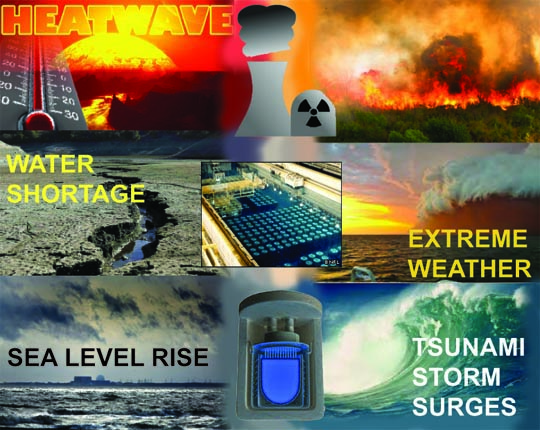 North Korea floods kill 22, approach nuclear reactor — but Kim doesn’t want help, WP, By Simon Denyer August 14, 2020 , TOKYO — Flooding caused by weeks of unusually heavy monsoon rains has killed at least 22 people in North Korea, with four others missing, and even approached the country’s main nuclear reactor, but leader Kim Jong Un says he is too worried about coronavirus to accept outside help.
The International Federation of the Red Cross said the floods have left at least 22 people dead and four missing, citing the Democratic People’s Republic of Korea Red Cross and the country’s State Committee for Emergency and Disaster Management.
The floodwaters approached the Yongbyon nuclear complex last week, reaching the bases of two pump houses designed to cool the country’s main nuclear reactor, according to the 38 North website, citing satellite imagery.
The floodwaters have receded somewhat and pose “no imminent danger,” as the main reactor apparently has not been operating for some time and a nearby experimental light water reactor has yet to come online, said Jenny Town, deputy director of 38 North, part of the Stimson Center.
“But this year, the river level is usually high,” Town added. “If this were to happen when a reactor was running, it could cause problems in the cooling systems that would necessitate the reactors to be shut down.” ………. https://www.washingtonpost.com/world/north-korea-floods-kill-22-approach-nuclear-reactor–but-kim-doesnt-want-help/2020/08/13/f53992a8-ddda-11ea-b4f1-25b762cdbbf4_story.html
A Major Nuclear Arms Treaty Expires Next Year. What Happens Next?
 A Major Nuclear Arms Treaty Expires Next Year. What Happens Next? https://www.wunc.org/post/major-nuclear-arms-treaty-expires-next-year-what-happens-next
signed an updated strategic arms reduction treaty. Unless that agreement, New START, is renewed before February, the two largest nuclear arsenals will be unconstrained for the first time since the height of the Cold War.
A Major Nuclear Arms Treaty Expires Next Year. What Happens Next? https://www.wunc.org/post/major-nuclear-arms-treaty-expires-next-year-what-happens-next
signed an updated strategic arms reduction treaty. Unless that agreement, New START, is renewed before February, the two largest nuclear arsenals will be unconstrained for the first time since the height of the Cold War.The impending deadline is a reminder that the possibility of nuclear warfare did not end with the Cold War, nor is North Korea the sole threat. In fact, expert Alexandra Bell suggests that domestic nuclear accidents, like the one in Goldsboro, North Carolina in 1961, are also a major threat. The infrastructure is aging, agrees Michaela Dodge, who argues that modernization is essential to the safety and effectiveness of strategic weapons in deterrence policy.
So what is the price tag of those upgrades?
Host Frank Stasio talks with Bell and Dodge about the risks, benefits and costs of maintaining strategic nuclear weaponry as the U.S. approaches the expiration of New START. Bell is the senior policy director for the Center for Arms Control and Non-Proliferation. Dodge is a research scholar at the National Institute for Public Policy.
Malaysia rejects nuclear power, focuses on renewable energy
Khairy says nuclear energy ‘not on the table’ for now, focus on renewable energy sources, Malay Mail, Friday, 14 Aug 2020, BY YISWAREE PALANSAMY KUALA LUMPUR, — Science, Technology and Innovation Minister Khairy Jamaluddin said today that the idea to develop nuclear energy as a power source will be a last option for Malaysia, as there are many other sources of energy in the same category which the country has yet to explore.
The Rembau MP said that his ministry is not considering nuclear energy development for now…..
In February, then Prime Minister Tun Dr Mahathir Mohamad spoke of the inherent need for a more non-polluting renewable energy source for the world, but rejected nuclear energy source, over the fear of the radioactive level in its waste.
Dr Mahathir pointed out that Malaysia does not have enough expertise in science that is needed to manage nuclear power.
He also expressed worry about the long-term effects of radioactive waste.
In July 2018, Yeo announced that the then PH government would not be building nuclear power plants or explore nuclear energy.
In winding up her ministerial reply on the 2020 Budget in Parliament last year, Yeo also announced that the Malaysian Nuclear Power Corporation (MNPC) would be shut down. ……. https://www.malaymail.com/news/malaysia/2020/08/14/khairy-says-nuclear-energy-not-on-the-table-for-now-focus-on-renewable-ener/1894036
Nuclear weapons countries have an obligation to lead in nuclear weapons control – U.N.
 Urgent need’ to stop erosion of nuclear order, major UN disarmament forum hears, UN News, 14 Aug 20
“There is an urgent need to stop the erosion of the nuclear order. All countries possessing nuclear weapons have an obligation to lead”, Director-General of the UN Office at Geneva (UNOG) Tatiana Valovaya, told the Conference on Disarmament, which she also heads.
Impetus moving forward
Ms. Valovaya noted that 2020 was a year of important disarmament milestones, including the 75th anniversary of the Organization’s founding, and of the atomic bombings of Hiroshima and Nagasaki, along with the 50th anniversary of the entry into force of the Nuclear Non-Proliferation Treaty.
She maintained that they should generate momentum to do more to counter the erosion of the disarmament, arms control and non-proliferation architecture, encouraging more constructive work to “negotiate new global legal instruments, including in this Conference”.
She urged participants to “jointly reflect on these issues” and what they mean for the Conference.
Upholding that the body remains an “extraordinary platform for dialogue and confidence-building”, she expressed encouragement over its members’ determination to resume meetings and stood ready, with the Secretariat, to support its work.
Funding shortfall
Speaking as UNOG chief, Ms. Valovaya explained that the Secretariat was facing “a severe liquidity crisis”.
“While we are sparing no effort to identify ways to re-prioritize and make bridge funding available”, she informed that the Office in Geneva “has not received sufficient funding for normal operations through to the year’s end”.
And this comes on top of “unforeseen expenses related to the COVID-19 pandemic”.
She said that her office would soon be briefing Member States in Geneva on the situation, measures and outlook going forward for the rest of the year……. https://news.un.org/en/story/2020/08/1070142
Renewable energy a better choice for Ohio, than nuclear bailout
Robots may be used for clean-up of highly radioactive areas of UK’s Dounreay nuclear complex

and taking apart the most highly radioactive areas of Dounreay. The nuclear
power complex on the Caithness coast near Thurso is being decommissioned.
Dounreay’s operator said they were working with Robotics and Artificial
Intelligence in Nuclear (Rain), a consortium of universities. Led by the
University of Manchester, they are exploring the potential for using robots
in the Fuel Cycle Area (FCA), which has the most contaminated parts of the
site.
most inaccessible”. A group of scientists from Rain carried out trials
earlier this year in the FCA laboratories of a small remotely operated
vehicle equipped with sensors, cameras and a manipulator “arm”.
https://www.bbc.co.uk/news/uk-scotland-highlands-islands-53763880
1 This Month

of the week – Shut Down Drone Warfare!


Tell the Ukrainian Government to Drop Prosecution of Peace Activist Yurii Sheliazhenko

Petition to revoke the licensing of the Near Surface Nuclear Disposal Facility (NSDF) at Chalk River. https://www.ourcommons.ca/petitions/en/Petition/Details?Petition=e-7247
To see nuclear-related stories in greater depth and intensity – go to https://nuclearinformation.wordpress.com
-
Archives
- April 2026 (114)
- March 2026 (251)
- February 2026 (268)
- January 2026 (308)
- December 2025 (358)
- November 2025 (359)
- October 2025 (376)
- September 2025 (257)
- August 2025 (319)
- July 2025 (230)
- June 2025 (348)
- May 2025 (261)
-
Categories
- 1
- 1 NUCLEAR ISSUES
- business and costs
- climate change
- culture and arts
- ENERGY
- environment
- health
- history
- indigenous issues
- Legal
- marketing of nuclear
- media
- opposition to nuclear
- PERSONAL STORIES
- politics
- politics international
- Religion and ethics
- safety
- secrets,lies and civil liberties
- spinbuster
- technology
- Uranium
- wastes
- weapons and war
- Women
- 2 WORLD
- ACTION
- AFRICA
- Atrocities
- AUSTRALIA
- Christina's notes
- Christina's themes
- culture and arts
- Events
- Fuk 2022
- Fuk 2023
- Fukushima 2017
- Fukushima 2018
- fukushima 2019
- Fukushima 2020
- Fukushima 2021
- general
- global warming
- Humour (God we need it)
- Nuclear
- RARE EARTHS
- Reference
- resources – print
- Resources -audiovicual
- Weekly Newsletter
- World
- World Nuclear
- YouTube
-
RSS
Entries RSS
Comments RSS
 nuclear-news