The Prospects of Nuclear Disarmament in the New Nuclear Architecture,
The Prospects of Nuclear Disarmament in the New Nuclear Architecture, Modern Diplomacy August 21, 2020, By Hamzah Taoqeer
The debate for arms control and nuclear disarmament has been unfortunately for long has been played as self-serving and hollow pledges by the major NWS which have failed to deliver upon them. The withdrawal from the INF would lead to further lowering of the nuclear threshold as the US would actively develop and deploy tactical nuclear weapons in regions of interest including Asia Pacific and Eastern Europe. The new nuclear architecture developed by the actions of major powers further weaken and deteriorate the efficacy of institutional norms. The efficacy and credibility of new initiatives such as CEND among other remains questionable as the P5 have failed to deliver measurable progress upon the existing arms control and disarmament initiatives.
The emerging nuclear architecture blur the legitimacy of the arms control initiatives and further encourage NNWS to pursue for alternative measures including nuclear weapons program to secure their interests. Thus, resulting in proliferation of nuclear weapons which threaten world peace and security. The major powers should for once initiate a robust implementation upon their aforementioned commitments in good faith rather than devising frameworks for achieving their limited interests……………. https://moderndiplomacy.eu/2020/08/21/the-prospects-of-nuclear-disarmament-in-the-new-nuclear-architecture/
Debate rages on for nuclear waste facility proposed near Carlsbad, more hearings scheduled
|
Debate rages on for nuclear waste facility proposed near Carlsbad, more hearings scheduled
Adrian Hedden, Carlsbad Current-Argus, 20 Aug 20, A project to build a temporary storage facility for high-level nuclear waste in southeast New Mexico will continue to be debated as the federal Nuclear Regulatory Commission scheduled four more public hearings to solicit public feedback on the proposal.Holtec International’s proposed consolidated interim storage facility (CISF) would temporarily hold spent nuclear fuel rods at the surface in an area near the Eddy-Lea county line…….. opponents continued to question the safety of the project and its plan to transport spent nuclear fuel from generators across the county and the legality of opening a temporary storage facility when the U.S. lacks a permanent repository for high-level nuclear waste…… The hearings were planned to be held online on Aug. 20 from 4 to 7 p.m., Aug. 25 from noon to 3 p.m., Aug. 26 from 4 to 7 p.m. and Sept. 2 from 9 a.m. to noon. Previously, the NRC held public meetings on the EIS on June 23 and July 9. Written comments were to be accepted until Sept. 22 via email to Holtec-CISFEIS@nrc.gov, via mail to the Office of Administration, Mail Stop: TWFN-7-A60M, ATTN: Program Management, Announcements and Editing Staff, U.S. Nuclear Regulatory Commission, Washington, DC or online to the federal government’s rulemaking page at regulations.gov using docket ID NRC-2018-0052………… Project debated by New Mexico officials, nuclear industry leadersNew Mexico Gov. Michelle Lujan Grisham and state officials voiced continued disapproval of the project, with Lujan Grisham writing a letter to President Donald Trump to voice her opposition last month. Lujan Grisham cited concerns the project could imperil the environment in New Mexico and threaten to disrupt local agriculture and extraction industries in the southeast region of the state…….. https://www.currentargus.com/story/news/local/2020/08/20/debate-rages-nuclear-waste-facility-proposed-near-carlsbad/5604978002/ |
|
Report: Israel ‘deeply concerned’ by Saudi Arabia, China alleged nuclear cooperation,
|
Report: Israel ‘deeply concerned’ by Saudi Arabia, China alleged nuclear cooperation, MEMO, Middle East Monitor, August 21, 2020 Israel’s Walla news website revealed that Tel Aviv has informed the United States that it was “gravely” concerned by alleged nuclear cooperation between Saudi Arabia and China.The website said senior Israeli intelligence officials had called their American counterparts to express their “grave concern” about the cooperation between Riyadh and Beijing.
According to the site, “unnamed” Israeli officials said there was a secret factory of primitive materials used in uranium enrichment in Saudi Arabia near the capital, Riyadh, explaining that the Wall Street Journal and the New York Times were the first to report on it, including satellite images of the factory. The officials pointed out that the office of Prime Minister Benjamin Netanyahu deals with the file as “very sensitive” politically since Israel considers Saudi Arabia an important ally in the face of Iran. The officials added that the Israeli intelligence services, the ministries of foreign affairs, intelligence and defence, and the Atomic Energy Commission are following the developments of the Saudi nuclear program………. According to Israeli officials, Saudi Arabia has cooperated with China, because the Chinese did not ask for guarantees that the programme would be purely civilian, which is what the United States always demands. https://www.middleeastmonitor.com/20200821-report-israel-deeply-concerned-by-saudi-arabia-china-alleged-nuclear-cooperation/ |
|
U.S. Democratic Party not really interested in reducing the bloated military spending

War, Peace and the Democrats, Common Wonders, Wednesday, August 19th, 2020 By Robert C. Koehler
 “There’s something happening here/What it is ain’t exactly clear . . .”
Or is it? “……………………………Yes, there are progressive, antiwar Democrats out there, gaining power, getting elected to office, almost winning presidential primaries — scaring the bejesus out of the Democratic establishment — but the party itself still stands firmly in the middle of nowhere, fully in favor of empathy and compassion and yet, somehow, fully supportive of the endless wars most of its own voters hate and utterly unwilling to challenge the bloated and ever-expanding defense budget.Citing the analysis of William Hartung and Many Smithberger, the Milwaukee Independent described that budget thus: “As of 2019, the annual Pentagon base budget, plus war budget, plus nuclear weapons in the Department of Energy, plus military spending by the Department of Homeland Security, plus interest on deficit military spending, and other military spending totaled $1.25 trillion . . .”
Indeed, as Alexander Sammon points out in the American Prospect, Democratic majorities were crucial this summer to the defeat of three separate bills, introduced by progressive Democrats, to reduce military spending and/or undo the militarization of police departments. These included amendments in both the Senate and the House to the National Defense Authorization Act, diverting 10 percent of the Department of Defense budget to health care, education and jobs; as well as a Senate proposal to end the 1033 Program, which allows the Pentagon to transfer military gear to the police. The amendment’s defeat in the House was especially an outrage, Sammon notes, in that the Dems hold a majority in the House and could have passed it.
“If Democrats are going to enact anything that resembles their own agenda,” Sammon writes, “they’re going to have to aim way higher than cutting defense to near Obama-era highs. Taking military spending not to pre-Trump but to pre-9/11 levels should be a starting point. Democratic voters abhor the War on Terror; it’s what helped deliver Obama the presidency back in 2008. It’s incumbent on Joe Biden to deliver on that preference, not just to end engagements in Iraq and Afghanistan but to bring an end to the bloated defense budgets of the War on Terror era. His silence on the proposal even in the thick of a campaign against Trump sends a troubling message.”
Climate, weather extremes, threaten nuclear reactors, and costs of preparing for them are increasing
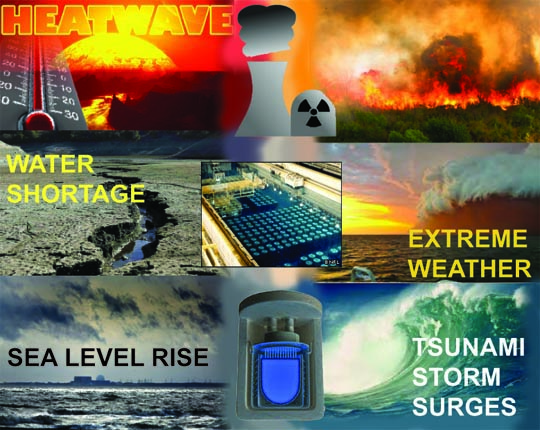
Dozens of US nuclear power plants at risk due to climate change: Moody’s, S and P Global, Author Steven Dolley Washington Editor, Keiron Greenhalgh 19 Aug 20
37 GW of nuclear capacity at risk from flooding
48 GW at risk from heat, water stress
Merchant plants have fewer options to recover mitigation costs
Washington — Dozens of US nuclear power plants, comprising nearly half the country’s operational nuclear generating capacity, “will face growing credit risks” in the next 10 to 20 years due to flooding, hurricanes, heat stress and other predicted impacts of climate change, Moody’s Investors Service said in a report Aug. 18.
“The consequences of climate change can affect every aspect of nuclear plant operations – from fuel handling and power and steam generation to maintenance, safety systems and waste processing,” the report said, noting that “the severity of these risks will vary by region, with the ultimate credit impact depending on the ability of plant operators to invest in mitigating measures to manage these risks.”
Moody’s did not specify mitigation measures that are being, or should be, taken.
Water cooling needs expose plants to the risk of flooding, sea-level rise and hurricanes, and “about 37 gigawatts (GW) of US nuclear capacity [have] elevated exposure to flood risk,” Moody’s said.
Also, the report noted, “rising heat and water stress can have an adverse impact on plant operations,” with “about 48 GW of nuclear capacity [having] elevated exposure to combined rising heat and water stress.”
“Regulated or cost-based nuclear plants,” comprising about 55 GW of capacity in the US, “face elevated heat and water stress across most locations, with moderate to high risk of floods, hurricanes, and sea level rise for certain coastal plants,” Moody’s said. However, it added: “The credit impact of these climate risks is likely to be more modest for operators of these nuclear plants, relative to market-based plants, because they have the ability to recoup costs through rate recovery mechanisms.”
By contrast, “market-based plants,” with a total of about 44 GW of capacity, “face elevated heat stress and more water stress than regulated/cost-based plants, with fewer plants at risk of floods and hurricanes,” it said.
The highest risk, or “red flag,” category includes plants that are “highly exposed to historical and/or projected risks, indicating high potential for negative impacts,” Moody’s said.
According to the report, five plants with a combined capacity of about 9.1 GW are in the red flag category for floods. Some 13 plants with a combined capacity of about 23.8 GW were found to be at red-flag risk for heat stress. The categories of hurricanes, sea level rise and water stress each had one plant expected to be at red-flag risk.
Because some US nuclear units “are seeking to extend their operations by 20, or even 40 years,” Moody’s said, “operators will have to consider these risks when implementing resilience measures.”………. https://www.spglobal.com/platts/en/market-insights/latest-news/electric-power/081820-dozens-of-us-nuclear-power-plants-at-risk-due-to-climate-change-moodys
Climate change a problem for nuclear waste dumps
 Climate change included in nuclear waste study, Dryden now, August 2020 by Mike Aiken
 Experts with the Nuclear Waste Management Organization are adjusting their forecasts for the Ignace area, so they include the possibility of more rainfall. The adjustment will allow for climate change, including the possibility of extreme weather and increased flooding.
“This is the first time this modelling work has been done for a potential repository location and any assessment of sites for the safe storage of used nuclear fuels must take into account the potential future impact of climate change on its infrastructure,” said Kelly Liberda, who is a senior engineer with Golder Associates, who are working on the site selection process.
“While it’s difficult to project the extent to which precipitation could fluctuate in specific geographic areas, the NMWO is taking steps to anticipate the most likely scenarios,” Liberda added.
Based on a multi-model assessment of publicly available data, the Golder Associates study found that both one-day probable maximum precipitation and one-day rainfall events in the Ignace study area are projected to increase in the 2050s and 2080s. …….
Global heating now posing physical and financial risks to U.S. nuclear reactors
|
A new report from Moody’s shows that a warming world may cause more service disruptions in the US. Climate change—particularly intense heat—is advancing so rapidly that it poses physical as well as credit risks to America’s aging nuclear fleet, a new report from Moody’s Investors Service finds. “Our plants are fairly hardened to severe weather,” said David Kamran, a projects and infrastructure analyst at Moody’s and the lead author of the report. “But climate change is moving quickly.” ……… in 2011, the US Nuclear Regulatory Commission asked domestic plants to conduct their own assessments of risks from climate change and other natural hazards. A 2019 Bloomberg review of correspondence between the commission and owners of 60 plants concerning those assessments found that 54 of their facilities weren’t designed to handle the flood risk they now face. ……. The new report is the result of an analysis conducted by Four Twenty Seven Inc, a climate risk data company Moody’s acquired last year. The group evaluated the potential effects of heat stress, water stress, hurricanes, flooding, and rising sea levels on 57 US nuclear power plants over the next 20 years. It found that while a handful of plants—including Cooper Nuclear Station in Nemaha, Neb. and Prairie Island in Goodhue, Minn.—face severe risk from floods, far more either will face or already face “red flag” conditions from heat. Nuclear plants are cooled by water, and in times of intense heat and drought, water resources can become either too warm or too scarce, forcing shutdowns. This has already happened, and not just in the South: in 2012, Dominion Energy Inc’s Millstone nuclear plant in Waterford, Conn. The report predicts that nuclear plants in the Rocky Mountain states, the Colorado River region, and California face the highest levels of water stress risk going forward. …… the report was meant to highlight the extent of the environmental pressures plants will have to adapt to withstand if they want to operate consistently in the coming decades. Resisting those stresses is potentially expensive— even more expensive than the plants have currently estimated, he said: “In certain cases they will need to make investments to further reinforce their plants and they need to have money in their cap-ex funds to do that.” https://www.livemint.com/news/world/nuclear-plants-face-more-heat-risk-than-they-re-prepared-to-handle-11597848362280.html |
|

Bill McKibben not sure that Kamala Harris will be strong on addressing climate change
|
We’re in the Kamala Harris era now, and so far, so good. Of the four people on the major-party Presidential tickets, she appears to be the most energetic and normal………. Listening to Joe Biden speak, I feel a constant mild apprehension about what may emerge; Harris relaxes me.
Given the very real possibility that she’ll be at or near the pinnacle of our politics for somewhere between four and sixteen years, it’s worth asking how she will handle the gravest crisis that looms over our planet. That’s not the same as asking if she should be elected, because, on climate issues, a shrink-wrapped pallet of frozen Ore-Ida French fries would be a vast improvement on the incumbent. But it’s going to take an unflinching, unrelenting effort to transform America’s energy system and lead a similar process globally. Is she committed to that?
Her defenders point to a number of powerful statements that she made over the course of her Presidential primary campaign. She’d eliminate the filibuster to pass a Green New Deal. She’d tell the Department of Justice to investigate oil and gas companies. ………
Harris has been particularly outspoken about environmental injustice: just six days before she got the V.P. nod, she joined Alexandria Ocasio-Cortez to introduce the Climate Equity Act, which, as the Times explained, “would create a dedicated Office of Climate and Environmental Justice Accountability within the White House and require the federal government to rate the effect that every environmental legislation or regulation would have on low-income communities.”
If there’s a rub, it’s that, to date, she hasn’t been that eager to really stand up to power on this issue. ……. What will she do if she becomes Vice-President? I imagine that her courage will depend on the climate movement’s success in eroding the political power of the oil companies. The weaker the fossil-fuel conglomerates become, the less scary they are. (Oil barons understand this, which is why they’re spending large sums to reëlect Trump). My guess is that Harris is a run-of-the mill politician, who will go where the footing is easiest. ………. (Note to Joe Biden.) The Sunrise Movement—the group of under-thirties who organized the sit-in at House Speaker Nancy Pelosi’s office that served as a coming-out party for the Green New Deal—produced a YouTube video for Markey last week, which may be my favorite political ad of all time. (Watch till the end for one of the best knife twists in campaign history). If Markey wins, he will go back to the Senate a national progressive hero; more to the point, he will have demonstrated that truly taking on climate change can pay off politically. That lesson won’t be lost on anyone, Harris included. ………. Obvious but important: a new study from Climate Central found that as temperatures rise, so does demand for air-conditioning. It projects that, by 2050, demand for air-conditioning will rise in the United States by fifty-nine per cent—and far more than that around the world. That is why we need highly efficient air-source heat pumps, which also cool air, and why we need enormous amounts of renewable electricity to power it all. …… Scoreboard ⬇️ Big number on the board this week: a hundred and thirty degrees Fahrenheit (54.4 degrees Celsius), which is the highest reliably recorded temperature ever on planet Earth. It happened over the weekend, in California’s Death Valley, which is also the place where the nominal Earth temperature record of a hundred and thirty-four degrees Fahrenheit was set, in 1931. That number, though, has been disputed ever since, and the great weather historian Christopher Burt published a lengthy investigation, in 2016, proving it could not have happened. For now, a hundred and thirty degrees is the mark—but don’t expect it to last. ……..Extraordinarily bad fire news from across the planet. In the Amazon, fires are burning at a rate not seen for a decade. In Siberia, fires may be burning at a rate we’ve never previously seen—and the heating, drying region may be on the verge of moving into a new and extreme “fire regime.” In Colorado and elsewhere in the American West, this year’s fire season has begun in earnest. The forests surrounding Hanging Lake—one of the state’s premier tourist sites—almost burned. The fourteen-year-old climate activist Haven Coleman reports via Twitter: “Even inside my house it’s hazy. . . . Feels like I’m being cornered, trapped. Stuck home since there’s covid everywhere, but NOW my home is becoming unbreathable. Everything sucks. Ugh.” Indeed. By midweek, evacuations were under way in California, where fires were threatening the city of Vacaville and other parts of Napa and Sonoma. …….The two-thousands were, officially, the hottest decade on record, up 0.39 degrees Celsius from the previous decade, which is a huge change in ten years’ time. It’s an urgent reminder that the next decade may be our final chance to take serious climate action A new study in Nature confirms that the effect of the pandemic on the planet’s temperature was negligible—greenhouse-gas emissions fell, but much of the smog that tends to cool the planet also disappeared. “These results highlight that without underlying long-term system-wide decarbonization of economies, even massive shifts in behaviour, only lead to modest reductions in the rate of warming,” the authors wrote. They also, however, noted some good news: “Pursuing a green stimulus recovery out of the post-covid-19 economic crisis can set the world on track for keeping the long-term temperature goal of the Paris Agreement within sight.” |
|

NuScam’s not so small nuclear reactors need $1.4 billion subsidy, and might not be so safe
 Smaller, cheaper [?] reactor aims to revive nuclear industry, but design problems raise safety concerns, Science, By Adrian Cho, Aug. 18, 2020 Engineers at NuScale Power believe they can revive the moribund U.S. nuclear industry by thinking small. Spun out of Oregon State University in 2007, the company is striving to win approval from the U.S. Nuclear Regulatory Commission (NRC) for the design of a new factory-built, modular fission reactor meant to be smaller, safer, and cheaper than the gigawatt behemoths operating today. But even as that 4-year process culminates, reviewers have unearthed design problems, including one that critics say undermines NuScale’s claim that in an emergency, its small modular reactor (SMR) would shut itself down without operator intervention.The issues are typical of the snags new reactor designs run into on the road to approval, says Michael Corradini, a nuclear engineer at the University of Wisconsin, Madison. “I don’t think these things are show-stoppers.” However, M. V. Ramana, a physicist who studies public policy at the University of British Columbia, Vancouver, and has been critical of NuScale, says the problems show the company has oversold the claim that its SMRs are “walk-away safe.” “They have given you the standard by which to evaluate them and they’re failing,” Ramana says.
Passive safety?
Normally, convection circulates water—laced with boron to tune the nuclear reaction—through the core of NuScale’s reactor (left). If the reactor overheats, it shuts down and valves release steam into the containment vessel, where it conducts heat to a surrounding pool and condenses (center). The water flows back into the core, keeping it safely submerged (right). But the condensed water can be low in boron, and reviewers worried it could cause the reactor to spring back to life………..
NuScale’s likely first customer, Utah Associated Municipal Power Systems (UAMPS), has delayed plans to build a NuScale plant, which would include a dozen of the reactors, at the Department of Energy’s (DOE’s) Idaho National Laboratory. The $6.1 billion plant would now be completed by 2030, 3 years later than previously planned, says UAMPS spokesperson LaVarr Webb. ……… The delay will give UAMPS more time to develop its application for an NRC license to build and operate the plant, Webb says. The deal depends on DOE contributing $1.4 billion to the cost of the plant, he adds.
……… A NuScale reactor—which would be less than 25 meters high, hold about one-eighth as much fuel as a large power reactor, and generate less than one-tenth as much electric power—would rely on natural convection to circulate the water
……….. In March, however, a panel of independent experts found a potential flaw in that scheme. To help control the chain reaction, the reactor’s cooling water contains boron, which, unlike water, absorbs neutrons. But the steam leaves the boron behind, so the element will be missing from the water condensing in the reactor and containment vessel, the NRC’s Advisory Committee on Reactor Safeguards (ACRS) noted. When the boron-poor water re-enters the core, it could conceivably revive the chain reaction and possibly melt the core, ACRS concluded in a report on its 5–6 March meeting.https://www.sciencemag.org/news/2020/08/smaller-cheaper-reactor-aims-revive-nuclear-industry-design-problems-raise-safety
Greta Thunberg on the global inaction on climate change
Greta Thunberg: the world is still in a state of climate crisis denial https://www.theguardian.com/environment/2020/aug/19/another-two-years-lost-to-climate-inaction-says-greta-thunberg, Damian Carrington Environment editor @dpcarrington, Wed 19 Aug 2020 Two years on from Greta Thunberg’s first solo school strike for the climate, she says the world has wasted the time by failing to take the necessary action on the crisis.
Thunberg’s strike inspired a global movement, and on Thursday she and other leading school strikers will meet Angela Merkel, the chancellor of Germany, which holds the rotating presidency of the European council. They will demand a halt to all fossil fuel investments and subsidies and the establishment of annual, binding carbon budgets based on the best science.
“Looking back [over two years], a lot has happened. Many millions have taken to the streets … and on 28 November 2019, the European parliament declared a climate and environmental emergency,” Thunberg said in an article for the Guardian with fellow strikers Luisa Neubauer, Anuna de Wever and Adélaïde Charlier.
“But over these last two years, the world has also emitted over 80bn tonnes of CO2. We have seen continuous natural disasters taking place across the globe. Many lives and livelihoods have been lost, and this is only the very beginning.”
They said leaders were speaking of an “existential crisis”, yet “when it comes to action, we are still in a state of denial. The gap between what we need to do and what’s actually being done is widening by the minute. Effectively, we have lost another two crucial years to political inaction.”
Thunberg and her colleagues said fighting the climate emergency must involve rich nations stopping some of their polluting activities.
- “However, it’s a fact which most people refuse to accept. Just the thought of being in a crisis that we cannot buy, build or invest our way out of seems to create some kind of collective mental short-circuit. This mix of ignorance, denial and unawareness is the very heart of the problem,” they said.
The trillions of dollars being spent by governments in response to the coronavirus pandemic are seen as a once-in-a-lifetime opportunity to put the world on course to halt global heating, with economists, scientists and health experts all saying the benefits would outweigh the costs.
However, G20 governments’ rescue packages are giving significantly more support to fossil fuels than to low-carbon energy. Germany’s recovery plan includes €40bn for climate measures such as electric vehicles, public transport and energy efficiency, and has been praised by green groups. But elsewhere, too little is being done, Thunberg and colleagues said.
“Even a child can see that the policies of today are incompatible with the current best available science,” they said.
- Scientists calculate that global carbon emissions must be cut by half by the end of this decade if humanity is to have a reasonable chance of keeping temperature rises to below 1.5C, the limit set in the Paris climate deal. Drops in emissions during coronavirus lockdowns are only a small blip in a long-term rising trend and will have a “negligible” effect on the climate crisis, researchers say.
“We understand the world is complicated and that what we are asking for may not be easy or seem unrealistic,” said the school strikers. “But it is much more unrealistic to believe that our societies would be able to survive the global heating we’re heading for. We are inevitably going to have to fundamentally change, one way or another. The question is: will the changes be on our terms, or on nature’s terms?”
Biggest bribery and money-laundering bust in Ohio history, but the crooked pro nuclear law still stands!
 Opinion: How bad nuclear plant bailout legislation got passed
Now the law is forcing Ohio taxpayers to cough up $1.3 billion in subsidies to prop up two aging nuclear plants – quashing cheaper natural gas and zero-emissions renewables like wind and solar. It also memorialized taxpayer subsidies for ailing coal plants – including, because Householder and his alleged co-conspirators were apparently feeling neighborly, for a coal plant across the border in Indiana.
But let’s not lose sight of FirstEnergy. The opaque electric utility had already long shirked accountability for its actions, cloaking itself in expendable subsidiaries and opposing virtually any measure to improve Ohio’s air and water, which the utility has long been responsible for befouling. This time, to protect its toxic nuclear and coal assets, the company apparently happily engaged in what even the scheme’s conspirators allegedly openly referred to as “pay to play,” buying Ohio lawmakers for a song compared to the $1.3 billion the utility now stands to skim from Ohioans’ pockets.
We have yet to see how many more dominoes fall. There’s Sam “The Randazzler” Randazzo, the supposed ex-lobbyist and current public utilities commission chair, who seems to have much to answer for in the scheme. And FirstEnergy, it appears, didn’t stop at allegedly buying Ohio politicians. Even after the law passed, it spent another $38 million in an apparent dark-money campaign to make sure it’d stopped Ohio’s vital transition to a clean energy economy – the prospect of thousands of new clean jobs, not to mention saving the Earth, apparently not enough when compared to FirstEnergy profit margins and executives’ Christmas bonuses
Even as the feds continue following the money, we know what must happen: Gov. DeWine, who unenthusiastically signed the bill, is now calling for its repeal – a crucial first step toward righting this eye-popping wrong. As we now know, courtesy of the FBI and Justice Department, supporting these ailing power plants was nothing more than a successful bid to line executives’ pockets – and, it seems, buy the house speaker a vacation home in Florida. As we continue to learn who knew what when, erasing this law will clear the way for cleaner, far cheaper, truly market-competitive resources like natural gas and renewables to power our homes and businesses.
Ohioans deserve better – more honest politicians, truly transparent electricity providers, cleaner air and water. Repealing this law, and holding our officials to account, is the way to get there.
Jigar Shah is president of Generate Capital, a San Francisco-based finance company that builds, owns and operates renewable energy infrastructure.
High financial risks in nuclear power – from global heating
Climate change poses high credit risks for nuclear power plants, Moody’s says, https://www.reuters.com/article/us-moody-s-powerplants/climate-change-poses-high-credit-risks-for-nuclear-power-plants-moodys-says-idUSKCN25E2A5 (Reuters) Reporting by Diptendu Lahiri in Bengaluru; Editing by Steve Orlofsky, 19 Aug 20
– Credit risks associated with climate change for nuclear power plant operators in the United States will rise over the next 10 to 20 years, Moody’s Investor Service said on Tuesday.Climate change can affect every aspect of nuclear plant operations like fuel handling, power and steam generation, maintenance, safety systems and waste processing, the credit rating agency said.
However, the ultimate credit impact will depend upon the ability of plant operators to invest in mitigating measures to manage these risks, it added.
Close proximity to large water bodies increase the risk of damage to plant equipment that helps ensure safe operation, the agency said in a note.
Moody’s noted that about 37 gigawatts (GW) of U.S. nuclear capacity is expected to have elevated exposure to flood risk and 48 GW elevated exposure to combined rising heat and water stress caused by climate change.
Nuclear plants seeking to extend their operations by 20, or even 40 years, beyond their existing 40-year licenses face this climate hazard and may require capital investment adjustments, Moody’s said.
“Some of these investments will help prepare for the increasing severity and frequency of extreme weather events.”
Book Review- Tempting Fate
LESSONS FROM CONFLICTS BETWEEN NUCLEAR AND NON-NUCLEAR STATES. War on the Rocks ALEXANDER LANOSZKA, AUGUST 19, 2020
Paul Avey, Tempting Fate: Why Nonnuclear States Confront Nuclear Opponents (Ithaca, NY: Cornell University Press, 2019)
With Tempting Fate, Paul C. Avey makes an invaluable contribution to our understanding of nuclear politics. Written in clear and accessible prose, Avey explains why some non-nuclear weapons states have challenged and resisted nuclear weapons states despite the existential risks involved. …………..
Is the £20 billion Sizewell C project right for the region and country?
 East Anglia’s nuclear option – is the £20 billion Sizewell C project right for the region and country? ANGLIA
The electricity company EDF plans to build a new nuclear power station on the Suffolk coast, but what will that mean for our region?
How will it impact local people and the environment? And what role does nuclear power play in the East as the country moves towards zero carbon emissions by 2050?
-
- EDF proposes building a twin nuclear reactor at a cost of £20 billion pounds. .
- ………………..It’s expected to operate for 60 years.
- The whole project will take around 10-12 years to build with a construction site covering 620 acres.
-
also a fear that it will come at a cost to existing businesses – especially the tourism industry.
One of those concerned is local brewery Adnams.
Andy Wood from Adnams said: “The tourism industry employs nearly 100,000 people, the value of tourism in Norfolk and Suffolk is about £5.4 billion, and all of these things are going to be impacted by a large construction infrastructure project.”
The impact on wildlife is also raising concerns.
At RSPB Minsmere – an internationally important wildlife reserve – there are serious concerns about how noise and pollution would irrevocably damage rare wildlife habitats and species.
Adam Rowlands, from RSPB Suffolk, said: “We’re concerned about the direct impact, so the noise, the visual disturbance, in essence that could change the patterns of the birds and the other species that use the area.”
…… People have until September 30 to give their views before a decision is made.
U.S. Air Force mulls getting hypersonic nuclear weapons
US Air Force may have accidentally revealed interest in hypersonic nuke, Defense News By: Valerie Insinna 19 Aug 20, WASHINGTON — The U.S. Air Force has issued, and quietly revoked, a solicitation to industry seeking technologies that would support a hypersonic glide vehicle capable of traversing intercontinental ranges, potentially signaling the military’s interest in a hypersonic nuclear weapon.
According to an Aug. 12 request for information first reported by Aviation Week, the Air Force Nuclear Weapons Center sought ideas for potential upgrades to intercontinental ballistic missiles, including a “thermal protection system that can support [a] hypersonic glide to ICBM ranges.”
The items listed as potential ICBM upgrades were all marked “unclassified/for official use only,” which notes information that — while not secret — is not normally released to the public. The RFI was then withdrawn after Aviation Week began inquiring about it, the report noted.
Asked about the RFI on Wednesday, Lt. Gen. Richard Clark, the Air Force’s deputy chief of staff for strategic deterrence and nuclear integration, said the service’s next-generation ICBMs — known as the Ground Based Strategic Deterrent — will not be available as a hypersonic variant when it is fielded in the late 2020s…………
As the sole bidder in the GBSD competition, Northrop Grumman is expected to win an estimated $85 billion over the life of the program. A contract award is slated to occur by September, although Northrop CEO Kathy Warden said in April that she expected a decision this month. https://www.defensenews.com/smr/nuclear-arsenal/2020/08/19/the-air-force-might-be-eyeing-a-hypersonic-nuclear-weapon/
1 This Month

of the week – Shut Down Drone Warfare!


Tell the Ukrainian Government to Drop Prosecution of Peace Activist Yurii Sheliazhenko

Petition to revoke the licensing of the Near Surface Nuclear Disposal Facility (NSDF) at Chalk River. https://www.ourcommons.ca/petitions/en/Petition/Details?Petition=e-7247
To see nuclear-related stories in greater depth and intensity – go to https://nuclearinformation.wordpress.com
-
Archives
- April 2026 (114)
- March 2026 (251)
- February 2026 (268)
- January 2026 (308)
- December 2025 (358)
- November 2025 (359)
- October 2025 (376)
- September 2025 (257)
- August 2025 (319)
- July 2025 (230)
- June 2025 (348)
- May 2025 (261)
-
Categories
- 1
- 1 NUCLEAR ISSUES
- business and costs
- climate change
- culture and arts
- ENERGY
- environment
- health
- history
- indigenous issues
- Legal
- marketing of nuclear
- media
- opposition to nuclear
- PERSONAL STORIES
- politics
- politics international
- Religion and ethics
- safety
- secrets,lies and civil liberties
- spinbuster
- technology
- Uranium
- wastes
- weapons and war
- Women
- 2 WORLD
- ACTION
- AFRICA
- Atrocities
- AUSTRALIA
- Christina's notes
- Christina's themes
- culture and arts
- Events
- Fuk 2022
- Fuk 2023
- Fukushima 2017
- Fukushima 2018
- fukushima 2019
- Fukushima 2020
- Fukushima 2021
- general
- global warming
- Humour (God we need it)
- Nuclear
- RARE EARTHS
- Reference
- resources – print
- Resources -audiovicual
- Weekly Newsletter
- World
- World Nuclear
- YouTube
-
RSS
Entries RSS
Comments RSS
 nuclear-news