Petition to Wales Parliament – demands an environmental assessment on Hinkley nuclear mud dumping
Welsh Parliament Petitions (accessed) 7th Sept 2020, Demand an EIA now on the dumping of radioactively contaminated mud in Welsh waters. We, the undersigned, call on the Welsh Government to invoke the
Environment (Wales) Act 2016 in respect of uncertainties, and to ensure
that a full Environmental Impact Assessment (EIA) is carried out before any
further sediment from Hinkley Point nuclear power station can be dumped at
Cardiff Grounds. Don’t allow the Welsh government to break their own law!
Dominion Energy wants to prolong old nuclear reactors – yet again!
Dominion Energy applies for additional 20-year license for its North Anna Power Station nuclear reactor units, By JOHN REID BLACKWELL Richmond Times–Dispatch, 7 Sept 20,
Dominion Energy, Virginia’s largest utility company, is seeking approval from federal regulators to continue operating its two nuclear reactor units in Louisa County until the years 2058 and 2060.
The Richmond-based company said Friday it has filed an application with the Nuclear Regulatory Commission to renew the North Anna Power Station’s operating licenses for additional 20-year terms.
An approval of the license would allow the company to operate the two reactors beyond a current license extension that was granted in 2003, which enabled the company to run the reactors until 2038 and 2040.
The original licenses for the two North Anna reactor units were granted in 1978 and 1980. As with all U.S. nuclear power plants, the original licenses were granted for 40 years……….
The application has not been made public yet. The NRC staff will conduct an initial review and ensure that protected information such as security-related information is redacted before the application is made public.
Two other nuclear reactor plants in the U.S.—the Turkey Point Nuclear Generating Station in Florida and the Peach Bottom Nuclear Generating Station in Pennsylvania—already have received a second renewal for their reactor licenses. …. https://fredericksburg.com/news/local/dominion-energy-applies-for-additional-20-year-license-for-its-north-anna-power-station-nuclear/article_ad34f155-d01d-5a41-9e05-8a48fe78fcf5.html
India and China both have a nuclear no-first-use policy- nuclear war between them is less likely
India–China border dispute: the curious incident of a nuclear dog that didn’t bark, Bulletin of the Atomic Scientists, By Ramesh Thakur, Manpreet Sethi, September 7, 2020 On June 15, nuclear-armed China and India fought with fists, rocks, and clubs along the world’s longest un-demarcated and contested boundary. Twenty Indian soldiers were killed; Indian estimates put the Chinese dead at around 40. The two countries remain in a state of military standoff.
Like the case of the dog that didn’t bark, which interested the great fictional detective Sherlock Holmes, the nuclear dimension of the recent border clashes was conspicuous by its invisibility. This may be in part because of the nuclear no-first-use policy expressed in the official nuclear doctrines of both countries. At a time when geopolitical tensions are high in several potential nuclear theaters, the nuclear arms control architecture is crumbling, and a new nuclear arms race is revving, there is a critical need to look for ideas that can prevent potential crises from escalating. Other nuclear powers can learn from China’s and India’s nuclear policies.
The normalization of nuclear threats. Over the last few years, leaders of many of the nuclear weapons states have taken to nuclear bluster. After the outbreak of the Ukraine crisis and annexation of Crimea in 2014, facing hostile Western criticism, Russian President Vladimir Putin pointedly remarked, “Russia is one of the most powerful nuclear nations”—a subtle but clear nuclear warning to the West. In July 2016, asked in Parliament if she would be prepared to authorize a nuclear strike that could kill 100,000 people, British Prime Minister Theresa May unwaveringly answered, “Yes.” And who can forget the tit-for-tat exchange of belligerent rhetoric by US President Donald Trump and North Korean leader Kim Jong-un in 2017 before the blossoming of their bromance in 2018?
In February 2019, after an attack on Indian paramilitary forces at Pulwama led to a clash between the air forces of India and Pakistan, Pakistan’s Prime Minister Imran Khan warned of the possibility of a nuclear war. Indian Prime Minister Narendra Modi, caught in the heat of an election campaign, responded that India’s nukes were not reserved for celebrating the fireworks festival of Diwali. After India revoked Kashmir’s autonomous status that August, Khan reiterated that nuclear war was a real risk. His foreign minister repeated the warning in Geneva later that same year.
This rhetoric, besides being dangerous, has given rise to another problem. The more the leaders of the nuclear armed states revalidate the role of nuclear weapons in their national security, the more they embolden calls of nuclear weapons acquisition in other countries like Germany, Japan, South Korea and Australia.
China and India’s nuclear reticence. This is where China and India, in the midst of a military crisis, provide a striking contrast. Neither side has drawn attention to its nuclear weapons in the 2020 border clashes. Nor have many analysts across the globe expressed alarm that the prolonged state of disquiet between the two could spiral out of control into a nuclear exchange……….
China, India, and no first use. An important dimension, however, that has been underestimated in explaining the two countries’ apparent nuclear sobriety is the similarity in their approach to nuclear weapons and deterrence.
They are the only two of the nine nuclear armed states with the stated commitment to a no-first-use policy, and the force postures to match. …….
In 2014, China and India called for negotiations on a no-first-use convention among the world’s nuclear powers. It might be time for the United States and other countries to give it a serious look. Indeed, the China–India border standoff demonstrates the practical utility of a nuclear policy centered on no-first-use and merits wider international attention. https://thebulletin.org/2020/09/india-china-border-dispute-the-curious-incident-of-a-nuclear-dog-that-didnt-bark/
Spain’s Asco 1 nuclear plant taken offline for three-day halt
|
Spain’s Asco 1 nuclear plant taken offline for three-day halt, 7 Sept 20, AuthorGianluca Baratti , EditorManish Parashar HIGHLIGHTSOutage from Sept. 5 through Sept. 8
Asco 2 planned maintenance in October Barcelona — Spain’s 1.03 GW Asco 1 nuclear plant was taken offline for an unplanned halt, operator Centrales Nucleares Asco Vandellos 2, or ANAV, said Sept. 5, leaving Spanish nuclear output at around 6 GW on Sept. 7………. Another one of ANAV’s plants — the 1.09 GW Vandellos 2 — was halted on Sept. 1 for a brief maintenance in the cooling system, coming back online Sept. 3. The group’s third plant, Asco 2, is due offline on Oct. 3 for a scheduled refueling halt through to Nov. 5. https://www.spglobal.com/platts/en/market-insights/topics/hydrogen |
|
|
France’s weekly nuclear power generation drops
|
French nuclear weekly generation falls below 30 GW to 9-week-low, AuthorAndreas Franke , EditorJonathan Dart
HIGHLIGHTS 28.4 GW average some 10 GW below Sept. 2019 Low river levels at Chooz, unplanned outages, delays France turned net importer for week ending Sept. 6 London — French nuclear generation averaged 28.4 GW in the seven days to Sept. 6, the lowest weekly average in nine weeks, according to data from system operator RTE. Nuclear output rose to 29.2 GW on Sept. 7, but that was 12 GW lower than a year earlier as the 3-GW Chooz plant remained offline due to low river levels, with a number of reactor returns delayed……… |
|
IAEA Providing Support for Saudi Arabia as It Plans to Adopt Nuclear Energy
|
IAEA Providing Support for Saudi Arabia as It Plans to Adopt Nuclear Energy: Saudi TV, By Reuters, Sept. 7, 2020, https://www.nytimes.com/reuters/2020/09/07/world/middleeast/07reuters-saudi-arabia-nuclearpower-iaea.html?auth=login-facebookDUBAI — The International Atomic Energy Agency (IAEA) director general Rafael Grossi was quoted on Monday as saying that Saudi Arabia was preparing to adopt nuclear energy and the agency was providing support, Saudi state TV Al-Ekhbariya reported. “Saudi Arabia is interested in nuclear energy and we are working on providing it with the necessary support,” Al-Ekhbariya quoted Grossi as saying. The kingdom has said it wants to tap nuclear technology for peaceful purposes and use nuclear power to diversify its energy mix. (Reporting by Dahlia Nehme; Editing by Rania El Gamal and Susan Fenton) |
|
This week: climate, nuclear, coronavirus news

It’s September, and supposed to be getting cooler in the Northern Hemisphere. But global heating rolls on inexorably. For September, my websites are focusing on the Poles, and on the cryosphere (yes, it’s a word that I’ve only just learned.) Surprisingly, both the Arctic and the Antarctic are seriously involved in nuclear as well as climate, issues.
On the nuclear scene – well, the news media is awash with unashamed handouts from the Bill Gates- Terra Power – GE-Hitachi – SNC-Lavalin etc propaganda about Small Modular Nuclear Reactors. Sadly, these articles do not examine the claims made about “fighting global warming”. I guess that journalists need to keep their jobs.
Coronavirus live news: India reports global one-day record of over 90,000 cases.
A bit of good news – Mirrar Aboriginal people at last have control of Jabiru, as Ranger uranium mining set to end operations.
Some more good news about the pandemic –Dr. Fauci Reveals Some ‘Good News’ About COVID.
Julian Assange due in court in latest stage of fight against US extradition. ‘He won’t survive’: Julian Assange’s partner pleads for his release.
Sea level rise from melting ice sheets matches worst-case climate warming scenarios. Six Portuguese youth file ‘unprecedented’ climate lawsuit against 33 countries . Viruses could be harder to kill after adapting to warm environments. Geoengineering to counter global heating? It’s a risky gamble.
Low Dose Ionizing Radiation Shown to Cause Cancer in Review of 26 Studies.
The atomic bombing cover-up and the reporter who revealed it to the world. Students unaware of nuclear weapons and the existential threat that they pose. It’s time to be fearful of nuclear war again. Two excellent new books on a nuclear-weapons -free world.
Risks of cyberattacks on nuclear reactors.
Renewable energy can save the natural world – but if we’re not careful, it will also hurt it.
ARCTIC. Arctic melting permafrost a serious problem (and they want to put Small Modular Nuclear Reactors there!) Sea ice at its lowest state in 5,500 years in Bering sea . The Arctic’s slow-moving underwater nuclear disaster – Russia’s radioactive trash.
Extreme Weather
SOUTH KOREA. Typhoon Haishen batters South Korea after slamming Japan.
SUDAN. Sudan declares state of emergency as record flooding kills 99 people.
PAKISTAN. Pakistan floods leave dozens dead and people angry at lack of help.
AFGHANISTAN. Afghanistan flash floods and mudslide buries homes, kills 160 as search for bodies continues.
*********************************************
RUSSIA. Investigative journalism – The threatening presence of highly radioactive material in Russa’s sunken nuclear submarines. Russia facing huge problem to recover radioactive sunken nuclear reactors, but Putin still plans new ones in the Arctic.
CENTRAL ASIA. Investigative journalism– Central Asia’s toxic nuclear legacy.
CANADA. Northern Canada and Arctic indigenous areas targeted for Small Modular Nuclear Reactors.
FRANCE. Global heating – low water rate affecting France’s Saint-Alban nuclear plant. France’s President Macron joins the global nuclear lobby’s push to export nuclear reactors.
UKRAINE. Radiation from Chernobyl spreads far away, as global heating exacerbates widfires.
INDIA. Investigative journalism – The dangerous and deadly toll of uranium mining, on Indian communities.
UK.
- The biggest nuclear site in Europe is at risk of blowing up.
- EDF’s Economic Statement on impact of Sizewell nuclear project – gives unproven, misleading evidence. EDF trying to scam UK gvernment to back uneconomic Sizewell C nuclear project. Kildare opinion sought on new British nuclear plant. Campaigners call on all Suffolk residents to submit comments on Sizewell C.
- More of Britain’s ageing nuclear power stations are likely to close early. Britain’s nuclear industry faces sharp U-turn – renewables a better bet.
- Petition against dumping ‘nuclear mud’ off Cardiff reaches 5k threshold for Senedd debate.
- Climate protestors stop Rupert Murdoch’s press in Britain.
USA.
Climate Hundreds rescued from fires by helicopter as heatwave bakes California. Increasing climate risks threaten nuclear reactors. 3 unplanned shutdowns- Turkey Point nuclear station vulnerable to climate extremes.
- The nuclear industry a big winner from U.S. election as Democrats and Republicans embrace this toxic industry.
- Over 800 coronavirus cases among workers at Vogtle nuclear project, may increase costs and delays.
- Small modular nuclear reactors.Members of Utah Associated Municipal Power Systems (UAMPS) should get out of NuScam small nuclear project -NOW! Fluor could improve its finances by abandoning NuScam, as some cities pull out of ”small” nuclear reactor scheme. Small nuclear reactors – NuScam looking dodgy as parent company Fluor shares sink?. Small nuclear reactor NuScam’s parent company Fluor – shares tumble afterdisclosure of accounting probe.
- Workers and families sue U.S. Department of Energy contractors over illnesses from work at Piketon-area nuclear plant.
- Ohio Nuclear Workers Sue Over ‘Creeping Chernobyl’ in Ohio. Nuclear corruption in Ohio: HB 6 was never about jobs and communities by keeping nuclear plants open. Ohio lawmakers wrangle over how to repeal crooked nuclear bailout law. Republicans And Democrats Clash Over How To Repeal Nuclear Bailout.
- Nuclear economics Exelon’s threat to Illinois – aiming to get more tax-payer funding. Santee Cooper and Westinghouse Electric to sell off equipment at the failed $9 billion VC Summer nuclear site. Duke Energy Has Squandered Billions in Failed Natural Gas and Nuclear Projects.
- Safety. Despite the undoubted danger of USA’s gigantic new plutonium pit production, USA safety officials won’t bother with a new environment study. Top official at USA nuclear safety agency resigns. Nuclear Regulatory Commission bans TVA executive over whistleblower retaliation.
- Nuclear waste – another great injustice to indigenous people, and people of color. Renewed concerns about safety as dig starts for new shaft at New Mexico’s nuclear Waste Isolation Pilot Plant. Nuclear waste project proposed near Carlsbad sees mixed response in final public hearing.
- U.S. Court finds that mass surveillance program exposed by Snowden was illegal.
- Vatican representative calls on U.S. to sign nuclear-test-ban treaty.
- How to educate American children about nuclear weapons?
- Plowshares’ Clare Grady, longtime Catholic Worker and peace activist, may face 21 years in gaol,
- Renewable Energy: The Decentralized Grid Comes to California Apartment Complexes.
IRAN. Iran claims it’s identified saboteurs behind blast at nuclear site. IAEA inspectors gain access to one of two Iran sites. Iran Nuclear Deal Parties ‘United in Resolve’ to Preserve Agreement.
MIDDLE EAST. The hazards of nuclear reactors in the Gulf region, and Saudi Arabia’s ambiguous energy program.
NORTH KOREA. South Korea adviser calls for ‘six-party security summit’ to discuss North Korea nuclear issue. North Korea’s nuclear activity still a ‘serious concern’: UN watchdog .
JAPAN. Tokyo Olympics will be most costly Summer Games, Oxford study shows. Japan should leave radioactive water in current storage tanks. Japan pushes forward with plans to dump radioactive water into ocean, despite public opposition. ICAN chief: Japan sabotaging nuclear disarmament.
AUSTRALIA. Morrison government rushing to make Austraia’s environment laws even weaker: a recipe for extinctions. Australian government, masks its anti-environment action under the cover of Covid-19.
Arctic melting permafrost a serious problem (and they want to put Small Modular Nuclear Reactors there!)

 Destabilising of infrastructure in Arctic regions , as permafrost melts, is a compelling reason why it is madness to plan for Small Modular Nuclear Reactors in Northern Canada
Whatever Happened To … The Melting Permafrost? 0893 KPCCC, Nadia Whitehead | NPR | September 6, 2020  “…………… It’s not just warmer temperatures that pose a problem for the permafrost. Scientists are now investigating whether rainfall could be causing serious issues in the Arctic’s permafrost – with repercussions for humans.
Since 2013, Fairbanks, Alaska, has had two of the wettest years in recorded history. A total ofo 14.6 inches of rain fell in the summer of 2014; it was the wettest summer yet. And that’s not a good thing for permafrost, says Thomas Douglas, a geochemist in the U.S. Army Corp of Engineers.
Permafrost — completely frozen ground composed of materials like soil, rocks and even bones and plants — makes up a nearly a quarter of the Northern Hemisphere. Much of it has been frozen for thousands of years.
Warming temperatures have begun to thaw permafrost, and now, increased rainfall seems to be intensifying the problem, according to Douglas’ latest study in Climate and Atmospheric Science, published in July.
“In general, across the arctic, the thought is that things are getting wetter,” Douglas says, but particularly in Fairbanks. “2014 and 2016 were the #1 and #3 summer precipitation years in what was then a 90-year record. Shattering records like this is just really unique.”……….
The thaw was worse in some locations more than others, depending on the terrain where measurements were taken. Forests and mossy landscapes seemed to protect the permafrost. There, for every additional inch of rain, the permafrost thawed by an additional quarter of an inch.
But in locations where human activity – such as trails and clearings — had altered the land, the thaw was worse. For every additional inch of rain, the researchers saw an additional inch of thaw. At one particular site, permafrost thaw depth grew from 47 inches in 2013 to nearly 75 inches in 2017.
Douglas explains, “When you remove vegetation, that’s like leaving the lid open on your cooler on a summer day. It allows heat and water to get down in the permafrost pretty rapidly.”
Out of all the team’s research, Douglas says their most important finding was that thinner layers of thawed permafrost seem to be vanishing — literally thawing away……….
Dmitry Streletskiy, a professor at George Washington University who specializes in permafrost, says that Douglas’s study is a great contribution to permafrost research. However, he emphasizes that the study was conducted in a boreal ecosystem, a sub-arctic region with warmer temperatures and relatively warm permafrost. ……..
Streletskiy agrees that permafrost is degrading on a global scale due to climate change. Its impacts are starting to show — and zombie pathogens shouldn’t be our only concern.
He and Douglas both point to the Norilsk oil spill in Russia, where an oil tank spewed more than 150,000 barrels of diesel into the arctic, and officials have been racing to clean it up. Many experts believe thawing permafrost is to blame; the oil tank, which sat on permafrost, collapsed in May.
What’s more, permafrost thaw can lead to deterioration in infrastructure, such as pipelines, railroads and homes, Streletskiy explains. “Small changes in temperature can affect how much weight a foundation built on permafrost can support. Say for example at -10 degrees, the foundation can support 100 tons, but at -8 degrees, it can only support 50 tons.”
For people who don’t live near the oil spill or in arctic regions, it’s easy to forget about permafrost. “Out of sight, out of mind,” Douglas says. But the thaw could one day affect everyone.
An estimated 1,400 to 1,600 billion metric tons of carbon are currently frozen in the permafrost. “There are a lot of questions about what’s going to happen when that [carbon]starts to thaw,” Douglas says……….. https://www.scpr.org/news/2020/09/06/94337/whatever-happened-to-the-melting-permafrost/
Central Asia’s toxic nuclear legacy
 According to Kyrgyz official data, the gamma radiation on tailings pit surfaces are within 17-60 mR/hr; however, in the damaged areas, radiation levels reach 400-500 mR/hr. An exposure to 100 mSv a year (a millisievert, mSv, is equal to 100 milliroentgens, mR) or 10,000 mR is the point where an increase in cancer is clearly evident. At 400-500 mR/hr this would be achieved in 20-25 hours, or just one day. Radionuclides and heavy metals from these tailing pits and dumps are seeping into the surface and groundwater, polluting water and farmland and increasing the risk of cancer for local people.
Birth anomalies are an additional indicator of environmental radioactive contamination. A study by the Institute of Medical Problems showed that the incidence of birth defects in Mailuu-Suu was three times higher than in the country’s second largest city of Osh. Studies have correlated birth defects to the distance of the parents’ residences from radioactive waste sites. Polluted water is the major factor causing the development of congenital malformations, according to research by the Institute of Medical Problems.
Mailuu-Suu: Cleaning up Central Asia’s toxic uranium legacy https://www.thethirdpole.net/2020/09/02/mailuu-suu-cleaning-up-central-asias-toxic-uranium-legacy/
Countries must set aside territorial disputes and work together to clean up radioactive waste seeping into rivers and farmland in the Ferghana Valley – causing an environmental and health catastrophe for people living in the region Janyl Madykova, September 2, 2020 Political tensions between countries in Central Asia have intensified since the collapse of the Soviet Union. Along with border conflicts and water disputes, problems have arisen from residual radioactive waste located in the Kyrgyz town of Mailuu-Suu in the Ferghana Valley, which has caused widespread pollution of river and farmland, and led to major impacts on the health and economy of people in Kyrgyzstan and Uzbekistan.
Industrial-scale uranium mining began in Mailuu-Suu during the Soviet era in 1946 and lasted until 1968. Uranium ore from Europe and China was also processed in Mailuu-Suu during this time.
As a result, the small town of 24,000 people is now surrounded by about 3 million cubic metres of uranium waste left in 23 tailings pits and 13 dumps. These sites have contaminated the Mailuu-Suu river, a major tributary of the Syr Darya which flows through Kyrgyzstan and into Uzbekistan, carrying radioactive waste into the densely populated Ferghana Valley.
The biggest problem is that earthquakes, landslides and heavy rainfall events have intensified in recent years, destroying uranium tailing storage sites along the river and mountain slopes, contaminating surrounding areas. A number of international organisations have worked to prevent further disasters in Mailuu-Suu. The World Bank has allocated more than USD 11 million to clean up uranium tailings. The European Commission launched an initiative in 2015 to remediate the most dangerous sites in Kyrgyzstan, Tajikistan and Uzbekistan.
However, the pollution remains, and Central Asian countries must cooperate to prevent further environmental disasters in the Ferghana Valley, as well as mitigate economic damage and resolve political issues.
A town built on radioactive waste
According to the state surveys there are 92 radioactive and toxic storage facilities across Kyrgyzstan today. The most dangerous of these are the Mailuu-Suu uranium sites, because of numerous hazards threatening the tailing pits. Were these tailing pits destabilised, they would have potentially catastrophic environmental consequences for Kyrgyzstan and the neighbouring countries of Uzbekistan and Kazakhstan, with the radioactive waste contaminating the river as well as the soil and irrigated farmland surrounding it.
Uranium was first discovered in the region in 1933, and within 20 years 10,000 tonnes of uranium oxide was extracted in Mailuu-Suu. Residual radioactive waste in southern Kyrgyzstan currently poses a major environmental threat to the densely populated parts of the Ferghana Valley, home to about 14 million people.
Landslides are the major risk. There are more than 200 landslide-prone locations around Mailuu-Suu. There was little such threat in the 1940s, but landslide activity has intensified since 1954 due to increased rainfall. Landslides in Mailuu-Suu occurred several times in 1988, 1992 and 2002, damaging infrastructure and altering water flow. The most dangerous landslide is Koi-Tash, which happened in 2017 and could block the riverbed and spread radioactive contamination down the river.
The 1950s saw one of the most salient examples of the danger posed by vulnerable waste dumps. In April 1958, as a result of rainfall and high seismic activity, an alluvial dam collapsed into tailings pit #7 in Mailuu-Suu, pushing more than 400,000 cubic metres of radioactive waste into the Mailuu-Suu river, which then spread 30-40 km downstream in irrigated farmland in Uzbekistan. The effects of this disaster have lasted to this day, with the radioactive contamination of the river and surrounding soil and vegetation causing major health problems and fatalities. Such disasters also heighten tensions between the regional states. Continue reading
The United Nations weather agency on the impact of climate change on the cryosphere
Climate change: UN agency laments northern summer’s ‘deep wound’ to Earth’s ice cover https://www.9news.com.au/world/climate-change-news-un-agency-laments-summers-deep-wound-to-earth-ice-cover/52152578-420d-40af-932f-cab14f5af6ac, By Associated Press-Sep 1, 2020 The United Nations weather agency says this summer will go down for leaving a “deep wound” in the cryosphere — the planet’s frozen parts — amid a heat wave in the Arctic, shrinking sea ice and the collapse of a leading Canadian ice shelf.
***************************************
Coronavirus live news: India reports global one-day record of over 90,000 cases

Labor day weekend crowds prompt Covid-19 fears; Netanyahu announces overnight curfews on 40 cities; UK reports almost 3,000 cases, level not seen since late May. Follow the latest updates
Covering Covid-19 in Africa
France declares more Covid-19 ‘red zones’
Many Americans face bleak winter as Covid takes toll on mental health
Kamala Harris says she wouldn’t trust Trump on Covid vaccine
‘Drenched in the virus’: was this Austrian ski resort a Covid ground zero?…..
https://www.theguardian.com/world/live/2020/sep/07/coronavirus-live-news-cases-rising-in-22-us-states-as-france-declares-more-covid-19-red-zones
The biggest nuclear site in Europe is at risk of blowing up
Why nuclear power is always going to be unsustainable
Energy Transition 3rd Sept 2020 The biggest nuclear site in Europe containing the world’s biggest stockpile of nuclear explosives is at risk of blowing up. What does this short-term decay tell us about the very long-term sustainability of a technology whose toxic waste last at least 24,000 years? Dr David Lowry takes a closer look.
|
|
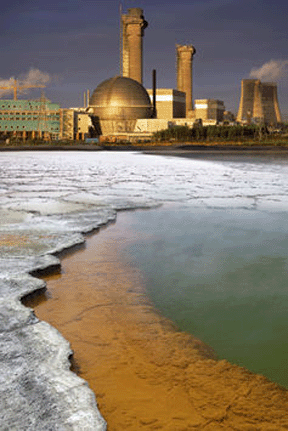
EDF’s Economic Statement on impact of Sizewell nuclear project – gives unproven, misleading evidence
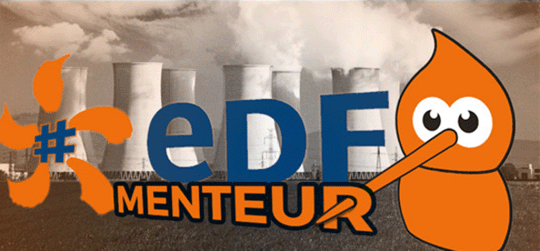 Stop Sizewell C 3rd Sept 2020, An independent review of EDF’s Economic Statement, assessing the impacts of Sizewell C to Suffolk’s local economy, has concluded that the project threatens “profitability and, in some cases, viability” of some local businesses, while others will be “at an immediate disadvantage when bidding for contracts”.
The report, Sizewell Economic Statement – Response, by highly-regarded independent research and analysis consultancy Development Economics, reveals multiple areas where EDF’s claimed benefits are over-optimistic, unproven or misleading, frequently omitting
evidence to support its figures or relying on “erroneous analysis”.
It concludes, critically, that EDF’s Economic Statement “fails to meet the minimum requirements of the legislation”, with no serious attempt to measure the deterrent effect on tourists and their expenditure, traffic congestion or competition for skills and labour.
The National Policy Statement EN-6 requires that applicants for major nuclear energy projects take into account ‘potential pressures on local and regional resources, demographic change and economic benefit’.
Workers and families sue U.S. Department of Energy contractors over illnesses from work at Piketon-area nuclear plant

 Former employees, families sue companies working on Piketon-area nuclear plant, https://www.dispatch.com/news/20200906/former-employees-families-sue-companies-working-on-piketon-area-nuclear-plant By Beth Burger
The Columbus DispatchThe lawsuit, filed last week, alleges workers and their families became ill due to the actions of U.S. Department of Energy contractors. The suit seeks a medical monitoring program to evaluate the multi-generational impact of radioactive contamination.
A lawsuit filed on behalf of former nuclear employees and their families accuses U.S. Department of Energy contractors of “poisoning workers and the people, land, air and water for miles” around the former Portsmouth Gaseous Diffusion Plant that was in southern Ohio.
The actions of DOE’s contractors released radioactive isotopes that “have created a situation akin to a creeping Chernobyl” and resulted in “injuries, sickness, disease, including cancers, damage to DNA, death, loss of and damages to property, and reduction in property values,” according to the lawsuit filed Thursday in U.S. District Court in Columbus.
The contamination likely spread in Pike, Scioto, Lawrence, Vinton and Adams counties in Ohio, according to the lawsuit.
Though the DOE is not named as a defendant in the case, its contractors are, including: Centrus Energy Corp., the United States Enrichment Corp., Lockheed Martin Corp., Uranium Disposition Services, BWXT Conversion Services, Mid-America Conversion Services, Bechtel Jacobs Co., Lata/Parallax Portsmouth LLC, FLUOR-BWXT Portsmouth LLC, Goodyear Tire and Rubber Co. and Martin Marietta Inc.
DOE spokeswoman Jessica Szymanski said Friday that the department does not comment on pending litigation.
The lawsuit is requesting a medical monitoring program that would evaluate the multi-generational impact of radioactive contamination.
“That is a major component of our request for relief,” said Nathan Hunter, one of the attorneys representing the plaintiffs, who noted that DNA damage could be transferred through generations.
There’s a workers’ compensation fund for nuclear workers, but that has failed the plaintiffs because of a host of issues, including falsified records, Hunter said.
The accusations are serious, and allege that DOE and the companies “actively deceived workers, the general public and regulators,” by suppressing critical information, including the release and spreading of nuclear poison, safety violations, arson, workplace exposures, and illegally transporting highly radioactive materials, as well as conspiring to destroy and falsify records.
Jeff Walburn worked in security at the plant for 31 years, and was hospitalized in 1994 because of damage to his lungs. He’s listed as a plaintiff.
“My life and family have been decimated by the nuclear scourge unleashed into the environment by these companies. These radioactive isotopes go into our bodies, creating cancers and genetic defects for generations,” he said in a released statement.
Charles “Chick” Lawson, a resident of Lucasville who was employed for 15 years in security and was the union safety representative and OHSHA investigator at the Portsmouth Gaseous Diffusion Plant, also is a plaintiff.
We are filing this lawsuit to expose the heinous actions and extensive cover-up by companies paid over a billion dollars to protect us,” he said in a released statement.
The lawsuit says that cancer rates in some affected areas are 700% greater than the national average. Scioto, Pike, Lawrence Vinton and Adams counties have the highest cancer rates in the state of Ohio, according to the lawsuit.
Pike County’s cancer rate was the second-highest in Ohio in 2019, according to the Ohio Department of Health. Vinton County had the highest rate of cancer, records show.
The lawsuit filed Thursday is the latest filed in connection to health issues associated with the former plant.
KILDARE OPINION SOUGHT ON NEW BRITISH NUCLEAR PLANT
 KILDARE OPINION SOUGHT ON NEW BRITISH NUCLEAR PLANT, Kildare Nationalist, SUNDAY, SEPTEMBER 06, 2020 UNDER provisions made at the United Nations, submissions are invited from interested parties in Kildare to comment on the development of a new nuclear power station planned for the east coast of England.Under the terms of the 1991 United Nations Convention, the Transboundary Environmental Public Consultation allows citizens in neighbouring nations have their say on certain public and private projects likely to have significant effects on the environment.
For this purpose, the member state of the UN in whose territory the project is intended to be carried out is required to send to its neighbours – no later than when informing its own public – a description of the project and any available information on its possible transboundary impact.
In this case, the Department of Environment, Planning and Local Government (DEPLG) was contacted by the British authorites in July about their plans to build a third reactor at the Sizewell nuclear power campus in Suffolk, to afford Irish citizens their chance to offer an opinion.
The letter from the UK’s Planning Inspectorate states that the Secretary of State has received an application to build two reactor units, giving a total site capacity of approximately 3,340MW, along with associated development required for the construction and operation of the Sizewell C Nuclear Power Station. …….
the Secretary of State decided to notify Ireland as if the development is likely to have significant adverse transboundary effects on the environment in this
State, as provided for in the UN Convention.
All documents related to the application are available to view on the Department of Environment’s website, and at the Planning Department, Kildare County Council – but by appointment only.
Submissions made in relation to the potential transboundary environmental effects of Sizewell C may be made in writing to the Planning Department, Kildare County Council, Aras Chill Dara, Naas, Co. Kildare or by e-mail to plandept@kildarecoco.ie by 28 October………….the Secretary of State decided to notify Ireland as if the development is likely to have significant adverse transboundary effects on the environment in this
State, as provided for in the UN Convention.
All documents related to the application are available to view on the Department of Environment’s website, and at the Planning Department, Kildare County Council – but by appointment only.
Submissions made in relation to the potential transboundary environmental effects of Sizewell C may be made in writing to the Planning Department, Kildare County Council, Aras Chill Dara, Naas, Co. Kildare or by e-mail to plandept@kildarecoco.ie by 28 October……..https://kildare-nationalist.ie/2020/09/06/kildare-opinion-sought-on-new-british-nuclear-plant/#.X1ViXHkzbIU
1 This Month

of the week – Shut Down Drone Warfare!


Tell the Ukrainian Government to Drop Prosecution of Peace Activist Yurii Sheliazhenko

Petition to revoke the licensing of the Near Surface Nuclear Disposal Facility (NSDF) at Chalk River. https://www.ourcommons.ca/petitions/en/Petition/Details?Petition=e-7247
To see nuclear-related stories in greater depth and intensity – go to https://nuclearinformation.wordpress.com
-
Archives
- April 2026 (103)
- March 2026 (251)
- February 2026 (268)
- January 2026 (308)
- December 2025 (358)
- November 2025 (359)
- October 2025 (376)
- September 2025 (257)
- August 2025 (319)
- July 2025 (230)
- June 2025 (348)
- May 2025 (261)
-
Categories
- 1
- 1 NUCLEAR ISSUES
- business and costs
- climate change
- culture and arts
- ENERGY
- environment
- health
- history
- indigenous issues
- Legal
- marketing of nuclear
- media
- opposition to nuclear
- PERSONAL STORIES
- politics
- politics international
- Religion and ethics
- safety
- secrets,lies and civil liberties
- spinbuster
- technology
- Uranium
- wastes
- weapons and war
- Women
- 2 WORLD
- ACTION
- AFRICA
- Atrocities
- AUSTRALIA
- Christina's notes
- Christina's themes
- culture and arts
- Events
- Fuk 2022
- Fuk 2023
- Fukushima 2017
- Fukushima 2018
- fukushima 2019
- Fukushima 2020
- Fukushima 2021
- general
- global warming
- Humour (God we need it)
- Nuclear
- RARE EARTHS
- Reference
- resources – print
- Resources -audiovicual
- Weekly Newsletter
- World
- World Nuclear
- YouTube
-
RSS
Entries RSS
Comments RSS
 nuclear-news