Nuclear no option for hydrogen production: German government
Energy ministry state secretary Feicht says, however, that the rule of nuclear will be discussed at an EU level, Recharge 6 October 2020 By Bernd Radowitz
“Nuclear isn’t an option for our energy system, be it the production of electricity for our electricity demand, [or] for the production of hydrogen,” Andreas Feicht, secretary of state in Germany’s economics and energy ministry, said at a virtual conference on hydrogen organized by his ministry……..
Green’ or ‘carbon-free’ hydrogen?
Germany by the end of 2022 will phase out its last atomic power stations, and in its €9bn ($10.6bn) national hydrogen strategy has laid down that it strives to ramp up a ‘green hydrogen’ economy mostly based on renewables such as offshore wind, with a temporary and limited role for ‘blue hydrogen’ produced from natural gas linked to carbon capture and storage (CCS)…………..
the Dutch government is planning to launch a consultation on building new nuclear power plants after a study commissioned by its economics and climate ministry claimed atomic energy is as cheap as wind or solar power – and supposedly the safest way to produce electricity in the country.
The study was conducted by a nuclear energy consultancy with links to the nuclear industry, though. At the same time, a flurry of studies advises against a nuclear renaissance.
‘Nuclear and renewables don’t mix’
The University of Sussex Business School and the ISM International School of Mangement this week published an analysis of 123 countries over 25 years in Nature Energy that concludes that nuclear and renewables don’t mix, and only the latter can deliver truly low carbon energy.
The researchers found that unlike with renewables, countries around the world with larger scale nuclear attachments do not tend to show significantly lower carbon emissions – and in poorer countries nuclear programmes actually tend to associate with relatively higher emissions.
The researchers found that unlike with renewables, countries around the world with larger scale nuclear attachments do not tend to show significantly lower carbon emissions – and in poorer countries nuclear programmes actually tend to associate with relatively higher emissions.
Champagne of power fuels
Michael Bloss, a Green Party member of the European Parliament, at the same hydrogen conference stressed that only “green hydrogen is clean hydrogen.”
Blue hydrogen as considered as a temporary option by the German government is no real option due to high amounts of methane leakage during its production, which he argued is “much more detrimental for the climate than CO2.”
Despite €3.7bn in EU investments into CCS since 2009 (according to the European Court of Auditors), the technology remained at the “beginning of its development” and is still “not ready to be applied,” Bloss said.
Renewable energies such as offshore wind, meanwhile, are the most cost-competitive energy source and should be used for hydrogen production, he added, without going into the nuclear versus renewables controversy.
Bloss, however, stressed that it has been said that “hydrogen is the Champagne among power fuels,” which must be used only in difficult-to-decarbonise sectors where it cannot be replaced by other applications, such as steel, cement or chemicals.https://www.rechargenews.com/wind/nuclear-no-option-for-hydrogen-production-german-government/2-1-887905
Dr. HELEN CALDICOTT on Nuclear Narcissism
Dr. HELEN CALDICOTT on Nuclear Narcissism For the Wild, 7 Oct 20, This year, the government of Japan announced plans to dump contaminated water from the Fukushima Daiichi Nuclear Power Plant into the ocean. Till this day, cleanup of the 2011 Fukushima disaster continues and it is estimated that by 2022 the Fukushima site will be at capacity for storing contaminated water. As outrageous as this news is, even more so is how little coverage it received, or outcry it warranted. It exemplifies the absurdity of nuclear energy, the inability of nuclear power reactors to deal with their waste, the pervasiveness of nuclear contamination and its paradoxical invisibility.
The author or editor of eight books including Nuclear Madness, Missile Envy, and, most recently, Sleepwalking to Armageddon, she has been the recipient of many awards and honorary degrees, the subject of three award-winning documentary films, and was named one of the 20th Century’s most influential women by the Smithsonian Institution.
Speeded up decommissioning of Crystal River nuclear reactor – some concerns about this
Duke nuclear plant demolition timeline cut from half-century to 7 years, By KEVIN SPEAR, ORLANDO SENTINEL |OCT 07, 2020 Duke Energy is poised to begin demolition of its shuttered nuclear plant, with a timeline reduced from nearly six decades to seven years because of a drop in costs.
Duke’s 890-megawatt reactor near Crystal River at the Gulf of Mexico has been out of commission since 2009, when a construction accident crippled the containment building. In 2015, facing a projected demolition cost of more than $1 billion, Duke was prepared to let the plant remain for 60 years before removing it.
But with the aging of nuclear power around the world and competitive advances in demolition technology, Duke is proceeding with a fixed contract of $540 million to remove the plant. That cost is to be covered by a trust fund of $717 million already paid for by the utility’s customers.
A newly formed company, Accelerated Decommissioning Partners, has begun engineering designs for demolition and is about to remove structures and infrastructure outside of the reactor building.
Accelerated Decommissioning Partners is a joint venture that includes NorthStar Group Services, which describes itself as the world’s largest demolition company, with services ranging from hurricane cleanup to asbestos removal, and is currently taking down the Vermont Yankee Nuclear Power Station.
The other partner is Orano USA, a supplier of nuclear materials and services. In 2018, the company transferred the Crystal River plant’s used nuclear fuel from a storage pool to containment within dry casks that are now stored in concrete bunkers at the plant site. There is no designated disposal facility in the U.S. for used fuel, and the dry casks could remain at Duke’s Crystal River site for years or decades………
In 2009, a major effort to extend the life of the the reactor damaged the reactor-containment building’s 3-foot-thick wall. After botched repair attempts, the plant was declared economically beyond repair.
The additional cost that customers had to absorb for the attempted upgrade and trying to fix the containment building was an estimated $1.7 billion, according to the Florida Office of Public Counsel, a legislatively created agency that serves as an advocate for utility customers.
Other lost nuclear costs would arise from Duke’s move to build a $22 billion plant in Levy County. That initiative was announced in 2006 but abandoned within a decade, resulting in costs that customers had to absorb of more than $870 million .
Charles Rehwinkel of the Office of Public Counsel said Duke’s contract with Accelerated Decommissioning Partners should have included better protections in case of demolition or financial problems.
“We remained concerned that this process, which is fairly new, could have a problem down the road,” Rehwinkel said. “The problems we would be concerned about would be cost overruns and if they get part way through the process in an area where there is still contaminated metal components and there is a bankruptcy or some halt that leaves them in the position of Duke having to get somebody else to come in.”
Edward Lyman, director of nuclear power safety at the Union of Concerned Scientists, said there isn’t much track record yet for the kind of accelerated decommissioning and demolition being performed at Duke’s plant.
But his initial concern is that Duke’s fixed-price contract with the joint venture leaves little flexibility for dealing with unexpected challenges.
“They are going to have a strong incentive to minimize cost and that could potentially come at the cost of safety,” Lyman said……..
The most challenging work will involve the reactor vessel, a cylindrical assembly the size of a semitruck, with steel walls at least 5 inches thick.
Roberts said crews will cut the vessel into pieces while submerged underwater, which blocks radiation.
Cuts will be done with robots and other remotely controlled machines with a variety of band saws, diamond-wire saws and high pressure water jets with abrasive ingredients. Cutting will be according to specific sizes, shapes and weights.
While still underwater, pieces will be inserted into canisters, which, in turn, will be inserted into steel casks for shipment “more than likely by rail” to a disposal site in west Texas, Roberts said…… https://www.orlandosentinel.com/news/environment/os-ne-duke-nuclear-plant-demolition-20201007-oa4bvubxanevnof2dzyzyshg2a-story.html
Ikata nuclear reactor to be shut down – 40 year decommissioning process
Regulator approves Ikata 2 decommissioning plan, WNN, 07 October 2020 Japan’s Nuclear Regulation Authority (NRA) today approved Shikoku Electric Power Company’s decommissioning plan for unit 2 of its Ikata nuclear power plant in Ehime prefecture. Decommissioning of the unit is expected to be completed by 2059.
Ikata 2 is a 538 MWe pressurised water reactor that began operating in March 1988. It was taken offline in January 2012 for periodic inspections. Shikoku announced in March 2018 that it did not plan to restart the reactor. It said the cost and scale of modifications required to upgrade the 40-year-old unit to meet the country’s revised safety standards made it uneconomical to restart it. ……….
According to the plan, decommissioning of the unit will take about 40 years and will be carried out in four stages. The first stage, lasting about 10 years, will involve preparing the reactor for dismantling (including the removal of all fuel and surveying radioactive contamination), while the second, lasting 15 years, will be to dismantle peripheral equipment from the reactor and other major equipment. The third stage, taking about eight years, will involve the demolition of the reactor itself, while the fourth stage, taking about seven years, will see the demolition of all remaining buildings and the release of land for other uses……. https://www.world-nuclear-news.org/Articles/Regulator-approves-Ikata-2-decommissioning-plan
Need to reconsider nuclear waste burial close to Lake Huron – on safety grounds
Based on my understanding, this project will not ameliorate the risk associated with nuclear waste — it will only increase the risk by burying it, increasing the difficulty of monitoring how well it is being contained. If there is a radioactive leak underground, 40 million people in Canada and the U.S. who are located along the Great Lakes could be affected! With so many people depending upon these lakes for their drinking water, what will we do should this happen?
Higher standards for handling the disposal of nuclear waste exist elsewhere, and new technologies could emerge for better dealing with its disposal. Based on this, I strongly believe that this project needs to be reconsidered. Those who wish to learn more, or get involved, can visit www.protectsouthbruce-nodgr.org…….. (registered readers only) https://www.therecord.com/opinion/letters-to-the-editors/2020/10/06/plan-for-nuclear-waste-storage-raises-concerns.html
October 7 Energy News — geoharvey

Opinion: ¶ “Nuclear Energy – The High Cost Of A Dying Industry” • Nuclear energy has had a seriously rough year. In an article by OilPrice.com, the author asked a question: “Why is nuclear energy so expensive?” The nuclear sector, OilPrice says, simply can’t compete with the flood of low cost natural gas and renewables. […]
October 7 Energy News — geoharvey
Major study finds that renewables lower emissions substantially, and nuclear power does not

Two’s a crowd: Nuclear and renewables don’t mix, https://techxplore.com/news/2020-10-crowd-nuclear-renewables-dont.html by University of Sussex OCTOBER 5, 2020
If countries want to lower emissions as substantially, rapidly and cost-effectively as possible, they should prioritize support for renewables, rather than nuclear power, the findings of a major new energy study concludes.
That’s the finding of new analysis of 123 countries over 25 years by the University of Sussex Business School and the ISM International School of Management which reveals that nuclear energy programs around the world tend not to deliver sufficient carbon emission reductions and so should not be considered an effective low carbon energy source.
Researchers found that unlike renewables, countries around the world with larger scale national nuclear attachments do not tend to show significantly lower carbon emissions—and in poorer countries nuclear programs actually tend to associate with relatively higher emissions.
Published today in Nature Energy, the study reveals that nuclear and renewable energy programs do not tend to co-exist well together in national low-carbon energy systems but instead crowd each other out and limit effectiveness.
Benjmin K Sovacool, Professor of Energy Policy in the Science Policy Research Unit (SPRU) at the University of Sussex Business School, said: “The evidence clearly points to nuclear being the least effective of the two broad carbon emissions abatement strategies, and coupled with its tendency not to co-exist well with its renewable alternative, this raises serious doubts about the wisdom of prioritizing investment in nuclear over renewable energy. Countries planning large-scale investments in new nuclear power are risking suppression of greater climate benefits from alternative renewable energy investments.”
The researchers, using World Bank and International Energy Agency data covering 1990-2014, found that nuclear and renewables tend to exhibit lock-ins and path dependencies that crowd each other out, identifying a number of ways in which a combined nuclear and renewable energy mix is incompatible.
These include the configuration of electricity transmission and distribution systems where a grid structure optimized for larger scale centralized power production such as conventional nuclear, will make it more challenging, time-consuming and costly to introduce small-scale distributed renewable power.
Similarly, finance markets, regulatory institutions and employment practices structured around large-scale, base-load, long-lead time construction projects for centralized thermal generating plant are not well designed to also facilitate a multiplicity of much smaller short-term distributed initiatives.
Andy Stirling, Professor of Science and Technology Policy at the University of Sussex Business School, said: “This paper exposes the irrationality of arguing for nuclear investment based on a ‘do everything’ argument. Our findings show not only that nuclear investments around the world tend on balance to be less effective than renewable investments at carbon emissions mitigation, but that tensions between these two strategies can further erode the effectiveness of averting climate disruption.”
The study found that in countries with a high GDP per capita, nuclear electricity production does associate with a small drop in CO2 emissions. But in comparative terms, this drop is smaller than that associated with investments in renewable energy.
And in countries with a low GDP per capita, nuclear electricity production clearly associates with CO2 emissions that tend to be higher.
Patrick Schmid, from the ISM International School of Management München, said: “While it is important to acknowledge the correlative nature of our data analysis, it is astonishing how clear and consistent the results are across different time frames and country sets. In certain large country samples the relationship between renewable electricity and CO2-emissions is up to seven times stronger than the corresponding relationship for nuclear.”
14 million tonnes of plastic on ocean floor – more on the coasts
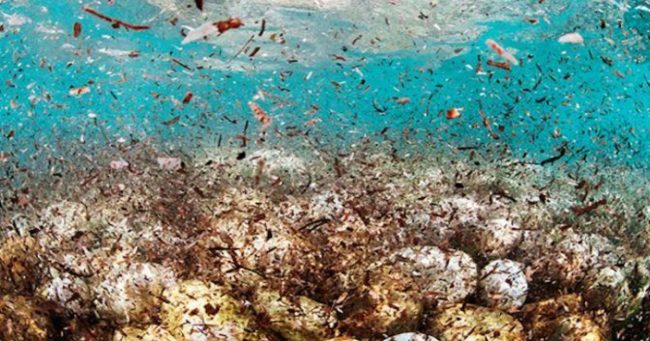
Every drink bottle we buy, face scrub we use and chip packet we finish results in tiny plastics entering the ocean.But where are these tiny micro-plastics, exactly?
Are they floating around on the ocean’s surface, waiting to be scooped up by a surfer?
Or are they stuck in the tummies of turtles or seabirds?
A new study by the CSIRO, Australia’s national science agency, has estimated up to 14 million tonnes of micro-plastics have sunk to the bottom of the ocean floor.
The peer-reviewed research, published on Tuesday, is the first global estimate for micro-plastics on the seafloor. Dr Britta Denise Hardesty, team leader with CSIRO’s Oceans and Atmosphere, said 14 million tonnes of micro-plastics was a “huge amount, especially when you think about how tiny all those bits are”.Dr Britta Denise Hardesty, team leader with CSIRO’s Oceans and Atmosphere, said 14 million tonnes of micro-plastics was a “huge amount, especially when you think about how tiny all those bits are”.
But where are these tiny micro-plastics, exactly?
Are they floating around on the ocean’s surface, waiting to be scooped up by a surfer?
Or are they stuck in the tummies of turtles or seabirds?
A new study by the CSIRO, Australia’s national science agency, has estimated up to 14 million tonnes of micro-plastics have sunk to the bottom of the ocean floor.
The peer-reviewed research, published on Tuesday, is the first global estimate for micro-plastics on the seafloor.
Dr Britta Denise Hardesty, team leader with CSIRO’s Oceans and Atmosphere, said 14 million tonnes of micro-plastics was a “huge amount, especially when you think about how tiny all those bits are”.
To put it into perspective: Imagine five carrier bags stuffed with plastic dotted along every single metre of coastline around the world, excluding Antarctica
The piles of bags would sit on every Australian beach, along Italy’s Amalfi Coast, around Vietnam’s Ha Long Bay, and all around Canada’s coastlines and beyond.
Now imagine someone pushing those bags into the ocean, and letting them sink into the darkness.
“It’s a confronting amount, and hopefully it provides a reasonable wake-up call,” Dr Hardesty told The New Daily.
“We’re finding them hundreds of kilometres offshore and thousands of metres deep – more micro-plastics than has been found by lots of other studies.”
“Micro-plastics come from the same place as plastics,” Dr Hardesty said, adding “micro just means they’re smaller than 5mm”.
“It’s really just small plastic from single-use items, consumer goods, industry or fishing-related goods, cosmetics, micro-beads, agriculture, aquaculture, household waste, everything.”Many of these tiny plastics end up in our oceans via stormwater drains, sewage systems, sea-based activities, littering, things falling off the backs of trucks, and improper waste management where people intentionally dump rubbish straight into the sea or rivers.
They often end up in the stomachs of marine animals like dolphins or fish, while bigger pieces of plastic can be just as dangerous.
“Masks that have those little straps can tangle the feet and legs of sea birds and things like that,” Dr Hardesty said.
“Rubber gloves might be more likely to look like a jellyfish that could be mistakenly eaten by turtles if they end up in the ocean.”
The World Economic Forum estimates one garbage truck of plastic alone is dumped into the ocean every minute of every day.
It estimates there could be more plastic in the ocean than fish by 2050.
The missing piece
Although the CSIRO’s findings are troubling, perhaps what’s more concerning is the answer to the following question: Where is the rest of the missing plastic?
Compared to the tonnes of plastic entering the ocean every day, Dr Hardesty said 14 million tonnes on the ocean floor was “just a drop in the ocean”.
“Where is all the missing plastic? Is it in the stomachs of animals? Is it floating on the surface?” she said.
“I’d say most of it is on our coastlines.”
Promises, promises — the media keeps buying the tired old nuclear spin marketing small reactors

Promises, promises — Beyond Nuclear International– Sometimes it’s “Promises promises”. On other days it’s “Another one bites the dust”.
Nuclear power is failing. So why does news coverage suggest the opposite?
By Linda Pentz Gunter 5 Oct 20, Sometimes it’s “Promises promises”. On other days it’s “Another one bites the dust”………
the unavoidable story, no matter what myths the pro-nuclear propagandists try to spin. Reality has an annoying habit of grabbing the headlines. And right now, those read:
“Fresh delays at EDF’s Flamanville 3”
“Scottish nuclear power station to shut down early after reactor problems”
“Hitachi ‘withdraws’ from £20bn Wylfa project”
“Olkiluoto-3 nuclear power plant 11 months behind latest schedule”
“Nuclear reactor in France shut down over drought”
“Exelon vows to shut down Byron, Dresden nuclear plants”
And so on.
However, despite this breaking news, you have to sort through a lot of aspirational chaff to find these headlines. The majority of articles about nuclear power are still centered around a rosy future as a climate-busting, jobs-providing cornerstone of any energy policy.
And the majority of politicians in countries where nuclear power still holds sway continue to support it. Why do we let them? Because they think we want them to. As linguistic and messaging guru, George Lakoff, so often repeats: “Voters don’t vote their self-interest. They vote their values.”
So when a nuclear company, or a politician, trumpets instant, well-paying jobs, voters line up to support it too. No matter that nuclear jobs are not likely to be instant, safe or long-lasting, will destroy the environment and do nothing for climate change — and even, in the case of promised new nuclear plants like Summer in South Carolina or Wylfa-B in Wales, may never materialize at all. A boost to the local economy is a good soundbite. Why look behind the arras, only to find nothing there?
But when the media looks behind the nuclear arras they find small modular reactors, micro reactors, “new generation” reactors, and the perpetual promise of fusion. And they interpret this as news, even though none of these reactor designs are new and fusion has been decades away for, well, decades.
These “new” nuclear developments are also often reported on as if they are actually happening. Such overstatements are routinely exposed in the annual World Industry Status Report, (a veritable Bible of empirical data, with the 2020 edition just released last week), which looks into the substance of such breaking news and finds it is almost always aspirational. Take a closer look and it is all about plans, not reality.
The same with alleged turncoats. The media love them.
So we get Zion Lights, a refugee from Extinction Rebellion UK, who is getting plenty of ink and headlines for her new found pro-nuclear delusions. She has positioned herself as an ex-co-leader of XR, a false claim the movement has corrected in a thorough takedown of Lights and her boss, Michael Shellenberger, which we published last week………. https://wordpress.com/read/feeds/72759838/posts/2949326488more https://wordpress.com/read/feeds/72759838/posts/2949326488
Boukadoum: Algeria to ratify Treaty on the Prohibition of Nuclear Weapons “as soon as possible”
Boukadoum: Algeria to ratify Treaty on the Prohibition of Nuclear Weapons “as soon as possible” http://www.aps.dz/en/algeria/36012-boukadoum-algeria-to-ratify-treaty-on-the-prohibition-of-nuclear-weapons-as-soon-as-possible
Pacific Island Nations determined to say NO to nuclear weapons, and support UN Treaty Ban

|
Pacific will continue to say no to nuclear weapons, UN told, https://www.rnz.co.nz/international/pacific-news/427663/pacific-will-continue-to-say-no-to-nuclear-weapons-un-told 5 Oct 20, Marking International Day Against Nuclear Explosions last weekend, the island nations agreed they had all suffered the effects of nuclear testing in the region.Presenting a joint statement from 12 Pacific countries to the United Nations General Assembly, Fiji’s Prime Minister said more than 300 nuclear tests were carried out in the Pacific from 1946 to 1996 – in the atmosphere, underground and underwater.
Frank Bainimarama told the online event communities living close to ‘ground zero’ were relocated from their ancestral homes and restricted from using the ocean resources for their livelihoods. Mr Bainimarama says those impacted also faced an increase in related health problems. “At the end of these nuclear tests, radioactive waste and machinery were either buried or dumped into the Pacific Ocean. Today, we still do not know the full impact of these nuclear tests on our environment and communities,” Frank Bainimarama said. Bainimarama said Pacific islanders considered themselves the custodians of the vast blue Pacific Ocean. “The Pacific Ocean defines who we are; it serves as the foundation of our economies, our environment, and the well-being of our communities,” he said. “We have a vision that the blue Pacific Ocean will become an ocean of peace and prosperity for our people and the world.” Bainimarama said protecting the blue Pacific continent was of paramount importance to the islanders’ future. He said it could only become an ocean of peace if it was nuclear-free. He said stopping the development of nuclear weapons and eliminating them altogether would free up much-needed global resources to assist vulnerable communities, and those around the world, in fighting the effects of climate change. “The world does not need nuclear weapons,” Bainimarama said. The challenges of nuclear disarmament can only be resolved by a strengthened multilateral system that sets the conditions for transparency, confidence-building, and co-operation.” The Fijian leader said the Treaty on the Non-Proliferation of Nuclear Weapons (NPT), the Comprehensive Nuclear Test Ban Treaty (CTBT) and the Treaty on the Prohibition of Nuclear Weapons (TPNW) were crucial if Pacific islands, which he refers to as PSIDS, were to further reduce and eliminate nuclear weapons. “Today, we PSIDS say no to nuclear weapons and we reiterate our commitment to the elimination of nuclear weapons everywhere,” Bainimarama said. “We encourage member states to ratify the Comprehensive Nuclear Test Ban Treaty (CTBT) and the Treaty on the Prohibition of Nuclear Weapons (TPNW). “It is morally right, and we owe it to ourselves and our future generations.” The Fijian leader presented a joint statement to the UN Assembly from the PSIDS’ members including the Federated States of Micronesia (FSM), Fiji, Kiribati, Nauru, Palau, Papua New Guinea, Marshall Islands, Samoa, Solomon Islands, Tonga, Tuvalu and Vanuatu. Bainimarama said their statement was also aligned with the message sent by the Tuvalu Mission at the UN on behalf of the Pacific Islands Forum. The online event was hosted by UN President Tijjani Muhammad-Bande from Nigeria. |
|
Sleepwalking into a crisis — Beyond Nuclear International

Former world leaders appeal for nuclear disarmament
Sleepwalking into a crisis — Beyond Nuclear International
France should reveal the location of its nuclear waste dump in Algeria

|
Calls for France to reveal location of nuclear waste dumped in Algeria https://www.middleeastmonitor.com/20201005-calls-for-france-to-reveal-location-of-nuclear-waste-dumped-in-algeria/ October 5, 2020 France should take initiative to solve the problem of the nuclear waste buried in the Algerian Sahara in the early 1960s, as no one knows its exact location, which is a classified military secret, the head of the Paris-based Observatory for Armament said.In an interview with Radio France Internationale yesterday, Patrice Bouvre said: “When France suspended its nuclear tests in 1966, it simply buried the waste of the 17 experiments it conducted over the years.”
He added that Paris classified the location or locations of the buried nuclear waste and the documents related to the affair as “a military secret”, which remains to date. As a result, there is no information available about the exact location of the nuclear waste buried in the Algerian desert, Bouvre explained. He called on the French authorities to reveal the truth about this file and to cooperate with Algeria to clean up the areas contaminated by the nuclear waste that still exposes these regions to serious environmental damages. France conducted 17 nuclear tests between 1960 and 1966 in the Algerian Sahara, and the waste from these experiments is buried in an unknown location in the area, hindering attempts to remove the radioactive materials and protect the population and the environment |
|
USA ‘s Environment and climate cases face a bleak future with a Republican dominated Supreme Court
 HOW WILL CLIMATE AND ENVIRONMENTAL CASES FARE ON A 6-3 CONSERVATIVE SUPREME COURT? THE ALLEGHENY FRONT, REID FRAZIER, OCTOBER 2, 2020
It appears that President Trump has enough votes in the Senate to confirm Supreme Court nominee Amy Coney Barrett before Election Day. That means the court’s balance would tip from a 5 to 4 advantage for conservatives to 6 to 3. What would this majority mean for the environment?
For our podcast, Trump on Earth, Reid Frazier examines what the loss of RBG could mean for the environment with Ellen Gilmer, senior legal reporter for Bloomberg Law.
But first, we take a look back at Ginsburg’s environmental legacy with Pam King and Jeremy Jacobs, reporters for E&E News who wrote in a recent article, “The passing of Supreme Court Justice Ruth Bader Ginsburg could shake the foundation of America’s bedrock environmental laws, leaving a chasm on the bench where once sat an environmental champion.” (Read the transcript to that interview HERE.)
(The interviews were conducted before Amy Coney Barrett was nominated to fill Justice Ruth Bader Ginsburg’s seat on the Supreme Court.)
Listen to the full episode or read the transcript below:
China-Saudi nuclear pact can trigger an arms race in West Asia
|
China-Saudi nuclear pact can trigger an arms race in West Asia. Saudi Arabia’s acquisition of nuclear capability would draw Turkey and Egypt to join the regional nuclear race, which might turn conflict-torn West Asia even more volatile. The Print ADIL RASHEED 5 October, 2020 At a time when the world was expecting Saudi Arabia to join the UAE and Bahrain in normalising relations with Israel, a noted British daily published a news story that has since raised Israeli concerns over the kingdom’s nascent nuclear programme. On 17 September 2020, an article in The Guardian reported that Chinese geologists have prepared a report for Saudi Arabia — as part of their nuclear energy cooperation agreement — which names locations having large reserves of uranium ore in the kingdom that could be sufficient for its domestic production of nuclear fuel. This news comes on the heels of an earlier Wall Street Journal report that the kingdom has also already constructed a facility with Chinese assistance for extracting uranium yellowcake from uranium ore, a major development in Riyadh’s avowedly peaceful nuclear programme. The report states that the facility is being built far away from the eastern borders close to Iran, with the help of two Chinese companies near the Saudi city of Ula, midway between Medina and Tabuk. …….. By supporting Iran when it has restarted uranium enrichment and by helping Saudi Arabia extract and process its indigenous fissile raw material, Beijing seems to be setting up and weaponising the two arch-rivals of the Gulf, thereby catalysing a nuclear arms race in West Asia, so that US military is never able to pivot effectively to China’s backyard in the Indo-Pacific. https://theprint.in/opinion/china-saudi-nuclear-pact-can-trigger-an-arms-race-in-west-asia/516781/ |
|
1 This Month

of the week – Shut Down Drone Warfare!


Tell the Ukrainian Government to Drop Prosecution of Peace Activist Yurii Sheliazhenko

Petition to revoke the licensing of the Near Surface Nuclear Disposal Facility (NSDF) at Chalk River. https://www.ourcommons.ca/petitions/en/Petition/Details?Petition=e-7247
To see nuclear-related stories in greater depth and intensity – go to https://nuclearinformation.wordpress.com
-
Archives
- April 2026 (57)
- March 2026 (251)
- February 2026 (268)
- January 2026 (308)
- December 2025 (358)
- November 2025 (359)
- October 2025 (376)
- September 2025 (257)
- August 2025 (319)
- July 2025 (230)
- June 2025 (348)
- May 2025 (261)
-
Categories
- 1
- 1 NUCLEAR ISSUES
- business and costs
- climate change
- culture and arts
- ENERGY
- environment
- health
- history
- indigenous issues
- Legal
- marketing of nuclear
- media
- opposition to nuclear
- PERSONAL STORIES
- politics
- politics international
- Religion and ethics
- safety
- secrets,lies and civil liberties
- spinbuster
- technology
- Uranium
- wastes
- weapons and war
- Women
- 2 WORLD
- ACTION
- AFRICA
- Atrocities
- AUSTRALIA
- Christina's notes
- Christina's themes
- culture and arts
- Events
- Fuk 2022
- Fuk 2023
- Fukushima 2017
- Fukushima 2018
- fukushima 2019
- Fukushima 2020
- Fukushima 2021
- general
- global warming
- Humour (God we need it)
- Nuclear
- RARE EARTHS
- Reference
- resources – print
- Resources -audiovicual
- Weekly Newsletter
- World
- World Nuclear
- YouTube
-
RSS
Entries RSS
Comments RSS
 nuclear-news