Confusion as USA- Russia nuclear arms talks fail
Nuclear arms talks spiral into confusion as Russia rejects US ‘delusion’, Top US negotiator claimed there was ‘an agreement in principle’ between Trump and Putin, Guardian, Julian Borger in WashingtonWed 14 Oct 2020 US-Russian nuclear arms control talks have sunk into confusion after the top American negotiator claimed there was “an agreement in principle” between Donald Trump and Vladimir Putin, a claim Moscow quickly rejected as a “delusion”. ………
The US had previously insisted that China be included in any future arms control negotiations rather than extending the bilateral arrangements in New Start, but Billingslea has dropped that demand in recent weeks, accepting that trilateral talks could be arranged later.
Alexandra Bell, a former state department official and now senior policy director at the Center for Arms Control and Non-Proliferation, said the pre-election urgency followed “literally months of the Trump administration saying there’s plenty of time to do this – there’s no rush”.
Senior parliamentarians from across Europe wrote to their US counterparts on Tuesday urging them to support a New Start extension.
Ohio lawmakers likely to repeal the tainted nuclear bailout law, after November 3
 Gov. DeWine Expects Bill to Repeal Bailout of Nuclear Power Plants to Come During Lame Duck Session, WKSU, The Statehouse News Bureau | By Jo Ingles, October 13, 2020 It’s been nearly three months since former Ohio House Speaker Larry Householder and four others connected to him were arrested on federal charges of wrongdoing associated with an energy bill signed into law last year. Gov. DeWine has said he wants that law, HB 6, repealed. But that hasn’t happened yet.The law took effect last year, and there are court challenges over the charges that ratepayers will see on their bills starting in January. And though legislation to repeal the bailout has been stymied in the Ohio Legislature so far, DeWine says he thinks Ohio lawmakers will pass the bill after the Nov. 3 election. Gov. DeWine Expects Bill to Repeal Bailout of Nuclear Power Plants to Come During Lame Duck Session, WKSU, The Statehouse News Bureau | By Jo Ingles, October 13, 2020 It’s been nearly three months since former Ohio House Speaker Larry Householder and four others connected to him were arrested on federal charges of wrongdoing associated with an energy bill signed into law last year. Gov. DeWine has said he wants that law, HB 6, repealed. But that hasn’t happened yet.The law took effect last year, and there are court challenges over the charges that ratepayers will see on their bills starting in January. And though legislation to repeal the bailout has been stymied in the Ohio Legislature so far, DeWine says he thinks Ohio lawmakers will pass the bill after the Nov. 3 election.
“We’ve certainly talked about this, about the importance of it passing and that it needs to pass. I get the impression that the lame duck session will be an interesting session, and I hope very productive,” DeWine sais. ….https://www.wksu.org/government-politics/2020-10-13/gov-dewine-expects-bill-to-repeal-bailout-of-nuclear-power-plants-to-come-during-lame-duck-session |
|
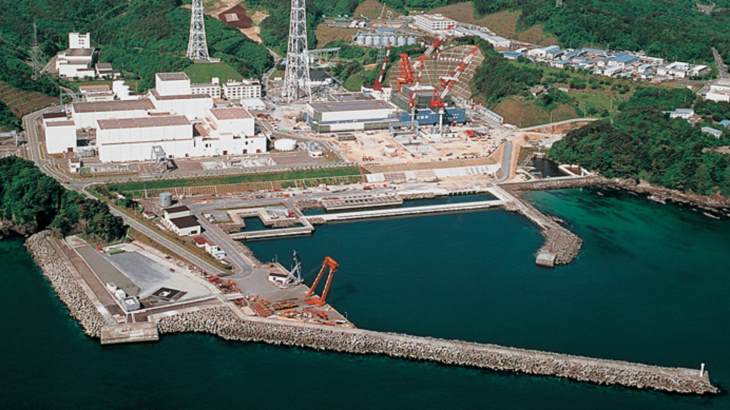
800-meter-long seawall being constructed, as Japan plans to reopen damaged Onagawa nuclear complex
|
Japan’s damaged nuclear reactor set to reopen https://www.aa.com.tr/en/asia-pacific/japan-s-damaged-nuclear-reactor-set-to-reopen/2005798, Quake-hit Onagawa nuclear complex awaits final approval by Miyagi provincial officials, Riyaz ul Khaliq |14.10.2020 ANKARAJapan’s nuclear reactor hit by a 2011 earthquake in the northeastern Miyagi province will resume operations by the end of this year, according to officials, the local media reported on Wednesday.
Miyagi Governor Yoshihiro Murai will formally announce his consent to restart the nuclear reactors at Onagawa complex by the end of the year, the Kyodo News agency said. Early this year, the 825,000-kilowatt reactor, operated by Tohoku Electric Power Company, won the approval of the country’s Nuclear Regulation Authority. All the three reactors were shut down when the massive quake and a 13-meter tsunami hit northeastern Japan on March 11, 2011, flooding the underground floors of the No. 2 unit. Nearly 10,000 people lost their lives while over 4,000 others are still missing. Onagawa nuclear reactor is the second such disaster-ravaged complex, after the Fukushima nuclear disaster, to pass stricter nuclear safety standards. The world has witnessed the worst nuclear disaster in 1986 at Chernobyl in today’s Ukraine. Unlike the Fukushima Daiichi plant of Tokyo Electric Power Company, the Onagawa plant’s emergency cooling system did not fail and underwent no meltdown after hit by the earthquake and tsunami. To restart the Onagawa nuclear reactors, the consent of local government leaders is the last remaining step needed after it cleared a national safety screening in February. Tohoku aims to restart the No. 2 unit of Onagawa nuclear complex in 2022 at the earliest. Currently, a 800-meter-long seawall at the plant is under construction. The operator has already decided to scrap unit No. 1. Murai would be the first governor of a disaster-hit province to allow resumption of a damaged nuclear reactor’s operations. The 2011 earthquake and tsunami triggered one of the world’s worst nuclear crises in Japan’s Fukushima province which caused all of Japan’s 54 reactors to halt. However, since then, nine units at five plants of the country have restarted following regulatory and local approvals. “When the plenary session [of the local assembly] shows its stance, I will make a decision upon hearing the opinions of mayors of cities, towns, and villages within the prefecture,” Murai said. |
USA starts off $3.2 billion subsidy program with $80 million each for “next generation” nuclear reactors

|
US DOE awards TerraPower, X-energy $80 million each for advanced nuclear reactors, S and P Global , Joniel Cha William Freebairn , EditorDerek Sands 14 Oct 20, Washington — The US Department of Energy has awarded two companies proposing next-generation nuclear reactors $80 million each in an initial award as part of a $3.2 billion program to build two advanced reactors that can be operational within seven years, Energy Secretary Dan Brouillette said Oct. 13.
One award went to a group including TerraPower, a company co-founded by billionaire Bill Gates, working with a General Electric and Hitachi joint venture, while the other is X-energy, a start-up that is advancing a reactor design originally developed in Germany. The awards are part of DOE’s Advanced Nuclear Reactor Demonstration Program, and future funding is dependent on appropriations, Brouillette said. Regarding advanced reactors, which generally use a different coolant than all operating commercial reactors in the US, “We want to make them more affordable to build, and we want to make them more affordable to operate,” Brouillette said. Brouillette said “it is likely” the advanced reactors will be built in Washington state, where he said a site is available. The key criteria to select applicants included that the reactor design represent a truly advanced technology dissimilar from existing reactors, Brouillette said. A second key factor was DOE’s assessment that the management team of the winning groups be able to supply the required 50-50 match in resources and deliver the projects within seven years, he said. TerraPower partnered with GE Hitachi, engineering and construction company Bechtel, and utilities Energy Northwest, Duke Energy and Pacificorp for its Natrium sodium fast reactor. The system will be supported by a new fuel fabrication facility to supply fuel for the unit, DOE said in a statement Oct. 13. That Natrium reactor and storage system is a 345-MW net reactor system coupled with a molten-salt-based energy storage system that will provide greater operating flexibility for owners, the companies have said. The Natrium system is designed to cost under $1 billion excluding financing costs. …… Congress appropriated $230 million to start a new demonstration program for advanced reactors in the fiscal 2020 budget. DOE said in May it would award $80 million each to two projects that could be operational in the next five to seven years. Additional funding was to be made available to up to five additional projects with anticipated deployment later than the near-term time frame. The other funding awards will be made in December, DOE said in the statement. https://www.spglobal.com/platts/en/market-insights/latest-news/electric-power/101320-us-doe-awards-terrapower-x-energy-80-million-each-for-advanced-nuclear-reactors X-energy is developing an 80-MW high temperature gas-cooled reactor, the Xe-100, which has begun a vendor design review with the Canadian Nuclear Safety Commission. It is working with Canadian engineering company Hatch on potential Canadian projects to deploy the Xe-100. The X-energy proposal includes four Xe-100 reactors and completion of a commercial-scale fuel fabrication facility. |
|
UK: consultation with 2300 people about radioactive waste dump – only 13 people supported it.
 Northern Echo 13th Oct 2020, THOUSANDS of people have written to the Environment Agency over concerns that plans to dump radioactive waste in Teesside will pose a risk to
communities. An application has been made by Augean North Ltd for a low
level radioactive waste permit at their existing Port Clarence site,
between Stockton and Billingham.
The Environment Agency, which held a
consultation which ended in January, published its report yesterday. About
2,300 people took part in the four-month exercise, with only 13 supporting
the application.
The Environment Agency is now considering these in
determining whether to grant the permit, taking into account information
submitted by Augean North. The operator has been asked to provide further
information, with a decision expected to be made by the end of January
2021.
Members of the public, as well members of Stockton on Tees Borough
Council and Redcar and Cleveland Borough Council commented on the
socioeconomic impact and the general impact on the area, as well as the
potential impact on regeneration plans. Last year, Tees Valley Mayor Ben
Houchen criticised the plans, which he said were against the interests of
those living in surrounding areas. The report can be viewed by visiting
consult.environment-agency.gov.uk/north-east/port-clarence-landfill-permit-application
Exelon to offload its nuclear power stations?
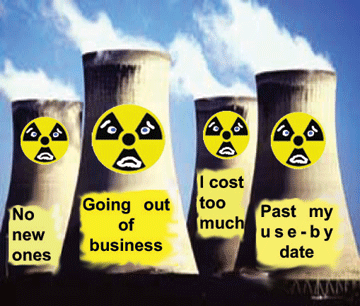 Exelon weighs shedding nuclear plants, other non-utility assets, Kiel Porter, Bloomberg News , 14 Oct 20, Exelon Corp. is considering a breakup that would involve separating its non-utility assets, according to people familiar with the matter.
The Chicago-based company is working with advisers to evaluate the split, said the people, who asked to not be identified because the matter isn’t public. No final decision has been made and Exelon could opt to keep its current structure, they said…….
Exelon’s non-utility operations include 21 nuclear reactors as well several solar, wind and natural-gas generating assets, according to its website. A potential split would leave Exelon focused on the regulated power market, with a portfolio that includes a half-dozen utilities in Pennsylvania, Maryland, Delaware and elsewhere.
Power companies are increasingly unloading unregulated assets to focus on their utilities, in part because investors prefer pure-play businesses. DTE Energy Inc. is considering unloading its non-utilities businesses, people familiar with the matter said last week. Dominion Energy Inc. agreed to sell its natural gas infrastructure earlier this year to Berkshire Hathaway Inc………
Christopher Crane said the company regularly evaluates whether to split up its utility and non-utility assets.
“One thing I can tell you is there’s an annual review on all the non-nuclear assets to see if they propose more value to others than we have projected for ourselves, and that annual review will continue,” he said. “And as we see assets that could perform better in somebody else’s portfolio and we could monetize those assets, we’ll do that.”Christopher Crane said the company regularly evaluates whether to split up its utility and non-utility assets. https://www.bnnbloomberg.ca/exelon-weighs-shedding-nuclear-plants-other-non-utility-assets-1.1507251
USA to market nuclear reactor to Bulgaria
 Bulgaria to hold talks with U.S. companies over new nuclear reactor, SOFIA, Oct 13 (Reuters) – Bulgaria’s government gave state-owned energy firm Bulgarian Energy Holding (BEH) a green light on Wednesday to start talks with U.S. companies on plans to build a new nuclear reactor at its Kozloduy power plant, the energy minister said…… Bulgaria to hold talks with U.S. companies over new nuclear reactor, SOFIA, Oct 13 (Reuters) – Bulgaria’s government gave state-owned energy firm Bulgarian Energy Holding (BEH) a green light on Wednesday to start talks with U.S. companies on plans to build a new nuclear reactor at its Kozloduy power plant, the energy minister said……
On Tuesday, Prime Minister Boyko Borissov said the new reactor should be based on U.S. technology and allow diversification in nuclear energy ….
Petkova did not name the companies that would be involved in talks, but said they were developers of nuclear technology, including those who work on small modular designs. She said she would have until the end of January to present the results from the research, which will explore potential technology that could be used for the new unit at the Kozloduy plant and options for its construction. Petkova did not name the companies that would be involved in talks, but said they were developers of nuclear technology, including those who work on small modular designs. She said she would have until the end of January to present the results from the research, which will explore potential technology that could be used for the new unit at the Kozloduy plant and options for its construction. https://www.reuters.com/article/bulgaria-nuclear-kozloduy/bulgaria-to-hold-talks-with-us-companies-over-new-nuclear-reactor-idUSL8N2H44VI |
|
Book review: GAMBLING WITH ARMAGEDDON

Coming Close to Nuclear Holocaust, NYT, By Talmage Boston, GAMBLING WITH ARMAGEDDON, Nuclear Roulette From Hiroshima to the Cuban Missile Crisis, 1945-1962, By Martin J. Sherwin On Aug. 6, 1945, after Hiroshima was destroyed, President Truman declared the atomic bomb “the greatest thing in history.” On Oct. 21, 1962, during the Cuban missile crisis, President Kennedy confided to a friend, “The world really is impossible to manage so long as we have nuclear weapons.” The two statements sum up the changes in thinking between those two dates.
Benefiting from more than a half century of hindsight, the Pulitzer-winning historian Martin J. Sherwin delivers a well-researched and reasoned analysis of nuclear weapons’ impact from 1945 to 1962 in “Gambling With Armageddon.” The book should become the definitive account of its subject.
Sherwin has three themes. First, history proves that the disadvantages of nuclear weapons outweigh their advantages. Yes, the A-bomb brought a quick end to World War II, but Dwight Eisenhower and Robert Oppenheimer both believed Japan’s defeat was imminent without the bomb. And while it tipped the balance of power until the Soviets developed their own nuclear weapon in 1949, this brief American advantage produced no geopolitical gains…….
The book’s final lesson is the unsettling one that regardless of how many wise decisions get made by prudent leaders,
Bribery Probe Into a Nuclear Plant Bailout Examines Facilities’ Owner
Bribery Probe Into a Nuclear Plant Bailout Examines Facilities’ Owner
Energy Harbor asked to turn over documents as federal prosecutors investigate nature of company’s payments to Ohio lawmaker…(subscribers only) https://www.wsj.com/articles/bribery-probe-into-a-nuclear-plant-bailout-examines-facilities-owner-11602688931
.S. govt funds small nuclear reactors, with $billions more tax-payer money to follow
DOE Awards $160M to TerraPower and X-Energy to Build Advanced Nuclear Plants by 2027, Greentech Media, 14 Oct 20 The U.S. Department of Energy has awarded $160 million to X-energy and TerraPower with the potential for billions more in federal funding, as the companies strive to build a working model of their smaller scale, more flexible advanced nuclear reactor designs by 2027. TerraPower is partnered with the GE Hitachi Nuclear Energy, a nuclear industry joint venture formed in 2007.
DOE’s Advanced Reactor Demonstration Program will provide $80 million to each award winner, DOE Secretary Dan Brouillette said Tuesday. DOE intends to invest about $3.2 billion over the next seven years into advanced nuclear, subject to future congressional appropriations, he said………
Smaller reactors are critical to rejuvenate an industry that’s struggling to finance and build the massive, gigawatt-plus power plants that make up the world’s existing nuclear fleet. In the U.S., several of these have been canceled, and Southern Company’s Plant Vogtle expansion is behind schedule and over budget.
Meanwhile, existing reactors in Pennsylvania and Illinois are facing the threat of closure due to challenging energy market economics, and California’s sole remaining nuclear reactor is set to close by mid-decade…………
TerraPower’s initial plans for what it calls a traveling wave reactor drew investment from Gates and Sun Microsystems billionaire Vinod Khosla with its promise of using depleted uranium rather than enriched uranium-235. But that project was abandoned last year after the Trump administration imposed limits on U.S.-China technology transfer forced it to cancel its partnership with China National Nuclear Corp. ……..
X-energy’s advanced pebble-bed reactor…… has yet to be proven in commercial form. A 15 MW demonstration reactor in Germany operated for two decades, but a second, larger-scale version was shut down after only four years of operation. China has built a 10 MW demonstration reactor, and a 250 MW unit began construction in 2012, but plans to start operations in 2019 have been pushed back, with no new completion date announced. ……
Donald Trump’s erratic behaviour revives the debate on the President’s unchecked nuclear authority
 Trump’s Virus Treatment Revives Questions About Unchecked Nuclear Authority
Even before the president was given mood-altering drugs, there was a movement to end the commander in chief’s sole authority to launch nuclear weapons. NYT, 12 Oct 20, By David E. Sanger and William J. Broad,
President Trump’s long rants and seemingly erratic behavior last week — which some doctors believe might have been fueled by his use of dexamethasone, a steroid, to treat Covid-19 — renewed a long-simmering debate among national security experts about whether it is time to retire one of the early inventions of the Cold War: the unchecked authority of the president to launch nuclear weapons.
Mr. Trump has publicly threatened the use of those weapons only once in his presidency, during his first collision with North Korea in 2017. But it was his decision not to invoke the 25th Amendment and turn control over to Vice President Mike Pence last week that has prompted concern inside and outside the government.
Among those who have long argued for the need to rethink presidents’ “sole authority” powers are former Defense Secretary William J. Perry, considered the dean of American nuclear strategists, who has cited the fragility of a nuclear-weapons control chain and the fear that it can be subject to errors of judgment or failure to ask the right questions under the pressure of a warning of an incoming attack.
Mr. Trump’s critics have long questioned whether his unpredictable statements and contradictions pose a nuclear danger. But the concerns raised last week were somewhat different: whether a president taking mood-altering drugs could determine whether a nuclear alert was a false alarm.
That question is a new one. The military’s Strategic Command often conducts drills that simulate actual but inconclusive evidence that the United States may be under nuclear attack. Such simulations drive home the reality that even a president asking all the right questions could make a mistake. But they rarely simulate what would happen if the president’s judgment was impaired.
“A nuclear crisis can happen at any time,” Tom Z. Collina, the policy director at the Ploughshares Fund, a private group that seeks to defuse nuclear threats, noted last week in an opinion piece. “If such a crisis takes place when a president’s thinking is compromised for any reason,” he added, “the results could be catastrophic.”
Traditionally, presidents have temporarily conveyed authority — including nuclear launch authority — to the vice president when they anticipated being under anesthesia. Ronald Reagan took that step in 1985, and George W. Bush did so in 2002 and 2007. There was no indication that Mr. Trump was unconscious, but there was reason to be concerned that the cocktail of drugs he was given could impair his judgment to make the most critical decisions entrusted to a president.
Last week in telephone interviews with Fox News and Fox Business Network, Mr. Trump said he was no longer taking experimental medications but was still on dexamethasone, which doctors say can produce euphoria, bursts of energy and even a sense of invulnerability. On Friday, he told Fox News he was off the drug, which he appears to have taken for less than a week.
But during that week, his prolific Twitter activity and rambling interviews led many to question whether the drugs had accentuated his erratic tendencies. His doctors’ refusal to describe with any specificity his condition or treatment only played up the concern.
“The history of obfuscating the medical condition of presidents is as old as the Republic,” said Vipin Narang, a professor at the Massachusetts Institute of Technology who has studied the nuclear command-and-control chain. “The issue here is that the dex” — shorthand for dexamethasone — “can make you paranoid and delusional.”
“We don’t know how much he was given,” Mr. Narang said. “And if he gives an order in the middle of the night, and no one is there to stop him, we are dependent on his military aide not to transmit the order or the duty officer at the national military command center to stop it.”………….
The “sole authority” tradition is unusual among the world’s nine nuclear powers; even Russia requires two out of three designated officials to sign off on a nuclear launch. While the Constitution says that only Congress can declare war, the speed of bombers and missiles made clear during the Cold War that there would be no time to convene Congress or mount a defense. As a result, Congress began delegating to the president all powers to use nuclear weapons during Harry S. Truman’s administration. He is the only president who has ordered a nuclear strike……..
“The last finger I would want on the nuclear button,” said Hans M. Kristensen, the director of the Nuclear Information Project at the Federation of American Scientists, a private group in Washington, “is that of a president on drugs.”……… https://www.nytimes.com/2020/10/11/us/politics/trump-nuclear-weapons-coronavirus.html
What to do about the USA President’s sole authority to launch a nuclear pre-emptive strike?
|
Quote of the week: “Ours is a world of nuclear giants and ethical infants… We have grasped the mystery of the atom and rejected the Sermon on the Mount.” The President of the United States has unrestricted powers to use nuclear weapons first if he or she deems this necessary. Concerns about the absence of checks and balances on the first use of nuclear weapons have spiked because of Donald Trump’s bellicose temperament and shallow understanding of nuclear flash points. They have been exacerbated by his erratic behavior and remarks while recovering from the COVID virus. What to do? Some on Capitol Hill have introduced legislation that would prohibit the president from launching a nuclear first strike without a declaration of war by the Congress. In my view, this is the wrong remedy. Instead, I propose a three person rule for crossing the nuclear threshold first that can be enacted by executive order and reaffirmed by the Congress………… https://www.armscontrolwonk.com/archive/1210154/the-presidents-sole-authority-for-first-use/ |


Climate disasters – Earth is becoming uninhabitable for millions of humans.

An uninhabitable hell’: UN says climate change ‘doubled the rate’ of disasters, SMH, By Olivia Rudgard, October 13, 2020 Climate change is largely responsible for a doubling in the number of natural disasters since 2000, the United Nations said Monday, as it warned that the Earth was becoming uninhabitable for millions of humans.
Three quarters of a billion more people were affected by catastrophic events of nature over the past two decades than in the 20 years before, the UN’s office for disaster risk reduction said.
Calling humanity “wilfully destructive”, it said the data was a wake-up call to governments that had failed to take the threat of climate change seriously or to prepare for more natural disasters.
It is baffling that we willingly and knowingly continue to sow the seeds of our own destruction, despite the science and evidence that we are turning our home into an uninhabitable hell for millions of people,” the authors said.
The report found that there were 7,348 major recorded disaster events between 2000 and 2019, compared with 4,212 between 1980 and 1999.
Climate-related disasters explained the bulk of the rise, increasing from 3,656 to 6,681. Floods and storms were the most common events. The incidence of flooding more than doubled, from 1,389 to 3,254.
Mami Mizutori, the UN’s representative for disaster risk reduction, said that NGOs and emergency services were “fighting an uphill battle against an ever-rising tide of extreme weather events”. She added: “The odds are being stacked against us when we fail to act on science and early warnings to invest in prevention, climate-change adaptation and disaster-risk reduction,” she said.
Asia was the worst-hit continent and China the worst-affected country, followed by the US. Overall, more than 4 billion people were affected by disasters, a rise from 3.25 billion. …….https://www.smh.com.au/environment/climate-change/an-uninhabitable-hell-un-says-climate-change-doubled-the-rate-of-disasters-20201013-p564hj.html
Los Alamos National Laboratory nuclear waste is potentially explosive
Report: LANL nuclear waste mix potentially explosive https://www.taosnews.com/news/environment/report-lanl-nuclear-waste-mix-potentially-explosive/article_543eb72c-0b50-11eb-825a-3777d9ad7922.html, By Scott Wyland swyland@sfnewmexican.com, Oct 10, 2020
Some of LANL’s facilities store radioactive waste without any engineered controls or safeguards beyond the containers, the board wrote in a cover letter addressed to the U.S. Department of Energy.
“As such, additional credited safety controls may be necessary to protect workers and the public,” the board said.
In 2014, a LANL waste container was packaged in a volatile blend of organic cat litter and nitrate salts, which caused the container to rupture and spew radiation at the Waste Isolation Pilot Plant. The underground disposal site closed for three years while it underwent a $2 billion cleanup.
The incidents that released high levels of radiation at WIPP and Idaho National Laboratory have shown the importance of adding multiple layers of protection to reduce the consequences of an accident, the board said.
The report estimates that an exploding waste canister could expose workers to 760 rem, far beyond the threshold of a lethal dose. A rem is a unit used to measure radiation exposure.
Federal guidelines define a lethal dose as high enough to cause 50 percent of the population to die within 30 days. Those levels range from 400 to 450 rem.
The 760 rem estimate is equal to 380,000 chest X-rays, said Dan Hirsch, retired director of programs on environment and nuclear policy at the University of California, Santa Cruz.
“This is vastly above what’s permissible for workers’ exposure,” Hirsch said, adding that far lower doses can cause cancer.
The 760 rem estimate is actually conservative, he said, noting that the WIPP explosion released four times that amount.
A spokeswoman for the National Nuclear Security Administration said officials were aware of the board’s letter and report regarding issues with transuranic waste storage and handling. She didn’t answer questions about the board’s criticisms or how the agency would tackle the problems identified in the report.
“Maintaining the safety, security, and effectiveness of America’s nuclear deterrent remains paramount to NNSA,” she said.
“It’s elementary,” Hirsch said. “You put certain chemicals together and they explode.”
Even water seeping into a barrel of waste containing sodium can trigger an explosion, Hirsch said. That’s what made a waste container blow up at a Nevada nuclear storage site five years ago, he said.
Having the waste containers stored above ground magnifies the hazard, Hirsch said. If one of those burst, it would be far more dangerous than one exploding at an underground site like WIPP, he said.
The report points to years of waste disposal problems that haven’t been corrected, said Greg Mello, executive director of the nonprofit Los Alamos Study Group.
“LANL keeps kicking the waste problem down the road,” Mello said. “LANL has always prioritized its weapons work, and this waste problem has built up for decades.”
If the lab produces plutonium triggers for bombs as planned, it will generate more waste that must be disposed of, Mello said. So if it doesn’t make its current waste safe and acceptable for WIPP, that waste might end up being stuck at the lab as a permanent hazard, Mello said.
The board, whose access the Energy Department has tried to restrict, has again shown how vital it is to report on hazards to workers – in this case, potentially lethal doses of radiation, said Jay Coghlan, executive director of nonprofit Nuclear Watch New Mexico.
“These dangers will only grow worse as LANL becomes less and less a lab and more and more a permanent nuclear weapons production site,” Coghlan said.
Any plutonium release is extremely hazardous, Hirsch said.
If someone inhales one millionth of an ounce of plutonium, that person has a 100 percent chance of getting cancer, Hirsch said. So every effort must be made to keep it contained and stabilized – something lab officials are not doing, he said.
“They seem to cut corners,” Hirsch said. “And they’re cutting corners with the most dangerous materials on Earth.”
On our website Read this story at santafenewmexican.com to view the Defense Nuclear Facilities Safety Board’s report on Los Alamos National Laboratory’s faulty radioactive waste storage, which includes the board’s letter to the U.S. Department of Energy.
Study shows that renewable energy is clearly better that nuclear at cutting greenhouse emissions
 25-Year Study of Nuclear vs Renewables Says One Is Clearly Better at Cutting Emissions, Science Alert, DAVID NIELD 11 OCTOBER 2020
Nuclear power is often promoted as one of the best ways to reduce our reliance on fossil fuels to generate the electricity we need, but new research suggests that going all-in on renewables such as wind and solar might be a better approach to seriously reducing the levels of carbon dioxide in the atmosphere.
Based on an analysis of 123 countries over a quarter of a century, the adoption of nuclear power did not achieve the significant reduction in national carbon emissions that renewables did – and in some developing nations, nuclear programmes actually pushed carbon emissions higher.
The study also finds that nuclear power and renewable power don’t mix well when they’re tried together: they tend to crowd each other out, locking in energy infrastructure that’s specific to their mode of power production.
Given nuclear isn’t exactly zero carbon, it risks setting nations on a path of relatively higher emissions than if they went straight to renewables….
It’s important to note that the study looked specifically at data from 1999-2014, so it excludes more recent innovations in nuclear power and renewables, and the scientists themselves say they have found a correlation, rather than cause and effect. But it’s an interesting trend that needs further investigation.
“The evidence clearly points to nuclear being the least effective of the two broad carbon emissions abatement strategies, and coupled with its tendency not to co-exist well with its renewable alternative, this raises serious doubts about the wisdom of prioritising investment in nuclear over renewable energy,” says Benjamin Sovacool, a professor of energy policy at the University of Sussex in the UK.
“Countries planning large-scale investments in new nuclear power are risking suppression of greater climate benefits from alternative renewable energy investments.”
The researchers suggest the tighter regulations and longer lead times associated with nuclear power are responsible for some of the statistics explored here, while the large-scale development that nuclear requires tends to leave less room for renewable projects that work on a smaller scale.
There are also broader considerations to weigh up – nuclear and renewables will be two factors among many in the policies put together by governments when it comes to reducing carbon emissions.
Plus, given the time frame, a lot of the nuclear power plants covered by this study are likely to have been getting towards the end of their lifespans, which means more energy is required to maintain them.
Whatever the ins and outs of the nuclear policies, the study does show a clear link between greater adoption of renewable projects and lower carbon emissions overall.
The study authors propose that by cutting out nuclear altogether, these renewable gains could be even greater.
This paper exposes the irrationality of arguing for nuclear investment based on a ‘do everything’ argument,” says researcher for technology policy Andrew Stirling at the University of Sussex.
“Our findings show not only that nuclear investments around the world tend on balance to be less effective than renewable investments at carbon emissions mitigation, but that tensions between these two strategies can further erode the effectiveness of averting climate disruption.”………..
it is astonishing how clear and consistent the results are across different time frames and country sets,” says Patrick Schmid, from the ISM International School of Management in Germany.
“In certain large country samples the relationship between renewable electricity and CO2-emissions is up to seven times stronger than the corresponding relationship for nuclear.”
The research has been published in Nature Energy. https://www.sciencealert.com/here-s-why-nuclear-won-t-cut-it-if-we-want-to-drop-carbon-as-quickly-as-possible
1 This Month

of the week – Shut Down Drone Warfare!


Tell the Ukrainian Government to Drop Prosecution of Peace Activist Yurii Sheliazhenko

Petition to revoke the licensing of the Near Surface Nuclear Disposal Facility (NSDF) at Chalk River. https://www.ourcommons.ca/petitions/en/Petition/Details?Petition=e-7247
To see nuclear-related stories in greater depth and intensity – go to https://nuclearinformation.wordpress.com
-
Archives
- April 2026 (34)
- March 2026 (251)
- February 2026 (268)
- January 2026 (308)
- December 2025 (358)
- November 2025 (359)
- October 2025 (376)
- September 2025 (257)
- August 2025 (319)
- July 2025 (230)
- June 2025 (348)
- May 2025 (261)
-
Categories
- 1
- 1 NUCLEAR ISSUES
- business and costs
- climate change
- culture and arts
- ENERGY
- environment
- health
- history
- indigenous issues
- Legal
- marketing of nuclear
- media
- opposition to nuclear
- PERSONAL STORIES
- politics
- politics international
- Religion and ethics
- safety
- secrets,lies and civil liberties
- spinbuster
- technology
- Uranium
- wastes
- weapons and war
- Women
- 2 WORLD
- ACTION
- AFRICA
- Atrocities
- AUSTRALIA
- Christina's notes
- Christina's themes
- culture and arts
- Events
- Fuk 2022
- Fuk 2023
- Fukushima 2017
- Fukushima 2018
- fukushima 2019
- Fukushima 2020
- Fukushima 2021
- general
- global warming
- Humour (God we need it)
- Nuclear
- RARE EARTHS
- Reference
- resources – print
- Resources -audiovicual
- Weekly Newsletter
- World
- World Nuclear
- YouTube
-
RSS
Entries RSS
Comments RSS
 nuclear-news