Why nuclear power is unsustainable.
https://dragontrailz.tumblr.com/post/632215852166610944/why-nuclear-power-is-unsustainable/amp
Nuclear pollution in China – the Uighur people pay the health and environmental price
A third of the PRCs uranium for nuclear energy comes from extortion in the Yili basin of Xinjiang. This is also home to a great population of Uighurs.
Today, China has one of the world’s largest nuclear energy development programmes. During the Cold War era, there did not exist a political or economic motivator for commercialising nuclear energy as coal-fired power stations and hydroelectric energy dominated the system. However, after 2005, China has been able to reinvent this narrative. Notably, what this resurrected was a reassertion of spaces of injustice for their minorities. Their lands were first grounds for nuclear weapons’ testing and now used for energy rather than warfare purposes, thus continuing a historical subjugation to nuclear imperialism. This nuclear imperialism situates itself within an already prevalent cyclic violence against China’s far western frontier region of Xinjiang’s ethnic minorities, the predominantly Muslim Uighurs, ever since the establishment of the People’s Republic of China (PRC) in 1949.
Given the inherent differentiation between the Uighurs and the Chinese dominant ethnicity, the Hans, the former’s identity was always up for scrutiny. The government came down particularly hard on the Uighurs after the events of 9/11 initiated the Global War on Terror (GWOT), as well as the Ürümqi riots on 5 July 2009 which saw clashes between protesting Uighurs, Han people, and China’s People’s Armed Police, leaving nearly 200 people dead in Xinjiang. The Chinese government has attributed security concerns with the certain ‘terrorist’ acts committed by a handful of them. Taking what some might perceive as an opportunist stand, China was able to claim being victim to global terrorism, to justify crackdown on the minority group. What this terrorist narrative in turn ushered in was a transnational territory of uncontrolled spaces where ‘dangerous populations’ need not be afforded legal protections and therefore be made to quarantine; containing their actions that often correspond to security threats. The antagonism was not restricted to the few Uighurs rioters. Instead the entire Uighur community as a single biological group was treated as the Homo Sacer.
………….. The systematic discrimination of the Uighur feeds into a larger understanding of necro-politics of Uighur lives having become too consequential juxtaposed with a system which is ready to dispense with this minority population. The emphasis here is on China’s first nuclear weapons test in Lop Nor, and the legacy it has translated onto the present day context through states sponsored uranium mining in the Yili Basin, underscoring a new kind of imperialism.
Nuclear weapon testing began in the mid-1960s. Soon a kind of nuclear imperialism started to take root in the existing Han colonisation of Uighur spaces. The latter revolved around a combination of contestation over the sovereignty of the Uighur homeland and the resource-rich soils they inhabited. The aftermath of the Sino-Soviet split meant a collapse in PRCs nuclear relationship with China which acted as a driver for hastening and furthering their ambitious nuclear programmes. The PRC became the fifth nation to develop nuclear weapons during the Cold War. They formally established the 10,000 km sq. Lop Nor Nuclear Test base in 1956. It still stands as the largest site of its kind in the world………
Professor Jun Takada conducted a study explaining how peak levels of radioactivity from large yield tests might have had prolonged consequences in the biological makeup of the generations to come observing congenital defects and cancer incidents in some. The cancer incidents in the region were approximately 35% higher than the rest of the state. Uighur traditional medicine could not cope with these cases. In short, a biopolitical regime protected the state from liability, meanwhile for the Uighurs, contestation around state assurance and health risks posed a blurring in the causation between sickness and exposition.
The Uighurs who were affected by the Lop Nor test therefore have been given no compensation or recognition from the state. Many Hans on the other hand were given assurance from the state especially in terms of healthcare on various occasions. This only furthered the resentment and tension between the Hans and the Uighurs of Xinjiang in the years to come.
Following this, peaceful protests sprung up. In November 1985, protests led by students in Beijing against nuclear weapon tests were met with brute state coercion. In 1993, Uighurs gathered at Log Nor and demanded the ban of nuclear testing but were interrupted by PLA forces, some protestors were shot in the process. The Tigers of Lop Nor were an organisation that even managed to send tanks inside nuclear spaces and blew up planes in protest. Moreover, enveloped in this environment, the Uighur identity that already clashed with Han nationalism was simply made starker; the anti-nuclear movement began to echo separatist tendencies.
Today, a third of the PRCs uranium for nuclear energy comes from extortion in the Yili basin of Xinjiang. This is also home to a great population of Uighurs. The PRC has placed a moratorium on the manufacturing of fissile material for deterrence purposes, transforming Xinjiang into the primary hub for the nuclear energy industry. The NINT continues to partake in nuclear research, to the north of the Lop Nor test site. There is no state system in place to ensure the safety of those dwelling the Yili. What this reflects is a revival of a past narrative of nuclear imperialism as uranium energy extraction seems to have overtaken nuclear testing. There appears to be no incentive from the ends of the government; a lacking in enforceable nuclear legislations and regional systems of monitoring and regulating nuclear activity. …….
. China now possesses over 44 nuclear reactors in operation and 18 others under construction and is striving towards ensuring that 1/5th of their energy comes from their power plants by 2030. Activism from the minorities in the region is often counted by officials as acts of Islamism or cultural protests rather than a legacy of activities against the nuclear industry which is another layer of discrimination that has been recognised by the Uighurs.
More anti-nuclear activism seems to be entering the eastern provinces of Shandong, Jiangsu, and Guangdong as a result of general community concerns against an unprotected nuclear policy. Online petitions and active media are slowly entering the scene to influence and mobilise public opinion. However, it is only perhaps a matter of time before the PRC silences them too.
Censorship is often used to subdue this kind of opposition online. What is worse is that the Uighurs of Xinjiang lack the agency to voice their grievances while practitioners in the east who are often familiar with the political systems and often well-educated are able to make negotiations with the state in terms of the relocation of nuclear power plants. ……… https://www.orfonline.org/expert-speak/nuclear-imperialism-china-xinjiang/
American election. Joe Biden’s climate plan would give the world a fighting chance

 BBC 18th Oct 2020, Who occupies the White House for the next four years could play a critical role in the fight against dangerous climate change, experts say. Matt McGrath weighs the likely environmental consequences of the US election.
Scientists studying climate change say that the re-election of Donald Trump could make it “impossible” to keep global temperatures in check. They’re worried another four years of Trump would “lock in” the use of fossil fuels for decades to come – securing and enhancing the infrastructure for oil and gas production rather than phasing them out as environmentalists want. Joe
Biden’s climate plan, the scientists argue, would give the world a fighting chance.
Scientific women get together in plan for marine protected area for Antarctica Peninsula
All-female scientific coalition calls for marine protected area for Antarctica Peninsula Plus other ways to help penguins, whales, and seabirds, EurekAlert, UNIVERSITY OF SYDNEY, Research News 19 Oct 20, The Western Antarctic Peninsula is one of the fastest warming places on earth. It is also home to threatened humpback and minke whales, chinstrap, Adélie and gentoo penguin colonies, leopard seals, killer whales, seabirds like skuas and giant petrels, and krill – the bedrock of the Antarctic food chain.With sea ice covering ever-smaller areas and melting more rapidly due to climate change, many species’ habitats have decreased. The ecosystem’s delicate balance is consequently tilted, leaving species in danger of extinction.
Cumulative threats from a range of human activities including commercial fishing, research activities and tourism combined with climate change is exacerbating this imbalance, and a tipping point is fast approaching.
Dr Carolyn Hogg, from the University of Sydney School of Life and Environmental Sciences, was part of the largest ever all-female expedition to the Antarctic Peninsula, with the women in STEMM initiative, Homeward Bound, in late 2019. There, she witnessed the beauty and fragility of the area, and the negative impacts of climate change and human activity on native species, first-hand. As part of the Homeward Bound program she learnt about the science, conservation and governance of Antarctica.
In a new commentary piece published in Nature, Dr Hogg and her colleagues from the expedition outline these threats, and importantly, offer ways to counter them. More than 280 women in STEMM who have participated in the Homeward Bound initiative are co-signatories to the piece.
A global initiative, Homeward Bound ‘aims to elevate the voices of women in science, technology, engineering mathematics and medicine in leading for positive outcomes for our planet’.
Women are noticeably absent in Antarctica’s human history, which is steeped in tales of male heroism. Female scientists are still a minority in the region’s research stations.
“Now, more than ever, a broad range of perspectives is essential in global decision-making, if we are to mitigate the many threats our planet faces,” said Dr Hogg.
“Solutions include the ratification of a Marine Protected Area around the Peninsula, set to be discussed on 19 October, at a meeting of a group of governments that collectively manage the Southern Ocean’s resources,” said Dr Hogg. “The region is impacted by a number of threats, each potentially problematic in their own right, but cumulated together they will be catastrophic.”
Decreasing krill affects whole ecosystem
The Peninsula’s waters are home to 70 percent of Antarctic krill. In addition to climate change, these krill populations are threatened by commercial fishing. Last year marked the third largest krill catch on record. Nearly 400,000 tonnes of this animal were harvested, to be used for omega-3 dietary supplements and fishmeal.
“Even relatively small krill catches can be harmful if they occur in a particular region, at a sensitive time for the species that live there,” said Dr Cassandra Brooks, a co-author on the comment from the University of Colorado, Boulder. “For example, fishing when penguins are breeding lowers their food intake, and affects their subsequent breeding success. A Marine Protected Area will conserve and protect this unique ecosystem and its wildlife, and we need to implement it now.”
Climate change is fundamentally altering the Western Antarctic Peninsula:……
Three ways to protect the Peninsula
1. A Marine Protected Area (MPA) designation for the waters………
2. Protect land areas ………
3. Integrate conservation efforts…….
….https://www.eurekalert.org/pub_releases/2020-10/uos-asc101520.php
Many 1000s sick in USA, but government spending priority is $billions, $trillions – for nuclear missiles!
 Pentagon estimates cost of new nuclear missiles at $95.8B Pentagon estimates cost of new nuclear missiles at $95.8B
By ROBERT BURNS, 29 Oct 20,
WASHINGTON (AP) — The Pentagon has raised to $95.8 billion the estimated cost of fielding a new fleet of land-based nuclear missiles to replace the Minuteman 3 arsenal that has operated continuously for 50 years, officials said Monday. The estimate is up about $10 billion from four years ago. The weapons, known as intercontinental ballistic missiles, or ICBMs, are intended as part of a near-total replacement of the American nuclear force over the next few decades at a total cost of more than $1.2 trillion. Some, including former Defense Secretary William J. Perry, argue that U.S. national security can be ensured without ICBMs, but the Pentagon says they are vital to deterring war. The Trump administration affirmed its commitment to fielding a new generation of ICBMs in a 2018 review of nuclear policy……… The current fleet of 400 deployed Minuteman missiles, each armed with a single nuclear warhead, is based in underground silos in Montana, North Dakota, Colorado, Wyoming and Nebraska. Their numbers are governed in part by the 2010 New START treaty with Russia, which is due to expire in February. Russia wants to extend the treaty but the Trump administration has set conditions not accepted by Moscow. The U.S. also is building a new fleet of ballistic missile submarines to replace the current Ohio-class strategic subs; a new long-range nuclear-capable bomber to replace the B-2 stealth aircraft; a next-generation air-launched nuclear cruise missile; and a new nuclear command and communications system. It also is working on updated warheads, including an ICBM warhead replacement for an estimated $14.8 billion…….. Last month the Air Force awarded Northrop Grumman a $13.3 billion contract for engineering and manufacturing development of the new missiles. The total “lifecycle” cost, including operating and sustaining the missiles over their expected lifetime into the 2070s, is set at $263.9 billion. https://apnews.com/article/politics-e4b80421be5dba5c5f5a162e55ac0d94 |
|
Considering the future of the Iran nuclear deal
 deal alive.
The deal, which imposes limitations on Iran’s civilian nuclear enrichment program, was agreed in July 2015 between the Iranians and the P5+1 group — China, Britain, France, Germany, Russia and the United States — and implemented six months later. The deal was struck when the Obama administration was in the White House following years of negotiations. The JCPOA gave Iran relief from international economic sanctions in return for dismantling major parts of its nuclear program and giving access to its facilities for inspection.
Yet ever since Donald Trump was elected president of the United States in November 2016, the future of the JCPOA has hung in the balance. Trump made it a campaign promise to pull out of the Iran deal. He kept his word and officially withdrew the United States from the JCPOA in May 2018, saying the deal is “defective” and did not address Iran’s ballistic missile program or its interference in the affairs of other countries in the Middle East.
Washington has since reinstated US sanctions on Iran and sought to penalize any nation doing trade with the Iranians, which has led to widespread criticism. In response, Iran has resumed its uranium enrichment at the Fordow nuclear plant, which is banned under the JCPOA.
The events surrounding the Iran deal have seen their ups and downs, but one thing is for sure: The collapse of the JCPOA is in no one’s best interest………….
Considering that US–Iran diplomatic relations are a nonstarter under the Trump administration, the result of the US presidential election on November 3 will be critical. President Trump has promised to reach a new deal with Iran “within four weeks” if he is reelected. If he wins, his administration would have to reshape its approach toward Iran in a constructive way to meet the timeline he has set. On the other hand, if Democratic nominee Joe Biden wins, his administration would likely rejoin the JCPOA, as well as seek additional concessions from Tehran. In a recent op-ed for CNN, Biden stated, “If Iran returns to strict compliance with the nuclear deal, the United States would rejoin the agreement as a starting point for follow-on negotiations.”
Biden served as the vice president under the previous Obama administration, which, together with the P5+1 group, negotiated the JCPOA back in 2015. Therefore, it is safe to say that the future of the nuclear deal might just rest on the outcome of the US election.
A Regional Arms Race
For now, however, the US withdrawal from the JCPOA has weakened the impact of the accord. More importantly, the near-collapse of the deal could have a direct impact on the next Non-Proliferation of Nuclear Weapons Review Conference in 2021, potentially drawing criticism from non-nuclear-weapon states that may wish to pursue civilian programs of their own.
The JCPOA is not only important for global nonproliferation efforts, but also for stability in the Middle East. The complete failure of the deal would have severe implications. ………
Sanctions on Iran
On August 20, France, Germany and the UK issued a joint statement saying they do not support the US request for the UN Security Council to initiate the “snapback mechanism” of the JCPOA, which would reimpose the international sanctions against Iran that were lifted in 2015. As the US is no longer a party to the JCPOA, it has limited influence over its enforcement. Therefore, the Security Council rejected the US move.
The Iranian economy was already fragile before President Trump withdrew from the JCPOA, and US-enforced sanctions are further complicating the situation. High living costs, a deep recession and plummeting oil exports are just the tip of the iceberg………..
Nuclear Nonproliferation
With all of this in mind, it is vital that the remaining parties to the JCPOA continue with constructive dialogue to try to uphold the agreement. Everyone benefits from the deal, and its success depends on each side’s fulfillment of their responsibilities and commitments, particularly Iran’s full compliance.
Most importantly, the Joint Comprehensive Plan of Action is necessary for the future of nuclear nonproliferation. If the deal collapses, then the world enters uncharted territory. https://www.fairobserver.com/region/middle_east_north_africa/elif-beyza-karaalioglu-jcpoa-iran-nuclear-deal-us-sanctions-iranian-news-middle-east-world-news-78178/
Royal Navy officer in charge of submarine’s nuclear weapons, sent back to UK, alleged to be drunk on duty
 Royal Navy officer in charge of sub’s nuclear weapons sent back to UK for ‘clocking on after night of drinking’ Lieutenant Commander Len Louw was carrying a bag of barbecue grilled chicken when he arrived for work. Sky News ,By Lucia Binding, news reporter, Monday 19 October 2020 ……….
Lieutenant Commander Len Louw was declared unfit for duty when he arrived at HMS Vigilant to take charge of nuclear missiles last month………..
Lieutenant Commander Louw was responsible for all weapons and sensors on the vessel. ……https://news.sky.com/story/royal-navy-officer-in-charge-of-subs-nuclear-weapons-sent-back-to-uk-for-clocking-on-after-night-of-drinking-12108234
In Germany , a new dispute over the old abandoned Gorleben nuclear waste site
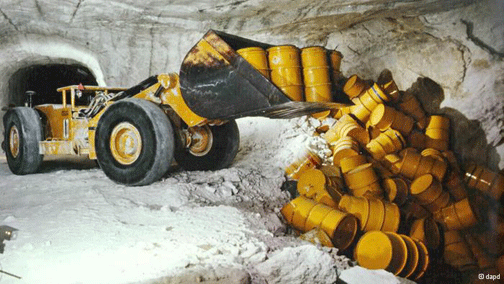
16 October 2020 Pledge Times (India/Germany)
New dispute over Gorleben
In an interview, the President of Germany’s Federal Office for the Safety of Nuclear Waste Management says it was problematic that Gorleben (current interim but beleaguered radwaste site) has been ruled out in the first review stage of the process to identify a geological repository site. The Green Party responded that the President “did not understand the procedure for which he is in charge. The search for a repository follows scientific criteria.”
USA aiming to beat Russia, China etc, in marketing nuclear reactors to Poland
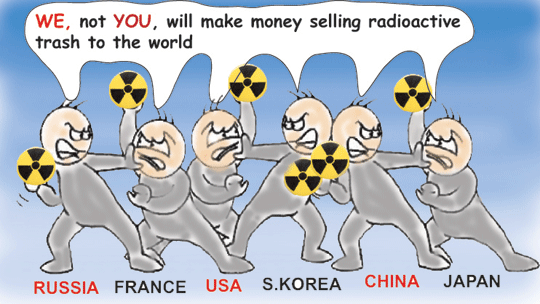 US to cooperate on Poland’s nuclear plans, Argus 9 October 2020, The US and Poland are set to sign an agreement to co-operate on Poland’s nuclear development programme, envisaging construction of 6-9GW of nuclear generation capacity, with the first unit to start in 2033.US secretary of energy Dan Brouillette and Poland’s secretary of energy infrastructure Piotr Naimski today agreed to sign a long-term agreement between the governments of both countries to co-operate on Polish nuclear development. US to cooperate on Poland’s nuclear plans, Argus 9 October 2020, The US and Poland are set to sign an agreement to co-operate on Poland’s nuclear development programme, envisaging construction of 6-9GW of nuclear generation capacity, with the first unit to start in 2033.US secretary of energy Dan Brouillette and Poland’s secretary of energy infrastructure Piotr Naimski today agreed to sign a long-term agreement between the governments of both countries to co-operate on Polish nuclear development.
The agreement, which had been already signed by the US side and is to be signed by Poland in the near future, provides that over the next 18 months the countries will work together on a financial and technical report on Poland’s nuclear power programme. This report will be the basis for US long-term involvement and for the Polish government to take final decisions on construction of nuclear power plants in the country, the US Department of Energy said……….. Earlier this year a Polish nuclear consortium led by government-controlled PGE sold its stakes in the PGE EJ 1 subsidiary, which initially was to be developing nuclear plants. In 2009 PGE said it planned to develop 6GW of nuclear capacity. Since then the company has struggled to come up with a financing model, and it recently opted to abandon its nuclear plans and focus on renewables. Under the current financing model, Poland plans to set up a joint venture with strategic foreign investors for development of the plants, with the Polish government maintaining at least 51pc. Tentative partners, beyond US companies, include firms from France and South Korea. https://www.argusmedia.com/en/news/2151529-us-to-cooperate-on-polands-nuclear-plans |
|
The very genuine promise of cheap electricity – solar power
 Nuclear power never delivered on its promise, but will solar? John Quiggin, Canberra Times, 19 Oct 20,

The International Energy Agency attracted attention recently when executive director Fatih Birol declared that solar would be “the new king of electricity markets.” Long known for its conservative view of renewables, the IEA’s latest Global Energy Review marked a radical change. Instead of growing slowly over time, solar (along with wind and other renewables) is now seen as meeting all new electricity demand, with coal set for a sharp decline. …….
The prospect of electricity this cheap might seem counter-intuitive to anyone whose model of investment analysis is based on concepts like “present value” and payback periods. But in the world of zero real interest rates that now appears to be upon us, such concepts are no longer relevant. Governments can, and should, invest in projects whenever the total benefits exceed the costs, regardless of how those benefits are spread over time.
- John Quiggin is a Professor of Economics at the University of Queensland and a columnist with Inside Story, where this article also appears. https://www.canberratimes.com.au/story/6974708/energy-that-is-too-cheap-to-meter/
France’s anti nuclear activists to train citizen scientists to measure radioactivity levels around a nuclear site
La Depeche 17th Oct 2020, The actinists who have been mobilizing on the ground for years against the
Orano-Malvesi plant (conversion and enrichment of uranium ore), want to
train citizens to take samples themselves to measure the radioactivity
around the nuclear site.
Britain’s zero emissions policy will bring many 1000s of jobs, investing in green infrastructure
help to achieve Boris Johnson’s national renewal mission, a report
published today says. Investment in green infrastructure and technologies
will prevent long-term scarring of the labour market in the wake of the
Covid-19 crisis, the report by the London School of Economics adds.
this summer to “build back better, build back greener, build back
faster” after GDP collapsed by a record 19.8 per cent as a result of a
national lockdown.
government investment would create the maximum number of jobs while also
helping to achieve the UK’s commitment of carbon neutrality, including
renewable energy infrastructure, electric vehicle production and home
energy efficiency retrofits. The UK was the world’s first major economy
to enshrine in law a commitment to reach net zero carbon emissions by 2050.
https://www.thetimes.co.uk/edition/business/net-zero-goal-will-be-ally-of-recovery-w09wcx7hn
A green recovery from the pandemic will bring more jobs, more economic success
 Business Green 19th Oct 2020, Analysis published by We Mean Business coalition recommends policymakers
reject traditional stimulus programmes that focus on VAT reductions and
boosting household spending in favour of targeted support for green
technologies and solutions.
In the latest addition to the library of
studies that has underscored the benefits of a ‘green recovery’ to the
coronavirus pandemic, economists have today published a new research
detailing how stimulus packages that invest in low carbon technologies and
infrastructure will generate more income, jobs, and GDP than traditional
recovery measures.
Economies around the world stand to benefit if
governments opt to invest in energy efficiency improvements, tree planting,
and electricity grid upgrades, while supporting an acceleration in the roll
out of wind and solar power capacity and introducing car scrappage schemes
that boost sales of electric vehicles, according to a report published this
morning by the We Mean Business Coalition.
After modelling a ‘green
recovery’ plan against a ‘return-to-normal’ plan across the UK, Germany,
Poland, US, India, and globally, researchers from Cambridge Econometrics
concluded the impact of a green recovery strategy would be “consistently
larger” than that delivered through a standard stimulus package.
“This report confirms what many companies already know – investing in the zero
carbon future is the best way to ensure business success,” said Maria
Mendiluce, chief executive of the We Mean Business coalition. “For
governments, spending and tailoring policies in a way that boosts green
technologies and innovation brings benefits to businesses, economies and
people as well as cutting emissions. To invest in any other way would be to
set the world on course for economic and environmental disaster at a time
when we need to build resilience.”
Swedish council votes in favour of nuclear waste disposal facility
China’s world-leading push for solar and wind energy
capacity each year than any other country, with over 760GW installed so
far. By contrast, the EU has only managed 500GW, the USA 250 GW.
capacity additions in China are expected to fall by over 16% to 19 GW from
2020 to 2021, given the Chinese government’s decision to end subsidies,
say analysts Wood Mackenzie.
250 GW of wind capacity to be added, with repowering opportunities onshore
and growth potential offshore. Indeed, some see the latter booming
dramatically. So, while wind subsidies will fall by 3.2%, wind capacity
will still grow, and PV solar seem likely to do even better: incentives for
PV will rise by 14%, with some seeing solar as the major growth area longer
term, helping China get 62% of its power from non-fossil sources by 2030.
https://renewextraweekly.blogspot.com/2020/10/china-renewables-to-expand-even-more.html
1 This Month

of the week – Shut Down Drone Warfare!


Tell the Ukrainian Government to Drop Prosecution of Peace Activist Yurii Sheliazhenko

Petition to revoke the licensing of the Near Surface Nuclear Disposal Facility (NSDF) at Chalk River. https://www.ourcommons.ca/petitions/en/Petition/Details?Petition=e-7247
To see nuclear-related stories in greater depth and intensity – go to https://nuclearinformation.wordpress.com
-
Archives
- April 2026 (34)
- March 2026 (251)
- February 2026 (268)
- January 2026 (308)
- December 2025 (358)
- November 2025 (359)
- October 2025 (376)
- September 2025 (257)
- August 2025 (319)
- July 2025 (230)
- June 2025 (348)
- May 2025 (261)
-
Categories
- 1
- 1 NUCLEAR ISSUES
- business and costs
- climate change
- culture and arts
- ENERGY
- environment
- health
- history
- indigenous issues
- Legal
- marketing of nuclear
- media
- opposition to nuclear
- PERSONAL STORIES
- politics
- politics international
- Religion and ethics
- safety
- secrets,lies and civil liberties
- spinbuster
- technology
- Uranium
- wastes
- weapons and war
- Women
- 2 WORLD
- ACTION
- AFRICA
- Atrocities
- AUSTRALIA
- Christina's notes
- Christina's themes
- culture and arts
- Events
- Fuk 2022
- Fuk 2023
- Fukushima 2017
- Fukushima 2018
- fukushima 2019
- Fukushima 2020
- Fukushima 2021
- general
- global warming
- Humour (God we need it)
- Nuclear
- RARE EARTHS
- Reference
- resources – print
- Resources -audiovicual
- Weekly Newsletter
- World
- World Nuclear
- YouTube
-
RSS
Entries RSS
Comments RSS
 nuclear-news