US urges countries to withdraw from UN nuclear ban treaty
 US urges countries to withdraw from UN nuke ban treaty, By EDITH M. LEDERER, October 22, 2020, UNITED NATIONS (AP) — The United States is urging countries that have ratified a U.N. treaty to ban nuclear weapons to withdraw their support as the pact nears the 50 ratifications needed to trigger its entry into force, which supporters say could happen this week.The U.S. letter to signatories, obtained by The Associated Press, says the five original nuclear powers — the U.S., Russia, China, Britain and France — and America’s NATO allies “stand unified in our opposition to the potential repercussions” of the treaty……..
Beatrice Fihn, executive director of the International Campaign to Abolish Nuclear Weapons, the 2017 Nobel Peace Prize-winning coalition whose work helped spearhead the nuclear ban treaty, told The Associated Press Tuesday that several diplomatic sources confirmed that they and other states that ratified the TPNW had been sent letters by the U.S. requesting their withdrawal.
She said the “increasing nervousness, and maybe straightforward panic, with some of the nuclear-armed states and particularly the Trump administration” shows that they “really seem to understand that this is a reality: Nuclear weapons are going to be banned under international law soon.”
Fihn dismissed the nuclear powers’ claim that the treaty interferes with the Nuclear Nonproliferation Treaty as “straightforward lies, to be frank.”
“They have no actual argument to back that up,” she said. “The Nonproliferation Treaty is about preventing the spread of nuclear weapons and eliminating nuclear weapons, and this treaty implements that. There’s no way you can undermine the Nonproliferation Treaty by banning nuclear weapons. It’s the end goal of the Nonproliferation Treaty.”
The NPT sought to prevent the spread of nuclear arms beyond the five original weapons powers. It requires non-nuclear signatory nations to not pursue atomic weapons in exchange for a commitment by the five powers to move toward nuclear disarmament and to guarantee non-nuclear states’ access to peaceful nuclear technology for producing energy………
“That the Trump administration is pressuring countries to withdraw from a United Nations-backed disarmament treaty is an unprecedented action in international relations,” Fihn said. “That the U.S. goes so far as insisting countries violate their treaty obligations by not promoting the TPNW to other states shows how fearful they are of the treaty’s impact and growing support.”
The treaty was approved by the 193-member U.N. General Assembly on July 7, 2017 by a vote of 122 in favor, the Netherlands opposed, and Singapore abstaining. Among countries voting in favor was Iran. The five nuclear powers and four other countries known or believed to possess nuclear weapons — India, Pakistan, North Korea and Israel — boycotted negotiations and the vote on the treaty, along with many of their allies………… https://apnews.com/article/nuclear-weapons-disarmament-latin-america-united-nations-gun-politics-4f109626a1cdd6db10560550aa1bb491
Shadow of $25 billion Nuclear Plant Vogtle hangs over Georgia Public Service Commission elections

Nuclear costs loom over races for Georgia PSC races
Public Service Commission must deal with $25 billion Plant Vogtle’s impact on electric rates, News 4 Ajax, Jeff Amy, Associated Press, 25 Oct 20, ATLANTA – The shadow of two nuclear reactors that Georgia Power Co. is building near Waynesboro hangs over two statewide elections for the Georgia Public Service Commission. Although the reactors are now getting so close to completion that they are likely to enter service, whoever is elected will have to deal with the $25 billion project’s ultimate impact on customer bills.
Electric customers statewide and even in Jacksonville will help pay for Plant Vogtle, as Georgia Power has contracts to provide power from the plant around the Southeast.
The five-person utility regulatory body is currently all Republican, with two members up for reelection this year. ………..
Amid rising costs, the plan to add a third and fourth nuclear reactor at Plant Vogtle survived a cost-overrun scare in 2018 with the heavy support of the state’s Republican establishment. Georgia Power, the largest subsidiary of the Atlanta-based Southern Co. is now building the only new nuclear plants in the U.S. ……… https://www.news4jax.com/news/georgia/2020/10/25/nuclear-costs-loom-over-races-for-georgia-utility-regulator/
And again, it’s delay delay at the costly Vogtle nuclear project
 Progress slips again at Vogtle nuclear plant, By Matt Kempner, The Atlanta Journal-Constitution, Georgia Power has fallen months further behind on critical steps to start the first of two new nuclear reactors at Plant Vogtle, despite having last revised its schedule only three months ago. Progress slips again at Vogtle nuclear plant, By Matt Kempner, The Atlanta Journal-Constitution, Georgia Power has fallen months further behind on critical steps to start the first of two new nuclear reactors at Plant Vogtle, despite having last revised its schedule only three months ago.And measures to halt COVID-19 within the project’s massive workforce continue to complicate construction.
The utility said it still expects to meet a state regulatory deadline to have the first reactor in commercial operation in November 2021. But its wiggle room for doing so has become increasingly thin. Missing the deadline little more than a year from now would increase already soaring costs, which could end up in the electric bills of 2.6 million customers……….. The Vogtle project already is years behind schedule and billions of dollars over budget, with customers at risk of having to cover those cost. State staffers and independent monitors have warned about the potential for still more delays, even before factoring in effects from the pandemic. …….. So far, more than 1,000 Vogtle workers have tested positive during the pandemic, according to the company’s latest filing. ……… Meanwhile, Georgia Power’s continued shifts in predictions about when it will complete scheduled Vogtle milestones have made it “impossible to determine where the project really stands,” said Kurt Ebersbach of the Southern Environmental Law Center, which has represented groups critical of Vogtle’s impact on consumers and the state……… https://www.ajc.com/news/progress-slips-again-at-vogtle-nuclear-plant/OK656Q6TQFHANDQW72D2ASP76E/ |
|
Unwanted nuclear submariness and military operations in the Arctic
Increased interest in the Arctic: “The U.S. Army has made a significant pivot” There is a pivot in the U.S. Army to train and operate more in Alaska to rebuild skills, according to Major General Peter Andrysiak, commander U.S. Army Alaska. He says the U.S. Army soon will release its own Arctic strategy.
Legal fight to stop Sizewell nuclear project destroying an historic Suffolk woodland
 East Anglian Daily Times 24th Oct 2020, Campaigners have agreed to continue their battle to stop an historic
Suffolk woodland from being felled – and are taking the fight to the
Court of Appeal.
Wood in order to use the land and Pillbox Field to relocate some Sizewell B
buildings ready for a start on Sizewell C.
Sizewell C) says the project is premature because the twin reactor nuclear
power station has yet to receive planning permission. TASC has now applied
to Court of Appeal following the High Court’s dismissal of supporter Joan
Girling’s bid for a judicial review application of the planning consent
earlier this month. Joan Girling said, ‘‘The Planning Inspectorate has
now accepted EdF’s recently submitted Sizewell C DCO application.
foregone conclusion. “There is no certainty that it will be given
approval. Until such time that the Sizewell C application is determined, it
is the view of many people that the needless destruction of Coronation Wood
should not go ahead.
https://www.eadt.co.uk/news/legal-fight-goes-on-to-save-coronation-wood-1-6898954
Difficulties in the membership of countries in the Comprehensive Test Ban Treaty
|
Precarious Multilateralism Seizes CTBTO Nuclear-Test-Ban Organization, By Stephanie Liechtenstein*, Passblue25 Oct 20, VIENNA (IDN) – For the first time in its 24-year history, state parties to the Comprehensive Test Ban Treaty, a multilateral agreement that bans all nuclear testing worldwide, have taken a controversial decision by a two-thirds majority. Decisions in the treaty’s body are usually taken by consensus. The majority decision on October 19 was focused on whether countries with unpaid dues could vote in the election of the next executive secretary of the Preparatory Commission to the Comprehensive Test Ban Treaty Organization. (The body is not part of the United Nations but has a cooperative agreement with it.) The decision occurred after several months of negotiations failed to produce agreement on the matter. The election is scheduled to take place at the Vienna-based organization from November 25 to 27. The lack of consensus reflects the hardening attitudes in international relations, where multilateralism has become more precarious amid intensifying competition among the world’s great powers, worsened in the pandemic. The disunity also shows that multilateral bodies like the CTBTO, as it is known, have become highly politicized, with decisions on such basics as voting methods taking longer to be finalized because of global squabbling. The executive secretary oversees a secretariat in Vienna with 260 staff members and an annual budget of around $130 million. It leads efforts on the treaty’s verification system by installing monitoring stations worldwide. The position also ensures that all member states of the organization receive the data from the monitoring system, particularly when a nuclear test or even a tsunami is detected. Lassina Zerbo of Burkina Faso has held the post for seven years. Besides, decisions on who can vote for the executive secretary position, there are also tensions about Zerbo’s plan to run for a third term. The Comprehensive Test Ban Treaty has 184 signatories but has not been entered into force, as numerous countries, including China, Egypt, Iran, Israel and the United States, have not ratified it. The Preparatory Commission originated in 1996 as an interim body to build the treaty’s verification regime. In the controversial vote on October 19, member states restored the voting rights of just nine countries out of a total of 25 countries that applied for reinstatement. Diplomats in Vienna say that the list of nine countries was presented by Canada and supported by numerous other Western nations, such as the US and Britain. (The organization’s meetings on the matter were held behind closed doors.) Two other proposals on restoring voting rights did not meet the necessary two-thirds majority. One proposal suggested reinstating the rights of all 25 countries; the other one, submitted by Russia, offered to restore the rights of 15 countries. Many of the countries that applied for restoring their rights are financially pressed because of the coronavirus pandemic; some are also hit by conflict or war and therefore lagging in payments……….. https://www.indepthnews.net/index.php/armaments/nuclear-weapons/3938-precarious-multilateralism-seizes-ctbto-nuclear-test-ban-organization |
|
USA government puts out a financial lifeline to the failing nuclear industry
But the winds of change could soon be blowing for U.S. nuclear. Last month the nuclear sector got a small but certainly not insignificant state-sponsored lifeline when the the Department of Energy (DOE) announced that “it would be awarding more than $65m in nuclear energy research, crosscutting technology development, facility access, and infrastructure awards.” According to reporting by PowerTechnology, “the awards fall under the department’s nuclear energy programs – the Nuclear Energy University Programme, the Nuclear Energy Enabling Technologies, and the Nuclear Science User Facilities.”
And now, just this week, there’s even better news for U.S. nuclear power. “After hemming and hawing for decades, the United States is taking some big steps in developing advanced nuclear reactor technologies,” Forbes reported on Wednesday. The article is referring to yet another major announcement from the DOE that took place just last week. The department will be awarding $80 million each–and that’s just in initial funding–to two different teams under the Advanced Reactor Demonstration Program (ARDP). The DOE has planned for an additional $3.2 billion in investment over the next seven years, an impressive sum that will be matched by the private sector within the nuclear industry. One of these teams is to be led by Bill Gates’ brainchild TerraPower in a joint effort with GE Hitachi. The other will be spearheaded by X-energy. …….https://oilprice.com/Alternative-Energy/Nuclear-Power/Nuclear-Energy-Granted-A-State-Sponsored-Lifeline-In-The-US.html
Keeping the Election Safe — limitless life

FacebookTwitterPinterestRedditShare How to Stop Trump from Stealing the Election Trump is likely to claim that mail-in ballots, made necessary by the pandemic, are rife with “fraud like you’ve never seen,” as he alleged during his debate with Joe Biden – although it’s been shown that Americans are more likely to be struck by lightning than […]
Keeping the Election Safe — limitless life
Nuclear weapons – always inhumane and unacceptable, now illegal — IPPNW peace and health blog

On October 24, Honduras became the 50th nation to ratify the UN Treaty on the Prohibition of Nuclear Weapons (TPNW). By crossing the 50 ratification threshold, this means that in 90 days, on 22 January 2021, the treaty will enter into legal force and become international law, binding on the states that have already ratified it, and all those which subsequently ratify the treaty.
Nuclear weapons – always inhumane and unacceptable, now illegal — IPPNW peace and health blog
UN Treaty on the Prohibition of Nuclear Weapons reaches the required 50 ratifications to become law

Historic milestone: UN Treaty on the Prohibition of Nuclear Weapons reaches 50 ratifications needed for entry into force https://www.icanw.org/historic_milestone_un_treaty_on_the_prohibition_of_nuclear_weapons_reaches_50_ratifications_needed_for_entry_into_force 25 Oct 20,
On October 24, 2020, the UN Treaty on the Prohibition of Nuclear Weapons reached the required 50 states parties for its entry into force, after Honduras ratified just one day after Jamaica and Nauru submitted their ratifications. In 90 days, the treaty will enter into force, cementing a categorical ban on nuclear weapons, 75 years after their first use.
This is a historic milestone for this landmark treaty. Prior to the TPNW’s adoption, nuclear weapons were the only weapons of mass destruction not banned under international law, despite their catastrophic humanitarian consequences. Now, with the treaty’s entry into force, we can call nuclear weapons what they are: prohibited weapons of mass destruction, just like chemical weapons and biological weapons.
ICAN’s Executive Director Beatrice Fihn welcomed the historic moment. “This is a new chapter for nuclear disarmament. Decades of activism have achieved what many said was impossible: nuclear weapons are banned,” she said.
Setsuko Thurlow, survivor of the atomic bombing of Hiroshima, said “I have committed my life to the abolition of nuclear weapons. I have nothing but gratitude for all who have worked for the success of our treaty.” As a long-time and iconic ICAN activist who has spent decades sharing the story of the horrors she faced to raise awareness on the humanitarian consequences of nuclear weapons this moment held particular significance: “This is the first time in international law that we have been so recognized. We share this recognition with other hibakusha across the world, those who have suffered radioactive harm from nuclear testing, from uranium mining, from secret experimentation.” Survivors of atomic use and testing all over the world have joined Setsuko in celebrating this milestone.
The three latest states to ratify were proud to be part of such a historic moment. All 50 states have shown true leadership to achieve a world without nuclear weapons, all while facing unprecedented levels of pressure from the nuclear armed states not to do so. A recent letter, obtained by AP only days before the ceremony, demonstrates that the Trump administration has been directly pressuring states that have ratified the treaty to withdraw from it and abstain from encouraging others to join it, in direct contradiction to their obligations under the treaty. Beatrice Fihn said: “Real leadership has been shown by the countries that have joined this historical instrument to bring it to full legal effect. Desperate attempts to weaken these leaders’ commitment to nuclear disarmament demonstrate only the fear of nuclear armed states of the change this treaty will bring.”
This is just the beginning. Once the treaty is in force, all states parties will need to implement all of their positive obligations under the treaty and abide by its prohibitions. States that haven’t joined the treaty will feel its power too – we can expect companies to stop producing nuclear weapons and financial institutions to stop investing in nuclear weapon producing companies.
How do we know? Because we have nearly 600 partner organisations in over 100 countries committed to advancing this treaty and the norm against nuclear weapons. People, companies, universities and governments everywhere will know this weapon has been prohibited and that now is the moment for them to stand on the right side of history.
Trump’s USA is pushing NuScale’s small nuclear reactors for South Africa

The US nuclear company with an eye on South Africa just got a R23 billion boost, courtesy of Donald Trump, https://www.businessinsider.co.za/nuscale-nuclear-which-has-plans-for-sa-gets-a-big-us-subsidy-to-test-its-design-2020-10 Phillip de Wet , Business Insider SA Oct 22, 2020,
- American nuclear energy company NuScale has been citing Cape Town as an example of an ideal customer for its still-theoretical generators.
- It has now received in-principle financial support from the American government to build a nuclear power station in South Africa.
 NuScale’s pathfinder project for its new technology, in Idaho, just got a promise of an infusion of US government cash worth some R23 billion.
- While South Africa abandoned plans to create next-generation PBMR systems, the administration of Donald Trump has pushed small-scale nuclear development.
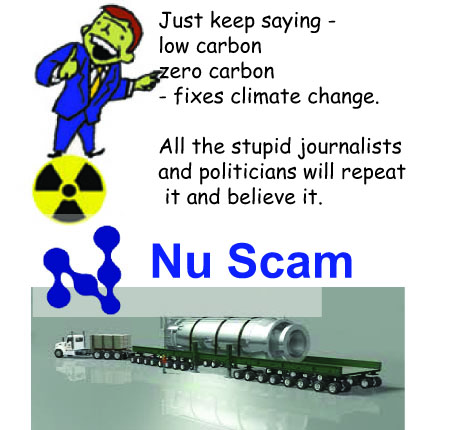
NuScale, a company with roots in US-funded research, this week received assurances that the American government will provide up to $1.4 billion (around R23 billion) in subsidies for a 12-module reactor it hopes to start building in Idaho by 2025.
The project is a commercial one, with municipal buyers lined up for the electricity, but the cash from the US department of energy is intended to bring the cost of that electricity down to $55 per MWh on a levelised cost of energy (LCOE) basis, making the project at least vaguely competitive with other forms of power generation.
Without the subsidies, the supposedly once-off cost of building a first-of-its kind power station would make the NuScale project commercially unviable, its planned customers say.
Just how once-off such costs are, and how much money the US government ends up actually spending on the project, will be closely watched in South Africa
Last week the US International Development Finance Corporation (DFC) announced it had signed a letter of intent to support NuScale “to develop 2,500 MW of nuclear energy in South Africa”.
NuScale has cited Cape Town as a purely theoretical customer for a 12-module version of its nuclear energy system, saying that such an installation could desalinate enough water to keep the entire city going.
But the 2,500MW number cited by the DFC suggests its South African ambitions are substantial. That is the full generating capability the South African government now envisages adding to the national grid from nuclear stations – but the government plan calls for a mixture of the conventional pressurised water reactors (PWRs) such as Russia’s Rosatom sells, and the type of small modular reactors (SMRs) NuScale is developing.
By seeking development finance for the full 2,500MW, NuScale appears to be signalling a plan to bid for the whole thing, rather than seeking to build only part of a new set of nuclear generators in SA alongside companies from China or elsewhere.
That matches the aggressive posture of the US government under the administration of Donald Trump. The DFC letter of intent is the first time the organisation has supported any nuclear project; a ban on its involvement in nuclear energy was lifted on the recommendation of a working group formed by the White House.
The state funding for the NuScale project in the US, meanwhile, comes after consistent and determined efforts under Trump’s presidency to “revitalise” nuclear energy in America, both in production and through research and development on next-generation systems.
South Africa, though determined to buy new nuclear power stations, has not had a similar political appetite to invest in research. In 2010 it mothballed work on the pebble bed modular reactor, a project launched in the late 1990s to create a safe, small, modular reactor system for both domestic use and sale abroad.
Russia once thought it had a done deal to build new nuclear reactors in South Africa. Half a decade later, thanks to its sheer political weight, China seems to be a serious contender for the job. Both France and South Korea have, at various points, been in the running too.
But as of this week, an American company with no track record of actually building commerical nuclear reactors yet is lining up the kind of money from the US government that could make its plans for South Africa viable – replacing a dream of home-grown next-generation nuclear with an imported version.
As of this year there are still vague plans to revive the project, in one form or another, but even if those were to succeed, the pace of development would have to be improbably fast for it to have any place in South Africa’s current round of explorations.
The Atlantic raised the big question. In a crisis, do Americans want Trump’s finger on the nuclear button?
 The Atlantic’s endorsement of Joe Biden raises a sobering point all Americans should consider. Daily Kos, Dartagnan Community, Friday October 23, 2020 “………. —The Atlantic reminds us that the person in charge of this country’s nuclear arsenal matters.
In most matters related to the governance and defense of the United States, the president is constrained by competing branches of government and by an intricate web of laws and customs. Only in one crucial area does the president resemble, in the words of the former missile officer and scholar Bruce Blair, an absolute monarch—his control of nuclear weapons. Richard Nixon, who was president when Major Hering asked his question, was reported to have told members of Congress at a White House dinner party, “I could leave this room and in 25 minutes, 70 million people would be dead.” This was an alarming but accurate statement.
Donald Trump and Joe Biden on climate change

 Independent 23rd Oct 2020 It has been around 20 years since a lengthy discussion on climate change featured in a presidential debate during which time a monumental shift has happened in how America views the crisis.
Two-thirds of Americans think that the US government should do more on climate change and moderator Kristen Welker asked both Donald Trump and Joe Biden how they would step up
on the issue during the final presidential debate on Thursday, with millions of Americans already taking to the polls ahead of election day on 3 November.
Calling it an “existential crisis”, Mr Biden sounded the alarm for the world to address global warming, as Mr Trump took credit for pulling the US out of the 2015 Paris Climate Accord, the international agreement aimed at doing precisely that. Mr Trump said his focus was saving
American jobs, while taking credit for some of the “cleanest air and water the nation has seen in generations” — partly down to regulations passed in the Obama era.
Independent 23rd Oct 2020, President Trump, who has repeatedly called climate change a “hoax”, said he planned for a “trillion trees” before touting America’s “clean air”, “clean water” and lower carbon emissions (all of which are, at best, misleading, as The Independent has reported).
The president then pivoted to an attack on clean energy, taking particular issue with windmills. “He thinks wind causes cancer. Windmills,” Mr Biden noted. “I know more about wind than you do,” Mr Trump replied, before going on to say windmills are extremely expensive, “kill all the birds” and “the fumes coming up, if you’re a believer in carbon emission … for these massive windmills is more than anything we’re talking about with natural gas which is very clean”.
Climate change a big threat to nuclear reactors – as water supplies at risk
 Climate change poses big water risks for nuclear, fossil-fueled plants, S and P Global, Esther Whieldon Taylor Kuykendall, 23 Oct 20,
But electric utilities’ overall exposure to power plant water stress risks could diminish as they pursue decarbonization strategies and replace water-dependent plants with wind and solar generation that require little to no water. Some companies are also implementing water management and related investment strategies to reduce their exposure. ……..
According to projections from the World Resources Institute’s Aqueduct Water Risk Atlas, water stress — when humanity’s competition for water exceeds the rate at which nature can replenish its stocks — could grow materially by 2030 in the drought-prone Western U.S., as well as the upper Midwest and portions of the Northeast and Florida, due to climate change.
About 61.8% of existing fossil-fueled and nuclear power plants in the Lower 48, or a combined 535 GW of operating capacity, is in areas that could face medium-high to extremely high water stress in 2030, based on an analysis of Market Intelligence’s power plant data paired with the Aqueduct water stress projections.
Moreover, 68.6% of the Lower 48’s natural gas-fired fleet, 73.3% of its oil-fueled fleet, 61.0% of its nuclear fleet, and 44.6% of its coal-fired fleet are in areas expected to face medium-high to extremely-high water stress that year.
“As we’re seeing snowpack decline — a natural mountainous reservoir of water — and as we’re getting lower amounts of total precipitation and available water in the U.S. West, this is going to be a really serious issue for the power sector,” said Betsy Otto, director of the Global Water Program at the World Resource Institute, or WRI. Moreover, scientists have said the West is entering a megadrought that could last more than 20 years.
Otto also noted that several other U.S. regions not normally thought of as facing water supply issues are already experiencing chronic water challenges that, if left unchecked, could become a problem if extended droughts, heatwaves, and other major extreme weather events should occur.
A number of utilities use WRI’s Aqueduct tool to assess their water risks in their annual reports to the CDP, formerly known as the Carbon Disclosure Project, and other organizations. But those reports typically focus on the WRI’s current water stress models and not the tool’s future climate projections.
WRI’s current water stress models show a number of regions that are facing water stress will be in the same situation, or worse, at the end of the decade.
Along those lines, Moody’s Investors Service in August reported that about 48 GW of nuclear capacity across the U.S. face elevated exposure to combined heat and water stress, including plants owned by Exelon Corp., Vistra Corp., Entergy Corp., and the Arizona Public Service Co.
In hot water
A plant’s location is not the only factor that will determine its vulnerability to water stress. A plant’s water source, cooling technology and the temperature of the water when it is withdrawn are also key factors, according to scientific reports. The Market Intelligence analysis using the WRI tool does not account for those three factors.
In addition, rising ambient air and water temperatures can also create operational and legal issues for plants. Because plants primarily use water to cool their systems, “if that water is hot or warmer to start with, that’s not so good. That makes the power plant less efficient” and it also means the plant risks violating federal restrictions on how hot water can be when it is discharged, said Auroop Ganguly, director of the Northeastern University College of Engineering Sustainability and Data Sciences Laboratory.
Ganguly co-authored a study that found that by the 2030s, climate-induced water stress in the form of increased water temperatures and limited freshwater supplies will hurt the power production of thermoelectric plants in the South, Southwest, West and West North Central regions of the U.S. According to the 2017 study, U.S. nuclear and fossil-fueled plants at that time used about 161 billion gallons per day, or 45% of the nation’s daily freshwater usage, 90% of which was for cooling.
The technologies used by a power plant can also make a big difference in how much water it needs. Dry-cooling technology uses very little water but is costlier and less efficient than alternatives. And while once-through cooling systems withdraw more water than recirculating systems, once-through cooling returns nearly all of the water to the source while recirculating systems consume more water due to evaporation………. https://www.spglobal.com/marketintelligence/en/news-insights/blog/street-talk-episode-69-banks-left-with-pockets-full-of-cash-and-few-places-to-go
Fossil fuels are ”very clean” – Donald Trump
Guardian 23rd Oct 2020, In Donald Trump’s world – laid bare during Thursday night’s finalpresidential debate with his Democratic rival Joe Biden in Nashville – fossil fuels are “very clean”, the US has the best air and water despite his administration’s extensive regulatory rollbacks, and thecountry can fix climate change by planting trees.
not exist. Humanity has just eight years to figure out how to get climate change under control before the future starts to look drastically worse – multiple-degree temperature increases, global sea-level rise, and increasingly disastrous wildfires, hurricanes, floods and droughts. Doing so will mean that unless there is a technological miracle, humans will at some point have to stop burning oil, gas and coal.https://www.theguardian.com/us-news/2020/oct/23/joe-biden-transition-from-oil-industry-rowing-back
1 This Month

of the week – Shut Down Drone Warfare!


Tell the Ukrainian Government to Drop Prosecution of Peace Activist Yurii Sheliazhenko

Petition to revoke the licensing of the Near Surface Nuclear Disposal Facility (NSDF) at Chalk River. https://www.ourcommons.ca/petitions/en/Petition/Details?Petition=e-7247
To see nuclear-related stories in greater depth and intensity – go to https://nuclearinformation.wordpress.com
-
Archives
- April 2026 (34)
- March 2026 (251)
- February 2026 (268)
- January 2026 (308)
- December 2025 (358)
- November 2025 (359)
- October 2025 (376)
- September 2025 (257)
- August 2025 (319)
- July 2025 (230)
- June 2025 (348)
- May 2025 (261)
-
Categories
- 1
- 1 NUCLEAR ISSUES
- business and costs
- climate change
- culture and arts
- ENERGY
- environment
- health
- history
- indigenous issues
- Legal
- marketing of nuclear
- media
- opposition to nuclear
- PERSONAL STORIES
- politics
- politics international
- Religion and ethics
- safety
- secrets,lies and civil liberties
- spinbuster
- technology
- Uranium
- wastes
- weapons and war
- Women
- 2 WORLD
- ACTION
- AFRICA
- Atrocities
- AUSTRALIA
- Christina's notes
- Christina's themes
- culture and arts
- Events
- Fuk 2022
- Fuk 2023
- Fukushima 2017
- Fukushima 2018
- fukushima 2019
- Fukushima 2020
- Fukushima 2021
- general
- global warming
- Humour (God we need it)
- Nuclear
- RARE EARTHS
- Reference
- resources – print
- Resources -audiovicual
- Weekly Newsletter
- World
- World Nuclear
- YouTube
-
RSS
Entries RSS
Comments RSS
 nuclear-news