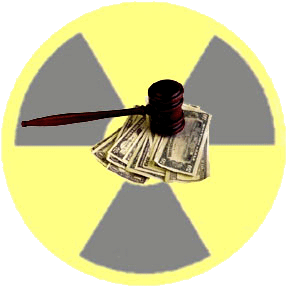
Columbus, Cincinnati, take legal action to block Ohio’s nuclear power plant bailout law
 Columbus, Cincinnati Suing To Block Rate Hike In Nuclear Power Plant Bailout Law https://www.wcbe.org/post/columbus-cincinnati-suing-block-rate-hike-nuclear-power-plant-bailout-law Columbus, Cincinnati Suing To Block Rate Hike In Nuclear Power Plant Bailout Law https://www.wcbe.org/post/columbus-cincinnati-suing-block-rate-hike-nuclear-power-plant-bailout-law
By JIM LETIZIA & ASSOCIATED PRESS 28 Oct 20, •The Cities of Columbus and Cincinnati are suing to block the state’s nuclear power plant bailout law at the center of a 60 million federal bribery probe from taking effect January 1st.
They cite the need to save consumers from higher bills the tainted legislation would impose. The suit claims the charge is an unconstitutional tax. Last year, opponents of the law argued the charge is not a tax when they attempted to put a repeal on the ballot. The cities are suing the state treasurer, the Public Utilities Commission Of Ohio chair and Akron-based FirstEnergy, the company behind the bribery scheme. Republican former Ohio House Speaker Larry Householder and four others have been indicted in the scandal. |
|
Two more cities opt out of Utah’s dubious small nuclear reactor project
|
The $6 billion project has built in “off-ramps” for members of the Utah Associated Municipal Power Systems to bow out of participation at this stage, with a deadline for this exit set for Saturday. The 720-megawatt NuScale Power project is planned for construction at the U.S. Department of Energy’s Idaho National Laboratory, about 180 miles north of Salt Lake City. Earlier this month, the federal agency announced it will provide nearly $1.4 billion for the project to pay for one-time costs for a plant that is being billed as a first-of-its-kind, next-generation nuclear power technology. The infusion of money would be subject to yearly appropriations by Congress, but project backers say it has had bipartisan support under both the Trump and Obama administrations. The power association is made up of 47 members in Utah and throughout the Intermountain West that are independent utilities. Bountiful and Beaver are the latest to leave the Carbon Free Power Project, citing concerns over rising costs,…. Concerns over costs and utilities acting as “seed investors” have been raised by the Utah Taxpayers Association, which warns project delays and mounting costs may make members vulnerable. The project passed one regulatory hurdle in a design certification process before the U.S. Nuclear Regulatory Commission and is moving onto the next phase of licensing…… If successful, the Carbon Free Power Project would be the first globally to deploy the modular technology. Construction of the 12-modular unit is expected to start in 2025, with the first unit coming online in 2029. https://www.deseret.com/utah/2020/10/28/21536595/news-nuclear-power-project-utah-cities-bountiful-bow-out-of-planned-nuscale-plant-idaho-uamps |
|
The very real risks of radiation accidents on Earth, from nuclear reactors in space
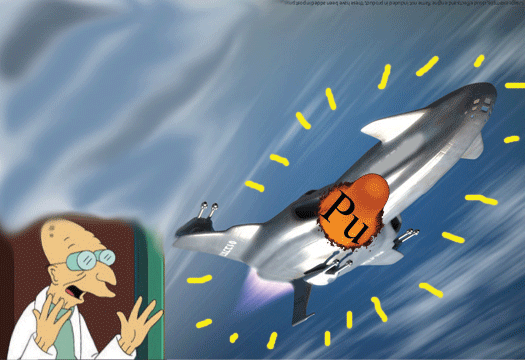 Ensuring Safety on Earth from Nuclear Sources in Space, Mirage News, 28 Oct 20, In early 1978, the world steeled itself as gravity pulled an uncontrolled satellite powered by a small reactor fueled with 45 kg of highly enriched uranium towards Earth. Since COSMOS 954’s impact point could not be predicted accurately, emergency responders had to assume that an inhabited area could be contaminated, and they feverishly prepared equipment and response procedures. This was the world’s first experience with the uncontrolled re-entry of a space object with radioactive materials. Ensuring Safety on Earth from Nuclear Sources in Space, Mirage News, 28 Oct 20, In early 1978, the world steeled itself as gravity pulled an uncontrolled satellite powered by a small reactor fueled with 45 kg of highly enriched uranium towards Earth. Since COSMOS 954’s impact point could not be predicted accurately, emergency responders had to assume that an inhabited area could be contaminated, and they feverishly prepared equipment and response procedures. This was the world’s first experience with the uncontrolled re-entry of a space object with radioactive materials.The radioactive materials launched into Earth orbit, or traveling in spacecraft, can potentially harm people or the environment in case of an accident and for which strict emergency response planning and effective information sharing at the international level are required. This was the topic of an IAEA webinar held last week for emergency response experts.
In the majority of nuclear and radiological emergencies there will be enough information to know the location of a potential release of radioactivity, but with space activities the exact location of impact cannot always be predicted. “The IAEA has developed arrangements to share information about any pending nuclear-powered satellite re-entry. Using the data, countries can quickly respond to protect the public and the environment from the radioactivity that might spread as a result of an accident,” said Frederic Stephani, Incident and Emergency Assessment Officer in the IAEA, during the webinar. COSMOS 954 eventually crashed in the Northwest Territories in Canada on 24 January 1978, scattering radioactive debris over a 600 km footprint and spreading radioactivity over 100 000 km2. The clean-up operation, called “Operation Morning Light,” jointly coordinated by Canada and the US, recovered 80 radioactive items…… accidents can occur during the launch, operation and end-of-service mission phases of space nuclear power source applications. These accidents could expose the nuclear power source to extreme physical conditions leading to a radioactive release into the Earth’s atmosphere. …. https://www.miragenews.com/ensuring-safety-on-earth-from-nuclear-sources-in-space/ |
|
Finland, stuck with increasingly costly Olkiluouti nuclear nightmare, plans and even worse expense, with small nucler reactors!
 Taz 26th Oct 2020, The European pressurized water reactor Olkiluoto 3 has long since developed into a Finnish BER – at least twelve years too late, three times as expensive as planned. And it’s far from being online. The same goes for the
new Hanhikivi project: years behind before construction began .
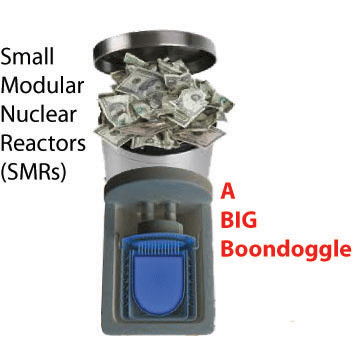
But the Finnish nuclear lobby is already planning another nuclear energy adventure: the construction of so-called Small Modular Reactors (SMR). Paul Dorfman of the UK UCL Energy Institute and co-author of an SMR study by the Nuclear
Consulting Group estimates that small reactors would provide increasingly expensive energy due to the cost of materials and personnel : the massive investments that would be required to create a supply chain so that replacing the economies of scale of large reactors with the advantage of series production would make the investment risk for SMR even higher than for standard reactors.
Britain to lose protection of the environment – as a result of Brexit
behalf of citizens is being undermined by the UK government. Ministers
promised that after Brexit, laws on air, water and waste would be policed
by an independent Office for Environmental Protection (OEP).
these laws were enforced by European courts, which prosecuted EU
governments that breached green rules. Ministers promised the OEP would be
similarly independent. But they now want to grant themselves powers to
“advise” the new body. These plans were revealed in a tabled amendment
to the Environment Bill. Critics fear ministers may counsel the OEP against
taking the government to court if it breaches laws.
Pressure on UK Prime Minister to show strong climate leadership
Business Green 28th Oct 2020, Pressure is mounting on Boris Johnson to come up with an ambitious
decarbonisation plan ahead of COP26 next year, with a major coalition of
health professionals, academics, faith and youth leaders today joining
calls from Conservative MPs and former world leaders for UK to demonstrate
strong climate leadership in the run up to the critical UN summit.
In a
series of letters to the Prime Minister today, various groups representing
millions of people in the UK and overseas urge the government to deliver a
“world-leading” climate plan to the UN in support of the Paris Agreement
“as early as possible this year” or well ahead of COP26 in November 2021.
Such a plan – or Nationally-Determined Contribution (NDC) in UN jargon –
should “at the very least” aligned with limiting global warming to 1.5C by
the end of the century and the UK’s 2050 net zero target, and should be
achieved entirely through domestic action without the use of international
carbon credits, according to the letter from faith groups.
https://www.businessgreen.com/news/4022373/pressure-mounts-pm-ambitious-uk-climate-plan-soon
Suspected COVID-19 outbreak declared at Canadian Nuclear Laboratories in Chalk River, Ontario.
The Renfrew County and District Health Unit (RCDHU) said it’s working closely with CNL to identify close contacts of the employees, who have been told to self-isolate at home and to get tested.
It also reminded those deemed high-risk contacts must self-isolate and monitor for symptoms for 14 days even if they’ve had a negative test, as it says COVID-19 could be incubating at the time of testing and that residents should not return to work, school or any public places during this time. …..
Three buildings at the Chalk River campus have been closed down for a thorough cleaning and 80 employees were sent home as a precaution. McGirl said, of those 80, two people have been told to self-isolate in addition to the two employees who tested positive. The names of all employees have been given to the RCDHU for contact tracing. …. https://ottawa.ctvnews.ca/suspected-covid-19-outbreak-declared-at-canadian-nuclear-laboratories-in-chalk-river-ont-1.5164185
Archbishop Tomasi has led the Vatican’s fight against nuclear weapons
|
Archbishop Tomasi has led the Vatican’s fight against nuclear weapons. Pope Francis is making him a Cardinal. America the Jesuit Review , Drew Christiansen, October 28, 2020 Sunday Oct. 25 was a double red-letter day for Silvano Maria Tomasi, C.S. Honduras had ratified the Treaty on Prohibition of Nuclear Weapons the day before, hastening a global nuclear weapons ban into force in January 2021. Helping shepherd that treaty through the United Nations had been one of the highlights of Archbishop Tomasi’s diplomatic career.Then at his noon Angelus meeting, Pope Francis announced the elevation of Archbishop Tomasi and 12 others as cardinals. Cardinal-elect Tomasi, a naturalized American citizen, was one of two Americans added to the college of cardinals, with Cardinal-elect Wilton Gregory of Washington. That announcement in combination with the treaty’s advancement was a moment of serendipity, the crowning of a rich career.
Among many international bodies joined by Archbishop Tomasi in a varied and vigorous career in diplomatic service to the Holy See were the United Nations Human Rights Council and the Conference on Disarmament. The U.N. Human Rights Council was the scene of many of the nuncio’s most important interventions on behalf of the rights of children and indigenous and migrant people, the right to development, in condemnation of human trafficking and in defense of a safe and healthy environment. The council was also the site of the most difficult moments of his tenure as the Holy See’s permanent observer to the United Nations and other international agencies in Geneva, addressing the church’s flawed response to the sex abuse crisis and facing the harsh judgments of the council and its members. It was with his colleagues in disarmament dialogues that he found the signature issue of his last years in diplomatic service, nuclear weapons abolition. Beginning in 2013, Archbishop Tomasi led the Holy See delegations to a series of international meetings on the humanitarian consequences of nuclear weapons that prepared the way for “the ban treaty.” After the U.N. conference had adopted the treaty, he worked with Cardinal Peter Turkson to prepare a Vatican conference to mark its passage. Before an audience of Nobel Peace Prize laureates, diplomats, civil society leaders and church peace activists, Pope Francis declared of nuclear weapons, “the threat of their use, as well as their very possession, is to be firmly condemned.”…….https://www.americamagazine.org/faith/2020/10/28/archbishop-tomasi-united-nations-vatican-nuclear-weapons-pope-francis-cardinal |
|
Super power: Here’s how to get to 100pct wind, solar and storage by 2030 — RenewEconomy

Deep disruption: New report from futurist Tony Seba and RethinkX says transition to 100pct renewables possible by 2030, and the “super” surplus of wind and solar can be used to power transport and industry. The post Super power: Here’s how to get to 100pct wind, solar and storage by 2030 appeared first on RenewEconomy.
Super power: Here’s how to get to 100pct wind, solar and storage by 2030 — RenewEconomy
A team led by renowned Stanford University futurist Tony Seba says most of
the world can transition to 100 per cent wind, solar and storage
electricity grids within the coming decade, in what they describe as the
fastest, deepest and most profound disruptions ever seen in the energy
industry.
The RethinkX team led by Seba, one of the few analysts to
correctly forecast the plunging cost of solar over the last decade,
predicts that the disruption caused solar, wind and lithium-ion battery
storage, or SWB, will be similar to the digital disruption of information
technology. “Just as computers and the Internet slashed the marginal cost
of information and opened the door to hundreds of new business models that
collectively have had a transformative impact upon the global economy, so
too will SWB slash the marginal cost of electricity and create a plethora
of opportunities for innovation and entrepreneurship.”
“Our analysis
shows that 100% clean electricity from the combination of solar, wind, and
batteries (SWB) is both physically possible and economically affordable
across the entire continental United States as well as the overwhelming
majority of other populated regions of the world by 2030.
“Adoption of
SWB is growing exponentially worldwide and disruption is now inevitable
because by 2030 they will offer the cheapest electricity option for most
regions. Coal, gas, and nuclear power assets will become stranded during
the 2020s, and no new investment in these technologies is rational from
this point forward.”
The analysis from Seba and the RethinkX team is just
the latest of a series of important reports that have been released in
recent weeks and months that look at the pace of technology change, the
energy transition and climate goals.
Lithuania protests Belarus’plan for nuclear power station close to their border
Daily Mail 27th Oct 2020, The Baltic nation of Lithuania sent a protest note Tuesday to Belarus over
a planned nuclear power plant close to their border that is scheduled to
start operating in early November. The Astravyets nuclear power plant, 40
kilometers (25 miles) south of Vilnius, Lithuania´s capital, is to start
production between Nov. 1-10, Belarusian operator Belenergo told
Lithuania´s power transmission system operator Litgrid on Monday.
France trying to market nuclear reactors to Romania
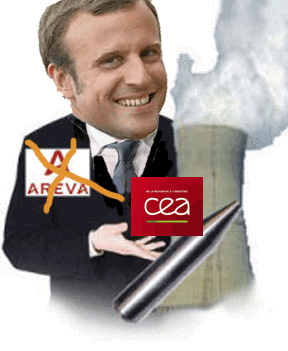 World Nuclear News 27th Oct 2020, France and Romania have signed a declaration of intent on cooperation in
the civil nuclear field, which aims, among other things, to work “with
strategic partners” to build units 3 and 4 of the Cernavoda nuclear power
plant and to upgrade unit 1. The document was signed yesterday by French
Prime Minister Jean Castex and his Romanian counterpart Ludovic Orban, who
led a delegation of his ministers to Paris.
https://www.world-nuclear-news.org/Articles/France-and-Romania-plan-joint-work-on-Cernavoda-pr
South Korea to end dependence on coal, switch to renewables
|
Guardian 28th Oct 2020, South Korea’s president, Moon Jae-in, has declared that the country will
go carbon neutral by 2050, bringing it into line with other major economies. In a policy speech in the national assembly on Wednesday, Moon said South Korea, one of the world’s most fossil fuel-reliant economies, would “actively respond” to the climate emergency “with the international community and achieve carbon neutrality by 2050”. He vowed to end its dependence on coal and replace it with renewables as part of its Green New Deal, a multibillion-dollar plan to invest in green infrastructure, clean energy and electric vehicles. |
|
Using a robot to map the highly radioactive area of the Chernobyl Nuclear Power Plant
University of Bristol and Spot on October 22, and the team intended to use
the robot to create a three-dimensional map of the distribution of nuclear
radiation.
1986 nuclear accident and, as a result, the robot adds new surveying
capabilities to the teams involved. Other robots were also implemented to
inspect and survey the area.
https://www.unilad.co.uk/technology/boston-dynamics-sent-spot-into-chernobyl-nuclear-plant/
Peter Kuznick on the Significance of the Treaty on the Prohibition of Nuclear Weapons — limitless life

Peter Kuznick on the Significance of the Treaty on the Prohibition of Nuclear Weapons David Swanson Peter Kuznick on the Significance of the Treaty on the Prohibition of Nuclear Weapons By World BEYOND War, October 27, 2020 https://worldbeyondwar.org/peter-kuznick-on-the-significance-of-the-treaty-on-the-prohibition-of-nuclear-weapons/ Peter Kuznick answered the following questions from Mohamed Elmaazi of Sputnik Radio and agreed to let World […]
Peter Kuznick on the Significance of the Treaty on the Prohibition of Nuclear Weapons — limitless life
ICRC calls ban treaty entry into force “a victory for humanity” — IPPNW peace and health blog
In a statement following the 50th ratification of the Treaty on the Prohibition of Nuclear Weapons (TPNW), Peter Maurer, the president of the International Committee of the Red Cross, said the treaty “allows us to turn our gaze towards the future; to imagine a world freed from these inhumane weapons no longer as a distant […]
ICRC calls ban treaty entry into force “a victory for humanity” — IPPNW peace and health blog
1 This Month

of the week – Shut Down Drone Warfare!


Tell the Ukrainian Government to Drop Prosecution of Peace Activist Yurii Sheliazhenko

Petition to revoke the licensing of the Near Surface Nuclear Disposal Facility (NSDF) at Chalk River. https://www.ourcommons.ca/petitions/en/Petition/Details?Petition=e-7247
To see nuclear-related stories in greater depth and intensity – go to https://nuclearinformation.wordpress.com
-
Archives
- April 2026 (34)
- March 2026 (251)
- February 2026 (268)
- January 2026 (308)
- December 2025 (358)
- November 2025 (359)
- October 2025 (376)
- September 2025 (257)
- August 2025 (319)
- July 2025 (230)
- June 2025 (348)
- May 2025 (261)
-
Categories
- 1
- 1 NUCLEAR ISSUES
- business and costs
- climate change
- culture and arts
- ENERGY
- environment
- health
- history
- indigenous issues
- Legal
- marketing of nuclear
- media
- opposition to nuclear
- PERSONAL STORIES
- politics
- politics international
- Religion and ethics
- safety
- secrets,lies and civil liberties
- spinbuster
- technology
- Uranium
- wastes
- weapons and war
- Women
- 2 WORLD
- ACTION
- AFRICA
- Atrocities
- AUSTRALIA
- Christina's notes
- Christina's themes
- culture and arts
- Events
- Fuk 2022
- Fuk 2023
- Fukushima 2017
- Fukushima 2018
- fukushima 2019
- Fukushima 2020
- Fukushima 2021
- general
- global warming
- Humour (God we need it)
- Nuclear
- RARE EARTHS
- Reference
- resources – print
- Resources -audiovicual
- Weekly Newsletter
- World
- World Nuclear
- YouTube
-
RSS
Entries RSS
Comments RSS
 nuclear-news