Now climate change, rising seas, swamping Kiribati and the Marshall Islands, victims of nuclear racism
Losing paradise, Atomic racism decimated Kiribati and the Marshall Islands; now climate change is sinking them, Beyond Nuclear https://wordpress.com/read/feeds/72759838/posts/2998141589–1 Nov 20, This is an extract from the Don’t Bank on the Bomb Scotland report “Nuclear Weapons, the Climate and Our Environment”.
 Kiribati. In 1954, the government of Winston Churchill decided that the UK needed to develop a hydrogen bomb (a more sophisticated and destructive type of nuclear weapon). The US and Russia had already developed an H-bomb and Churchill argued that the UK “could not expect to maintain our influence as a world power unless we possessed the most up-to-date nuclear weapons”.
The governments of Australia and New Zealand refused to allow a hydrogen bomb test to be conducted on their territories so the British government searched for an alternative site. Kiritimati Island and Malden Island in the British Gilbert and Ellice Islands Colony in the central Pacific Ocean (now the Republic of Kiribati) were chosen. Nine nuclear weapons tests – including the first hydrogen bomb tests – were carried out there as part of “Operation Grapple” between 1957 and 1958.
Military personnel from the UK, New Zealand and Fiji (then a British colony) and Gilbertese labourers were brought in to work on the operation. Many of the service personnel were ordered to witness the tests in the open, on beaches or on the decks of ships, and were simply told to turn their backs and shut their eyes when the bombs were detonated. There is evidence that Fijian forces were given more dangerous tasks than their British counterparts, putting them at greater risk from radiation exposure. The local Gilbertese were relocated and evacuated to British naval vessels during some of the tests but many were exposed to fallout, along with naval personnel and soldiers.
After Grapple X, the UK’s first megaton hydrogen bomb test in November 1957, dead fish washed ashore and “birds were observed to have their feathers burnt off, to the extent that they could not fly”. The larger Grapple Y test in 1958 spread fallout over Kiritimati Island and destroyed large areas of vegetation.
Despite evidence that military personnel and local people suffered serious health problems as a result of the tests, including blindness, cancers, leukaemia and reproductive difficulties, the British government has consistently denied that they were exposed to dangerous levels of radiation and has resisted claims for compensation.
Like the Marshall Islands, the low-lying Republic of Kiribati is now bearing the brunt of the effects of climate change. Salt water washed in on king tides has contaminated the islands’ scarce freshwater resources. Pits that are used to grow taro plants have been ruined and the healthy subsistence lifestyle of local people is under threat.
It is predicted that rising sea levels will further impact freshwater resources and reduce the amount of agricultural land, while storm damage and erosion will increase. Much of the land will ultimately be submerged. In anticipation of the need to relocate its entire population, the government of Kiribati bought 20km2 of land on Fiji in 2014.
The UK is set to spend £3.4 billion a year on Trident nuclear weapons system between 2019 and 2070. If Trident were scrapped, a portion of the savings could be provide to the Republic of Kiribati in the form of climate finance (see section 1.2.1). Scrapping Trident would also allow money and skills to be redirected towards measures aimed at drastically cutting the UK’s carbon emissions (see section 1.2.2) – action that Pacific island nations are urgently demanding.
The Marshall Islands. The most devasting incident of radioactive contamination took place 8,000 km from the US mainland during the Castle Bravo test in 1954. The US detonated the largest nuclear weapon in its history at Bikini Atoll in the Marshall Islands, causing fallout to spread over an area of more than 11,000km. Residents of nearby atolls, Rongelap and Utirik, were exposed to high levels of radiation, suffering burns, radiation sickness, skin lesions and hair loss as a result.

Castle Bravo was just one of 67 nuclear weapons tests conducted by the US in the Marshall Islands between 1946 and 1958. Forty years after the tests, the cervical cancer mortality rate for women of the Marshall Islands was found to be 60 times greater than the rate for women in the US mainland, while breast and lung cancer rates were five and three times greater respectively. High rates of infant mortality have also been found in the Marshall Islands and a legacy of birth defects and infertility has been documented. Many Marshallese were relocated by the US to make way for the testing.
Some were moved to Rongelap Atoll and relocated yet again after the fallout from Castle Bravo left the area uninhabitable.
Rongelap Atoll was resettled in 1957 after the US government declared that the area was safe. However, many of those who returned developed serious health conditions and the entire population was evacuated by Greenpeace in 1984. An attempt to resettle Bikini Atoll was similarly abandoned in 1978 after it became clear that the area was still unsafe for human habitation.
A 2019 peer-reviewed study found levels of the radioactive isotope caesium-137 in fruits taken from some parts of Bikini and Rongelap to be significantly higher than levels recorded at the sites of the world’s worst nuclear accidents, Chernobyl and Fukushima.
Compounding the injustice of nuclear weapons testing, the Republic of the Marshall Islands is now on the frontline of the climate emergency. The government declared a national climate crisis in 2019, citing the nation’s extreme vulnerability to rising sea levels and the “implications for the security, human rights and wellbeing of the Marshallese people”.
At Runit Island, one of 40 islands in the Enewetak Atoll, rising sea levels are threatening to release radioactive materials into an already contaminated lagoon. In the late 1970s, the US army dumped 90,000 cubic metres of radioactive waste, including plutonium, into a nuclear blast crater and covered it with a concrete cap. Radioactive materials are leaking out of the crater and cracks have appeared on the concrete cap. Encroaching salt water caused by rising sea levels could collapse the structure altogether. The Marshallese government has asked the US for help to prevent an environmental catastrophe but the US maintains that the dome is the Marshall Islands’ responsibility. Hilda Heine, then President of the Republic of the Marshall Islands, said of the dome in 2019: “We don’t want it. We didn’t build it. The garbage inside is not ours. It’s theirs.”
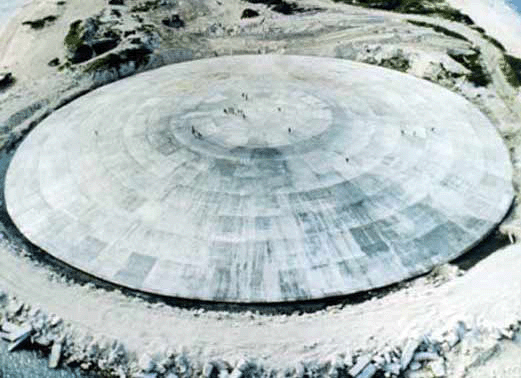
The Runit Island dome offers a stark illustration of the ways in which the injustices of nuclear weapons testing and climate change overlap. Marshall Islanders were left with the toxic legacy of nuclear weapons testing conducted on their territory by another state. The country is now being forced to deal with the effects of a climate crisis that they did not create, including the erosion of the Runit dome.
The nations that contributed most to the crisis are failing to cut their emissions quickly enough to limit further global heating, leaving the Marshallese at the mercy of droughts, cyclones and rising seas. A recent study found that if current rates of greenhouse gas emissions are maintained, the Marshall Islands will be flooded with sea water annually from 2050. The resulting damage to infrastructure and contamination of freshwater supplies will render the islands uninhabitable.
If the US scrapped its nuclear weapons programme, it could give a portion of the billions of dollars that would be saved to the Republic of the Marshall Islands to help the country mitigate and adapt to climate disruption (see section 1.2.1 on international climate finance). The US could also use the freed-up funds to invest in its own Just Transition away from a fossil-fuel powered economy. Read the full report.
Coronavirus cases rise in grim march to America’s Election Day


Coronavirus cases rise in grim march to Election Day, SMH, By Doina Chiacu and Susan Cornwell
Nearly 87,000 cases were reported on Saturday, with 909 deaths and record hospitalisations for the sixth straight day in the Midwest, according to a Reuters tally. In October, 31 states set records for increases in new cases, 21 for hospitalised COVID-19 patients and 14 for record increases in deaths.
President Donald Trump, the Republican seeking re-election against Democratic challenger Joe Biden on Tuesday, downplays the virus and has accused Democrats of overblowing the pandemic that has killed more 230,000 Americans, more than any other country.
Biden and fellow Democrats have hammered Trump as a poor leader who failed to contain COVID-19 in the United States, which also leads the world in the daily average number of new cases.
Trump’s false accusation Friday that doctors were profiting from COVID-19 deaths drew harsh criticism from the governor of the election battleground state of Wisconsin.
“We have a president that believes that the doctors are at fault, they’re messing with the numbers and he believes that it’s over. It ain’t over,” Democratic Governor Tony Evers told CNN’s State of the Union on Sunday.
“We have hospitalisations going through the roof,” he said. “We absolutely need somebody that understands that this is an issue, it’s a thing. People are dying.”……..
Stanford University economists estimated that Trump’s campaign rallies have resulted in 30,000 additional confirmed cases of COVID-19, and likely led to more than 700 deaths overall, according to a paper posted this weekend.
Infectious disease experts have long suspected that the president’s rallies might be so-called superspreader events. But scientists have not been able to get a good read on their impact, in part because of a lack of robust contact tracing.
Trump has repeatedly disdained masks, even after outbreaks affected his own family and multiple White House staffers.
In contrast, Biden has stuck to federal health guidelines that discourage large, crowded gatherings during his campaign events. He has called Trump’s handling of the virus negligent and irresponsible.
Amid the acrimony, DeWine urged Americans to come together and fight what he called a war against a common enemy.
“This virus doesn’t care whether we vote for Joe Biden or whether we vote for Donald Trump. It’s coming after us.” https://www.smh.com.au/world/north-america/coronavirus-cases-rise-in-grim-march-to-election-day-20201102-p56ali.html
Superannuation funds getting out of investments on nuclear weapons
|
It would probably come as a surprise, and a disappointment, to most Australians to hear that some of their superannuation is invested in nuclear weapons. Especially given the strong community backing for nuclear disarmament, with two surveys in 2018 and 2020 (IPSOS) showing that between 71 and 79% of respondents supported Australia signing and ratifying the Treaty on the Prohibition of Nuclear Weapons. Yet the vast majority of superannuation funds have holdings in companies involved in the manufacture and maintenance of nuclear weapons. While many funds exclude investments in “controversial weapons”, astoundingly this definition often still allows nuclear weapons investment. But this is about to change. With the Treaty on the Prohibition of Nuclear Weapons (TPNW), which was endorsed by 122 countries at the United Nations in 2017, having just reached the milestone of 50 countries ratifying it, the treaty becomes international law in less than three months. Nuclear weapons, the worst of the weapons of mass destruction, will finally be on the same illegal footing as chemical and biological weapons. This means assistance of any sort, including financial assistance, towards nuclear weapons becomes illegal under international law. Only 26 companies support these weapons. Boeing, for example, the second largest weapons producer in the world, has contracts worth more than US$1.7 billion: building new nuclear weapons for the US, key components for the long-range nuclear Minuteman Intercontinental Ballistic Missiles system, sustaining the UK Trident II system and making tail-kit assemblies for the new B61 bombs. Divestment is accelerating. Globally, major investors are already ceasing their exposure to nuclear weapons activities. This includes two of the top five pension funds in the world, the Norwegian Government Pension Fund and ABP, which have divested from the 26 companies tied to nuclear weapons. Deutsche Bank and KBC are also divesting. In Japan, 16 banks (including three mega banks) have flagged ceasing investment in nuclear weapons companies. With accelerating divestment, the risks of holding nuclear weapons stocks increases. Superannuation funds in Australia are starting to consider the financial risks, reputational risks and ethical imperatives surrounding investments in nuclear weapons. Some, like Australian Ethical, Future Super and Bank Australia have already acted……… As with climate change, there is little point accumulating funds on behalf of the community if they contribute to the deaths of billions and a severely damaged future. Quit Nukes, an Australian-based campaign launched late last year, is working to get super fund portfolios out of the financing of nuclear weapons. The campaign members have met with senior executives at more than a dozen funds, the regulator APRA, several banks, index setters and a number of industry bodies. Blackrock, MSCI and other index setters have recognised the increasing demand from the public for ethical funds and have created products to suit. The full list of funds that have already acted is on the Quit Nukes website. Consumers are increasingly concerned about their funds being invested in destructive and unethical industries and super funds need to respond. https://www.michaelwest.com.au/disarmament-treaty-drops-bomb-on-super-funds-investing-in-nuclear-weapons/ |
|
|


USA should accept Russia’s offer of a one-year extension of the Strategic Arms Reduction Treaty
 Russia and the U.S. Need a Timeout on Nuclear Weapons, With New START about to expire, the U.S. should accept Moscow’s offer of a one-year extension. Bloombeerg By James Stavridis, 31 October 2020, “…….. The stakes are vastly higher when it comes to negotiations involving the possible use of strategic nuclear weapons, such as those on intercontinental ballistic missiles, which have the potential to end civilization as we know it. In my final military job, as supreme allied commander at NATO, I argued contentiously with senior Russian officials that U.S. Aegis missile systems in Eastern Europe — which are intended primarily to avert an Iranian attack on the continent — could not threaten their strategic nuclear force. It was a debate that went around and around in circles.
The administration’s goals are overambitious for now — particularly given that Trump may not be in office in three months — so it would be smart to take up Russia’s offer.
Plutonium: How Nuclear Power’s Dream Fuel Became a Nightmare
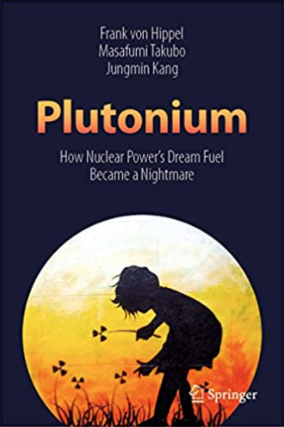 Nailing the Coffin of Civilian Plutonium, Plutonium: How Nuclear Power’s Dream Fuel
 Became a Nightmare, By Frank von Hippel, Masafumi Takubo, and Jungmin KangSpringer Press, Reviewed by Thomas Countryman, November 2020
Even in the world of speculative investment bubbles, it would be difficult to find a parallel to the business of making plutonium. This “industry” has seen massive investment by private and mostly governmental funds in pursuit of creating the world’s most dangerous material, an investment that has failed to yield a single dollar in returns. Nevertheless, a combination of scientific ambition, bureaucratic inertia, and governmental hubris keeps alive a dream that should have been smothered long ago.
Leave it to three highly experienced specialists to briefly recount the history, clearly explain the physical realities, and precisely pick apart the ever-weakening arguments that have supported reprocessing spent nuclear fuel into a new plutonium-based fuel. Frank von Hippel, Masafumi Takubo, and Jungmin Kang accomplish all of this in Plutonium: How Nuclear Power’s Dream Fuel Became a Nightmare. Its planned translation into Japanese and Korean should help citizens participate in critical upcoming decisions about continuing plutonium projects by governments in Tokyo and Seoul.
The earliest rationale for using plutonium as a nuclear fuel rested on the fact that spent nuclear fuel, the leftover material from civilian nuclear power plants, still contained far more potential energy than had yet been consumed. In the 1970s, uranium was believed to be scarce in the natural environment, and the full utilization of its energy capacity made some engineering, logical, and economic sense. In succeeding decades, the economic rationale has been constantly undermined by the realization that natural uranium is sufficiently plentiful that its price is no longer the primary cost factor in nuclear power generation, by the unanticipated complexity of building advanced reactors optimized to use plutonium as fuel, by the cost of new and necessary safety regulations applicable to all reactors, and most recently by the continued fall in the cost of generating renewable energy.
In the face of these realities, only France, at a substantial economic loss, currently operates a full program for recovering plutonium from spent fuel for use as new nuclear fuel. Russia reprocesses spent fuel and is now testing plutonium in a breeder reactor. Japan has indicated it plans to open one of the world’s largest reprocessing plants in Rokkasho in the next two years, but that two-year time frame has been the boilerplate forecast for each of the past 10 years. India is actively reprocessing civilian spent fuel, and China is constructing a major facility for that purpose. South Korea has announced an end to its nuclear power program, but some officials and experts retain the aspiration to pursue civilian reprocessing.
No other nuclear-powered nation is actively pursuing “closing” the nuclear fuel cycle by reprocessing plutonium for energy generation. The economic and technical realities forced one country after another—Germany, Belgium, Switzerland, the United Kingdom, then the United States—to end their own efforts.
This weak support highlights the merits of the authors’ arguments. They systematically deconstruct the political and technical arguments in favor of such programs. Crucially, they demonstrate the factual inaccuracy of the primary argument advanced by Japanese and South Korean advocates that reprocessing spent fuel will diminish the volume and danger of nuclear waste that must ultimately be stored in geological repositories. They also knock down convincingly the claim that plutonium that is reactor grade, as opposed to weapons grade, is unusable in an explosive device.
Although it may be the prerogative of sovereign states to spend their own money irrationally, the authors focus also on important externalities, in particular the threat to the world’s security and environment from the continued production of plutonium. A commitment to the closed fuel cycle delays the inevitable decision that must be made by Japan and South Korea concerning permanent safe storage of spent fuels, a decision on which the United States also continues to procrastinate. In addition, it leads to unsafe practices concerning the storage of spent fuel rods destined for reprocessing. The authors describe for the first time how close the world was to a greater disaster in 2011, as overcrowded spent fuel cooling ponds could have led to a much greater radiation release following the accident at Japan’s Fukushima Daiichi nuclear plant. The authors explain that moving the spent fuel to interim dry cask storage would avert such catastrophic risks.
Of still greater concern is the risk that even a sliver of the massive plutonium stockpiles could be acquired by terrorists to use in a nuclear explosive device or a panic-inducing radiological dispersion device. Since plutonium was first fabricated 80 years ago, nations have created more than 500 tons of what is arguably the world’s most dangerous material. The International Atomic Energy Agency defines a “significant quantity” of plutonium, or enough to make a nuclear weapon, as eight kilograms, although even a Nagasaki-size blast could be generated with significantly less plutonium. Thus, the 300 tons of plutonium designated for civilian use would be sufficient to create more than 35,000 warheads.
Continuing to accumulate plutonium is not only a terrorism risk, but also a source of tension between states. There is concern in Beijing that Japan holds greater stocks of separated plutonium than China and in Seoul that South Korea holds none. The authors note briefly but tellingly the normally unstated security considerations that in part motivate civilian reprocessing programs: an intention to sustain a latent weapons capacity.
The authors make a convincing case for the international community to act together to end further production of separated plutonium. The effort to negotiate a fissile material cutoff treaty, which would ban production of plutonium for weapons, remains frozen in a glacier at the Conference on Disarmament. Whether or when it moves ahead, there is a separate compelling need to negotiate a ban on civilian separation of plutonium.
Although less than 200 pages, Plutonium is not light reading. Its economic and scientific arguments are compact, thoroughly documented, and clear even to lay people. For policymakers and the public, it provides a clear picture of a dream whose claimed benefits have all evaporated but whose danger remains ominously present.
Thomas Countryman is the chair of the Arms Control Association Board of Directors. He served 35 years in the U.S. Foreign Service, retiring in 2017 as acting undersecretary of state for arms control and international security.
A tiny group built the momentum for the Treaty on the Prohibition of Nuclear Weapons
 Nuclear weapons treaty backed by 50 nations to become international law https://independentaustralia.net/politics/politics-display/nuclear-weapons-treaty-backed-by-50-nations-to-become-international-law,14455
2020 HAS BEEN a very tough year with fires, pestilence and massive economic and human disruption but amid the difficulties, an Australian-born initiative is steadily growing global support and offers our shared planet its best way to get rid of its worst weapons.
In October 2017, the International Campaign to Abolish Nuclear Weapons (ICAN), an initiative born in Melbourne and adopted, adapted and applied around the world, was awarded the 2017 Nobel Peace Prize.
This was in recognition of its:
“…work to draw attention to the catastrophic humanitarian consequences of any use of nuclear weapons and for its ground-breaking efforts to achieve a treaty-based prohibition of such weapons.”
Fast forward to October 2020 and the Treaty on the Prohibition on Nuclear Weapons has just cleared a big hurdle. Despite strong pressure from the nuclear weapons states, especially the U.S., 50 nations have now ratified the ban treaty. It will enter into force and become part of international humanitarian law on 22 January 2021.
At a time when the threat of nuclear war is more explicit than it has been in decades, the ICAN story is timely and shows the power of both the individual and the idea. When ICAN started in 2007, its founders could have fitted in a minibus. Ten years later, there are over 500 ICAN groups and formal partners in more than 100 nations. And a treaty. Continue reading
Despite propaganda from nuclear front group ”Third Way”, research shows that nuclear power as carbon reducer is counter-productive
 For many scientists — and Bill Gates — nuclear energy is part of the answer to the world’s climate-change problem. The market for nuclear power could triple by 2050 across the world, according to a recent study by Third Way, a U.S.-based think tank. There are more than 60 advanced reactor designs in development in the U.S., the Atlantic Council, a U.S. think tank, said in a paper.
data from 123 countries over a 25-year period, examining how the introduction of either nuclear-power or renewable-energy sources affects each country’s levels of carbon emissions.
Surge in fires in Brazil’s Amazon

|
Fires in Brazil’s Amazon rainforest jump in October, By Jake Spring, BRASILIA (Reuters) 1 Nov 20, – Fires in Brazil’s Amazon rainforest surged in October and the number of blazes is up 25% in the first 10 months of 2020, compared to a year ago, data from government space research agency Inpe showed on Sunday.
October recorded 17,326 hot spots in the world’s largest rainforest, more than double the number of fires detected in the same month last year. Destruction of the forest has soared since right-wing President Jair Bolsonaro took office in 2019. The president says he wishes to develop the region to lift it out of poverty, while environmental advocates say his policies embolden illegal loggers, miners and ranchers. The number of fires so far this year remains at a decade high. In only the first 10 months of the year, 2020 has surpassed the total number of fires for full-year 2019, when the destruction spurred international criticism that Brazil was not doing enough to protect the forest……. Fires in Brazil’s Pantanal, the world’s largest wetlands, also increased in October compared to a year ago, according to Inpe. The Pantanal, home to many rare species including the world’s densest population of jaguars, has recorded the most fires this year since records began in 1998. For the year through Oct. 25, 28% of the wetland has burned, according to the Federal University of Rio de Janeiro, an area nearly the size of Denmark…… https://www.reuters.com/article/us-brazil-environment/fires-in-brazils-amazon-rainforest-jump-in-october-idUSKBN27H1J1 |
|
Documentary history from the perspective of radiation victims.
 Documentary explores history of radiation through victims, http://www.asahi.com/ajw/articles/13850920, By MASATO TAINAKA/ Staff Writer, November 1, 2020 Paris-based filmmaker Kenichi Watanabe completed a documentary on nuclear radiation in time for the 10th anniversary of the Fukushima nuclear plant accident in March.
The film, titled “Notre ami l’atome–Un siecle de radioactivite” (Our friend the atom–A century of radioactivity), traces the history of radioactive exposure, spanning more than a century, from the discovery of radioactivity through today.
It is told from the perspective of radiation victims.
“Focusing on radioactivity, I want to reconstruct the idea that ‘nuclear energy and atomic weapons are inseparable,’” Watanabe, 69, said.
The film is set for theatrical release in spring 2021. It made its broadcast debut this summer in Europe and was shown at select venues across Japan in October.
The documentary features interviews with an ex-soldier who observed a nuclear test during the Cold War in the U.S. Nevada desert, and a former fishing boat crew member from Kochi Prefecture who was exposed to fallout when the United States conducted a nuclear test at Bikini Atoll in the Pacific.
It also includes interviews with soldiers allegedly exposed to radiation during Operation Tomodachi, a disaster relief effort conducted off the coast of the Tohoku region by the U.S. armed forces after the accident at the Fukushima No. 1 nuclear power plant, and a person who underwent thyroid surgery after that nuclear disaster.
The title is a reference to “Our Friend the Atom,” a Disney film produced to promote the benefits of atomic power in the 1950s during the administration of President Dwight D. Eisenhower, who called for the “peaceful use of atomic energy.”
At the time, an anti-nuclear movement was gaining momentum in Japan after the tuna fishing boat Daigo Fukuryu Maru and other vessels were contaminated by fallout from the U.S. thermonuclear weapon test at Bikini Atoll in 1954. The Diet, meanwhile, passed the country’s first-ever budget proposal for nuclear energy.
“It was imperative for Japan, which suffered atomic bombings in Hiroshima and Nagasaki and whose Constitution contains the war-renouncing Article 9, to come up with an ‘atomic dualism’ to introduce nuclear energy, saying that ‘its peaceful use is good and military use is bad,’” Watanabe said.
Watanabe was born in 1951. He started his career working at Iwanami Productions Inc. in Japan before moving to Paris to produce documentaries for European TV companies.
U.S. Senate unanimously passes resolution supporting nuclear weapons workers made ill by radiation
 Senate Unanimously Passes Udall, Heinrich Resolution Honoring Nation’s Nuclear Weapons Workers, Declares National Day of Remembrance Daily Post by Carol A. Clark November 1, 2020, WASHINGTON D.C. – U.S. Senators Tom Udall (D-N.M.) and Martin Heinrich (D-N.M.) announced Thursday that the Senate unanimously passed a bipartisan resolution to designate Oct. 30, 2020, as National Day of Remembrance for workers who helped develop and support the nation’s nuclear weapons program…….. Senate Unanimously Passes Udall, Heinrich Resolution Honoring Nation’s Nuclear Weapons Workers, Declares National Day of Remembrance Daily Post by Carol A. Clark November 1, 2020, WASHINGTON D.C. – U.S. Senators Tom Udall (D-N.M.) and Martin Heinrich (D-N.M.) announced Thursday that the Senate unanimously passed a bipartisan resolution to designate Oct. 30, 2020, as National Day of Remembrance for workers who helped develop and support the nation’s nuclear weapons program……..“Today, we honor the thousands of miners, millers, maintenance workers, scientists, support staff, and families in New Mexico and across the country whose sacrifice has too often gone unrecognized,” Udall said. “During the Cold War, thousands of New Mexicans made tremendous sacrifices to build the country’s first nuclear weapons and mine the uranium to protect our national defense. Many of these brave Americans have been left out of programs Congress has designated to care for and compensate nuclear workers including the Radiation Exposure Compensation Act program and the Energy Employees Occupational Illness Compensation Program. While we can never take away the years of pain and suffering these families have endured as a result of their service, we can take action to make them whole. We will never stop fighting to expand these laws until those affected by this nation’s nuclear weapons activities are fairly compensated.”
……… I also recognize the many atomic workers who are coping with serious health problems due to their exposure to hazardous and radioactive material. I will never stop fighting for the justice and compensation that these atomic workers deserve for their service to our nation.”
Tens of thousands of Americans have worked in the nuclear weapons programs since World War II at the Department of Energy’s (DOE) Los Alamos and Sandia National Labs in New Mexico. Many of these workers became sick due to exposure from toxic or radioactive materials before proper workplace protections and scientific understanding were established. Congress has since enacted the Energy Employees Occupational Illness Compensation Program Act (EEOICPA) in October 2000. This resolution additionally provides compensation to those who were exposed in uranium mines and mills during the Cold War, some of whom are covered separately by the Radiation Exposure Compensation Act (RECA). Udall and Heinrich have long pushed to expand the RECA law to compensate not only the workers affected, but those suffering from the effects of radiation during the Cold War by these nuclear weapons facilities. https://ladailypost.com/senate-unanimously-passes-udall-heinrich-resolution-honoring-nations-nuclear-weapons-workers-declares-national-day-of-remembrance/
|
|
Compensation claims recognised – workers made ill by working at Fukushima’s wrecked nuclear plant
 Compensation claims related to Fukushima nuclear plant work total 269, https://japantoday.com/category/national/compensation-claims-related-to-fukushima-plant-work-total-269
The workers’ compensation claims that have been recognized by labor authorities include six cases of workers who developed cancer or leukemia due to radiation exposure, and four others who suffered from overwork-related illnesses, according to the Ministry of Health, Labor and Welfare officials.
Decommissioning of the Fukushima plant is still under way nearly 10 years after the massive earthquake and tsunami that devastated northeastern Japan triggered meltdowns at the Fukushima Daiichi nuclear plant. To this day, about 4,000 people still work on site every day, with many at risk of radiation exposure.
The compensation claims that have been approved refer to the period since the March 2011 nuclear accident through Oct 1 this year.
According to the plant operator, Tokyo Electric Power Company Holdings Inc, three people died between fiscal 2011 and 2019.
One worker, who wished to remain anonymous, told Kyodo News the pressure of working at a nuclear power plant as opposed to a normal working site is “incomparable.”
“I have to deal with so much anxiety and stress as I could never know what may happen inside a nuclear power plant,” said the man from Iwaki, Fukushima Prefecture.
According to the worker, he wears two protective layers of clothing and tapes them together so there is no space between them, and also puts on a raincoat.
“I sweat a lot even in winter and I drink a lot of water,” he said, adding that several of his colleagues suffered from heat stroke or heat exhaustion while working at the plant.
TEPCO said a total of 98 people suffered from heat-related illnesses between fiscal 2011 and 2019, having had to wear masks and protective gear made of less permeable materials under the sweltering summer heat.
At the site of the Fukushima Daiichi plant, 313 accidents have occurred in the same period of time, including several fatal cases between 2014 and 2015 in which workers fell into a tank, TEPCO said.
Acknowledging that many accidents had occurred, a TEPCO official said, “We will continue to work with our contractors to prevent such incidents from happening.”
The most consequential election — IPPNW peace and health blog
There has never been an election – or probably any single national event – of greater global moment than the impending US election. This could hardly be more evident than from the perspective of planetary health. If Trump is returned to the White House for another four years and the Republican Party retains control of the US Senate, the prospects for reducing the growing danger of nuclear war appears bleak; and the decisive turn towards a low carbon future within the narrow time window needed to have any chance of keeping global temperature rise below 2°C will also be very much more difficult, if not impossible, to achieve. Always the most active of the nine nuclear-armed states in seeking to oppose and undermine the Treaty on the Prohibition of Nuclear Weapons, the administration has recently taken the extraordinary step of admonishing governments that have signed and ratified the treaty to withdraw from it. At the same time, the administration has made explicit nuclear threats in violation of the UN Charter; escalated further astronomical military spending, including spending on new nuclear weapons systems, forecast to reach up to US$2 trillion over the next 30 years. Current US spending on new nuclear warheads is at an all-time record level.
The most consequential election — IPPNW peace and health blog
Why Trump Can’t Afford to Lose — limitless life

A Reporter at Large November 9, 2020 Issue Why Trump Can’t Afford to Lose The President has survived one impeachment, twenty-six accusations of sexual misconduct, and an estimated four thousand lawsuits. That run of good luck may well end, perhaps brutally, if Joe Biden wins. By Jane Mayer November 1, 2020 Few people have evaded consequences […]
Why Trump Can’t Afford to Lose — limitless life
Expert guidance for the next President to head off a nuclear catastrophe
5 Steps for the Next President to Head Off a Nuclear Catastrophe
To the horror of experts, 30 years after the Cold War, the global risk from nuclear weapons is actually getting worse. Here’s how a new administration can turn that around. Politico, By EDMUND G. BROWN JR. , REP. RO KHANNA and WILLIAM J. PERRY, 10/30/2020
Edmund G. Brown Jr. is the former governor of California and executive chair of the Bulletin of the Atomic Scientists.
Rep. Ro Khanna (D-Calif.) represents Silicon Valley in the House of Representatives.
William J. Perry was the 19th United States Secretary of Defense.
As fires rage across the West and the coronavirus continues its deadly march, President Donald Trump tweets and fulminates but refuses to take charge. He denies climate change; on the pandemic, he leaves to the states his clear responsibility to protect the people of America.
Tragically, his incompetence extends beyond Covid-19 and climate change to another existential danger, rarely debated in Washington or covered by the media: the chance of a nuclear blunder.
The Cold War may have ended in 1989, but the United States and Russia together still possess more than 12,000 nuclear weapons, 90 percent of the world’s arsenal, nearly 2,000 of which are programmed to launch in minutes at the command of either countries’ president. The risk of a real nuclear catastrophe is not a bugbear from a past decade. It is a current threat, and becoming more serious because of Trump’s policies—and because the public has largely stopped paying attention.
How can we change course? That starts with the election of a new president, one who will have the courage to restore nuclear sanity. This is precisely what President Ronald Reagan did when he joined Mikhail Gorbachev in 1985, declaring that “a nuclear war can never be won and must never be fought.”
Third, the next president should immediately extend the New START Treaty with Russia and begin follow-on negotiations to reduce deployed strategic nuclear forces by one-third, something Obama himself had planned to do.
The next president should reflect deeply on our existential predicament and chart a new and wiser path for America. https://www.politico.com/news/magazine/2020/10/30/5-steps-for-the-next-president-to-head-off-a-nuclear-catastrophe-433695
Financial red flags warn against Utah’s NuScale small nuclear reactor project

|
Is nuclear power Utah’s future? Red flags suggest holding off https://www-deseret-com.cdn.ampproject.org/c/s/www.deseret.com/platform/amp/opinion/2020/10/27/21535010/guest-opinion-nuclear-power-plant-idaho-utah-uamps-nuscale-red-flags?fbclid=IwAR13pzEW_7Bl0BQVlj8jN5UUIcoX9Mi_BZbgQq-22TBtjnJLSeSov8rZER, By M.V. Ramana, – on October 27, 2020 UAMPS has promised electricity at $55 per megawatt hour (MWh), down from the $65 it promised two years ago. One might imagine that the lower price is due to declining costs, but according to UAMPS, the project’s estimated costs have gone up, not down. In its 2018 Budget & Plan of Finance, UAMPS approved a construction cost of approximately $4.2 billion. This year, the UAMPS Amended Budget & Plan of Finance mentions a figure of approximately $6.1 billion. If the construction costs are going up, then why did the cost of electricity come down from $65/MWh to $55/MWh? The question arises because UAMPS and NuScale have not been transparent with the methodology used to develop figures like $55/MWh. The lack of transparency means the public does not know what assumptions are being made, let alone whether those assumptions are realistic. We do know that Pacificorp and Idaho Power have concluded that electricity from NuScale reactors would cost $94-$121/MWh. The UAMPS project also bears other red flags, and seems headed for failure. Less than 25% subscriptions. Based on public testimony, the UAMPS project has subscribers for less than 25% of the total power, leaving 75% of the output unclaimed. Communities continue to withdraw, citing the increasing costs, uncertain technology and the lack of subscribers. Several of the communities that withdrew were among the project’s largest subscribers. Project delays continue. NuScale initially claimed it could deliver the first working nuclear reactor in 2015. Now, the first UAMPS reactors aren’t scheduled to come online until 2029-2030, roughly 15 years later than originally expected — provided there are no further delays. NuScale’s experience is consistent with an independent study that showed that 175 of the 180 nuclear power projects examined took on average 64% longer than projected (and had final costs that exceeded the initial budget by an average of 117%). Unpredictable taxpayer subsidies. UAMPS and NuScale expect taxpayers to cover 25% of the project’s costs over the next nine years. Contrary to NuScale/UAMPS’ assurances about the recent U.S. Department of Energy $1.4 billion “funding vehicle,” there is no way to guarantee these funds. As the on-again, off-again Yucca Mountain project illustrates, federal funding for nuclear projects can be fickle and subject to withdrawal at any time. In the long history of failed U.S. nuclear projects, the public is almost never given an honest, transparent assessment of the likelihood of expensive overruns, lengthy scheduling delays and possible project collapse. The problems already apparent in the UAMPS project fit squarely into this history of failure. Some UAMPS members — Logan, Lehi, Kaysville and Murray, among them — seem to have realized that the risk of such failure is high enough and have pulled out of the project, cutting their losses. By the end of this week, roughly 30 Utah cities and towns will have a similar decision to make. They can either decide to continue the gamble and be tied to a contract that could leave them with millions of dollars of public debt. Or they could follow the lead of Logan, Lehi, Kaysville and Murray and vote to withdraw from this financially risky nuclear project. The sad irony is that even in the highly unlikely event of NuScale delivering on its promises, the $55/MWh figure is well above the current cost of procuring electricity for UAMPS itself, which has averaged around $29/MWh in the last two years. The $55/MWh would also far exceed the cost of renewables, which are continuing to decline in prices. Thus, a long term contract for $55/MWh is a recipe for excessive electricity costs for decades. I do think that UAMPS can achieve one of the stated goals of NuScale project promoters, namely invest in low-carbon sources of energy. But the way to do that is to pursue currently available solar, wind, energy storage (batteries) and energy efficiency. That is cheaper, safer, cleaner and more reliable than going deeper into the NuScale dead-end. Professor M.V. Ramana is the Simons Chair in Disarmament, Global and Human Security and Director of the Liu Institute for Global Issues at the School of Public Policy and Global Affairs at the University of British Columbia in Vancouver, Canada. Dr. Ramana is a member of the International Panel on Fissile Materials, the International Nuclear Risk Assessment Group and the team that produces the annual World Nuclear Industry Status Report. |
|
1 This Month

of the week – Shut Down Drone Warfare!


Tell the Ukrainian Government to Drop Prosecution of Peace Activist Yurii Sheliazhenko

Petition to revoke the licensing of the Near Surface Nuclear Disposal Facility (NSDF) at Chalk River. https://www.ourcommons.ca/petitions/en/Petition/Details?Petition=e-7247
To see nuclear-related stories in greater depth and intensity – go to https://nuclearinformation.wordpress.com
-
Archives
- April 2026 (44)
- March 2026 (251)
- February 2026 (268)
- January 2026 (308)
- December 2025 (358)
- November 2025 (359)
- October 2025 (376)
- September 2025 (257)
- August 2025 (319)
- July 2025 (230)
- June 2025 (348)
- May 2025 (261)
-
Categories
- 1
- 1 NUCLEAR ISSUES
- business and costs
- climate change
- culture and arts
- ENERGY
- environment
- health
- history
- indigenous issues
- Legal
- marketing of nuclear
- media
- opposition to nuclear
- PERSONAL STORIES
- politics
- politics international
- Religion and ethics
- safety
- secrets,lies and civil liberties
- spinbuster
- technology
- Uranium
- wastes
- weapons and war
- Women
- 2 WORLD
- ACTION
- AFRICA
- Atrocities
- AUSTRALIA
- Christina's notes
- Christina's themes
- culture and arts
- Events
- Fuk 2022
- Fuk 2023
- Fukushima 2017
- Fukushima 2018
- fukushima 2019
- Fukushima 2020
- Fukushima 2021
- general
- global warming
- Humour (God we need it)
- Nuclear
- RARE EARTHS
- Reference
- resources – print
- Resources -audiovicual
- Weekly Newsletter
- World
- World Nuclear
- YouTube
-
RSS
Entries RSS
Comments RSS
 nuclear-news