U.S. Senate election results – a disappointment for climate action, but with a couple of bright spots
 Also this week, the United States exits the Paris climate agreement, NYT, By Henry Fountain and Lisa
  Friedman, Nov. 4, 2020, The United States presidential race is still up in the air, and the battle for control of the Senate appears far from over. But one thing is clear the day after Election Day 2020: The “green wave” that environmentalists had hoped for failed to materialize.
There were bright spots for the environment. In the Senate, two Democrats, John Hickenlooper in Colorado and Mark Kelly in Arizona, have defeated incumbent Republicans who have received poor marks from environmental and conservation groups for their voting records.
Mr. Kelly was endorsed by Climate Hawks Vote, a progressive group that promotes candidates who promise to take action on climate change. Mr. Hickenlooper was not. While he declared during the campaign that action on climate change was urgently needed, his past ties to the oil and gas industry in Colorado made some groups wary. ……..
Mr. Hickenlooper could turn out to be the greenest of green lawmakers, but if Democrats don’t win control of the Senate it might make little difference. While the House looks certain to remain in Democratic hands, in the Senate the party needs more victories: Two, if Joseph R. Biden Jr. wins the presidency, which would allow Kamala Harris to break tie votes; or three, if President Trump is re-elected. Even two more Democratic victories seemed less likely on Wednesday than they did before the vote count began.
Climate and the environment were front and center in several state and local elections, and the outcomes appear certain in a few of those……… https://www.nytimes.com/2020/11/04/climate/climate-us-election.html
America’s Kings Bay peace activists to be sentenced Nov. 12 and 13
 Kings Bay Plowshares 7 Judge Denies Further Delays, Virtual Sentencing Nov. 12 & 13. Festival of Hope Sunday Nov 8 at 4 pm
Judge Lisa Godbey Wood, presiding over the trial and sentencing of the Kings Bay Plowshares in Brunswick, GA, has denied any further continuances for sentencing as requested by the last four defendants due to COVID-19 restrictions. The remaining KBP7 defendants have been ordered to be sentenced on November 12th and 13th. Despite their desire to be sentenced in person in open court as is their legal right, three of the defendants have reluctantly chosen to do it remotely via video because of the health risks of travel to the court in Georgia for themselves and supporters. Mark Colville has filed a motion to challenge this order.
Although the judge has delayed the sentencing five times because of health and safety concerns, she said that was enough even though the nation is now experiencing record breaking numbers of more than 120,000 daily cases. “With nearly a quarter of a million US COVID deaths, and prison cases exploding again, more court delays are certainly advisable, ” said Veterans For Peace activist and KBP7 supporter Ellen Barfield of Baltimore.
In a rare opportunity, as a consequence of COVID-19 court and travel restrictions, hundreds of people were able to listen on a conference call line to the October sentencing of Fr. Steve Kelly and Patrick O’Neill who gave their final statements as to why they were compelled to act against the nuclear doomsday machine at the Trident nuclear submarine base at Kings Bay. They also heard the testimony from character witnesses for the defendants attesting to the good things they do in their lives and their devotion to peace. Many of these statements are posted on the website in recent news.
Some of the supporters were moved to tears but also filled with joy by their courage. We invite you to call in to hear the four defendants’ profound and powerful statements and to hear the testimony from their character witnesses.
Australian govt will feel the heat when a Biden administration rejoins the Paris climate agreement
 Biden says the US will rejoin the Paris climate agreement in 77 days. Then Australia will really feel the heat, The Conversation Christian Downie, Australian Research Council DECRA Fellow, Australian National University, November 6, 2020 When the US formally left
 the Paris climate agreement, Joe Biden tweeted that “in exactly 77 days, a Biden Administration will rejoin it”.
The US announced its intention to withdraw from the agreement back in 2017. But the agreement’s complex rules meant formal notification could only be sent to the United Nations last year, followed by a 12-month notice period — hence the long wait.
While diplomacy via Twitter looks here to stay, global climate politics is about to be upended — and the impacts will be felt at home in Australia if Biden delivers on his plans.
Biden’s position on climate change
Can he do it under a divided Congress?
While the votes are still being counted — as they should (can any Australian believe we actually need to say this?) — it seems likely the Democrats will control the presidency and the House, but not the Senate.
This means Biden will be able to re-join the Paris agreement, which does not require Senate ratification. But any attempt to legislate a carbon price will be blocked in the Senate, as it was when then-President Barack Obama introduced the Waxman-Markey bill in 2010.
What’s needed are ambitious targets and mandates for the power sector, transport sector and manufacturing sector, backed up with billions in government investment.
Fortunately, this is precisely what Biden is promising to do. And he can do it without the Senate by using the executive powers of the US government to implement a raft of new regulatory measures.
Take the transport sector as an example. His plan aims to set “ambitious fuel economy standards” for cars, set a goal that all American-built buses be zero emissions by 2030, and use public money to build half a million electric vehicle charging stations. Most of these actions can be put in place through regulations that don’t require congressional approval.
And with Trump out of the White House, California will be free to achieve its target that all new cars be zero emissions by 2035, which the Trump administration had impeded.
If that sounds far-fetched, given Australia is the only OECD country that still doesn’t have fuel efficiency standards for cars, keep in mind China promised to do the same thing as California last week.
What does this mean for Australia?
For the last four years, the Trump administration has been a boon for successive Australian governments as they have torn up climate policies and failed to implement new ones.
Rather than witnessing our principal ally rebuke us on home soil, as Obama did at the University of Queensland in 2014, Prime Minister Scott Morrison has instead benefited from a cosy relationship with a US president who regularly dismisses decades of climate science, as he does medical science. And people are dying as a result.
For Australia, the ambitious climate policies of a Biden administration means in every international negotiation our diplomats turn up to, climate change will not only be top of the agenda, but we will likely face constant criticism.
Indeed, fireside chats in the White House will come with new expectations that Australia significantly increases its ambitions under the Paris agreement. Committing to a net zero emissions target will be just the first.
The real kicker, however, will be Biden’s trade agenda, which supports carbon tariffs on imports that produce considerable carbon pollution. The US is still Australia’s third-largest trading partner after China and Japan — who, by the way, have just announced net zero emissions targets themselves……
With Biden now in the White House, it’s not just global climate politics that will be turned on its head. Australia’s failure to implement a serious domestic climate and energy policy could have profound costs.
Costs, mind you, that are easily avoidable if Australia acts on climate change, and does so now. https://theconversation.com/biden-says-the-us-will-rejoin-the-paris-climate-agreement-in-77-days-then-australia-will-really-feel-the-heat-149533
Sudden resignation of head of USA’s National Nuclear Security Administration
Gordon-Hagerty, who became the first woman to lead the NNSA in February 2018, sent her letter of resignation to the White House Friday, according to a pair of senior NNSA officials, speaking to Defense News on background.
The NNSA is a semi-autonomous office located within the Department of Energy. While the Defense Department manages the delivery systems of the nuclear force — ships, planes and missiles — NNSA has oversight over the development, maintenance and disposal of nuclear warheads. While the agency falls under the purview of DoE, much of its budget is set by the Nuclear Weapons Council, which is largely controlled by Defense Department officials.
Per the sources, the resignation was driven by almost a year of clashes between Gordon-Hagerty’s office and Secretary of Energy Dan Brouillette. That fight first seeped into public earlier this year, when Brouillette sought to cut NNSA’s budget request. Defense officials, backed by supporters from Congress, went to the White House and forced the issue in NNSA’s favor.
Tensions never truly receded and continued to play out in Congress during the fiscal 2021 budget season. Senate Armed Services Committee chairman Sen. Jim Inhofe, R-Okla., led pro-defense lawmakers in an effort to give the Pentagon more official control over NNSA; House lawmakers created several pieces of legislation that would give the Energy department more control.
The issue seemed to come to a head when the Department of Energy Organization and Management Improvement Act, passed by the House Committee on Energy and Commerce Sept. 9, changed language that made the NNSA a quasi-independent entity, in essence folding the agency more fully under DOE’s control. The move was seen by NNSA officials as an attempt by Brouillette to outright destroy the agency………. https://news.yahoo.com/head-nuclear-weapons-agency-unexpectedly-184158751.html
Japan: the next generation of LDP leaders embrace both carbon neutrality and the elimination of nuclear energy.
Nuclear Power and Japan’s 2050 Climate Pledge
Japan’s latest carbon-neutrality pledge puts the spotlight on the challenges facing the country’s nuclear power industry. The Diplomat , By Tom Corben,, November 05, 2020 In his inaugural address to the Diet last month, Japan’s Prime Minister Suga Yoshihide officially announced that his government would revise the country’s carbon-neutrality commitments, aiming for zero emissions by 2050. Suga expressed his intent to “put maximum effort into achieving a green society…..
Of course, the nuclear lobby’s entrenched interests at the highest levels of the government and within the LDP itself will likely continue to frustrate efforts to comprehensively revise Japan’s nuclear energy policies. Indeed, there is every chance that the revised Basic Energy Plan due next year will maintain, if not expand, the share of Japan’s energy mix allocated to nuclear power. Still, without significant changes to the regulatory environment, a more favorable business environment, or a major shift in public opinion or political support, at present it is difficult to see Japan’s nuclear power industry making a major contribution to Japan’s carbon-neutrality goals in the coming decades.
Putin orders Russian government to try to meet Paris climate goals
Putin orders Russian government to try to meet Paris climate goals
President Vladimir Putin has signed a decree ordering the Russian government to try to meet the 2015 Paris Agreement to fight climate change, but stressed that any action must be balanced with the need to ensure strong economic development.
Exploring the reasons why Britain is to ‘re-nationalise’ it’s nuclear weapons
UK Government move to ‘re-nationalise’ Britain’s nuclear weapons, The National
|
By Martin HannanMultimedia Journalist 6th NovemberEARLIER this week the UK Government slipped out a story about Britain’s nuclear deterrent in the form of a ministerial statement that hardly anyone noticed.
It indicated that the Atomic Weapons Establishment (AWE) headquartered on the former site of RAF Aldermaston is effectively going to be re-nationalised. Stripped of civil-servant speak, the statement says that the UK Government is exercising its right to end early a 25-year contract with a consortium of companies that run AWE plc. From next year AWE will become an arms-length operation wholly owned by the Ministry of Defence. That will include AWE’s presence at the Royal Naval Armaments depot at Coulport on Loch Long which services the Clyde Submarine Base at Faslane, home to Britain’s Trident submarines. The statement indicates the change is on grounds of efficiency. It read: “The change in Model will remove the current commercial arrangements, enhancing the MoD’s agility in the future management of the UK’s nuclear deterrent, whilst also delivering on core MoD objectives and value for money to the taxpayer. Forgive the cynical view but that all says “in other words, we’re back in complete charge and will spend what we like on the replacement for Trident with no need for reports to shareholders and that public sort of stuff”. WHEN WAS AWE ORIGINALLY PRIVATISED? THE Act to effectively privatise Aldermaston was passed under John Major’s Tory Government in 1991. The transfer of a previously MoD-run facility to the private sector caused some controversy at the time, but went ahead anyway……….. WHY IS THIS HAPPENING? GOOD question. Obviously somebody somewhere is not happy. Ending a 25-year contract four years early is not a usual tactic of HM Government – quite the opposite with contracts often renewed “on the nod”. It could also be an advance move in a long-rumoured possible project for the MoD to take back more sites and facilities and run them as arms-length operations. Babcock and other private contractors at Faslane and elsewhere will have taken note of the move. ARE ALDERMASTON AND SCOTLAND LINKED? THE convoys that take nuclear weapons between Coulport/Faslane and Aldermaston have been a worry for anti-nuclear campaigners for decades. In an independent Scotland, the Westminster Government would be asked to remove Trident and its ilk, which has always begged the question – what is the MoD’s plan B for Trident or its replacement after independence? Answer: there isn’t one. Go on, ask them yourselves. https://www.thenational.scot/news/18850871.uk-government-move-re-nationalise-britains-nuclear-weapons/ |
|
Canada’s Bruce County Council postpones voting on nuclear waste bunker plan
 Bruce County defers vote to support the science behind a nuclear waste bunker, By Janice MacKay, Blackburn News, November 5, 2020 Bruce County Council has agreed to defer the vote on a motion made at today’s meeting to accept the Nuclear Waste Management’s proposed Deep Geologic Repository to store used nuclear fuel as a matter of settled science.Michelle Stein of the group “no DGR South Bruce” told council via skype Thursday during their meeting that the motion was premature when the science isn’t settled on the proposed nuclear fuel Repository…….. Bruce County defers vote to support the science behind a nuclear waste bunker, By Janice MacKay, Blackburn News, November 5, 2020 Bruce County Council has agreed to defer the vote on a motion made at today’s meeting to accept the Nuclear Waste Management’s proposed Deep Geologic Repository to store used nuclear fuel as a matter of settled science.Michelle Stein of the group “no DGR South Bruce” told council via skype Thursday during their meeting that the motion was premature when the science isn’t settled on the proposed nuclear fuel Repository……..
She says moving the waste could add increased risk as it is transported through local municipalities. She worries that since there is no nuclear fuel DGR operating in the world, developing one in South Bruce would be an experiment which could put local rivers and waterways at risk. She added that the nuclear fuel waste would also still need to be stored at the surface, as “the nuclear waste needs to go into cooling pools, and then it needs to be stored above ground for approximately 30 years before it’s even cool enough to be moved.” https://blackburnnews.com/uncategorized/2020/11/05/bruce-county-defers-vote-support-science-behind-nuclear-waste-bunker/ |
|
Covid-19 divides and weakens the nuclear sector in South Africa
 Covid-19 divides and weakens the nuclear sector in South Africa, Daily Maverick, By Chris Yelland• 5 November 2020 Covid-19 divides and weakens the nuclear sector in South Africa, Daily Maverick, By Chris Yelland• 5 November 2020
The coronavirus crisis is undermining the business plan and turnaround strategy at the Nuclear Energy Corporation of South Africa. The resulting losses are creating debilitating divisions between labour, middle and senior management, executives and boards of Necsa and its subsidiaries – as well as wage increases Following a tumultuous operational and management period for several years, with massive financial losses, new Nuclear Energy Corporation of South Africa (Necsa) chairperson David Nicholls and acting CEO Ayanda Myoli presented a restructuring and turnaround plan to Parliament on 20 May 2020……… While many considered the turnaround plan to be hopelessly optimistic even before the Covid-19 crisis in South Africa from March 2020, the impact of the national and international lockdowns are estimated to have resulted in the Necsa group taking a massive hit, which would increase the expected loss for 2020/21 to more than R300-million. …… While many considered the turnaround plan to be hopelessly optimistic even before the Covid-19 crisis in South Africa from March 2020, the impact of the national and international lockdowns are estimated to have resulted in the Necsa group taking a massive hit, which would increase the expected loss for 2020/21 to more than R300-million. https://www.dailymaverick.co.za/article/2020-11-05-covid-19-divides-and-weakens-the-nuclear-sector-in-south-africa/ |
|
Nuclear Technology Germany Association says Small Nuclear Reactors (SMRs) will always be more expensive than large ones.
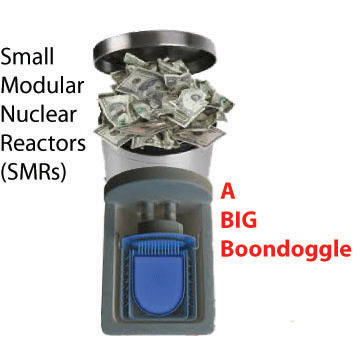 German nuclear industry cautious about usefulness of small reactors for energy transition, Nuclear phase-out Technology, Clean Energy Wire, Süddeutsche Zeitung , 6 Nov 20 Small Modular Reactors (SMR) are increasingly hailed as an effective way for using nuclear power to curb the climate crisis without the major risks associated with conventional nuclear plants, but Germany’s nuclear industry is sceptical whether the small reactors really can help boost international climate action, Christian J. Meier writes for the Süddeutsche Zeitung German nuclear industry cautious about usefulness of small reactors for energy transition, Nuclear phase-out Technology, Clean Energy Wire, Süddeutsche Zeitung , 6 Nov 20 Small Modular Reactors (SMR) are increasingly hailed as an effective way for using nuclear power to curb the climate crisis without the major risks associated with conventional nuclear plants, but Germany’s nuclear industry is sceptical whether the small reactors really can help boost international climate action, Christian J. Meier writes for the Süddeutsche Zeitung
……… Nicolas Wendler of industry association Nuclear Technology Germany (KernD) says SMRs are always going to be more expensive than bigger reactors due to lower power output at constant fixed costs, as safety measures and staffing requirements do not vary greatly compared to conventional reactors. In terms of levelised energy costs, SMRs will always be more expensive than big plants.” In order for SMRs to be profitable, these should run at maximum utilisation most of the time, Wendler argues, concluding that the potential on the German market would not be much greater than what is needed to adjust oscillating renewable power production…. https://www.cleanenergywire.org/news/german-nuclear-industry-cautious-about-usefulness-small-reactors-energy-transition
|
U.S. Navy to spend $billions on two Columbia-class nuclear missile submarines
|
US Navy inks $9.4B contract for two Columbia-class nuclear missile submarines, Defense News
By: David B. Larter 6 Nov 20, WASHINGTON — The U.S. Navy announced Thursday it had inked a $9.47 billion contract with builder General Dynamics Electric Boat for the full construction cost of the lead boat of the Columbia-class ballistic missile submarine, as well as advanced procurement money for the second boat, the future USS Wisconsin.
The announcement marks the end of the beginning for the Columbia class, which the Navy has for years said is its top priority. The 12-ship class will replace the retiring Ohio-class submarines. The Columbia is slated to make its first patrol in 2031, and the Navy says it must meet the timeline to maintain continuous sea-based deterrent patrols……. The Columbia program is a massively expensive undertaking, with the Navy estimating it will run about $7.5 billion per hull over the class. By 2026, when the Navy will be buying one Columbia per year, considering the FY21′s roughly $20 billion shipbuilding request as a guide, Columbia would eat up to 38 percent of the Navy’s shipbuilding money……. https://www.defensenews.com/naval/2020/11/05/navy-inks-contract-for-two-columbia-class-nuclear-missile-submarines/ |
|
Texas governor wants Trump to oppose nuclear waste dump plan
Gov. Abbott Asks Trump for Help with Nuclear Waste in West Texas, Sanangelo Live, MATT TRAMMELL, NOV 6, 2020, ANDREWS, TX – Governor Greg Abbott sent a letter to President Trump last week urging him to put a stop to storing high levels of nuclear waste in rural West Texas.
In the letter sent to President Trump, on Sep. 29, Abbott gave a number of reasons for his opposition.
The main concerns the Governor has is the risk the nuclear material will bring to the Permian Basin.
Here is the full letter: [ but extract only posted here]
Dear Mr. President: Thank you for all you do to ensure a prosperous economy and strong energy industry in the United States. I write to express my opposition to the license applications to the Nuclear Regulatory Commission (NRC) for the consolidated interim storage of spent nuclear fuel and high-level waste at proposed sites within the state of Texas and within the state of New Mexico, close to the Texas border. A stable oil and gas industry is essential to the economy, and crucial to the security of our great nation. Allowing the interim storage of spent nuclear fuel and high- level nuclear waste at sites near the largest producing oilfield in the world will compromise the safety of the region.
The proposed facilities would be sited in the Permian Basin Region, which is the largest producing oilfield in the world ……..the Permian Basin is a significant economic and natural resource for the entire country, and the proposed storage facilities would place America’s recovering economy and energy security at great risk.
The NRC is currently evaluating issuance of a 40-year license to Interim Storage Partners (ISP) for a consolidated interim storage facility in west Texas as well as issuance of a 40-year license to Holtec International for such a facility in southeastern New Mexico. As proposed, the ISP facility would store commercial spent nuclear fuel and reactor-related materials, presenting a radiological risk greater than currently authorized for storage and disposal in Texas. ISP has also indicated it may seek to renew the license for an additional 20 years, which would result in an operating life of 60 years, or until a permanent facility is established. ……..https://sanangelolive.com/news/politics/2020-11-06/gov-abbott-asks-trump-help-nuclear-waste-west-texas
UK govt’s spin to Scotland, promoting nuclear submarines – but the Scots are nae sae daft
 We cannot defeat our real enemies by using nuclear weapons, https://www.thenational.scot/news/18850915.cannot-defeat-real-enemies-using-nuclear-weapons/, Jim Taylor, Edinburgh, 6 Nov 20
At the conclusion of the programme, Rear Admiral John Weale tells us that no-one really wants nuclear weapons … but “we are planning to have them for the next 50 years”.
So it’s a done deal, whether we Scots support it or not. Our UK Union membership means we will be forced against our will to be party to this inhumane weapon system, and the increased danger it puts us in with its continued location at Faslane.
Trident’s replacement is currently reckoned to cost around £200 billion, before any expected design, construction, operational cost overruns and other usual ongoing cost increases. With the potential for a further cycle of replacement during the next 50 years, going forward, the cost to the nation will rise exponentially.
Clearly the Royal Navy took the unprecedented step to permit this programme being made at the behest of the UK Government trying to warm our feelings about nuclear weapons, recognise a “need” for them and in the hope this will drive a wedge in Scotland’s drive to call upon its Claim of Right and independence.
Isn’t the UK Government’s mistake assuredly that Scots are nae sae daft?
Nuclear now costs twice the price of renewables and the gap is growing. No need for Hinkley C, Sizewell, Bradwell etc

 North writes,
” ………The Green Party have been arguing for many years in recognition of the work by Friends of the Earth, the Centre for Alternative Technology (CAT) in Wales and many others, that we do not need ‘further expansion of nuclear and gas turbines’ but to be far more clever about our energy use, easy to do now that renewables are cheaper than nuclear and new gas.
CAT has been at the forefront of development of research on renewable technology and Green building for some 50 years.
Their latest report ‘Zero Carbon Britain (Rising to the Climate Emergency)’ clearly demonstrates that the UK has the tools and technology to efficiently power this country with 100 per cent renewable technology (read the executive summary, it’s only eight pages long).
By using energy more efficiently we can power down by 60 per cent with particularly large savings in heating buildings and transport.
There is absolutely no need for nuclear power in our energy mix and we cannot afford it, let alone pay for cleaning up the sites at the end which taxpayers always end up paying for.
Nuclear now costs twice the price of renewables and the gap is growing.
How many Herald readers know that the electricity from the Hinkley Point nuclear reactor will cost UK consumers £92.50 per Kwh (the most recent offshore wind turbine fields are half of this)?
The deal was signed by (former Prime Minister) Theresa May and supported by Labour and Lib Dems.
The profits are going to the Chinese government which will run it for 40 years. The French firm (EDF) that has been building Hinkley Point and wants to build more nuclear reactors in the UK wants to cushion the financial blow of future nuclear power stations in this country by charging electricity customers a few extra pounds every month on their bill even now.
This is referred to as a new funding model, I’d call it a rip-off. Are people really happy to put billions of pounds into the coffers of the Chinese government and EDF rather than invest, as part of a Green New Deal, in insulation and draught-proofing of UK homes to keep us warmer, take over two and a half million households out of fuel poverty and permanently reduce everyone’s fuel bills. https://www.cravenherald.co.uk/opinion/opinion_letters/18824349.letter-no-need-nuclear-power/
Nuclear power – simply unaffordable for the Philippines
|
DOE to submit ‘nuclear power plan’ to Duterte this December, Manila Bulletin, November 6, 2020, by Myrna M. Velasco” For BNPP’s repowering, Duterte previously instructed the energy department to also undertake a study on that proposal; and to assess the cost impact that will have on consumers’ pockets.
But on that particular sphere, Senate Committee on Energy Chairman Sherwin T. Gatchalian sounded off cynicism on claims that electricity rates in the Philippines will go down with the proposed repowering of the mothballed 620-megawatt BNPP project. “It’s not true that prices are lower because of the layers of technology that shall be integrated into the nuclear power facility to ensure its safe operations,” he claimed. Gatchalian noted that in Vietnam’s case, that country shelved its planned nuclear power development after determining that the resulting power price will just be comparable with other electric generating facilities — and yet there’s great degree of risk that they have to manage on the safety aspect of technology deployment. ………In the Philippines, the propounded revival of BNPP’s operations had been hurdled by concerns of ‘social acceptance’ in the many years that already passed; and there are also questions on where to source the US$1.0 billion to US$2.0 billion funding for BNPP’s rehabilitation.The other major issue is which entity shall be designated to operate the plant, since the Electric Power Industry Reform Act (EPIRA) already prohibits state-run National Power Corporation (NPC) from engaging into operation or investments in power generation… |
1 This Month

of the week – Shut Down Drone Warfare!


Tell the Ukrainian Government to Drop Prosecution of Peace Activist Yurii Sheliazhenko

Petition to revoke the licensing of the Near Surface Nuclear Disposal Facility (NSDF) at Chalk River. https://www.ourcommons.ca/petitions/en/Petition/Details?Petition=e-7247
To see nuclear-related stories in greater depth and intensity – go to https://nuclearinformation.wordpress.com
-
Archives
- April 2026 (44)
- March 2026 (251)
- February 2026 (268)
- January 2026 (308)
- December 2025 (358)
- November 2025 (359)
- October 2025 (376)
- September 2025 (257)
- August 2025 (319)
- July 2025 (230)
- June 2025 (348)
- May 2025 (261)
-
Categories
- 1
- 1 NUCLEAR ISSUES
- business and costs
- climate change
- culture and arts
- ENERGY
- environment
- health
- history
- indigenous issues
- Legal
- marketing of nuclear
- media
- opposition to nuclear
- PERSONAL STORIES
- politics
- politics international
- Religion and ethics
- safety
- secrets,lies and civil liberties
- spinbuster
- technology
- Uranium
- wastes
- weapons and war
- Women
- 2 WORLD
- ACTION
- AFRICA
- Atrocities
- AUSTRALIA
- Christina's notes
- Christina's themes
- culture and arts
- Events
- Fuk 2022
- Fuk 2023
- Fukushima 2017
- Fukushima 2018
- fukushima 2019
- Fukushima 2020
- Fukushima 2021
- general
- global warming
- Humour (God we need it)
- Nuclear
- RARE EARTHS
- Reference
- resources – print
- Resources -audiovicual
- Weekly Newsletter
- World
- World Nuclear
- YouTube
-
RSS
Entries RSS
Comments RSS
 nuclear-news