Biden – Harris win is a win for the climate
 Joe Biden and Kamala Harris cinch win, Climate Group responds, Mirage News 8 Nov 20, The Climate Group congratulates Joe Biden and Kamala Harris on their historic victory, as announced by the New York Times, Associated Press, and BBC.President-elect Biden’s climate and clean energy plan is the most ambitious we’ve seen from a major US presidential nominee. Under his administration and leadership, we are optimistic about the future of US climate action and the opportunity for renewed global collaboration to address the
  climate crisis.
Amy Davidsen, Executive Director at the Climate Group, said: “Concern for the climate played a major role in the 2020 presidential debates. President-elect Biden’s win shows that Americans expect their president to follow climate science and take the bold and necessary actions to get the US back on track as a leader….. https://www.miragenews.com/joe-biden-and-kamala-harris-cinch-win-climate-group-responds/
Explaining the diseconomics problems for the NuScale small nuclear reactors plan in Utah

First major modular nuclear project having difficulty retaining backers, The complicated finances of the first major test of small modular nuclear reactors. https://arstechnica.com/science/2020/11/first-major-modular-nuclear-project-having-difficulty-retaining-backers/ JOHN TIMMER – 11/8/2020,
Earlier this year, the US took a major step that could potentially change the economics of nuclear power: it approved a design for a small, modular nuclear reactor from a company called NuScale. These small reactors are intended to overcome the economic problems that have ground the construction of large nuclear plants to a near halt. While each only produces a fraction of the power possible with a large plant, the modular design allows for mass production and a design that requires less external safety support.
But safety approval is just an early step in the process of building a plant. And the leading proposal for the first NuScale plant is running into the same problem as traditional designs: finances.
The proposal, called the Carbon Free Power Project, would be a cluster of a dozen NuScale reactors based at Idaho National Lab but run by Utah Associated Municipal Power Systems, or UAMPS. With all 12 operating, the plant would produce 720MW of power. But UAMPS is selling it as a way to offer the flexibility needed to complement variable renewable power. Typically, a nuclear plant is either producing or not, but the modular design allows the Carbon Free Power Project to shut individual reactors off if demand is low.
According to one report, the US Department of Energy had originally planned to purchase the first reactor for research use, then turn it over to UAMPS. But now, the goal is apparently for the DOE to provide an annual supplement of about $130 million a year for a decade. However, that would be dependent upon annual renewals of the funding by Congress during that decade, which is yet another risk. Separately, to reach a target price for the power that is expected to be competitive with natural gas, the project has been made larger and its completion delayed by three years.
That shouldn’t be unexpected, as utilities are notoriously conservative—justifiably so, considering how much their customers rely on electricity. So any new electrical technology is likely to face some struggles as its customers learn to use it effectively and understand how to extract the most value out of it. Typically, the government steps in to provide some support during this awkward phase, as it has done for wind and solar, and plans to do for NuScale.
The Public Relations battle for nuclear power in the UK- editors giving it a free ride?
 A secret military agenda. UK defence policy is driving energy policy – with the public kept in the dark, Beyond Nuclear, By David Thorpe, 8 Nov 20 , “…………The PR battle for nuclear
There is a PR battle in the UK media for new nuclear – and now there are two sides to it.
Editors seem to favour giving pro-nuclear writers a clear ride and rarely question their baseless claims that nuclear is zero carbon. This is misguided and not based on empirical data, says Dr Lowry.
If the carbon footprint of the full uranium life cycle is considered – from uranium mining, milling, enrichment (which is highly energy intensive), fuel fabrication, irradiation, radioactive waste conditioning, storage, packaging to final disposal – nuclear power’s CO2 emissions are between 10 to 18 times greater than those from renewable energy technologies, according to a recent study by Mark Jacobson, professor of civil and environmental engineering at Stanford University, California.
Another recent peer-reviewed article in Nature Energy shows that nations installing nuclear power don’t have lower carbon emissions, but those installing lots of renewables do. Moreover, investment in new nuclear “crowds out” investment in renewables.
Renewables therefore offer a more rapid and cost-effective means to address net zero targets. The opportunity cost of nuclear is severely negative. The 2019 version of the World Nuclear Industry Status Report comprehensively demolishes any evidence-based arguments on the utility of nuclear to help address climate change.
But that’s not the real argument. It’s military. At the very least, we deserve to be told………. https://wordpress.com/read/feeds/72759838/posts/3011373103
David Thorpe is author of books such as Solar Technology and One Planet Cities. He also runs online courses such as Post-Graduate Certificate in One Planet Governance. He is based in the UK. https://wordpress.com/read/feeds/72759838/posts/3011373103
Boris Johnson at a critical point on the decision about Sizewell C nuclear construction
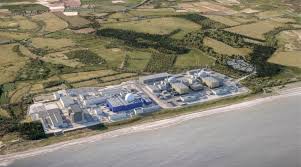 Times 7th Nov 2020, The prime minister was set to announce a ten-point plan to meet the UK’s climate change promises due the week after next.
https://www.thetimes.co.uk/article/petrol-and-diesel-car-sales-face-2030-ban-x8bn3rjgp
UK government influenced by pro nuke advisor Dominic Cummins and Rolls Royce to invest in uneconomic nuclear power
By David Thorpe, 8 Nov 20 A secret military agenda. UK defence policy is driving energy policy – with the public kept in the  dark, Beyond Nuclear By David Thorpe, 8 Nov 20 ” ……………..Rolls Royce and Dominic Cummings This sad, radioactive site is operated by – guess who – Rolls-Royce (under the Vulcan Trials Operation and Maintenance contract).
And Rolls Royce is already benefiting from public money flowing into new nuclear. It has for years been lobbying the government to support its small nuclear reactors wheeze.
Its 2017 pitch document contained phrases like “providing 440MW of electricity per year — enough to power a city the size of Leeds” – that Downing Street has literally copied and pasted into the above article fed to the Financial Times.
It doesn’t take much insight to see that Rolls Royce has turned Boris Johnson’s right-hand elf – the one who hates energy efficiency – Dominic Cummings. One can see his hand in the push for SMRs, while BEIS is pushing support for Sizewell C.
Rolls Royce is axing up to 8,000 jobs because of the pandemic-related aviation crash. This troubled company is a huge symbol of Great Britain plc. Millions of public money for SMRs is just what it needs.
But to back both Sizewell and the SMRs would be far too expensive for the public purse, already heavily in debt because of the coronavirus pandemic. Burke believes the SMR pitch is “Cummings fight back against the public pressure for Sizewell from EDF and (Tom) Greatrex”.
Tom Greatrex is the Nuclear Industry Association’s chairman. In a Times article he recently called for “a strong and unambiguous statement of the need for new nuclear to be able to meet the net-zero target” with backing for Sizewell……… https://wordpress.com/read/feeds/72759838/posts/3011373103
U.S. Nuclear Bomb Overseer Quits After Clash With Energy Chief
|
U.S. Nuclear Bomb Overseer Quits After Clash With Energy Chief By Ari Natter
and Jennifer Jacobs7 November 2020,
|
Belarus opens nuclear plant opposed by neighboring Lithuania
The president of Belarus has formally opened the country’s first nuclear power plant over the objections of neighboring Lithuania, abc News ByThe Associated Press, 8 November 2020, KYIV, Ukraine — Belarusian President Alexander Lukashenko on Saturday formally opened the country’s first nuclear power plant, a project sharply criticized by neighboring Lithuania……
In line with a law banning electricity imports from Belarus once the nuclear plant started up, Lithuania’s Litgrid power operator cut the inflow of electricity from Belarus when the plant began producing electricity on Tuesday…….
Belarus suffered severe damage from the 1986 Chernobyl nuclear disaster, which spewed radioactive fallout from a plant in then-Soviet Ukraine across large areas of Europe. That painful legacy has fueled opposition to the nuclear plant project in Belarus.
Andrei Sannikov, a prominent opposition figure who was imprisoned for 16 months after running against Lukashenko in the 2010 presidential election, tweeted Saturday that the plant constitutes a “geopolitical weapon” against the European Union.
Lithuania closed its sole Soviet-built nuclear power plant in 2009. In recent weeks, Lithuanian authorities have handed out free iodine pills to residents living near the Belarus border. Iodine can help reduce radiation buildup in the thyroid in case of a leak at the nuclear plant. https://abcnews.go.com/International/wireStory/belarus-opens-nuclear-plant-opposed-neighboring-lithuania-74073929
Britain’s second option for new nuclear – Big Nuclear Reactors
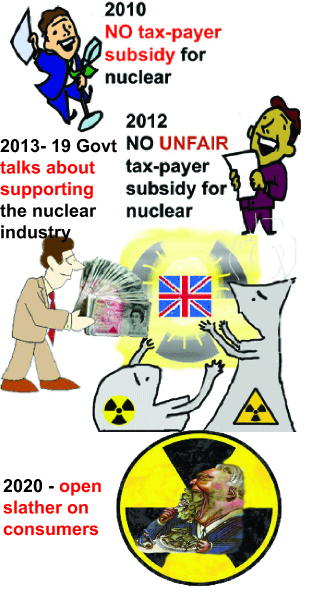 A secret military agenda. UK defence policy is driving energy policy – with the public kept in the dark, Beyond NuclearBy David Thorpe, 8 Nov 20 “……..The second option for new nuclear. While Downing Street is pushing SMRs, BEIS has been looking for a way to finance the £20 billion Sizewell C reactor which EDF has been lobbying to build in Suffolk. This could be why it did not want to bankroll Rolls Royce’s expansion.
One idea being floated by BEIS is the government taking equity stakes in future nuclear plants such as Sizewell C, the energy minister has confirmed.
French energy company EDF is unable to continue with its plans for a new UK nuclear power station without even more government support than it has already had.
The CEO of EDF, Jean-Bernard Lévy, met the Chancellor of the Exchequer Rishi Sunak recently to beg for such support. The head of Greenpeace UK, John Sauven, wrote to the Chancellor saying giving support may be in EDF’s interests, but it is not in the UK’s. Nevertheless, the government is considering taking a direct stake in the project, using a “Regulated Asset Base” (RAB) financing model, where costs are added to consumers’ bills during construction.
This would still result in multibillion-pound liabilities showing on the government’s balance sheet. So the Treasury is studying whether the government should in return have equity stakes in EDF’s Sizewell plant.
The government previously offered to take a one-third stake in Hitachi’s Wylfa plant on Anglesey, but the Japanese company still scrapped the project last month – even then it was too expensive.
The RAB approach is being challenged anyway by the national nuclear regulator, the Office for Nuclear Regulation, because it could introduce a dual regulator for the industry, which it does not regard as sensible or workable.
Renewables can supply UK energy needs and net zero targets sooner and cheaper than nuclear
Renewables are safer, cheaper, quicker to install and genuinely low carbon, with no fuel supply chain.
The Sizewell reactor could not realistically be supplying power until 2034 at the earliest, while wind and solar plants take less than two years to commission, on average.
The ability of the national grid to absorb more fluctuating renewable electricity input is improving, helped by the collapsing cost of batteries, and investment in hydrogen and other forms of storage.
The National Infrastructure Commission has testified that the absorption of 65 per cent renewables on the grid by 2030 is cost-effective – and more is technically achievable.
Implicitly recognising the truth of this, the Ministry of Defence’s Chief Scientific Adviser on nuclear science and technology matters, Robin Grimes, has just opened up another front against renewables.
Grimes is advocating nuclear power’s potential for cogeneration – using its “waste” heat for all manner of things from district heating and seawater desalination to synthetic fuel production and industrial process heat.
This is not likely to make much of a dent in the cost-benefit equation.
Alarm bells should be set ringing when you know that this same Grimes was also co-author of a once-secret report in 2014 for the Ministry of Defence where it was recommended that the UK nuclear submarine industry needs to forge links with civil nuclear power in order to extricate itself from the dire situation it is in.
This secret report discussed what to do about the radiation-leaking Vulcan Naval Reactor Test Establishment, a military submarine reactor testing facility built in 1950 at Dounreay in Scotland.
Engineers with nuclear expertise are dying out with the reactors. New nuclear subs need a new supply chain and new expertise. What better place to tackle all these issues?…………….https://wordpress.com/read/feeds/72759838/posts/3011373103
Welsh families in the shadow of Wylfa nuclear station are slowly being pushed out
Wales Online 8th Nov 2020 There used to be a tight-knit community of mostly Welsh speakers living in
the shadow of a nuclear power station — until it was decided they were in
the way. One by one, the families and farmers living and working the land
around the Wylfa nuclear power station on the island of Anglesey have been
slowly bought off and forced to move, leaving just a handful of stubborn people
https://www.walesonline.co.uk/news/wales-news/people-forced-leave-homes-factory-19224272
Fears of local community about drugs and sexual exploitation in the 10 year Sizewell C nuclear build
East Anglian Daily Times 8th Nov 2020, Fears have been voiced that the 10-year construction of Sizewell C could
bring drug gangs and prostitution – including the sexual exploitation of women and teenage girls and “pop-up brothels” – to the area.
https://www.eadt.co.uk/news/sizewell-c-pop-up-brothels-and-county-lines-1-6920469
Small and large new nuclear reactors in Britain’s so-called ‘green industrial revolution’
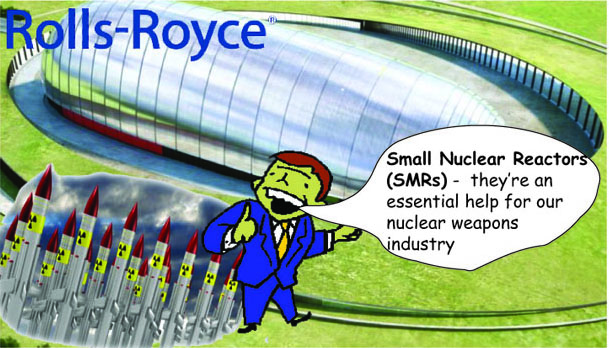 Mail on Sunday 7th Nov 2020, Boris Johnson is poised to launch major plans for a ‘green industrial revolution’ backing a new wave of nuclear power plants to boost the economy and slash Britain’s carbon emissions. The proposals are expected to include the green light to build a nuclear plant at Sizewell C in Suffolk and thenext stage in a programme that would lead to a production line of rapidlyn and more cheaply produced small modular reactors within a decade, The Mail on Sunday understands.
The Government is considering a ‘Made in Britain’ solution that may include a taxpayer-backed injection from an infrastructure growth fund – a plan that would need rubber stamping by the Treasury. Funding could also include backing from British pension funds. It would allow the Government to help subsidise the small modular reactor programme (SMR) with as much as £2billion and a stake in Sizewell C of up to 10 per cent of its £20billion build costs.
Sizewell C is backed by French state-backed EDF Energy, which could become a minority shareholder. Government financing would also help slash the cost of electricity produced by the plant. Britain has eight nuclear power plants, generating about a fifth of the country’s electricity. Seven are due to close by 2030.
The SMR consortium is led by Rolls-Royce and includes construction and engineering companies Assystem, Atkins, BAM Nuttall,
Jacobs and Laing O’Rourke. It hopes to build ten to 15 reactors in the UK, largely on former nuclear sites. Plans are already being discussed for the possibility of joint sites in locations including Moorside in Cumbria – where Japanese multinational Toshiba recently pulled out of developing its own reactor – that could contain a large EDF-backed reactor and a smaller modular reactor, creating a ‘clean energy hub’.
EDF has insisted synergies with Hinkley will mean the cost of energy from a second plant at Sizewell C would be slashed. It is understood site preparations could begin immediately and that planning consent for the project itself could be given
as soon as 2022, meaning the plant could be online by 2032.
https://www.thisismoney.co.uk/money/markets/article-8924115/Lift-GREEN-Industrial-Revolution.html
A win for decency, rationality, co-operation , and science
Joe Biden, Kamala Harris, and the Democrats have won the American election.
For four years, the world has put up with a lying, narcissistic, sociopath as American President. Trump has done such damage to civil systems of health and environment, to democratic institutions, and to international relations. He has epitomised the bullying style of leadership that has become so popular and so dangerous in this 21st century world.
Jo Biden, in the way that he ran his campaign, and in his winning speech, demonstrates a completely opposite style – one of reasonableness, courtesy, and respect for science and democratic agencies.
A key factor today is the appalling state of coronavirus cases, and coronavirus deaths in the USA. That is a no. 1 challenge to the American administration. Now, they will have a leader who understands the seriousness of the pandemic, and cares.
The Democratic leadership understands the climate crisis, and even if the Senate should be dominated by Republicans, Biden can still rejoin the USA to the Paris Climate Accord. Much action against global heating can be done by executive action, bypassing the Senate,
On the nuclear issue, Biden will almost certainly support international arms control agreements, but not the Treaty on the Prohibition of Nuclear Weapons. Unfortunately, the Democratic Party now, as it did under Obama, still basks in the arms of the ”peaceful”nuclear lobby, and the nuclear weapons making industry.

The beginning of the end for nuclear weapons?

|
The beginning of the end for nuclear weapons? https://www.aspistrategist.org.au/the-beginning-of-the-end-for-nuclear-weapons/, 6 Nov 2020|Tara Gutman The ratification on 25 October of the Treaty on the Prohibition of Nuclear Weapons (TPNW) by Honduras, the 50th nation to sign, marked the beginning of the final chapter of the legitimacy of nuclear weapons.Even without the nuclear-armed states and their allies, the TPNW will now automatically enter into force on 22 January 2021, and immediately set a new benchmark against which all other nuclear disarmament measures will be judged.
The treaty’s activation will begin to shift the international legal norm and generate a stigma around these cruellest of indiscriminate weapons. This will have ramifications for defence policy, military doctrine, weapons manufacturing, banks and super funds, as was the case when cluster munitions, chemical and biological weapons, and landmines were outlawed. The TPNW couldn’t be more timely. Numerous organisations, including the International Red Cross and Red Crescent Movement, the 2017 Nobel-prize winner ICAN, and the Bulletin of the Atomic Scientists have judged that the risk of nuclear conflict is higher now than it has been for decades. This is because nuclear-armed states are expanding their arsenals by, for example, including smaller, tactical atomic weapons; modernising their nuclear-weapon delivery systems to include underwater drones and nuclear-capable hypersonic missiles; and abandoning longstanding arms-control agreements. Some, too, are vulnerable to cyberattacks. Last month, 56 former world leaders were in furious agreement with humanitarians, civil society and the science. Their unequivocal statement in support of the TPNW asserted that without a doubt ‘a new nuclear arms race is underway’. Here was no pollyannaish crowd of flower-holding peaceniks. The gathering included two former secretary-generals of NATO and one of the United Nations, prime ministers, foreign ministers and defence ministers from 20 NATO member countries plus South Korea and Japan, all urging their governments to join the treaty. Having such diverse backing is one of the TPNW’s greatest strengths and why it will eventually upend the status quo. Since the treaty’s adoption in 2017, nuclear-armed states and allied nations have denounced it as weak and a distraction that will undermine the existing legal architecture, the cornerstone of which is the Nuclear Non-Proliferation Treaty (NPT) drafted in 1968. While the NPT was a monumental accomplishment, its implementation stagnated as nuclear-armed states came to believe that they were entitled to maintain their own nuclear weapons in perpetuity. Its integrity eroded as it repeatedly failed to fulfil its aspiration to ‘facilitate the cessation of manufacture of nuclear weapons, the liquidation of all existing stockpiles, and the elimination from national arsenals of nuclear weapons and the means of their delivery’. Disappointingly and fatally, it made no substantial progress on the key obligation to ‘pursue negotiations in good faith on effective measures relating to cessation of the nuclear arms race at an early date and to nuclear disarmament, and on a treaty on general and complete disarmament under strict and effective international control’. While the NPT will remain a key pillar of the legal architecture with a leading role to play, the TPNW is designed to complement it and remedy its critical shortcomings while reinforcing the same norms and institutions championed by the NPT. Some nuclear-armed states and their allies continue to argue that these weapons are a necessary component of their defence posture and that they keep us safe. Former NATO leaders disagree and argue strongly that these weapons unleash obscene humanitarian consequences. As long as there are nuclear weapons there is a risk that they will be used, intentionally, by accident or by miscalculation, and no adequate humanitarian response can be mounted. The argument ignores the shocking and painful deaths and injuries inflicted on hundreds of thousands of Japanese by two relatively small bombs in 1945. Today in Hiroshima and Nagasaki, Red Cross hospitals continue to treat the survivors and research is being conducted to determine whether the illnesses being experienced by their descendants two generations later can be explained by mutations in their DNA caused by radiation. Nuclear-aligned countries, such as Australia, were reticent to engage with the TPNW treaty-making process, reasoning that it may be inconsistent with their legal obligations under their defence arrangements. But a recently published legal analysis of whether joining the TPNW would undermine the ANZUS security treaty found that it creates no legal impediment. The ANZUS treaty makes no reference to nuclear matters, and even if subsequent practice and statements have effectively redrawn its terms, there is still no legal barrier to entering negotiations to vary it. Similarly, the former world leaders said their governments ‘could remain in alliances with nuclear armed states, as nothing in the [NATO] treaty or our defence pacts precludes that’. In the commercial sector, the onset of the TPNW was being felt even before Honduras’s ratification. The flow of investment funds away from nuclear weapons manufacturers has been steadily increasing. Sixteen Japanese banks, two of the top five major global pension funds, the Norwegian Government Pension Fund, KBC Bank Ireland, Deutsche Bank and others have now divested or in the process of divesting. Significant numbers of banks, super funds and pension funds have included in their environmental social governance frameworks commitments not to fund controversial weapons. Nuclear weapons should now, belatedly, be assigned to this category and excluded from their portfolios. Manufacturers of nuclear weapons and their banks and shareholders must re-examine their policies, practices and investment screening criteria to preserve their reputations, avoid regulatory risks and stranded assets, and demonstrate to shareholders that they are behaving in accordance with international standards and best practice. As the International Red Cross and Red Crescent Movement welcomes the January 2021 commencement of the nuclear weapons ban regime in the midst of a global pandemic, we remind all governments that Covid-19 has taught us that even low-probability events can and do occur, to devastating effect. Just like the Covid-19 response, we will eliminate this threat only with sensible, ethical, global action. There will never be a vaccine for the bodily effects of nuclear weapons or their impact on our fragile environment. Prevention is the only course. We have worked towards this new era for 75 years, motivated by the interests of humanity and the principles of international humanitarian law. We hope that all states will join the 50 early adopters and support this sensible, ethical treaty sooner rather than later. Tara Gutman is an international humanitarian law adviser with Australian Red Cross. |
|
The accumulating radioactive water is another Fukushima disaster crisis
|
Japan faces another Fukushima disaster crisis https://www.eco-business.com/news/japan-faces-another-fukushima-disaster-crisis/ – 6 Nov 20, A plan to dump a million tonnes of radioactive water from the Fukushima disaster off Japan is alarming local people. Paul Brown, Climate News Network. The Japanese government has an unsolvable problem: what to do with more than a million tonnes of water contaminated with radioactive tritium, in store since the Fukushima disaster and growing at more than 150 tonnes a day.
The water, contained in a thousand giant tanks, has been steadily accumulating since the nuclear accident in 2011. It has been used to cool the three reactors that suffered a meltdown as a result of the tsunami that hit the coast. Tritium is a radioactive element produced as a by-product by nuclear reactors under normal operation, and is present everywhere in the fabric of the reactor buildings, so water used for cooling them is bound to be contaminated by it. To avoid another potentially catastrophic meltdown in the remaining fuel the cooling has to continue indefinitely, so the problem continues to worsen. The government has been told that Japan will run out of storage tanks by 2022. Announcement delayedAs often happens when governments are faced with difficult problems, the unpalatable decision to release the contaminated water into the sea has not been formally announced, but the intention of the government to take this course has been leaked and so widely reported. Immediately both local and worldwide adverse reaction has resulted. There are the direct effects on the local fishermen who fear that no one will want to buy their catch, but over a wider area the health effects are the main concern. As ever with the nuclear industry, there are two widely different views on tritium. The Health Physics Society says it is a mildly radioactive element that is present everywhere, and doubts that people will be affected by it. But the Nuclear Information and Resource Service believes tritium is far more dangerous and increases the likelihood of cancers, birth defects and genetic disorders. The issue is further complicated because the Fukushima wastewater contains a number of other radionuclides, not in such high quantities, but sufficient to cause damage. Ian Fairlie, an independent consultant on radioactivity in the environment, is extremely concerned about Japan’s plans and the health of the local people. In a detailed assessment of the situation he says other highly dangerous radioactive substances, including caesium-137 and strontium-90, are also in the water stored at Fukushima. They are in lower quantities than the tritium, he says, but still unacceptably high – up to 100 times above the legally permitted limit. All these radionuclides decay over time − some take thousands of years − but tritium decays faster, the danger from it halving every 12.3 years. In a briefing for the Nuclear Free Local Authorities (NFLA), a UK based organisation, another independent analyst, Tim Deere-Jones, discusses research that shows that tritium binds with organic material in plants and animals. This is potentially highly damaging to human health because it travels up the food chain in the marine environment, specifically accumulating in fish. This means fish-eating communities on the Japanese coast could ingest much larger quantities of tritium than some physicists think likely. Relying on dilutionTim Deere-Jones is also concerned that the tritium will be blown inshore on the prevailing wind in sea spray and will bio-accumulate in food plants, making it risky to eat crops as far as ten miles inland. Because of the potential dangers of releasing the water the NFLA has asked the Japanese government to reconsider its decision. The government has not yet responded though, because officially it is still considering what to do. However, it is likely to argue that pumping the contaminated water into the sea is acceptable because it will be diluted millions of times, and anyway seawater does already contain minute quantities of tritium. Dr Fairlie is among many who think this is too dangerous, but he admits there are no easy solutions. He says: “Barring a miraculous technical discovery which is unlikely, I think TEPCO/Japanese Gov’t [TEPCO is the Tokyo Electric Power Company, owner of the Fukushima Daiichi plant] will have to buy more land and keep on building more holding tanks to allow for tritium decay to take place. Ten half-lives for tritium is 123 years: that’s how long these tanks will have to last – at least. “This will allow time not only for tritium to decay, but also for politicians to reflect on the wisdom of their support for nuclear power.” |
|
1 This Month

of the week – Shut Down Drone Warfare!


Tell the Ukrainian Government to Drop Prosecution of Peace Activist Yurii Sheliazhenko

Petition to revoke the licensing of the Near Surface Nuclear Disposal Facility (NSDF) at Chalk River. https://www.ourcommons.ca/petitions/en/Petition/Details?Petition=e-7247
To see nuclear-related stories in greater depth and intensity – go to https://nuclearinformation.wordpress.com
-
Archives
- April 2026 (44)
- March 2026 (251)
- February 2026 (268)
- January 2026 (308)
- December 2025 (358)
- November 2025 (359)
- October 2025 (376)
- September 2025 (257)
- August 2025 (319)
- July 2025 (230)
- June 2025 (348)
- May 2025 (261)
-
Categories
- 1
- 1 NUCLEAR ISSUES
- business and costs
- climate change
- culture and arts
- ENERGY
- environment
- health
- history
- indigenous issues
- Legal
- marketing of nuclear
- media
- opposition to nuclear
- PERSONAL STORIES
- politics
- politics international
- Religion and ethics
- safety
- secrets,lies and civil liberties
- spinbuster
- technology
- Uranium
- wastes
- weapons and war
- Women
- 2 WORLD
- ACTION
- AFRICA
- Atrocities
- AUSTRALIA
- Christina's notes
- Christina's themes
- culture and arts
- Events
- Fuk 2022
- Fuk 2023
- Fukushima 2017
- Fukushima 2018
- fukushima 2019
- Fukushima 2020
- Fukushima 2021
- general
- global warming
- Humour (God we need it)
- Nuclear
- RARE EARTHS
- Reference
- resources – print
- Resources -audiovicual
- Weekly Newsletter
- World
- World Nuclear
- YouTube
-
RSS
Entries RSS
Comments RSS
 nuclear-news