Russia’s nuclear imperialism in Africa
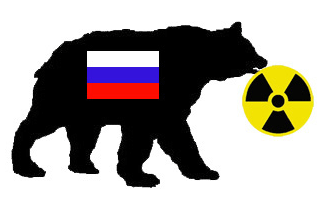
Russia’s nuclear play for power in Africa, DW 2 July 20,
Russia is pushing nuclear technology to African nations to both turn a profit and expand its political might on the continent. Rwanda’s parliament has just approved a plan for Russia’s state-owned Rosatom nuclear conglomerate to build it a nuclear research center and reactor in the capital, Kigali.
The Center of Nuclear Science and Technologies, planned for completion by 2024, will include nuclear research labs as well as a small research reactor with up to 10 MW capacity.
Ethiopia, Nigeria and Zambia have signed similar deals with Rosatom, while countries such as Ghana, Uganda, Sudan and DRC have less expansive cooperation agreements.
Rosatom has been aggressively wooing African nations since the mid-2000s and the nuclear deals are seen as part of Russia’s push turn a profit and also gain influence in Africa.
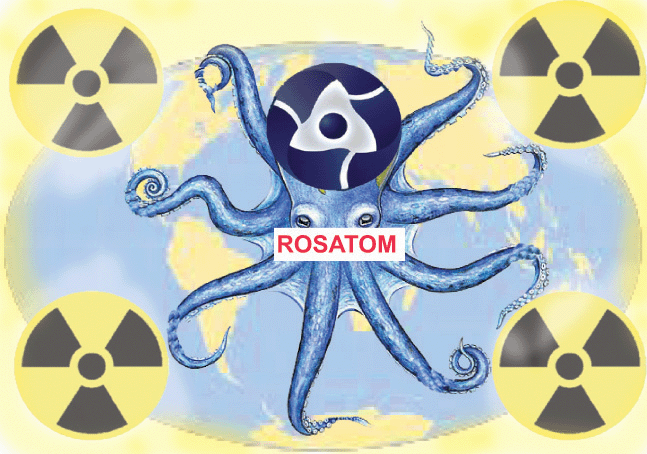
Western sanctions first imposed on Russia in 2014 over its annexation of the Crimea in the Ukraine have forced Russia to seek alternative sources of incomes and also new friends.
Nuclear technology instead of trade
“For Putin to remain relevant in Russia, he really has to ensure that Russia has a big influence,” said Ovigwe Eguegu, a geopolitics analyst with the international affairs platform, Afripolitika. “That’s why he is looking at African markets so he has more parties to partner with when it comes to international issues.”
African nations constitute the largest voting bloc in the United Nations.
While the Soviet Union had a close relationship to various African states during the Cold War, Russia’s trade balance with Africa is one tenth of that of China, meaning it needs to look for other means to get a foothold on the continent.
“Russia is using the tools that they have to expand their influence and right now, Russia has lots of experience in the nuclear energy area,” Eguegu said in a phone interview from Abuja.
Rosatom nuclear leader
Rosatom is the world’s biggest nuclear company by foreign orders. While it has projects in developed countries such as Finland and Hungary, it’s mainly involved in developing regions.
The Rosatom packages are popular because the corporation’s sheer size means it can offer all-in-one deals, from training local workers to developing nuclear science curricula, supplying uranium for the plant’s life time and dealing with nuclear waste — with the added plus of Russian state loans for the projects.
The cost and financing of Rwanda’s nuclear research center is still undisclosed. But Russia is extending a $25 billion (€22.23 billion) loan to Egypt to cover 85% of the cost of the El Dabaa nuclear power plant, which Rosatom is constructing.
Rosatom has come to dominate nuclear exports to developing countries because of their generous financing and worker training,” according to the 2018 Center for Global Development policy paper, Atoms for Africa.
Additionally, Russia is itself a major player in the nuclear market, responsible for some 8% of uranium production worldwide as well as 20% of uranium conversion and 43% of uranium enrichment (conversion and enrichment are stages of processing uranium so it can be used by commercial nuclear power reactors)………….
many experts, including Gatari, believe that nuclear technology doesn’t yet make sense for African countries. They lack the highly skilled local workforce required to run the technological intricacies of such reactors. Plus, nuclear facilities are vastly expensive and take years to build.
Gatari warns of countries becoming locked into costly projects that end up being “white elephants”.
“Such a project can only be driven by strong and educated local human resources,” the nuclear researcher said. “That knowledge isn’t possible by rushing young students through training for a short time.
And the cost of maintaining that kind of installation can cripple the budget of a country for a long, long time.”
Doing the smooth sell
Currently, South Africa is the only country in sub-Saharan Africa with a functioning nuclear power plant, while Nigeria and Ghana have research reactors, which are primarily used for studying and training and to test materials, such as minerals.
In Europe, safety concerns around nuclear technologies have already caused countries such as Germany, Italy, Spain and Switzerland to vote to phase out nuclear power.
These concerns are compounded in Africa, given the the political instability of certain regions and the threat of sabotage or terrorist attacks. This hasn’t stopped Rosatom, and Russia, from doing a soft sell of nuclear technologies on the continent.
Rosatom funds scholarships for students from sub-Saharan Africa to study nuclear sciences and engineering in Russia. As of January 2020, around 300 students from more than 15 African countries were studying nuclear specialties there.
It runs an online video competition, Atoms for Africa, where participants stand a chance to win an all expenses paid trip to Russia for a video dedicated to innovative nuclear technologies.
In 2019, it even held an international fishing competition near the Leningrad nuclear power station, Russia’s largest, to demonstrate the safety of nuclear power for water bodies. (The competition was won by an Egypt team).
“There is good money if you can sell a research reactor,” said nuclear scientist Gatari. “Unfortunately, the convincing capacity of [Rosatom’s] marketing is very high, and the understanding of those who are buying is low.” https://www.dw.com/en/russias-nuclear-play-for-power-in-africa/a-54004039
A global push for racial justice in the climate movement
A global push for racial justice in the climate movement For years, mainstream environmental movements around the globe have excluded people of color, who are disproportionately impacted by climate change. Today’s global Black Lives Matter protests have amplified calls for institutions of all kinds — including environmental groups — to challenge and dismantle chronic systemic racism., The World, June 30, 2020 By Anna Kusmer
Environmental sociologist Dorceta Taylor remembers being the only Black person in her environmental science class at Northeastern Illinois University in the early 1980s. When she asked her white professor why there weren’t more Black students, he quickly told her that it was “because Blacks are not interested in the environment,” she said.
This assumption ran counter to everything she knew. She had grown up in Jamaica, where people from all backgrounds were passionate about the environment and loved nature.
Taylor, until recently a professor of environmental racism at the University of Michigan, found that underrepresentation exists at environmental organizations across the United States. In 2014, just under 16% of people of color were represented in a survey of hundreds of organizations, compared to about 35% of the population, she said. In the early 1990s, only about 2% of the staff of environmental nongovernmental organizations were people of color.
In the UK, the environmental sector is one of the least diverse sectors of the economy.
Yet, people of color are disproportionately impacted by environmental degradation and climate change, and environmental organizations are being called to focus more than ever before on environmental justice.
In the past few weeks, big international green groups including Greenpeace and 350.org have responded with statements, videos and op-eds supporting Black Lives Matter and calling for racial justice.
Related: Black Lives Matter UK says climate change is racist
But environmental activist Suzanne Dhaliwal is skeptical this will translate into real inclusion, particularly in the UK, where she lives and works. Dhaliwal, who identifies as British Indian Canadian Sikh, grew up partly in Canada and spent much of her 20s working alongside big environmental nonprofits in the UK. ………
So, Dhaliwal started her own environmental nonprofit, UK Tar Sands Network, which works alongside Indigenous communities and organizations to campaign against UK companies investing in oil extraction in Alberta, Canada.
“Now, what I call for is direct funding of Black and Brown and Indigenous organizations and leadership training,” said Dhaliwal. “We need research money so that we can research new strategies.”
Other environmentalists are trying to change environmental organizations from within.
Samia Dumbuya just started a job with the European branch of international nonprofit Friends of the Earth, working on climate justice and energy issues. She lives in the UK.
As a Black person whose parents are refugees from Sierre Leone, talking about racial justice issues within the environmental movement is personal for her. She says she sees how climate change is affecting her parents’ home country with increasingly bad flooding and landslides. ………
Across the globe, the urban spaces that are overpoliced and lack public investment also have the worst air quality and contaminated drinking water. The environmental movement will grow stronger with more diverse representation, but also by making these connections, Taylor said.
“Environmentalists all over the country are really taking note that they need to think of the environment now as not just the trees and the birds and the flowers, but the human relationships that are in them — and how these are really threatening some people way more than they’re threatening others.” https://www.pri.org/stories/2020-06-30/global-push-racial-justice-climate-movement
“Clean Energy” Who are they Kidding? The Moorside Site Again under Threat of New Nuclear Crapola. —

The Nuclear Industry is SUPER KEEN to promote itself as Clean Energy what with the Springfields Nuclear Fuel Manufacturing site (near the Preston New Road frack site) now calling itself a “Clean Energy Technology Park” and the Extinction Rebellion Public Relations guru saying she has “followed the science” and her nuclear mentor George Monbiot along […]
via “Clean Energy” Who are they Kidding? The Moorside Site Again under Threat of New Nuclear Crapola. —
U.S. Pentagon lacks the cash to build new nuclear weapons
 We Don’t Have Enough Cash to Build New Nuclear Weapons, Says Air Force https://www.defenseone.com/politics/2020/07/we-dont-have-enough-cash-build-new-nuclear-weapons-says-air-force-chief/166598/ Chief Nukes or conventional weapons, “the current budget does not allow you to do both,” says Gen. Dave Goldfein, suggesting Congress create a separate account.
The Pentagon’s budget is not large enough to buy new nuclear weapons and conventional forces simultaneously, the U.S. Air Force’s top general said Wednesday.
Chief of Staff Gen. Dave Goldfein gave a blunt assessment of the Pentagon’s growing list of bills amid a growing US deficit, on Wednesday, suggesting nuclear expenses have grown so great they may require a separate account of their own.
I think a debate is that this will be the first time that the nation has tried to simultaneously modernize the nuclear enterprise while it’s trying to modernize an aging conventional enterprise,” Goldfein said during a Brookings Institution appearance. “The current budget does not allow you to do both.”
The Trump administration’s $705 billion fiscal 2021 budget request for the Pentagon — which Congress is reviewing — calls for nearly $29 billion in nuclear weapons spending. The money would go toward new stealth bombers, intercontinental ballistic missiles, ballistic missile submarines, a new nuclear cruise missile and upgrades to the global nuclear command, control and communications network. The stealth bomber is the only weapon that could be used for nuclear or conventional strikes. The Energy Department, which oversees nuclear warheads, has requested $15.6 billion in fiscal 2021.
In January 2019, the Congressional Budget Office estimated that the Pentagon’s nuclear weapons spending plan would cost $494 billion between 2019 and 2028, an average of about $50 billion per year.
Pentagon officials today argue they need 3 to 5 percent annual spending increases to fund weapons projects of all kinds, however defense spending is expected to flatten or slightly decline in the coming years regardless who wins November’s presidential election.
“There are either going to be some significant trades made or we’re going to have to find a fund for strategic nuclear deterrence, that we can use to modernize,” Goldfein said.
In recent years, Pentagon officials, including former Defense Secretary Ash Carter, and lawmakers have considered creating a nuclear weapons fund separate from the military services budgets. Todd Harrison, director of defense budget analysis and the Aerospace Security Project at the Center for Strategic and International Studies, questioned the rationale for moving those funds.
“It doesn’t make new money appear,” he said.
During the Obama administration, the Pentagon began the decades-long process of updating its nuclear arsenal with new ICBMs, bombers, submarines and missiles. Some independent estimates say the price tag could reach nearly $1.7 trillion over the next 30 years. How to pay for it is still debated in the Defense Department, but the need for nuclear weapons is not.
“I would just offer that in my mind, I could never advise anybody to unilaterally disarm or give up second strike capability,” Goldfein said. “I do believe we have to have a debate about the way we’re going to fund this essential part of our military going forward.”
Fukushima radioactive reference layer found in Northern glaciers as they thaw

 Terrawatch: unearthing snow’s ‘Fukushima layer’ https://www.theguardian.com/science/2020/jun/30/terrawatch-unearthing-snows-fukushima-layer
Chinese glaciologists have found the freeze-thaw process has concentrated discharge from the disaster Kate Ravilious, @katerav Wed 1 Jul 2020 The Fukushima nuclear accident has added a distinctive signature to snow and ice across the northern hemisphere, new research published in Environmental Research Letters shows. Triggered by the Tōhoku earthquake and tsunami off the coast of Japan on 11 March 2011, the disaster resulted in a month-long discharge of radioactive material into the atmosphere, ocean and soil.Feiteng Wang from the Tian Shan glaciological station in Lanzhou, China, and colleagues collected snow samples in 2011 and 2018 from a number of glaciers (spanning a distance of more than 1,200 miles (2,000km) in north-western China. They expected the Fukushima signature to have faded away by 2018, but to their surprise the freeze-thaw processing had made it more concentrated, creating a strong and lasting reference layer in the ice.
Many reference layers from the last 50 years (such as the Chernobyl nuclear disaster) have melted away in recent warming events, making it difficult to date the upper layers of ice cores. “Reference layers are crucial and a prerequisite for telling the story of the ice core,” says co-author Jing Ming. “The Fukushima layer will be useful for dating ice in one or two decades when the snow transforms to ice,” he adds.
Radiation particles leak may have come from Russia’s super nuclear weapons, rather than from commercial reactor
Russia’s nuclear energy body has denied that the radiation originated from its two nuclear power stations in the region. However, it is not only civilian power stations that use nuclear reactors. Tom Moore, a nuclear policy expert and former senior professional staff member of the U.S. Senate Foreign Relations Committee, believes that these military reactors cannot be ruled out:
“CTBTO radionuclide monitoring is intended to discriminate explosive events and to complement seismic monitoring. Not to effectively rule in or rule out a source of radionuclides as being civil or military reactors.”
Possible Cause: Burevestnik Cruise Missile
The first military system under development which comes to mind is the Burevestnik cruise missile. Its name means ‘Storm Bringer’ in Russian, after the Petral sea bird. It is more formally known by the designation 9M730 and NATO code name Skyfall. This is a nuclear-armed cruise missile that is designed to use a nuclear engine to give it virtually unlimited range. Burevestnik is the natural candidate because it is airborne, so any accident would likely release radioactive material into the sky.
This may have previously happened on August 9, 2019. There was a fatal radiation incident at the State Central Navy Testing Range at Nyonoksa. This is near to Severodvinsk in Russia’s arctic north, the same area that the CTBTO has pointed towards this time. Then it was caused by an explosion in a rocket engine. Many analysts believe that this was most likely related to the Burevestnik missile.
Possible Cause: Poseidon Drone-Torpedo
The other weapon in the frame is Poseidon. This is a massive nuclear-powered torpedo that is intended to be launched from specially built submarines. At 60-78 feet long it is about twice the size of a Trident missile. Its designation is believed to be 2m39 and it is known in NATO as Kanyon. Its virtually unlimited range and high autonomy would make it hard to classify. The U.S. government has described it as an intercontinental, nuclear armed, undersea autonomous torpedo. It is a weapon worthy of a Bond villain that would literally go underneath missile defenses. Its threat is slow but inevitable doom to coastal cities such as New York and Los Angeles.
While Poseidon probably doesn’t have very much shielding on its reactor, it is normally underwater, so any radiation leak may not reach the atmosphere. But it would be lifted out of the water after a test launch, so there is room for an incident that could get detected hundreds of miles away in Scandinavia.
Open Source Intelligence On The Suspects
Open source intelligence analysts have been following these weapons. Evgeniy Maksimov noted that flight tests of Burevestnik were probably being conducted. He noted two no-fly zones closed for June 22-27 at a missile test range. But the launch site was far south of where the radiation is believed to originate.
A better candidate may therefore be Poseidon. Vessels believed to be associated with its tests were active in the region at the time. The special support vessel Akademik Aleksandrov was at sea around June 18 to 23, in the area of interest. This ship is suspected of being involved in retrieving Poseidon weapons. Twitter user Frank Bottema found a matching vessel using radar satellite imagery.
We may never know for sure the cause of the heightened radiation levels. But Russia’s denials that it was from a civilian power plant, combined with the ongoing tests, point a finger at the nuclear-powered weapons. This reignites the debate about how safe these projects are, even in peacetime.
Radioactive particles in atmosphere: Russia tells IAEA it has had no nuclear incidents
Russia Tells IAEA It Is Incident-Free After Nuclear Particle Increase, https://www.nytimes.com/reuters/2020/06/30/world/europe/30reuters-nuclear-particles-baltic-russia.html By Reuters
June 30, 2020 VIENNA — Russia has told the U.N. atomic watchdog there have been no nuclear incidents on its territory that could explain elevated but still harmless levels of radioactive particles detected on the Baltic Sea last week, the U.N. agency said on Tuesday.
A separate body, the Comprehensive Nuclear-Test-Ban Treaty Organization (CTBTO), which watches for nuclear weapon tests, said on Friday a monitoring station in Sweden had found higher-than-usual levels of caesium-134, caesium-137 and ruthenium-103. The CTBTO said they were produced by nuclear fission.
CTBTO chief Lassina Zerbo posted a borderless map https://twitter.com/SinaZerbo/status/1276559857731153921?s=20 online showing where the particles might have come from in the 72 hours before they were detected – an area covering the tips of Denmark and Norway as well as southern Sweden, much of Finland, Baltic countries and part of western Russia including St. Petersburg.
All those countries except Denmark, which has no nuclear power plants http://www.ensreg.eu/country-profile/Denmark, and Russia, which has a history of not fully explaining incidents that emitted radioactive particles, told the International Atomic Energy Agency by Monday that there were no events on their territory that could explain the increase.
On Tuesday evening, however, the IAEA issued a statement https://www.iaea.org/newscenter/pressreleases/more-countries-provide-radioisotope-information-to-iaea-reported-levels-very-low saying the list of countries that had declared themselves incident-free had grown to around 40 and now included Denmark and Russia.
“Apart from Estonia, Finland and Sweden, none of the other countries which have so far provided information and data to the IAEA said they had detected elevated radioisotope levels,” said the IAEA, which asked member states for information over the weekend after the CTBTO announcement.
Asked on Monday if Russia was the origin of the elevated particle levels, Kremlin spokesman Dmitry Peskov said Moscow had detected no sign of a radiation emergency.
(Reporting by Francois Murphy; editing by Jonathan Oatis)
Scepticism over USA Dept Energy report that the Runit nuclear waste dome is “safe”
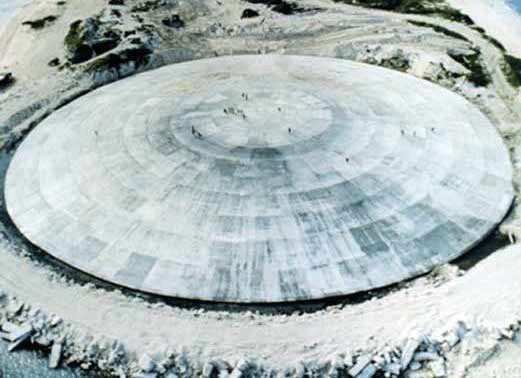
The new report does not include a plan to repair the dome, which was required by Congress.
In 1981, the U.S. government declared in a report that the island should be quarantined indefinitely and that the “possibility would always exist that high levels of plutonium-contaminated subsurface soil could be exposed by wave or storm action.”
The DOE report found that Runit Dome, a repository for atomic waste the United States produced during Cold War weapons testing, is sound and that radioactive leakage into the nearby lagoon is not significant.
After Congress grew concerned last year about the leaking dome, it ordered the DOE to produce a report on the dome’s structural integrity amid climate change and rising sea levels.
The report noted that while sea level rise could increase storm surge, swells, and “lead to wave-induced over-wash of lower sections of the dome,” there is not enough definitive data to determine “how these events might impact on the environment.”
One Marshallese leader was disappointed the DOE again downplayed the risks and declined to take responsibility for Runit Dome and its leaking contents.
“We don’t expect the Enewetak community to feel any safer based on this report as it doesn’t contain any new information from what they’ve seen…and don’t trust,” said Rhea Christian-Moss, the chairperson of the Marshall Islands’ National Nuclear Commission, a government-operated nuclear waste and radiation oversight panel.
“The report offers nothing new and is more or less what we expected to see,” she said, lamenting the Senate’s redaction of a critical line in the House’s mandate, which stipulated that the Department of Energy provide a plan detailing the removal of the radioactive waste into a “safer and more stable location.”
The Department of Energy report is signed by Dan Brouillette, the agency’s secretary. Terry Hamilton, the department’s lead contractor on the project, was not available for comment.
In November last year, The Times published an investigation of the lingering radiation legacy in the Marshall Islands, and the refusal of U.S. authorities to take ownership for the hazards posed by Runit Dome
In December, Congress signed the National Defense Authorization Act for 2020, which required the DOE to provide a plan to repair the dome, evaluate the environmental effects of the dome on the lagoon over the next 20 years, and assess its structure and the potential risk to the people who live near it.
The department was also required to assess how rising sea levels could affect the dome.
Christian-Moss noted data gaps in the report, as well, including the level of radiation in groundwater leaking from the dome into the lagoon.
In 2019, at a presentation delivered in the Marshall Islands to Marshallese and U.S. officials, the DOE’s contractor, Hamilton, mentioned elevated levels of radioactivity in giant clams living near the dome.
The new report does not mention the clams but states that not enough information is available to understand how leakage from the dome is affecting marine life. However, according to the energy department, studies of people living nearby show normal levels of radiation — suggesting they are not being adversely affected.
“The absence of data to show any risk does not mean that there is no risk.” she said. “So my main takeaway from the report is that many risks are still ‘unknown.’”
Nowhere else has the United States saddled another country with so much of its nuclear waste, a product of its Cold War atomic testing program.
The waste site, known alternatively as the Tomb, holds more than 3.1 million cubic feet — or 35 Olympic-size swimming pools — of U.S.-produced radioactive soil and debris, including lethal amounts of plutonium.
The radioactive material was collected, moved and contained by U.S. soldiers during the late 1970s. Many of those veterans say they were unaware of the contents and did not wear protective equipment.
“All in all the message seems to be that we should be concerned but not alarmed,” said Michael Gerrard, a legal scholar at Columbia University’s law school. “It is as if Runit is like a radioactive sore in the middle of the Pacific, but one that can get by with band-aids for the foreseeable future unless they find more bleeding.”
The DOE authors also maintain that the lagoon’s sediments are so contaminated with radioactive elements that any additional spillage from the dome would be undetectable.
“It remains to be seen whether the Marshallese will accept this report by the Americans, given how poorly the U.S. has treated the Marshallese in so many ways since 1945,” said Gerrard.
In July 2019, DOE officials responded claiming they didn’t have the funding to build a fence and installation of a perimeter would be logistically too complex.
In 1981, the U.S. government declared in a report that the island should be quarantined indefinitely and that the “possibility would always exist that high levels of plutonium-contaminated subsurface soil could be exposed by wave or storm action.”
UK Labour says state-owned Chinese firm CGN should be excluded from Hinkley nuclear project
Labour Questions ‘Aggressive’ China’s Involvement In UK 5G And Nuclear Energy Deals
Shadow foreign secretary signals tougher stance on Huawei and Hinckley Point amid Hong Kong crisis. Huffington Post, By Rachel Wearmouth, 2 July 20 China’s involvement in the UK’s 5G network and nuclear energy programme should be questioned after “aggressive” actions towards the UK, Labour has said.
Nandy said the UK should dump the 5G deal and said state-owned Chinese firm CGN should also be excluded from plans to finance nuclear energy plant Hinckley Point, in Somerset.
Speaking to Times Radio presenter John Pienaar, Nandy said: “We need far greater strategic independence from China, which means that we need to have home-grown alternatives for our 5G network and our nuclear power.”
She went on to say: “I don’t think we should be handing over large chunks of our energy infrastructure, especially our nuclear energy infrastructure, to a country that’s behaved in such an aggressive way towards the UK and the people of Hong Kong in recent weeks.” …………. https://www.huffingtonpost.co.uk/entry/bar-aggressive-china-from-5g-and-nuclear-energy-deals-in-uk-says-labour_uk_5efcb53bc5b612083c55d19e?guccounter=1&guce_referrer=aHR0cHM6Ly9uZXdzLmdvb2dsZS5jb20v&guce_referrer_sig=AQAAAATQSZ7H9fv_HgI3hWPha0plWMLUzrUnPUbrBmIuuNrwU_Rjr1Nt
France’s oldest nuclear power plant at Fessenheim finally shut down
The two reactors at Fessenheim began operation in 1977 and 1978 and were already three years beyond their projected 40-year life span.
Although there is no legal limit on the operating life of French nuclear power plants, EDF had envisaged a 40-year lifetime for all second-generation PWRs.
Fessenheim had become a focus for anti-nuclear campaigners after the 2011 Fukushima accident in Japan, prompting then President Francois Hollande to promise its closure. However, it was not until 2018 that his successor Emmanuel Macron finalised the decision.,,,….. https://www.neimagazine.com/news/newsfessenheim-closes-down-8004216
No nuclear waste dump near Lake Huron: opposition of indigenous people, Saugeen Ojibway Nation, the deciding factor
The quest for a deep geologic repository for nuclear waste on the lip of Lake Huron in Ontario is dead.
The 15-plus-year-old effort by Ontario Power Generation to build the underground dump for low and intermediate nuclear waste from Ontario’s 20 reactors appeared to end in January, following the vote of the Saugeen Ojibway Nation against the repository. Eighty-six percent of the first nation voted against the dump, 1,058-170.
SON is made up of the Chippewas of Nawash Unceded First Nation and the Chippewas of Saugeen First Nation. Their territory includes the Bruce Peninsula and runs down the coast of Lake Huron past Goderich and along the shores of Georgian Bay to just beyond Collingwood. SON has roughly 4,500 members.
OPG officially terminated the project on May 27 in a letter to Jonathon Wilkerson, the Federal Minister of Environment and Climate Change, asking for the withdrawal of its application for a building license and ending the environmental impact assessment for the DRG.
“… OPG has informed the Canadian Nuclear Safety Commission that we do not intend to carry out the Project and have asked that the application for a Site Preparation and Construction License be withdrawn,” said Lise Morton, vice president of OPG’s Nuclear Waste Management Division. “Similarly, OPG requests the minister to cancel the environmental assessment for the Project.”
Wilkerson responded on June 15.
“I accept Ontario Power Generation’s request to withdraw the project from the federal environmental assessment process…,” said the minister.
Wilkerson also forwarded his decision to Rumina Velshi, president of the Canadian Nuclear Safety Commission……..
The long term safety of the project — located less than a half-mile from Lake Huron, one of the five Great Lakes that provide drinking water to at least 34 million people in two countries — was at the heart of the controversy. …..
The underground dump was designed to store 200,000 cubic meters of nuclear waste, some of which would remain toxic for at least 100,000 years, roughly 10 times longer than the Great Lakes have been in existence; some of it would remain lethal for more than a million years.
Depositing so much toxic waste on the edge of 20% of the world’s surface fresh water was dubbed as insanity by critics, who pointed to the possibility of the DGR being overtopped by fresh water tsunamis like the Great Lakes Hurricane of 1912, breached by seismic activity in the region, of which there has been a significant amount, threatened by rising lake levels due to climate change, or even targeted by terrorists.
Critics noted that all major underground repositories for nuclear waste to date have failed. https://www.voicenews.com/news/opg-ends-quest-for-nuclear-waste-dump-on-lake-huron/article_9c8334ac-bb07-11ea-8003-7fbee9888ced.html
Temporary Injunction Slows Holtec’s Work at Closed Nuclear Plant
Temporary Injunction Slows Holtec’s Work at Closed Nuclear Plant, By STEPHANIE A. FAUGHNAN, June 29, 2020 LACEY, NJ – Holtec’s decommissioning work of the former Oyster Creek Nuclear Plant has slowed down since the beginning of this month in compliance with a court-ordered mandate. Ocean County Superior Court Judge Francis R. Hodgson, Jr.’s imposition of temporary restraints on Holtec, puts a temporary hold on work – other than that permitted by the Nuclear Regulatory Commission.
Attorneys for the Township of Lacey filed the court application requesting judicial intervention, citing what it calls Holtec’s refusal to obtain necessary permits or approvals from the municipality.
The Verified Complaint filed by Jerry J. Dasti, of Dasti, Murphy. McGucklin, Ulaky, Koutsouris & Murphy incorporated a letter the firm sent to Holtec’s legal counsel. An excerpt accuses Holtec of already initiating the process of “building structures into the ground, by excavating a substantial area, which presumably will thereafter house the spent fuel rods.”…….
LACEY, NJ – Holtec’s decommissioning work of the former Oyster Creek Nuclear Plant has slowed down since the beginning of this month in compliance with a court-ordered mandate. Ocean County Superior Court Judge Francis R. Hodgson, Jr.’s imposition of temporary restraints on Holtec, puts a temporary hold on work – other than that permitted by the Nuclear Regulatory Commission.
Attorneys for the Township of Lacey filed the court application requesting judicial intervention, citing what it calls Holtec’s refusal to obtain necessary permits or approvals from the municipality.
The Verified Complaint filed by Jerry J. Dasti, of Dasti, Murphy. McGucklin, Ulaky, Koutsouris & Murphy incorporated a letter the firm sent to Holtec’s legal counsel. An excerpt accuses Holtec of already initiating the process of “building structures into the ground, by excavating a substantial area, which presumably will thereafter house the spent fuel rods.”…….. https://www.tapinto.net/towns/barnegat-slash-waretown/sections/government/articles/temporary-injunction-slows-holtec-s-work-at-closed-nuclear-plant
Many experts question Trump’s claim on China’s nuclear weapons buildup
- When negotiators from the United States and Russia met in Vienna last week to discuss renewing the last major nuclear arms control treaty that still exists between the two countries, American officials surprised their counterparts with a classified briefing on new and threatening nuclear capabilities — not Russia’s, but China’s.
….. Many outside experts question whether China’s buildup — assessed as bringing greater capability more than greater numbers — is as fast, or as threatening, as the Trump administration insists.
The United States conducted more nuclear tests during the Cold War than the rest of the world combined. Over decades of experimentation, and more than 1,000 tests, its bomb designers learned many tricks of extreme miniaturization as well as how to endow their creations with colossal destructive force. Compared with the atomic bomb that leveled Hiroshima, the nation’s first explosive test of a hydrogen bomb, in 1954, produced a blast 1,000 times as powerful.
Because of that history, many nuclear experts now argue that if Mr. Trump begins a new wave of global testing, it would aid American rivals more than the United States.
For years, some Republicans have urged preparations for a test and poured money into the effort. One instrument now being prepared for the Nevada complex costs $800 million; it would test the behavior of plutonium.
Today, Republicans are still urging more upgrades and speedups, including at the Nevada complex. This month, Senator Tom Cotton, Republican of Arkansas, offered an amendment to a defense bill that would add at least $10 million to “carry out projects related to reducing the time required to execute a nuclear test.”
Top Democrats in the House told the Pentagon and the Energy Department in a recent letter that the idea of a renewal in nuclear testing was “unfathomable,” as well as “shortsighted and dangerous.”
But Mr. Billingslea thinks he succeeded in getting the Russians to think about what is happening in China, not in the Nevada desert. During his meeting last week, the Russians were taking copious notes on China’s buildup, while reviewing classified slides. He insists they want to sit down and talk more later in the summer.
They will do so without the Chinese….https://www.nytimes.com/2020/06/30/us/politics/trump-russia-china-nuclear.html
UK upholding the nuclear non-proliferation regime, supports Iran nuclear deal
Upholding the nuclear non-proliferation regime, Gov.UK
Statement by Ambassador Jonathan Allen, UK Chargé d’Affaires to the UN, at the Security Council meeting on non-proliferation., 30 June 2020.…..The United Kingdom has frequently restated our full commitment to the JCPoA, in line with our collective security interests, which include upholding the nuclear non-proliferation regime and preventing Iran from developing a nuclear weapon.
We have also frequently stated our unequivocal regret and concern at the United States decision to leave the JCPoA and to reimpose sanctions on Iran. We understand the continued impact this has had in Iran and on the Iranian people.
Since May 2018, we have worked tirelessly to preserve the JCPoA. We have fully upheld our commitments and we have gone beyond our obligations to develop INSTEX, which is operational and facilitating transactions.
Mr President, the United Kingdom deeply regrets that since 2019, Iran has taken nuclear measures contrary to its commitments under the JCPoA. These measures seriously undermine the non-proliferation benefits of the agreement. This is the reason that the E3 initiated the JCPoA’s Dispute Resolution Mechanism on the 14th of January as one of the last tools under the agreement to find a diplomatic way forward and bring Iran back into compliance with the Deal. ………
Preservation of the JCPoA will continue to be the guiding principle for the E3 on this agenda. This is because we believe in the absence of a viable alternative, that the agreement provides the best means of achieving our shared objectives on regional security and stability, upholding the nuclear nonproliferation regime and ensuring the continued authority and integrity of the Security Council. https://www.gov.uk/government/speeches/upholding-the-nuclear-non-proliferation-regime
The suspension of the Tokyo OLympic Games 2020 — limitless life
The suspension of the Tokyo OLympic Games 2020 Dear Friends, Please allow me to draw your attention to the crucial facts relevant to the Tokyo Olympic Games. The Tokyo Metropolitan Government is confronted with the serious financial shortage due to the Coronavirus crisis.(934.5billion yen reduced to 80.7 billion yen!) The influential economic […]
The suspension of the Tokyo OLympic Games 2020 — limitless life
1 This Month

petition to oppose the rapid increase of space-military industry threatening Jeju Island and the region.
[Petition by April 19th (KST)] Stop the joint military-Hanwha Systems-Jeju Provincial Government Sea Launch!
World Nuclear Power. Reactors 1951-2026, 75 Years of Nuclear Power.
Interactive Map– https://dv.worldnuclearreport.org/

Chernobyl: The Lost Tapes – A good documentary on Chernobyl on SBS available On Demand for the next 3 weeks– https://www.sbs.com.au/ondemand/tv-program/chernobyl-the-lost-tapes/2352741955560

of the week–London Campaign for Nuclear Disarmament


Tell the Ukrainian Government to Drop Prosecution of Peace Activist Yurii Sheliazhenko
To see nuclear-related stories in greater depth and intensity – go to https://nuclearinformation.wordpress.com
-
Archives
- April 2026 (194)
- March 2026 (251)
- February 2026 (268)
- January 2026 (308)
- December 2025 (358)
- November 2025 (359)
- October 2025 (376)
- September 2025 (257)
- August 2025 (319)
- July 2025 (230)
- June 2025 (348)
- May 2025 (261)
-
Categories
- 1
- 1 NUCLEAR ISSUES
- business and costs
- climate change
- culture and arts
- ENERGY
- environment
- health
- history
- indigenous issues
- Legal
- marketing of nuclear
- media
- opposition to nuclear
- PERSONAL STORIES
- politics
- politics international
- Religion and ethics
- safety
- secrets,lies and civil liberties
- spinbuster
- technology
- Uranium
- wastes
- weapons and war
- Women
- 2 WORLD
- ACTION
- AFRICA
- Atrocities
- AUSTRALIA
- Christina's notes
- Christina's themes
- culture and arts
- Events
- Fuk 2022
- Fuk 2023
- Fukushima 2017
- Fukushima 2018
- fukushima 2019
- Fukushima 2020
- Fukushima 2021
- general
- global warming
- Humour (God we need it)
- Nuclear
- RARE EARTHS
- Reference
- resources – print
- Resources -audiovicual
- Weekly Newsletter
- World
- World Nuclear
- YouTube
-
RSS
Entries RSS
Comments RSS
 nuclear-news