Pandemic slows down nuclear construction, increases costs
 Coronavirus company news summary – EDF says construction delays likely – Nuclear plant bill ramps up for Georgia Power, https://www.power-technology.com/uncategorised/coronavirus-company-news-summary-edf-says-construction-delays-likely-nuclear-plant-bill-ramps-up-for-georgia-power/ 31 July 20
The ongoing Covid-19 pandemic has increased Georgia Power’s share of the costs for the Vogtle nuclear plant by nearly $150m. However, the company still intends to complete the construction of Units 3 and 4 as per schedule by November 2021 and November 2022, despite the disruptions caused by the pandemic.
EDF has acknowledged that coronavirus has slowed down construction and maintenance of its nuclear power plant fleet in France and the UK. , A statement by EDF said the risk of delays in commissioning of the UK’s Hinkley Point C plant is “high”. In France, all construction activities at the Flamanville 3 EPR project were suspended between mid-March and early-May, which could result in further delays and additional costs.
Singareni Collieries Company has revealed plans to build 800MW of solar power projects in the southern Indian state of Telangana. The plan encompasses building 500MW of floating solar capacity on large water bodies.
The AES Corporation has made a strategic investment of nearly $8.6m in Australian solar technology innovator 5B to accelerate the adoption of solar energy. It claims 5B’s MAVERICK design allows customers to leverage a higher number of solar resources at three-times the pace, while providing up to two times more energy within the same footprint of traditional solar facilities.
Legal case settled over nuclear plant Vogtle
JEA Settles Litigation Over Nuclear Plant Vogtle, WJCT News 89.9, By BILL BORTZFIELD • JUL 30, 2020 JEA has ended its attempt to get out of a deal it made to buy electricity from a Georgia nuclear power plant that has seen billions of dollars in cost overruns.
Thursday afternoon Jacksonville’s public utility announced it has settled litigation and all related claims with the Municipal Electric Authority of Georgia (MEAG Power) in its dispute over the Alvin W. Vogtle Electric Generating Plant, which is commonly referred to as Plant Vogtle.
In settling the case, JEA acknowledged the contract is “valid and enforceable.”…….
Earlier this week JEA’s board unanimously agreed to have JEA’s legal team attempt to reach a settlement….. https://news.wjct.org/post/jea-settles-litigation-over-nuclear-plant-vogtle
That followed a U.S. District judge’s June ruling against JEA in the lawsuit, saying the contract Jacksonville’s utility set up for the nuclear power plant is still valid.
A science professor has a radical idea. Scientists should care about the world, not just about their careers
These days, science is simply a career. You do your work and you keep your eyes to the bench. But the world can be a better place if we take our eyes off the bench occasionally. So this letter is a reminder to our colleagues: Get involved, and consider it our contribution to the general public who support our research.
3 Questions: Jonathan King on the future of nuclear weapons testing http://news.mit.edu/2020/3qs-jonathan-king-future-nuclear-weapons-testing-0729
Professor of biology discusses a scientist’s responsibility to speak out about important issues that affect our nation and the world. Raleigh McElvery | Department of Biology, July 29, 2020
In an open letter published on July 16 in Science, four MIT professors and nearly 70 additional scientific leaders called upon fellow researchers to urge U.S. government officials to halt plans to restart nuclear weapons testing. Corresponding author and professor of biology Jonathan King sat down to discuss the history of nuclear testing, his personal ties to the issue, and his responsibilities as a scientist. He also co-chairs the Nuclear Disarmament Working Group of Massachusetts Peace Action, MIT’s annual Reducing the Threat of Nuclear War conference, and the editorial board of the MIT Faculty Newsletter.
Q: What events have made you passionate about the issue of nuclear weapons testing?
A: I grew up in the shadow of nuclear war, participating in drills at school where you would duck under your desk. During the Cold War, the world’s nations exploded hundreds of dangerous nuclear tests, releasing radioactivity into the atmosphere in order to develop these weapons. I was a college student during the Cuban Missile Crisis, and remember vividly the fear of a nuclear exchange.
Around that time, it became clear to our nation’s leaders that this was not the way to go. In his famous speech at American University, President Kennedy reversed direction. Professor of chemistry at Caltech Linus Pauling led an effort with his wife to back Kennedy and collect 9,000 signatures from scientists endorsing the president’s Partial Nuclear Test Ban Treaty. This was before the internet, so getting 9,000 signatures was not easy, and it had a national impact. I was actually a graduate student at Caltech, following up on Pauling’s work on proteins, when the treaty was ratified and he was awarded the Nobel peace prize for his work.
When I arrived at MIT as an assistant professor, Jerome Wiesner was the Institute president. He was also a key player in pushing the Partial Nuclear Test Ban Treaty, and Kennedy had previously named him chair of the President’s Science Advisory Committee (PSAC). MIT was full of world leaders in nuclear disarmament, including physicists who had worked on the bomb and decided it was a mistake. I’m not a physicist, but I was among the generation at MIT that was very vocal about these issues.
Q: What is the current state of nuclear weapon testing and regulation in the United States, and what concerns do you have about renewed testing?
A: The U.S. hasn’t tested a nuclear weapon since 1992. In that period of time, the Comprehensive Test Ban Treaty (CTBT) was developed by many nations, agreeing not to conduct a nuclear weapons test of any yield. The Senate hasn’t ratified it, but in 2016 the U.S. did adopt UN Security Council Resolution 2310, agreeing to uphold the goal of the CTBT and withhold nuclear testing.
However, the current administration is proposing to modernize nuclear weapons and restart testing, which is both provocative and dangerous. Even if these tests are small, contained, and underground, they will still open the door for other nations to restart testing of their own, and possibly lead to a new nuclear weapons arms race.
When a nuclear weapon — either a conventional bomb or hydrogen bomb — explodes, many radioactive isotopes are produced. Some of them are short-lived and decay quickly, but others like strontium-90 are much longer-lived. These ones can make you sick very slowly, and some can mutate or damage DNA. Even underground tests can leak radioactivity into the atmosphere and environment.
Q: What spurred you and your colleagues to write an open letter to Science, and what was your goal in doing so?
A: Our letter was signed by 70 scientific leaders and Nobel Prize winners, and calls upon the scientific community to warn the nation that this is a dangerous way to go. We also urged the Senate to ratify the CTBT, and pass a new bill introduced by Senator Ed Markey called the Preserving Leadership Against Nuclear Explosives Testing (PLANET) Act — which would prevent spending money on the renewal of testing.
I come from a culture that views scientists as public servants. All my research has been funded by taxpayer dollars, and with that comes a responsibility to help address threats to the community. The very history of my department, the MIT Department of Biology, is tied to scientists taking a stand against social and political issues. I was just a young assistant professor when faculty members like David Baltimore and Ethan Signer led demonstrations to oppose the Vietnam War. It was a very open environment and we supported one another.
These days, science is simply a career. You do your work and you keep your eyes to the bench. But the world can be a better place if we take our eyes off the bench occasionally. So this letter is a reminder to our colleagues: Get involved, and consider it our contribution to the general public who support our research.
Marshall Islands leaders hope for better help over radioactively polluted weapons tests sites
This week leaders of four nuclear test-affected atolls spoke of the building movement movement to issues surrounding the actions of the US from 1946 to 1958.
Elected leaders from Bikini and Enewetak, the ground zeroes for 67 nuclear weapons tests, and Rongelap and Utrok, two atolls heavily contaminated with radioactive fallout from the 1954 Bravo hydrogen bomb test, described separate meetings in the past few days with US Ambassador to the Marshall Islands, Roxanne Cabral, and Marshall Islands President, David Kabua, as “productive and positive.”
The push for action on compensation, health care and cleanups of radioactive islands comes against the backdrop of negotiations between the Marshall Islands and US governments to extend expiring grant funding in a Compact of Free Association.
Island leaders said nuclear test legacy issues had languished for years and they wanted the Marshall Islands to pursue them during the upcoming talks.
It was preferred that a solution was found that benefitted both the Marshall Islands and the United States…….
US-provided compensation fell far short of funds needed to meet compensation awards for this nuclear test-affected nation……
Utrok Mayor Tobin Kaiko said he personally, as well as other nuclear test-affected islanders, continued living with health problems caused by exposure to radioactive fallout.
He said their suffering had been exacerbated by US authorities consistently downplaying the hazards of radiation and the potential for health problems among affected islanders………. https://www.rnz.co.nz/international/pacific-news/422407/nuclear-affected-atolls-in-marshalls-see-promise-in-us-talks
USA’s budget for nuclear weapons goes up and up
 NATIONAL NUCLEAR SECURITY ADMINISTRATION:
Information on the Fiscal Year 2021 Budget Request and Affordability of Nuclear Modernization Activities, Government Accountability Office
GAO-20-573R: Published: Jul 30, 2020. The Department of Energy’s National Nuclear Security Administration is in the middle of a long-term effort to modernize the U.S. nuclear weapons stockpile.
DOE’s 2021 budget estimate for nuclear modernization activities for FYs 2021-2025 is $81 billion—$15 billion more than its 2020 budget estimate for the same period.
Such an increase may require cuts in other national defense programs to keep the defense budget within spending limits.
What GAO Found
The Department of Energy’s (DOE) National Nuclear Security Administration (NNSA) is in the midst of a long-term effort to modernize the U.S. nuclear weapon stockpile and its supporting production infrastructure. NNSA’s modernization plans and budgets are communicated to Congress on an annual basis primarily through two key documents—the Stockpile Stewardship and Management Plan (SSMP) and DOE’s budget justification—together referred to as NNSA’s nuclear security budget materials. GAO reviewed four areas related to the affordability of NNSA’s modernization activities as described in these budget materials:
Funding for nuclear modernization activities. Congress funds NNSA’s nuclear modernization activities through the Weapons Activities appropriation account, which falls under the National Defense budget function along with other NNSA, DOE, and Department of Defense (DOD) appropriations related to the common defense and security of the United States. Discretionary defense spending for fiscal year 2021 may not exceed a certain statutory limit, or else a sequestration—a cancellation of budgetary resources—would be triggered. Therefore, a proposed increase for a given program under the National Defense budget function may need to be offset by reductions in other defense programs to keep the defense budget within statutory spending limits………https://www.gao.gov/products/gao-20-573r#summary
Dismantling nuclear reactors in Snowdonia; should be cleaned up by 2083, if We’re lucky

 Trawsfynydd: Nuclear reactors to go under new decommissioning plan, By George Herd, BBC News, 30 July 2020
Plans have been unveiled to remove nuclear reactors and towers at a former power plant in Snowdonia.
It follows a decision to name Trawsfynydd in Gwynedd as the lead project for former Magnox stations in the UK.
The twin reactors will become the very first in the UK to be fully decommissioned.
It should safeguard hundreds of jobs at the plant for 20 years, and help drive decommissioning plans at other sites.
There are 10 former Magnox nuclear power stations in the UK, which have all now stopped generating electricity – the last being Wylfa on Anglesey in 2015.
Trawsfynydd was shut down in 1991 after operating for a quarter of a century.
Under original plans, the twin reactor buildings that tower over the landscape were due to be reduced in height by two-thirds, and then left in a care and maintenance phase, before the site is completely cleared in 2083.
The new programme will see the remaining reactor buildings demolished, while a new low-level radioactive waste store is built on the site to hold the material.
Magnox, which operates the site on behalf of the UK’s Nuclear Decommissioning Authority, said it estimated there would be 50,000 cubic metres of very low or low-level waste retained, until a new geological waste disposal site is identified by the UK government. …..
Magnox said it was still in the “early days” of planning the next phase of active decommissioning at Trawsfynydd, and would be launching consultations with stakeholders, including the community.
It said it envisaged a 20 year programme to:
- Remove the reactor building’s concrete panel outer shell down to ground level
- Remove the six 1,000 tonne boilers stored in sections and the 45 tonne overhead crane from each reactor, for off-site disposal
- Remove the reactors, their components and the reactor core
- Demolish the remaining reactor buildings
State of the art robotics and remote handling will be used to dismantle Trawsfynydd’s twin reactors and “minimise the risk of radiation dose to workers”.
Magnox said it still expected the site to be completely cleared by the 2083 target……
“There is a duty on the nuclear sector and today’s electricity users to take responsibility for the clear-up of sites, and Trawsfynydd’s twin reactors will be the first to be completely decommissioned in the United Kingdom,” said the Plaid Cymru MP for Dwyfor Meirionnydd. “In this respect, work undertaken here will lead the entire sector, and open opportunities for a whole new generation of engineers.”…. https://www.bbc.com/news/uk-wales-53595839
No more Hiroshima! No more Nagasaki! — limitless life
July 2020 We Hibakusha [A-bomb survivors] call the atomic bombs ‘weapons of the devil.’ We cannot allow even a single bomb to exist on this planet…. The pain of the victims of that day must not be forgotten. […]
Mysterious case of mass drone incursions over America’s most powerful nuclear power plant
The Night A Drone Swarm Descended On Palo Verde Nuclear Power Plant, The Drive, BY TYLER ROGOWAY AND JOSEPH TREVITHICK JULY 29, 2020
The mysterious case of mass drone incursions over America’s most powerful nuclear power plant that only resulted in more questions and no changes.
While the news has been filled with claims that strange unidentified craft with unexplainable capabilities are appearing over highly sensitive U.S. installations and assets as of late, a much less glamorous, more numerous, and arguably far more pressing threat has continued to metastasize in alarming ways—that posed by lower-end and even off-the-shelf drones. Less than a year ago and just days after the stunning drone attacks on Saudi Arabia’s most critical energy production infrastructure deep in the heart of that highly defended country, a bizarre and largely undisclosed incident involving a swarm of drones occurred on successive September evenings in 2019. The location? America’s most powerful nuclear plant, the Palo Verde Nuclear Generation Station situated roughly two dozen miles west to Phoenix, near Tonopah, Arizona.

In a trove of documents and internal correspondences related to the event, officials from the Nuclear Regulatory Commission (NRC) described the incident as a “drone-a-palooza” and said that it highlighted concerns about the potential for a future “adversarial attack” involving small unmanned aircraft and the need for defenses against them. Even so, the helplessness and even cavalier attitude toward the drone incident as it was unfolding by those that are tasked with securing one of America’s largest and most sensitive nuclear facilities serves as an alarming and glaring example of how neglected and misunderstood this issue is.
What you are about to read is an unprecedented look inside a type of event that is less isolated in nature than many would care to believe.
A Rapidly Accelerating Threat
Assange appears in court, as lawyers warn case may be delayed by new US indictment
 Assange appears in court, as lawyers warn case may be delayed by new US indictment https://www.wsws.org/en/articles/2020/07/28/assa-j28.html By Thomas Scripps, 28 July 2020WikiLeaks founder Julian Assange’s case management hearing yesterday continued the travesty of legal due process to which he has been subjected for more than a decade. Assange appears in court, as lawyers warn case may be delayed by new US indictment https://www.wsws.org/en/articles/2020/07/28/assa-j28.html By Thomas Scripps, 28 July 2020WikiLeaks founder Julian Assange’s case management hearing yesterday continued the travesty of legal due process to which he has been subjected for more than a decade.
The journalist and publisher is fighting extradition to the United States, where he faces politically motivated frame-up charges of espionage with a combined potential sentence of 175 years. He has not attended hearings via videolink for the last three months on the advice of doctors, due to his fragile state of health and the threat of exposure to coronavirus. At the previous hearing on June 29, District Judge Vanessa Baraitser had scolded Assange for not being present, demanding medical evidence to justify his non-appearance in future. But yesterday, Baraitser ruled the hearing could go ahead without Assange after Belmarsh prison disrupted his plans to attend. Prison authorities claimed to have forgotten to arrange videolink facilities for the world-famous political prisoner. Edward Fitzgerald QC, the lead defence lawyer, said he would prefer his client to be present. The hearing was adjourned for ten minutes to allow him to contact Assange. When court resumed, Fitzgerald confirmed his wish to see his client attend. The hearing was then adjourned for another hour and a quarter. When Assange was finally produced via videolink he appeared tired and downcast, according to reporters in the court room. The brief exchanges between Fitzgerald, Baraitser and prosecuting lawyer Joel Smith, centred on the superseding indictment against Assange issued by the US Department of Justice on June 24. The new indictment is based on the testimony of Sigurdur Thordarson, described by WikiLeaks as a “sociopath, convicted conman and sex criminal involved in an FBI entrapment operation against WikiLeaks.” It alleges that Assange recruited and incited hackers against a range of classified, official, and private computers between 2009 and 2015. It contains no new charges but significantly expands the scope of allegations against WikiLeaks, deepening the assault on freedom of the press being waged by the US government. Assange’s support for whistleblower Edward Snowden and transparency of information are alleged in the superseding indictment to constitute solicitation and theft of classified information. Former WikiLeaks section editor Sarah Harrison and former WikiLeaks spokesperson Jacob Applebaum are targeted on the same basis. But the new indictment had not been served in the UK courts at the time of the last hearing (June 29) and had still not been submitted as of yesterday. Baraitser noted, “As it stands no further superseding indictment is before this court.” Smith responded for the prosecution that “It has been disclosed to the defence” and Baraitser confirmed, “It has only been disclosed to the court via email from the defence but not formally.” Smith said that he could not commit to a timeline for serving the new indictment, before absurdly claiming that the “usual procedures” would be followed. There is nothing “usual” about this case, including the procedures surrounding the new indictment. As Fitzgerald said during the hearing, “We’ve had it sprung on us.” Kristinn Hrafnsson, Editor-in-chief of WikiLeaks, explained in a statement yesterday, “What the US is doing is truly unprecedented. A new indictment is being introduced halfway into extradition proceedings, which have been a year in the making. The Assange extradition case started in February and was scheduled to resume in May but was then forced to adjourn until September due to the COVID lockdown. “The ‘new’ superseding indictment actually contains nothing new. All the alleged events have been known to the prosecution for years. It contains no new charges. What’s really happening here is that despite its decade-long head-start, the prosecution are still unable to build a coherent and credible case. So, they’ve scrapped their previous two indictments and gone for a third try. They are wasting the court’s time and flagrantly disregarding proper process.” As it stands, the UK courts are continuing with Assange’s extradition process based on an outdated indictment. The new version has been significantly adjusted and can only raise new and substantial legal issues that must be responded to. The defence are due to serve their skeleton argument on August 25. At the last case management hearing, Summers noted that that the superseding indictment “has the obvious capacity to derail the September date [for the next phase of the hearing].” Fitzgerald told the court yesterday that it would be “improper” if the US government’s actions led to a delay in the case, particularly beyond the November US presidential election, in which he expected Assange to serve as a political football. He continued, “We are concerned about a fresh request being made at this stage with the potential consequence of derailing proceedings and that the US attorney-general is doing this for political reasons.” Baraitser told him to “reserve his comments” on the new request, as it had not yet been served. Fitzgerald indicated the defence may need a fourth week to fully present their arguments during the second phase of the extradition hearing—currently scheduled to last three weeks. Smith said that chief lawyer for the prosecution, James Lewis QC, would not be available for a fourth week and Baraitser agreed that it would be a “real concern” for the court if the case stretched to an additional week. Both parties agreed the court could decide later if a fourth week would be needed. Journalists and monitors from political, legal, and medical organisations attempting to access the court via conference call were again unable to hear proceedings. The audio quality is routinely terrible, but on this occasion not even snatches of conversation where audible since, for the second time, the call was somehow left on hold after the adjournment. Space in the court is still strictly limited by social distancing measures. As Assange appeared in court yesterday from Belmarsh prison, his partner Stella Morris gave evidence in a Spanish court over the spying activities of UC Global. The Spanish security company was hired by the CIA to spy on Assange and his closest associates during his final years of political asylum at the Ecuadorian embassy in London. It recorded Assange’s privileged meetings with lawyers, and his private consultations with medical doctors and journalists. The activities of UC Global, including plans to kidnap or murder Assange, expose the criminal and all-encompassing character of the US vendetta against Assange and WikiLeaks. Assange’s final case management hearing will take place at 10am at Westminster Magistrates Court on August 14, ahead of the resumption of the extradition hearing proper on September 7 at Central Criminal Court. It was agreed that Assange, the judge, the defence, and the prosecution will all attend in person, but it remains unclear what the arrangements will be for the public, press and international observers. |
|
|
India’s nuclear power industry – unsafe and shrouded in secrecy
 The alarming safety record of India’s nuclear power plants https://tribune.com.pk/article/97109/the-alarming-safety-record-of-indias-nuclear-power-plants In 2016, an emergency was declared when the nuclear plant at Kakrapar was shut down after a major water leak, Syed Zain Jaffery, July 28, 2020
The Indian nuclear power industry is still veiled in confidentiality and opacity while refusing to reveal its safety details. Prominent environmental watchdogs have already voiced apprehensions about safety standards adopted by the nuclear establishment, where technical negligence or poor maintenance is commonplace, and regulatory bodies in India habitually sweep major nuclear accidents under the carpet. The production of nuclear energy is regulated in secrecy by a government body known as the Nuclear Power Corporation of India (NPCIL).
It is no mystery as to why India is reluctant to establish a completely autonomous and politically neutral nuclear oversight authority to discretely operate from the industry it oversees. The nuclear disaster in Fukushima demonstrated the significance of independent nuclear oversight. India’s persistent refusal to create an independent regulatory body shows a lack of confidence in maintaining standards which are internationally recognised.
The former chairman and managing director of Nuclear Power Corporation, S.K. Jain, was of the view that,
This entire episode shows the lack of awareness in India regarding upholding proper safety procedures through a timely tackling of any evolving threats.
Alarmingly, Indian nuclear engineers failed to investigate the exact reason for the leakage. The central government unpublicised the incident and did not even allow ordinary citizens to use geiger-counters to measure radiation. Shockingly, New Delhi has prohibited the use of geiger-counters, which is a global norm, under the vague excuse of national security. An on-site emergency at Kakrapar nuclear power plant and the circumstance that led to the major leakage raises many questions regarding Indian nuclear expertise.
Syed Zain Jaffery The author holds a Masters degree from NUST, Islamabad and writes about current affairs and politics.
New Mexico Governor opposes nuclear waste dump in that state
Gov. argues against Holtec nuclear storage site, Albuquerque Journal , BY THERESA DAVIS / JOURNAL STAFF WRITER Tuesday, July 28th, 2020 Gov. Michelle Lujan Grisham sent a letter to President Donald Trump on Tuesday, arguing against a proposed nuclear waste interim storage facility in southeast New Mexico.
The proposed Holtec International site would store 500 stainless steel canisters of the nation’s spent nuclear fuel on 1,000 acres between Carlsbad and Hobbs, with a full storage capacity of 10,000 canisters.
“New Mexico has grave concerns for the unnecessary risk to our citizens and our communities, our first responders, our environment, and to New Mexico’s agriculture and natural resource industries,” Lujan Grisham wrote in the letter……
The governor said it would be “economic malpractice” to store spent nuclear fuel underground in a region that depends on agriculture and oil and gas. She added that a “perceived or actual nuclear incident” could disrupt those industries.
“The proposed (facility) would join the ranks of uranium mining, nuclear energy and defense-related programs that have long created risks to public health and the environment in the state of New Mexico that are disproportionately greater than such risks to the general population of the United States,” she wrote…… https://www.abqjournal.com/1480362/gov-argues-against-holtec-nuclear-storage-site.html
Following the nuclear scandal An Ohio resident has filed a class action lawsuit against FirstEnergy
 Ratepayer files class action suit against FirstEnergy amid nuclear plant bailout scandal https://www.reuters.com/article/usa-energy-lawsuit/ratepayer-files-class-action-suit-against-firstenergy-amid-nuclear-plant-bailout-scandal-idUSL2N2F000N Sebastien Malo, 29 Jul 20,
An Ohio resident has filed a class action lawsuit against FirstEnergy Corp and one of its former subsidiaries, claiming that the electric utilities should pay damages for conspiring with the state’s former House speaker, who was federally charged with conspiring to bail out two of the subsidiary’s nuclear power plants in exchange for $60 million in bribes.
Jacob Smith filed a Racketeer Influenced and Corrupt Organizations Act civil lawsuit against FirstEnergy Corp and First Energy Service Company on Monday in U.S. District Court for the Southern District of Ohio, claiming that tens of thousands of customers were like him wrongly charged on their electricity bills to subsidize the survival of the failing power plant under a law championed by the disgraced politician.
Union of Concerned Scientists, nuclear watchdogs and environmentalists urge against funding for nuclear tests
Groups Push to Remove Proposed Funding for Nuclear Testing https://www.manufacturing.net/home/news/21141496/groups-push-to-remove-proposed-funding-for-nuclear-testing Jul 28th, 2020 ALBUQUERQUE, N.M. (AP) A Senate defense bill includes funding to resume live testing for the first time in nearly three decades.
Deep within a multibillion-dollar defense spending measure pending in Congress is an apology to New Mexico, Nevada, Utah and other states affected by radiation from nuclear testing over the decades.
But communities downwind from the first atomic test in the New Mexico desert on July 16, 1945, are still holding out for compensation for health effects that they say have been ongoing for generations due to fallout from the historic blast.
So far, their pleas for Congress to extend and expand a federal radiation compensation program have gone unanswered. The program currently covers workers who became sick as a result of the radiation hazards of their jobs and those who lived downwind of the Nevada Test Site.
“When you talk about enhancing plutonium pit production and defense spending in the trillions, you can’t tell us there’s not enough money to do this,” she told The Associated Press. “You can’t expect us to accept that any longer and that adds insult to injury. It’s as if we count for nothing.”
U.S. Rep. Ben Ray Lujan, the New Mexico Democrat who advocated for the apology, continues to push for amendments to the radiation compensation program. His office recently convened a meeting among downwinders, uranium miners, tribal members, other advocates and staff in House Speaker Nancy Pelosi’s office.
“The congressman believes that the need for medical and monetary compensation has never been more urgent,” said Monica Garcia, a spokeswoman for the congressman.
The concerns of Cordova and other advocates are growing amid rumblings about reported discussions within the Trump administration about whether to conduct live nuclear weapons testing.
The discussions come as the New START treaty between the U.S. and Russia nears expiration in 2021. Russia has offered to extend the nuclear arms control agreement while the Trump administration has pushed for a new pact that would also include China.
While the U.S. House has adopted language that would prohibit spending to conduct or make preparations for any live nuclear weapons tests, a group of senators has included $10 million for such an effort in that chamber’s version of the bill.
The Union of Concerned Scientists, nuclear watchdogs and environmentalists all are pushing for the funding to be eliminated. They sent letters this week in opposition and plan to lobby lawmakers.
“A U.S. resumption of nuclear testing would set off an unpredictable and destabilizing international chain reaction that would undermine U.S. security,” reads one letter.
Kevin Davis with the Union of Concerned Scientists’ global security program said resuming live testing would be unnecessary because the U.S. has been able to do sub-critical experiments and use its super computers along with data from past testing to run simulations on the nation’s nuclear stockpile.
The last full-scale underground test was done Sept. 23, 1992, by scientists with Los Alamos National Laboratory at the Nevada Test Site northwest of Las Vegas. Less than two weeks later, then President George H.W. Bush signed legislation mandating a moratorium on U.S. underground nuclear testing.
Democrat Rep. Ben McAdams of Utah is among those leading the effort to ban spending for testing. He said thousands of residents in his state are still dealing with trauma and illness as a result of previous testing.
Dozens of groups also signed on to a letter sent to congressional leaders in May advocating for the expansion of the radiation compensation program.
“We can’t continue to allow the government to walk away from their responsibility,” Cordova said.
Should aging nuclear reactors get propped up with subsidies? Ohio scandal highlights this question
 After $60M Bribery Charges, Questions Renewed over Ratepayer Subsidies for Nuclear Power https://www.njspotlight.com/2020/07/after-60m-bribery-charges-questions-renewed-over-ratepayer-subsidies-for-nuclear-power/ TOM JOHNSON | JULY 28, 2020
FirstEnergy Corp. CEO Chuck Jones was more than halfway through his second-quarter earnings call Friday, when he could no longer hold in his frustrations. “It’d be really nice,’’ he said softly, ‘’we have 15 minutes left if we could actually talk about the great quarter that we had at some point here.’’
Unfortunately for him, analysts were not interested. Instead, they sought to gauge the Ohio energy giant’s risks and exposure following the announcement three days earlier of its role in the $60 million bribery scandal related to the bailout of two nuclear plants formerly owned by the company. The federal investigation led to the arrest of Ohio’s speaker of the House, his chief political aide and three lobbyists.
The alleged scheme involved using funds from FirstEnergy, its former subsidiary and operator of the plants, and another subsidiary, to help pass a bill last year to keep the plants open with a $1.3 billion subsidy paid for by utility customers. Once enacted into law, funds funneled to a dark-money nonprofit set up by the Ohio Speaker Larry Householder were used to block a referendum seeking to overturn the law.
The scandal has revived questions about whether these aging nuclear plants deserve the subsidies and how they were awarded. New Jersey was one of four states to allow ratepayer subsidies to avoid closing nuclear power plants.
At this juncture, there are more questions than answers relating to FirstEnergy’s , involvement. FirstEnergy, which owns Jersey Central Power & Light and its subsidiaries, is cooperating with the investigation, Jones said. “I believe First Energy acted properly in this matter,’’ Jones told analysts. None of the money from the bailout went to FirstEnergy, he said.
FirstEnergy source of some funds
In the call, peppered repeatedly with questions about the probe, Jones acknowledged about one-quarter of the $60 million in funds diverted to the nonprofit Generation Now came from FirstEnergy. “We do make prudent decisions to spend corporate funds on issues that we believe that are important to our customers and shareholders,’’ he said.
The lobbyists arrested and identified in the 82-page affidavit never worked for FirstEnergy on the nuclear bailout bill, according to Jones. “Who they worked for, I’m not sure, but I know they did not work for us.’’
The Justice Department affidavit never specifically identified companies or entities involved in the scheme, leading to confusion about where in the corporate structure the illegal activity is coming from, according to one analyst.
Renewed criticism about ratepayer subsidies
Still, the affidavit renewed criticism from some in the energy sector over states subsidizing bailout of nuclear power plants, a process that has also occurred in New York, New Jersey and Illinois. In New Jersey, Public Service Enterprise Group and Exelon Corp. won subsidies amounting to $300 million a year to prevent their three plants in South Jersey from closing after a bitter two-year legislative battle.
“This should raise questions in New Jersey whether the ZEC (zero-emission certificate) legislation is necessary,’’ said Glen Thomas, president of the P3 Group, a coalition of energy suppliers that opposes nuclear subsidies. “We now know in Ohio the only reason these bills passed (was) legislators were being bribed.’’
Last week, Ohio Gov. Mike DeWine, reversing a stance he took only the day before, called for the repeal of the law, saying Householder’s alleged bribery scheme ‘’tainted’’ it.
Others were more circumspect. Paul Patterson, an analyst with Glenrock Associates, asked Jones a question on Friday’s call wondering what, if any, illegal activity was cited in the affidavit against the company. Jones said he would let his prepared remarks answer that question.
“If this is the rules that are set up, and if you are so dependent on government policies, then why are people so surprised that they then try to influence policies,’’ Patterson said in an interview with NJ Spotlight.
According to the Justice Department affidavit, companies in the alleged scheme paid out $60.8 million over a three-year period. Householder was elected speaker in January 2019. Three months later, HB6, the nuclear bailout bill, was introduced and it passed in late May 2019.
Money kept flowing
Even after the bill was enacted, the money still flowed freely, according to the affidavit. At least $450,000 was paid out to 15 signature-collection firms so they would be conflicted by working on behalf of the ballot campaign, the affidavit said. In addition, funds were found to bribe workers collecting signatures, including to find out details about how well the signature signups were going.
In the end, the groups opposing the subsidy failed to collect enough signatures to put the issue on the ballot.
“These are matters of utmost public concern,’’ said Steven Goldenberg, a lawyer actively involved in the nuclear subsidy case in New Jersey. “It is critical they are decided on their merits, not on behalf of undue political influence.’’
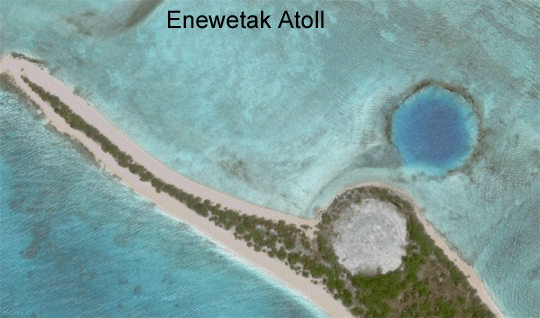
U.S. Rep. Tulsi Gabbard refutes the claim that Marshall Islands nuclear waste site is safe
|
Gabbard dismisses US claim that Marshall Islands nuclear waste site is safe https://www.westhawaiitoday.com/2020/07/28/nation-world-news/gabbard-dismisses-us-claim-that-marshall-islands-nuclear-waste-site-is-safe/
By Susanne Rust Los Angeles Times | Tuesday, July 28, 2020 One of Hawaii’s high-profile politicians has dismissed a recent Department of Energy report concluding that a leaking U.S. nuclear waste repository in the Marshall Islands is safe for people there.
She called for the department to convene a more independent assessment of the waste site. “I think it’s time the Department of Energy relied on someone with fresh eyes to examine the situation,” said U.S. Rep. Tulsi Gabbard, one of Hawaii’s two Democratic House members, in a recent interview with the Los Angeles Times. Gabbard, who gained national attention by launching what some called a quixotic campaign for the Democratic presidential nomination, has been outspoken in Congress on behalf of the Marshall Islands, which the United States used as a testing site for scores of nuclear weapons during the Cold War. She’s pushed to reinstate Medicaid eligibility to people from the Marshall Islands, Micronesia and Palau who are working and living in the United States but lack access to healthcare. She also was instrumental in requiring the Department of Energy to reexamine the safety of Runit Dome, a leaking nuclear waste repository in the Marshall Islands, as part of the 2019 National Defense Authorization Act. “The U.S. government is responsible for this storage site and must ensure the protection of the people and our environment from the toxic waste stored there,” Gabbard said in a news release announcing her amendment to the defense bill. In calling for “fresh eyes” on the waste site, Gabbard was referring to Terry Hamilton, who has been the Energy Department’s go-to contractor for nuclear issues in the Marshall Islands since 1990. Hamilton was a contributor to the Department of Energy report, which concluded that while sea level rise could increase storm surge and “lead to wave-induced over-wash of lower sections of the dome,” there is not enough definitive data to determine “how these events might impact on the environment.” Neither Hamilton nor his employer, the Lawrence Livermore National Laboratory, responded to a request for comment. But in an earlier email, Hamilton said the risk posed by the waste site is low “based on the argument that the total amount of fallout contamination contained in Runit Dome is dwarfed by residual amounts of fallout contamination deposited in marine sediments inside Enewetak lagoon.” He added that, though he did not write the document, he provided the “reports, publications and data” that informed the Energy Department’s conclusions. Published at the start of July, the assessment referenced 27 papers and reports, 25 of which were not peer-reviewed, including 13 by Hamilton. All were published by agencies within the U.S. government. The lack of independent review frustrated both Gabbard and some Marshallese leaders. “The Department of Energy is well aware of the public mistrust for their research in the Marshall Islands, but they have never demonstrated any interest in doing anything about it, i.e. including independent scientists in their studies or consulting with Marshallese communities for their knowledge on the environment,” Rhea Christian-Moss wrote in an email to The Times. “I’m not sure credibility is their goal,” she said. Runit Dome, located in the Marshall Island’s Enewetak Atoll, holds more than 3.1 million cubic feet — or 35 Olympic-sized swimming pools — of U.S.-produced radioactive soil and debris, including lethal amounts of plutonium, produced by 67 bomb tests between 1946 and 1958. Spurred by “moral obligation,” the U.S. government cleaned the atoll of irradiated debris and soil before handing the islands back to the Marshallese, in 1980. The Marshallese had been involuntarily removed during the 1940s. The waste — metal and concrete debris, as well as irradiated topsoil — were dumped in an atomic bomb crater on Runit Island, and capped with concrete. Last year, Hamilton told a small audience of Marshallese and American politicians and regulators that the dome was probably leaking, and that it was vulnerable to rising sea levels and increased storm surge. Congress, in its approval of last year’s defense bill, ordered the Energy Department to provide a written report on the risks that Runit Dome poses to the people, environment and wildlife of Enewetak lagoon. In addition, the report required an assessment of how climate change could affect the site. “I think they’d be reacting very differently if it was in their backyard,” she said of the report’s authors. Gabbard said she would continue to press the issue with the Energy Department “and try to get answers that were not addressed in this report.” Although outspoken on the Marshall Islands and the U.S. radiation legacy there, Gabbard has often been publicly alone on the issue. Other key Democrats, including Sens. Mazie Hirono of Hawaii and Jack Reed of Rhode Island, ranking member of the Armed Services Committee, declined to comment for this story. |
|
1 This Month
Chernobyl: The Lost Tapes – A good documentary on Chernobyl on SBS available On Demand for the next 3 weeks– https://www.sbs.com.au/ondemand/tv-program/chernobyl-the-lost-tapes/2352741955560

of the week–London Campaign for Nuclear Disarmament

Tell the Ukrainian Government to Drop Prosecution of Peace Activist Yurii Sheliazhenko
To see nuclear-related stories in greater depth and intensity – go to https://nuclearinformation.wordpress.com
-
Archives
- April 2026 (152)
- March 2026 (251)
- February 2026 (268)
- January 2026 (308)
- December 2025 (358)
- November 2025 (359)
- October 2025 (376)
- September 2025 (257)
- August 2025 (319)
- July 2025 (230)
- June 2025 (348)
- May 2025 (261)
-
Categories
- 1
- 1 NUCLEAR ISSUES
- business and costs
- climate change
- culture and arts
- ENERGY
- environment
- health
- history
- indigenous issues
- Legal
- marketing of nuclear
- media
- opposition to nuclear
- PERSONAL STORIES
- politics
- politics international
- Religion and ethics
- safety
- secrets,lies and civil liberties
- spinbuster
- technology
- Uranium
- wastes
- weapons and war
- Women
- 2 WORLD
- ACTION
- AFRICA
- Atrocities
- AUSTRALIA
- Christina's notes
- Christina's themes
- culture and arts
- Events
- Fuk 2022
- Fuk 2023
- Fukushima 2017
- Fukushima 2018
- fukushima 2019
- Fukushima 2020
- Fukushima 2021
- general
- global warming
- Humour (God we need it)
- Nuclear
- RARE EARTHS
- Reference
- resources – print
- Resources -audiovicual
- Weekly Newsletter
- World
- World Nuclear
- YouTube
-
RSS
Entries RSS
Comments RSS
 nuclear-news