Plowshare anti nuclear-weapons activists again face prison .
 Longtime Anti-Nuke Activists Face Prison, Again, After Breaking Into Naval Base https://www.npr.org/2020/12/28/948116757/longtime-anti-nuclear-activists-face-prison-again-after-breaking-into-naval-base
December 28, 20205: Heard on Morning Edition
EMMA PEASLEE. Dressed in black, the seven intruders cut through a fence and stole along the perimeter of the naval base, trying to avoid detection from the guard towers, as a loudspeaker overhead blared: “Deadly force is authorized!”
Patrick O’Neill, who had a GoPro strapped to his head, tried to reassure himself by remembering a scene in the Bible where Jesus escapes unscathed from a wrathful mob that wants to throw him off a cliff.
When O’Neill and the others reached their target, they poured their own blood on the shield of the Kings Bay naval base in Georgia and attached a poster of Martin Luther King Jr. to a mock-up of a Trident II D5 ballistic missile at the welcome area.
The anti-nuclear activists — Roman Catholics who call themselves Plowshares, from the Biblical passage about “beating swords into plowshares” — followed the metaphor quite literally and took a hammer to the replica of the warhead.
The break-in on the night of April 4, 2018, ended with the arrest and conviction on charges of trespassing and destruction of property for the seven activists aged 58 to 81.
And in the midst of a pandemic that’s wreaking havoc on prisons and disproportionately affecting older people, six of them have been sentenced to up to 33 months in prison. The seventh is scheduled to be sentenced in February.
The Plowshares activists were seeking to revive the anti-nuclear movement by committing acts of civil disobedience.
They are part of a larger faith-based movement that has been around since the 1980s, when anti-nuclear protests used to draw millions into the streets.
Those days are long gone, but the threat of nuclear warfare isn’t. According to some atomic scientists, the threat may be even greater now, and the activists are frustrated that in their view hardly anyone is paying attention.
Which is one reason why they have broken into military bases and sometimes succeeded in doing damage to actual nuclear armaments. In a highly publicized protest in 1980, Plowshares activists hammered two missile nose cones at a General Electric complex in King of Prussia, Pa., causing tens of thousands of dollars worth of damage. In 2012, another group that included an 82-year-old Catholic nun defaced a bunker holding weapons-grade uranium at the Y-12 National Security Complex in Oak Ridge, Tenn.
People are always astounded that a bunch of old people or unarmed people or whatever people can gain access to these weapons at all,” said O’Neill, 64.
Martha Hennessey, 65, had already been to prison three times before beginning her sentence at a federal prison in Danbury, Conn., on Dec. 14. She is the granddaughter of the journalist-turned-activist Dorothy Day, who founded the pacifist Catholic Worker Movement in the 1930s.
Rather than dwell on her own sentence, she drew attention to the mass incarceration of people who have committed minor offenses.
“I mean, there are people being thrown into prison for years for, you know, things that are not even crimes,” she said in an interview before reporting to prison.
Members of the Plowshares group prefer not to talk about the risks they might face in prison, but their families are worried.
“I’m afraid that my dad might die in prison,” said Maura O’Neill, 26, one of O’Neill’s eight children. “I worry that he might contract COVID and get really sick, and it feels like a real possibility.”
Brexit: UK and Euratom have signed a Nuclear Cooperation Agreement (NCA)
World Nuclear News 29th Dec 2020, The UK and the European Atomic Energy Community (Euratom) have signed a
Nuclear Cooperation Agreement (NCA). This is separate from the wider UK-EU Trade and Cooperation Agreement that was also announced on 24 December and which has since been approved by ambassadors from the 27 EU Member States, paving the way for it to take effect on 1 January. UK lawmakers will tomorrow return to the House of Commons, the lower chamber of parliament,
to vote on the so-called post-Brexit trade deal.
https://www.world-nuclear-news.org/Articles/UK-and-Euratom-sign-Nuclear-Cooperation-Agreement
Scotland wants no part in the Tories’ latest nuclear energy folly
|
Douglas Chapman: Scotland wants no part in the Tories’ latest nuclear energy folly https://leftfootforward.org/2020/12/douglas-chapman-scotland-wants-no-part-in-the-tories-latest-nuclear-energy-folly/ Douglas Chapman MP, 30 Dec 20,
As Scotland moves away from nuclear power, the UK Government is trying to impose this costly distraction, writes Douglas Chapman MP. The UK Government’s publication of their new Energy White Paper shows that they are still very much out of sync with Scotland.With nuclear power at the centre of Johnson’s great green revolution, Scotland and Westminster are once more at loggerheads. The UK Government argues that we must examine all renewable and low to zero carbon options as we turn from fossil fuels and face the climate crisis head on. But the White Paper reveals that the UK government are in discussions with French energy giant, EDF, to build a £20bn nuclear power plant at Sizewell in Suffolk. In addition, they plan to develop Small Modular Reactors (SMRs) or pop-up nuclear power plants built in factories rather than involving heavy construction, as well as research and development into more advanced nuclear technologies. This is a problem for Scotland given that energy is a reserved power and we have very different plans for our renewable development. The Scottish Government rejects the case for nuclear power to be included in the push to net zero, arguing that our future clean energy ambitions can be met by far safer, more affordable and more environmentally sound means. Scotland is in the fortunate position of having an abundance of natural resources with 25% of Europe’s tidal and wind resource for instance. We are aware of our responsibility to the natural environment as well as our citizens and our updated Climate Plan reflects these values of fairness, wellbeing and a just transition to a greener future. White elephant Right now, nuclear power is still included in our current energy mix and is sourced from two stations at Torness and Hunterston. The Scottish Government is moving towards decreasing this output and increasing solar, offshore and onshore wind sources, with our wind turbines having already produced nearly twice of our entire nations domestic power with some left over for export back in 2019. When wind and solar are by far the cheaper option as compared to nuclear, at £39.65/MWh to Hinkley’s £92.50, it’s a no brainer on cost. Overall, the nuclear industry is a slow and expensive business. Given we are facing a climate emergency of terrifying proportions, turning to nuclear energy and the development of new technologies like SMR’s will not be a quick fix. The vast sums pledged by Johnson to support EDF at Sizewell are even more controversial given that the government is examining a “regulated asset base” approach to funding, or in other words putting the financial risk on to the UK consumer. No to nuclear Results from the recent UK wide Citizens Assembly on Climate Change indicate that it’s not just the Scots who are concerned with nuclear power. Nearly half – 46% – of assembly members strongly disagreed that nuclear should be part of the renewable energy plan citing concerns with cost, safety, long-term waste management, and damage to the local environment. For Scotland, it’s more personal than that. We already carry the weight of responsibility as home to the UK’s domestic nuclear power base; a key tenant of SNP policy is ridding Scotland of the burden of Trident when we become independent, a hugely popular pledge with the Scottish electorate. And then there’s the not insignificant matter of toxic waste and the decommissioning debacle of existing nuclear reactors such as Dounreay in Thurso, which, according to the Nuclear Decommissioning Authority, will take another 313 years before its regarded as a “safe site”. In addition, in 2018, the nuclear reactors at Hunterston were shut down due to concerns over cracks in the graphite core. People living close by had every right to be worried. Big plans Now Johnson’s government is forcing through the Internal Market Bill and the blatant devolution power grab, Scotland will have even less say in how we manage our renewable resources, as devolved powers such as grant of consent and planning permission could be deliberately reserved in the name of Brexit. We may be a small nation, but we have big plans in fulfilling our obligation to the planet and our responsibility in this global climate challenge. New nuclear power stations are not and never will be part of these plans. The UK Government will have a fight on their hands if they try to derail our ambition. Douglas Chapman is the Scottish National Party MP for Dunfermline and West Fife. |
|
In so many ways, Sizewell C nuclear plan is a bad deal for Britain, and especially for climate action
 Why Sizewell C is a bad deal for the UK public and our net zero goals
https://bhesco.co.uk/blog/stop-sizewell-c-nuclear-power by Dan Curtis on 21/12/2020 It has been a tumultuous few weeks for the UK’s energy policy, with the Prime Minister’s Ten Point Plan for achieving Net Zero by 2050 followed swiftly by the Government’s long overdue Energy White Paper.
Then, the news broke that the UK Government has begun discussions with French utility EDF for the development of a new nuclear reactor at Sizewell, “C” in Suffolk, basically scrapping their 10 year policy that “there will be no levy, direct payment or market support for electricity supplied or capacity provided by a private sector new nuclear operator, unless similar support is also made available more widely to other types of generation”.
The site at Sizewell contains two existing nuclear power facilities, Sizewell A (decommissioning and site restoration until 2098 at taxpayers’ cost) and Sizewell B (still active). The new proposals are to build an extension to the site, implementing the same reactor design as that Hinkley Point “C” in Somerset.
Defenders of the project invariably claim that expanding the UK’s nuclear fleet will contribute to the decarbonisation of the energy supply, ensure energy security, while providing consumers with long-term affordable electricity – all arguments which fail to stand up to scrutiny, as we shall demonstrate.
Nuclear power does not provide good value for money
It takes a phenomenal amount of money to develop new nuclear power stations, before we even begin to consider the additional cost of storing and managing the radioactive waste material.
Hinkley C was originally estimated to cost £18 billion but the project has been mired in delays and is now vastly over-budget, predicted to cost up to £3 billion more than initially forecast – a quite remarkable overspend.
To address this vulnerability to financial losses for the project developers EDF and Chinese firm CGN, who are considering withdrawing their investment, the UK Government are considering investing directly in Sizewell C, shifting risk and cost to the British taxpayer.
This is in addition to a suggestion of implementing a “regulated asset base” financing model which would enable EDF to charge energy customers for the cost of construction as well as the cost of electricity generation (thereby exposing both customers and taxpayers to the risk of project cost overruns).
Adding to the financial nonsense of new nuclear power is the sky-high cost of the electricity that is produced to the end user. The government has granted a guaranteed, inflation linked price of £92.50 per megawatt hour for the electricity to be produced by Hinkley Point C.
Compare this to the cost of offshore wind, which under a 2019 contract for difference auction, saw prices come in at £39.65 per megawatt hour – less than half the cost of energy from Hinkley.
In contrast to the ever-increasing costs of nuclear (Sizewell C has an estimated starting price tag of £20 billion, which will no doubt balloon), the cost of solar and wind power continue to fall year on year, with solar costs having declined by an astonishing 87% since 2010.
A primary motivation for nuclear power is its value for military applications
The astronomical construction and decommissioning costs of nuclear power does not make financial sense when looking at it from a UK taxpayer/ consumer viewpoint. It is only when considering the wider potential applications of a nuclear programme that we can begin to understand why successive UK governments have been so supportive of the industry.
Researchers at the University of Sussex found compelling evidence that the UK’s domestic nuclear power programme is only supported by the Government because of its value in contributing towards the military nuclear weapons programme, which would otherwise be financially unviable without such subsidised support from domestic energy customers.
Prof Andrew Stirling of the university’s Science Policy Research Unit (SPRU) said:
”The exclusion of these issues from the consultation remit reflects a serious military-driven bias in UK Government attachments to nuclear power. This is not only making carbon emissions reductions slower and more expensive, but also impeding possibilities for the UK post-COVID economic recovery”.
We believe that the arguments in favour of nuclear power are disingenuous. Backers of nuclear power should be honest that they want to build more nuclear plants not because they will provide energy security or a good deal for customers, but because they are necessary for maintaining the UK’s fleet of nuclear submarines, and all of the sabre rattling ‘seat at the table’ geo-political bravado that goes along with retaining our position as a nuclear power.
New nuclear power takes too long to build to have any meaningful role in tackling the urgent climate crisis
Wherever new nuclear power stations are being built we see long delays and broken promises.
Hinkley Point C has suffered setbacks and complications ever since development began in 2017 and it is not expected to come online until 2025. It’s the same story at other locations where this type of reactor is being built, such as in Flamanville in France which is seven years overdue and the Olkiluoto plant in Finland which is ten years late! There is only one EPR nuclear reactor operational in the world. This is the Taishun plant in China, built on the same sea where Fukishima exploded in 2011.
Clearly, new nuclear power plants will not address the issue of urgent and radical carbon emissions reductions needed to be achieved by 2030 if we are to avoid irreversible climate breakdown.
It is also worth noting the gigantic carbon footprint that would result from the construction of Sizewell C. When considering the pros and cons of nuclear power, it is vital to honestly account for the enormous quantities of cement (which has a huge carbon footprint) and other hazardous materials required to build the facility in the first place.
Adding insult to the assertion that Sizewell C will be a long-term benefit to the environment is the fact that the site is to be located adjacent to an RSPB nature reserve Minsmere, a AONB site that EDF has already started demolishing.
Nuclear power produces nuclear waste which lasts for thousands of years
The by-product of nuclear fission is hazardous nuclear waste which remains radioactive for thousands of years. This presents an extraordinary liability and storage risk to future UK taxpayers and residents.
The current liability cost of decommissioning and safely storing our existing nuclear waste is estimated to be in the region of £232 billion – a truly eye-watering sum, and one that will only continue to increase as more nuclear reactors such as Hinkley and Sizewell contribute additional toxic waste materials for every year that they are operational.
The UK already has the largest stockpile of radioactive plutonium in the world, estimated to be between 112 and 140 tons, stored in an area of outstanding natural beauty in Cumbria. Future generations will not think kindly of us if we continue to add to this dangerous legacy with more hazardous nuclear waste that costs billions each year to manage to avert disaster.
The UK does not need Sizewell C or any other nuclear power stations – we can meet our energy needs with 100% clean renewable energy
We already have the means at our disposal to meet our heat and power needs through a combination of renewable energy and energy storage technologies.
Combine this with a comprehensive programme to reduce demand through energy efficiency improvements and we can conclude with confidence that there is no reason to develop new nuclear power stations in the UK. In fact, the alternatives will deliver lower energy prices for the consumer and better taxpayer value over the long term.
A common defence for nuclear power is the need for a steady supply of ‘base load’ power in the event that intermittant renewables cannot meet demand.
But this way of thinking is obsolete. Our future energy supply in the UK will be based on dynamism and flexibility, where consumers adapt their behaviour in sync with variable generation output. As Steve Holliday, former CEO of National Grid said in 2015:
“The idea of baseload power is already outdated. I think you should look at this the other way around. From a consumer’s point of view, baseload is what I am producing myself. The solar on my rooftop, my heat pump – that’s the baseload.”
The Government’s recent announcement that it is entering into talks with EDF regarding Sizewell C is, we are told, the beginning of a long consultation process which will consider the long-term costs and benefits of such a project before reaching a conclusion on whether to give it the go ahead.
These talks are by no means a ‘green-light’ to the project. We hope that it is not naïve to believe that due diligence will be done, that the information will be honest and transparent, and that logical, rational thinking for the benefit of all residents of our small island will prevail.
But this way of thinking is obsolete. Our future energy supply in the UK will be based on dynamism and flexibility, where consumers adapt their behaviour in sync with variable generation output. As Steve Holliday, former CEO of National Grid said in 2015:
“The idea of baseload power is already outdated. I think you should look at this the other way around. From a consumer’s point of view, baseload is what I am producing myself. The solar on my rooftop, my heat pump – that’s the baseload.”
The Government’s recent announcement that it is entering into talks with EDF regarding Sizewell C is, we are told, the beginning of a long consultation process which will consider the long-term costs and benefits of such a project before reaching a conclusion on whether to give it the go ahead.
These talks are by no means a ‘green-light’ to the project. We hope that it is not naïve to believe that due diligence will be done, that the information will be honest and transparent, and that logical, rational thinking for the benefit of all residents of our small island will prevail.’
Sources ……
South Korean government to cut nuclear power generation
Government to Cut Coal-fired and Nuclear Power Generation, Business Korea, By Jung Suk-yee, December 29, 2020The South Korean government finalized its ninth national power supply plan on Dec. 28. According to it, half of coal-fired power plants in South Korea will be shut down within 15 years for the purpose of carbon reduction, 11 old nuclear power plants will be shut down at the ends of their service lives without any service life extension, and LNG- and renewable energy-based power generation will be expanded to offset the resultant decrease in power supply. ……
Joe Biden reported to be considering cuts to America’s $1.2trillion nuclear modernization program
|
Joe Biden ‘is eyeing cuts to America’s $1.2trillion nuclear modernization program and could reverse Trump administration’s efforts to develop a new warhead’
Daily Mail, By CHRIS JEWERS FOR MAILONLINE 30 December 2020 President-elect Joe Biden is eyeing cuts to America’s $1.2 trillion nuclear modernization program and could reverse the Trump administration’s efforts to develop a new warhead, sources have said. According to CNN, two transition officials and an outside adviser to the incoming administration have said that Biden instead intends to place a greater emphasis on arms control. The incoming commander in chief plans to reassess the more than $1 trillion nuclear modernization program and determine whether it warrants the large expenditure, the three sources told the news organisation. According to the experts, the issue is partly due to finances, with the program taking up a large proportion of the Pentagon’s budget that could be allocated to evolving conventional and asymmetric weaponry. …….. The issue is particular pertinent as a Cold War-era nuclear agreement with Moscow expires just 16 days after Biden takes office on January 20. Many experts believe that the modernization program has grown bloated under President Donald Trump, CNN reports, and instead sustained increases in overall military spending are required in the coming decades………. According to the Congressional Budget Office, the Trump administration aimed to spend nearly $500 billion – accounting for inflation adjustments – on maintaining and replacing its nuclear arsenal over the coming decade……. While progress has been made in reducing Cold War nuclear arsenals, the world’s overall nuclear inventory remains at a very high level – although this number is also coming down gradually. Approximately 91 percent of all nuclear warheads belong to either Russia or the US, each of which has around 4,000 warheads in their stockpiles….. https://www.dailymail.co.uk/news/article-9096071/Joe-Biden-eyeing-cuts-Americas-1-2trillion-nuclear-modernization-program.html |
|
Increasing Pentagon Spending When People Are Going Hungry Is Madness, by John Nichols — Rise Up Times

“Upending the process by which ever increasing cash flows are directed into the military-industrial complex may not be popular with McConnell and the defense contractors he represents. But it most definitely is popular in a country where the overwhelming majority of Democratic voters and more than half of Republicans voters are ready to take money out of the Pentagon budget and move it into the fight against the coronavirus pandemic and the economic pain that extends from it.
Increasing Pentagon Spending When People Are Going Hungry Is Madness, by John Nichols — Rise Up Times
Do Americans really care about war crimes? by Jared Keller — Rise Up Times

“So do war crimes matter to the average American? In the short term, it appears that war crimes and their related pardons are simply new battlegrounds in the ever-expansive culture war between left and right, liberals and conservatives, that seems to have enveloped modern politics rather than becoming matters of human dignity in their own right. And that’s a damn shame.”
Do Americans really care about war crimes? by Jared Keller — Rise Up Times
The gigantic Chalk River Mound (the so-called ‘NSDF’) would not reduce Canada’s radioactive waste liabilities and could in fact increase them — Concerned Citizens of Renfrew County and Area
The NSDF “Licensed Inventory” (Table 13 in the NSDF Waste Acceptance Criteria), if followed by the proponent, would only allow disposal of a tiny fraction of the Government of Canada’s legacy nuclear waste. The NSDF would yield virtually no reduction in the federal nuclear legacy liability despite the expenditure of hundreds of millions of tax dollars. […]
The gigantic Chalk River Mound (the so-called ‘NSDF’) would not reduce Canada’s radioactive waste liabilities and could in fact increase them — Concerned Citizens of Renfrew County and Area
Tokyo Olympics Impossible — limitless life

Dear Friends, I am sending you my message addressed to President Bach of the IOC. Japan faces seriously aggravating Covif-19 crisis. Japanese civil society firmly believes the Tokyo Olympic Games is now totally out of the question. Japan needs to be liberated from the Olympic burden in order to consecrate maximum efforts to coping […]
Tokyo Olympics Impossible — limitless life
9 of the important nuclear stories of 2020

Christina Macpherson’s websites & blogs
In the news media, nuclear news has today gone very quiet.
Of course, it’s not only the “festive” season, but more importantly, the global tragedy of pandemic that is afflicting the lives of so many millions of people. In turn, the economic disruption is affecting society, and grinding down activities, including nuclear ones.
Today, even the advertorials promoting small nuclear reactors,, fusion, and the “need” for more nuclear weapons have gone quiet.
So, it seems a good opportunity to revisit some of the many significant stories of 2020. So, below this post, I’m listing just 9 of these.
The insanity of nuclear power in space
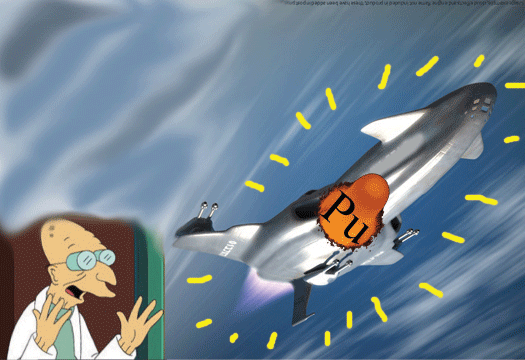
 The Big Push for Nukes in Space, https://www.counterpunch.org/2020/12/15/the-big-push-for-nukes-in-space/?fbclid=IwAR1rGf0qomJlTKuhqCOsTTl3EkKOQzxf2QxOJ-3n0MnxGWNLvybgxXPovTU BY KARL GROSSMAN.– 15 Dec 20, Last week a SpaceX rocket exploded in a fireball at the SpaceX site in Texas. “Fortunately,” reported Lester Holt on NBC TV’s Nightly News, “no one was aboard.”
But what if nuclear materials had been aboard?
The nuclear space issue is one I got into 35 years ago when I learned—from reading a U.S. Department of Energy newsletter—about two space shuttles, one the Challenger which was to be launched the following year with 24.2 pounds of plutonium aboard.
The plutonium the shuttles were to carry aloft in 1986 was to be used as fuel in radioisotope thermoelectric generators—RTGs—that were to provide a small amount of electric power for instruments on space probes to be released from the shuttles once the shuttles achieved orbit.
The plutonium-fueled RTGs had nothing to do with propulsion.
I used the U.S. Freedom of Information Act to ask what would be the consequences of an accident on launch, in the lower or upper atmosphere—and what about the dispersal of deadly plutonium. A few years earlier, I wrote Cover Up: What You Are Not Supposed to Know About Nuclear Power, so I was well familiar with plutonium, considered the most lethal radioactive substance.
For 10 months there was a stonewall of challenges to my FOIA request by DOE and NASA. Finally, I got the information, heavily redacted, with the claim that the likelihood of a shuttle accident releasing plutonium was “small.”
Said one document: “The risk would be small due to the high reliability inherent in the design of the Space Shuttle.” NASA put the odds of a catastrophic shuttle accident at one-in-100,000.
Then, on January 28, 1986 the Challenger blew up.
It was on its next mission—in May 1986—that it was slated to have a plutonium-fueled RTG aboard.
From a pay phone in an appliance store –amid scores of TV sets with that horrible video of the Challenger exploding—I called The Nation magazine and asked the folks there whether they knew that the next launch of the Challenger was to be a nuclear mission. They didn’t.
They had me write an editorial that appeared on The Nation’s front page titled “The Lethal Shuttle.” It began, “Far more than seven people could have died if the explosion that destroyed Challenger had occurred during the next launch…”
And I got deeper and deeper into the nukes-in-space issue—authoring two books, one The Wrong Stuff, presenting three TV documentaries, writing many hundreds of newspaper and magazine articles and speaking widely on the issue.
NASA, incidentally, later in 1986, drastically increased the odds of a catastrophic shuttle accident to one-in-76. It turned out the one-in-100,000 estimate was based on dubious guessing.
I found that accidents involving the use of nuclear power in space is not a sky-is-falling threat. In the then 26 U.S. space nuclear shots, there had been three accident, the worst in 1964 involving a satellite powered by a SNAP 9-A radioisotope thermoelectric generator fueled with plutonium.
The satellite failed to achieve orbit, broke up in the atmosphere as it came crashing back down to Earth, its plutonium dispersing as dust extensively on Earth. Dr. John Gofman, an M.D. and Ph.D., professor of medical physics at the University of California at Berkeley, formerly associate director of Lawrence Livermore National Laboratory, author of Poisoned Power and involved in early studies of plutonium, long pointed to the SNAP 9-A accident as causing an increase in lung cancer on Earth.
Today the use of nuclear in space is being pushed harder than ever.
“US Eyes Building Nuclear Power Plants for Moon and Mars,” declared the headline this July of an Associated Press dispatch. “US Eyes Building Nuclear Power Plants for Moon and Mars”.
As Linda Pentz Gunter, editor at Beyond Nuclear International, recently wrote here on CounterPunch, “Yet undeterred by immorality and expense, and apparently without the slightest concern for the radioactive dirt pile these reactors will produce, NASA and the Department of Energy are eagerly soliciting proposals.” https://www.counterpunch.org/2020/10/21/nukes-on-the-moon/
In July, too, the White House National Space Council issued a strategy for space exploration that includes “nuclear propulsion methods.” “US Ramps Up Planning for Space Nuclear Technology”
General Atomics Electromagnetic Systems has come out with a design for a nuclear propulsion reactor for trips to Mars.
Nuclear propulsion, its promoters are saying, would get astronauts to Mars quicker.
Shouted the headline in Popular Mechanics last month: “The Thermal Nuclear Engine That Could Get Us to Mars in Just 3 Months.”
And Elon Musk, founder and CEO of Space X, has been touting the detonation of nuclear bombs on Mars to, he says, “transform it into an Earth-like planet.” https://www.independent.co.uk/life-style/gadgets-and-tech/news/elon-musk-mars-nuke-humans-live-mirrors-spacex-a9072631.html
As Business Insider explains, Musk “has championed the idea of launching nuclear weapons just over Mars’ poles since 2015. He believes it will help warm the planet and make it more hospitable for human life.”
As space.com says: “The explosions would vaporize a fair chunk of Mars’ ice caps, liberating enough water vapor and carbon dioxide—both potent greenhouse gases—to warm up the planet substantially, the idea goes.” https://www.space.com/elon-musk-nuke-mars-terraforming.html
It’s been projected that it would take more than 10,000 nuclear bombs to carry out the Musk plan.
The nuclear bomb explosions would also would render Mars radioactive.
The nuclear bombs would be carried to Mars on the fleet of 1,000 Starships that Musk wants to build—like the one that blew up this week.
SpaceX is selling T-shirts emblazoned with the words “Nuke Mars.”
Beyond the this completely insane plan to ruin Mars, as on Earth, solar energy can provide all the power needed for would-be settlements on Mars and the Moon. Continue reading
How the marketing of American weapons determines U.S. foreign policy on China

Key Pentagon Official Turned China Policy Over to Arms Industry & Taiwan Supporters October 28, 2020, The triumph of corporate and foreign interests over one of the most consequential decisions regarding China is likely to bedevil U.S. foreign policy for  years to come, writes Gareth Porter. https://consortiumnews.com/2020/10/28/key-pentagon-official-turned-china-policy-over-to-arms-industry-taiwan-supporters/ By Gareth Porter
The Grayzone
When the United States finalized a set of seven arms sales packages to Taiwan in August, including 66 upgraded F-16 fighter planes and longer-range air-to-ground missiles that could hit sensitive targets on mainland China, it shifted U.S. policy sharply toward a much more aggressive stance on the geo-strategic island at the heart of military tensions between the United States and China.
Branded “Fortress Taiwan” by the Pentagon, the ambitious arms deal was engineered by Randall Schriver, a veteran pro-Taiwan activist and anti-China hardliner whose think tank had been financed by America’s biggest arms contractors and by the Taiwan government itself.
Since assuming the post of assistant secretary of defense for Asian and Pacific security affairs in early 2018, Schriver has focused primarily on granting his major arms company patrons the vaunted arms deals they had sought for years.
The arms sales Schriver has overseen represent the most dangerous U.S. escalation against China in years. The weapons systems will give Taiwan the capability to strike Chinese military and civilian targets far inland, thus emboldening those determined to push for independence from China.
Although no U.S. administration has committed to defending Taiwan since Washington normalized relations with China, the Pentagon is developing the weapons systems and military strategy it would need for a full-scale war. If a conflict breaks out, Taiwan is likely to be at its center.
Returning Favors
Schriver is a longtime advocate of massive, highly provocative arms sales to Taiwan who has advanced the demand that the territory be treated more like a sovereign, independent state. His lobbying has been propelled by financial support from major arms contractors and Taiwan through two institutional bases: a consulting business and a “think tank” that also led the charge for arms sales to U.S. allies in East Asia.
The first of these outfits was a consulting firm called Armitage International, which Schriver founded in 2005 with Richard Armitage, a senior Pentagon and State Department official in the Reagan and George W. Bush administrations.
Schriver had served as Armitage’s chief of staff in the State Department and then as deputy sssistant secretary of state for East Asian and Pacific affairs. (Armitage, a lifelong Republican, recently released a video endorsement of Joseph Biden for president).
As a partner in Armitage International, Schriver was paid consulting fees by two major arms contractors — Boeing and Raytheon — both of which hoped to obtain arms sales to Taiwan and other East Asian allies to compensate for declining profits from Pentagon contracts.
Schriver started a second national-security venture in 2008 as president and CEO of a new lobbying front called The Project 2049 Institute, where Armitage served as chairman of the board. The name of the new institution referred to the date by which some anti-China hawks believed China intended to achieve global domination.
From its inception, The Project 2049 Institute focused primarily on U.S. military cooperation with Northeast Asian allies — and Taiwan in particular — with an emphasis on selling them more and better U.S. arms.
Schriver, known as the Taiwan government’s main ally in Washington, became the key interlocutor for major U.S. arms makers looking to cash in potential markets in Taiwan. He was able to solicit financial support for the institute from Lockheed Martin, General Atomics, BAE and Raytheon, according to Project 2049’s internet site, which provides no figures on the amounts given by each prior to 2017.
Equally important, however, is The Project 2049 Institute’s heavy dependence on grants from the government of Taiwan. The most recent annual report of the institute shows that more than a third of its funding in 2017 came either directly from the Taiwan government or a quasi-official organization representing its national security institutions.
Project 2049 received a total of $280,000 from the Taiwan Ministry of Defense and Taiwan’s unofficial diplomatic office in Washington (TECRO) as well as $60,000 from the “Prospect Foundation,” whose officers are all former top national-security officials of Taiwan. In 2017, another $252,000 in support for Schriver’s institute came from the State Department, at a time when it was taking an especially aggressive public anti-China line.
By creating a non-profit “think tank,” Schriver and Armitage had found a way to skirt rules aimed at minimizing conflicts of interest in the executive branch.
The Executive Order 13770 issued by President Donald Trump in early 2017 that was supposed to tighten restrictions on conflicts of interest barred Schriver from participation for a period of two years “in any particular matter that is directly and substantially related to my former employer or former clients….”
However, the financial support for Project 2049 from Boeing, Lockheed-Martin, General Atomics, Northrop Grumman and Raytheon, and from Taiwanese official and quasi-official bodies were considered as outside that prohibition, because they were not technically “clients.”
Big Wins for Supporters
Brought into the Pentagon at the beginning 2018 to push China policy toward a more confrontational stance, Schriver spent 2018 and the first half of 2019 moving proposals for several major arms sales to Taiwan — including the new F-16s and the air-to-ground missiles capable of hitting sensitive targets in China — through inter-agency consultations.
He secured White House approval for the arms packages and Congress was informally notified in August 2019, however, Congress was not notified of the decision until August 2020. That was because Trump was engaged in serious trade negotiations with China and wanted to avoid unnecessary provocation to Beijing.
Lockheed Martin was the biggest corporate winner in the huge and expensive suite of arms sales to Taiwan. It reaped the largest single package of the series: a 10-year, $8 billion deal for which it was the “principal contractor” to provide 66 of its own F-16 fighters to Taiwan, along with the accompanying engines, radars and other electronic warfare equipment.
The seven major arms sales packages included big wins for other corporate supporters as well: Boeing’s AGM-84E Standoff Land Attack Missile (SLAM), which could be fired by the F-16s and hit sensitive military and even economic targets in China’s Nanjing region, and sea-surveillance drones from General Atomics.
In February 2020, shortly after Schriver left the Pentagon, the Taiwanese President Tsai Ing-wen received the lobbyist in her office in Taipei and publicly thanked him for having “facilitated the sale of F-16V fighter jets to Taiwan and attached great importance to the role and status of Taiwan in the Indo-Pacific region.” It was an extraordinary expression of a foreign government’s gratitude for a U.S. official’s service to its interests.
Having delivered the goods for the big military contractors and the Taiwan government, Schriver returned to The Project 2049 Institute, replacing Armitage as chairman of the board.
Neocon Vision
The arms sales to Taiwan represented a signal victory for those who still hoping to reverse the official U.S. acceptance the People’s Republic of China as the legitimate government of all of China.
Ever since the 1982 U.S.-China Joint Communique, in which the United States vowed that it had “no intention of interfering in China’s internal affairs or pursuing a policy of “two China’s” or “one China, one Taiwan,” anti-China hardliners who opposed that concession have insisted on making the 1979 Taiwan Relations Act, which called for the United States to sell Taiwan such arms “as may be necessary to enable Taiwan to maintain a sufficient self-defense capability” as keystone of U.S. Taiwan policy.
The neoconservative Project for a New American Century (PNAC) led by William Kristol and Robert Kagan wanted to go even further; it pushed for the United States to restore its early Cold War commitment to defend Taiwan from any Chinese military assault.
Thus a 1999 PNAC statement called on the United States to “declare unambiguously that it will come to Taiwan’s defense in the event of an attack or a blockade against Taiwan, including against the offshore islands of Matsu and Kinmen.”
After leaving the World Bank in 2008 amidst a scandal involving his girlfriend, Paul Wolfowitz – the author of that 1999 statement on East Asia – turned his attention to protecting Taiwan.
Despite the absence of any business interest he was known to have in Taiwan, Wolfowitz was chairman of the board of the U.S.-Taiwan Business Council from 2008 to 2018. The Project 2049 Institute was a key member of the council, along with all the major arms companies hoping to make sales to Taiwan.
During the first days of Wolfowitz’s chairmanship, the U.S.-China Business Council published a lengthy study warning of a deteriorating air power balance between China and Taiwan. The study was obviously written under the auspices of one or more of the major arms companies who were members, but it was attributed only to “the Council’s membership” and to “several outside experts” whom it did not name.
The study criticized both the George W. Bush and Obama administrations for refusing to provide the latest F-16 models to Taiwan, warning that U.S. forces would be forced to defend the island directly if the jets were not immediately supplied. It also called for providing Taiwan with land-attack cruise missiles capable of hitting some of the most sensitive military and civilian targets in the Nanjing province that lay opposite Taiwan.
The delicacy of the political-diplomatic situation regarding Taiwan’s status, and the reality of China’s ability to reunify the country if it chooses to do so has deterred every administration since George H.W. Bush sold 150 F-16 fighter jets to Taiwan. That was, until Shriver’s provocative “Fortress Taiwan” sale went through.
The triumph of corporate and foreign interests in determining one of the most consequential U.S. decisions regarding China is likely to bedevil U.S. policy for years to come. At a moment when the Pentagon is pushing a rearmament program based mainly on preparation for war with China, an influential former official backed by arms industry and Taiwanese money has helped set the stage for a potentially catastrophic confrontation.
Gareth Porter is an independent investigative journalist who has covered national security policy since 2005 and was the recipient of Gellhorn Prize for Journalism in 2012. His most recent book is The CIA Insider’s Guide to the Iran Crisis, co-authored with John Kiriakou, just published in February.
This article is from The Grayzone
Small Nuclear Reactors – the Big New Way – to get the public to fund the nuclear weapons industry
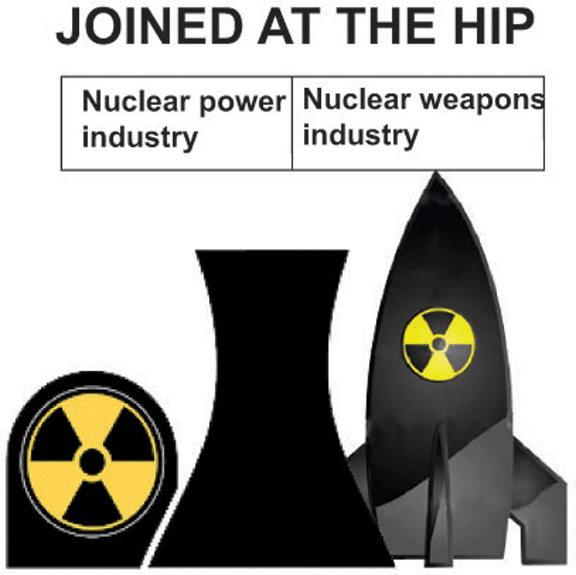
so-called “small nuclear reactors”
Downing Street told the Financial Times, which it faithfully reported, that it was “considering” £2 billion of taxpayers’ money to support “small nuclear reactors”
They are not small
The first thing to know about these beasts is that they are not small. 440MW? The plant at Wylfa (Anglesey, north Wales) was 460MW (it’s closed now). 440MW is bigger than all the Magnox type reactors except Wylfa and comparable to an Advanced Gas-cooled Reactor.
Only if military needs are driving this decision is it explicable.
”Clearly, the military need to maintain both reactor construction and operation skills and access to fissile materials will remain. I can well see the temptation for Defence Ministers to try to transfer this cost to civilian budgets,”
Any nation’s defence budget in this day and age cannot afford a new generation of nuclear weapons. So it needs to pass the costs onto the energy sector.
How the UK’s secret defence policy is driving energy policy – with the public kept in the dark. https://www.thefifthestate.com.au/energy-lead/how-the-uks-secret-defence-policy-is-driving-energy-policy-with-the-public-kept-in-the-dark/ BY DAVID THORPE / 13 OCTOBER 2020
The UK government has for 15 years persistently backed the need for new nuclear power. Given its many problems, most informed observers can’t understand why. The answer lies in its commitment to being a nuclear military force. Continue reading
Untrue: claims that the nuclear bombing of Hiroshima and Nagasaki ended World War 2
 Did the Atomic Bomb End the Pacific War?
The use of the atomic weapon must be seen as a continuation and a start: the nuclear continuation of the conventional terror bombing of Japanese civilians, and the start of a new “cold war.” Portside, August 2, 2020 Paul Ham
Many historians and most lay people still
believe the atomic destruction of Hiroshima and Nagasaki ended the Pacific War.
They claim with varying intensity that the Japanese regime surrendered unconditionally in response to the nuclear attack; that the bomb saved a million or more Amercian servicemen; that Hiroshima and Nagasaki were chosen chiefly for their value as military targets; and that the use of the weapon was, according to a post-war propaganda campaign aimed at soothing American consciences, ‘our least abhorrent choice’.
The trouble is, not one of these claims is true.
That such denial of the facts has been allowed to persist for 75 years, that so many people believe this ‘revisionist’ line – revisionist because it was concocted after the war as a post-facto justification for the bomb – demonstrates the power of a government-sponsored rewrite of history over the minds of academics, journalists, citizens and presidents.
The uranium bomb dropped on Hiroshima, code-named ‘Little Boy’, landed on the city center, exploding above the main hospital and wiping out dozens of schools, killing 75,000 people, including tens of thousands of school children.
‘Fat Man’, the plutonium bomb used on Nagasaki, incinerated the largest Catholic community in Japan, obliterating the country’s biggest cathedral along with a residential district packed with schools and hospitals. Its missed its original target, the city center.
Zealous apologists for the bomb will have started picking holes: Hiroshima held troops? Yes, a few enfeebled battalions. Hiroshima had military factories? Most were on the outskirts of town, well clear of the bomb. Continue reading
-
Archives
- February 2026 (228)
- January 2026 (308)
- December 2025 (358)
- November 2025 (359)
- October 2025 (376)
- September 2025 (258)
- August 2025 (319)
- July 2025 (230)
- June 2025 (348)
- May 2025 (261)
- April 2025 (305)
- March 2025 (319)
-
Categories
- 1
- 1 NUCLEAR ISSUES
- business and costs
- climate change
- culture and arts
- ENERGY
- environment
- health
- history
- indigenous issues
- Legal
- marketing of nuclear
- media
- opposition to nuclear
- PERSONAL STORIES
- politics
- politics international
- Religion and ethics
- safety
- secrets,lies and civil liberties
- spinbuster
- technology
- Uranium
- wastes
- weapons and war
- Women
- 2 WORLD
- ACTION
- AFRICA
- Atrocities
- AUSTRALIA
- Christina's notes
- Christina's themes
- culture and arts
- Events
- Fuk 2022
- Fuk 2023
- Fukushima 2017
- Fukushima 2018
- fukushima 2019
- Fukushima 2020
- Fukushima 2021
- general
- global warming
- Humour (God we need it)
- Nuclear
- RARE EARTHS
- Reference
- resources – print
- Resources -audiovicual
- Weekly Newsletter
- World
- World Nuclear
- YouTube
-
RSS
Entries RSS
Comments RSS
 nuclear-news