Pandemic, climate, nuclear weapons – lessons for survival in 2021
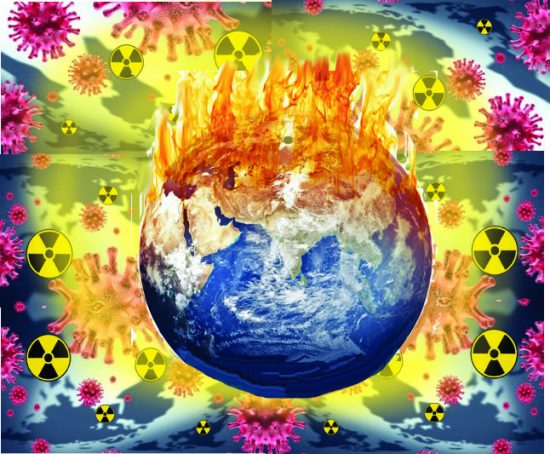
Lessons from pandemic-nuclear weapons nexus for survival in 2021 http://www.koreatimes.co.kr/www/opinon/2020/12/197_301593.html By Peter Hayes, 30 Dec 20,
As Earth hurtled around the Sun at over 100,000km per hour, humans were rudely reminded in 2020 by the COVID-19 pandemic that no-one is in charge ― or rather, nature is in charge.
Humanity faces many intertwined global problems in 2021. The short list includes climate change, habitat loss, biodiversity loss, biochemical pollution, overpopulation, demographic aging, food insecurity, water scarcity, disease and pandemics. These problems are both cause and effect of extreme poverty, inequality, forced migration, and social conflict that leads to war.
Hovering above all these inter-twined global problems is the truly existential threat of nuclear war. Nuclear war is the most immediate and direct extinction trap into which the species could fall.
Yet unlike other global problems, nuclear weapons are uniquely and 100 percent human-made. The RECNA Nuclear Warhead Data Monitoring Team at Nagasaki University estimates that as of June 2020, nine nuclear armed states maintain 13,410 nuclear warheads ― enough for about one ton of TNT-equivalent explosive power for every human alive today.
By the same token, the threat of nuclear war is one global problem that can be solved, relatively quickly, and ultimately, forever. Northeast Asia, where the pandemic likely increases the risk of nuclear war, is a case in point. COVID-19 may destabilize nuclear commands and ravage nuclear and conventional forces and, destabilize nuclear-prone conflicts at a time when tension should be reduced, not increased.
To reduce this risk, the Nagasaki 75th Anniversary Pandemic-Nuclear Nexus Scenarios project concluded that leaders in this region must, among many other urgent measures,
― Slow and reverse nuclear force developments and operations in the Northeast Asian region, including through nuclear-weapon-free zones and nonproliferation treaties
― Develop a secure, reliable nuclear hotline network for communicating in a nuclear crisis
― Launch public health security initiatives in the Northeast Asian region to respond to pandemics
― Engage younger generations in the nuclear disarmament movement and mobilize a broader base of potential stakeholders in nuclear issues
― Enlarge existing city networks such as Mayors for Peace and establish new city/regional cooperation networks to play a more direct role in reducing nuclear risk and pushing for nuclear disarmament
Rather than merely increasing the velocity of existing change and bringing underlying conflicts to the surface, the pandemic heralds an epochal, global, and systemic transformation that will lead to a new distribution of power capacities in geopolitical, geoeconomic, and geoecological dimensions.
In this permanent pandemic world, the effective governance of global problems in an era of permanent pandemics may rise bottom-up from “first responder” cities, provinces, corporations, and civil society organizations, driven by sheer necessity to create a global mosaic of networked responses and shared solutions.
This is a world that might adopt the Treaty on the Prohibition of Nuclear Weapons as the foundation of nuclear governance, not the old legal order that approves of the existence and even the use of nuclear weapons.
Cutting across this hopeful image is a darker portrayal of how humans may respond to multiple existential threats in an epoch defined by pandemics. In this 21st century feudalism, great powers are weakened relative to each other, and small and medium powers acquire symmetric and ultra-modern means of military power projection designed to maintain control and keep the other outside borders during protracted pandemics.
Thus, today’s Cold Peace struggling to manage COVID-19 may degenerate into a new Cold War with more states and even non-state actors armed with nuclear weapons.
Although humans can make nuclear weapons to destroy life on a massive scale, they can’t make even a simple life form, let alone a single ant or an ecosystem. Arguably, humanity’s best bet for survival is to reduce its global footprint, anticipate the impacts of global change, and adapt rapidly while nature restores itself.
That task begins with making all humans safe from pandemic infections because no human can be safe while other humans are infected. This is the equivalent of delivering one ton of TNT-equivalent of destructive power in the form of a vial of vaccine ― surely achievable even if revolutionary in principle. From this simple proposition flows a revolution in global governance in all affairs, without which humans will likely face a dire, dark, and bleak future.
As we enter 2021, therefore, states and people must ask themselves whether there are better ways to prepare for the uncertain futures created by the COVID-19 pandemic than to rely on primitive nuclear weapons, and which of these is most robust.
Peter Hayes is honorary professor at the Center for International Security Studies, Sydney University, Australia and director at the Nautilus Institute in Berkeley, California. He is also a research director of the Asia-Pacific Leadership for Nuclear Non-Proliferation and Disarmament (APLN). His article was published in cooperation with the APLN (www.apln.network).
No comments yet.
1 This Month


10 March A LIVE WEBINAR THE REAL EFFECTS OF NUCLEAR POWER
What the Industry Isn’t Telling Us
1:00 PM Mountain, 2 pm Central, 3 pm Eastern. Live on the Keepers of the Water Facebook page

18 March Webinar @ 1 PM EST: An Assessment of SMR Projects: The Case of Canada
register for the zoom:
https://us02web.zoom.us/webinar/register/WN_o8BIIOUvQ2ONJR1nta65DQ#/registration


of the week – STOP SMALL MODULAR REACTORS IN CANADA
To see nuclear-related stories in greater depth and intensity – go to https://nuclearinformation.wordpress.com
-
Archives
- March 2026 (62)
- February 2026 (268)
- January 2026 (308)
- December 2025 (358)
- November 2025 (359)
- October 2025 (376)
- September 2025 (258)
- August 2025 (319)
- July 2025 (230)
- June 2025 (348)
- May 2025 (261)
- April 2025 (305)
-
Categories
- 1
- 1 NUCLEAR ISSUES
- business and costs
- climate change
- culture and arts
- ENERGY
- environment
- health
- history
- indigenous issues
- Legal
- marketing of nuclear
- media
- opposition to nuclear
- PERSONAL STORIES
- politics
- politics international
- Religion and ethics
- safety
- secrets,lies and civil liberties
- spinbuster
- technology
- Uranium
- wastes
- weapons and war
- Women
- 2 WORLD
- ACTION
- AFRICA
- Atrocities
- AUSTRALIA
- Christina's notes
- Christina's themes
- culture and arts
- Events
- Fuk 2022
- Fuk 2023
- Fukushima 2017
- Fukushima 2018
- fukushima 2019
- Fukushima 2020
- Fukushima 2021
- general
- global warming
- Humour (God we need it)
- Nuclear
- RARE EARTHS
- Reference
- resources – print
- Resources -audiovicual
- Weekly Newsletter
- World
- World Nuclear
- YouTube
-
RSS
Entries RSS
Comments RSS
 nuclear-news
Leave a comment