Plowshare anti nuclear-weapons activists again face prison .
 Longtime Anti-Nuke Activists Face Prison, Again, After Breaking Into Naval Base https://www.npr.org/2020/12/28/948116757/longtime-anti-nuclear-activists-face-prison-again-after-breaking-into-naval-base
December 28, 20205: Heard on Morning Edition
EMMA PEASLEE. Dressed in black, the seven intruders cut through a fence and stole along the perimeter of the naval base, trying to avoid detection from the guard towers, as a loudspeaker overhead blared: “Deadly force is authorized!”
Patrick O’Neill, who had a GoPro strapped to his head, tried to reassure himself by remembering a scene in the Bible where Jesus escapes unscathed from a wrathful mob that wants to throw him off a cliff.
When O’Neill and the others reached their target, they poured their own blood on the shield of the Kings Bay naval base in Georgia and attached a poster of Martin Luther King Jr. to a mock-up of a Trident II D5 ballistic missile at the welcome area.
The anti-nuclear activists — Roman Catholics who call themselves Plowshares, from the Biblical passage about “beating swords into plowshares” — followed the metaphor quite literally and took a hammer to the replica of the warhead.
The break-in on the night of April 4, 2018, ended with the arrest and conviction on charges of trespassing and destruction of property for the seven activists aged 58 to 81.
And in the midst of a pandemic that’s wreaking havoc on prisons and disproportionately affecting older people, six of them have been sentenced to up to 33 months in prison. The seventh is scheduled to be sentenced in February.
The Plowshares activists were seeking to revive the anti-nuclear movement by committing acts of civil disobedience.
They are part of a larger faith-based movement that has been around since the 1980s, when anti-nuclear protests used to draw millions into the streets.
Those days are long gone, but the threat of nuclear warfare isn’t. According to some atomic scientists, the threat may be even greater now, and the activists are frustrated that in their view hardly anyone is paying attention.
Which is one reason why they have broken into military bases and sometimes succeeded in doing damage to actual nuclear armaments. In a highly publicized protest in 1980, Plowshares activists hammered two missile nose cones at a General Electric complex in King of Prussia, Pa., causing tens of thousands of dollars worth of damage. In 2012, another group that included an 82-year-old Catholic nun defaced a bunker holding weapons-grade uranium at the Y-12 National Security Complex in Oak Ridge, Tenn.
People are always astounded that a bunch of old people or unarmed people or whatever people can gain access to these weapons at all,” said O’Neill, 64.
Martha Hennessey, 65, had already been to prison three times before beginning her sentence at a federal prison in Danbury, Conn., on Dec. 14. She is the granddaughter of the journalist-turned-activist Dorothy Day, who founded the pacifist Catholic Worker Movement in the 1930s.
Rather than dwell on her own sentence, she drew attention to the mass incarceration of people who have committed minor offenses.
“I mean, there are people being thrown into prison for years for, you know, things that are not even crimes,” she said in an interview before reporting to prison.
Members of the Plowshares group prefer not to talk about the risks they might face in prison, but their families are worried.
“I’m afraid that my dad might die in prison,” said Maura O’Neill, 26, one of O’Neill’s eight children. “I worry that he might contract COVID and get really sick, and it feels like a real possibility.”
Brexit: UK and Euratom have signed a Nuclear Cooperation Agreement (NCA)
World Nuclear News 29th Dec 2020, The UK and the European Atomic Energy Community (Euratom) have signed a
Nuclear Cooperation Agreement (NCA). This is separate from the wider UK-EU Trade and Cooperation Agreement that was also announced on 24 December and which has since been approved by ambassadors from the 27 EU Member States, paving the way for it to take effect on 1 January. UK lawmakers will tomorrow return to the House of Commons, the lower chamber of parliament,
to vote on the so-called post-Brexit trade deal.
https://www.world-nuclear-news.org/Articles/UK-and-Euratom-sign-Nuclear-Cooperation-Agreement
Scotland wants no part in the Tories’ latest nuclear energy folly
|
Douglas Chapman: Scotland wants no part in the Tories’ latest nuclear energy folly https://leftfootforward.org/2020/12/douglas-chapman-scotland-wants-no-part-in-the-tories-latest-nuclear-energy-folly/ Douglas Chapman MP, 30 Dec 20,
As Scotland moves away from nuclear power, the UK Government is trying to impose this costly distraction, writes Douglas Chapman MP. The UK Government’s publication of their new Energy White Paper shows that they are still very much out of sync with Scotland.With nuclear power at the centre of Johnson’s great green revolution, Scotland and Westminster are once more at loggerheads. The UK Government argues that we must examine all renewable and low to zero carbon options as we turn from fossil fuels and face the climate crisis head on. But the White Paper reveals that the UK government are in discussions with French energy giant, EDF, to build a £20bn nuclear power plant at Sizewell in Suffolk. In addition, they plan to develop Small Modular Reactors (SMRs) or pop-up nuclear power plants built in factories rather than involving heavy construction, as well as research and development into more advanced nuclear technologies. This is a problem for Scotland given that energy is a reserved power and we have very different plans for our renewable development. The Scottish Government rejects the case for nuclear power to be included in the push to net zero, arguing that our future clean energy ambitions can be met by far safer, more affordable and more environmentally sound means. Scotland is in the fortunate position of having an abundance of natural resources with 25% of Europe’s tidal and wind resource for instance. We are aware of our responsibility to the natural environment as well as our citizens and our updated Climate Plan reflects these values of fairness, wellbeing and a just transition to a greener future. White elephant Right now, nuclear power is still included in our current energy mix and is sourced from two stations at Torness and Hunterston. The Scottish Government is moving towards decreasing this output and increasing solar, offshore and onshore wind sources, with our wind turbines having already produced nearly twice of our entire nations domestic power with some left over for export back in 2019. When wind and solar are by far the cheaper option as compared to nuclear, at £39.65/MWh to Hinkley’s £92.50, it’s a no brainer on cost. Overall, the nuclear industry is a slow and expensive business. Given we are facing a climate emergency of terrifying proportions, turning to nuclear energy and the development of new technologies like SMR’s will not be a quick fix. The vast sums pledged by Johnson to support EDF at Sizewell are even more controversial given that the government is examining a “regulated asset base” approach to funding, or in other words putting the financial risk on to the UK consumer. No to nuclear Results from the recent UK wide Citizens Assembly on Climate Change indicate that it’s not just the Scots who are concerned with nuclear power. Nearly half – 46% – of assembly members strongly disagreed that nuclear should be part of the renewable energy plan citing concerns with cost, safety, long-term waste management, and damage to the local environment. For Scotland, it’s more personal than that. We already carry the weight of responsibility as home to the UK’s domestic nuclear power base; a key tenant of SNP policy is ridding Scotland of the burden of Trident when we become independent, a hugely popular pledge with the Scottish electorate. And then there’s the not insignificant matter of toxic waste and the decommissioning debacle of existing nuclear reactors such as Dounreay in Thurso, which, according to the Nuclear Decommissioning Authority, will take another 313 years before its regarded as a “safe site”. In addition, in 2018, the nuclear reactors at Hunterston were shut down due to concerns over cracks in the graphite core. People living close by had every right to be worried. Big plans Now Johnson’s government is forcing through the Internal Market Bill and the blatant devolution power grab, Scotland will have even less say in how we manage our renewable resources, as devolved powers such as grant of consent and planning permission could be deliberately reserved in the name of Brexit. We may be a small nation, but we have big plans in fulfilling our obligation to the planet and our responsibility in this global climate challenge. New nuclear power stations are not and never will be part of these plans. The UK Government will have a fight on their hands if they try to derail our ambition. Douglas Chapman is the Scottish National Party MP for Dunfermline and West Fife. |
|
In so many ways, Sizewell C nuclear plan is a bad deal for Britain, and especially for climate action
 Why Sizewell C is a bad deal for the UK public and our net zero goals
https://bhesco.co.uk/blog/stop-sizewell-c-nuclear-power by Dan Curtis on 21/12/2020 It has been a tumultuous few weeks for the UK’s energy policy, with the Prime Minister’s Ten Point Plan for achieving Net Zero by 2050 followed swiftly by the Government’s long overdue Energy White Paper.
Then, the news broke that the UK Government has begun discussions with French utility EDF for the development of a new nuclear reactor at Sizewell, “C” in Suffolk, basically scrapping their 10 year policy that “there will be no levy, direct payment or market support for electricity supplied or capacity provided by a private sector new nuclear operator, unless similar support is also made available more widely to other types of generation”.
The site at Sizewell contains two existing nuclear power facilities, Sizewell A (decommissioning and site restoration until 2098 at taxpayers’ cost) and Sizewell B (still active). The new proposals are to build an extension to the site, implementing the same reactor design as that Hinkley Point “C” in Somerset.
Defenders of the project invariably claim that expanding the UK’s nuclear fleet will contribute to the decarbonisation of the energy supply, ensure energy security, while providing consumers with long-term affordable electricity – all arguments which fail to stand up to scrutiny, as we shall demonstrate.
Nuclear power does not provide good value for money
It takes a phenomenal amount of money to develop new nuclear power stations, before we even begin to consider the additional cost of storing and managing the radioactive waste material.
Hinkley C was originally estimated to cost £18 billion but the project has been mired in delays and is now vastly over-budget, predicted to cost up to £3 billion more than initially forecast – a quite remarkable overspend.
To address this vulnerability to financial losses for the project developers EDF and Chinese firm CGN, who are considering withdrawing their investment, the UK Government are considering investing directly in Sizewell C, shifting risk and cost to the British taxpayer.
This is in addition to a suggestion of implementing a “regulated asset base” financing model which would enable EDF to charge energy customers for the cost of construction as well as the cost of electricity generation (thereby exposing both customers and taxpayers to the risk of project cost overruns).
Adding to the financial nonsense of new nuclear power is the sky-high cost of the electricity that is produced to the end user. The government has granted a guaranteed, inflation linked price of £92.50 per megawatt hour for the electricity to be produced by Hinkley Point C.
Compare this to the cost of offshore wind, which under a 2019 contract for difference auction, saw prices come in at £39.65 per megawatt hour – less than half the cost of energy from Hinkley.
In contrast to the ever-increasing costs of nuclear (Sizewell C has an estimated starting price tag of £20 billion, which will no doubt balloon), the cost of solar and wind power continue to fall year on year, with solar costs having declined by an astonishing 87% since 2010.
A primary motivation for nuclear power is its value for military applications
The astronomical construction and decommissioning costs of nuclear power does not make financial sense when looking at it from a UK taxpayer/ consumer viewpoint. It is only when considering the wider potential applications of a nuclear programme that we can begin to understand why successive UK governments have been so supportive of the industry.
Researchers at the University of Sussex found compelling evidence that the UK’s domestic nuclear power programme is only supported by the Government because of its value in contributing towards the military nuclear weapons programme, which would otherwise be financially unviable without such subsidised support from domestic energy customers.
Prof Andrew Stirling of the university’s Science Policy Research Unit (SPRU) said:
”The exclusion of these issues from the consultation remit reflects a serious military-driven bias in UK Government attachments to nuclear power. This is not only making carbon emissions reductions slower and more expensive, but also impeding possibilities for the UK post-COVID economic recovery”.
We believe that the arguments in favour of nuclear power are disingenuous. Backers of nuclear power should be honest that they want to build more nuclear plants not because they will provide energy security or a good deal for customers, but because they are necessary for maintaining the UK’s fleet of nuclear submarines, and all of the sabre rattling ‘seat at the table’ geo-political bravado that goes along with retaining our position as a nuclear power.
New nuclear power takes too long to build to have any meaningful role in tackling the urgent climate crisis
Wherever new nuclear power stations are being built we see long delays and broken promises.
Hinkley Point C has suffered setbacks and complications ever since development began in 2017 and it is not expected to come online until 2025. It’s the same story at other locations where this type of reactor is being built, such as in Flamanville in France which is seven years overdue and the Olkiluoto plant in Finland which is ten years late! There is only one EPR nuclear reactor operational in the world. This is the Taishun plant in China, built on the same sea where Fukishima exploded in 2011.
Clearly, new nuclear power plants will not address the issue of urgent and radical carbon emissions reductions needed to be achieved by 2030 if we are to avoid irreversible climate breakdown.
It is also worth noting the gigantic carbon footprint that would result from the construction of Sizewell C. When considering the pros and cons of nuclear power, it is vital to honestly account for the enormous quantities of cement (which has a huge carbon footprint) and other hazardous materials required to build the facility in the first place.
Adding insult to the assertion that Sizewell C will be a long-term benefit to the environment is the fact that the site is to be located adjacent to an RSPB nature reserve Minsmere, a AONB site that EDF has already started demolishing.
Nuclear power produces nuclear waste which lasts for thousands of years
The by-product of nuclear fission is hazardous nuclear waste which remains radioactive for thousands of years. This presents an extraordinary liability and storage risk to future UK taxpayers and residents.
The current liability cost of decommissioning and safely storing our existing nuclear waste is estimated to be in the region of £232 billion – a truly eye-watering sum, and one that will only continue to increase as more nuclear reactors such as Hinkley and Sizewell contribute additional toxic waste materials for every year that they are operational.
The UK already has the largest stockpile of radioactive plutonium in the world, estimated to be between 112 and 140 tons, stored in an area of outstanding natural beauty in Cumbria. Future generations will not think kindly of us if we continue to add to this dangerous legacy with more hazardous nuclear waste that costs billions each year to manage to avert disaster.
The UK does not need Sizewell C or any other nuclear power stations – we can meet our energy needs with 100% clean renewable energy
We already have the means at our disposal to meet our heat and power needs through a combination of renewable energy and energy storage technologies.
Combine this with a comprehensive programme to reduce demand through energy efficiency improvements and we can conclude with confidence that there is no reason to develop new nuclear power stations in the UK. In fact, the alternatives will deliver lower energy prices for the consumer and better taxpayer value over the long term.
A common defence for nuclear power is the need for a steady supply of ‘base load’ power in the event that intermittant renewables cannot meet demand.
But this way of thinking is obsolete. Our future energy supply in the UK will be based on dynamism and flexibility, where consumers adapt their behaviour in sync with variable generation output. As Steve Holliday, former CEO of National Grid said in 2015:
“The idea of baseload power is already outdated. I think you should look at this the other way around. From a consumer’s point of view, baseload is what I am producing myself. The solar on my rooftop, my heat pump – that’s the baseload.”
The Government’s recent announcement that it is entering into talks with EDF regarding Sizewell C is, we are told, the beginning of a long consultation process which will consider the long-term costs and benefits of such a project before reaching a conclusion on whether to give it the go ahead.
These talks are by no means a ‘green-light’ to the project. We hope that it is not naïve to believe that due diligence will be done, that the information will be honest and transparent, and that logical, rational thinking for the benefit of all residents of our small island will prevail.
But this way of thinking is obsolete. Our future energy supply in the UK will be based on dynamism and flexibility, where consumers adapt their behaviour in sync with variable generation output. As Steve Holliday, former CEO of National Grid said in 2015:
“The idea of baseload power is already outdated. I think you should look at this the other way around. From a consumer’s point of view, baseload is what I am producing myself. The solar on my rooftop, my heat pump – that’s the baseload.”
The Government’s recent announcement that it is entering into talks with EDF regarding Sizewell C is, we are told, the beginning of a long consultation process which will consider the long-term costs and benefits of such a project before reaching a conclusion on whether to give it the go ahead.
These talks are by no means a ‘green-light’ to the project. We hope that it is not naïve to believe that due diligence will be done, that the information will be honest and transparent, and that logical, rational thinking for the benefit of all residents of our small island will prevail.’
Sources ……
South Korean government to cut nuclear power generation
Government to Cut Coal-fired and Nuclear Power Generation, Business Korea, By Jung Suk-yee, December 29, 2020The South Korean government finalized its ninth national power supply plan on Dec. 28. According to it, half of coal-fired power plants in South Korea will be shut down within 15 years for the purpose of carbon reduction, 11 old nuclear power plants will be shut down at the ends of their service lives without any service life extension, and LNG- and renewable energy-based power generation will be expanded to offset the resultant decrease in power supply. ……
Joe Biden reported to be considering cuts to America’s $1.2trillion nuclear modernization program
|
Joe Biden ‘is eyeing cuts to America’s $1.2trillion nuclear modernization program and could reverse Trump administration’s efforts to develop a new warhead’
Daily Mail, By CHRIS JEWERS FOR MAILONLINE 30 December 2020 President-elect Joe Biden is eyeing cuts to America’s $1.2 trillion nuclear modernization program and could reverse the Trump administration’s efforts to develop a new warhead, sources have said. According to CNN, two transition officials and an outside adviser to the incoming administration have said that Biden instead intends to place a greater emphasis on arms control. The incoming commander in chief plans to reassess the more than $1 trillion nuclear modernization program and determine whether it warrants the large expenditure, the three sources told the news organisation. According to the experts, the issue is partly due to finances, with the program taking up a large proportion of the Pentagon’s budget that could be allocated to evolving conventional and asymmetric weaponry. …….. The issue is particular pertinent as a Cold War-era nuclear agreement with Moscow expires just 16 days after Biden takes office on January 20. Many experts believe that the modernization program has grown bloated under President Donald Trump, CNN reports, and instead sustained increases in overall military spending are required in the coming decades………. According to the Congressional Budget Office, the Trump administration aimed to spend nearly $500 billion – accounting for inflation adjustments – on maintaining and replacing its nuclear arsenal over the coming decade……. While progress has been made in reducing Cold War nuclear arsenals, the world’s overall nuclear inventory remains at a very high level – although this number is also coming down gradually. Approximately 91 percent of all nuclear warheads belong to either Russia or the US, each of which has around 4,000 warheads in their stockpiles….. https://www.dailymail.co.uk/news/article-9096071/Joe-Biden-eyeing-cuts-Americas-1-2trillion-nuclear-modernization-program.html |
|
1 This Month
To see nuclear-related stories in greater depth and intensity – go to https://nuclearinformation.wordpress.com/
12 February – Webinar The Big Push: New Nuclear Projects in Canada
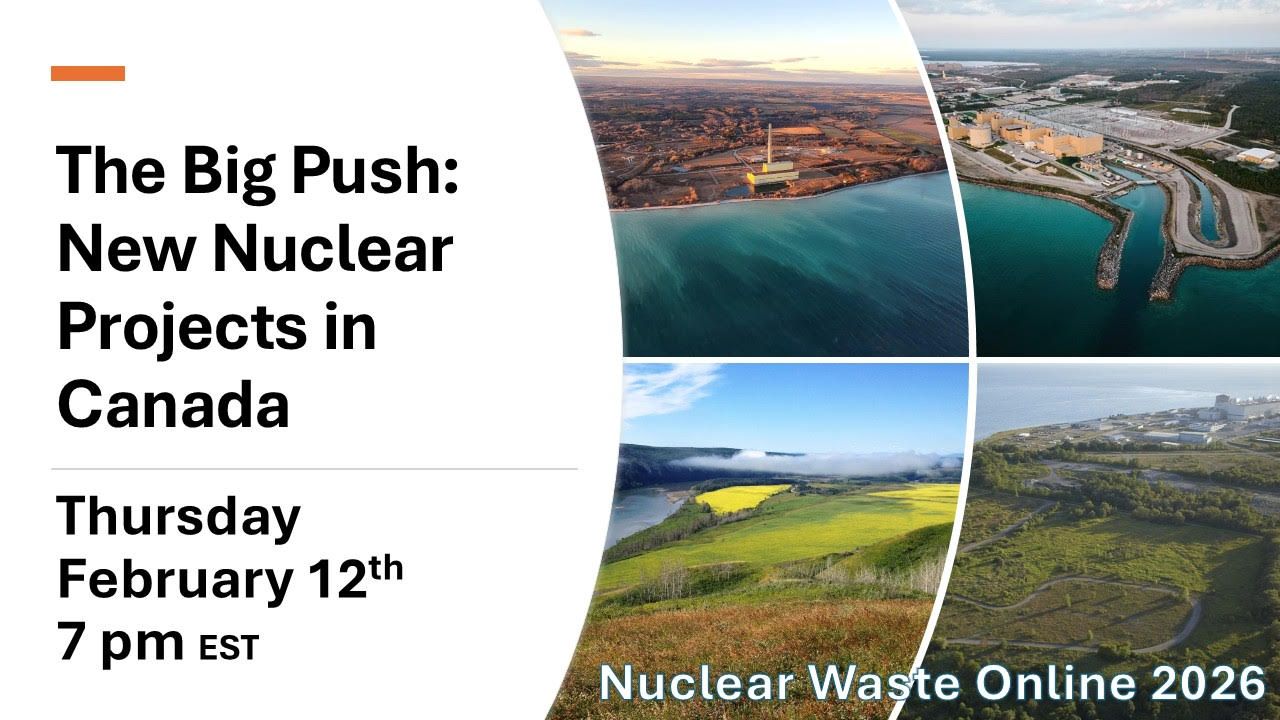
Thursday, February 12, 7 pm Eastern | 2nd of 4 sessions in the 2026 Nuclear Waste Online webinar series
Join a webinar on the push for new nuclear generation in Canada. Go to Northwatch.org to register or use the registration link https://us02web.zoom.us/webinar/register/WN_ZfWOf1GITqSRIZX8CB-A9w

-
Archives
- February 2026 (105)
- January 2026 (308)
- December 2025 (358)
- November 2025 (359)
- October 2025 (376)
- September 2025 (258)
- August 2025 (319)
- July 2025 (230)
- June 2025 (348)
- May 2025 (261)
- April 2025 (305)
- March 2025 (319)
-
Categories
- 1
- 1 NUCLEAR ISSUES
- business and costs
- climate change
- culture and arts
- ENERGY
- environment
- health
- history
- indigenous issues
- Legal
- marketing of nuclear
- media
- opposition to nuclear
- PERSONAL STORIES
- politics
- politics international
- Religion and ethics
- safety
- secrets,lies and civil liberties
- spinbuster
- technology
- Uranium
- wastes
- weapons and war
- Women
- 2 WORLD
- ACTION
- AFRICA
- Atrocities
- AUSTRALIA
- Christina's notes
- Christina's themes
- culture and arts
- Events
- Fuk 2022
- Fuk 2023
- Fukushima 2017
- Fukushima 2018
- fukushima 2019
- Fukushima 2020
- Fukushima 2021
- general
- global warming
- Humour (God we need it)
- Nuclear
- RARE EARTHS
- Reference
- resources – print
- Resources -audiovicual
- Weekly Newsletter
- World
- World Nuclear
- YouTube
-
RSS
Entries RSS
Comments RSS
 nuclear-news