Danger to San Onofre nuclear waste, from ocean’s king tides
 Annual High Tide Spurs Concerns About Future Safety of San Onofre Nuclear Waste Stock Near South OC, Voice of OC, By BRANDON PHO November 23, 2020, Annual High Tide Spurs Concerns About Future Safety of San Onofre Nuclear Waste Stock Near South OC, Voice of OC, By BRANDON PHO November 23, 2020, They’re called king tides:Ocean waves that grow especially tall a few times during the year, rumbling against the California coast and offering a glimpse into future sea level rise and a reshaping shoreline, according to state coastal regulators.
Those tides rolled up to San Onofre last weekend, where a sea wall stands to protect what nearby communities fear is a man-made disaster in waiting: the decommissioned but still radioactive San Onofre Nuclear Generating Station (SONGS). The following week, local officials and activists convened a set of dueling community forums that well capture the ongoing dispute over what exact risk the nuclear waste sitting at SONGS poses to all life within the area joining Orange and San Diego counties. The debate centers on the integrity of SONGS’ nuclear waste storage system, which has been criticized as prone to failure and an ecological and human health hazard. One Nov. 19 forum hosted by nuclear watchdogs saw some of their fears echoed back to them by Dr. Ian Fairlie, a radiation biologist in London who once headed the Secretariat of the UK Government’s CERRIE committee on internal radiation risks……. Members of the public laid out those concerns at an Aug. 20 panel meeting, and the comments can be read here. ……. environmentalists are looking at sea level rise’s impacts on coastlines well into 2100. Edison had previously argued studies into that time frame aren’t necessary……… There’s deep disagreement about what to do with the leftover nuclear waste, all 1,800 metric tons of which are in dry storage and embedded in concrete. The spent fuel contains radioactive isotopes like Cesium-137, the amount of which critics say is comparable to levels released during the Chernobyl disaster of 1986.……… The contention between watchdogs and Edison is the type of dry storage the company chose. Critics say the company has cheaped out through more cost-efficient, but less safe, thin-walled HOLTEC canisters, feared to be more prone to cracking and corrosion from conditions like the plant’s salty seaside locale. Instead, watchdogs have called for the use of thicker casks they say would better stave off the risk of failure and exposure. Fairlie at the Nov. 19 forum, hosted by the Samuel Lawrence Foundation and local nuclear safety groups, said the current canisters in use by Edison are “not very good – they are cheap … 5/8ths of an inch thick, prone to cracking.” They’re “designed to be temporary and they’re not really robust from external attack in my view,” he said, adding “it would be much, much, much better” for the spent fuel to be stored in a thicker cask — “Unlikely to be subject to cracks.” The only problem? “They’re very expensive.” ……… https://voiceofoc.org/2020/11/annual-high-tide-spurs-concerns-about-future-safety-of-san-onofre-nuclear-waste-stock-near-south-oc/ |
|
Depressing news for the nuclear lobby in Western Europe
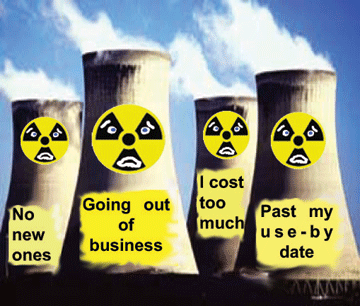 Western Europe cools on plans for nuclear power https://climatenewsnetwork.net/western-europe-cools-on-plans-for-nuclear-power/, November 25th, 2020, by Paul Brown As more reactors face closure, governments in Europe may prefer renewable energy to replace nuclear power.
LONDON, 25 November, 2020 – News that two more reactors in the United Kingdom are to shut down on safety grounds earlier than planned has capped a depressing month for nuclear power in Europe.
The news came after weeks of unfounded speculation, based on “leaks”, that the British government was about to take a stake in a giant new French-designed nuclear power station planned at Sizewell in Suffolk on the east coast of England as part of a “Green New Deal.” Taxpayers’ backing would have enabled the heavily-indebted French company EDF to finance the project.
In the event Boris Johnson, the prime minister, in his 10-point “green” plan for the UK, boosted a far more speculative alternative scheme from a Rolls-Royce consortium which was helping to pay for research and development into a full-blown proposal to construct 16 small modular reactors (SMRs).
He failed to mention the Sizewell scheme at all, and instead of singing the praises of nuclear power extolled the virtues of offshore wind power, in which the UK is currently the world leader.
Johnson hopes that offshore wind will produce enough electricity to power every home in Britain, leaving little room for a nuclear industry. He has referred to the UK as “becoming the Saudi Arabia of wind power.”
Meanwhile across the English Channel in Belgium the Electrabel company – the Belgian subsidiary of French utility Engie – has cancelled any further planned investment in its seven-strong nuclear reactor fleet because of the government’s intention to phase out nuclear power by 2025.
“The cause of this damage [at Hunterston] is not fully understood, and it is entirely possible that this form of age-related damage may be much more extensive”
Plans will only be re-instated if a Belgian government review fails to find enough alternative electricity supply to replace the reactors’ output. The seven Belgian reactors currently produce half the country’s electricity supply.
These reversals come seven years after British governments promised a nuclear renaissance by encouraging French, Japanese, American and finally Chinese companies to build ten nuclear power stations in the UK. Only one station has been begun, a £22 billion (US$29 bn) joint venture between EDF and Chinese backers.
The French, with a 70% stake and the Chinese with 30%, began work on the twin reactors, to be known as Hinkley Point C, in Somerset in the West of England more than two years ago. The station was due to be completed in 2025, but is behind schedule and has cost overruns.
The two partners wanted to replicate these reactors at the planned Suffolk plant, Sizewell C, but EDF has not found the necessary capital to finance it, hoping that the London government would either take a stake or impose a nuclear tax on British consumers to help pay for it.
The idea was for Hinkley Point C and Sizewell C to replace the 14 smaller reactors that EDF owns in Britain, thus keeping the nuclear industry’s 20% share of the UK’s electricity production. Johnson appears to have dashed these hopes. At best Hinkley Point C will produce 7% of the nation’s needs.
Meanwhile there is a question mark over the future of EDF’s remaining reactor fleet in Britain. Two of the 14, also at the Sizewell site, are French-designed pressurised water reactors opened in 1991, and have plenty of life left in them, but the other 12 are all older British-designed advanced gas-cooled reactors (AGRs) that use graphite blocks to control nuclear reactions.
Premature closure
A serious safety flaw has emerged in this design, involving hundreds of cracks in the graphite, causing doubts over whether the reactors could be turned off quickly in an emergency.
After a long stand-off with the UK’s nuclear safety watchdog, the Office for Nuclear Regulation, EDF decided earlier this year to prematurely close two of the worst affected reactors – both in a station known as Hunterston B in Scotland. Now, for the same reason, two further reactors at Hinkley Point B in Somerset will also close. All four reactors will be defuelled in 2022.
Currently six of these 12 AGR reactors are turned off – out of service for maintenance or safety checks. Two of them, at Dungeness B on the south-east coast of England, have been undergoing repairs since 2018 – this time because of corrosion of vital pipework – although cracks in the graphite blocks are also a safety issue here too.
While EDF remains upbeat about its prospects in developing nuclear power and is keeping its remaining ageing AGR reactors going until they can be replaced, it is hard to see where the company will get the money to build a new generation of reactors or attract government subsidies to do so.
The UK’s decision to back the British company Rolls-Royce to develop SMRs means it is unlikely the government has the money or the political inclination to back the French as well.
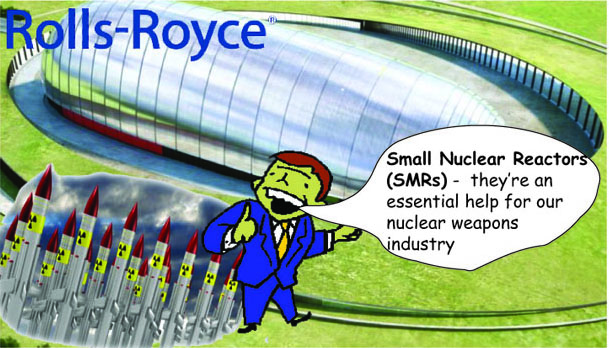 Rolls-Royce has been badly hit by the Covid-19 pandemic because a large part of its business relies on the struggling aviation business, while it needs support because it makes mini-reactors to power British nuclear submarines. The proposed SMR research programme will allow nuclear-trained personnel to switch between military and civilian programmes.
Long out of office
The Rolls-Royce SMRs are a long shot from the commercial point of view, since they  are unproven and likely to be wildly expensive compared with renewable energy. However, they have the political advantage of being British, and their development lies so far into the future that the current government will be out of office before anyone knows whether they actually work or are economic.
As far as the current crop of reactors is concerned, it is clear that at least those with graphite cores are nearing the end of their lives. Nuclear power has some way to go before it can expect a renaissance in the UK.
Paul Dorfman is a research fellow at University College London. He told the Climate News Network: “It is  apparent that the graphite cores of Hunterston B, Hinkley B, and possibly all UK AGR reactors have developed and continue to develop significant structural damage to graphite bricks, including keyway cracks in the fuelled section of the reactor.
“It is also clear that the cause of this damage is not fully understood, and it is entirely possible that this form of age-related damage may be much more extensive.
“Given that weight loss in graphite blocks and subsequent graphite cracking occurs in all UK AGRs, what’s happening with Hunterston B has significant implications for the entire UK AGR fleet.
Dr Dorfman concluded: “Given the parlous finances of EDF, who are already struggling with their own reactor up-grade bills in France, it is entirely likely that UK nuclear generation will be reduced to just Sizewell B, with electricity generation relying almost entirely on renewables by the time Hinkley C comes online, very late and over-cost as usual.” – Climate News Network
The effect on Europe of the UN Treaty on the Prohibition of Nuclear Weapons
 Nuclear prohibition: Changing Europe’s calculations https://www.europeanleadershipnetwork.org/commentary/nuclear-prohibition-changing-europes-calculations/ Beatrice Fihn |Executive Director of the International Campaign to Abolish Nuclear Weapons (ICAN),Daniel Högsta |Campaign Coordinator of the International Campaign to Abolish Nuclear Weapons (ICAN), 25 Nov 20,
On 22 January 2021, nuclear weapons will be placed in the same category as chemical and biological weapons – the other weapons of mass destruction – illegal under international law. On that date, the Treaty on the Prohibition of Nuclear Weapons (TPNW) will enter into force and will change the legal and normative landscape around nuclear weapons. This has significant implications for any European governments complicit in the practice of deployment and potential use of nuclear weapons of mass destruction.
A historic milestone for nuclear disarmament
Continue reading
Waste Isolation Pilot Plant – building of ventilation shaft is halted, due to Covid-19 and planning problems
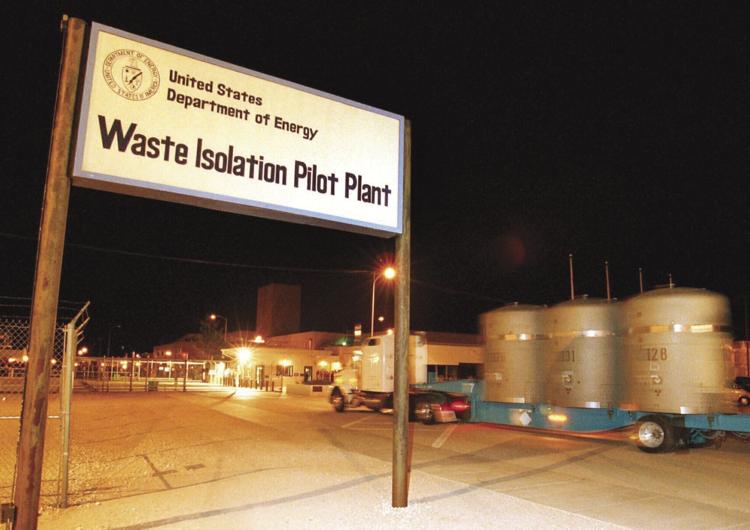 WIPP: New Mexico regulators halt utility shaft project, cite COVID-19, planning problems, Adrian Hedden, Carlsbad Current-Argus, 25 Nov 20, Construction of a $100 million utility shaft at the Waste Isolation Pilot Plant could be halted after the New Mexico Environment Department denied a request to extend state authorization to build the shaft, citing missed deadlines in the planning of the project and the continued spread in COVID-19 cases at the facility.
The shaft, part of an almost $300 million rebuild of WIPP’s ventilation system, along with a series of fans and filter buildings known as the Safety Significant Confinement Ventilation System (SSCVS), was intended to improve airflow in the WIPP underground and allow for waste emplacement and mining to occur simultaneously along with future expansions of the nuclear waste repository……….
Spike in COVID-19 at WIPP could put workers in danger
NMED also cited a recent rise in COVID-19 cases at WIPP, as the pandemic continued to spread in record-breaking numbers across New Mexico, and the agency’s responsibility to ensure human health is not put at risk by activities under the TA, requesting a plan for COVID-19 mitigation at the facility. https://www.currentargus.com/story/news/local/2020/11/24/wipp-utility-shaft-halted-new-mexico-cites-covid-planning-problems/6397790002/
Germany hosts France, Britain for talks on Iran nuclear deal
Germany hosts France, Britain for talks on Iran nuclear deal, DW, 25 Nov 20,
German Foreign Minister Heiko Mass met his counterparts Dominic Raab and Jean-Yves Le Drian in Berlin for talks on the Iran nuclear deal. The trio hopes for a change in US policy once Joe Biden is sworn in.
German Foreign Minister Heiko Maas held talks with his French and British counterparts in Berlin on Monday, with the partners urging Iran to stop breaching a nuclear deal it signed in 2015.
“From our view, Iran is systematically violating the agreement,” a spokeswoman with the German Foreign Ministry said. “Together with our European partners, we urge Iran to stop these violations and return to fulfilling all its nuclear obligations.”
Maas met with Britain’s Dominic Raab and France’s top diplomat Jean-Yves le Drian ahead of an expected change of policy towards Iran when US President-elect Joe Biden is sworn in as president in January.
Maas’s spokeswoman said she “confident” that a “constructive” US approach would help rein in the Iranian government, German news agency DPA reported.
The agreement, which world powers reached with Iran, sought to limit Tehran’s nuclear program to prevent it from developing nuclear weapons in return for the easing of economic sanctions…….
Changing US policy
Biden, who takes office on January 20, has said he would re-join the accord if Tehran first resumed strict compliance.
He wants to work with allies “to strengthen and extend it, while more effectively pushing back against Iran’s other destabilizing activities.”…..https://www.dw.com/en/germany-hosts-france-britain-for-talks-on-iran-nuclear-deal/a-55699826
Living with the Nuclear Prohibition Treaty: nuclear weapons states swould be unwise to attack it
 Living With the Nuclear Prohibition Treaty: First, Do No Harm, Carnegie Endowment for International Peace, GEORGE PERKOVICH 25 Nov 20 Now that fifty countries have ratified the UN Treaty on the Prohibition of Nuclear Weapons (TPNW), it will enter into force in January 2021…….
NATIONS WITHOUT NUCLEAR WEAPONS HAVE REASON TO SUPPORT THE TREATY
Supporters of the prohibition treaty are not crazy. They have good reasons. The 122 countries that adopted the treaty in 2017 were already legally committed not to acquire nuclear weapons, as they had signed the fifty-year-old Nuclear Non-Proliferation Treaty.
None of them face threats of aggression from the United States, Russia, China, or other countries that nuclear weapons would plausibly deter. Yet, all could suffer great harm from someone else’s nuclear war—especially one involving the still excessively destructive U.S. and Russian arsenals…….
TPNW supporters represent more than half of the world’s population and are understandably frustrated that the nuclear weapon states have not fulfilled their legal obligations and political commitments to pursue nuclear disarmament. …
COUNTRIES WITH NUCLEAR WEAPONS WON’T SIGN UP
A cynical answer is that the TPNW will do little good. The nine governments that wield nuclear weapons will not sign it. Nor have any security allies of nuclear-armed states, including all members of NATO, Japan, and South Korea, for example. In other words, the treaty will not change any country’s reliance on or possession of nuclear weapons.
While that is true, both supporters and critics of the treaty have reason to heed Hippocrates’s injunction to “first do no harm.” The importance of this injunction is especially great in NATO Europe and the United States.
In several NATO states, significant numbers of citizens and civil society organizations and their political representatives strongly support the TPNW. This includes the Netherlands and Germany, which are among the five states that host U.S. nuclear bombs as part of NATO’s nuclear-sharing arrangement…………
CRITICIZING THE TPNW IS THE WRONG APPROACH
Here, the United States, the United Kingdom and France—as nuclear weapon states—have vital roles to play. If they do not openly respect the concerns that motivate support for the TPNW, and instead direct critical ire at those who do, they will harden rather than weaken the resolve of TPNW supporters. The United States and France are particularly guilty of this.
A much wiser course, building on opportunities that a new administration in Washington may offer, would be to reinvigorate efforts to stop the incipient qualitative and quantitative arms race between Russia and the United States and NATO. …… https://carnegieendowment.org/2020/11/10/living-with-nuclear-prohibition-treaty-first-do-no-harm-pub-83198
NRC approves financially dodgy sale of Indian Point Nuclear Station to Holtec
 Sale of NYC-Area Nuclear Power Plant Gets Federal Approval, https://www.nbcnewyork.com/news/local/sale-of-nyc-area-nuclear-power-plant-gets-federal-approval/2742312/, 23 Nov 20, After the plant shuts down in the spring, the current operator plans to transfer its license to another company to dismantle the reactors and clean up the site along the Hudson River by 2033.
The Nuclear Regulatory Commission has approved sale of the Indian Point nuclear power plant to a dismantling company without granting requests by lawmakers and environmental groups for public hearings.
The NRC announced Monday that it has signed off on its staff’s recommendation last week to approve Entergy Corp.’s sale of the plant north of New York City to New Jersey-based Holtec International. After the plant shuts down in the spring, Entergy plans to transfer its license to Holtec to dismantle the reactors and clean up the site along the Hudson River by 2033.
The NRC agreed to rescind or modify the transfer after it decides whether to grant New York state and the environmental group Riverkeeper’s requests for hearings about their concerns regarding the sale. New York Attorney General Letitia James has called the Holtec deal “very risky,” questioning Holtec’s financing and experience.
During a Zoom conference Friday organized by the Hudson River Sloop Clearwater environmental group, Assistant New York Attorney General Joshua Tallent said he would like to see money for spent radioactive fuel management set aside in a supplemental fund until the decommissioning is done to reduce the chance that taxpayers are stuck with the tab for cost overruns.
European Commission approves Romania’s purchase of nuclear reactors
 EU blesses Romania’s $8bn US nuclear deal https://www.globalconstructionreview.com/news/eu-blesses-romanias-8bn-us-nuclear-deal/ 25 November 2020 | By GCR Staff EU blesses Romania’s $8bn US nuclear deal https://www.globalconstructionreview.com/news/eu-blesses-romanias-8bn-us-nuclear-deal/ 25 November 2020 | By GCR Staff
The European Commission has approved an agreement between the governments of the US and Romania to add two reactors to the Cernavoda nuclear power plant, ending longstanding plans to enlist Chinese aid in the project.Ludovic Orban, the prime minister of Romania, announced the endorsement on Friday. “We are delighted that we received this agreement from the Directorate of Energy, which will allow us to sign the agreement in the final form,” he said. Romania and the US signed an intergovernmental agreement in October for an $8bn programme of works to refurbish reactor 1 and build reactors 3 and 4 at the Black Sea plant (see further reading). The two also agreed a memorandum of understanding whereby America’s Export-Import Bank would provide $7bn of loans for the development of nuclear and related projects. In 2013 Romania and China signed two agreements that assigned China General Nuclear (CGN) a leading role in building and financing the reactors. This was followed by a deal in May 2019 between Romania’s state nuclear company Nuclearelectrica and CGN to build two 700MW reactors. Romania changed course at the start of this year as the Trump administration intensified its criticisms of China. The project will be coordinated by Aecom and will involve a consortium of companies from the US, Romania, Canada, and France to install two Canadian Candu 6 reactors. Romania and France have signed a declaration of intent on civil nuclear cooperation, and Orano, a state-owned French engineer, has also agreed to work with Nuclearelectrica on the project. |
|
Security concerns delay Czech nuclear expansion
Czech nuclear expansion faces delay amid concerns of opposition, secret services, EURACTIV.com with Reuters 25 Nov 20, A tender to decide who builds a new unit at a Czech nuclear power plant may face delays after security services and opposition parties raised concerns about the possible participation of bidders from China and Russia, officials said.
According to a document seen by Reuters, a working group of intelligence and foreign policy officials under the Interior Ministry wants conditions imposed to ensure bidders from countries that pose a security risk are disqualified.
The main Czech power utility ČEZ, which is 70% state-owned, has been planning to launch a tender before the end of the year for a 1,200 MW unit at its Dukovany power plant and to pick a winner in 2022.
The project is worth at least $7.24 billion at current prices, making it the country’s biggest investment deal so far, and includes a state commitment to buy power from the plant at profitable terms for ČEZ.
President Milos Zeman has sought closer ties with China and Russia. He has favoured their participation, and the government
But Prime Minister Andrej Babiš said on Monday the tender was not yet ready, and suggested it should not be decided just 10 months before an election……… https://www.euractiv.com/section/energy/news/czech-nuclear-expansion-faces-delay-amid-concerns-of-opposition-secret-services/
Former CEO of failed V.C. Summer nuclear project pleads guilty to fraud charges
 Former SCANA CEO pleads guilty to fraud charges for failed nuclear power project, https://abcnews4.com/news/local/former-scana-ceo-pleads-guilty-to-fraud-charges-for-failed-nuclear-power-project by Tony Fortier-Bensen, Wednesday, November 25th 2020 COLUMBIA, SC (WCIV)
The former chief executive officer of SCANA pleaded guilty on Tuesday to fraud charges for the failed V.C. Summer project in Fairfield County.
Kevin Marsh pleaded guilty to one count of conspiracy and one count of obtaining false property by false pretenses, according to a plea agreement.
The agreement also said that Marsh would serve 18 to 36 months and has agreed to pay $5 million in restitution.
In June, retired SCANA chief operating officer Steve Byrne entered a guilty plea for his actions in relation to the failed nuclear power plant.
The U.S Attorney’s office alleges Byrne and Marsh conspired with other SCANA executives to deceive state and federal government overseers, stock holders and power customers in order to keep funding coming in to build two nuclear reactors at the V.C. Summer Nuclear Station.
The expansion project cost Santee-Cooper and the defunct South Carolina Electric & Gas over $9 billion before the two entities abandoned the project in July 2017.
In addition, Marsh agreed to waive indictment and arraignment and work with authorities to provide further information on the failed project.
Under the plea agreement, Marsh could be sentenced to serve 18 to 36 months in prison. Marsh has also agreed to pay $5 million in restitution.
Cybersecurity breach at Kudankulam Nuclear Power Plant (KKNPP) undetected for over 6 months

 Breach at Kudankulam nuclear plant may have gone undetected for over six months: By Nirmal John, , ET Nov 25, 2020
The cybersecurity breach at the Kudankulam Nuclear Power Plant (KKNPP) may have remained undetected for more than six months, reveals a report from Singapore-based cybersecurity firm Group-IB.
Experts from Group-IB, who discovered and analysed an archive containing dtrack, a remote-administration tool attributed to North Korean group Lazarus, says that analysis “revealed that the logs contained data from a compromised machine running Windows that belonged to an employee of the Nuclear P ..
Ontario could get clean renewable energy from neighbouring provinces, with no need for nuclear power
 With nuclear power plants approaching end of life, what’s next in Ontario? Barrie Today, Peter Bursztyn 25 Nov 20, ‘Two decades is just enough time for major new electricity generation projects to go through the planning and permitting process, get built, and come on line,’ says reader With nuclear power plants approaching end of life, what’s next in Ontario? Barrie Today, Peter Bursztyn 25 Nov 20, ‘Two decades is just enough time for major new electricity generation projects to go through the planning and permitting process, get built, and come on line,’ says reader
……. When Hydro Quebec’s grand James Bay hydroelectricity project was built, many of the dams were constructed with space to accept more turbine units than are now installed.
In other words, these dams spill a great deal of water which could instead flow through a turbine to generate power. Taken as a whole, James Bay is one of the world’s largest power generation projects. Its capacity is 15,527 megawatts, the equivalent of 16 nuclear power plants. In 1971, when the project began, the Canadian government tried to persuade Quebec to choose nuclear power instead. With hindsight, Quebec was wise to choose hydroelectricity. Ontario, which did not have similar hydroelectric resources, built Unfortunately, we found nuclear to be a costly method of producing electricity; expensive enough that much of the debt incurred to build Ontario’s nuclear “fleet” still remains on the province’s books a half-century on. We never managed to pay it off……. our fleet of nuclear power plants is coming to the end of its design life. Over the coming two decades, most of our nuclear fleet will begin to wink out. We know that we cannot replace them with new nuclear units; they are simply too costly. The last Liberal government called for tenders to build nuclear plants, but insisted the bidders had to be responsible for cost over-runs. As a result, two of the three potential builders dropped out. The third offered to build, but refused to accept responsibility for cost escalation. The nuclear plan was quietly dropped……….. Ontario cannot generate enough renewable, carbon-free electricity to replace our current nuclear output within our own borders. (It is worth saying that nuclear power is not renewable.) Fortunately, our neighbouring provinces — Manitoba and Quebec — have the potential to generate considerably more than they currently use. Many of Quebec’s already completed dams have space in their turbine halls for more units. Quebec could “drop in” about 13,000 MW of generation. This is roughly equal to Ontario’s nuclear capacity, and not all of our nuclear units are running at any one time. Quebec has also surveyed other potential hydroelectric sites, both to the south and to the north of the James Bay project. More hydroelectric power could be exploited in northeast Quebec. Our western neighbour, Manitoba, has a number of sites with hydroelectric generation potential on the Nelson River near major existing power stations. There is also untapped potential hydroelectric power available to the southeast of Lake Winnipeg, even closer to Ontario. ………. Although the wind doesn’t blow continuously, expanding wind generation would reduce the amount of electricity Alberta needs to purchase from B.C. Since hydro power can be ramped up very rapidly, it would also reduce or even eliminate the need for gas-fired generation to meet demand peaks. Of course, the same applies to Ontario. We are a country blessed with a great deal of hydroelectric potential. Inexpensive, carbon-free electricity generation is within our grasp. All it needs is vision and leadership. https://www.barrietoday.com/letters-to-the-editor/letter-with-nuclear-power-plants-approaching-end-of-life-whats-next-in-ontario-2902273 |
|
Orano, formerly Areva, targeted by judicial investigation for corruption.

Orano, formerly Areva, targeted by judicial investigation for corruption. 25 Nov 20, A new case shakes the French nuclear group Orano, formerly known as Areva. An
investigation was opened by the Paris prosecutor’s office for facts “of
corruption of a foreign public official”, implicating in particular one of
the providers of Orano, the company Eurotradia International. “We had not
noticed anything abnormal and we are now at the disposal of justice,” said
the spokesperson for Orano, who claims to have terminated his contracts
with Eurotradia.
Concern in France over lack of expert inspection of nuclear sites
Montel News 24th Nov 2020, The lack of inspections at nuclear sites by safety experts, due to the
coronavirus pandemic, raises fears for the safety of the facilities, union
officials in the energy sector told Montel.
The Nuclear Safety Authority
(ASN) canceled all its physical inspections of nuclear power plants, except
the inspections considered essential, during the first containment in the
spring. Since then, some inspections have resumed in the field but many are
still carried out remotely.
This reduction in on-site checks is
exacerbating a situation where the workforce is already limited and
communication with workers is lacking, say some union officials.
Precious Suffolk Coast bird habitat to be destroyed by Sizewell C nuclear ptoject
 Bird Guides 22nd Nov 2020, Despite the UK Government this week announcing “greater protections for England’s iconic landscapes”, concerns are increasing over plans for a new twin nuclear reactor at Sizewell, on the Suffolk coast, with The Wildlife Trusts expressing deep worry. The Sizewell C project would cut through the Suffolk Coast and Heaths Area of Outstanding Natural Beauty and its associated important wildlife designations.
ahead. Christine Luxton, Chief Executive of Suffolk Wildlife Trust, commented: “Sizewell C would destroy a vast swathe of the Suffolk coastline in one of the most beautiful natural parts of the UK.
https://www.birdguides.com/news/the-wildlife-trusts-raise-concerns-over-sizewell-c/
1 This Month
23 April – WEBINAR – Why new nuclear reactors are the wrong tools for decarbonization Thursday, April 23 • 1 AM – 2 AM AEST


Pine Ridge Uranium is the real threat, not Tehran- Tell Burgum: Stop the Extraction.
Chernobyl: The Lost Tapes – A good documentary on Chernobyl on SBS available On Demand for the next 3 weeks– https://www.sbs.com.au/ondemand/tv-program/chernobyl-the-lost-tapes/2352741955560
To see nuclear-related stories in greater depth and intensity – go to https://nuclearinformation.wordpress.com
-
Archives
- April 2026 (264)
- March 2026 (251)
- February 2026 (268)
- January 2026 (308)
- December 2025 (358)
- November 2025 (359)
- October 2025 (376)
- September 2025 (257)
- August 2025 (319)
- July 2025 (230)
- June 2025 (348)
- May 2025 (261)
-
Categories
- 1
- 1 NUCLEAR ISSUES
- business and costs
- climate change
- culture and arts
- ENERGY
- environment
- health
- history
- indigenous issues
- Legal
- marketing of nuclear
- media
- opposition to nuclear
- PERSONAL STORIES
- politics
- politics international
- Religion and ethics
- safety
- secrets,lies and civil liberties
- spinbuster
- technology
- Uranium
- wastes
- weapons and war
- Women
- 2 WORLD
- ACTION
- AFRICA
- Atrocities
- AUSTRALIA
- Christina's notes
- Christina's themes
- culture and arts
- Events
- Fuk 2022
- Fuk 2023
- Fukushima 2017
- Fukushima 2018
- fukushima 2019
- Fukushima 2020
- Fukushima 2021
- general
- global warming
- Humour (God we need it)
- Nuclear
- RARE EARTHS
- Reference
- resources – print
- Resources -audiovicual
- Weekly Newsletter
- World
- World Nuclear
- YouTube
-
RSS
Entries RSS
Comments RSS
 nuclear-news