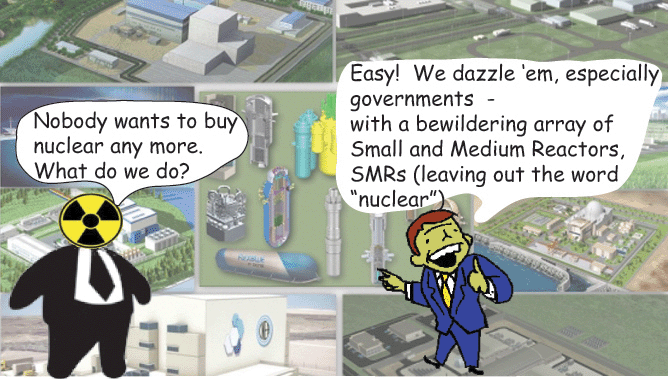
Rolls-Royce vows to create 6,000 UK jobs with nuclear power station plans, Engineering firm is part of consortium pushing for government backing, Jasper Jolly, Wed 11 Nov 2020
‘……….However,it faces opposition on the grounds of safety, security and cost.
The consortium this week signed agreements with the US company Exelon Generation and the Czech power company CEZ to consider the reactors.
Small nuclear reactors were first developed in the 1950s to use in nuclear-powered submarines. Since then Rolls-Royce has designed reactors for seven classes of submarine and two separate land-based prototype reactors.
However, to be cost-effective for civilian use the power generated by the reactors has to compete with renewable sources such as wind and solar power. The costs of installing renewables have fallen dramatically in the last decade and they do not pose the same safety concerns.
The Financial Times last month reported that the government was backing the plans to commit between £1.5bn and £2bn, and that it would form part of Boris Johnson’s 10-point plan for the environment. However, the second wave of coronavirus has caused the delay of the Treasury’s multiyear spending review. …..
a 2017 study by the consortium partner Atkins found that the electricity produced from the small reactors would be a third more expensive than traditional plants……. https://www.theguardian.com/business/2020/nov/11/rolls-royce-vows-to-create-6000-uk-jobs-with-nuclear-power-station-plans
November 12, 2020
Posted by Christina Macpherson |
business and costs, Small Modular Nuclear Reactors |
Leave a comment
 The Government looks set to fail in its first major domestic test over its declared commitment to the environment ahead of an upcoming speech by the Prime Minister.
A recent PR charm offensive by the energy company EDF extolling the green credentials of its proposals to build the Sizewell C nuclear reactor seems to be swaying government opinion, despite the fact that the project may irreversibly damage one of the UK’s most important and well protected wildlife sites. It is rumoured that the Prime Minister will announce the importance of future nuclear energy development in his upcoming 10-point speech on the environment.
The Royal Society for the Protection of Birds ’s Chief Executive, Beccy Speight, said: “The Government has committed to protect 30% of the UK’s land by 2030 to boost biodiversity, so allowing the destruction of one of the most nature rich places we already have in the UK would be a crazy decision. The Prime Minister must not let EDF pull the wool over his eyes regarding what a damaging project this would be.
“If EDF were to be given permission to build a brand-new twin nuclear reactor slap bang on the border of a globally important wildlife haven, then we believe that contrary to the ambition set out by this Government, nowhere in the UK is sacred anymore. The Government has stated that we are in an ecological emergency as well as a climate emergency and it simply cannot afford to waste taxpayer’s money destroying flagship reserves which mean so much to wildlife and people.”
The RSPB has waited for over a decade for EDF Energy to show them evidence that RSPB Minsmere won’t be irrevocably damaged if the energy giant builds the UK’s latest white elephant: Sizewell C. That evidence has never materialised and EDF continue to try and paint the development as environmentally friendly despite evidence to the contrary.
Home to a whopping 6000 species, Minsmere is widely acknowledged as one of Europe’s most important wildlife sites and has legal protection at both the national and international level. Protected animals that call the Suffolk coast home like otters, water voles, marsh harriers, bats and many more could all fall victim to this huge infrastructure project and legally protected land, Sizewell Marshes SSSI, could be built directly on. The concerns extend to marine life too with proposals suggesting waters off the local beaches could warm and that toxic chemicals could be pumped into the sea along with worrying numbers of dead fish.
Beccy Speight continued: “We could be witnessing the horrors of HS2 all over again, wasting tax payers’ money on destroying irreplaceable homes for nature. If Sizewell C was to be built, it should come as no surprise to us all that we would once again be witnessing chainsaws and diggers decimating precious habitats which are not only important to wildlife, but to people’s health and wellbeing too. For this to happen as we attempt to recover from a pandemic caused by a zoonotic disease only adds to the bitter irony of the situation. We urge the Government to think again.”
November 12, 2020
Posted by Christina Macpherson |
environment, opposition to nuclear, UK |
Leave a comment
The Democrats don’t say much about nuclear power, -but the Party seems to be well in favour of it.
During the campaign,The Washington Post questioned Democrat presidential candidates on their views on nuclear power.

At that time 10 Democratic contenders said ”No new plants”
7 said ”Expand nuclear power”
4 said phase nukes out
Harris and Biden were among the 6 who at that time were undecided.
At that time Kamala Harris was no longer running for president. She said “So the biggest issue that I believe we face in terms of nuclear energy is the waste and what are we going to do with that,” Harris said at a CNN climate town hall. “We have to make sure that this is not about the federal government coming in and … making decisions about what each state can do in terms of the nuclear waste issue which is the biggest part of the concern about nuclear energy.” When pressed, Harris did not agree to phasing out nuclear power. ”
Harris and Biden waited to see which way the land lay – (
and also what companies would back their campaign?
November 12, 2020
Posted by Christina Macpherson |
politics, USA |
Leave a comment
 Pauline Hanson’s One Nation torpedoes Kimba nuclear waste dump in SA, Claire Bickers, Federal Politics Reporter, The Advertiser, November 11, 2020
Pauline Hanson will torpedo the Federal Government’s bid to build a radioactive waste dump in regional South Australia.
The One Nation leader, who aims to win a seat in SA at the next federal election, has confirmed she will not back legislation to build the nuclear waste storage site at Napandee farm, near Kimba.
Without One Nation’s two crucial votes – and Labor, the Greens, and independent senator Rex Patrick not backing the Bill – the government does not have enough votes for it to pass parliament without changes.
Senator Hanson told The Advertiser she had serious concerns about the process to select Napandee, the level of community support, the waste site being built on farming land, and the facility storing intermediate radioactive waste above ground.
“I want to make the right decision, not for the interim, I want to make the right decision for future generations,” Senator Hanson said.
“I’m not going to be badgered or pushed into this.
“It’s about looking after the people of SA, but also the whole of Australia.”
Senator Hanson said One Nation wanted to win a seat in SA at the next election, and she hoped South Australians would take into account her strong stance on the waste site.
One Nation adviser Jennifer Game, who ran as the party’s SA Senate candidate at the 2019 election, has been leading research and consultation on the Kimba site.
“I think the government has rushed the decision to have it there,” Senator Hanson said.
Almost 62 per cent of 734 Kimba residents supported the facility in a postal vote in 2019 but Senator Hanson said locals had indicated to the party that closer to half of the town did not support the facility.
The region’s native title holders, the Barngarla people, were also not given a say in the official vote.
Senator Hanson was concerned other locations that may be suitable were not investigated, such as an old mining site in Leonora, in Western Australia, which may be able to store the waste underground.
“We don’t know what the future is going to hold, we don’t know if war is going to touch our shores,” she said.
“Do we really want a facility that is above ground that could be problems further down the track, if anything happens?”…https://www.adelaidenow.com.au/news/south-australia/pauline-hansons-one-nation-torpedoes-kimba-nuclear-waste-dump-in-sa/news-story/9043c46fa44ecd8a1b4e46be111745f3
November 12, 2020
Posted by Christina Macpherson |
AUSTRALIA, politics, wastes |
Leave a comment
 Anglian Daily Times 10th Nov 2020, The Government has vowed to ensure it considers whether Sizewell C mitigation measures are stringent enough, after a Suffolk MP called for adequate scrutiny of the plans. Sources have indicated that the Government is close to giving the go ahead for the £20 billion scheme on the Suffolk coast, prompting Central Suffolk and North Ipswich MP Dr Dan Poulter to call on the Secretary of State for Business, Alok Sharma, to ensure developers EDF will be “held to account and will properly engage with theconsultation to implement the changes needed to improve road and rail infrastructure”.
Raising the issue in Parliament on Tuesday morning, Dr Poulter said that while the development would bring benefits such as de-carbonisation and thousands of new jobs, it was “not a case of Sizewell C being built at any cost”. He said: “Many people in Suffolk have concerns about the failure of EDF to properly engage with the consultation process. “There are still over 50 outstanding concerns raised by Suffolk County Council.”
https://www.eadt.co.uk/news/government-sizewell-c-scrutiny-pledge-1-6924184
Campaign group project images on side of Government building. Stop Sizewell C, who are against the development of a nuclear plant in Suffolk, have projected two images on the side of a Government building.
https://planetradio.co.uk/greatest-hits/suffolk/news/campaign-group-project-image-on-government-building/
November 12, 2020
Posted by Christina Macpherson |
politics, UK |
Leave a comment
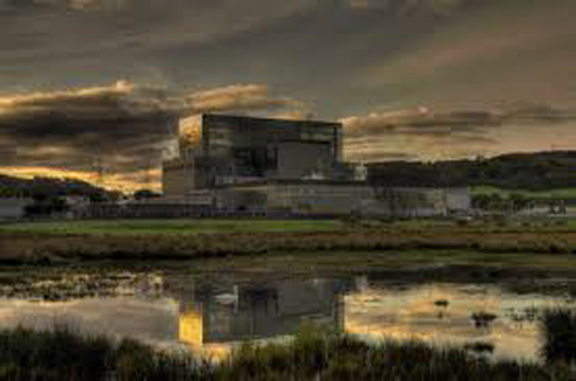
 No to Nuclear Power, November 2020,
 On 27th August, the Office for Nuclear Regulation (ONR) announced it was giving EDF permission to restart Reactor 3 at Hunterston B for a limited period – generating up to a total of 16.425 Terawatt days, approximately six months’ operation. (1) Then on 24 September ONR gave EDF permission for Reactor 4 to return to service for a similar limited period. By the end of September both reactors were operating. (2)
Following the Reactor 3 announcement, EDF said it is hoping to run both reactors at the site for two last six-month periods each and then begin decommissioning them “no later than 7 January 2022”. The reactors were previously scheduled to be shut down in March 2023.
ONR has yet to give permission for either reactor to operate for a second six months, and this will require new safety cases.
The NFLA and campaigners have condemned the moves to restart Hunterston, warning that public health is being put at risk. They are calling for the plant to be permanently closed down now. “The safest thing to do is to close Hunterston B and start accelerated decommissioning of its reactors,” said the group’s Scottish convener, Glasgow SNP councillor Feargal Dalton. “We totally disagree with EDF that decommissioning should start in 2022. It should happen now for the sake of public safety.” He added: “The fact it has taken two years and much resource from EDF to provide sufficient information to the ONR to allow a restart to take place is indicative of the level of risk over the structural integrity of these reactors.” (3)
Reactor three has an estimated 377 cracks in its graphite core and has been shut down since 9 March 2018. It will only be allowed to operate for six months before it will have to close down again so that its core can be checked for new cracks. Then EDF will need new permission to operate it for a further, final six months. Reactor four at Hunterston has an estimated 209 cracks in its core, and was shut down on 2 October 2018. It was allowed to restart for four months in 2019.
According to the Daily Business website, EDF employs approximately 580 workers (and around 200 contractors). About 125 will lose their jobs in January 2022 with others retained until 2025 for the de-fuelling process. (4) After that, there will be the massive task on dismantling the two reactors safely.
Dr Richard Dixon, director of Friends of the Earth Scotland said “Whether it was clever press strategy or fluke, EDF managed to use the closure announcement to bury the news that their damaged reactor is starting up again. They must be laughing all the way to the bank.” (5)
West Kilbride Tory councillor Todd Ferguson called for Hunterston to be shut immediately. He said Hunterston should not be a ‘guinea pig’ for the UK nuclear industry testing how long power stations can last. “There comes a time when the reactors should remain offline for good. The North Ayrshire Conservative Group believe the time to look at this is now.” (6)
The NFLA Scotland Forum have joined with Friends of the Earth Scotland, WWF Scotland, CND Scotland and the Nuclear Consulting Group to raise serious concerns over the decision of the Office for Nuclear Regulation (ONR) to allow these reactors to restart. It is important to note that the majority of the Scottish population live downwind of Hunterston B and the consequences of an accident will be catastrophic. In terms of the energy generation issues by closing Hunterston B, it needs to be noted that EDF Energy has recently been asked by the National Grid to reduce output at Sizewell B in Suffolk due to a lack of energy demand, providing it with £50 million in order to do this. With the reducing cost and increasing levels of renewable energy coming on stream there is absolutely no need to restart Hunterston B. Restarting for 6 or 12 months is creating an unnecessary risk to the people of Scotland. If accelerated decommissioning of the site was to take place, many jobs can be diverted into such activity for some time to come. In addition, whilst there is fuel in the reactor, it is a criticality risk and has to be almost fully staffed until it is defueled in 2025. (7 )
The latest technical documents (8) put online by the Office for Nuclear Regulation (ONR) show:
1. EDF has predicted that the number of cracks in reactor three’s graphite core will increase from the current 570 to 781 after six months operation, and to 943 after 12 months operation. 943 cracks would bring the reactor close to EDF’s new “damage tolerance level” of 1,331 cracks, and exceeds its “intermediate damage tolerance assessment” of 905 cracks.
2. EDR has scrapped its “operational allowance” for cracks, which in 2018 was 350. It now says that the safety limit is its “Currently Established Damage Tolerance Level” of 1,331. So, the acceptable number of cracks has nearly quadrupled in two years.
3. EDF has done new analysis of “in-event cracking” to assess the damage that a one-in tenthousand-year earthquake could do if it occurred in the next six months. This predicts that “overloads” would cause an additional 500 cracks.
The ONR report also contains some interesting remarks on EDF assessments. It says for example that the company’s estimates of the likelihood of fragments of debris broken off graphite blocks “migrating to safety significant locations” are “inherently subjective”. It also suggests that EDF’s safety case methodology is “approaching its limit of viability”. The ONR report also contains some interesting remarks on EDF assessments. It says for example that the company’s estimates of the likelihood of fragments of debris broken off graphite blocks “migrating to safety significant locations” are “inherently subjective”. It also suggests that EDF’s safety case methodology is “approaching its limit of viability”.
Despite all this of course, ONR bought EDF’s argument that it should be allowed to operate for another six months. But maybe getting ONR’s permission for a second six months’ operation – as EDF want – is not certain.
Jobs Nicola Sturgeon has promised to look into job fears surrounding Hunterston’s closure. Calls have been made for the Scottish Government and North Ayrshire Council to create a plan for the workforce. Nicola Sturgeon said the government is committed to creating new employment locally. Conservative MSP Jamie Greene says the impact of the decommissioning will be huge and insists local people will need extra support. Kenneth Gibson, the SNP MSP for the area, says work needs to be done quickly to support jobs and that officials must look towards a green future. He said: “The decision should encourage the Scottish and UK Governments to work in partnership with the council to deliver the economic transition of the area with a greater sense of urgency. Whilst defuelling will mean no immediate job losses, investment locally in green, clean energy is now the priority.” (9)
• EDF Energy has announced that it intends to submit new safety cases to ONR to re-open Reactors 3 and 4 at Hinkley Point B – Hunterston’s sister reactors. It currently expects reactor 4 to return to service on 26 February 2021 and reactor 3 on 12 March 2021. The Stop Hinkley Campaign is calling for both reactors to remain closed. Stop Hinkley spokesperson Roy Pumfrey said: “Nuclear engineer, the late John Large said more than a decade ago that it was
gambling with public safety to allow reactors with cracks in their core to keep operating. Every minute these reactors operate that gamble become riskier. We call upon the UK Government to intervene and request the ONR to re-consider their unwise decisions at Hunterston B and to refuse to accept EDF’s safety cases for Hinkley Point B. It is EDF in Paris, France which will benefit from the restart of these reactors, but it is those of us who live in Somerset and middle England who are being exposed to these involuntary risks” (10)
http://www.no2nuclearpower.org.uk/wp/wp-content/uploads/2020/11/SafeEnergy_No88.pdf
November 12, 2020
Posted by Christina Macpherson |
safety, UK |
1 Comment
|
Nuclear security administrator resigns from post, https://www.reviewjournal.com/news/politics-and-government/nuclear-security-administrator-resigns-from-post-2180746/ By Gary Martin Las Vegas Review-Journal
November 10, 2020 – WASHINGTON — Lisa Gordon-Hagerty, who headed the National Nuclear Security Administration that oversees national security sites in Nevada and New Mexico, has resigned from her position, according to the Department of Energy.
Gordon-Hagerty resigned as administrator on Friday, according to a NNSA statement.
Dr. William Bookless, the NNSA principal deputy administrator, was appointed acting administrator of the semi-autonomous agency that maintains and measures the effectiveness of the nation’s nuclear weapons stockpile.
The NNSA oversees the Nevada National Security Site, located 65 miles north of Las Vegas on 1,370 square miles. The site, which conducts subcritical nuclear weapons testing, employees about 2,400 workers.
Los Alamos National Laboratory also is under the agency.
The resignation of Gordon-Hagerty followed a clash with Energy Secretary Dan Brouillette, who apparently said President Donald Trump has lost confidence in her, according to Bloomberg. The White House declined to comment.
But Rep. Dina Titus, D-Nev., said “the chaos of the Trump administration extends even to the agency responsible for safeguarding our nuclear weapons.”
I will keep a close watch on the activities at NNSA during this transitional period while we eagerly await the inauguration of President-elect (Joe) Biden,” Titus said.
Sen. Catherine Cortez Masto, D-Nev., said she was disappointed to learn of Gordon-Hagerty’s resignation.
“It is imperative that any future Administrator uphold NNSA’s mission to ensure the safety, security, and reliability of our nation’s nuclear stockpile, the continued security and efficiency of the Nevada National Security Site and the agreement the State of Nevada reached with the Department of Energy to begin removing the weapons grade plutonium currently being stored at NNSS next year,” Cortez Masto said.
The termination of Gordon-Hagerty also brought a rebuke of Brouillette from Sen. James Inhofe, R-Okla., who questioned the timing of the move. Inhofe also praised the abilities of Gordon-Hagerty, who was confirmed by the Senate for the position in 2018.
She was the first woman to serve in the position, according to a NNSA news release announcing her resignation.
|
|
November 12, 2020
Posted by Christina Macpherson |
politics, safety, USA, weapons and war |
Leave a comment
Russia retires Leningrad 2 RBMK, 10 November 2020
The Leningrad 2 nuclear power unit in in Sosnovy Bor in Western Russia was shut down permanently today. The RBMK, which has been in operation for 45 years, is to be replaced by Leningrad II-2, a VVER-1200, which on 6 November received regulatory approval to start pilot operation…… https://www.world-nuclear-news.org/Articles/Russia-retires-Leningrad-2-RBMK
November 12, 2020
Posted by Christina Macpherson |
decommission reactor, Russia |
Leave a comment
Shiv Nadar School Hosts Virtual Boot Camp on Nuclear Energy, Climate Change and Sustainability, India Education Diary
By India Education Diary Bureau Admin -November 11, 2020, Noida: Shiv Nadar School, Noida, (a not-for-profit initiative of the Shiv Nadar Foundation in K12 education) organized the first-of-its-kind Energy Boot Camp as part of its STEAM (Science, Technology, Engineering, Art, and Math) program to bring awareness about clean energy, climate change and sustainability.The Boot Camp was organized virtually in association with the Indian Youth Nuclear Society (IYNS), from November 6 to 8, 2020 and witnessed participation from around 2000 students (Grade 6 to 12)……..
https://indiaeducationdiary.in/shiv-nadar-school-hosts-virtual-boot-camp-on-nuclear-energy-climate-change-and-sustainability/
November 12, 2020
Posted by Christina Macpherson |
Education, India |
Leave a comment
Middle East nuclear ambitions stymied by financial constraints, enrichment fears, S and P Global , AuthorDania Saadi, EditorKshitiz Goliya-11 Nov 20,
HIGHLIGHTSIran, UAE producing nuclear power for electricity generation
Egypt, Jordan, Saudi Arabia, Turkey want to follow suit
But Saudi Arabia and Jordan want uranium enrichment
Dubai — While the UAE started its first nuclear reactor this year, other countries in the Middle East are stuck in their plans as they grapple with financial constraints, uranium enrichment aspirations, and Western fears amid Iran’s controversial nuclear ambitions.
he UAE, so far, is the only regional country to have agreed to the so-called “gold standard” in its nuclear cooperation agreement with the US, foregoing any plans to enrich uranium, which is the West’s main cause of concern.
The UAE’s peaceful program includes four 1.4 GW nuclear reactors, the first of which started in August, to meet up to 25% of the country’s electricity needs.
“The question of deployment of sensitive nuclear technologies has been a hot button issue in the Middle East for years, beginning in 1970s when Israel clandestinely produced nuclear weapons and the rest of the countries in the region had to respond to that development,” said Mark Hibbs, senior fellow at the Carnegie Endowment for International Peace’s nuclear policy program.
“Nuclear transparency issues in the Middle East are not confined to just to one or two or three countries but are the concern of virtually all states in a region where suspicion is widespread and where international cooperation and confidence building are limited.”
Saudi nuclear plans
In Saudi Arabia, earlier scenarios to develop 17.6 GW of nuclear power by 2032 have been scaled back to building a mix of 1.2-1.6 GW and small modular reactors without any set timeline.
However, the West has concerns about the Saudi program because of its stated intentions to mine and enrich its uranium deposits.
In a March 2018 interview with CBS, Crown Prince Mohammed bin Salman said, “Saudi Arabia does not want to acquire any nuclear bomb, but without a doubt if Iran developed a nuclear bomb, we will follow suit as soon as possible.”
Such statements have unnerved Western countries, including some US lawmakers, who have urged the US Administration to persuade Saudi Arabia to agree to the “gold standard” and foreswear enriching uranium.
Resource-barren Jordan
Turkey, which has a so-called 123 nuclear cooperation agreement with the US just like the UAE, is building its first nuclear plant Akkuyu, which will consist of four 1.2 GW reactors being supplied by Rosatom, with work on the first unit set to start in 2023………
esource-barren Jordan needs financial help to achieve its ambition to produce nuclear energy to help halt its reliance on energy imports. Jordan, which in 2015 signed with Rosatom a $10 billion deal to build a 2 GW nuclear power plant, has since scrapped this plan and is looking at small modular reactors.
Financial constraints
Jordan also wants to mine and enrich its own uranium deposits, which is another sticking point with the US in reaching a 123 agreement.
“Finances is likely to pose the biggest obstacle to fulfilling these [nuclear] dreams because nuclear energy is such a costly venture,” said Mark Fitzpatrick, associate fellow at the International Institute for Strategic Studies.
“If you look at it in terms of energy efficiency, nuclear energy is not the most efficient way of developing electricity. Solar energy probably offers better efficiency in the long-run, while in the short-run because of the depressed price of oil, countries are finding it more economic to just import oil.”
However, the elephant in the room that may thwart the region’s nuclear ambitions is Iran, which started in 1959 with a small US nuclear reactor but ended up entangled in a major standoff with the West in the 2000s……
Besides Iran, another cause for concern is the potential attack on nuclear facilities.
“Modern nuclear power plants are designed to be secure against most kinds of threats but they can’t be perfectly secure against threats such as an airplane directly attacking the plant…or in the case of an attack like the Israeli attack on Iraq’s Osirak reactor [in 1981],” Fitzpatrick said. https://www.spglobal.com/platts/en/market-insights/videos/market-movers-europe/110920-utilities-renewables-libya-oil-lockdown-lng-uniper-germany
November 12, 2020
Posted by Christina Macpherson |
business and costs, MIDDLE EAST, politics international |
Leave a comment
|
 Covid outbreak at former Trawsfynydd nuclear power plant, BBC 11 Nov 20, Covid outbreak at former Trawsfynydd nuclear power plant, BBC 11 Nov 20,
Work has been scaled back on the site of former nuclear power station following an outbreak of Covid.
Magnox said a “small number” of employees tested positive at the Trawsfynydd site in Gwynedd, where they are working to remove nuclear reactors and towers.
Those affected and others found through track and trace are self-isolating.
It said some key work will continue on site but other staff can work from home.
The twin reactors will become the first in the UK to be fully decommissioned.
|
|
November 12, 2020
Posted by Christina Macpherson |
decommission reactor, health, UK |
Leave a comment
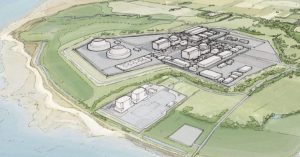 Guardian 11th Nov 2020
 , China’s ambition to build a nuclear plant in Essex will likely

fail on national security grounds. The new national security and investment bill, aiming to give the government sweeping powers to block foreign takeovers and investments, will inevitably be viewed through the lens of China and new nuclear power plants in UK.
November 12, 2020
Posted by Christina Macpherson |
politics, politics international, UK |
Leave a comment
New Civil Engineer 11th Nov 2020, A consortium led by Bechtel is reportedly in talks with the government
about acquiring the Wylfa Newydd site on Anglesey earmarked for nuclear
development. Plans for a £20bn nuclear plant were recently scrapped by
developer Horizon after 18 months of talks with government about a funding
mechanism eventually fizzled out. The site is however still safeguarded and
the project could theoretically be restarted by a third party. Led by the
Bechtel, the consortium includes Southern Company, an electricity utility,
and Westinghouse, a nuclear engineering company.
https://www.newcivilengineer.com/latest/bechtel-led-consortium-in-talks-about-wylfa-site-11-11-2020/
City AM 10th Nov 2020, A group of US companies has reportedly approached the government about
taking over the development of a nuclear power plant at Wylfa in north
Wales. Engineering giant Bechtel will lead the consortium, and will be
joined by utility firm Southern and nuclear engineers Westinghouse.
https://www.cityam.com/us-consortium-mulls-taking-on-abandoned-wylfa-nuclear-project/
November 12, 2020
Posted by Christina Macpherson |
business and costs, politics, UK |
Leave a comment

Christina Macpherson’s websites & blogs
Despite the enormous and present threats of pandemic and climate change, it’s now time for this site to return to its original focus – the NUCLEAR horror.
Others are covering well those two other related dangers.
The nuclear danger stays in the backround. And the mindless cringing mainstream media keeps on regurgitating handouts from NuScam and the rest of the global nuclear salesmen.
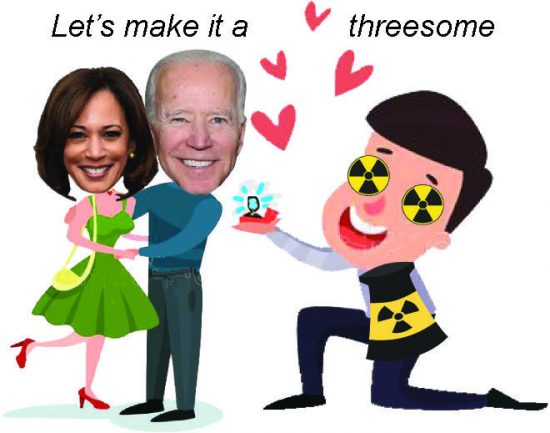
The switch in the USA to a Democrat administration will make the nuclear lobby’s path just so much smoother and easier. Biden and Harris look so much nicer than Trump, (and they are nicer). So much easier for progressive people to support their pro nuclear policies.
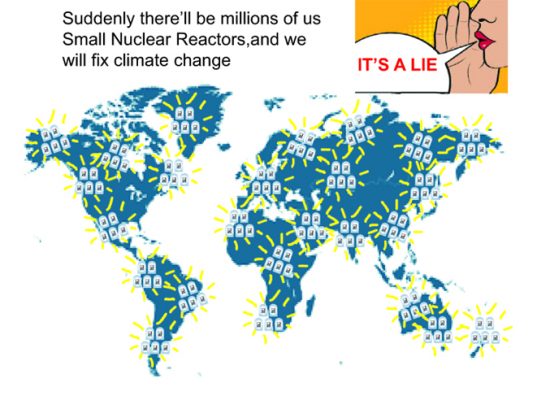
And hey shucks – we all worry about climate change – and NuScale’s small nuclear reactors are going to fix that – aren’t they?

November 10, 2020
Posted by Christina Macpherson |
Christina's notes |
Leave a comment

NJ Ratepayers Unite to Stop More Nuclear Corporation Bailouts, Energy Monopolies https://www.insidernj.com/press-release/nj-ratepayers-unite-stop-nuclear-corporation-bailouts-energy-monopolies/ November 9, 2020,
Diverse energy users and consumer advocate groups create NJ Ratepayers United
Trenton, N.J. –– As a $300 million annual nuclear subsidy continues to burden New Jersey consumers, a coalition has formed to oppose another proposed major energy policy initiative from PSEG and Exelon that would enable the companies to transform the state’s electricity capacity market and obtain windfall profits.
NJ Ratepayers United (NJRU) is a diverse coalition of New Jersey consumers, business groups, consumer advocates, grassroots organizations and energy providers that have joined forces to stop the proposed Fixed Resource Requirement (FRR). This proposed overhaul would transform how the state procures power, eliminating ratepayer protections and empowering select companies to leverage their market power to further increase electricity costs. Continue reading →
|
|
|
|
|
November 10, 2020
Posted by Christina Macpherson |
business and costs, opposition to nuclear, USA |
Leave a comment









 nuclear-news