Ontario could get clean renewable energy from neighbouring provinces, with no need for nuclear power
 With nuclear power plants approaching end of life, what’s next in Ontario? Barrie Today, Peter Bursztyn 25 Nov 20, ‘Two decades is just enough time for major new electricity generation projects to go through the planning and permitting process, get built, and come on line,’ says reader With nuclear power plants approaching end of life, what’s next in Ontario? Barrie Today, Peter Bursztyn 25 Nov 20, ‘Two decades is just enough time for major new electricity generation projects to go through the planning and permitting process, get built, and come on line,’ says reader
……. When Hydro Quebec’s grand James Bay hydroelectricity project was built, many of the dams were constructed with space to accept more turbine units than are now installed.
In other words, these dams spill a great deal of water which could instead flow through a turbine to generate power. Taken as a whole, James Bay is one of the world’s largest power generation projects. Its capacity is 15,527 megawatts, the equivalent of 16 nuclear power plants. In 1971, when the project began, the Canadian government tried to persuade Quebec to choose nuclear power instead. With hindsight, Quebec was wise to choose hydroelectricity. Ontario, which did not have similar hydroelectric resources, built Unfortunately, we found nuclear to be a costly method of producing electricity; expensive enough that much of the debt incurred to build Ontario’s nuclear “fleet” still remains on the province’s books a half-century on. We never managed to pay it off……. our fleet of nuclear power plants is coming to the end of its design life. Over the coming two decades, most of our nuclear fleet will begin to wink out. We know that we cannot replace them with new nuclear units; they are simply too costly. The last Liberal government called for tenders to build nuclear plants, but insisted the bidders had to be responsible for cost over-runs. As a result, two of the three potential builders dropped out. The third offered to build, but refused to accept responsibility for cost escalation. The nuclear plan was quietly dropped……….. Ontario cannot generate enough renewable, carbon-free electricity to replace our current nuclear output within our own borders. (It is worth saying that nuclear power is not renewable.) Fortunately, our neighbouring provinces — Manitoba and Quebec — have the potential to generate considerably more than they currently use. Many of Quebec’s already completed dams have space in their turbine halls for more units. Quebec could “drop in” about 13,000 MW of generation. This is roughly equal to Ontario’s nuclear capacity, and not all of our nuclear units are running at any one time. Quebec has also surveyed other potential hydroelectric sites, both to the south and to the north of the James Bay project. More hydroelectric power could be exploited in northeast Quebec. Our western neighbour, Manitoba, has a number of sites with hydroelectric generation potential on the Nelson River near major existing power stations. There is also untapped potential hydroelectric power available to the southeast of Lake Winnipeg, even closer to Ontario. ………. Although the wind doesn’t blow continuously, expanding wind generation would reduce the amount of electricity Alberta needs to purchase from B.C. Since hydro power can be ramped up very rapidly, it would also reduce or even eliminate the need for gas-fired generation to meet demand peaks. Of course, the same applies to Ontario. We are a country blessed with a great deal of hydroelectric potential. Inexpensive, carbon-free electricity generation is within our grasp. All it needs is vision and leadership. https://www.barrietoday.com/letters-to-the-editor/letter-with-nuclear-power-plants-approaching-end-of-life-whats-next-in-ontario-2902273 |
|
Orano, formerly Areva, targeted by judicial investigation for corruption.
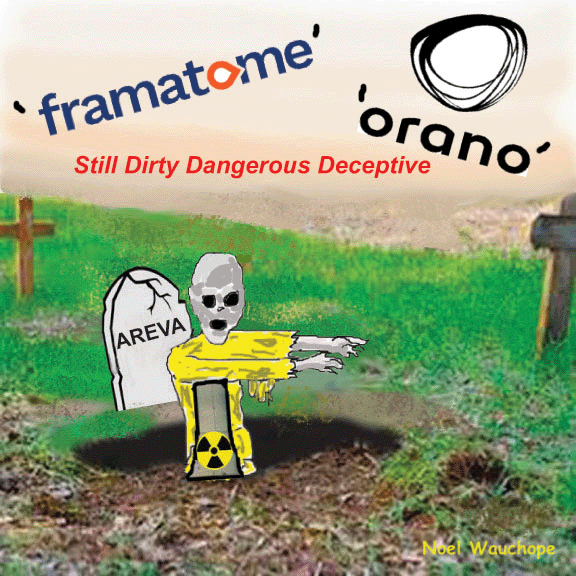
Orano, formerly Areva, targeted by judicial investigation for corruption. 25 Nov 20, A new case shakes the French nuclear group Orano, formerly known as Areva. An
investigation was opened by the Paris prosecutor’s office for facts “of
corruption of a foreign public official”, implicating in particular one of
the providers of Orano, the company Eurotradia International. “We had not
noticed anything abnormal and we are now at the disposal of justice,” said
the spokesperson for Orano, who claims to have terminated his contracts
with Eurotradia.
Concern in France over lack of expert inspection of nuclear sites
Montel News 24th Nov 2020, The lack of inspections at nuclear sites by safety experts, due to the
coronavirus pandemic, raises fears for the safety of the facilities, union
officials in the energy sector told Montel.
The Nuclear Safety Authority
(ASN) canceled all its physical inspections of nuclear power plants, except
the inspections considered essential, during the first containment in the
spring. Since then, some inspections have resumed in the field but many are
still carried out remotely.
This reduction in on-site checks is
exacerbating a situation where the workforce is already limited and
communication with workers is lacking, say some union officials.
1 This Month


Tell the Ukrainian Government to Drop Prosecution of Peace Activist Yurii Sheliazhenko

Petition to revoke the licensing of the Near Surface Nuclear Disposal Facility (NSDF) at Chalk River. https://www.ourcommons.ca/petitions/en/Petition/Details?Petition=e-7247


of the week – STOP SMALL MODULAR REACTORS IN CANADA
To see nuclear-related stories in greater depth and intensity – go to https://nuclearinformation.wordpress.com
-
Archives
- March 2026 (204)
- February 2026 (268)
- January 2026 (308)
- December 2025 (358)
- November 2025 (359)
- October 2025 (376)
- September 2025 (258)
- August 2025 (319)
- July 2025 (230)
- June 2025 (348)
- May 2025 (261)
- April 2025 (305)
-
Categories
- 1
- 1 NUCLEAR ISSUES
- business and costs
- climate change
- culture and arts
- ENERGY
- environment
- health
- history
- indigenous issues
- Legal
- marketing of nuclear
- media
- opposition to nuclear
- PERSONAL STORIES
- politics
- politics international
- Religion and ethics
- safety
- secrets,lies and civil liberties
- spinbuster
- technology
- Uranium
- wastes
- weapons and war
- Women
- 2 WORLD
- ACTION
- AFRICA
- Atrocities
- AUSTRALIA
- Christina's notes
- Christina's themes
- culture and arts
- Events
- Fuk 2022
- Fuk 2023
- Fukushima 2017
- Fukushima 2018
- fukushima 2019
- Fukushima 2020
- Fukushima 2021
- general
- global warming
- Humour (God we need it)
- Nuclear
- RARE EARTHS
- Reference
- resources – print
- Resources -audiovicual
- Weekly Newsletter
- World
- World Nuclear
- YouTube
-
RSS
Entries RSS
Comments RSS
 nuclear-news