Near to flaspoint – disputes between India, Pakistan,China
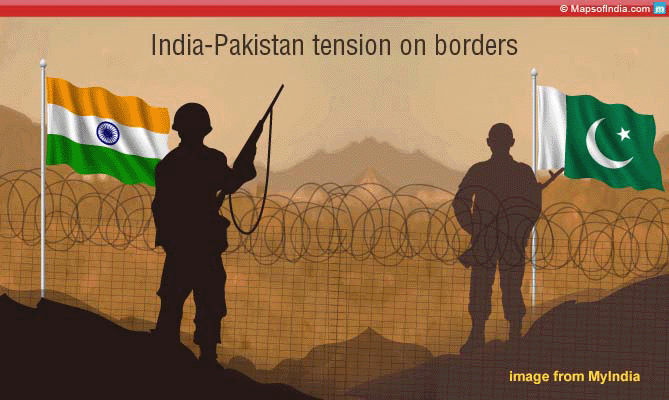 Tensions between 3 nuclear-armed powers are rising toward the boiling point ABBY POKRAKA, RESPONSIBLE STATECRAFT Tensions between 3 nuclear-armed powers are rising toward the boiling point ABBY POKRAKA, RESPONSIBLE STATECRAFT
SEP 30, 2020,
For decades, India and Pakistan have clashed over Kashmir, the mountainous region both countries claim. But to make matters more complicated, China has a stake in the area, too. The Aksai Chin region — located between Kashmir and Tibet — is under Chinese control and has been a source of conflict between India and China since 1962.
The borderlands between these three nuclear-armed states is increasingly a flashpoint for conflict. The international community ignores these growing challenges at its peril and should be looking for ways to help manage potential crises in the region. And while the United States can play a role, in this particular instance, direct US involvement is probably not the best way forward…………. China was drawn into a dispute between India and Pakistan when India revoked Kashmir’s autonomy in August 2019 and wanted to incorporate parts of “Xinjiang and Tibet into its Ladakh union territory,” which China believes violates its dominion due to its occupation of Tibet. It appears that over the last year the situation in Kashmir has not gotten better. ……It seems clear that after decades of poor relations, the tensions in this part of the world may reach a boiling point. Finding a solution to these half-century conflicts seems daunting, but it is necessary. While many nations have fought throughout history, a conflict between nuclear-armed states carries an unbearable risk of escalation. To start, these countries can take small steps to stabilise the security of the region and pave the way for better relations. Starting a dialogue, bilateral or trilateral, can improve communication in the longer term, which can help reduce the likelihood of conflict. Establishing crisis communications was an important step the United States and the Soviet Union took in the wake of the Cuban Missile Crisis, and de-escalation practices the two countries implemented in the early 1960s remained in place through the end of the Cold War. A third party could help facilitate regional discussions. Given its history in the region, the United States might have seemed like a good option for such facilitation, but that is not the case at this time……. This week, President Trump took aim at China before the United Nations, blaming it for the global COVID pandemic. At this point, there is no reason China would see the United States as a desirable mediator for any regional conflict…… friction among China, India, and Pakistan continues to grow. The only way to diffuse the tension and prevent destructive escalation is through diplomacy. Other countries need to step up and work to reduce the hostilities. Make no mistake, a large-scale, regional conflict among nuclear-armed states would have global consequences. https://www.businessinsider.com.au/httpsresponsiblestatecraftorg20200925india-china-pakistan-three-nuclear-powers-hurtling-towards-the-boiling-point-2020-9 |
|
No comments yet.
1 This Month


Tell the Ukrainian Government to Drop Prosecution of Peace Activist Yurii Sheliazhenko

Petition to revoke the licensing of the Near Surface Nuclear Disposal Facility (NSDF) at Chalk River. https://www.ourcommons.ca/petitions/en/Petition/Details?Petition=e-7247


of the week – STOP SMALL MODULAR REACTORS IN CANADA
To see nuclear-related stories in greater depth and intensity – go to https://nuclearinformation.wordpress.com
-
Archives
- March 2026 (204)
- February 2026 (268)
- January 2026 (308)
- December 2025 (358)
- November 2025 (359)
- October 2025 (376)
- September 2025 (258)
- August 2025 (319)
- July 2025 (230)
- June 2025 (348)
- May 2025 (261)
- April 2025 (305)
-
Categories
- 1
- 1 NUCLEAR ISSUES
- business and costs
- climate change
- culture and arts
- ENERGY
- environment
- health
- history
- indigenous issues
- Legal
- marketing of nuclear
- media
- opposition to nuclear
- PERSONAL STORIES
- politics
- politics international
- Religion and ethics
- safety
- secrets,lies and civil liberties
- spinbuster
- technology
- Uranium
- wastes
- weapons and war
- Women
- 2 WORLD
- ACTION
- AFRICA
- Atrocities
- AUSTRALIA
- Christina's notes
- Christina's themes
- culture and arts
- Events
- Fuk 2022
- Fuk 2023
- Fukushima 2017
- Fukushima 2018
- fukushima 2019
- Fukushima 2020
- Fukushima 2021
- general
- global warming
- Humour (God we need it)
- Nuclear
- RARE EARTHS
- Reference
- resources – print
- Resources -audiovicual
- Weekly Newsletter
- World
- World Nuclear
- YouTube
-
RSS
Entries RSS
Comments RSS
 nuclear-news
Leave a comment