Lawsuit: Ohio Attorney General sues to stop nuclear bailout money, and break up dark money groups

Ohio Attorney General Dave Yost sues to block nuclear bailout money from being paid, The lawsuit also seeks to dissolve the dark money groups involved in the bribery scheme. Author: WKYC Staff, Associated Press, 10TV Web Staff, September 23, 2020
COLUMBUS, Ohio — Ohio Attorney General Dave Yost filed a lawsuit on Wednesday to block the state’s nuclear plants from collecting fees on electricity bills that were authorized in a new law at the center of a $60 million federal bribery probe involving the former speaker of the Ohio House.
The suit was filed in Franklin County Court in Columbus against Energy Harbor, asking the judge to block payments to the company’s two nuclear plants near Cleveland and Toledo that were bailed out through the now-tainted legislation.
Energy Harbor is the former FirstEnergy Solutions, a onetime subsidiary of FirstEnergy Corp. The subsidiary filed for Chapter 11 bankruptcy in 2018 amid a mounting load brought on by the rise of competition from natural gas power in the East and Midwest.
HB 6, a roughly $1 billion financial bailout, was signed into law in July 2019. It added a new fee to every electricity bill in the state and directed over $150 million a year through 2026 to the plants in Lake and Ottawa counties. The fee will be added to every electricity bill in the state starting January 1.
Federal prosecutors allege that from March 2017 to March 2020, former Ohio House Speaker Larry Householder and others received millions of dollars in exchange for help in passing HB 6.
Wednesday’s lawsuit came hours after a House committee looking at repealing the law heard varying proponent testimony from energy lobbying groups and state office representing consumers. Governor Mike DeWine has said he supports a repeal of the law.
Yost had previously promised he would take the legal remedies necessary if the General Assembly could not do so in time.
The lawsuit also seeks to freeze the assets of former House Speaker Larry Householder’s $1 million campaign fund and dissolve the dark money groups involved in the bribery scheme, Yost said.
“Corruption like this doesn’t happen without cash, lots of cash,” he said.
Federal prosecutors in July accused Householder and four others of shepherding energy company money for personal and political use as part of an effort to pass the legislation, then kill any attempt to repeal it at the polls. All five men have pleaded not guilty………. https://www.wkyc.com/article/news/politics/attorney-general-dave-yost-sues-to-stop-nuclear-bailout-money-from-being-paid/95-431fd46c-44c0-440a-9076-46e1c9d23f8a
Japan’s nuclear regulator approves restart of Kashiwazaki-Kariwa plant, but still hurdles to overcome

The Nuclear Regulation Authority’s green light now shifts the focus over to whether local governments will agree in the coming months to restart the
TEPCO is keen to get the plant back up and running. It has been financially reeling from the closure of its nuclear plants in Fukushima Prefecture following the triple meltdown at the Fukushima No. 1 nuclear plant in 2011 triggered by the earthquake and tsunami disaster.
The company plans to bring the No. 6 and No. 7 reactors back online at the Kashiwazaki-Kariwa nuclear complex, which is among the world’s largest nuclear plants.
The two reactors each boast 1.35 gigawatts in output capacity. They are the newest of the seven reactors there, first put into service between 1996 and 1997.
TEPCO has not revealed specific plans yet on what to do with the older five reactors……..http://www.asahi.com/ajw/articles/13753076
USA Government Accountabilty Office calls for assessment of costs for planned new nuclear warheads
 NUCLEAR WEAPONS: NNSA Should Further Develop Cost, Schedule, and Risk Information for the W87-1 Warhead Program, https://www.gao.gov/products/GAO-20-703 NUCLEAR WEAPONS: NNSA Should Further Develop Cost, Schedule, and Risk Information for the W87-1 Warhead Program, https://www.gao.gov/products/GAO-20-703
GAO-20-703: Sep 23, 2020. The National Nuclear Security Administration plans to replace the W78—an older type of nuclear warhead used in intercontinental ballistic missiles—with the W87-1, starting in 2030. But it’s unclear if NNSA can produce enough of the W87-1’s fissile cores in time to meet its planned production schedule.NNSA estimated that the new warhead could cost up to $14.8 billion, which could make it the most expensive program of this type to date. Upcoming design decisions for the weapon could affect cost. But the agency didn’t have formal plans to assess the costs and benefits of these decisions. Our recommendations address these and other concerns. |
|
|
False report of a nuclear disaster in Ukraine
Hackers spread false reports of nuclear disaster, death of US troops in Ukraine, https://www.kyivpost.com/ukraine-politics/hackers-spread-false-reports-of-nuclear-disaster-death-of-us-troops-in-ukraine.html?cn-reloaded=1
Notably, the fake news campaign occurred during the climax of the large Ukrainian-American-British-Canadian military exercises Joint Endeavor 2020, which continue all across the country since Sept. 19, and during yet another round of Ukrainian-American anti-terror drills Rapid Trident in Lviv Oblast.
Moreover, the fake stories were published and massively spread not only by dubious Facebook accounts but also by hacked websites of local authorities and even the police.
The reports started off with a post published on the official website of the local government in the town of Varash some 340 kilometers northwest of Kyiv. The town is located just near the Rivne Nuclear Power Plant and is home to most of the enterprise’s personnel.
The message stated that during Rapid Trident drills, one of the Rivne power plant blocks was accidentally cut off from the electricity supply, which resulted in a catastrophic radioactive release, with severely contaminated materials spilled into the Styr River nearby. According to the fake report, the leak constituted 10% of the radioactive fallout registered during the 1986 Chornobyl accident, the worst nuclear disaster in human history.
So, the website said, the Varash town government had made a decision to declare the state of emergency and launch an operation to evacuate the civilian population from a newly established 30-kilometer alienation zone around the power plant.
The message stated that during Rapid Trident drills, one of the Rivne power plant blocks was accidentally cut off from the electricity supply, which resulted in a catastrophic radioactive release, with severely contaminated materials spilled into the Styr River nearby. According to the fake report, the leak constituted 10% of the radioactive fallout registered during the 1986 Chornobyl accident, the worst nuclear disaster in human history.
So, the website said, the Varash town government had made a decision to declare the state of emergency and launch an operation to evacuate the civilian population from a newly established 30-kilometer alienation zone around the power plant.
Simultaneously with the Lviv report, the Kherson police website said the local law enforcers investigated “the death of American military councilors” in the oblast, which also on Sept. 23 hosted a major round of Ukrainian-American maneuvers Joint Endeavor 2020, which were visited by Ukraine’s President Volodymyr Zelensky.
And at the same time, an official website of the police department of Vinnytsya Oblast, also a scene of the Joint Endeavor exercises, suddenly said a U.S. military serviceperson was arrested on charges of raping a 16-year-old girl.
In all cases, the country’s police immediately refuted the claims on its official Telegram channel, adding that some of its regional websites were hacked simultaneously at 11:45 a.m. Kyiv time.
The police’s main website was switched off for emergency works. As of Sept. 23 evening, it was still not available for users.
Later in the day, the police said it had initiated a criminal case regarding the hacking campaign.
It’s important to dispel three persistent myths about China’s nuclear weapons
 THE DANGEROUS MYTHS ABOUT CHINA’S NUCLEAR WEAPONS, War on the Rocks, DAVID LOGAN, SEPTEMBER 18, 2020
……….While the Cold War superpowers engaged in arms racing, China committed to building a “lean and effective” force. Since obtaining a nuclear weapons capability, China has publicly claimed a categorical no-first-use policy and has asserted that “China does not engage in any nuclear arms race with any other country and keeps its nuclear capabilities at the minimum level required for national security.”
Misplaced Attention: The Real Risks of Beijing’s Nukes
Misplaced Attention: The Real Risks of Beijing’s Nukes………..
Addressing the Risks
These myths can exacerbate dangerous nuclear dynamics between China and the United States. The belief that China’s no-first-use policy is a sham increases the risk of Washington misidentifying a Chinese signal of resolve as preparations for a nuclear strike………
The myths can also hobble efforts to address more legitimate risks. Many of these risks, particularly those rooted in different perceptions, could be mitigated through formal dialogue. Beijing and Washington can share and refine understandings about escalation dynamics or their aims in a crisis or conflict. But misperception and miscommunication, sometimes rooted in the very myths discussed above, can make it difficult carry out such dialogues…………
Perhaps most significantly, a misguided focus on the myths could, perversely, make those myths realities. ……….
fixating on poorly sourced or unfounded claims makes any dialogue both less likely to occur and less effective if it does happen. There are enough real concerns about China’s nuclear modernization that need to be addressed without being distracted by myths. https://warontherocks.com/2020/09/the-dangerous-myths-about-chinas-nuclear-weapons/

Britain’s nuclear power plans in tatters
Climate News Network 23rd Sept 2020, The decision by the Japanese company Hitachi to abandon its plan to buildtwo large nuclear plants in the United Kingdom leaves the British government’s energy plans in tatters, and the UK nuclear industry
reeling.
The UK’s official plan is still to build ten nuclear stations in
Britain, but only three schemes remain. Most have now been cancelled by the
companies that planned to build them, principally because they cannot raise
the capital to do so.
This leaves only the debt-laden French giant EdF and
the Chinese state-owned industry still in the field. At the same time,
Britain’s existing nuclear plants are in trouble. They are not ageing
gracefully, cracks in their graphite cores and rust in their pipework
causing ever-lengthening shutdowns and retirement dates to be brought
forward.
The plants at Hunterston B in Scotland, Hinkley Point B in
Somerset in the West of England, and Dungeness B in Kent on the south-east
coast, are all struggling to survive.
https://climatenewsnetwork.net/uk-nuclear-industry-seeks-subsidies-for-survival/
Marshall Islands in danger of being overcome by rising sea levels
Star of the day: David Kabua, President of the Marshall Islands, believes his territory will disappear under rising sea levels, https://pledgetimes.com/star-of-the-day-david-kabua-president-of-the-marshall-islands-believes-his-territory-will-disappear-under-rising-sea-levels/ by Bhavi Mandalia, September 22, 2020 The Marshall Islands facing rising waters. (HILARY HOSIA / AFP)
David Kabua, 71, president for nine months of the Marschall Islands is worried. This small confetti of land lost in the Pacific Ocean, 180 km², perched just two meters from sea level, is threatened by rising waters. There is not much on the 30 atolls that make up the archipelago, nothing to covet, nothing to export, no natural resources, only small farms, fishing boats and a huge radioactive waste storage site. , memory of the American nuclear tests of the 1960s.
This little piece of land, so coveted during the wars for its strategic location, no longer has any leverage to attract attention. And yet, it will soon no longer appear on the world maps. This is the warning cry launched by David Kabua on Monday September 21 at the UN, a simple cry: “My country will disappear if the world does not keep its promises, those made during the Paris agreement.” He recounted the impact of climate change, the increasingly devastating tides, population evacuations, the intense droughts which generate another plague: swarms of mosquitoes carrying various diseases. And then there is the money that is lacking to build the necessary infrastructure to protect its 75,000 inhabitants. Money promised five years ago, and which does not arrive. Finally, there is worse:“The fact, he said, that industrialized countries continue to finance fossil fuels, oil, gas and coal. We are doing our part, but alone we can do nothing. “
David Kabua addresses the United Nations. The UN that the Marschall Islands joined in 1991 but that they could well leave, in fact, not voluntarily, but by force of circumstances, because the atolls will end up submerged. So he concluded by asking: “Will we still be here for the UN’s 100th anniversary in 2045? How about you? Are you going to help us keep our islands in this world?” In the assembly, the question created a long silence. David Kabua, for his part, has nothing more to give than a warning, a prophecy for all. We know. But we look elsewhere. Hope does exist, however, it is in the motto of the Marschall Islands: “Achievement through joint effort“. And we have 25 years ahead of us.
Will Bears Ears Become the World’s Radioactive Waste Dump?
First, it was a multinational corporation with a factory in the Baltic nation of Estonia that sought to send its unwanted radioactive waste to southeast Utah. Now, another overseas entity, the Japan Atomic Energy Agency (JAEA), has its sights set on the White Mesa uranium mill for new radioactive waste shipments as well.
Is the White Mesa Mill, on the doorstep of the White Mesa Ute community and just outside the original boundaries of Bears Ears National Monument, on a fast track to become a dumping ground for foreign industrial polluters and distant government entities? Not if we have anything to say about it.
Why White Mesa?
Why, you may ask, is the White Mesa Mill so attractive for those in faraway lands who want to dispose of their radioactive waste? It’s simple, really. Sending the material to a uranium mill halfway around the world is expedient when compared to other options. It’s likely the cheapest option for the waste generator.
And this waste-processing business helps keep the struggling uranium mill afloat amid market downturns, too. Usually, the mill would pay miners for the uranium ore they deliver. In this case, it’s likely that the party sending the waste will pay the mill. On a recent investor call, the mill owner’s CEO admitted that accepting, processing, and disposing of these kinds of wastes earns the company $5-15 million a year.
What is this stuff?
In late May, the mill’s owner, Energy Fuels Resources, notified the state of Utah’s Division of Waste Management and Radiation Control that the company plans to receive 136 tons (about 10 dump trucks full) of radioactive waste from two Japan Atomic Energy Agency research facilities: the Ningyo Center and the Tono Center.
The material includes natural uranium ores from mines in Japan and other mines around the world that the Japanese agency tested, as well as uranium-loaded resins, filter-bed sands, and uranium-loaded carbon — materials that concentrate uranium during water cleanup at the two facilities.
The waste contains very little uranium. According to the mill owner, the company would produce less than 0.6 tons of yellowcake from the waste; the rest of the 136 tons would be dumped in massive waste pits at the mill that sit above the White Mesa Ute community’s drinking-water supply. The company likes to claim that it’s “recycling.” But charging millions to accept waste and ultimately dumping more than 99 percent of it into waste pits sounds like a radioactive waste dump, not a recycling operation.
When is the Japanese waste coming?
Energy Fuels Resources’ letter gives no dates as to when it plans to accept this waste, to be shipped from Japan across the Pacific Ocean, likely to ports in Washington state, then transferred to White Mesa by rail and truck across the Western United States. Utah regulators have evaluated the company’s proposal, and on July 28, 2020, they issued a letter concurring with the company’s plans.
This means you, the public, had no formal opportunity to weigh in. That’s why letting regulators know that you object to the Japanese waste is so important now.
No import license, no public involvement
Energy Fuels Resources claims, and the state of Utah agrees, that it doesn’t need an individual import license issued by the U.S. Nuclear Regulatory Commission to accept the Japanese radioactive waste. Nor, the company claims, does it need an amendment to its state-issued license, which would trigger a public comment period.
These claims are based on regulatory alchemy. Though the material is radioactive and is viewed as waste in Japan, the mill owner prefers to call the material “natural ores and equivalent feed materials” because those are the materials the company is licensed to accept for processing and permanent disposal at the mill. But we disagree.
We object to more international radioactive waste being shipped to the White Mesa Mill near the Ute Mountain Ute Tribe’s White Mesa Community. We also believe the public should be heard on this matter. That’s why we’re asking you to take action.
Act now. Let Utah regulators know that the White Mesa Mill is no place for foreign waste ›
History repeats itself
This isn’t the first time the Japanese government has shipped radioactive waste to the White Mesa Mill. In 2004, the Japanese Supreme Court ordered the removal of contaminated soils from the Ningyo-Toge area (one of the two sites that could ship waste now) based on pressure and litigation from those living nearby. Hefty fines were levied against the Japan Atomic Energy Agency for each day the waste remained on site past a court-imposed deadline. In 2005, the agency paid the then-owners of the White Mesa Mill $5.8 million to process uranium from and permanently dispose of 500 tons of contaminated soils.
The Salt Lake Tribune covered the story then, and it sounds much like the situation today. The Tribune noted that “reports from Japan often describe the contaminated soil as waste headed to Utah for disposal.” In 2005, as now, the owners of the mill claim the material is “ore,” not “waste,” and that no special licenses are required.
What’s changed since then? In 2010, the Nuclear Regulatory Commission clarified that an import license is required unless the “materials [are] imported solely for the purposes of recycling and not for waste management or disposal…” A 2003 paper on Ningyo and Tono cleanup plans states repeatedly that: “reclamation of uranium mining and milling facilities is necessary to reduce the burden of the waste management on future generations.”
Then, as now, shipping the waste to White Mesa shifts the burden to the White Mesa Ute community. These materials are clearly treated as waste in Japan, just as the Estonian material is treated as undesirable waste in Estonia. In Japan as in Estonia, the goal is disposal — far away. For that reason, we believe the mill’s owners need an import license from the Nuclear Regulatory Commission for this waste, and for the Estonian waste.
Join us in letting the state of Utah know you agree. White Mesa, the White Mesa Ute community, and Bears Ears cannot become the world’s radioactive dumping ground.
Bosnia and Herzegovina call for a safer location for Croatia’s nuclear waste dump plan
|
Turkovic in Vienna asks from Croatia to find a new Location for Nuclear Waste Disposal http://www.sarajevotimes.com/turkovic-in-vienna-asks-from-croatia-to-find-a-new-location-for-nuclear-waste-disposal/
SEPTEMBER 21, 2020 The Minister of Foreign Affairs of Bosnia and Herzegovina, Bisera Turkovic, spoke today in Vienna at the 64th General Assembly of the International Atomic Energy Agency (IAEA). She also spoke about Croatia’s plan to build nuclear waste dumps on Trgovska Gora.
“Due to the proposed nuclear waste in Trgovska Gora, in the neighboring state of Croatia, the lives of those living near the Una River are endangered. The location in Trgovska Gora is less than one kilometer from the border with BiH. Therefore, we are asking for the help of the European Union and the IAEA, in order to help our neighbor find a safe and suitable place for his nuclear waste, “said Turkovic. During his five-day visit to the Republic of Austria, Turkovic will hold a series of meetings with the country’s officials and representatives of several UN agencies based in Vienna and the OSCE, Report.ba reports. |
|
New Mexico is strongly objecting to licensing of Holtec’s multibillion-dollar nuclear waste dump plan
New Mexico objects to license for nuclear fuel storage plan, Madison.com , By SUSAN MONTOYA BRYAN Associated Press, 23 Sept 20
-
- ALBUQUERQUE, N.M. (AP) — The state of New Mexico is strongly objecting to federal nuclear regulators’ preliminary recommendation that a license be granted to build a multibillion-dollar storage facility for spent nuclear fuel from commercial power plants around the U.S.
State officials, in a letter submitted Tuesday to the Nuclear Regulatory Commission, said the site is geologically unsuitable and technical analysis has been inadequate so far. They also say regulators have failed to consider environmental justice concerns and have therefore fallen short of requirements spelled out by federal environmental laws.
The officials pointed to a legacy of contamination in New Mexico that includes uranium mining and milling and decades of nuclear research and bomb-making at national laboratories, saying minority and low-income populations already have suffered disproportionate health and environmental effects as a result.
A group of Democratic state lawmakers also raised concerns, sending separate comments to the commission that pointed to resolutions passed by a number of cities and counties in New Mexico and Texas that are opposed to building the facility.
Elected leaders in southeastern New Mexico support the project, saying it would bring jobs and revenue to the region and provide a temporary option for dealing with the spent fuel.
The deadline to comment on draft environmental review was Tuesday. A study on the project’s impact on human safety is pending and will require another round of public comment.
New Jersey-based Holtec is seeking a 40-year license to build what it has described as a state-of-the-art complex near Carlsbad. The first phase calls for storing up to 8,680 metric tons of uranium, which would be packed into 500 canisters. Future expansion could make room for as many as 10,000 canisters of spent nuclear fuel……. https://madison.com/news/national/govt-and-politics/new-mexico-objects-to-license-for-nuclear-fuel-storage-plan/article_f13be5d3-9381-57dd-aa21-b83915cb57c0.html
Britain’s nuclear power dreams melting away – with soaring costs, and political problems
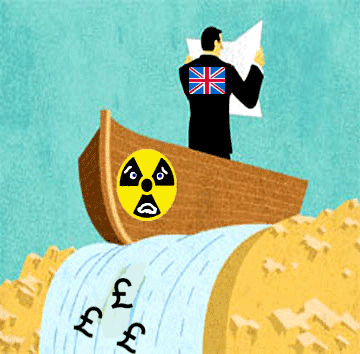 U.K. Nuclear Fleet Plans Evaporating Amid Economic, Political Problems, https://www.enr.com/articles/50109-uk-nuclear-fleet-plans-evaporating-amid-economic-political-problems September 20, 2020, Peter Reina
The U.K.’s hopes for a fleet of new nuclear plants, potentially exceeding 13,000 MW, took another hit when Japan’s Hitachi Ltd. recently pulled out of a major project in Wales. With Chinese investment in two other projects alsolmore doubtful, only the 3,300MW Hinkley Point C project in Somerset, England, has so far progressed to construction
Having suspended development work on the Welsh two-unit plant at Wylfa Newydd in January 2019, Hitachi earlier this month announced that the already difficult investment environment had “become increasingly severe due to the impact of COVID-19.” The company wrote off $2.8 billion of investment in the Welsh plant last year.
Hitachi’s departure followed the Toshiba Corp.’s decision in late 2018 to quit the 3,400-MW Moorside plant, in Cumbria. It had failed to find co-investors for its Westinghouse powered project.
With uncertainty growing, Hinkley Point C is the only U.K. nuclear project o have started work, which is so far largely on schedule, according to Electricité de France (EdF), which controls 66.5% of the deal. China General Nuclear Corp. owns 33.5% of project, which will be powered by two French EPR pressurized water reactors.
Hitachi’s withdrawal from the U.K. market has alarmed supporters of the nuclear industry, since it also casts a cloud over the planned 3,340-MW Sizewell C project in Cumbria.
“For the first time in a generation the U.K has developed a world class nuclear construction and engineering supply chain. Without Sizewell C, we will not sustain it,” says Cameron Gilmour, spokesperson for the Sizewell C Consortium lobby group of key companies in the sector.
The Sizewell C plant would replicate Hinkley Point C and is “shovel ready” according to Gilmour. The U.K. Planning Inspectorate is considering an application for the project submitted this May. The agency’s recommendations will end up on the government’s desk for a final decision at some point.
However, general investment uncertainties and increasingly frosty relations between the U.K and Chinese governments bode ill for the deal, says Stephen Thomas, an energy policy specialist at the University of Greenwich, London.
Set up under a previous conservative administration, the Hinkley Point C deal included CGNC’s participation as a junior partner in Sizewell C. Also, CGNC would have full responsibility for a proposed 2,300 MW Bradwell plant in Essex.
Bradwell would be a global showcase for the technology as it would be the first plant in an industrialized country to use the Chinese Hualong One reactors, Thomas says.
However, the Chinese government was angered over the U.K.’s rejection this July of Huawei technology for the cell phone networks. At the same time, criticism by the country’s lawmakers of China’s participation in critical infrastructure is increasing.
Both developments make the Bradwell deal uncertain. And if Bradwell falls, the Chinese are unlikely to remain merely as passive, junior investors in Sizewell C, potentially scuppering the whole deal, says Thomas.
Investment uncertainties lie at the heart of the U.K.’s fading nuclear hopes. The government offered the Hitachi team a far less generous deal than the one secured by EdF for Hinkley Point C.
While the Hinkley deal protects U.K. electricity consumers from cost escalations, it comes at a high price, according to Thomas. The deal is based on a “contract for differences” which sets an index linked energy price of $120 per MWh at 2012 prices for 35 years. That is hugely more than the $51 per MWh now being bid for offshore wind contracts, he says.
For subsequent deals, the government last year turned to the Regulatory Asset Base (RAB) form of funding used by water and types of utilities. Rather than having a target energy price, electricity tariffs would be controlled by the regulator, which would consider factors such as need for investment and a fair rate of return on capital.
The government completed a review of the system this January but has yet to make a decision, adding to investment uncertainty, says Thomas.
Meanwhile, in the west of England, contractors recently placed the 170-tonne base of the second reactor’s steel containment liner at Hinkley Point on time, despite pandemic working restrictions.
EdF claims to have met critical path goals during the pandemic, but it has yet to reveal the extent of delays on other parts of the job. The site’s workforce is now back to its pre-pandemic level of 4,500 having fallen to 2,000 after February.
Civil and building work is being handled by a joint venture of Paris-based Bouygues Travaux Publics and the U.K.’s Laing O’Rourke Plc. in a contract signed in late 2017, then valued at around $3.6 billion.
However, “challenging ground conditions” and additional design effort have contributed to an overall project cost rise to $29 billion from around $23 billion in 2016, reports EdF. The company still plans to commission the first unit in 2025, but the project has yet to enter its trickier nuclear component phase, officials concede.
Europe’s only two other projects using the same reactor design and involving Bouygues are hugely over schedule. Finland’s Olkiluoto 3 plant and EdF’s flagship French project at Flamanvile are both running about a decade late.
With this track record and future financing doubts, prospects for new projects around the world look bleak, says Thomas.
But nuclear power “has had a history of climbing out of the coffin,” he adds.
45 nations have now ratified the U.N. Treaty on the Prohibition of Nuclear Weapons

 KYODO NEWS –21 Sept 20 Malta, a Mediterranean island country, completed the ratification process for a U.N.-adopted nuclear ban treaty Monday, bringing the number of such countries and regions to 45 with a total of 50 required for the pact to enter into force, a nonprofit antinuclear organization said.The latest ratification comes on the same day the U.N. General Assembly held a ceremony marking the 75th anniversary of the world body’s founding.
 With the addition of one more signatory to the Treaty on the Prohibition of Nuclear Weapons, the International Campaign to Abolish Nuclear Weapons, or ICAN, hopes for an early enforcement of the pact, possibly by the end of this year.
However, the treaty’s potential effectiveness remains uncertain as all five permanent members of the U.N. Security Council, all of which are nuclear powers, have declined to ratify it.
Japan, the only country in the world to have experienced nuclear bombings, has not ratified the pact either, in light of its security alliance with the United States providing nuclear deterrence against adversaries.
The nuclear ban treaty, adopted in 2017, will enter into force 90 days after it has been ratified by at least 50 countries and regions. According to the United Nations, 84 countries and regions have signed the nuclear ban treaty.
In a related move, a group of 56 former leaders or ministers from countries that depend on U.S. nuclear deterrence on Monday released a letter urging the leaders of their respective countries to participate in the U.N. nuclear ban treaty.
From Japan, former Prime Minister Yukio Hatoyama, former Foreign Minister Makiko Tanaka and former Defense Minister Naoki Tanaka joined the petition.
Japanese government dangles financial carrot to persuade reluctant communities to take nuclear wastess
 But there is no prospect for the establishment of such a recycling system which would allow for disposing only of the
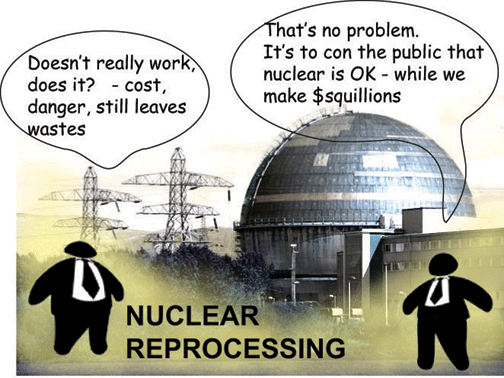 waste from reprocessing and recycling.
Eventually, Japan, like most other countries with nuclear power plants, will be forced to map out plans for “direct disposal,” or disposing of spent fuel from nuclear reactors in underground repositories.
Hokkaido Governor Suzuki has taken a dim view of the financial incentive offered to encourage local governments to apply for the first stage of the selection process, criticizing the proposed subsidies as “a wad of cash used as a powerful carrot.”
|
EDITORIAL: Much at stake in picking a final nuclear waste disposal site, http://www.asahi.com/ajw/articles/13749856 21 Sept 20, Two local communities in Hokkaido are considering pitching themselves as candidates for the site for final disposal of highly radioactive waste from nuclear power plants.Last month, the mayor of Suttsu in the northernmost main island said the municipal government is thinking to apply for the first stage of the three-stage process of selecting the site for the nation’s final repository for nuclear waste. During this period, past records about natural disasters and geological conditions for the candidate area are examined. Town authorities are holding meetings with local residents to explain its intentions. In Kamoenai, a village also in Hokkaido, the local chamber of commerce and industry submitted a petition to the local assembly to consider an application for the process. The issue was discussed at an assembly committee. However, the assembly decided to postpone making a decision after further discussion. Both communities are located close to the Tomari nuclear power plant operated by Hokkaido Electric Power Co. and struggling with common rural problems such as a dwindling population and industrial and economic stagnation. The law decrees that when the first stage of the selection process starts, the municipality that is picked will receive up to 2 billion yen ($19.1 million) in state subsidies for two years. But the Ministry of Economy, Trade and Industry and the Nuclear Waste Management Organization of Japan (NUMO), which are in charge of the selection process, have promised it will not move to the second stage if the prefectural governor or local mayor voices an objection. Hokkaido Governor Naomichi Suzuki has already expressed his opposition. A huge amount of spent nuclear fuel has been produced by nuclear plants in Japan, and it needs to be stored and disposed of somewhere in this country. This policy challenge requires a solid consensus among a broad range of people, including residents of cities who have been beneficiaries of electricity generated at nuclear plants. The two Hokkaido municipalities’ moves to consider applying for the first stage of the selection process should be taken as an opportunity for national debate on the issue. The first step should be to establish a system for local communities to discuss the issue thoroughly from a broad perspective. It is crucial to prevent bitter, acrimonious divisions in local communities between supporters and opponents. The central government and other parties involved need to provide whatever information is needed from a fair and neutral position to help create an environment for healthy, in-depth debate. There is also a crucial need to fix the problems with the current plan to build a final repository for radioactive waste. Under the plan, which is based on the assumption that a nuclear fuel recycling system will eventually be established, the repository will be used to store waste to be left after spent nuclear fuel is reprocessed to recover and recycle plutonium and uranium. But there is no prospect for the establishment of such a recycling system which would allow for disposing only of the waste from reprocessing and recycling. Eventually, Japan, like most other countries with nuclear power plants, will be forced to map out plans for “direct disposal,” or disposing of spent fuel from nuclear reactors in underground repositories. The central government has not changed its policy of maintaining nuclear power generation as a major power source. If nuclear reactors keep operating, they will continue producing spent fuel. The government will find it difficult to win local support for the planned repository unless it makes clear what kind of and how much radioactive material will be stored at the site. Many local governments are facing a fiscal crunch partly because of the impact of the COVID-19 pandemic. Hokkaido Governor Suzuki has taken a dim view of the financial incentive offered to encourage local governments to apply for the first stage of the selection process, criticizing the proposed subsidies as “a wad of cash used as a powerful carrot.” It takes tens of thousands of years for the radioactivity of spent nuclear fuel to decline to sufficiently safe levels. Trying to stem local opposition by dangling temporary subsidies could create a serious problem for the future in the communities. It is vital to ensure that the repository plan will secure a long-term policy commitment to the development of the local communities and ensure benefits for the entire areas. September 22, 2020 |
|
David Suzuki on nuclear power as a climate change solution ”I want to puke.”
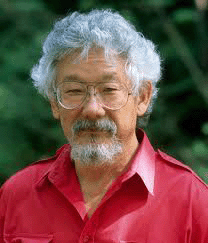 I want to puke. Because politicians love to say, “Oh, yeah, we care about this and boy, there’s [nuclear] technology just around the corner.”
Yeah, it’s taken a child [environmental activist Greta Thunberg] to finally have an impact that is more than all of us environmentalists put together over the past years.
The power of that child is that she’s got no vested interest in anything. She’s just saying: “Listen to the science because the scientists are telling us I have no future if we don’t take some drastic action.”
I want to puke’: David Suzuki reacts to O’Regan’s nuclear power endorsement
The Nature of Things host also addressed the climate crisis and youth’s role in climate change https://www.cbc.ca/radio/checkup/is-it-time-to-call-an-election-1.5728483/i-want-to-puke-david-suzuki-reacts-to-o-regan-s-nuclear-power-endorsement-1.5731819
CBC Radio Sep 21, 2020 David Suzuki spoke to Checkup host Ian Hanomansing about how to tackle climate change while in the midst of the COVID-19 pandemic, and took questions from callers, in Sunday’s Ask Me Anything segment.
With the COVID-19 pandemic at the forefront of the news cycle, it might be easy to forget about the ongoing climate change crisis.
While managing the pandemic has become the first priority of the Canadian government and other governments around the world, climate change was a major talking point in the 2019 federal election campaign.
This summer, the last intact ice shelf in the Canadian Arctic collapsed. South of the border, dry, hot weather conditions in states such as Oregon and Washington have led to historic wildfires.
David Suzuki is a scientist and environmental activist. He’s also the host of The Nature of Things on CBC television. Continue reading
Iran will not renegotiate nuclear deal if Biden wins US presidency, Zarif says
|
Iran will not renegotiate nuclear deal if Biden wins US presidency, Zarif says
Iranian foreign minister said returning to the terms of the accord should happen ‘without conditions’ Middle East Eye, By MEE staff, Washington: 21 September 2020
Iranian Foreign Minister Mohammad Javad Zarif said on Monday that Tehran has no plans of renegotiating the 2015 nuclear deal, stressing that Washington must return to the accord “without condition”.
Speaking to the Council on Foreign Relations in a virtual interview, Zarif discussed a broad range of topics including the prospect of reviving the nucler agreement that Donald Trump nixed in 2008. Asked how Iran would react if Joe Biden wins the US presidency in the upcoming November election, Zarif said Tehran is concerned with Washington’s policies, not internal US politics. ……. https://www.middleeasteye.net/news/iran-zarif-nuclear-deal-biden-us-presidency |
|
1 This Month
5 January -Webinar-What is Trump’s Golden Dome?
REGISTER AT Massachusetts Peace Action Education


New book – https://www.amazon.com/dp/1923372157?utm_source=substack&utm_medium=email
Now until to February 10, 2026 Radioactive waste storage in France: the debate is finally open! How to participate?
-
Archives
- January 2026 (51)
- December 2025 (358)
- November 2025 (359)
- October 2025 (377)
- September 2025 (258)
- August 2025 (319)
- July 2025 (230)
- June 2025 (348)
- May 2025 (261)
- April 2025 (305)
- March 2025 (319)
- February 2025 (234)
-
Categories
- 1
- 1 NUCLEAR ISSUES
- business and costs
- climate change
- culture and arts
- ENERGY
- environment
- health
- history
- indigenous issues
- Legal
- marketing of nuclear
- media
- opposition to nuclear
- PERSONAL STORIES
- politics
- politics international
- Religion and ethics
- safety
- secrets,lies and civil liberties
- spinbuster
- technology
- Uranium
- wastes
- weapons and war
- Women
- 2 WORLD
- ACTION
- AFRICA
- Atrocities
- AUSTRALIA
- Christina's notes
- Christina's themes
- culture and arts
- Events
- Fuk 2022
- Fuk 2023
- Fukushima 2017
- Fukushima 2018
- fukushima 2019
- Fukushima 2020
- Fukushima 2021
- general
- global warming
- Humour (God we need it)
- Nuclear
- RARE EARTHS
- Reference
- resources – print
- Resources -audiovicual
- Weekly Newsletter
- World
- World Nuclear
- YouTube
-
RSS
Entries RSS
Comments RSS
 nuclear-news